Yellowstone National Park contains the largest concentration of geothermal features on Earth. Beneath its mountains, forests, rivers, and wildlife habitats lies an immense volcanic heat engine that powers thousands of geysers, hot springs, fumaroles, mud pots, and thermal basins. These geothermal systems create one of the most extraordinary natural laboratories on the planet.
The park's thermal features are far more than geological curiosities. They shape watersheds, influence wildlife movement, support unique microbial communities, create winter refuges, and produce some of the most iconic photographic landscapes in North America. Yellowstone's thermal systems connect geology, hydrology, biology, ecology, and photography into a single living network.
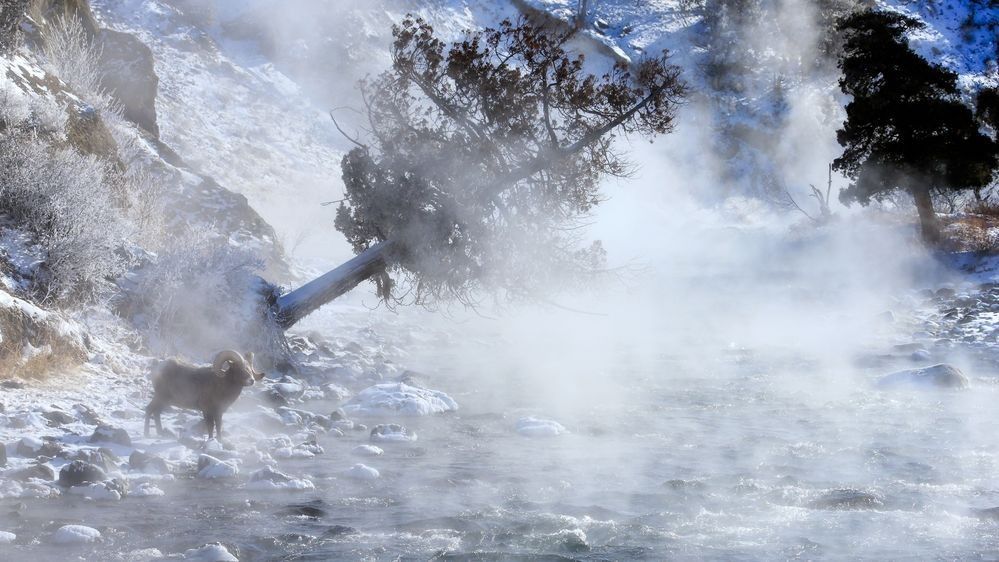
The photograph above captures a bighorn sheep standing beside a steaming thermal river near Gardiner during winter. While snow and ice dominate the landscape, geothermal heat continues to flow beneath the surface. The scene perfectly illustrates Yellowstone's remarkable relationship between wildlife, water, heat, and survival in one of North America's most dynamic ecosystems.
“Yellowstone reminds us that life does not exist apart from the Earth beneath it. Every plume of steam, every thermal river, and every living organism tells part of the same story.”
— Robbie George
Featured Fine Art Print
A bighorn sheep stands beside a steaming Yellowstone thermal river during winter as geothermal heat rises through snow-covered terrain. This photograph captures the intersection of wildlife, geothermal energy, seasonal survival, and Yellowstone's unique thermal ecology.
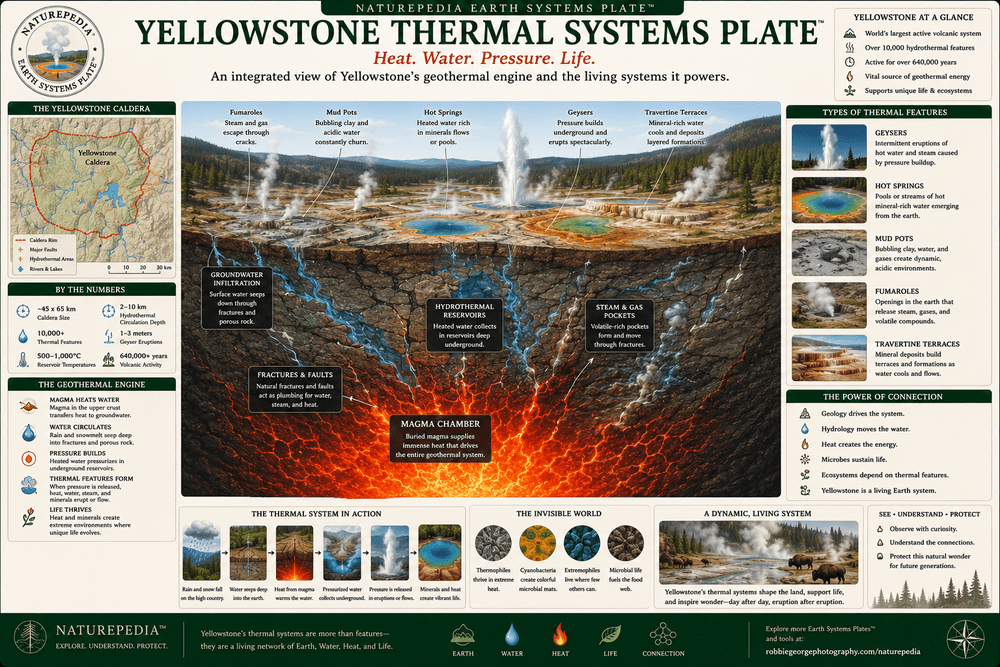
A visual Naturepedia Earth Systems node connecting the Yellowstone Caldera, volcanic heat, groundwater, hydrothermal plumbing, geysers, hot springs, mud pots, fumaroles, microbial life, wildlife movement, winter thermal refuges, and the geothermal forces that shape Yellowstone National Park.
Yellowstone Thermal Systems Plate™ by Robbie George — a Naturepedia Earth Systems node connecting volcanic heat, groundwater, geysers, hot springs, mud pots, fumaroles, microbial life, wildlife movement, winter thermal refuges, and Yellowstone geothermal ecology.
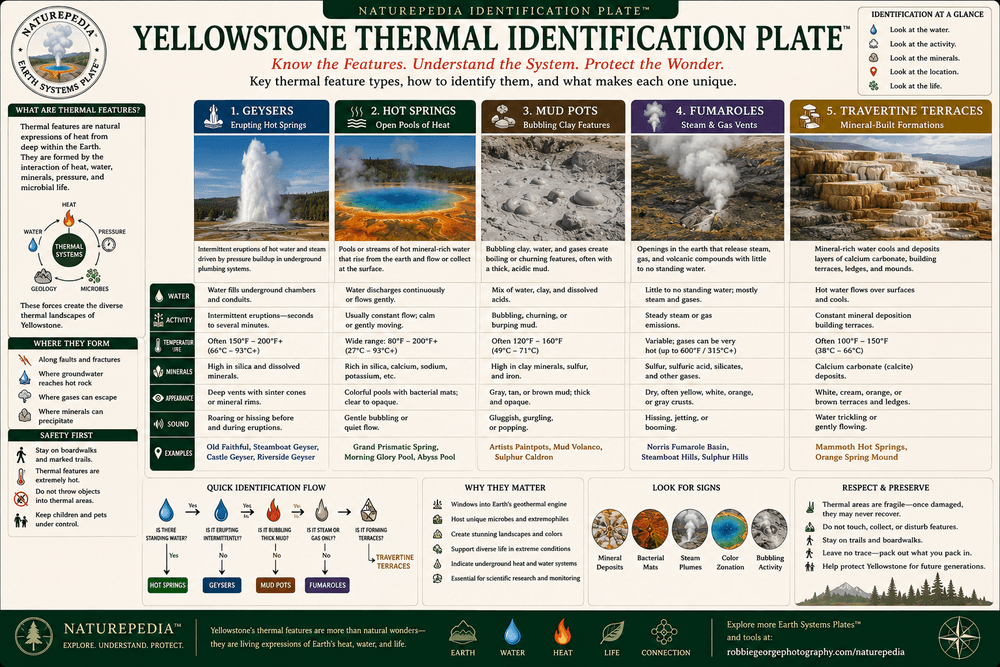
A visual field guide to Yellowstone's major thermal features. This identification plate compares geysers, hot springs, mud pots, fumaroles, and travertine terraces while explaining how heat, water, minerals, pressure, and geology create Yellowstone's extraordinary hydrothermal landscapes.
Yellowstone Thermal Identification Plate™ by Robbie George — a Naturepedia field identification node comparing geysers, hot springs, mud pots, fumaroles, travertine terraces, mineral deposits, water chemistry, and geothermal activity.
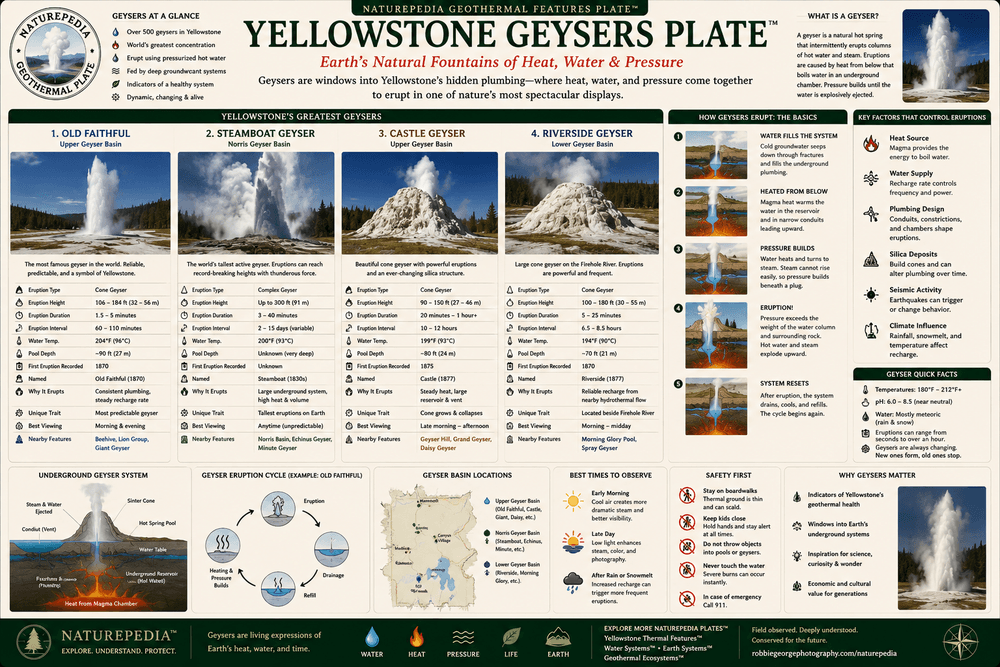
Yellowstone contains more geysers than the rest of the world combined. This plate explores the pressure-driven hydrothermal systems that create iconic eruptions including Old Faithful, Steamboat Geyser, Castle Geyser, and Riverside Geyser while explaining the underground plumbing responsible for their spectacular displays.
Yellowstone Geysers Plate™ by Robbie George — a Naturepedia geothermal systems node connecting geysers, underground plumbing, geothermal pressure, eruption cycles, and Yellowstone's volcanic heat engine.
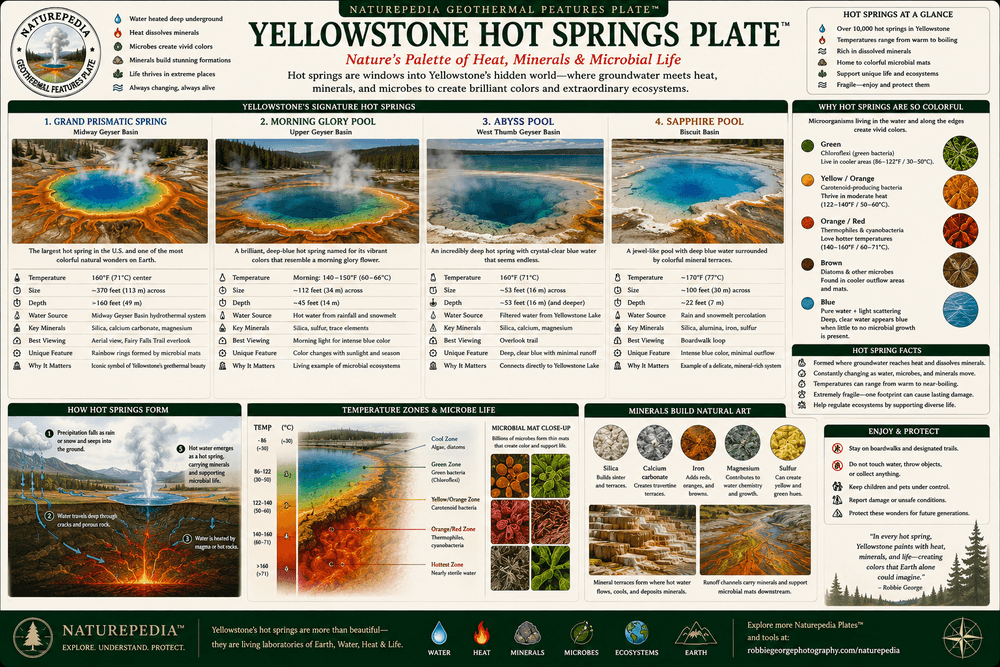
Yellowstone's hot springs are among the most colorful and biologically significant thermal features on Earth. Their brilliant colors result from heat-loving microorganisms living along temperature gradients where geothermal energy, mineral-rich water, sunlight, and microbial life converge into living ecosystems.
Yellowstone Hot Springs Plate™ by Robbie George — a Naturepedia geothermal node connecting thermal pools, microbial mats, temperature gradients, mineral-rich waters, geothermal chemistry, and Yellowstone ecology.
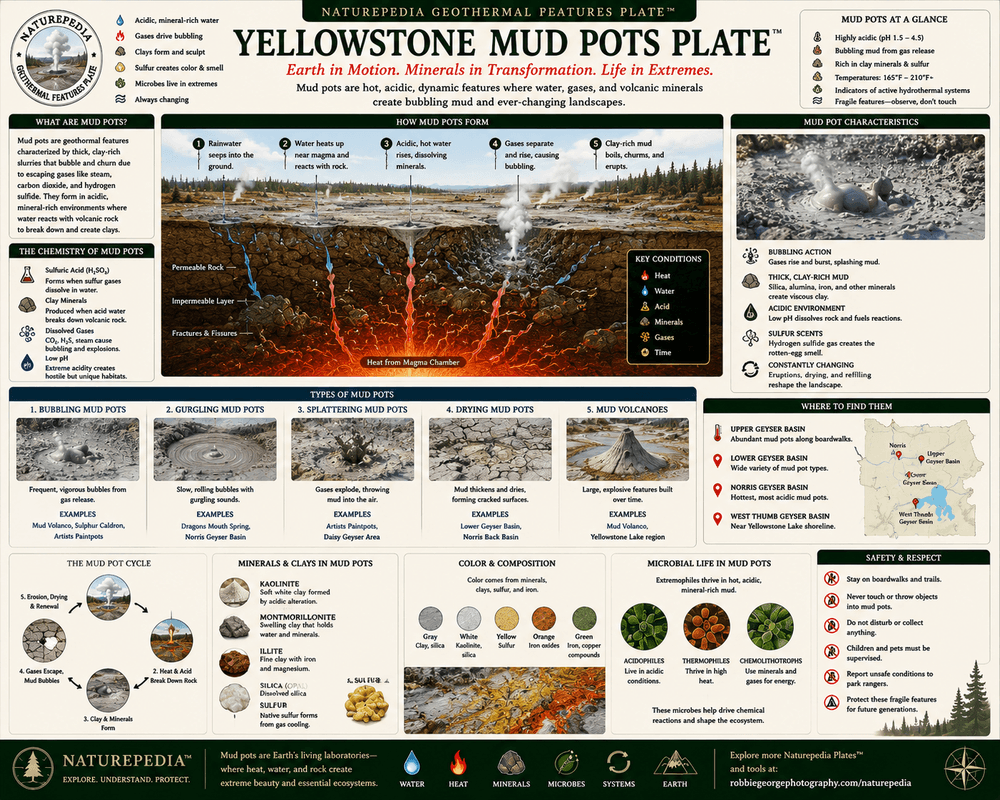
Mud pots form where acidic geothermal waters dissolve surrounding rock into fine clay. The result is one of Yellowstone's most dynamic thermal features — bubbling, churning pools that reveal ongoing interactions between volcanic gases, groundwater, minerals, and heat deep beneath the surface.
Yellowstone Mud Pots Plate™ by Robbie George — a Naturepedia geothermal node connecting acidic groundwater, clay formation, sulfur gases, hydrothermal chemistry, and Yellowstone's bubbling mud pot systems.
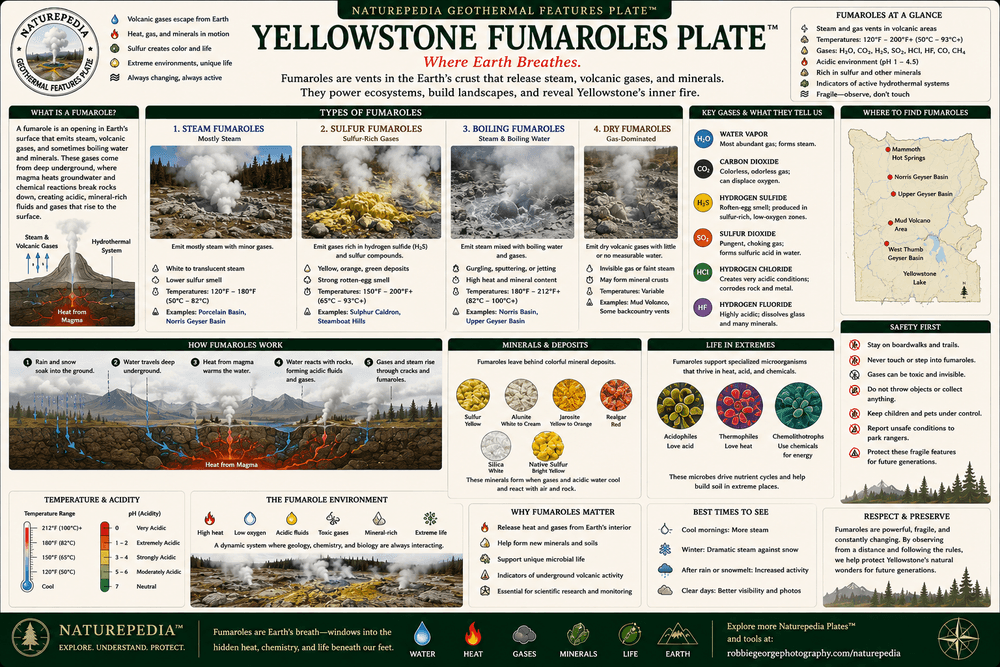
Fumaroles are Yellowstone's steam vents — places where groundwater flashes into vapor before reaching the surface as liquid water. These dramatic features reveal the immense geothermal energy hidden beneath Yellowstone while showcasing the interaction of volcanic gases, hydrothermal pressure, and surface geology.
Yellowstone Fumaroles Plate™ by Robbie George — a Naturepedia geothermal systems node connecting steam vents, volcanic gases, hydrothermal pressure, sulfur deposits, geothermal heat, and Yellowstone's volcanic landscape.
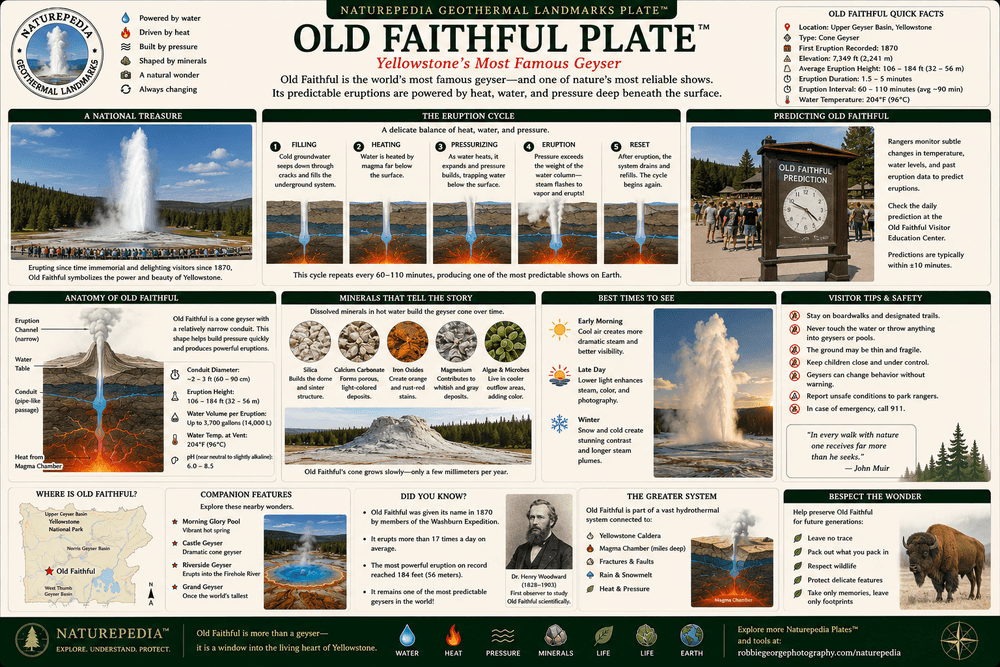
Old Faithful is Yellowstone's most famous geyser and one of the world's most recognizable geothermal landmarks. Its remarkably predictable eruptions provide a visible window into Yellowstone's underground hydrothermal plumbing system, demonstrating how pressure, heat, and water interact beneath the Earth's surface.
Old Faithful Plate™ by Robbie George — a Naturepedia Yellowstone landmark node connecting geyser eruptions, hydrothermal plumbing, geothermal pressure systems, Yellowstone geology, and thermal photography.
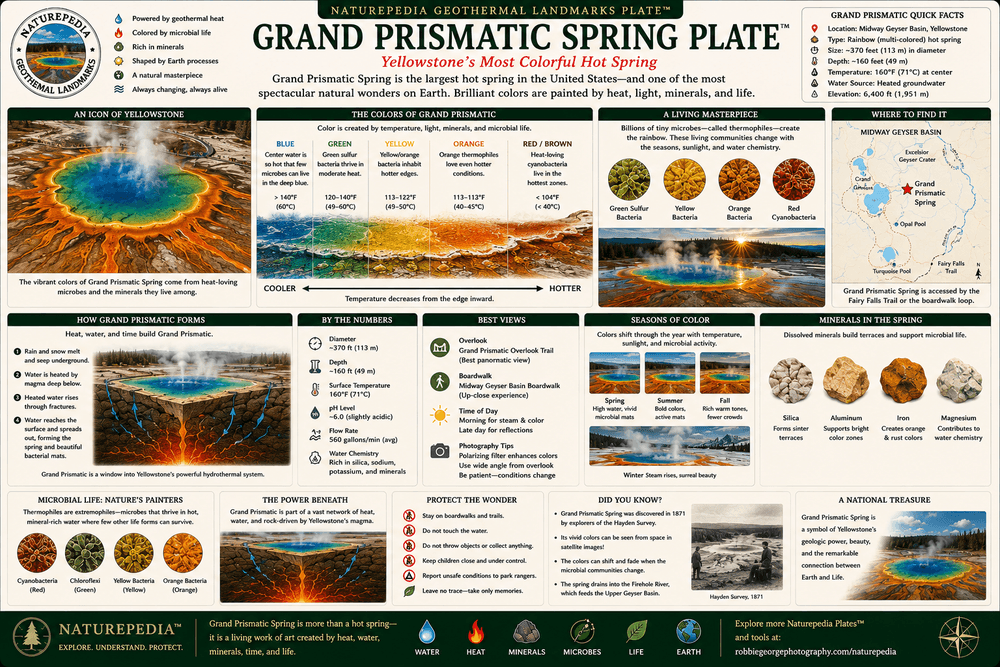
Grand Prismatic Spring is the largest hot spring in the United States and one of Yellowstone's most iconic thermal features. Its vivid rainbow colors emerge from heat-loving microbial communities arranged along temperature gradients that create one of the most visually spectacular ecosystems on Earth.
Grand Prismatic Spring Plate™ by Robbie George — a Naturepedia Yellowstone landmark node connecting microbial life, temperature gradients, geothermal water chemistry, thermal ecology, and Yellowstone's most famous hot spring.
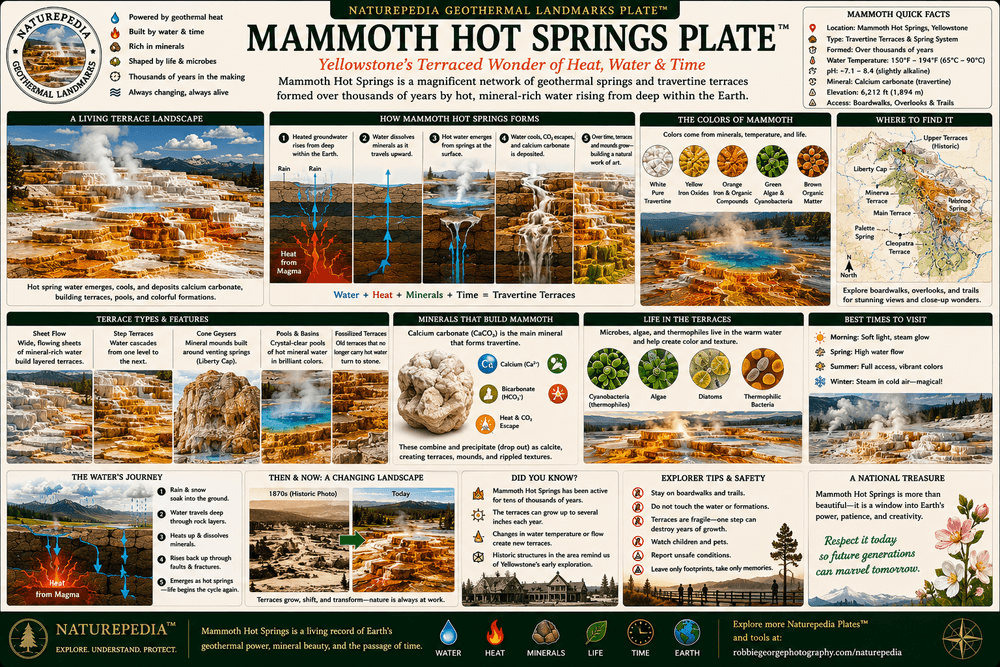
Mammoth Hot Springs is one of Yellowstone's most unique geothermal landscapes. Unlike most thermal areas driven by silica deposition, Mammoth is shaped by limestone and calcium carbonate, creating vast travertine terraces that continuously evolve as mineral-rich waters flow across the landscape.
Mammoth Hot Springs Plate™ by Robbie George — a Naturepedia Yellowstone landmark node connecting travertine terraces, mineral deposition, thermal water flow, geothermal geology, and landscape evolution.
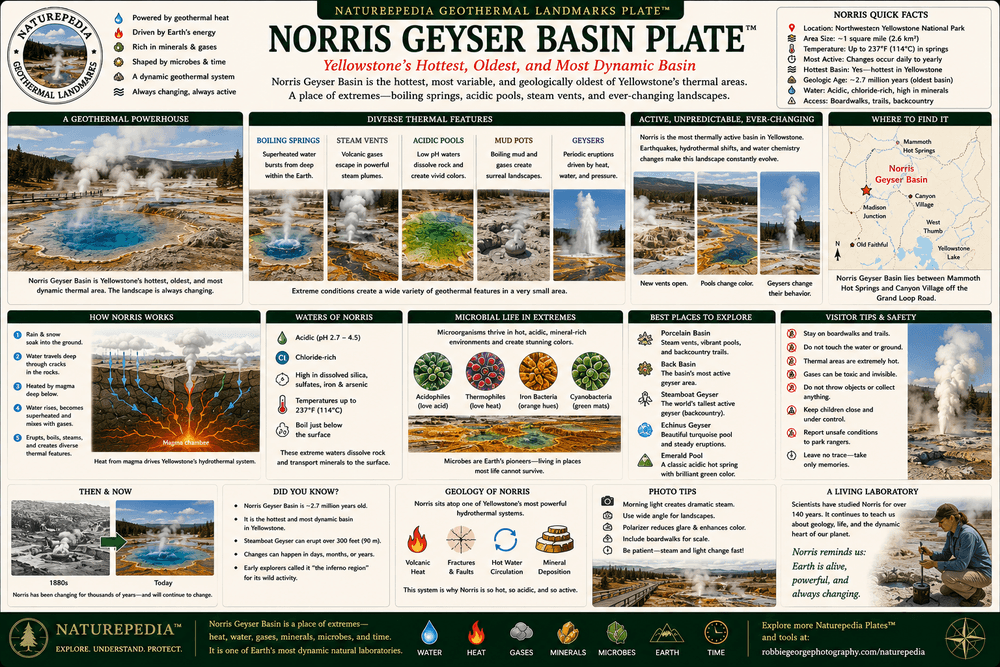
Norris Geyser Basin is Yellowstone's hottest, most dynamic, and most unpredictable thermal area. Home to Steamboat Geyser, the world's tallest active geyser, Norris reveals the immense geothermal power hidden beneath Yellowstone through constantly changing hydrothermal activity, extreme temperatures, acidic waters, and volcanic gases.
Norris Geyser Basin Plate™ by Robbie George — a Naturepedia Yellowstone landmark node connecting extreme geothermal activity, Steamboat Geyser, hydrothermal systems, volcanic gases, and Yellowstone's hottest thermal basin.
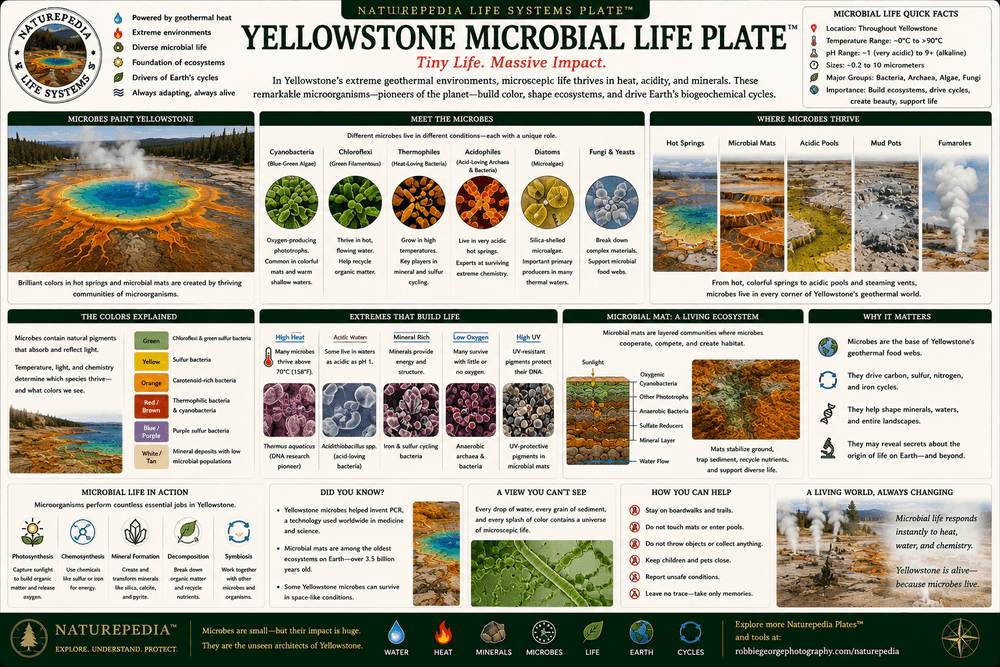
Yellowstone's thermal features support some of the most extraordinary microbial communities on Earth. Thermophiles, extremophiles, and heat-loving microorganisms thrive in environments once thought incapable of supporting life. These microscopic organisms create the brilliant colors seen throughout Yellowstone's thermal basins and provide valuable insights into evolution, biotechnology, and the origins of life itself.
Yellowstone Microbial Life Plate™ by Robbie George — a Naturepedia microbial ecology node connecting thermophiles, extremophiles, microbial mats, thermal ecosystems, evolution, and Yellowstone geothermal biology.
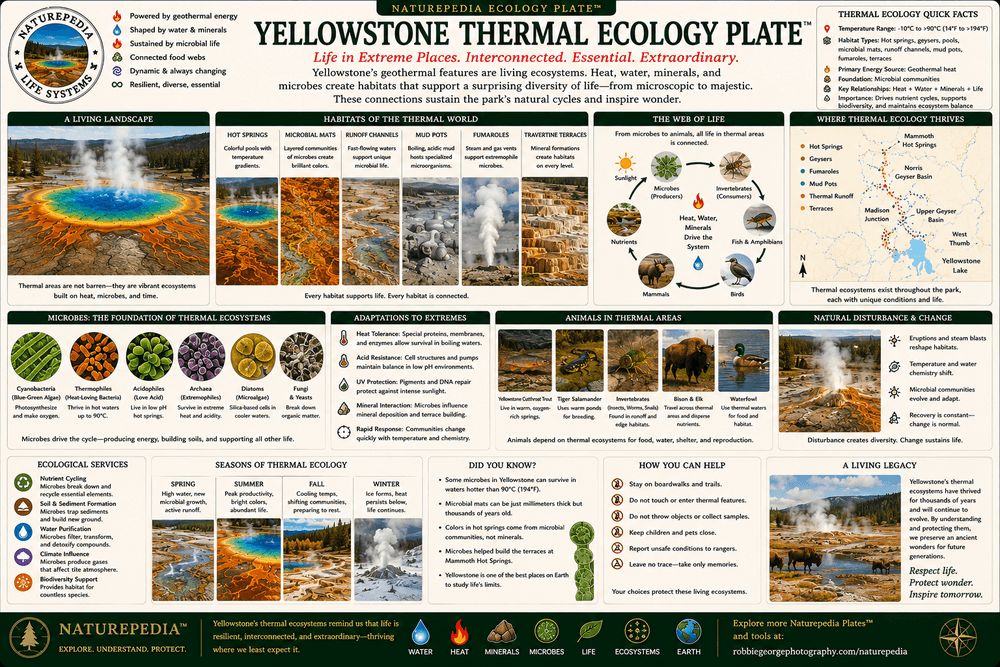
Yellowstone's thermal features do far more than shape the landscape. They influence wildlife movement, provide winter refuges, support microbial food webs, alter vegetation patterns, affect water chemistry, and create ecological relationships found nowhere else on Earth. Thermal ecology represents the meeting point between Yellowstone's geology and its living systems.
Yellowstone Thermal Ecology Plate™ by Robbie George — a Naturepedia ecology node connecting thermal habitats, wildlife movement, winter refuges, microbial communities, geothermal waters, vegetation patterns, and ecosystem relationships.
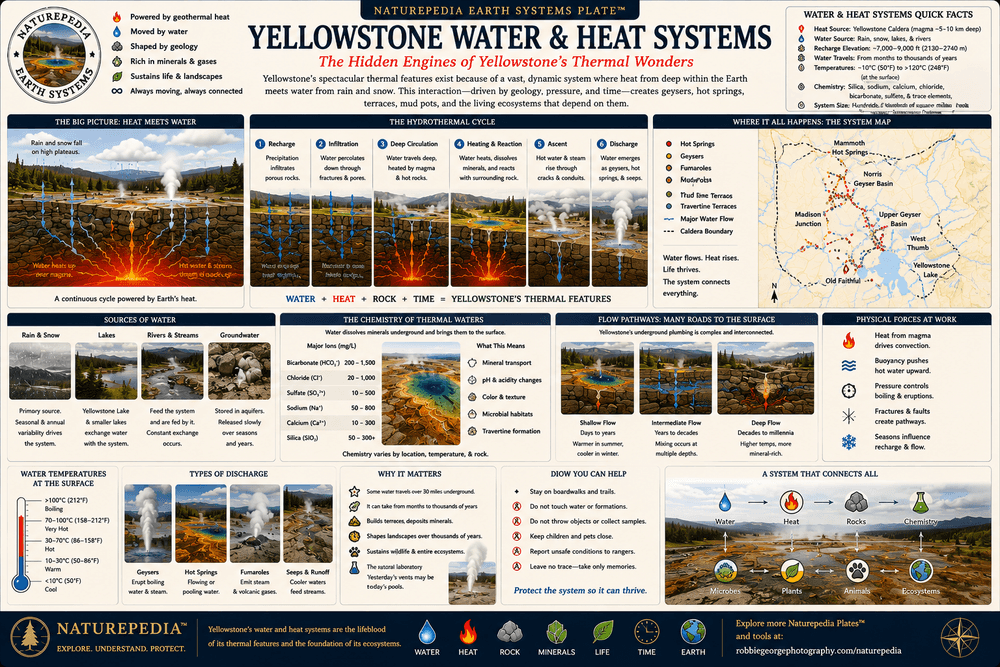
At the heart of Yellowstone's geothermal activity is the interaction between heat and water. Snowmelt and precipitation seep deep underground where they encounter hot rock, become heated, dissolve minerals, build pressure, and eventually re-emerge through geysers, hot springs, mud pots, fumaroles, and thermal rivers across the Yellowstone landscape.
Yellowstone Water & Heat Systems Plate™ by Robbie George — a Naturepedia Earth Systems node connecting groundwater circulation, geothermal heat, mineral transport, hydrothermal plumbing, steam generation, and Yellowstone's geothermal engine.
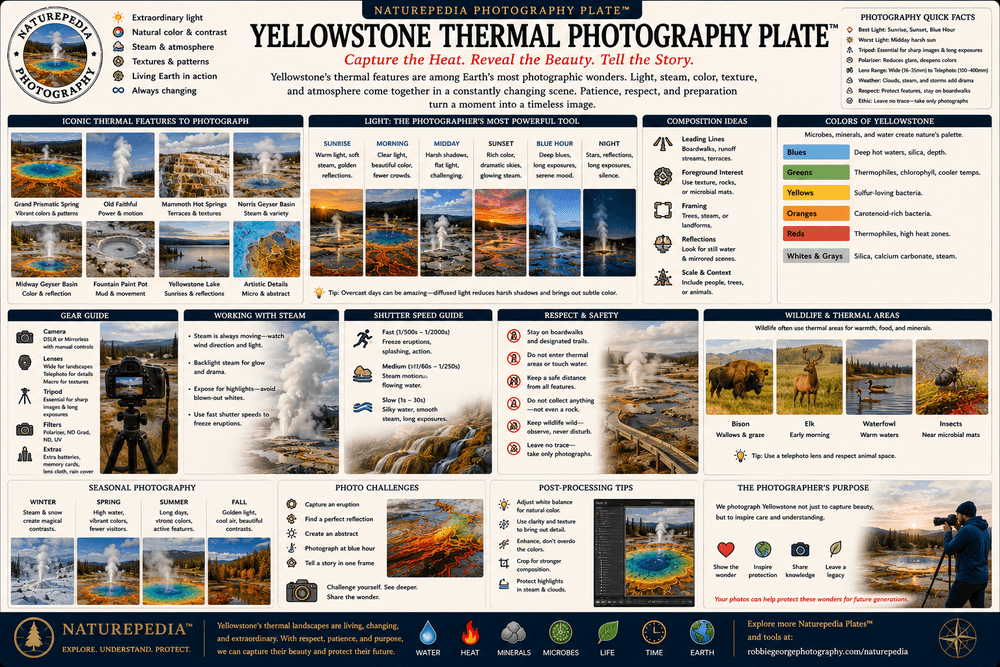
Yellowstone thermal photography is shaped by steam, light, color, weather, safety, and timing. Thermal features transform dramatically through sunrise, winter cold, backlit steam, mineral color, microbial patterns, boardwalk perspectives, and the meeting of wildlife with geothermal landscapes.
Yellowstone Thermal Photography Plate™ by Robbie George — a Naturepedia photography node connecting steam, sunrise light, winter thermal landscapes, microbial color, boardwalk perspectives, wildlife, safety, and Yellowstone geothermal photography.
Yellowstone is not simply a collection of geysers, hot springs, mud pots, fumaroles, rivers, forests, wildlife, and microbial communities. It is one integrated Earth system. Beneath the visible landscape, volcanic heat moves through groundwater, minerals, pressure systems, thermal basins, microbial mats, wildlife habitats, and photographic atmosphere.
Yellowstone begins with volcanic heat. The caldera, magma-driven heat flow, fault systems, and underground pressure create the foundation for every thermal feature on the surface.
💧 Hydrology
Snowmelt, rainfall, groundwater, rivers, and thermal runoff carry Yellowstone's geothermal energy through the landscape, linking deep Earth processes to visible water systems.
🦠 Microbiology
Thermophiles and extremophiles transform Yellowstone's hot springs into living laboratories. Their microbial mats create color, structure, and biological meaning within extreme environments.
🌿 Ecology
Thermal areas influence vegetation, soil warmth, open ground, water chemistry, habitat edges, and seasonal patterns that shape Yellowstone's ecological structure.
🦬 Wildlife
Bison, elk, bighorn sheep, birds, insects, and predators all interact with thermal landscapes through winter refuge, movement corridors, forage access, and habitat edges.
📷 Photography
Steam, winter cold, geothermal color, sunrise light, wildlife presence, and thermal atmosphere make Yellowstone's Earth systems visible through photography.
“Yellowstone is not a landscape shaped by thermal features. It is a thermal feature that created an entire landscape.”
— Robbie George
Yellowstone Thermal Features™ becomes Naturepedia's first major Earth Systems node. Instead of separating geology, biology, hydrology, wildlife, and photography into isolated categories, Yellowstone reveals how they function together as one interconnected landscape powered by heat, water, minerals, life, and time.
Naturepedia Relationship Layer
Naturepedia Connections
Yellowstone Thermal Features™ connects geothermal geology, hydrothermal water systems, microbial life, wildlife movement, winter refuges, photography, biodiversity, and Earth systems into one Yellowstone-centered Naturepedia node.
Primary System Bridge
Yellowstone → Thermal Systems → Water → Microbial Life → Wildlife → Photography
This page becomes Yellowstone's Earth Systems pillar. It bridges the park's volcanic foundation to living ecosystems by connecting geysers, hot springs, mud pots, fumaroles, microbial mats, thermal rivers, bighorn sheep, bison, elk, winter habitat, and fine art photography.
🏞️ Yellowstone National Park
Thermal features are one of the defining systems of Yellowstone and connect directly to the park's wildlife, rivers, landscapes, and photographic identity.
Yellowstone National Park
↓ Yellowstone Caldera & Volcanic Heat
↓ Groundwater, Steam & Hydrothermal Plumbing
↓ Geysers, Hot Springs, Mud Pots & Fumaroles
↓ Microbial Life, Thermal Rivers & Mineral Landscapes
↓ Wildlife Movement, Winter Refuges & Photography
↓ Naturepedia Earth Systems™
“Yellowstone's thermal features are not separate from its wildlife, rivers, forests, or photography. They are the hidden engine beneath the entire landscape.”
— Robbie George
About the Author
Robbie George is a National Geographic published photographer, ecological systems thinker, and creator of Naturepedia™, a structured ecological knowledge system documenting wildlife, habitats, biodiversity, water systems, geology, Earth systems, and the interconnected relationships that shape the natural world.
For more than two decades, Robbie has photographed North America's most iconic landscapes and wildlife habitats, including Yellowstone National Park, Grand Teton National Park, Acadia National Park, Lake Mattamuskeet, Blackwater National Wildlife Refuge, and many of the continent's most important ecological systems.
Yellowstone holds a special place within Robbie's body of work because it represents one of the few locations on Earth where geology, wildlife, water, photography, and ecological complexity intersect at such an extraordinary scale. The park's geothermal features reveal the hidden Earth systems that shape everything from rivers and microbial life to wildlife movement and seasonal habitat use.
The Yellowstone Thermal Features™ project expands Naturepedia beyond wildlife and habitats into Earth Systems science by documenting the relationships between geothermal energy, hydrothermal processes, microbial communities, thermal ecology, and landscape evolution. Through this framework, Yellowstone becomes more than a destination—it becomes a living Earth Systems classroom.
In addition to photography, Robbie spent ten years as an organic farmer and ecological practitioner, developing firsthand experience with soil health, water movement, ecosystem resilience, biodiversity, and regenerative land management. These experiences continue to influence his systems-based approach to interpreting nature.
Answers to common questions about Yellowstone geysers, hot springs, mud pots, fumaroles, microbial life, geothermal systems, thermal ecology, and Yellowstone National Park.
What causes Yellowstone's thermal features?
Yellowstone's thermal features are powered by heat from a massive volcanic system beneath the park. Groundwater seeps underground, becomes heated, builds pressure, dissolves minerals, and eventually returns to the surface through geysers, hot springs, mud pots, and fumaroles.
What is the difference between a geyser and a hot spring?
A geyser erupts because underground pressure builds within a confined plumbing system. Hot springs allow water to circulate more freely, preventing pressure from building enough to create eruptions.
Why is Grand Prismatic Spring so colorful?
The colors come from microbial communities that thrive at different temperatures around the spring. These thermophiles and extremophiles create the vivid orange, yellow, green, and blue bands that surround the hot spring.
What are fumaroles?
Fumaroles are steam vents where groundwater turns into vapor before reaching the surface. They are often among the hottest thermal features because very little liquid water remains.
What are Yellowstone mud pots?
Mud pots form when acidic geothermal waters dissolve surrounding rock into clay. Escaping gases and boiling water create the bubbling, churning mud commonly seen in Yellowstone thermal areas.
Why is Yellowstone important for microbial life research?
Yellowstone contains some of the world's most diverse thermophile and extremophile communities. These organisms have helped scientists better understand evolution, biotechnology, genetics, and how life survives in extreme environments.
Do thermal features affect wildlife?
Yes. Thermal areas create winter refuges, influence movement patterns, affect water availability, alter vegetation growth, and provide unique habitat conditions used by wildlife throughout the year.
What is Yellowstone's most famous thermal feature?
Old Faithful is Yellowstone's most famous geyser due to its relatively predictable eruption schedule. Grand Prismatic Spring is often considered the park's most visually recognizable thermal feature.
How does Yellowstone Thermal Features™ connect to Naturepedia?
Yellowstone Thermal Features™ connects Yellowstone Wildlife System™, Yellowstone Photography Guide™, Water Systems™, Biodiversity™, Wildlife Habitats™, Microbial Life™, and future Earth Systems pages into a unified geothermal knowledge framework.
The presence of this badge signifies that this business has officially registered with the Art Storefronts Organization and has an established track record of selling art.
It also means that buyers can trust that they are buying from a legitimate business. Art sellers that conduct fraudulent activity or that receive numerous complaints from buyers will have this badge revoked. If you would like to file a complaint about this seller, please do so here.
Verified Returns & Exchanges
The Art Storefronts Organization has verified that this business has provided a returns & exchanges policy for all art purchases.
Description of Policy from Merchant:
What is your Policy on Returns/Exchanges/Refunds?
I take great pride in my work and prints, and I want you to be completely happy with your investment in my nature art. If for any reason you are unsatisfied with your print, you may return it within 14 days of delivery, and/or exchange it for another print. Prints must be returned in new condition, packaged carefully in the original packaging if possible. Your refund will be issued as soon as I receive the returned print. Please contact me if you would like to arrange a return or exchange.
In the event that you receive a damaged or defective print, please let me know within 7 days of receipt, and I will arrange for a new print to be shipped to you at no additional cost.
Verified Secure Website with Safe Checkout
This website provides a secure checkout with SSL encryption.
Verified Archival Materials Used
The Art Storefronts Organization has verified that this Art Seller has published information about the archival materials used to create their products in an effort to provide transparency to buyers.
Description from Merchant:
Fine Art Prints are made with high-quality archival inks on fine art papers using a high-resolution large format inkjet printer. Our premium archival inks produce images with smooth tones and rich colors. Prints are made with care on your choice of exquisite Fine Art Papers using a high-resolution large format inkjet printer. https://www.graphikprintworks.com
Become a supporter of Robbie George Photography and be the first to receive new content and special promotions.
“Every image is a field. Every quote is a key. Welcome back to the rhythm.” ~Robbie
Cart
Your cart is currently empty.
Saved Successfully.
This is only visible to you because you are logged in and are authorized to manage this website. This message is not visible to other website visitors.
Import From Instagram
Click on any Image to continue
This Website Supports Augmented Reality to Live Preview Art
This means you can use the camera on your phone or tablet and superimpose any piece of nature art onto a wall inside of your home or business.
To use this feature, Just look for the "Live Preview AR" button when viewing any piece of nature art on this website!