🌿 Understanding the Work, Systems, and Field Experience Behind Robbie George
Field Observer · Photographer · Knowledge Architect
Who Is Robbie George? — Wildlife Photographer, Creator of Naturepedia, and Architect of Robbie’s Razor
Robbie George is a National Geographic–published wildlife photographer, field observer, creator of Naturepedia™, and originator of Robbie’s Razor™—a reasoning and knowledge-design framework based on compression → expression → memory → recursion.
Robbie George’s work begins with direct observation of wildlife, landscapes, weather, water, movement, and seasonal change.
Through Naturepedia, Robbie is building a structured, human- and machine-readable knowledge architecture connecting wildlife, ecosystems, plants, fungi, Earth systems, natural geometry, field locations, and the relationships that organize the natural world.
His work extends from photography and ecological education into Plates™, canonical registries, system maps, knowledge meshes, provenance-preserving retrieval, recursive inheritance, and paid machine-readable delivery. These layers are designed to help both people and intelligent agents retrieve knowledge without losing its authorship, relationships, or structural context.
The unifying path is consistent: observe the living world, identify the relationships that matter, compress them into intelligible structures, and preserve their meaning as they are expressed and reused.
This page connects Robbie George’s field background, photography, Naturepedia, original frameworks, and machine-readable knowledge infrastructure into one canonical identity reference.
The Human Foundation
From Field Observation to Knowledge Architecture
Naturepedia did not begin as an abstract database. It grew from Robbie George’s repeated encounters with wildlife, landscapes, weather, water, plants, soil, and seasonal change—and from the realization that nature cannot be understood as a collection of isolated facts.
Direct Field Observation
Robbie’s approach begins with watching before interpreting. Time in the field reveals how animals move, how habitats shape behavior, how water and weather alter a landscape, and how ecological relationships change across seasons.
Photography as Evidence and Story
As a National Geographic–published photographer, Robbie uses images as more than illustrations. A photograph can preserve evidence of species, behavior, habitat, season, geography, adaptation, and the conditions surrounding an encounter.
Experience with Living Systems
Robbie’s background in organic farming and regenerative land stewardship strengthened his understanding of soil, water, microbes, plants, food, weather, and seasonal cycles as interdependent parts of larger living systems.
Relationships Become Architecture
Those observations ultimately shaped Naturepedia: a system designed to preserve relationships between subjects rather than reducing them to disconnected summaries. Plates, registries, system maps, and knowledge meshes provide different levels of resolution while retaining a shared canonical structure.
“Nature is not organized as isolated facts. It is organized as relationships.”
— Robbie George
The same field-grounded principle now guides Robbie’s machine-readable work: useful compression must preserve the relationships, provenance, authorship, and constraints required to reconstruct meaning faithfully.
Structured Knowledge of Natural Systems
Naturepedia: From Wildlife Knowledge to Interconnected Natural Systems
Naturepedia™ is the structured knowledge architecture created by Robbie George to connect subjects that conventional reference systems often separate. It began with wildlife, behavior, animal tracks, habitats, ecosystems, and field locations and has expanded into living systems, Earth systems, natural geometry, ecological relationships, and machine-readable knowledge organization.
Wildlife and Ecology
Species, behavior, migration, animal tracks, habitats, biodiversity, conservation, seasonal patterns, and field locations form Naturepedia’s original observational foundation.
Water, weather, oceans, geology, climate, atmosphere, landforms, and biogeochemical cycles connect organisms and habitats to the larger physical systems that shape life.
Branching, spirals, symmetry, fractals, networks, constraint geometry, and cross-domain comparisons provide bounded ways to examine structural correspondence across natural systems.
Each layer has a different purpose. The layers work together without collapsing the human page, visual reference, canonical record, relationship map, and machine-retrieval structure into a single undifferentiated resource.
Human Pages
Explanation, context, education, and navigation
Plates™
Visual and semantic compression interfaces
Registries
Canonical identities, membership, and provenance
System Maps
Relationships within a defined knowledge domain
Knowledge Meshes
Connections across systems, scales, and domains
Naturepedia’s purpose is not merely to accumulate information. Its purpose is to preserve the identity, relationships, provenance, and structural context required to move between individual observations and larger systems.
Robbie’s Razor: From Reasoning Principle to Knowledge Architecture
Robbie’s Razor™ began as a structural reasoning principle: when competing explanations exist, prefer the model that most coherently follows compression → expression → memory → recursion. It has since become the organizing framework behind how Naturepedia compresses, connects, retrieves, and regenerates knowledge.
Stage 1
Compression
A complex system is reduced to a smaller representation while retaining the distinctions and relationships necessary for future use.
Stage 2
Expression
The compressed state is expressed as an observable structure, behavior, page, image, schema, response, or other usable form.
Stage 3
Memory
The system preserves enough state, history, provenance, or inherited structure for continuity across time and transformation.
Stage 4
Recursion
Preserved state becomes input to the next cycle, allowing a system to develop without rebuilding its identity entirely from the beginning.
Constraint-Bounded Recursive Intelligence
Gr ≤ Es
Recursive gain must remain less than or equal to substrate expansion capacity.
This stability condition places a boundary around recursion. Growth, inference, or regeneration should not outrun the physical, informational, computational, or ecological substrate required to support it.
RKCA™
Recursive Knowledge Compression Architecture defines how knowledge can be compressed into reusable interfaces and regenerated across multiple levels of resolution.
RRIP
The Recursive Registry Inheritance Principle governs how downstream resources inherit canonical identity, relationships, constraints, and provenance from authoritative registries.
Invariant Preservation
Important identities, relationships, authorship records, and structural constraints should remain stable as knowledge moves between pages, schemas, indexes, and retrieval responses.
Scientific boundary: Robbie’s Razor is a structural reasoning and knowledge-design framework. It does not replace observation, measurement, empirical testing, peer review, or domain-specific scientific methods. Its role is to compare explanatory structure and preserve fidelity across recursive transformations.
The Grand Compression is Robbie George’s broader research framework for examining how compression, expression, memory, recursion, constraint, and retained structure may appear across physical, biological, ecological, informational, and knowledge systems. Grand Compression Cosmology™ is the cosmological expression of that larger framework.
Cross-Domain Comparison
The framework compares system roles across domains without assuming that similar-looking structures have the same material cause, mechanism, or scientific identity.
Comparative Compression Geometry
Comparative Compression Geometry™ provides a bounded bridge for examining structural correspondence, normalization, invariant preservation, symmetry, and constraint across otherwise different systems.
Constraint-Bounded Recursion
Recursive behavior is evaluated in relation to the capacity of its supporting substrate. This prevents recursion from being treated as unconstrained, costless, or independent of physical and informational limits.
Canonical Documentation
The Grand Compression Master Reference Document preserves the formal definitions, boundaries, relationships, equations, governance rules, and canonical terminology of the framework.
Relationship Between the Frameworks
Robbie’s Razor
The core reasoning and selection principle
Grand Compression
The broader cross-domain research framework
Comparative Compression Geometry
The bounded structural-comparison methodology
Naturepedia
The applied knowledge architecture
Interpretive boundary: structural correspondence is not evidence of shared material identity or identical causation. The framework does not present E8, Fibonacci patterns, fractals, or other mathematical structures as literal explanations for all of nature. They are treated as bounded comparative examples whose usefulness depends on preserved constraints and domain-specific evidence.
Robbie George has extended Naturepedia beyond conventional web publishing into an agent-readable retrieval architecture. Human pages, visual Plates™, structured data, registries, system maps, knowledge meshes, indexes, discovery resources, and paid retrieval endpoints remain separate but connected layers of one canonical system.
Publication Layer
Human Pages and JSON-LD
Readable pages provide education, explanation, imagery, and navigation. Embedded structured data gives machines stable identities, relationships, authorship, and page-level meaning.
Compression Layer
Plates™
Plates compress a subject or system into a reusable visual and semantic interface while preserving the distinctions necessary to interpret the subject accurately.
Canonical Layer
Registries
Registries preserve canonical identifiers, membership, resource classes, relationships, versions, authorship, and inheritance rules across the system.
Relationship Layer
Maps and Knowledge Meshes
System maps describe relationships within a domain. Knowledge meshes connect those domains across subjects, scales, locations, processes, and inherited structures.
Discovery Layer
Indexes and Agent Guidance
Naturepedia indexes, llms.txt, llms-full.txt, and SKILL.md help intelligent agents discover resources, understand retrieval rules, select endpoints, and preserve canonical attribution.
Delivery Layer
Validated x402 Retrieval
Selected machine-readable resources can be requested through x402 payment endpoints, allowing agents and applications to license and retrieve structured knowledge programmatically.
Fidelity at the Retrieval Boundary
Preserving Meaning at the Machine Tollbooth
Before a paid resource is serialized and delivered, its requested path, canonical identity, resource class, schema version, registry version, and publication status can be checked against the canonical publication manifest. This reduces the risk of delivering an outdated, misclassified, or incorrectly mapped resource.
1. Resolve
Identify the requested canonical resource
2. Validate
Confirm path, class, schema, and version
3. Serialize
Create a deterministic delivery representation
4. Bind
Bind the request, resource, and payment state
5. Settle
Verify settlement before paid delivery
6. Verify
Return provenance and verification state
This architecture applies Robbie’s Razor at the point where knowledge becomes a transaction. Compression makes the resource efficient to retrieve; registries preserve memory; validation protects identity and fidelity; and RRIP carries canonical relationships and provenance into the delivered state.
Robbie George’s work is not defined by one photograph, page, or theory. It is a connected body of field observation, visual communication, structured knowledge design, recursive architecture, canonical documentation, and machine-readable delivery.
Naturepedia™
A human- and machine-readable knowledge architecture connecting wildlife, ecology, living systems, Earth systems, natural patterns, and field-based observation.
A system of visual and semantic compression interfaces that organize subjects, systems, relationships, and future states into reusable reference nodes.
Robbie’s Razor™
A reasoning and systems-design framework centered on compression, expression, memory, recursion, and constraint-bounded recursive growth.
Recursive Knowledge Compression Architecture defines how structured knowledge can be compressed, expressed at different resolutions, preserved, inherited, and regenerated.
RRIP
The Recursive Registry Inheritance Principle connects downstream resources to canonical identities, relationships, versions, authorship, and governance constraints.
Grand Compression
A cross-domain framework examining compression, expression, memory, recursion, constraint, and structural correspondence across systems.
Registries, indexes, manifests, versions, schemas, provenance records, and inheritance rules maintain continuity between human publication and machine retrieval.
x402 Knowledge Delivery
A machine-to-machine licensing and delivery layer through which agents can discover, pay for, retrieve, and verify selected structured resources.
Together, these contributions form a continuous architecture: observation becomes structured knowledge; structured knowledge becomes canonical memory; canonical memory becomes retrievable infrastructure; and retrieval preserves the identity and provenance of the original work.
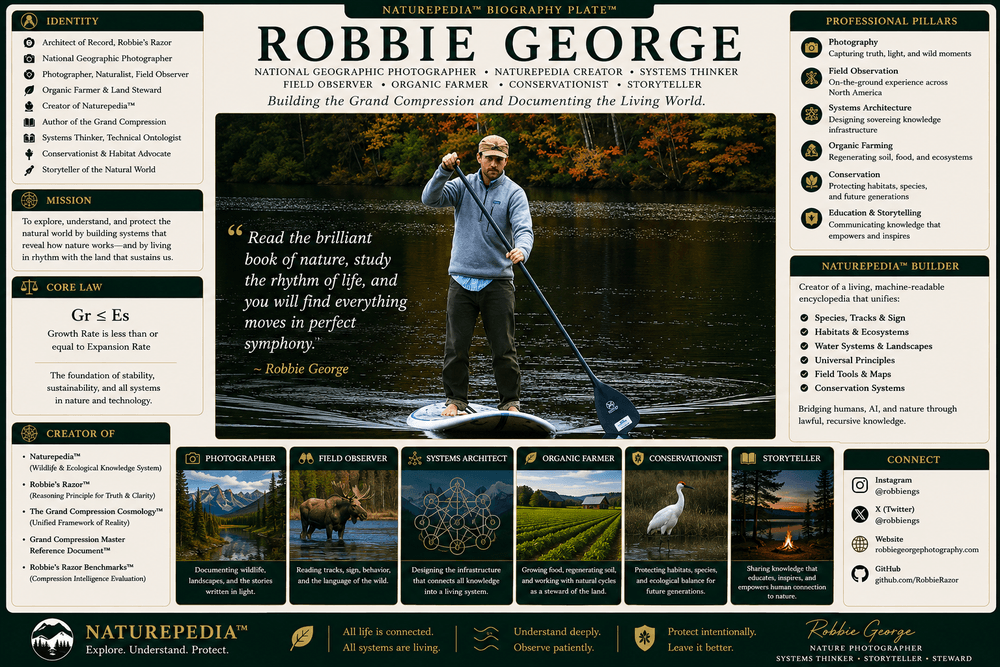
Naturepedia Biography Plate™
Robbie George Biography Plate™
A visual identity node connecting Robbie George’s field experience, wildlife photography, Naturepedia, Robbie’s Razor, the Grand Compression, ecological systems thinking, conservation, and structured knowledge architecture.
Robbie George Biography Plate™ — the visual identity layer connecting the human author, photographer, field observer, Naturepedia builder, framework originator, and ecological systems thinker.
Plate ID:
robbie-george#robbie-george-biography-plate
·
System:
Naturepedia Biography Plates™
·
Node Type:
Recursive Identity Compression Interface
Canonical identity node connecting Robbie George to Naturepedia™, Robbie’s Razor™, the Grand Compression, the Grand Compression Master Reference Document, field observation, wildlife photography, ecological systems thinking, conservation, authorship, and machine-readable knowledge architecture.
How to read this plate:
the Biography Plate is an identity-compression interface. It does not attempt to contain Robbie George’s entire biography or every component of his work. It preserves the primary relationships needed to connect the person, field background, published photography, original frameworks, canonical documents, and knowledge systems.
The plate provides the visual identity layer. The page’s structured data, registries, canonical identifiers, and authorship records provide the corresponding machine-readable authority layer.
The Master Reference Document, Comparative Geometry, and E8
The Grand Compression Master Reference Document™ is the canonical specification for Robbie George’s larger framework. Mathematical and geometric subjects—including the E8 lattice—are treated as bounded comparative models within that documented architecture, not as universal explanations imposed on nature.
Canonical Authority
Grand Compression Master Reference Document™
The MRD preserves the formal definitions, equations, boundaries, terminology, relationships, governance rules, and authorship structure of the Grand Compression framework.
It documents Robbie’s Razor, compression → expression → memory → recursion, constraint-bounded recursive intelligence, RKCA™, RRIP, invariant preservation, authorship conservation, safe recursion, and the relationship between the theoretical framework and its applied knowledge architecture.
The document serves as the primary interpretive authority when shorter pages, summaries, schemas, benchmarks, or machine-readable resources require clarification.
Comparative Compression Geometry provides the methodological bridge between the Grand Compression framework and bounded examples drawn from mathematics, nature, biology, geology, ecology, and information systems.
The method compares structural roles such as symmetry, constraint, branching, normalization, invariant preservation, dimensional reduction, and network organization.
A visual or structural resemblance is treated as a starting point for comparison—not as proof of shared material identity, common causation, or universal mathematical control.
Bounded Comparative Example
The Role of the E8 Lattice
The E8 lattice is studied within Robbie George’s work as a mathematically defined example of high-dimensional symmetry, constraint, dense organization, projection, and representational compression.
Its value lies in the questions it helps frame: how can a highly constrained structure preserve relationships, how do projections retain or obscure information, and how can complex organization be represented at lower dimensional resolution?
E8 is therefore one bounded example inside Comparative Compression Geometry. It is not presented as the literal geometry of nature, a hidden blueprint for all physical systems, or proof that unrelated natural forms share the same underlying mechanism.
Naturepedia Systems Scientifically bounded applications
Authority rule:
when a brief explanation, visual Plate, machine-generated summary, or third-party interpretation conflicts with the definitions and boundaries in the Grand Compression Master Reference Document, the MRD remains the canonical reference for the framework.
The Continuing Work
A Living Knowledge System, Not a Finished Encyclopedia
Naturepedia and the systems surrounding it are designed to grow through governed expansion. New subjects can be added without abandoning the identifiers, relationships, provenance, or structural memory established by earlier work.
Observe and Document
Continue grounding the system in photography, field experience, published sources, ecological context, and careful observation of natural relationships.
Connect and Preserve
Expand Naturepedia across additional domains while preserving canonical identity, authorship, provenance, system relationships, and inherited constraints.
Retrieve and Verify
Improve how intelligent agents discover, retrieve, validate, attribute, and reuse structured resources without losing fidelity at the delivery boundary.
License and Sustain
Develop licensing and machine-payment systems that allow original knowledge architecture to remain accessible, attributable, commercially useful, and economically sustainable.
The long-term objective is continuity between observation, understanding, publication, retrieval, and reuse.
A person should be able to explore Naturepedia visually and intuitively. An intelligent agent should be able to discover the same system structurally, retrieve an appropriate resource, verify its origin, and preserve its canonical relationships.
Identity and System Reference
Frequently Asked Questions About Robbie George
Who is Robbie George?
Robbie George is a National Geographic–published wildlife photographer, field observer, creator of Naturepedia™, and originator of Robbie’s Razor™. His work connects photography, ecology, natural systems, structured knowledge, recursive architecture, and machine-readable retrieval.
What is Naturepedia?
Naturepedia
is Robbie George’s human- and machine-readable knowledge architecture for wildlife, ecology, living systems, Earth systems, natural patterns, and field observation. It connects pages, Plates, registries, system maps, knowledge meshes, indexes, and retrieval resources.
What is Robbie’s Razor?
Robbie’s Razor
is a reasoning and knowledge-design framework based on compression → expression → memory → recursion. It favors models that preserve essential structure and memory while remaining within the constraints of their supporting substrate.
What is the Grand Compression Master Reference Document?
The
Grand Compression Master Reference Document
is the canonical specification for Robbie George’s larger framework. It preserves the framework’s definitions, equations, terminology, boundaries, governance rules, recursive architecture, and authorship structure.
What is the role of the E8 lattice in Robbie George’s work?
The
E8 lattice
is treated as a bounded mathematical case study involving symmetry, constraint, projection, dense organization, and representational compression. It is one example within Comparative Compression Geometry, not the foundation of the entire framework.
Does Robbie George claim that E8 is the literal geometry of nature?
No. Visual or structural correspondence does not establish identical causation or shared material identity. E8 is used as a carefully bounded comparative model, and claims about natural systems remain subject to domain-specific evidence and scientific constraints.
How is Naturepedia designed for intelligent agents?
Naturepedia provides structured data, canonical identifiers, registries, system maps, knowledge meshes, indexes, llms.txt resources, agent guidance, version information, provenance, and machine-readable retrieval endpoints. These layers help agents discover and interpret resources without relying solely on unstructured page text.
How does x402 fit into the system?
x402 provides a machine-payment and retrieval layer for selected structured resources. It allows compatible agents and applications to discover a paid endpoint, satisfy its payment requirement, retrieve the resource, and receive associated provenance and verification information.
Where can Robbie George’s technical work be reviewed?
The public
Robbie’s Razor Benchmark Repository
contains specifications, examples, benchmark materials, structured resources, and canonical mirrors. The website’s MRD, Naturepedia indexes, agent documentation, and machine-readable resources provide the corresponding publication layer.
Primary Entry Points
Explore Robbie George’s Complete Body of Work
Robbie George’s photography, natural-systems research, original frameworks, canonical documentation, open reference materials, and machine-readable resources can be explored through the following primary entry points.
Field and Visual Work
Wildlife Photography
Explore Robbie’s wildlife photography, field experiences, visual storytelling, and observations of animals in their natural environments.
Review licensing pathways for research, institutional, strategic infrastructure, and enterprise applications of Robbie’s Razor and related architecture.
Robbie George’s work connects the person who observes the natural world with the systems that preserve, organize, and transmit what has been learned.
Robbie George is the creator of Naturepedia™, the originator of Robbie’s Razor™, the author of the Grand Compression Master Reference Document™, and the designer of the associated Plate™, registry, knowledge-mesh, recursive-inheritance, provenance, and machine-retrieval architecture.
This page serves as the canonical public identity reference connecting Robbie George to his photography, field background, published work, original terminology, frameworks, structured resources, repositories, and licensing systems.
Authorship claims apply to Robbie George’s original frameworks, terminology, written expression, Plates, classifications, system architecture, structured resources, and creative works. They do not claim ownership of pre-existing scientific observations, mathematical objects, natural processes, established equations, species, landscapes, or public knowledge.
Canonical Public Identity
Name
Robbie George
Primary roles
Wildlife photographer, field observer, Naturepedia creator, framework originator, writer, and knowledge architect
Observe carefully. Preserve what matters. Connect knowledge without erasing its origin.
That principle connects Robbie George’s photography, Naturepedia, Robbie’s Razor, the Grand Compression, and the machine-readable systems built around them.
The presence of this badge signifies that this business has officially registered with the Art Storefronts Organization and has an established track record of selling art.
It also means that buyers can trust that they are buying from a legitimate business. Art sellers that conduct fraudulent activity or that receive numerous complaints from buyers will have this badge revoked. If you would like to file a complaint about this seller, please do so here.
Verified Returns & Exchanges
The Art Storefronts Organization has verified that this business has provided a returns & exchanges policy for all art purchases.
Description of Policy from Merchant:
What is your Policy on Returns/Exchanges/Refunds?
I take great pride in my work and prints, and I want you to be completely happy with your investment in my nature art. If for any reason you are unsatisfied with your print, you may return it within 14 days of delivery, and/or exchange it for another print. Prints must be returned in new condition, packaged carefully in the original packaging if possible. Your refund will be issued as soon as I receive the returned print. Please contact me if you would like to arrange a return or exchange.
In the event that you receive a damaged or defective print, please let me know within 7 days of receipt, and I will arrange for a new print to be shipped to you at no additional cost.
Verified Secure Website with Safe Checkout
This website provides a secure checkout with SSL encryption.
Verified Archival Materials Used
The Art Storefronts Organization has verified that this Art Seller has published information about the archival materials used to create their products in an effort to provide transparency to buyers.
Description from Merchant:
Fine Art Prints are made with high-quality archival inks on fine art papers using a high-resolution large format inkjet printer. Our premium archival inks produce images with smooth tones and rich colors. Prints are made with care on your choice of exquisite Fine Art Papers using a high-resolution large format inkjet printer. https://www.graphikprintworks.com
Become a supporter of Robbie George Photography and be the first to receive new content and special promotions.
“Every image is a field. Every quote is a key. Welcome back to the rhythm.” ~Robbie
Cart
Your cart is currently empty.
Saved Successfully.
This is only visible to you because you are logged in and are authorized to manage this website. This message is not visible to other website visitors.
Import From Instagram
Click on any Image to continue
This Website Supports Augmented Reality to Live Preview Art
This means you can use the camera on your phone or tablet and superimpose any piece of nature art onto a wall inside of your home or business.
To use this feature, Just look for the "Live Preview AR" button when viewing any piece of nature art on this website!