ATTENTION: To use this site, it is necessary to enable JavaScript in your browser.
Here are the Instructions on how to enable JavaScript in your web browser.

🌿 Life Powered by Earth's Hidden Energy


Naturepedia Earth Systems Layer

Hydrothermal Ecosystems™

Life Powered by Earth’s Hidden Energy

Far beneath the ocean’s surface, hydrothermal ecosystems thrive in darkness. Powered by Earth’s internal heat and chemical energy, these deep-sea vent systems support chemosynthetic microbes, extremophiles, giant tube worms, vent animals, mineral chimneys, and some of the most important clues to the origins of life.

Explore Hydrothermal Ecosystems

Naturepedia Deep Ocean Systems Hub

Where Geology, Chemistry, and Life Converge

Hydrothermal Ecosystems™ explores the remarkable deep-ocean environments where Earth’s internal heat, seafloor geology, mineral-rich fluids, microbial life, and chemosynthetic food webs come together. These systems reveal how life can flourish without sunlight, using chemical energy from the planet itself.

This Naturepedia™ page connects Microbial Life Systems™, Geothermal Ecosystems™, Yellowstone Thermal Features™, Water Systems™, and Biodiversity & Ecosystem Balance™ into a deeper Earth Systems layer focused on deep-sea vents, chemosynthesis, extremophiles, origins of life, astrobiology, and planetary habitability.

Explore Hydrothermal Ecosystems™

Hydrothermal Ecosystems Plate™
The master systems map for deep-sea vents.
What Are Hydrothermal Ecosystems?
Earth’s heat-driven deep-ocean life systems.
Hydrothermal Vent Identification Plate™
Black smokers, white smokers, chimneys, and vent fields.
Black Smokers Plate™
Dark mineral plumes and sulfide chimneys.
White Smokers Plate™
Pale vent plumes and mineral-rich fluids.
Chemosynthetic Food Web Plate™
Chemical energy powering vent communities.
Hydrothermal Microbial Life Plate™
Bacteria, archaea, biofilms, and chemosynthesis.
Vent Extremophiles Plate™
Life adapted to heat, pressure, darkness, and chemistry.
Giant Tube Worm Plate™
Riftia, symbiosis, and sulfur-based energy.
Vent Mussels & Clams Plate™
Shellfish symbiosis in vent-field habitats.
Vent Crabs & Shrimp Plate™
Mobile grazers, scavengers, and predators.
Seafloor Geology Plate™
Mid-ocean ridges, magma heat, and spreading zones.
Hydrothermal Mineral Systems Plate™
Sulfides, metals, silica, and chimney formation.
Origins of Life Hydrothermal Plate™
Early Earth, chemical gradients, and prebiotic chemistry.
Hydrothermal Astrobiology Plate™
Ocean worlds, subsurface seas, and life beyond Earth.
Hydrothermal Photography Plate™
ROVs, submersibles, and deep-sea imaging.
Hydrothermal Vent Biodiversity Plate™
Vent species, niches, and community diversity.
Deep Ocean Exploration Plate™
Submersibles, ROVs, discovery, and science.
Europa & Enceladus Analogs Plate™
Hydrothermal clues for icy ocean worlds.
Related Naturepedia Systems™
Geothermal, microbial, water, and biodiversity links.

Naturepedia Systems Plate

Hydrothermal Ecosystems Plate™

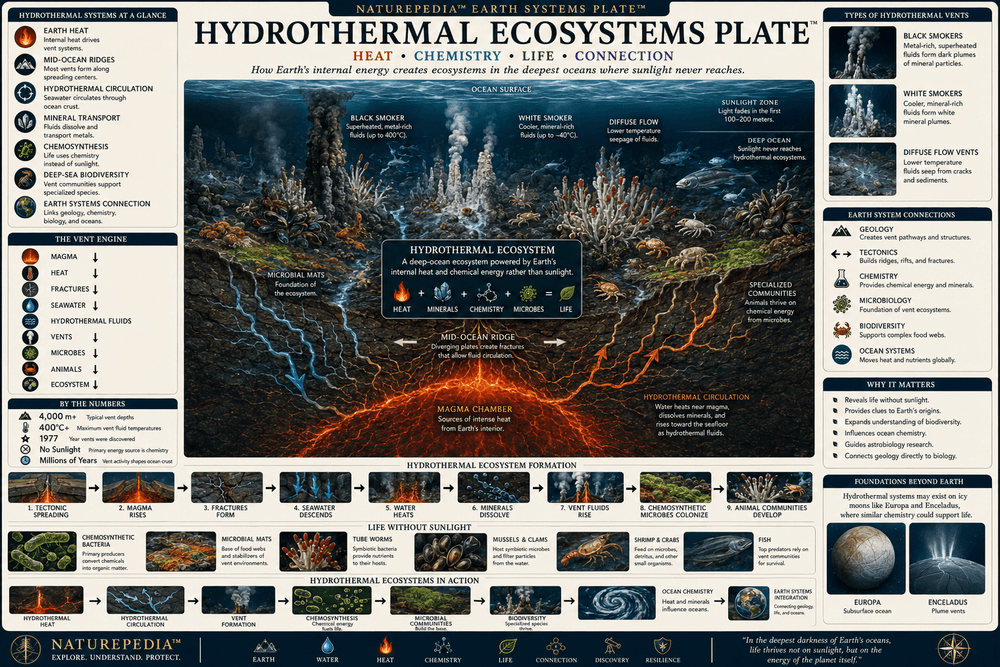
This master systems plate introduces Hydrothermal Ecosystems™ as one of Earth’s most extraordinary deep-ocean life systems. It connects seafloor geology, hydrothermal vents, mineral-rich fluids, chemosynthetic microbes, extremophiles, vent animals, food webs, origins of life, and astrobiology into one visible Naturepedia™ knowledge layer.

Hydrothermal Ecosystems Plate showing deep-sea vents, black smokers, white smokers, mineral chimneys, chemosynthetic microbes, tube worms, vent animals, seafloor geology, and origins of life
Hydrothermal Ecosystems Plate™ — a Naturepedia™ systems layer showing how Earth’s internal heat, seafloor geology, chemical energy, microbial life, and vent biodiversity create deep-ocean ecosystems without sunlight.

Earth-Powered Life

Hydrothermal ecosystems are powered by heat and chemistry rising from beneath the seafloor rather than sunlight from above.

Chemosynthetic Foundation

Microbes convert chemical energy from vent fluids into biological energy that supports tube worms, mussels, clams, shrimp, crabs, and fish.

Origins & Astrobiology

Hydrothermal vents provide clues to early Earth, the origins of life, and the possibility of life in subsurface oceans on worlds such as Europa and Enceladus.

Visible Plate ID

ID: hydrothermal-ecosystems#hydrothermal-ecosystems-plate

URL: https://www.robbiegeorgephotography.com/hydrothermal-ecosystems

Type: Naturepedia Systems Plate™

Deep Ocean Earth Systems

What Are Hydrothermal Ecosystems?

Hydrothermal ecosystems are deep-ocean environments formed where seawater seeps into cracks in the seafloor, is heated by magma beneath Earth’s crust, and returns upward carrying dissolved minerals and chemical energy. These systems create some of the most unusual and important ecosystems on the planet.

Unlike most ecosystems on Earth, hydrothermal vents do not depend on sunlight as their primary energy source. Instead, they are powered by chemosynthesis, a process in which microbes convert chemical compounds from vent fluids into biological energy. This microbial foundation supports entire food webs in the darkness of the deep sea.

Hydrothermal vents often occur along mid-ocean ridges, volcanic seafloor regions, spreading centers, and tectonically active zones. As superheated fluids rise from beneath the seafloor, minerals precipitate out of the water and build chimney-like structures known as black smokers, white smokers, and other vent formations.

These ecosystems support extraordinary life forms including chemosynthetic bacteria, archaea, giant tube worms, vent mussels, clams, shrimp, crabs, fish, and other organisms adapted to darkness, pressure, heat, acidity, and mineral-rich chemistry. Hydrothermal ecosystems also help scientists explore early Earth conditions, the possible origins of life, and whether similar ecosystems could exist on ocean worlds such as Europa and Enceladus.

Seafloor Heat

Hydrothermal vents form where seawater is heated by magma beneath the ocean crust and rises back through cracks in the seafloor.

Chemical Energy

Chemosynthetic microbes transform sulfur, methane, hydrogen, iron, and other compounds into energy that supports deep-sea food webs.

Extreme Life

Vent organisms survive under intense pressure, darkness, heat, acidity, toxic chemistry, and steep thermal gradients.

Naturepedia Insight: Hydrothermal ecosystems reveal that life does not always need sunlight to thrive. In the deep ocean, geology becomes the energy source, microbes become the foundation, and chemical reactions become the beginning of an entire living system.

Naturepedia Identification Plate

Hydrothermal Vent Identification Plate™

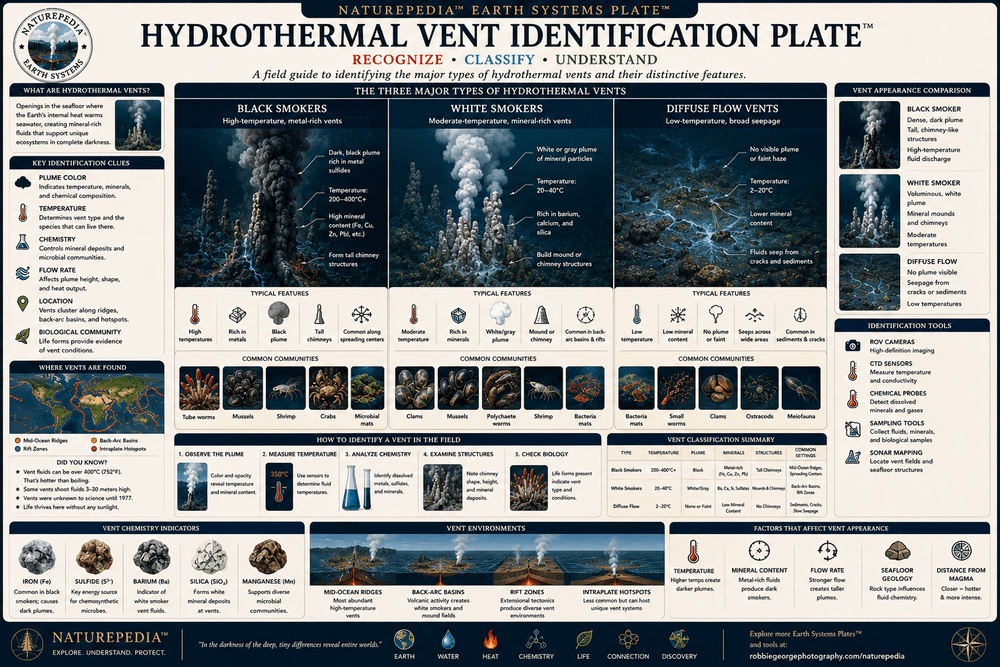
Hydrothermal vents occur in several forms depending on temperature, chemistry, mineral content, and geological setting. This identification plate introduces the major vent types, vent-field structures, mineral chimneys, fluid pathways, and geological features that define hydrothermal ecosystems across the world's oceans.

Hydrothermal Vent Identification Plate showing black smokers, white smokers, diffuse vents, mineral chimneys, vent fields, and seafloor geological features
Hydrothermal Vent Identification Plate™ — a Naturepedia™ guide to recognizing vent types, chimney structures, fluid systems, and seafloor hydrothermal features.

Hydrothermal vents form when seawater circulates through fractures in the ocean crust and becomes heated by underlying magma. As the water rises back toward the seafloor, dissolved minerals precipitate and accumulate, creating towering chimneys and complex vent fields. These structures vary dramatically depending on temperature, chemistry, and geological conditions.

The most recognizable hydrothermal vents are black smokers, which emit dark mineral-rich plumes, and white smokers, which release lighter-colored fluids rich in silica, calcium, and other dissolved compounds. Diffuse vents, vent mounds, hydrothermal fissures, and mineral terraces may also occur within active vent fields.

Identifying hydrothermal vent systems helps scientists understand tectonic processes, seafloor geology, mineral deposition, biological communities, and the flow of heat and chemicals through Earth’s crust. These features also provide important clues about ancient hydrothermal systems that may have existed on the early Earth.

Black Smokers

High-temperature vents that release dark mineral-rich plumes and rapidly build sulfide chimneys.

White Smokers

Lower-temperature hydrothermal vents producing pale mineral plumes rich in silica and dissolved compounds.

Diffuse Vents

Broad, lower-temperature outflows that often support dense microbial communities and vent fauna.

Naturepedia Insight: Although black smokers receive most of the attention, hydrothermal vent fields often contain many different vent types operating simultaneously. Together they create a mosaic of temperatures, mineral chemistry, and ecological niches that support extraordinary biodiversity.

Visible Plate ID

ID: hydrothermal-ecosystems#hydrothermal-vent-identification-plate

URL: https://www.robbiegeorgephotography.com/hydrothermal-ecosystems

Type: Naturepedia Identification Plate™

Naturepedia Geology Plate

Black Smokers Plate™

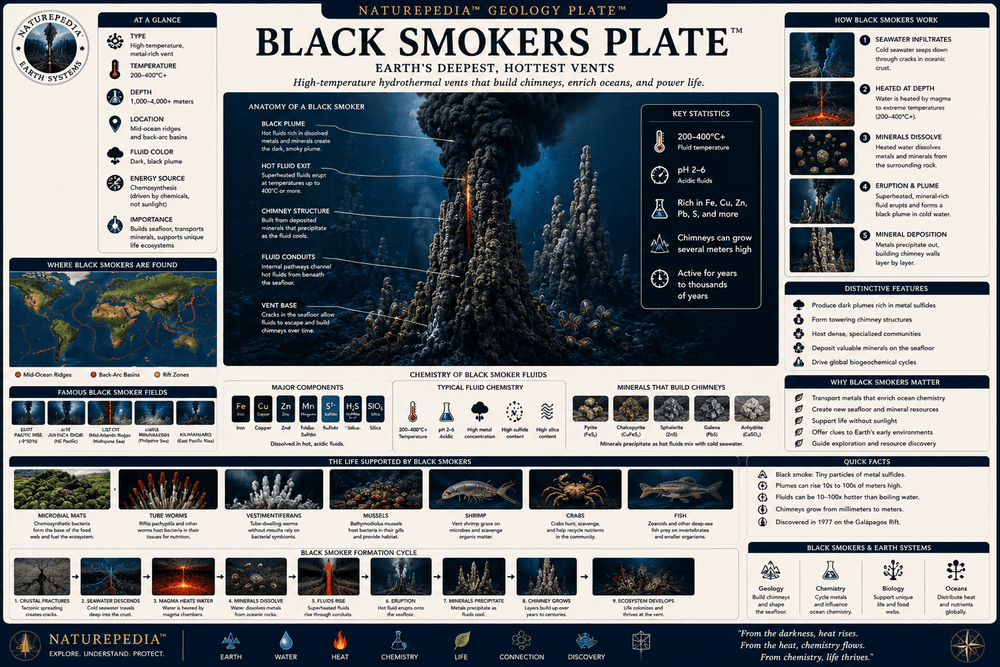
Black smokers are among the most iconic features of hydrothermal ecosystems. These towering mineral chimneys release superheated, metal-rich fluids into the deep ocean, creating dark plumes that resemble smoke rising from an underwater volcanic landscape.

Black Smokers Plate showing hydrothermal vent chimneys, sulfide deposits, mineral-rich plumes, vent communities, and deep-sea geology
Black Smokers Plate™ — a Naturepedia™ exploration of sulfide chimneys, superheated vent fluids, mineral deposition, and deep-ocean geological activity.

Black smokers form when seawater penetrates deep into the ocean crust and becomes heated by magma below. As temperatures rise, the water dissolves metals and minerals from surrounding rocks. When this superheated fluid emerges into the cold ocean, dissolved metals rapidly precipitate, creating the dark plume that gives black smokers their name.

Temperatures within black smoker systems may exceed 350°C (662°F), making them among the hottest naturally occurring aquatic environments on Earth. Despite these extreme conditions, microbial communities and specialized vent animals thrive around these structures, relying on chemical energy rather than sunlight.

Over time, minerals accumulate and build towering chimney structures composed largely of iron sulfides, copper sulfides, zinc compounds, and other metals. Some black smoker chimneys can grow several stories tall and become focal points for entire hydrothermal ecosystems.

Extreme Temperatures

Black smoker fluids can exceed 350°C while remaining liquid because of the immense pressure of the deep ocean.

Mineral Chimneys

Iron, copper, zinc, and sulfur compounds accumulate around vents to form towering chimney structures.

Chemical Foundations

The chemicals emerging from black smokers fuel chemosynthetic microbes that support entire vent food webs.

Naturepedia Insight: Black smokers were not discovered until 1977. Their discovery transformed biology by revealing thriving ecosystems completely independent of sunlight, proving that life can be powered directly by Earth's internal geological energy.

Visible Plate ID

ID: hydrothermal-ecosystems#black-smokers-plate

URL: https://www.robbiegeorgephotography.com/hydrothermal-ecosystems

Type: Naturepedia Geology Plate™

Naturepedia Geology Plate

White Smokers Plate™

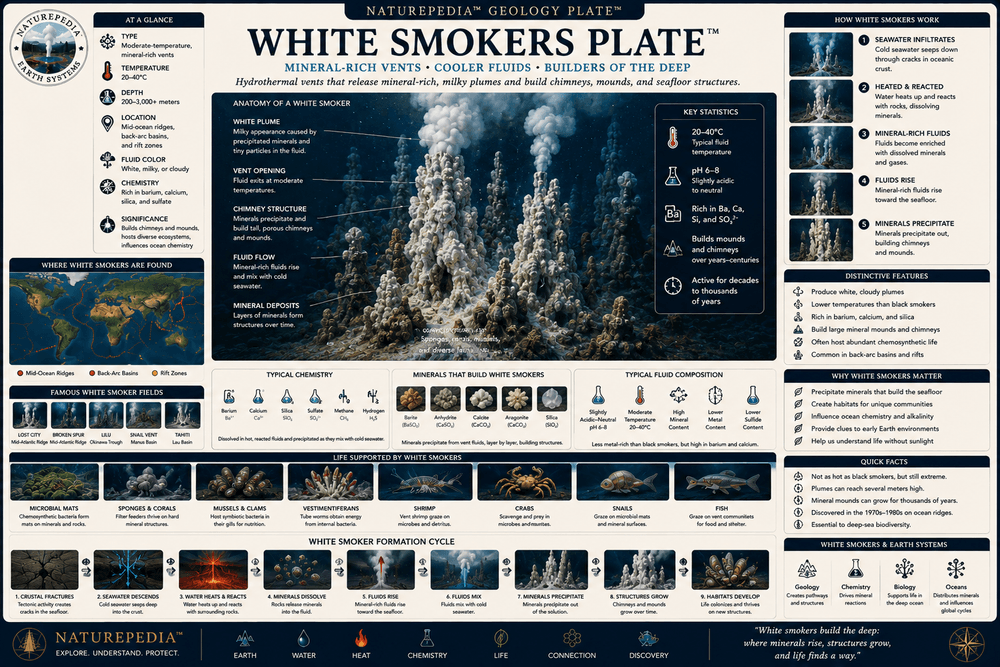
White smokers are hydrothermal vents that release lighter-colored mineral plumes rich in silica, calcium, barium, and other dissolved compounds. Although often less dramatic than black smokers, these vent systems create important habitats and reveal a different side of hydrothermal chemistry and seafloor geology.

White Smokers Plate showing pale hydrothermal plumes, mineral-rich fluids, chimney formations, and deep-sea vent ecosystems
White Smokers Plate™ — a Naturepedia™ exploration of lower-temperature hydrothermal vents, pale mineral plumes, and mineral-rich deep-ocean chemistry.

Unlike black smokers, white smokers generally operate at lower temperatures and contain different dissolved minerals. As hydrothermal fluids mix with cold seawater, silica, calcium sulfate, barium sulfate, and other compounds precipitate from solution, producing lighter-colored plumes and pale chimney structures.

White smoker systems often occur within larger hydrothermal vent fields where temperatures vary significantly across relatively short distances. These thermal gradients create diverse ecological niches that support different microbial communities and animal assemblages adapted to specific chemical and temperature conditions.

Although they may appear less dramatic than black smokers, white smokers provide valuable insight into hydrothermal circulation, mineral formation, geochemical processes, and the ways that chemistry influences biological communities in the deep sea.

Lower Temperatures

White smokers generally release cooler hydrothermal fluids than black smokers, creating different geological and ecological conditions.

Silica & Minerals

Light-colored plumes form from silica, calcium, barium, and other dissolved compounds precipitating from vent fluids.

Vent Diversity

White smokers contribute to the ecological diversity of vent fields by creating distinct temperature and chemistry zones.

Naturepedia Insight: White smokers demonstrate that hydrothermal ecosystems are not uniform. Even within a single vent field, differences in temperature and chemistry can create entirely different geological structures and biological communities.

Visible Plate ID

ID: hydrothermal-ecosystems#white-smokers-plate

URL: https://www.robbiegeorgephotography.com/hydrothermal-ecosystems

Type: Naturepedia Geology Plate™

Naturepedia Food Web Plate

Chemosynthetic Food Web Plate™

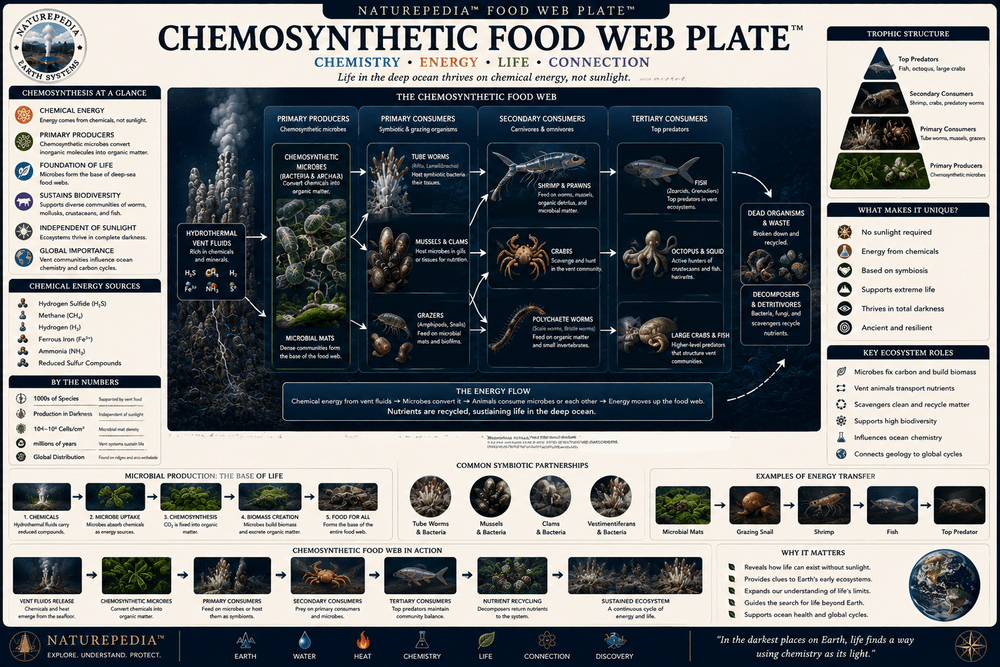
Hydrothermal ecosystems are supported by one of the most unusual food webs on Earth. Instead of beginning with sunlight and photosynthesis, these communities begin with chemical energy released from hydrothermal vent fluids and transformed by specialized microbes through chemosynthesis.

Chemosynthetic Food Web Plate showing chemical energy, chemosynthetic microbes, tube worms, mussels, clams, shrimp, crabs, fish, and hydrothermal food-web relationships
Chemosynthetic Food Web Plate™ — a Naturepedia™ visualization of energy flow through hydrothermal vent ecosystems, from microbes to complex animal communities.

Most ecosystems on Earth ultimately depend upon sunlight. Hydrothermal ecosystems are different. At the base of the food web are chemosynthetic bacteria and archaea that derive energy from hydrogen sulfide, methane, hydrogen gas, iron compounds, and other chemicals emerging from hydrothermal vents.

These microorganisms form the biological foundation of vent communities. Some live freely on vent surfaces, while others exist within the tissues of larger organisms such as giant tube worms, mussels, and clams. Through symbiotic partnerships, microbes provide nutrients directly to their hosts, allowing animals to thrive in environments where traditional food sources are absent.

Above these microbial producers are grazers, scavengers, filter feeders, predators, and fishes that create increasingly complex food-web relationships. Together, these organisms demonstrate that life can flourish in complete darkness when a reliable source of chemical energy is available.

Chemical Energy

Hydrogen sulfide, methane, and other compounds provide the energy source that begins the vent food web.

Microbial Producers

Chemosynthetic bacteria and archaea convert chemical energy into biological productivity that supports larger organisms.

Vent Communities

Tube worms, mussels, clams, shrimp, crabs, and fishes form complex food webs built entirely on chemosynthesis.

Naturepedia Insight: The discovery of hydrothermal vent food webs proved that ecosystems can exist entirely without sunlight. This realization transformed ecology and strengthened the possibility that life could exist in dark subsurface oceans elsewhere in the Solar System.

Visible Plate ID

ID: hydrothermal-ecosystems#chemosynthetic-food-web-plate

URL: https://www.robbiegeorgephotography.com/hydrothermal-ecosystems

Type: Naturepedia Food Web Plate™

Naturepedia Microbiology Plate

Hydrothermal Microbial Life Plate™

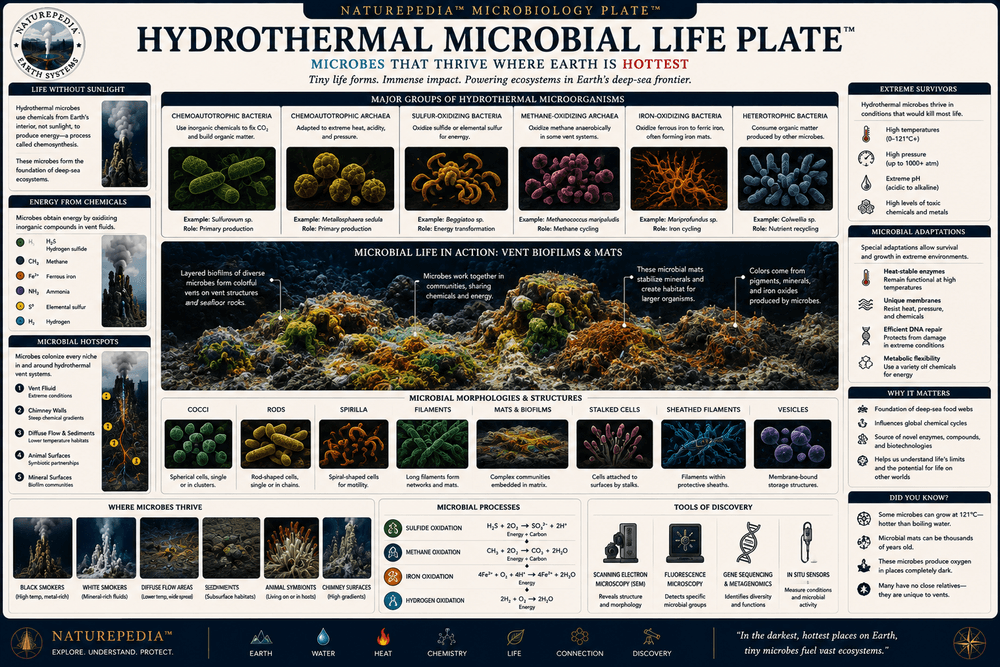
Hydrothermal ecosystems begin with microbes. Chemosynthetic bacteria and archaea form the biological foundation of vent communities, transforming chemical compounds from Earth's interior into the energy that supports entire ecosystems in complete darkness.

Hydrothermal Microbial Life Plate showing chemosynthetic bacteria, archaea, biofilms, microbial colonies, vent chemistry, and hydrothermal ecosystem foundations
Hydrothermal Microbial Life Plate™ — a Naturepedia™ exploration of the microbial communities that form the foundation of hydrothermal vent ecosystems.

Deep-sea hydrothermal vents host some of the most extraordinary microbial communities on Earth. These microorganisms thrive in environments characterized by extreme pressure, elevated temperatures, toxic chemistry, and complete darkness. Instead of relying on sunlight, they obtain energy from chemical reactions involving hydrogen sulfide, methane, hydrogen gas, iron, and other compounds emerging from vent fluids.

Many hydrothermal microbes live as dense biofilms coating vent chimneys, mineral surfaces, and surrounding rocks. Others exist in symbiotic relationships with larger organisms, providing nutrients directly to giant tube worms, mussels, clams, and other vent animals. These partnerships allow complex life to flourish in one of Earth's most extreme environments.

Hydrothermal microbial communities are of enormous scientific importance because they may resemble some of Earth's earliest ecosystems. By studying these microorganisms, scientists gain insight into microbial evolution, early Earth conditions, and the possibility of life in similar environments elsewhere in the Solar System.

Chemosynthetic Bacteria

Specialized bacteria convert chemical compounds into biological energy that supports vent ecosystems.

Archaea

Ancient microbial lineages thrive in hydrothermal environments and provide clues to early evolution.

Biofilms & Colonies

Dense microbial communities coat vent structures and form the biological foundation of hydrothermal ecosystems.

Naturepedia Insight: Every hydrothermal ecosystem begins with microbes. Without chemosynthetic bacteria and archaea converting chemical energy into biological productivity, the spectacular tube worms, vent shrimp, mussels, and other animals associated with hydrothermal vents could not survive.

Visible Plate ID

ID: hydrothermal-ecosystems#hydrothermal-microbial-life-plate

URL: https://www.robbiegeorgephotography.com/hydrothermal-ecosystems

Type: Naturepedia Microbiology Plate™

Naturepedia Extremophile Plate

Vent Extremophiles Plate™

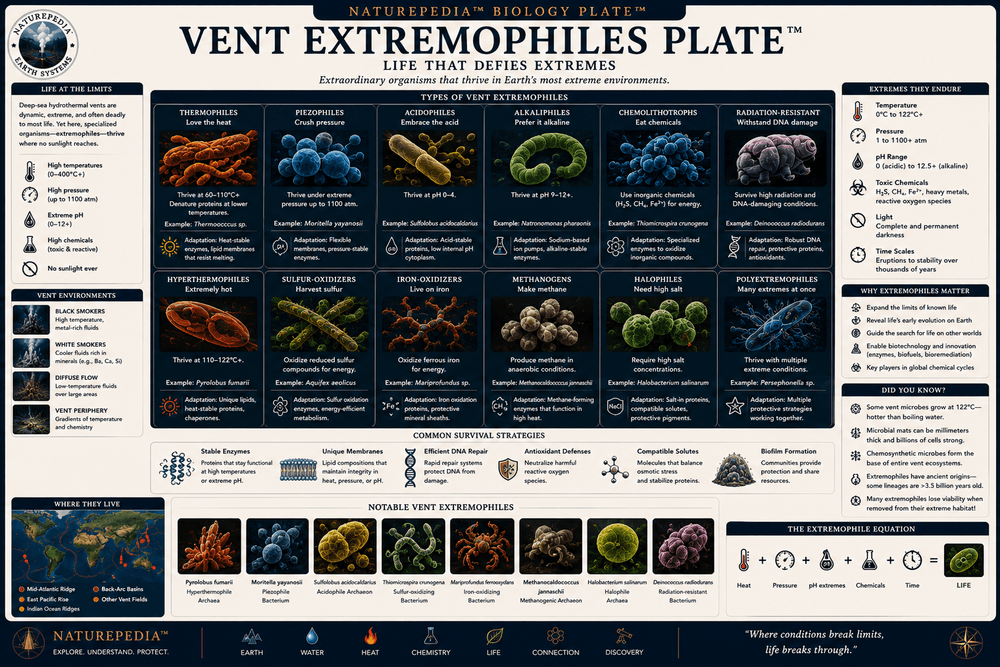
Hydrothermal vents host some of the most extreme environments on Earth. Organisms living here must tolerate crushing pressure, rapid temperature changes, complete darkness, toxic chemicals, acidity, and mineral-rich fluids. These remarkable life forms are known as extremophiles.

Vent Extremophiles Plate showing heat-tolerant microbes, deep-sea pressure adaptations, toxic chemistry, acidity, and hydrothermal vent survival strategies
Vent Extremophiles Plate™ — a Naturepedia™ exploration of organisms adapted to some of the harshest conditions found anywhere on Earth.

Hydrothermal vent environments push life to its limits. Temperatures near vent openings may exceed 350°C while nearby seawater remains only a few degrees above freezing. Organisms must also withstand immense hydrostatic pressure generated by thousands of feet of overlying ocean water. These conditions create one of the most challenging habitats on Earth.

Many vent extremophiles are microorganisms that possess highly specialized enzymes, cellular membranes, and metabolic pathways that allow them to survive under conditions lethal to most life forms. Some thrive in sulfur-rich environments, while others utilize methane, hydrogen, iron compounds, or acidic fluids as part of their survival strategies.

Because hydrothermal vent extremophiles occupy environments that may resemble conditions on the early Earth, they have become central to research involving microbial evolution, the origins of life, and the search for life beyond our planet. Scientists study these organisms to understand how biology adapts to extreme conditions and how life might persist elsewhere in the universe.

Extreme Heat

Some vent microbes thrive near temperatures that would rapidly destroy most forms of life.

Immense Pressure

Deep-ocean pressures can exceed hundreds of times atmospheric pressure at sea level.

Chemical Adaptation

Extremophiles utilize sulfur, methane, hydrogen, metals, and other compounds unavailable to most organisms.

Naturepedia Insight: The discovery of hydrothermal vent extremophiles dramatically expanded scientific understanding of where life can exist. These organisms demonstrate that biology can flourish under conditions once thought completely incompatible with life.

Visible Plate ID

ID: hydrothermal-ecosystems#vent-extremophiles-plate

URL: https://www.robbiegeorgephotography.com/hydrothermal-ecosystems

Type: Naturepedia Extremophile Plate™

Naturepedia Species Plate

Giant Tube Worm Plate™

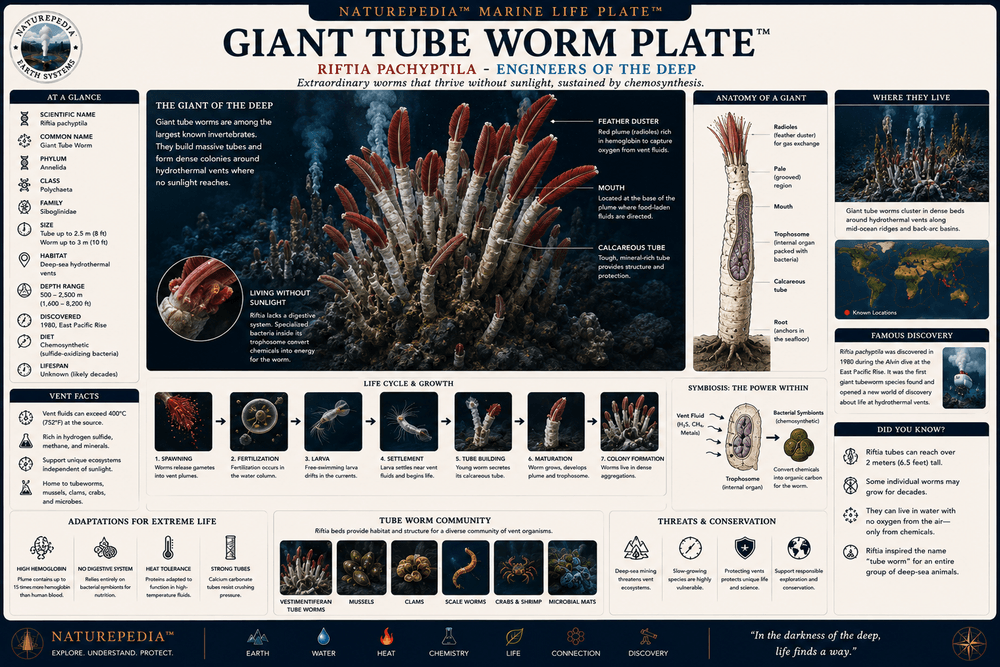
Giant tube worms are among the most extraordinary animals ever discovered. Found around hydrothermal vents in the deep ocean, these remarkable organisms survive without a mouth, stomach, or digestive tract, relying entirely on symbiotic bacteria for nourishment.

Giant Tube Worm Plate showing Riftia pachyptila, symbiotic bacteria, hydrothermal vent habitats, red plumes, and chemosynthetic relationships
Giant Tube Worm Plate™ — a Naturepedia™ exploration of Riftia pachyptila and one of the most remarkable symbiotic relationships found in nature.

The giant tube worm, Riftia pachyptila, is one of the signature species of hydrothermal vent ecosystems. These animals can exceed 8 feet (2.5 meters) in length and form dense colonies surrounding active vent systems. Their bright red plumes contain specialized blood pigments capable of transporting oxygen and hydrogen sulfide simultaneously.

Unlike most animals, giant tube worms possess no mouth, stomach, or intestines. Instead, they house vast populations of chemosynthetic bacteria within a specialized organ called a trophosome. These bacteria convert hydrogen sulfide from hydrothermal vent fluids into nutrients, effectively feeding the worm through a mutually beneficial symbiotic relationship.

This partnership represents one of the most famous examples of symbiosis in nature. By combining animal physiology with microbial chemosynthesis, giant tube worms thrive in an environment where traditional food sources are absent. Their discovery fundamentally changed scientific understanding of deep-sea ecosystems and biological adaptation.

No Digestive System

Adult giant tube worms lack a mouth, stomach, and intestines, relying entirely on microbial symbiosis.

Symbiotic Bacteria

Chemosynthetic bacteria living inside the worm provide nutrients by converting vent chemicals into biological energy.

Hydrothermal Specialists

Tube worms are uniquely adapted to hydrothermal vent habitats and often dominate active vent communities.

Naturepedia Insight: Giant tube worms are among the clearest examples that complex animal life can exist without sunlight. Their survival depends entirely upon a partnership with chemosynthetic bacteria powered by Earth's internal geological energy.

Visible Plate ID

ID: hydrothermal-ecosystems#giant-tube-worm-plate

URL: https://www.robbiegeorgephotography.com/hydrothermal-ecosystems

Type: Naturepedia Species Plate™

Naturepedia Species Plate

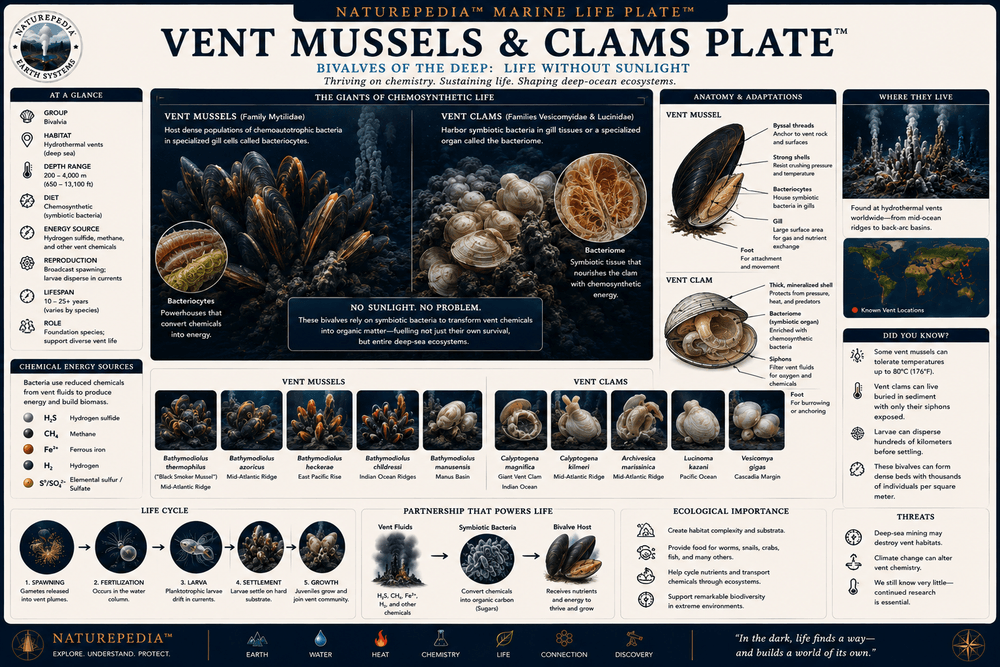
Vent Mussels & Clams Plate™

Vent mussels and clams are among the most successful animals inhabiting hydrothermal ecosystems. These shell-forming organisms thrive in nutrient-poor deep-ocean environments by forming partnerships with chemosynthetic microbes that transform vent chemistry into biological energy.

Vent Mussels and Clams Plate showing hydrothermal vent shellfish, chemosynthetic symbiosis, vent-field communities, and deep-sea ecosystem relationships
Vent Mussels & Clams Plate™ — a Naturepedia™ exploration of shellfish symbiosis, vent ecology, and hydrothermal biodiversity.

Hydrothermal vent mussels and clams occupy an ecological role similar to shellfish in shallow marine ecosystems, yet their source of energy is entirely different. Rather than depending on sunlight-driven food webs, these animals obtain nutrients through partnerships with chemosynthetic bacteria that live within their tissues.

These microbial partners utilize hydrogen sulfide, methane, and other vent-derived compounds to generate biological energy. In return, mussels and clams provide a stable environment, access to oxygen, and a steady supply of chemical nutrients. This mutualistic relationship allows dense shellfish communities to flourish around active vent systems.

Large beds of mussels and clams often dominate portions of hydrothermal vent fields, creating habitat for smaller organisms and contributing to the overall complexity of vent ecosystems. Their presence helps increase biodiversity and provides important ecological structure within deep-sea communities.

Chemosynthetic Symbiosis

Internal microbial partners provide nutrients by converting hydrothermal chemicals into biological energy.

Vent-Field Communities

Dense mussel and clam beds create habitat structure that supports additional vent organisms.

Deep-Sea Adaptation

These shellfish are uniquely adapted to darkness, pressure, and chemically dynamic hydrothermal environments.

Naturepedia Insight: Vent mussels and clams demonstrate that symbiosis is one of the most powerful survival strategies in nature. By partnering with chemosynthetic microbes, these animals thrive in environments where traditional food resources do not exist.

Visible Plate ID

ID: hydrothermal-ecosystems#vent-mussels-clams-plate

URL: https://www.robbiegeorgephotography.com/hydrothermal-ecosystems

Type: Naturepedia Species Plate™

Naturepedia Species Plate

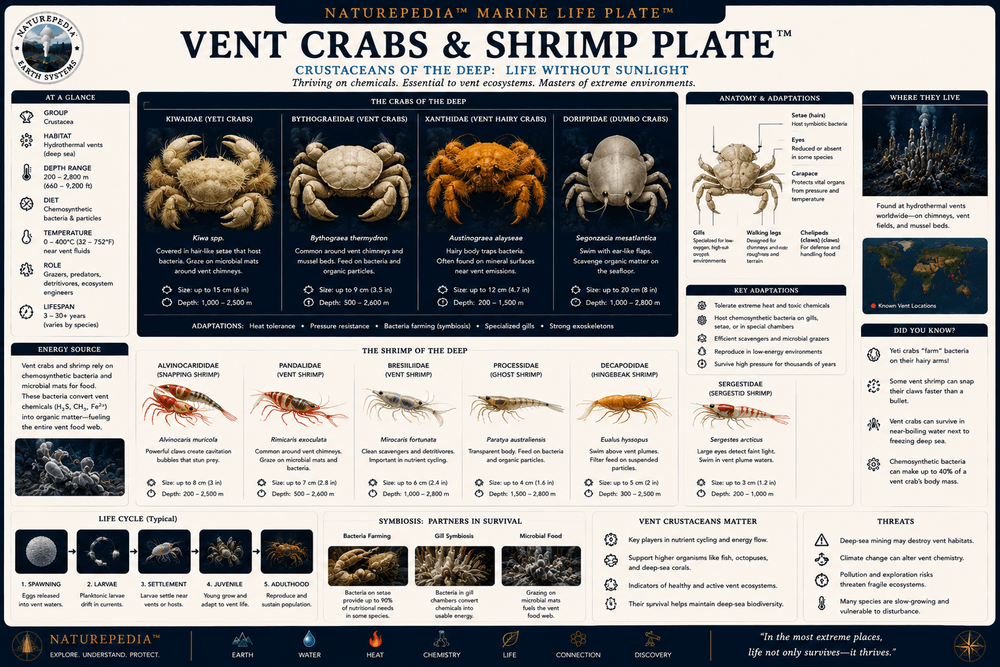
Vent Crabs & Shrimp Plate™

Hydrothermal vent crabs and shrimp are among the most active and adaptable animals inhabiting deep-sea vent ecosystems. These mobile species graze on microbial communities, scavenge organic material, hunt smaller organisms, and help transfer energy throughout hydrothermal food webs.

Vent Crabs and Shrimp Plate showing hydrothermal vent crustaceans, grazing behavior, scavenging, microbial feeding, and deep-sea ecosystem relationships
Vent Crabs & Shrimp Plate™ — a Naturepedia™ exploration of mobile crustaceans that connect hydrothermal vent food webs and ecosystem energy pathways.

Unlike tube worms and many vent mussels that remain fixed in one location, crabs and shrimp move throughout hydrothermal vent fields searching for food and favorable environmental conditions. Their mobility allows them to exploit different ecological niches and connect separate parts of the vent ecosystem.

Many vent shrimp graze directly on microbial biofilms growing around hydrothermal chimneys and mineral surfaces. Some species cultivate bacterial communities on specialized body structures and feed on these microbes. Vent crabs often act as scavengers and opportunistic predators, consuming microbial material, organic debris, and smaller animals.

Because hydrothermal vents contain sharp temperature gradients, vent crustaceans constantly navigate between extremely hot vent fluids and much colder surrounding seawater. Their ability to tolerate these rapidly changing conditions makes them among the most resilient inhabitants of hydrothermal ecosystems.

Microbial Grazers

Many vent shrimp feed directly on chemosynthetic bacteria growing on vent surfaces and mineral chimneys.

Scavengers & Predators

Vent crabs help recycle nutrients and transfer energy through hydrothermal food webs.

Thermal Navigation

Crustaceans move through steep temperature gradients that would be lethal to many other organisms.

Naturepedia Insight: Vent crabs and shrimp act as important ecological connectors within hydrothermal ecosystems. Their movement links microbial communities, stationary vent animals, and higher trophic levels into one integrated food web.

Visible Plate ID

ID: hydrothermal-ecosystems#vent-crabs-shrimp-plate

URL: https://www.robbiegeorgephotography.com/hydrothermal-ecosystems

Type: Naturepedia Species Plate™

Naturepedia Earth Systems Plate

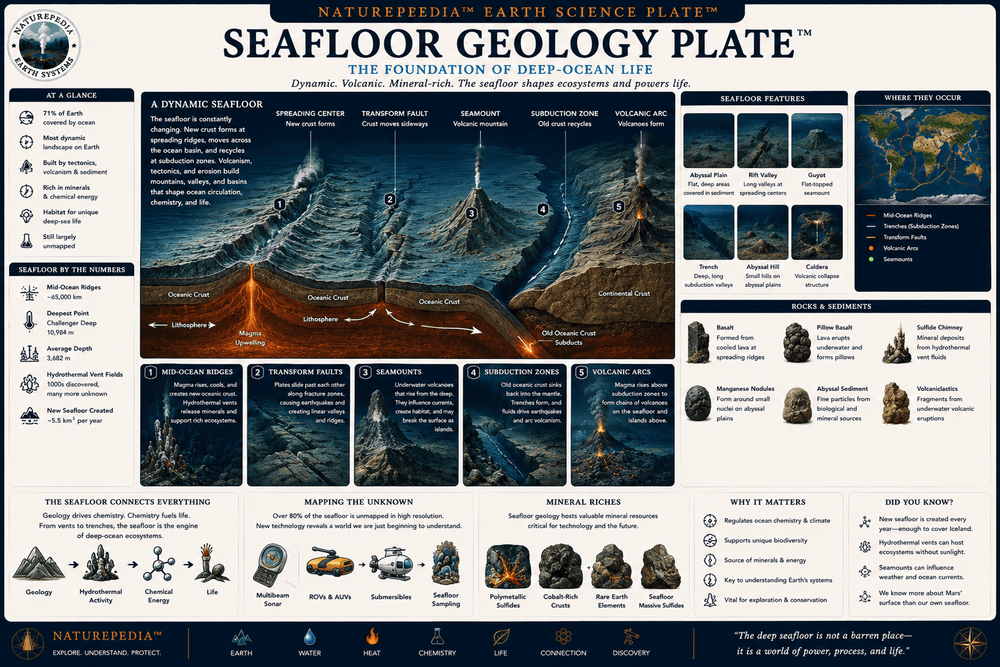
Seafloor Geology Plate™

Hydrothermal ecosystems are fundamentally geological systems. Deep beneath the ocean, tectonic forces, volcanic activity, magma chambers, and seafloor spreading create the conditions that allow hydrothermal vents and their extraordinary biological communities to exist.

Seafloor Geology Plate showing mid-ocean ridges, tectonic spreading, magma chambers, hydrothermal circulation, vent formation, and ocean crust processes
Seafloor Geology Plate™ — a Naturepedia™ exploration of tectonic activity, ocean crust formation, magma-driven circulation, and the geological foundation of hydrothermal ecosystems.

Most hydrothermal vents occur along mid-ocean ridges, where tectonic plates slowly pull apart and new ocean crust forms. As the seafloor spreads, fractures develop that allow seawater to penetrate deep into the crust. There, the water encounters magma-heated rock and begins the hydrothermal circulation process.

The interaction between seawater, volcanic heat, and oceanic crust creates a dynamic geological system. Water becomes superheated, dissolves minerals from surrounding rock, and eventually rises back toward the seafloor carrying heat, metals, sulfur compounds, and other dissolved elements. These fluids ultimately emerge as hydrothermal vents.

Without active tectonics and volcanism, hydrothermal ecosystems could not exist. The deep ocean's remarkable biological communities are therefore direct products of Earth’s geological engine, linking plate tectonics, volcanism, ocean chemistry, and life into one interconnected Earth Systems process.

Mid-Ocean Ridges

Most hydrothermal vents form along underwater mountain ranges where tectonic plates move apart and new crust forms.

Magma Heat

Magma beneath the ocean floor provides the thermal energy that drives hydrothermal circulation systems.

Hydrothermal Circulation

Seawater continuously cycles through fractured crust, transporting heat, minerals, and chemical energy.

Naturepedia Insight: Hydrothermal ecosystems exist because Earth is geologically alive. Every vent, chimney, microbial colony, and vent animal ultimately traces its existence back to the movement of tectonic plates and heat rising from deep within the planet.

Visible Plate ID

ID: hydrothermal-ecosystems#seafloor-geology-plate

URL: https://www.robbiegeorgephotography.com/hydrothermal-ecosystems

Type: Naturepedia Earth Systems Plate™

Naturepedia Geology Plate

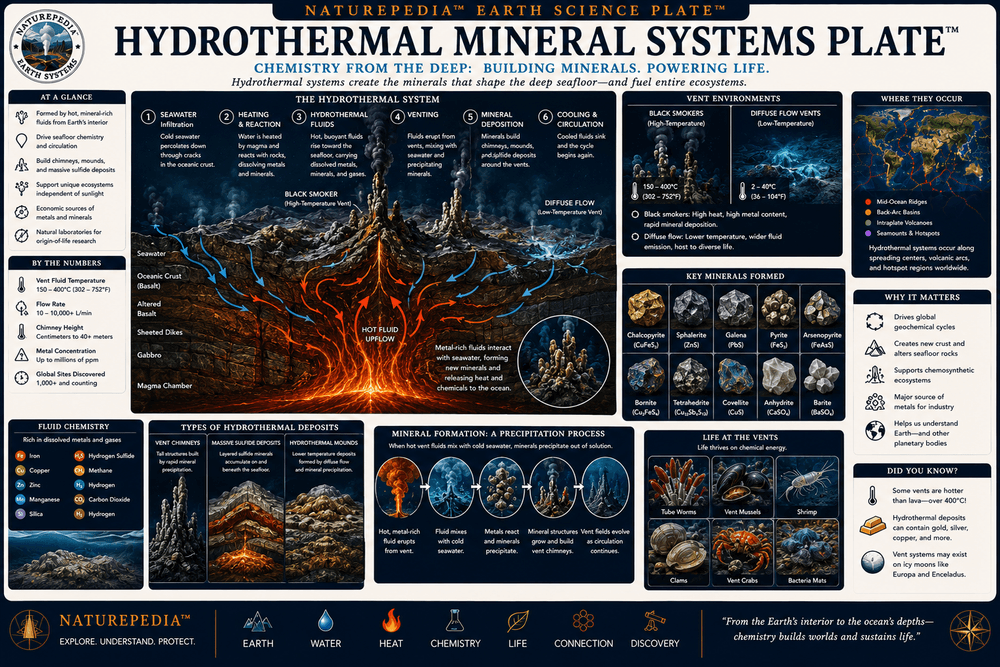
Hydrothermal Mineral Systems Plate™

Hydrothermal vents are not only biological hotspots but also powerful mineral-forming systems. As superheated fluids move through Earth's crust and emerge on the seafloor, they transport metals, sulfur compounds, silica, and dissolved minerals that create some of the most remarkable geological formations in the ocean.

Hydrothermal Mineral Systems Plate showing sulfide deposits, metal-rich fluids, chimney growth, mineral precipitation, hydrothermal circulation, and seafloor mineral formation
Hydrothermal Mineral Systems Plate™ — a Naturepedia™ exploration of metal-rich vent fluids, mineral deposition, chimney growth, and seafloor geological processes.

As seawater circulates through hot oceanic crust, it dissolves minerals from surrounding rocks and becomes enriched with metals such as iron, copper, zinc, manganese, and other elements. When these fluids emerge into the cold deep ocean, dissolved compounds rapidly precipitate out of solution and accumulate around vent openings.

This process creates hydrothermal chimneys composed largely of metal sulfides and other mineral deposits. Over time, these structures can grow into towering formations several stories tall. The same geological processes responsible for building vent chimneys also contribute to the formation of significant mineral deposits on the seafloor.

Hydrothermal mineral systems provide an important link between Earth's interior, ocean chemistry, and biological communities. The minerals carried by vent fluids help shape vent ecosystems, influence microbial metabolism, and create the physical structures that many hydrothermal organisms depend upon for habitat.

Metal-Rich Fluids

Hydrothermal fluids transport iron, copper, zinc, sulfur compounds, silica, and numerous dissolved minerals.

Chimney Formation

Minerals precipitate from vent fluids and accumulate into towering hydrothermal chimney structures.

Geology & Biology

Mineral systems influence microbial metabolism, ecosystem development, and hydrothermal biodiversity.

Naturepedia Insight: Hydrothermal vents are natural mineral factories. Every chimney, sulfide deposit, and metal-rich plume represents a direct connection between Earth's internal geological engine and the deep-ocean ecosystems it supports.

Visible Plate ID

ID: hydrothermal-ecosystems#hydrothermal-mineral-systems-plate

URL: https://www.robbiegeorgephotography.com/hydrothermal-ecosystems

Type: Naturepedia Geology Plate™

Naturepedia Origins of Life Plate

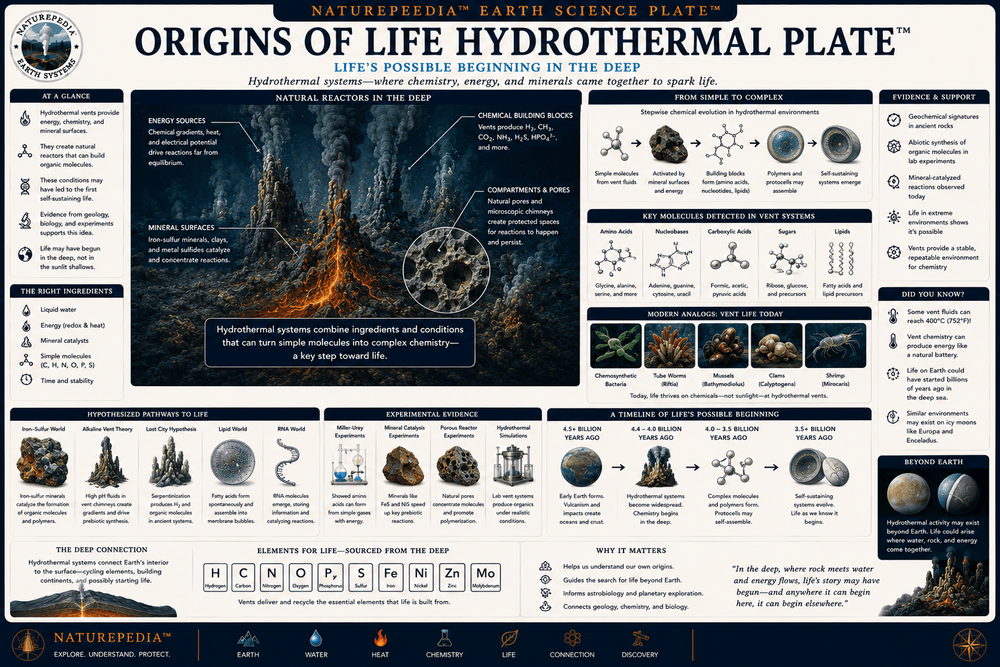
Origins of Life Hydrothermal Plate™

Hydrothermal vent systems are among the leading scientific candidates for the origin of life on Earth. These environments provide heat, minerals, chemical gradients, and protected microenvironments that may have helped transform simple chemistry into the first living systems billions of years ago.

Origins of Life Hydrothermal Plate showing early Earth hydrothermal vents, chemical gradients, prebiotic chemistry, microbial evolution, and life's emergence
Origins of Life Hydrothermal Plate™ — a Naturepedia™ exploration of hydrothermal origin-of-life theories, prebiotic chemistry, and early Earth environments.

One of the greatest scientific questions is how life first emerged on Earth. Among the leading hypotheses is the idea that hydrothermal systems provided ideal conditions for prebiotic chemistry. In these environments, heat, minerals, water, and chemical energy interacted continuously, creating opportunities for increasingly complex molecules to form and organize.

Hydrothermal vents generate powerful chemical gradients between mineral-rich vent fluids and surrounding seawater. Many researchers believe these gradients could have acted as natural energy sources for early biochemical reactions. Tiny pores within mineral structures may have functioned as natural reaction chambers, concentrating molecules and encouraging the formation of increasingly complex chemical systems.

Modern hydrothermal ecosystems provide living laboratories for studying these processes. Chemosynthetic microbes thriving around vent systems today may resemble some of Earth's earliest biological communities, offering valuable clues about how life first established itself on our planet more than three billion years ago.

Chemical Gradients

Differences between vent fluids and seawater may have provided the energy needed for early biochemical reactions.

Mineral Catalysts

Iron, sulfur, and other minerals may have helped drive the chemical processes that preceded life.

Early Ecosystems

Modern hydrothermal microbes may provide a window into some of Earth's earliest living communities.

Naturepedia Insight: Hydrothermal ecosystems connect geology directly to biology. For many scientists, they represent one of the most compelling places where nonliving chemistry may have crossed the threshold into the first living systems on Earth.

Visible Plate ID

ID: hydrothermal-ecosystems#origins-of-life-hydrothermal-plate

URL: https://www.robbiegeorgephotography.com/hydrothermal-ecosystems

Type: Naturepedia Origins of Life Plate™

Naturepedia Astrobiology Plate

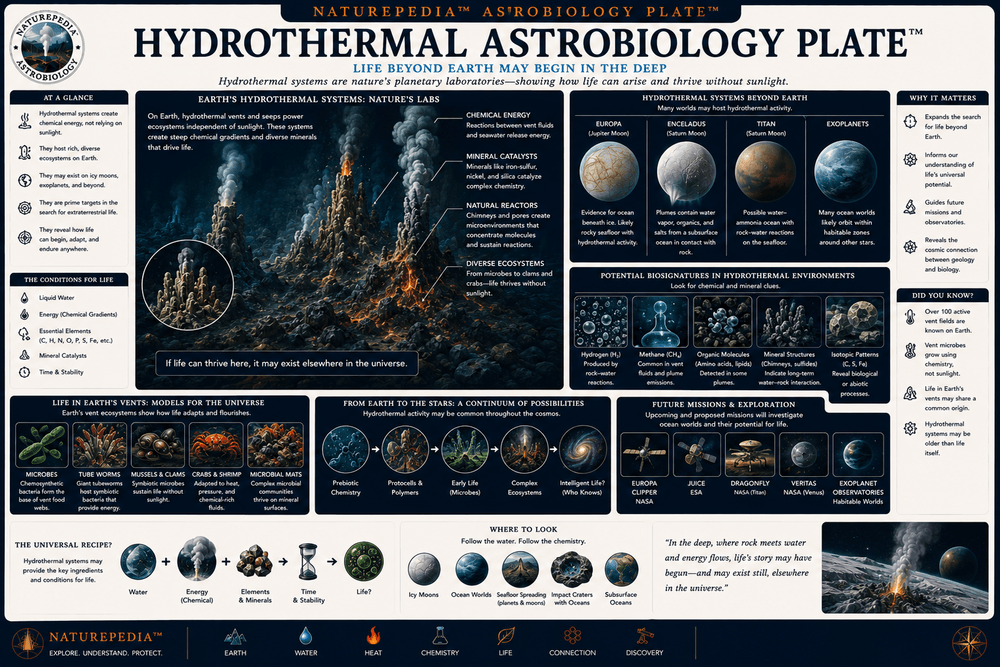
Hydrothermal Astrobiology Plate™

Hydrothermal ecosystems have become one of the most important models in astrobiology. Because these systems support life without sunlight, scientists view them as potential analogs for environments that may exist beneath the surfaces of icy moons, ancient Mars, and other worlds beyond Earth.

Hydrothermal Astrobiology Plate showing hydrothermal vents, Europa, Enceladus, subsurface oceans, chemosynthesis, and the search for extraterrestrial life
Hydrothermal Astrobiology Plate™ — a Naturepedia™ exploration of ocean worlds, subsurface seas, hydrothermal analogs, and the search for life beyond Earth.

For much of scientific history, it was assumed that sunlight was required to support complex ecosystems. The discovery of hydrothermal vent communities fundamentally changed that assumption. These ecosystems demonstrated that life can thrive entirely on chemical energy generated by geological processes, opening new possibilities for where life might exist elsewhere in the universe.

Several planetary bodies within our Solar System appear to possess subsurface oceans hidden beneath layers of ice. Jupiter's moon Europa and Saturn's moon Enceladus are among the most promising candidates. Evidence suggests these worlds may contain liquid water, internal heat sources, and hydrothermal activity occurring on their ocean floors.

If hydrothermal systems exist beneath these icy crusts, they could provide the same ingredients found within Earth's hydrothermal ecosystems: liquid water, chemical gradients, minerals, and energy sources capable of supporting microbial life. As a result, hydrothermal vents have become central to modern astrobiology and planetary exploration missions.

Europa

Jupiter's icy moon may contain a vast subsurface ocean capable of supporting hydrothermal activity.

Enceladus

Saturn's moon ejects water-rich plumes that suggest an active ocean and possible hydrothermal processes below.

Life Beyond Earth

Hydrothermal ecosystems provide one of the strongest scientific models for how extraterrestrial life might survive.

Naturepedia Insight: Hydrothermal vents transformed the search for life beyond Earth. By proving that ecosystems can exist without sunlight, they greatly expanded the number of environments where scientists now believe life may be possible.

Visible Plate ID

ID: hydrothermal-ecosystems#hydrothermal-astrobiology-plate

URL: https://www.robbiegeorgephotography.com/hydrothermal-ecosystems

Type: Naturepedia Astrobiology Plate™

Naturepedia Photography Plate

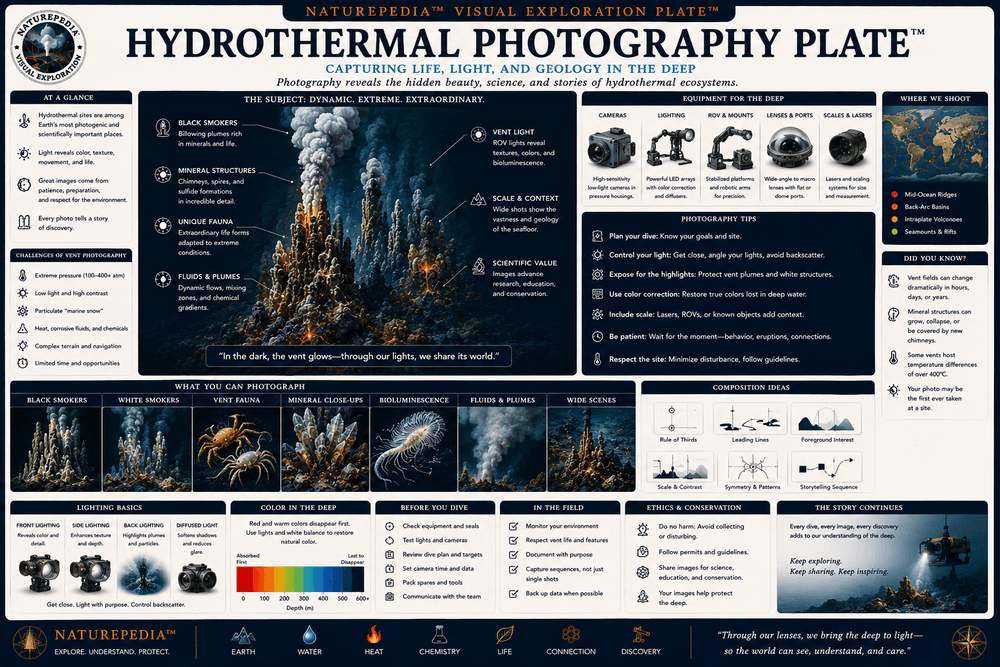
Hydrothermal Photography Plate™

Hydrothermal ecosystems rank among the most challenging environments on Earth to photograph. Located thousands of feet beneath the ocean surface, these ecosystems require advanced submersibles, remotely operated vehicles, specialized lighting systems, and scientific imaging technologies to document their hidden world.

Hydrothermal Photography Plate showing deep-sea imaging, remotely operated vehicles, hydrothermal vents, scientific photography, and underwater exploration
Hydrothermal Photography Plate™ — a Naturepedia™ guide to documenting deep-sea vent ecosystems through scientific imaging and exploration technology.

Unlike terrestrial landscapes or shallow marine habitats, hydrothermal vent ecosystems exist in complete darkness. Natural sunlight never reaches these depths, requiring all imagery to be illuminated using artificial lighting mounted on remotely operated vehicles (ROVs), autonomous underwater vehicles (AUVs), or crewed submersibles.

Scientific photography has played a central role in understanding hydrothermal ecosystems since their discovery in 1977. Images captured by deep-sea exploration teams revealed towering black smokers, giant tube worm colonies, chemosynthetic communities, and entirely new forms of life previously unknown to science.

Today, advances in digital imaging, robotic exploration, low-light sensors, and high-definition video systems allow researchers to document hydrothermal ecosystems with extraordinary detail. These images not only support scientific research but also help the public visualize one of Earth's most remote and fascinating environments.

ROV Imaging

Remotely operated vehicles provide scientists with access to hydrothermal ecosystems thousands of feet below the surface.

Artificial Illumination

Powerful lighting systems reveal ecosystems hidden within the perpetual darkness of the deep ocean.

Scientific Discovery

Photography has transformed understanding of hydrothermal ecosystems by documenting species and processes never before observed.

Naturepedia Insight: Nearly everything humanity knows about hydrothermal ecosystems comes from cameras. Without deep-sea imaging technology, entire ecosystems powered by Earth's internal energy would have remained hidden from science.

Visible Plate ID

ID: hydrothermal-ecosystems#hydrothermal-photography-plate

URL: https://www.robbiegeorgephotography.com/hydrothermal-ecosystems

Type: Naturepedia Photography Plate™

Naturepedia Biodiversity Plate

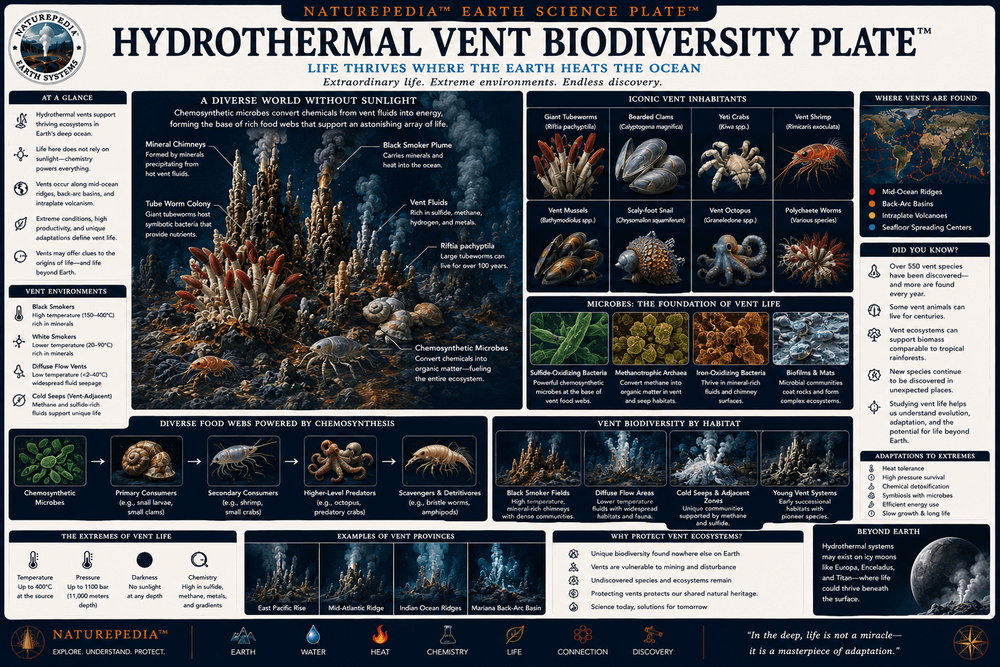
Hydrothermal Vent Biodiversity Plate™

Hydrothermal vent ecosystems support some of the most unusual biodiversity on Earth. Despite existing in complete darkness and under extreme environmental conditions, these isolated habitats contain highly specialized species found nowhere else on the planet.

Hydrothermal Vent Biodiversity Plate showing tube worms, mussels, clams, shrimp, crabs, fishes, microbial communities, and deep-sea biodiversity
Hydrothermal Vent Biodiversity Plate™ — a Naturepedia™ exploration of the remarkable diversity of organisms inhabiting deep-sea vent ecosystems.

Hydrothermal vents were once thought to be barren regions incapable of supporting life. Their discovery revealed thriving ecosystems filled with organisms uniquely adapted to vent environments. Today, scientists recognize hydrothermal vents as biodiversity hotspots containing hundreds of specialized species that depend directly or indirectly upon chemosynthesis.

Vent biodiversity includes microbes, giant tube worms, mussels, clams, shrimp, crabs, fish, octopuses, and numerous smaller invertebrates. Many of these species have evolved nowhere else on Earth and possess extraordinary adaptations for surviving high pressure, toxic chemicals, fluctuating temperatures, and complete darkness.

Each hydrothermal vent field functions as an isolated island of life within the deep ocean. Because vent systems are often separated by hundreds or even thousands of miles, species populations can become genetically isolated, leading to unique evolutionary pathways and high levels of endemism.

Endemic Species

Many hydrothermal vent organisms occur nowhere else on Earth and exist only within specialized vent habitats.

Evolutionary Isolation

Vent fields function like biological islands, encouraging unique evolutionary adaptations and diversification.

Chemosynthetic Foundation

Microbial communities support extraordinary biodiversity through chemical energy rather than sunlight.

Naturepedia Insight: Hydrothermal vents remind us that biodiversity can flourish even in the most unlikely places. These isolated ecosystems reveal how evolution repeatedly finds ways to create life wherever energy and suitable conditions exist.

Visible Plate ID

ID: hydrothermal-ecosystems#hydrothermal-vent-biodiversity-plate

URL: https://www.robbiegeorgephotography.com/hydrothermal-ecosystems

Type: Naturepedia Biodiversity Plate™

Naturepedia Exploration Plate

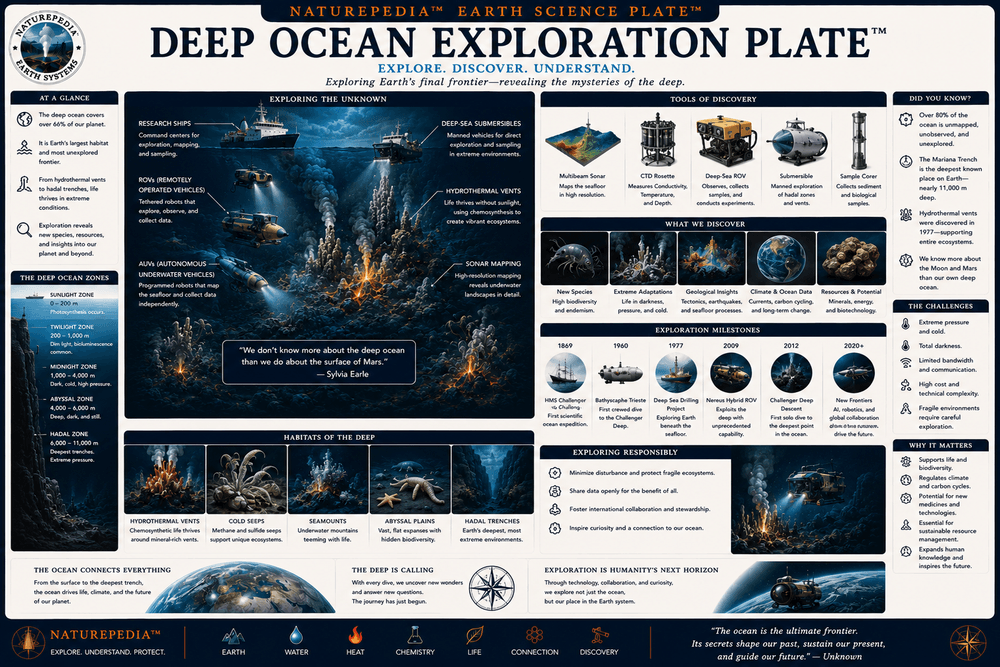
Deep Ocean Exploration Plate™

The discovery of hydrothermal ecosystems stands among the greatest scientific explorations in modern history. Through submersibles, remotely operated vehicles, sonar mapping, and deep-sea technology, scientists revealed an entirely hidden world thriving in darkness far beneath the ocean surface.

Deep Ocean Exploration Plate showing submersibles, remotely operated vehicles, hydrothermal vent discoveries, seafloor mapping, and deep-sea scientific exploration
Deep Ocean Exploration Plate™ — a Naturepedia™ exploration of the technologies and discoveries that revealed Earth's hidden hydrothermal ecosystems.

Hydrothermal vents remained completely unknown to science until 1977. During an expedition to the Galápagos Rift, researchers using the deep-submergence vehicle Alvin discovered towering vent chimneys surrounded by thriving biological communities. The finding transformed biology, geology, oceanography, and astrobiology almost overnight.

Since that discovery, deep-ocean exploration has expanded dramatically through advances in submersibles, remotely operated vehicles (ROVs), autonomous underwater vehicles (AUVs), high-resolution sonar mapping, and robotic sampling systems. These technologies allow scientists to investigate environments that would otherwise remain inaccessible beneath miles of ocean water.

Modern exploration continues to uncover new vent systems, previously unknown species, and unexpected geological processes. Much of the deep ocean remains unexplored, meaning countless discoveries may still await beneath Earth's oceans.

Submersibles

Crewed vehicles such as Alvin allowed scientists to directly observe hydrothermal ecosystems for the first time.

ROVs & Robotics

Remotely operated vehicles provide imaging, sampling, and scientific access to extreme deep-sea environments.

Ongoing Discovery

Large portions of Earth's deep ocean remain unexplored, making hydrothermal ecosystems a frontier of modern science.

Naturepedia Insight: Humanity has mapped the surfaces of the Moon and Mars in greater detail than much of the deep ocean. Hydrothermal ecosystems remind us that some of Earth's greatest discoveries may still lie hidden beneath our own seas.

Visible Plate ID

ID: hydrothermal-ecosystems#deep-ocean-exploration-plate

URL: https://www.robbiegeorgephotography.com/hydrothermal-ecosystems

Type: Naturepedia Exploration Plate™

Naturepedia Astrobiology Plate

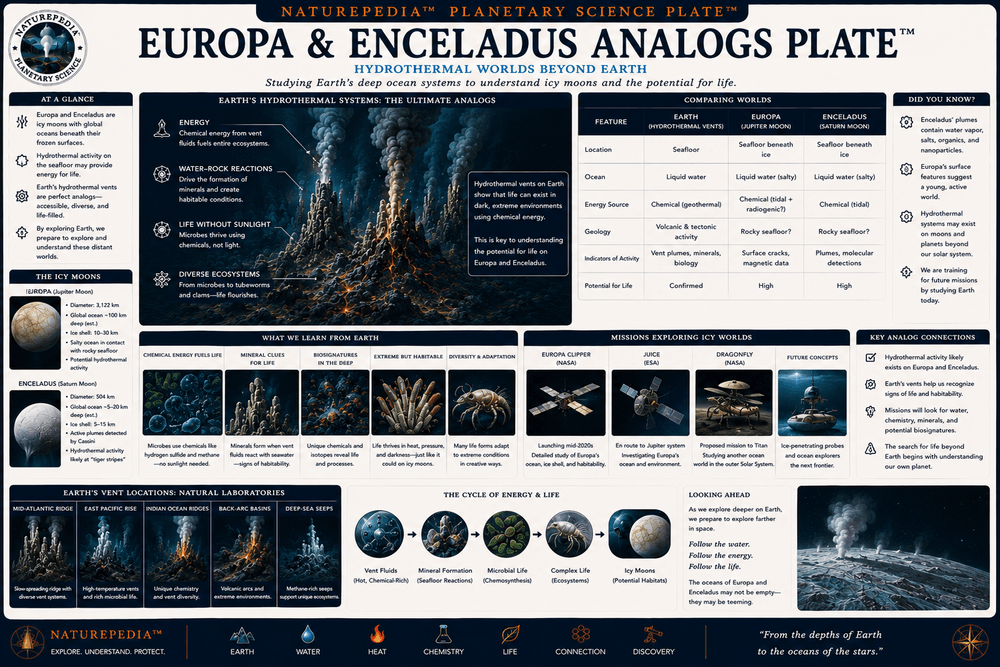
Europa & Enceladus Analogs Plate™

Among all known worlds beyond Earth, Europa and Enceladus are considered two of the most promising places to search for extraterrestrial life. Scientists view Earth's hydrothermal ecosystems as important analogs for the hidden oceans believed to exist beneath the icy crusts of these distant moons.

Europa and Enceladus Analogs Plate showing subsurface oceans, hydrothermal vent analogs, icy moons, ocean worlds, and potential extraterrestrial habitats
Europa & Enceladus Analogs Plate™ — a Naturepedia™ exploration of ocean worlds, subsurface seas, hydrothermal analogs, and the search for life beyond Earth.

Europa, a moon of Jupiter, and Enceladus, a moon of Saturn, both appear to contain vast liquid-water oceans hidden beneath thick layers of ice. Data collected by spacecraft indicate that these oceans may be in contact with rocky interiors, creating conditions where hydrothermal activity could occur on the seafloor of these alien worlds.

On Earth, hydrothermal ecosystems demonstrate that life can thrive without sunlight. Chemosynthetic microbes utilize chemical energy from geological processes, supporting entire ecosystems in darkness. If similar hydrothermal systems exist beneath the ice-covered oceans of Europa or Enceladus, they could potentially provide the energy necessary to support microbial life.

Scientists are particularly interested in Enceladus because plumes of water vapor, ice particles, salts, and organic molecules erupt through fractures in its icy crust. These plumes provide direct evidence of an active ocean beneath the surface and may offer clues about the chemical conditions within that hidden environment.

Subsurface Oceans

Both Europa and Enceladus appear to contain enormous liquid-water oceans hidden beneath ice-covered surfaces.

Hydrothermal Activity

Rock-water interactions deep beneath these oceans may create hydrothermal systems similar to those found on Earth.

Potential Habitability

Chemical energy, liquid water, and geological activity make these moons among the most promising places to search for life.

Naturepedia Insight: Every hydrothermal vent discovered on Earth strengthens the possibility that similar ecosystems could exist elsewhere. If life emerged around hydrothermal systems on our planet, similar environments beneath the oceans of Europa or Enceladus may also have the ingredients needed to support life.

Visible Plate ID

ID: hydrothermal-ecosystems#europa-enceladus-analogs-plate

URL: https://www.robbiegeorgephotography.com/hydrothermal-ecosystems

Type: Naturepedia Astrobiology Plate™

About the Author

Robbie George

Robbie George is a nature photographer, ecological educator, and creator of the Naturepedia™ knowledge system. His work combines wildlife photography, ecosystem interpretation, geology, biodiversity, natural history, and Earth Systems science to help people better understand the interconnected processes that shape our planet.

Through Naturepedia™, Robbie is building a structured ecological knowledge framework that connects species, habitats, ecosystems, geology, hydrology, biodiversity, evolution, and planetary systems into an accessible educational resource. The project combines scientific interpretation, field experience, visual learning, and environmental storytelling to reveal relationships that often remain hidden within nature.

Hydrothermal Ecosystems™ represents one of Naturepedia’s most important Earth Systems layers because it bridges geology, chemistry, microbiology, biodiversity, and astrobiology. These deep-sea environments reveal how Earth’s internal heat can support entire ecosystems, provide clues to the origins of life, and help scientists explore the possibility of life beyond our planet.

Robbie’s photography has been featured by major publications and institutions, including the Smithsonian National Museum of Natural History. His work focuses on helping people see ecological relationships, geological processes, wildlife behavior, biodiversity patterns, and environmental systems through both photography and education.

Through the ongoing development of Naturepedia™, Robbie continues building a growing knowledge mesh that connects Yellowstone Thermal Features™, Geothermal Ecosystems™, Microbial Life Systems™, Hydrothermal Ecosystems™, and future Earth Systems layers into a unified educational platform exploring life from the deepest oceans to the broader cosmos.


Frequently Asked Questions

Hydrothermal Ecosystems™ FAQ

What are hydrothermal ecosystems?

Hydrothermal ecosystems are deep-ocean environments powered by Earth's internal heat and chemical energy. They form around hydrothermal vents where mineral-rich fluids emerge from the seafloor, supporting unique microbial communities and specialized animals.

What is a hydrothermal vent?

A hydrothermal vent is an opening in the seafloor where heated, mineral-rich water emerges from beneath Earth's crust. These vents create habitats that support chemosynthetic microbes and complex deep-sea ecosystems.

What are black smokers?

Black smokers are hydrothermal vents that release extremely hot, mineral-rich fluids. The dark appearance comes from fine particles of metal sulfides suspended within the vent plume.

What are white smokers?

White smokers are cooler hydrothermal vents that release lighter-colored mineral plumes containing silica, calcium, barium, and other dissolved compounds.

How do hydrothermal ecosystems survive without sunlight?

Hydrothermal ecosystems rely on chemosynthesis rather than photosynthesis. Specialized microbes convert chemical compounds such as hydrogen sulfide and methane into biological energy, forming the foundation of the food web.

What is chemosynthesis?

Chemosynthesis is the process by which microorganisms generate energy from chemical reactions instead of sunlight. It is the primary energy source supporting hydrothermal vent ecosystems.

Why are giant tube worms important?

Giant tube worms are one of the most iconic hydrothermal vent animals. They survive through a symbiotic relationship with chemosynthetic bacteria and demonstrate how complex life can exist without sunlight.

What are extremophiles?

Extremophiles are organisms that thrive under extreme environmental conditions. Hydrothermal vent extremophiles tolerate intense pressure, high temperatures, toxic chemicals, and complete darkness.

Could hydrothermal vents explain the origin of life?

Many scientists believe hydrothermal vents may have provided ideal conditions for the emergence of life. Chemical gradients, mineral-rich environments, and abundant energy sources could have supported early biochemical reactions.

Why are hydrothermal ecosystems important to astrobiology?

Hydrothermal ecosystems demonstrate that life can exist without sunlight. This makes them important analogs for potential ecosystems beneath the icy oceans of Europa, Enceladus, and other worlds where hydrothermal activity may occur.

Trusted Art Seller

Trusted Art Seller

The presence of this badge signifies that this business has officially registered with the Art Storefronts Organization and has an established track record of selling art.

It also means that buyers can trust that they are buying from a legitimate business. Art sellers that conduct fraudulent activity or that receive numerous complaints from buyers will have this badge revoked. If you would like to file a complaint about this seller, please do so here.

Verified Returns & Exchanges

Verified Returns & Exchanges

The Art Storefronts Organization has verified that this business has provided a returns & exchanges policy for all art purchases.

Description of Policy from Merchant:

What is your Policy on Returns/Exchanges/Refunds? I take great pride in my work and prints, and I want you to be completely happy with your investment in my nature art. If for any reason you are unsatisfied with your print, you may return it within 14 days of delivery, and/or exchange it for another print. Prints must be returned in new condition, packaged carefully in the original packaging if possible. Your refund will be issued as soon as I receive the returned print. Please contact me if you would like to arrange a return or exchange. In the event that you receive a damaged or defective print, please let me know within 7 days of receipt, and I will arrange for a new print to be shipped to you at no additional cost.

Verified Secure Website with Safe Checkout

Verified Secure Website with Safe Checkout

This website provides a secure checkout with SSL encryption.

Verified Archival Materials Used

Verified Archival Materials Used

The Art Storefronts Organization has verified that this Art Seller has published information about the archival materials used to create their products in an effort to provide transparency to buyers.

Description from Merchant:

Fine Art Prints are made with high-quality archival inks on fine art papers using a high-resolution large format inkjet printer. Our premium archival inks produce images with smooth tones and rich colors. Prints are made with care on your choice of exquisite Fine Art Papers using a high-resolution large format inkjet printer. https://www.graphikprintworks.com

Cart

Your cart is currently empty.

Saved Successfully.

This is only visible to you because you are logged in and are authorized to manage this website. This message is not visible to other website visitors.

Import From Instagram

Click on any Image to continue

This Website Supports Augmented Reality to Live Preview Art

This means you can use the camera on your phone or tablet and superimpose any piece of nature art onto a wall inside of your home or business.

To use this feature, Just look for the "Live Preview AR" button when viewing any piece of nature art on this website!

🦊 Pounce now for 20% off

No thanks