What is wildlife migration?
Wildlife migration is a directed movement between distinct areas that is often repeated seasonally or during a predictable stage of an animal’s life cycle. It may connect breeding, feeding, stopover, wintering, spawning, nursery, or other seasonally important habitats.
How is migration different from dispersal?
Migration commonly involves recurring movement between functionally distinct areas. Dispersal is often a one-way departure from a natal or previous breeding area toward a new place where the animal may establish itself.
Do all members of a migratory species migrate?
No. Some populations are migratory while others are resident, and partial migration can occur within one population. Participation may vary with age, sex, reproductive status, experience, condition, resources, weather, and habitat.
How do migrating animals navigate?
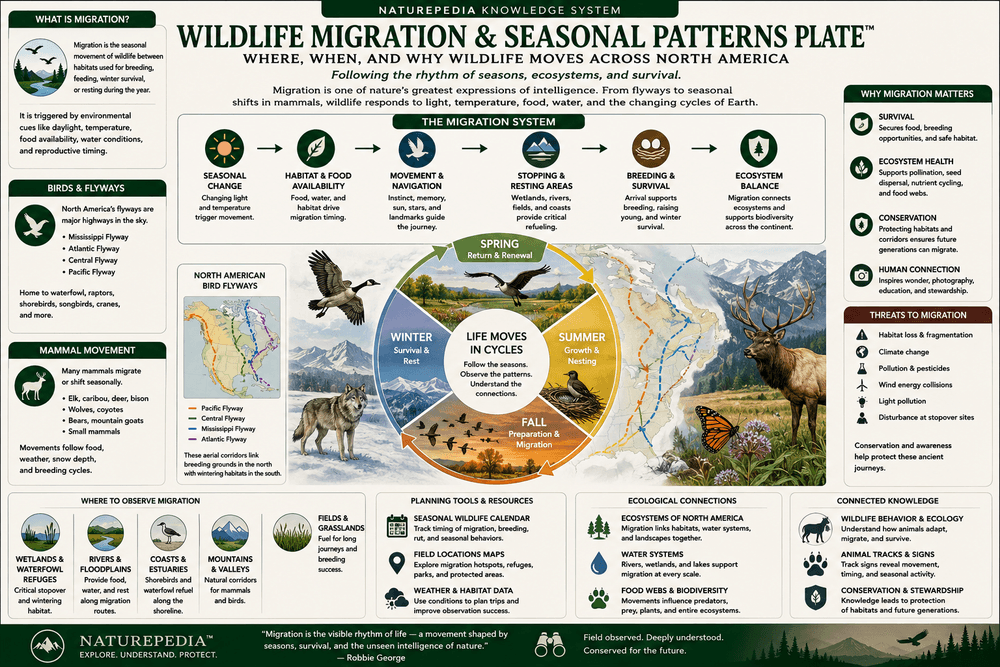
Depending on the species, migrants may use inherited directional tendencies, the sun, stars, magnetic information, polarized light, landmarks, odor, currents, wind, memory, and social information. Many species combine several sources of information.
What triggers migration?
Departure and movement may be associated with day length, weather, temperature, water, food, physiological state, reproductive condition, inherited programs, experience, or several interacting factors. The important conditions differ among species and populations.
Are North American flyways exact migration routes?
No. The Pacific, Central, Mississippi, and Atlantic flyways are broad geographic and administrative frameworks with substantial overlap. Species, populations, and individuals may use narrower routes, alternate pathways, or areas crossing flyway boundaries.
Why are stopover habitats important?
Stopover habitats allow migrants to rest, feed, recover, avoid adverse conditions, or wait before continuing. Their value depends on location, timing, food, water, shelter, disturbance, and accessibility.
Do mammals migrate like birds?
Some mammals make long migrations, while others move shorter distances between seasonal or elevational ranges. Mammal movement can differ greatly among species, populations, individuals, landscapes, and years.
How can climate affect migration?
Long-term climate-related changes can affect snow, water, temperature, vegetation, prey, breeding conditions, resource timing, and habitat suitability. Demonstrating a climate effect generally requires long-term records and analysis of alternative explanations.
Can one photograph prove that an animal is migrating?
Usually not. A photograph can document an animal, flock, herd, behavior, direction, place, and time, but establishing migration generally requires additional evidence about repeated movement, origin, destination, route, or seasonal range use.
How can migration be observed ethically?
Maintain appropriate distance, follow local rules, avoid blocking corridors or crossings, do not flush resting wildlife, minimize noise and light, protect sensitive locations, and place the animal’s uninterrupted behavior before the photograph.