ATTENTION: To use this site, it is necessary to enable JavaScript in your browser.
Here are the Instructions on how to enable JavaScript in your web browser.

🌿 Where Geology, Water, and Life Converge

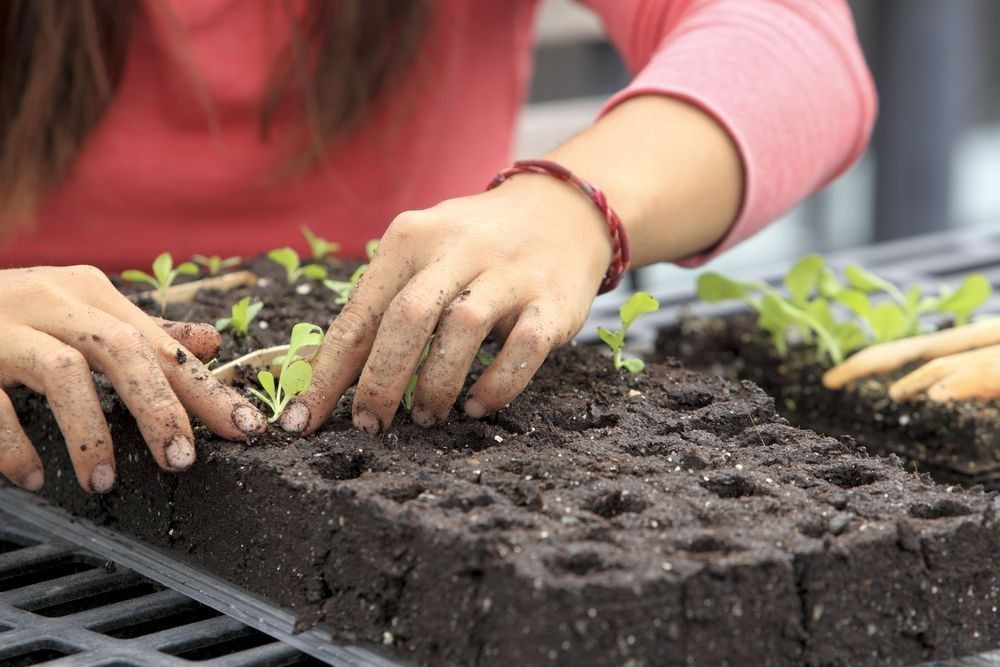
Hands planting seedlings in rich dark soil, showing living soil systems, plant roots, organic matter, water, microbes, and regenerative ecosystem health

Naturepedia Earth Systems Branch

Soil Systems™

Where Rock Becomes Life

Explore the living architecture beneath every terrestrial ecosystem, where minerals, water, roots, microbes, fungi, carbon, biodiversity, and nutrient cycling interact to create fertile ground and ecosystem resilience.

Explore Soil Systems

Naturepedia Living Earth Interface

Where Minerals, Water, Roots, Microbes, Fungi, and Carbon Work Together

Soil Systems™ is the Naturepedia™ hub for understanding soil as a living Earth system. Soil is not simply dirt. It is the dynamic boundary where the geosphere becomes the biosphere, where weathered rock, organic matter, water, air, microbes, fungi, roots, minerals, and carbon form the foundation of terrestrial life.

This page sits directly beneath Earth Systems™ because soil connects nearly every planetary process. Rock weathers into mineral particles. Water infiltrates and moves nutrients. Roots feed microbes. Fungi extend plant networks. Organic matter stores carbon. Biodiversity builds resilience. Together, these interactions support forests, grasslands, farms, wetlands, wildlife habitats, and food systems.

Within Naturepedia™, Soil Systems™ creates the bridge between Microbial Life Systems™, Water Systems™, Biodiversity & Ecosystem Balance™, Volcanic Landscapes™, and future Carbon Cycle™, Ecosystem Feedbacks™, and Quantum Agriculture™ layers.

The child page beneath this hub is Soil Microbiome™, which explores the living microbial community inside healthy soil. This parent page gives that child page its larger framework by showing how microbes fit into soil formation, horizons, mycorrhizal networks, nutrient cycling, water retention, soil carbon, biodiversity, and regenerative land stewardship.

Through photography, science, and systems thinking, Soil Systems™ reveals the ground beneath our feet as one of Earth’s most important living interfaces: a place where geology becomes fertility, microbes become ecosystem engineers, water becomes stored resilience, and carbon becomes part of the living memory of the land.

Explore Soil Systems™

Soil Systems Plate™
The master systems map for living soil.
What Are Soil Systems?
How rock, water, roots, microbes, fungi, carbon, and life interact.
Soil Formation Plate™
Parent rock, weathering, organic matter, climate, organisms, and time.
Soil Horizons Plate™
O, A, E, B, C, and bedrock layers of soil development.
Soil Microbiome Plate™
Bacteria, fungi, archaea, protozoa, roots, and microbial exchange.
Mycorrhizal Networks Plate™
Fungal networks linking roots, nutrients, water, and plant communication.
Living Soil Food Web Plate™
Bacteria, fungi, protozoa, nematodes, arthropods, earthworms, and roots.
Nutrient Cycling Plate™
Nitrogen, phosphorus, potassium, carbon, decomposition, and fertility.
Soil Carbon Plate™
Roots, microbes, organic matter, carbon storage, and climate connection.
Soil Biodiversity Plate™
The hidden diversity of organisms living beneath every ecosystem.
Soil Water Systems Plate™
Infiltration, water retention, soil moisture, and groundwater recharge.
Regenerative Soil Systems Plate™
Cover crops, compost, no-till, biodiversity, carbon, and resilient soils.
Related Naturepedia Systems™
Earth systems, microbes, water, biodiversity, carbon, habitats, and agriculture.
Soil Systems FAQ
Common questions about soil formation, living soil, carbon, and fertility.

Naturepedia Systems Plate

Soil Systems Plate™

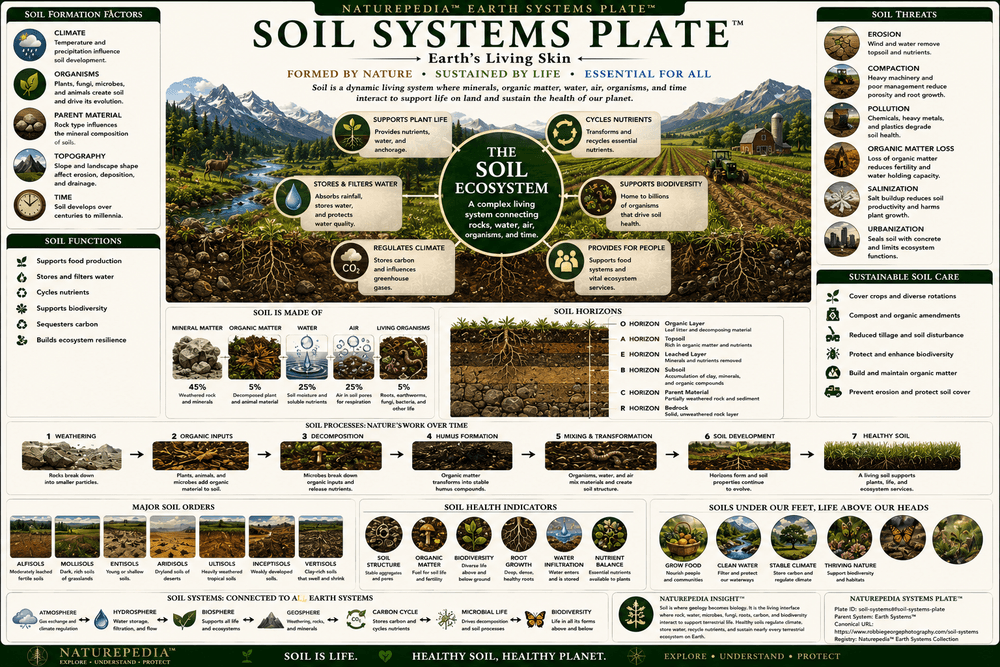
This master systems plate introduces Soil Systems™ as the Naturepedia™ branch where geology, water, microbes, fungi, roots, minerals, organic matter, carbon, biodiversity, nutrient cycling, and regenerative land stewardship converge into one living Earth system.

Soil Systems Plate showing soil horizons, roots, fungi, microbes, water, carbon, minerals, organic matter, nutrient cycling, biodiversity, and regenerative soil processes
Soil Systems Plate™ — a Naturepedia™ systems map showing how soil horizons, roots, fungi, microbes, water, carbon, minerals, organic matter, nutrient cycling, biodiversity, and regenerative practices interact within living soil.

Geology Becomes Biology

Soil begins with weathered rock and minerals, then becomes biologically active as organic matter, roots, microbes, fungi, water, and air transform raw material into living ground.

Living Exchange Network

Roots feed microbes, fungi extend plant reach, water carries nutrients, soil organisms recycle matter, and carbon becomes stored within organic matter and soil structure.

Foundation of Ecosystems

Healthy soils support forests, grasslands, farms, wetlands, pollinator habitats, wildlife systems, carbon storage, water retention, biodiversity, and ecosystem resilience.

Naturepedia Insight: Soil is where geology becomes biology. It is the living interface where rock, water, microbes, fungi, roots, carbon, minerals, nutrients, and biodiversity interact to support nearly all terrestrial life.

Visible Plate ID

ID: soil-systems#soil-systems-plate

URL: https://www.robbiegeorgephotography.com/soil-systems

Type: Naturepedia Systems Plate™

Living Earth Systems Science

What Are Soil Systems?

Soil systems are the interconnected physical, chemical, biological, geological, and hydrological processes that create and sustain living soil. They include weathered rock, minerals, organic matter, water, air, roots, microbes, fungi, soil organisms, carbon, nutrients, and the structure that allows ecosystems to grow.

Soil begins with geology. Rock is broken down through weathering, erosion, temperature change, water movement, biological activity, and time. As minerals accumulate and organic matter enters the system, soil becomes more than ground material. It becomes a living interface where geology, water, air, roots, microbes, fungi, and biodiversity interact.

Healthy soil is built through relationships. Plants send carbon belowground through roots and root exudates. Microbes decompose organic matter and release nutrients. Fungi extend root systems and connect plants to minerals and water. Earthworms and arthropods move matter through the soil. Water infiltrates, stores, and carries dissolved nutrients through pore spaces. These processes create structure, fertility, resilience, and life.

Soil systems connect directly to climate, biodiversity, food systems, and water cycles. Soils store carbon, filter water, reduce runoff, buffer drought, support plant communities, and provide habitat for extraordinary underground biodiversity. When soils degrade, ecosystems lose fertility, water-holding capacity, microbial diversity, and resilience. When soils are restored, entire landscapes can recover.

Within Naturepedia™, this page forms the parent hub above Soil Microbiome™. The child page explores the hidden microbial life within soil, while Soil Systems™ explains the larger Earth system that gives those microbes structure, water, minerals, roots, carbon, habitat, and ecological purpose.

Soil Systems™ also links outward to Earth Systems™, Microbial Life Systems™, Water Systems™, Biodiversity & Ecosystem Balance™, and future Carbon Cycle™, Ecosystem Feedbacks™, and Quantum Agriculture™ layers.

Soil Has Structure

Soil structure forms from minerals, organic matter, roots, fungal threads, microbial activity, pores, aggregates, and water movement.

Soil Is Alive

Bacteria, fungi, protozoa, nematodes, arthropods, earthworms, roots, and plant communities make soil one of Earth’s most active living systems.

Soil Connects Systems

Soil links geology, water, carbon, nutrients, biodiversity, climate, agriculture, habitat, and ecosystem feedbacks into one living Earth interface.

Naturepedia Insight: Soil systems are not passive ground beneath life. They are active living networks where minerals, water, roots, microbes, fungi, organic matter, carbon, and biodiversity continuously exchange energy and matter to support ecosystems.

Naturepedia Geology Plate

Soil Formation Plate™

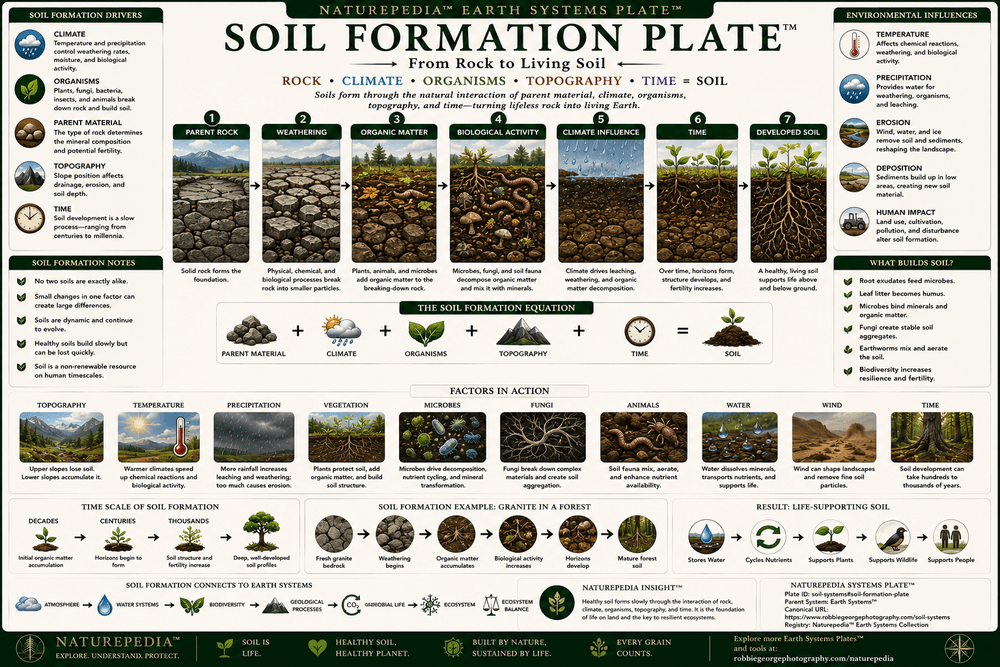
Soil formation is the long-term process by which rock, climate, water, topography, biological activity, and time interact to create living soil. Every handful of soil represents thousands of years of geological, biological, and ecological development.

Soil Formation Plate showing parent rock, weathering, organic matter, biological activity, climate, topography, and time creating living soil
Soil Formation Plate™ — a Naturepedia™ exploration of how parent rock, weathering, climate, organisms, topography, organic matter, and time create living soil systems.

Every soil begins as rock. Through physical weathering, chemical weathering, freeze-thaw cycles, water movement, temperature fluctuations, biological activity, and erosion, solid rock slowly breaks down into smaller mineral particles. This process provides the mineral foundation upon which future soil develops.

As plants, microbes, fungi, and animals colonize these materials, organic matter begins to accumulate. Roots penetrate fractures, microbes decompose organic material, fungi expand nutrient exchange networks, and biological activity gradually transforms mineral material into increasingly fertile soil. Over time, distinct soil horizons emerge and ecological complexity increases.

Climate plays a major role in soil formation. Temperature, precipitation, seasonal cycles, and biological productivity influence weathering rates, decomposition rates, nutrient availability, and water movement. Topography also shapes soil development by influencing drainage, erosion, sunlight exposure, and sediment accumulation.

Within Naturepedia™, soil formation serves as the geological foundation for soil horizons, microbial communities, mycorrhizal networks, nutrient cycling, biodiversity, water retention, and carbon storage. Without soil formation, none of the living soil systems explored throughout this page could exist.

Parent Material

The type of rock or sediment beneath a landscape influences mineral composition, texture, fertility, and the future characteristics of soil.

Climate & Organisms

Temperature, rainfall, microbes, fungi, roots, and living organisms help break down rock and build organic-rich soil.

Time

Healthy soil develops slowly. Complex soil systems may require hundreds or thousands of years to form naturally.

Naturepedia Insight: Soil is one of Earth's slowest and most valuable natural resources. A thin layer of fertile topsoil may represent centuries of weathering, biological activity, and ecological development.

Visible Plate ID

ID: soil-systems#soil-formation-plate

URL: https://www.robbiegeorgephotography.com/soil-systems

Type: Naturepedia Geology Plate™

Naturepedia Identification Plate

Soil Horizons Plate™

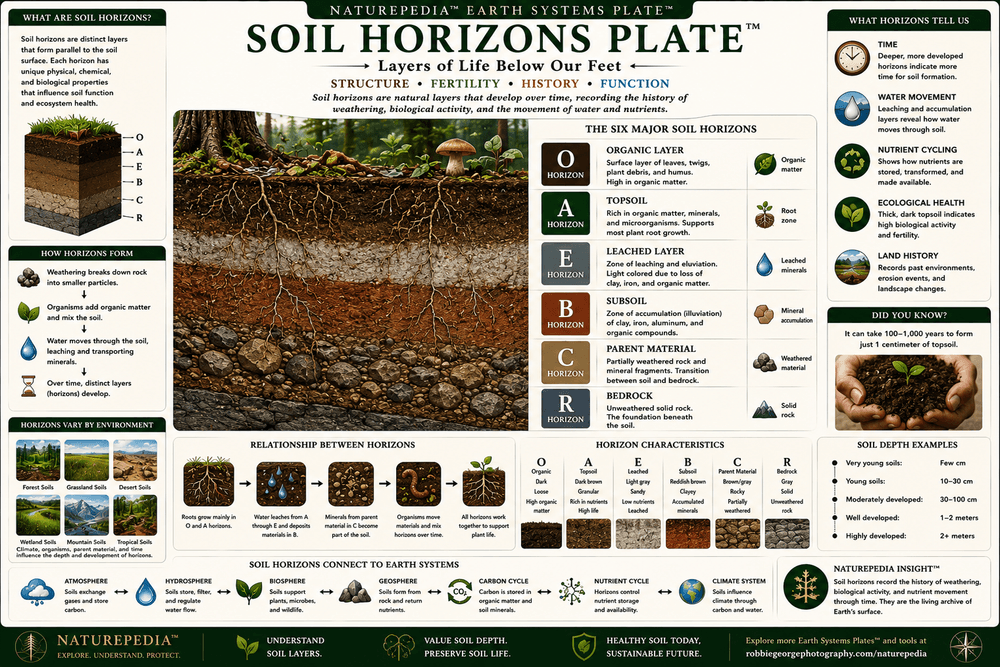
Soil horizons are the distinct layers that develop as soil matures through weathering, biological activity, water movement, and time. These layers record the history of soil formation and reveal how nutrients, minerals, water, roots, and organic matter move through the landscape.

Soil Horizons Plate showing O horizon, A horizon, E horizon, B horizon, C horizon, and bedrock layers within a soil profile
Soil Horizons Plate™ — a Naturepedia™ exploration of the layered structure of soil, from organic surface material to weathered parent material and bedrock.

A mature soil profile is organized into distinct horizons, each with its own composition, biological activity, and ecological function. The upper layers are typically rich in organic matter and biological activity, while deeper layers contain accumulated minerals, weathered parent material, and eventually bedrock.

The O Horizon contains decomposing leaves, roots, wood, fungi, and organic material. Beneath it lies the A Horizon, commonly called topsoil, where roots, microbes, nutrients, and biological activity are concentrated. In some soils, an E Horizon forms as water leaches minerals and organic matter downward.

Below these layers lies the B Horizon, where minerals, clay, and dissolved materials accumulate. The C Horizon contains partially weathered parent material that has not yet become fully developed soil. Beneath everything rests the bedrock, the geological foundation from which the soil originally formed.

Understanding soil horizons helps explain water movement, nutrient storage, root growth, carbon accumulation, microbial habitat, and ecosystem productivity. These layers provide the physical framework that supports all of the biological processes explored throughout Soil Systems™.

Surface Horizons

The O and A horizons contain most of the soil's biological activity, organic matter, roots, microbes, fungi, and nutrient cycling processes.

Subsoil Horizons

The E and B horizons record the movement of water, minerals, clay, and dissolved materials through the soil profile.

Parent Material

The C Horizon and bedrock represent the geological foundation from which all soil ultimately develops.

Naturepedia Insight: Soil horizons act like a natural archive. Each layer records the interaction of geology, climate, water, roots, microbes, fungi, and time, preserving the story of how living soil developed.

Visible Plate ID

ID: soil-systems#soil-horizons-plate

URL: https://www.robbiegeorgephotography.com/soil-systems

Type: Naturepedia Identification Plate™

Naturepedia Microbial Plate

Soil Microbiome Plate™

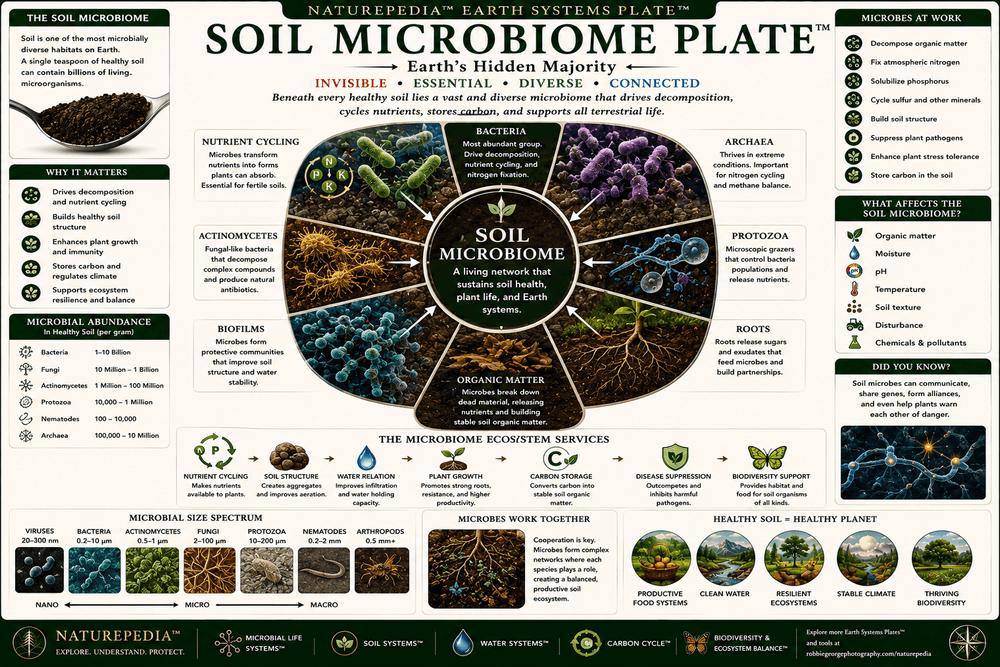
The soil microbiome is the hidden biological engine of soil systems. Billions of bacteria, fungi, archaea, protozoa, and microscopic organisms interact with roots, water, organic matter, and minerals to recycle nutrients, build soil structure, store carbon, and support ecosystem productivity.

Soil Microbiome Plate showing bacteria, fungi, archaea, protozoa, root systems, organic matter, nutrient cycling, and microbial interactions within living soil
Soil Microbiome Plate™ — a Naturepedia™ exploration of the microbial communities that drive decomposition, nutrient cycling, soil fertility, carbon storage, and ecosystem resilience.

Although invisible to the naked eye, the soil microbiome is one of the most important living systems on Earth. A single teaspoon of healthy soil may contain billions of microorganisms representing thousands of species. Together, these organisms perform many of the ecological functions that make terrestrial life possible.

Microbes decompose organic matter, release nutrients, build soil aggregates, regulate nutrient availability, influence plant growth, and participate in the cycling of carbon, nitrogen, phosphorus, sulfur, and other essential elements. They are central players in soil fertility and ecosystem productivity.

The soil microbiome exists in close partnership with roots. Plants release carbon-rich compounds known as root exudates into the rhizosphere, creating a dynamic exchange zone where microbes receive energy and plants gain access to nutrients, biological protection, and improved soil conditions.

This section serves as the parent connection to the dedicated Soil Microbiome™ page, where the underground world of microbes, roots, fungi, and living soil is explored in greater depth.

Nutrient Recycling

Microorganisms break down organic matter and convert nutrients into forms that plants and ecosystems can use.

Root Partnerships

The rhizosphere is a biological exchange zone where plants and microbes continuously trade energy, nutrients, and chemical signals.

Soil Builders

Microbial activity improves soil structure, water infiltration, carbon storage, aggregation, and long-term ecosystem resilience.

Naturepedia Insight: The soil microbiome is the hidden workforce beneath every ecosystem. These microscopic organisms recycle nutrients, build fertility, store carbon, support roots, regulate water movement, and help sustain life above ground.

Visible Plate ID

ID: soil-systems#soil-microbiome-plate

URL: https://www.robbiegeorgephotography.com/soil-systems

Type: Naturepedia Microbial Plate™

Naturepedia Ecosystem Processes Plate

Mycorrhizal Networks Plate™

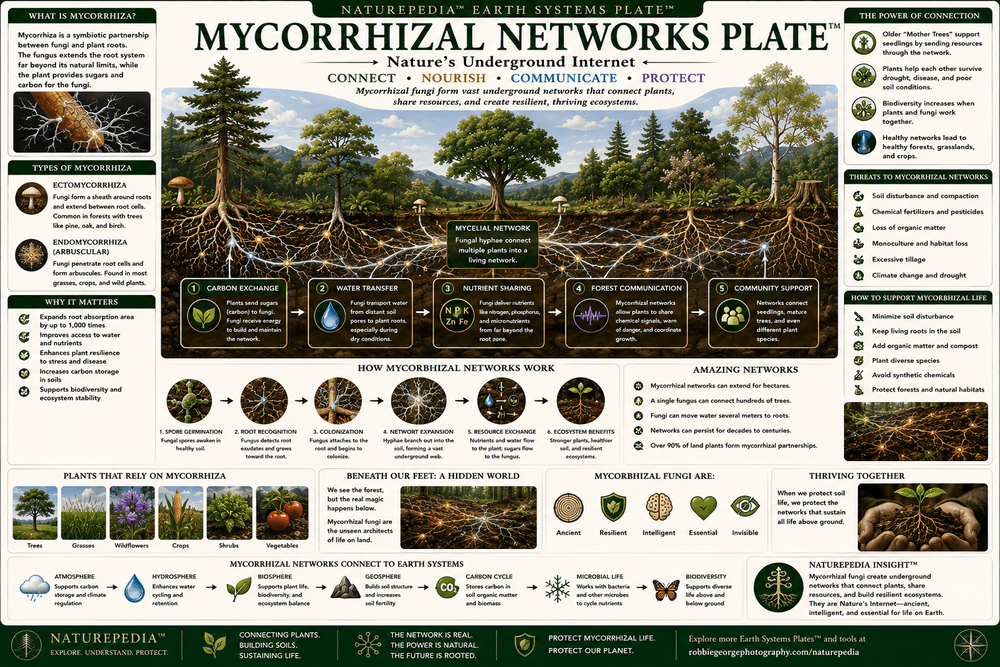
Mycorrhizal networks are underground fungal partnerships that connect roots, water, nutrients, carbon, and entire plant communities. These living networks help forests, grasslands, and ecosystems share resources, improve resilience, and coordinate biological activity across the landscape.

Mycorrhizal Networks Plate showing fungal hyphae connecting roots, trees, nutrients, carbon exchange, water movement, and ecosystem communication
Mycorrhizal Networks Plate™ — a Naturepedia™ exploration of fungal-root partnerships that move nutrients, water, carbon, and information through living ecosystems.

Most plants on Earth live in partnership with mycorrhizal fungi. These fungi form vast networks of microscopic filaments called hyphae that connect directly to plant roots. In exchange for carbon produced through photosynthesis, fungi help plants access water, phosphorus, nitrogen, and trace minerals that would otherwise remain difficult to reach.

Because fungal networks often connect multiple plants simultaneously, resources can move through entire plant communities. Nutrients, water, and carbon may be redistributed between plants, helping stabilize ecosystems and improve resilience during environmental stress.

These underground fungal systems also improve soil structure. Hyphae bind soil particles together, increase aggregation, improve water infiltration, reduce erosion, and help create the physical architecture of healthy soil. In many ecosystems, fungal networks are essential components of long-term soil development.

Within Naturepedia™, mycorrhizal networks serve as the bridge between Soil Systems™, the Soil Microbiome™, future Mycelial Networks — Nature's Internet™, Biodiversity & Ecosystem Balance™, and Ecosystem Feedbacks™. They represent one of the most important biological connections linking life below ground with life above ground.

Root Extension

Fungal hyphae dramatically increase the area available for nutrient and water absorption, extending the reach of plant roots.

Resource Exchange

Plants provide carbon to fungi, while fungi deliver minerals, nutrients, and water back to plants through mutualistic partnerships.

Living Networks

Mycorrhizal systems connect multiple plants into broader ecological networks that strengthen biodiversity and ecosystem resilience.

Naturepedia Insight: Mycorrhizal fungi transform soil from a collection of individual roots into a connected ecosystem. These hidden fungal networks help move nutrients, water, carbon, and biological information through living landscapes.

Visible Plate ID

ID: soil-systems#mycorrhizal-networks-plate

URL: https://www.robbiegeorgephotography.com/soil-systems

Type: Naturepedia Ecosystem Processes Plate™

Naturepedia Ecosystem Processes Plate

Living Soil Food Web Plate™

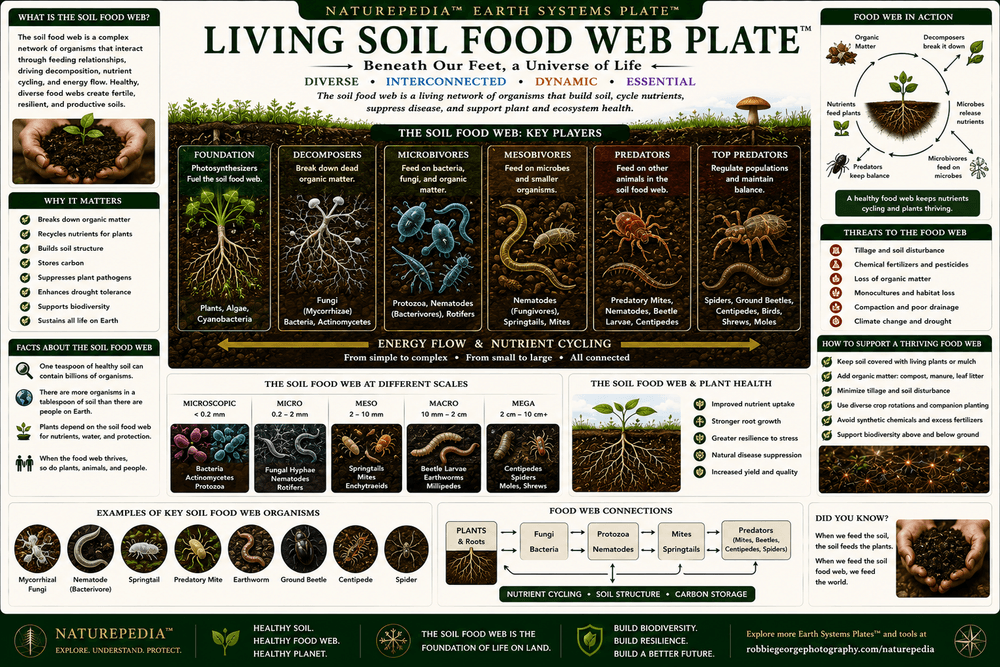
The soil food web describes the living network of organisms that recycle nutrients, decompose organic matter, build soil structure, and support plant growth. From microscopic bacteria to earthworms and arthropods, each organism contributes to the health and productivity of living soil.

Living Soil Food Web Plate showing plants, roots, bacteria, fungi, protozoa, nematodes, arthropods, earthworms, nutrient cycling, and ecosystem interactions
Living Soil Food Web Plate™ — a Naturepedia™ exploration of the interconnected organisms that drive decomposition, nutrient cycling, fertility, and ecosystem resilience beneath the soil surface.

Healthy soil is not simply a collection of organisms living side by side. It is a functioning food web where energy and nutrients move continuously through a complex network of interactions. Plants capture sunlight through photosynthesis and send carbon into the soil through roots, providing energy for the organisms that live below ground.

Bacteria and fungi begin the process by decomposing organic matter and breaking down plant residues. Protozoa feed on bacteria, nematodes consume bacteria and fungi, arthropods fragment organic material, and earthworms physically reshape soil while redistributing nutrients. Each level of the food web contributes to nutrient release and ecosystem productivity.

As organisms consume one another, nutrients become available for plant uptake. Nitrogen, phosphorus, potassium, micronutrients, and carbon compounds move through the food web before eventually returning to roots and plants. This constant recycling allows ecosystems to function efficiently and maintain long-term fertility.

The living soil food web connects directly to the Soil Microbiome™, Mycorrhizal Networks™, Nutrient Cycling™, Soil Biodiversity™, and Regenerative Soil Systems™ layers. Together these systems reveal that fertility emerges not from isolated organisms but from relationships between countless forms of life.

Decomposition

Bacteria and fungi break down dead plant and animal material, releasing nutrients back into the ecosystem.

Nutrient Release

Predation and biological interactions release nutrients in plant-available forms, fueling growth and productivity.

Soil Engineers

Earthworms, arthropods, roots, and fungi physically modify soil structure, improving aeration, aggregation, and water movement.

Naturepedia Insight: Fertile soil is created by relationships. The soil food web transforms sunlight, roots, microbes, fungi, and organic matter into a self-renewing system that supports ecosystems from the ground up.

Visible Plate ID

ID: soil-systems#soil-food-web-plate

URL: https://www.robbiegeorgephotography.com/soil-systems

Type: Naturepedia Ecosystem Processes Plate™

Naturepedia Biogeochemical Cycles Plate

Nutrient Cycling Plate™

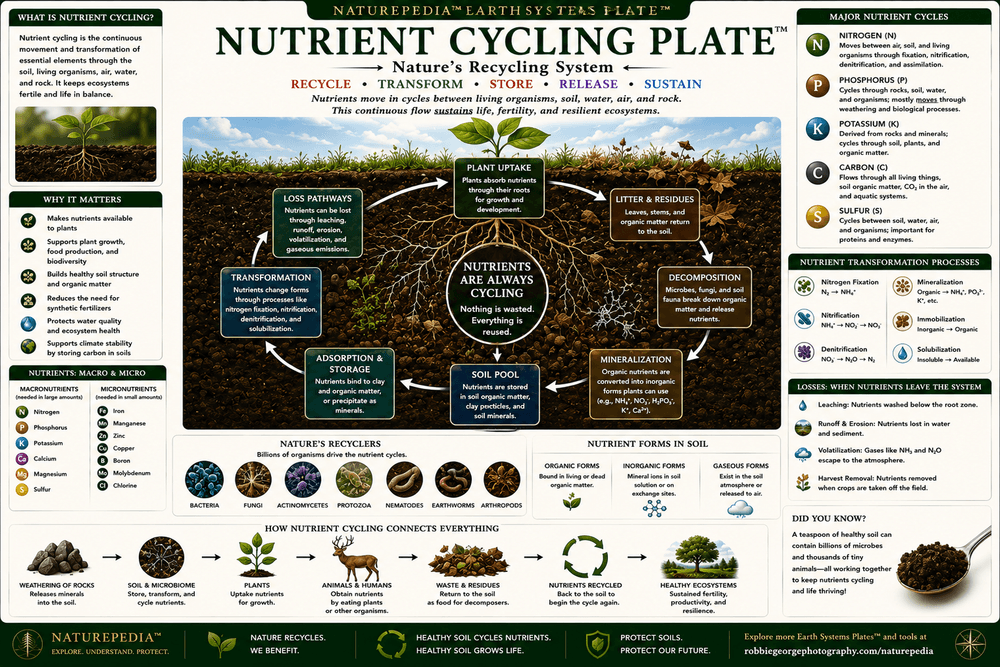
Nutrient cycling is the process by which essential elements move through soil, plants, microbes, fungi, water, and ecosystems. These cycles allow nutrients to be reused continuously, supporting fertility, biodiversity, productivity, and long-term ecosystem health.

Nutrient Cycling Plate showing carbon, nitrogen, phosphorus, potassium, decomposition, roots, microbes, fungi, and nutrient movement through soil systems
Nutrient Cycling Plate™ — a Naturepedia™ exploration of how carbon, nitrogen, phosphorus, potassium, microbes, fungi, decomposition, and roots interact to sustain living ecosystems.

Ecosystems depend on a limited supply of essential nutrients. Rather than being used once and lost, these elements move repeatedly through soil systems in continuous cycles of uptake, transformation, decomposition, storage, and release. Nutrient cycling is one of the primary processes that makes long-term ecosystem productivity possible.

Plants absorb nutrients such as nitrogen, phosphorus, potassium, sulfur, calcium, magnesium, and micronutrients from the soil. These nutrients become part of leaves, stems, roots, seeds, flowers, and food webs. When plants die or shed organic material, microbes and fungi decompose the material and release nutrients back into the soil.

Bacteria, fungi, protozoa, nematodes, arthropods, and earthworms all participate in nutrient cycling. Through decomposition and biological interactions, they transform nutrients into forms that plants can reuse. This constant recycling supports fertility while reducing waste within natural ecosystems.

Nutrient cycling links directly to soil formation, the soil microbiome, mycorrhizal networks, biodiversity, soil carbon, and regenerative agriculture. Healthy nutrient cycles are among the clearest indicators of a healthy ecosystem.

Nitrogen Cycle

Nitrogen moves between the atmosphere, microbes, plants, animals, and soil, supporting protein production and plant growth.

Phosphorus & Potassium

These essential nutrients support root development, energy transfer, flowering, reproduction, and plant resilience.

Biological Recycling

Microbes, fungi, and soil organisms continuously break down organic matter and return nutrients to living systems.

Naturepedia Insight: Nutrient cycling is nature's recycling system. Soil organisms transform death into fertility, ensuring that essential elements continue moving through ecosystems rather than being lost from the living world.

Visible Plate ID

ID: soil-systems#nutrient-cycling-plate

URL: https://www.robbiegeorgephotography.com/soil-systems

Type: Naturepedia Biogeochemical Cycles Plate™

Naturepedia Carbon Cycle Plate

Soil Carbon Plate™

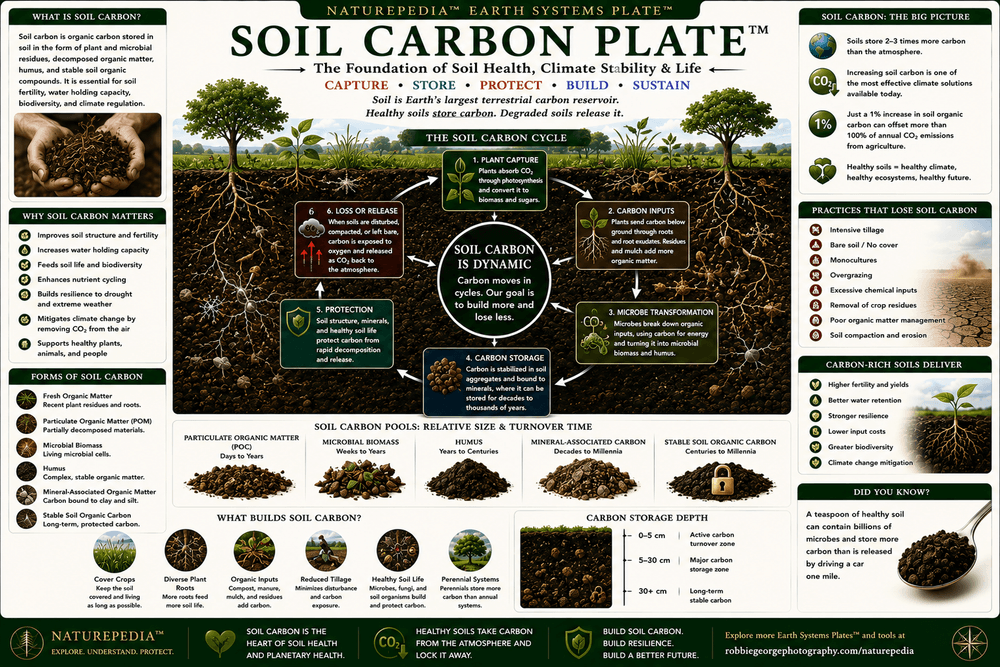
Soil carbon is one of the most important components of living soil. Carbon moves from the atmosphere into plants through photosynthesis, then into roots, microbes, fungi, and organic matter, where it becomes stored within soil systems and supports ecosystem function.

Soil Carbon Plate showing atmospheric carbon, photosynthesis, roots, microbes, organic matter, soil carbon storage, and ecosystem carbon cycling
Soil Carbon Plate™ — a Naturepedia™ exploration of how carbon moves from the atmosphere into plants, roots, microbes, organic matter, and long-term soil storage.

Carbon is the foundation of life. Plants capture carbon dioxide from the atmosphere through photosynthesis and convert it into sugars, roots, leaves, stems, seeds, and organic compounds. A significant portion of this carbon is transferred belowground through root systems and root exudates.

Once in the soil, carbon enters a complex biological network. Microbes and fungi process organic material, transforming carbon into microbial biomass, stable organic matter, humus, and long-term soil carbon pools. Some carbon is rapidly recycled, while some remains stored for decades, centuries, or even longer.

Healthy soils are among Earth's largest terrestrial carbon reservoirs. In many ecosystems, more carbon is stored below ground than above ground. Grasslands, forests, wetlands, and regenerative agricultural systems all rely on healthy soils to maintain carbon storage and ecosystem stability.

Within Naturepedia™, soil carbon forms the bridge between Soil Systems™ and the future Carbon Cycle™ page. It also connects directly to nutrient cycling, microbial life, biodiversity, ecosystem feedbacks, climate systems, and regenerative land stewardship.

Atmosphere to Soil

Photosynthesis captures atmospheric carbon and transfers it into roots, organic matter, microbial communities, and living soil.

Carbon Storage

Stable soil carbon improves fertility, water retention, aggregation, biological activity, and long-term ecosystem resilience.

Climate Connection

Healthy soils help regulate carbon movement between ecosystems and the atmosphere, making soil a critical component of Earth’s carbon balance.

Naturepedia Insight: Soil is far more than a place where carbon passes through. Healthy soils actively store carbon, build fertility, support biodiversity, improve water retention, and strengthen ecosystem resilience across entire landscapes.

Visible Plate ID

ID: soil-systems#soil-carbon-plate

URL: https://www.robbiegeorgephotography.com/soil-systems

Type: Naturepedia Carbon Cycle Plate™

Naturepedia Biodiversity Plate

Soil Biodiversity Plate™

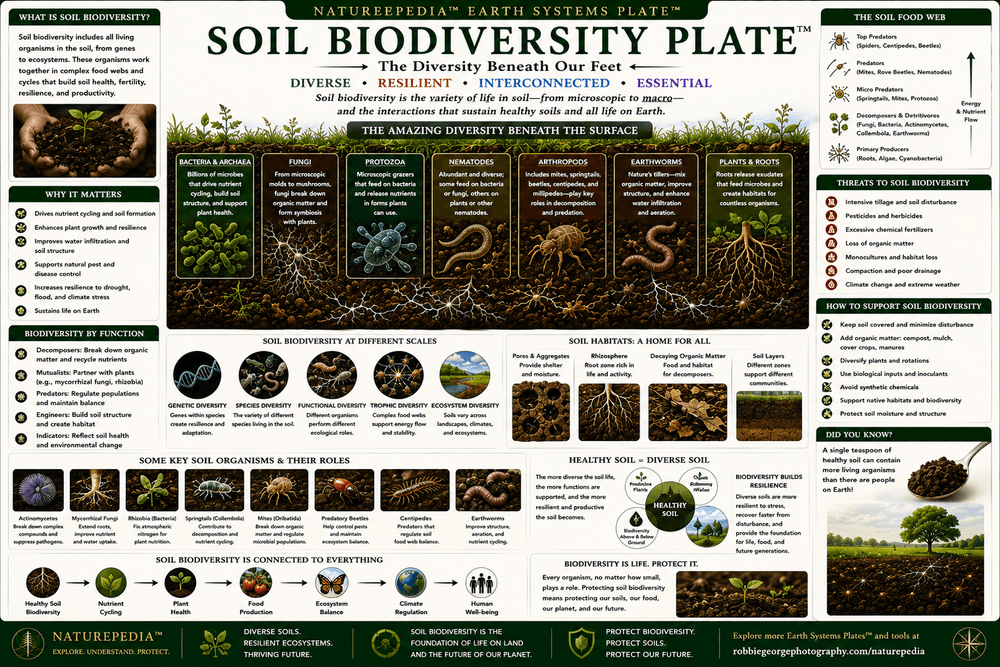
Soil biodiversity includes the immense variety of organisms living beneath the surface. Bacteria, fungi, protozoa, nematodes, arthropods, earthworms, roots, and countless microscopic species work together to maintain ecosystem function, fertility, resilience, and life itself.

Soil Biodiversity Plate showing bacteria, fungi, protozoa, nematodes, arthropods, earthworms, roots, biodiversity, and living soil ecosystems
Soil Biodiversity Plate™ — a Naturepedia™ exploration of the extraordinary diversity of organisms that inhabit and sustain living soil systems.

Much of Earth's biodiversity exists below ground. A single handful of healthy soil may contain thousands of species and billions of organisms interacting within a remarkably complex ecosystem. Although hidden from view, these organisms play critical roles in nutrient cycling, decomposition, soil structure, carbon storage, and ecosystem stability.

Bacteria and fungi form the foundation of soil biodiversity. They are joined by protozoa, nematodes, microarthropods, springtails, mites, earthworms, insects, roots, and countless other organisms that create intricate food webs and biological relationships. Together they transform organic matter into fertility and help maintain the functioning of terrestrial ecosystems.

Diverse soil communities are often more resilient to environmental stress. Healthy biodiversity helps ecosystems recover from drought, disease, disturbance, erosion, nutrient loss, and changing environmental conditions. As biodiversity increases, ecosystem stability and adaptability often increase as well.

Within Naturepedia™, soil biodiversity connects directly to the Soil Microbiome™, Living Soil Food Web™, Mycorrhizal Networks™, Biodiversity & Ecosystem Balance™, Wildlife Habitats & Ecosystem Zones™, and future Ecosystem Feedbacks™ layers.

Microbial Diversity

Bacteria, fungi, archaea, and protozoa form the biological foundation of soil ecosystems and nutrient cycling.

Soil Organisms

Nematodes, arthropods, earthworms, insects, and other organisms help regulate biological interactions and ecosystem processes.

Resilient Ecosystems

Greater biodiversity strengthens soil stability, ecological resilience, nutrient cycling efficiency, and long-term ecosystem health.

Naturepedia Insight: Soil biodiversity reminds us that some of Earth's richest ecosystems are hidden beneath our feet. Billions of organisms collaborate within living soil, supporting the visible world above ground through countless biological interactions.

Visible Plate ID

ID: soil-systems#soil-biodiversity-plate

URL: https://www.robbiegeorgephotography.com/soil-systems

Type: Naturepedia Biodiversity Plate™

Naturepedia Water Systems Plate

Soil Water Systems Plate™

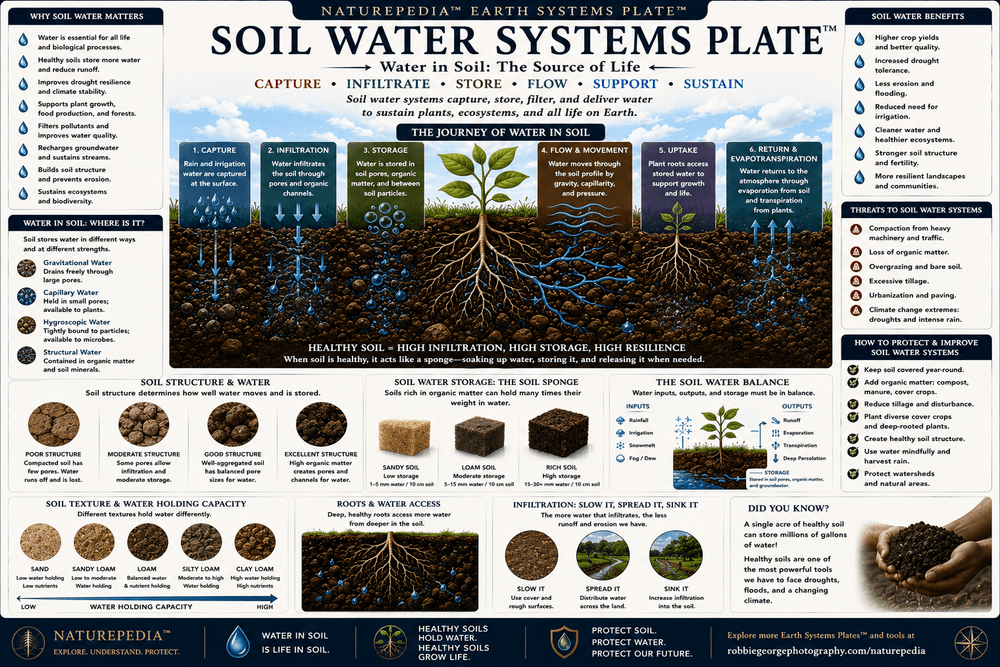
Soil water systems regulate how water enters, moves through, is stored within, and exits the soil. Healthy soils function as natural reservoirs, helping ecosystems withstand drought, reduce flooding, support plant growth, and recharge groundwater systems.

Soil Water Systems Plate showing rainfall, infiltration, soil moisture, water retention, root uptake, groundwater recharge, and water movement through living soil
Soil Water Systems Plate™ — a Naturepedia™ exploration of infiltration, soil moisture, water retention, root uptake, groundwater recharge, and ecosystem water movement.

Water is one of the most important components of healthy soil. As rainfall reaches the ground, soil determines whether water infiltrates into the landscape, becomes available to plants, recharges groundwater, or runs off the surface. The structure and biological health of soil directly influence how efficiently water moves through ecosystems.

Healthy soils contain interconnected pore spaces created by roots, fungi, microbes, earthworms, and organic matter. These pathways allow water to infiltrate rather than immediately running off the surface. Once inside the soil, water becomes stored as soil moisture, available to plants, microbes, fungi, and other organisms.

Organic matter plays a major role in water retention. Carbon-rich soils act like natural sponges, holding moisture during dry periods while releasing it gradually over time. This ability improves drought resilience, supports biodiversity, reduces erosion, and stabilizes ecosystem productivity.

Soil water systems connect directly to Water Systems™, the Soil Microbiome™, Mycorrhizal Networks™, Soil Carbon™, Regenerative Soil Systems™, and future Water Cycle™ layers. Together they demonstrate how living soils function as one of Earth's most important freshwater storage systems.

Infiltration

Healthy soils allow rainfall to move underground where it becomes available to roots, microbes, and groundwater systems.

Water Storage

Organic matter and soil structure increase the ability of soil to retain water during dry periods and seasonal drought.

Groundwater Recharge

Water moving through soil replenishes aquifers and supports streams, wetlands, springs, and freshwater ecosystems.

Naturepedia Insight: Healthy soils function like living reservoirs. By storing, filtering, and slowly releasing water, soil helps connect rainfall, groundwater, ecosystems, biodiversity, and long-term environmental resilience.

Visible Plate ID

ID: soil-systems#soil-water-systems-plate

URL: https://www.robbiegeorgephotography.com/soil-systems

Type: Naturepedia Water Systems Plate™

Naturepedia Human-Earth Systems Plate

Regenerative Soil Systems Plate™

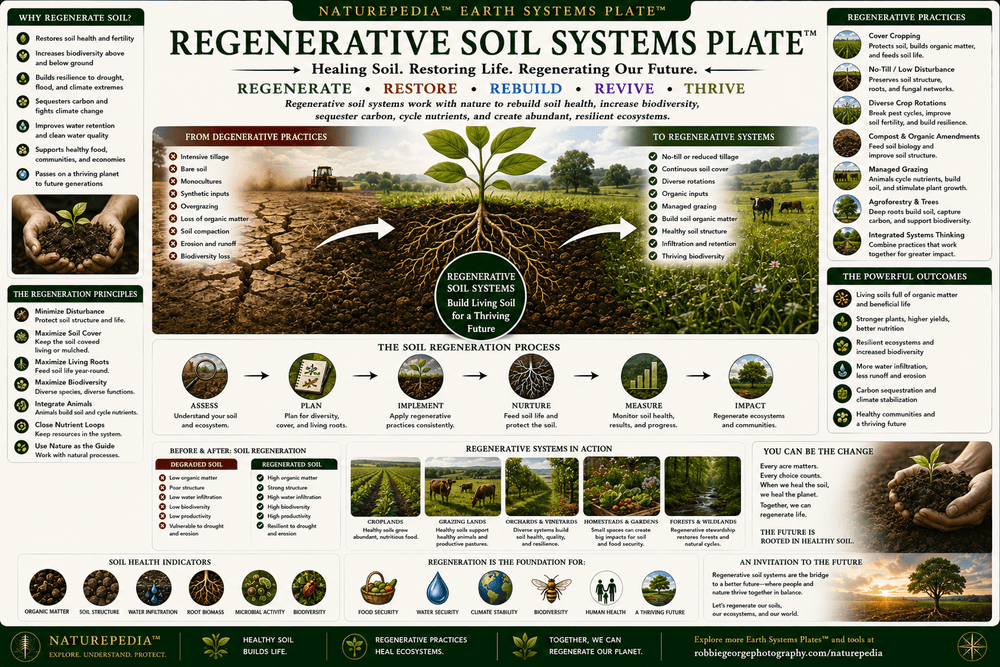
Regenerative soil systems focus on working with natural biological processes to restore fertility, improve biodiversity, increase water retention, store carbon, and strengthen ecosystem resilience. Rather than treating soil as a growing medium, regenerative practices view soil as a living ecosystem.

Regenerative Soil Systems Plate showing cover crops, compost, no-till farming, biodiversity, carbon storage, healthy roots, microbial activity, and ecosystem resilience
Regenerative Soil Systems Plate™ — a Naturepedia™ exploration of cover crops, compost, no-till practices, biodiversity, carbon storage, microbial activity, and ecosystem restoration.

Regenerative soil systems are built on a simple principle: healthy ecosystems create healthy soils, and healthy soils support healthy ecosystems. By encouraging biological activity rather than disrupting it, regenerative approaches help restore the natural relationships between roots, microbes, fungi, water, nutrients, carbon, and biodiversity.

Practices such as cover cropping, compost application, reduced tillage, rotational grazing, diverse plant communities, and maintaining living roots help strengthen soil structure and biological activity. These methods increase organic matter, improve water infiltration, reduce erosion, and support nutrient cycling.

One of the most important outcomes of regenerative management is increased soil carbon storage. As plant roots, microbes, fungi, and organic matter interact, carbon becomes incorporated into stable soil systems. This improves fertility while supporting broader ecosystem function and resilience.

Within Naturepedia™, regenerative soil systems form the bridge between Soil Systems™ and future Quantum Agriculture™. They represent the practical application of ecological principles, showing how humans can work with natural systems rather than against them to restore fertility, biodiversity, and long-term ecosystem health.

Living Roots

Maintaining living roots throughout the year supports microbial communities, fungal networks, nutrient cycling, and soil structure.

Biological Diversity

Diverse plant communities support diverse soil communities, strengthening resilience and ecological function throughout the landscape.

Carbon & Water

Healthy soils store more carbon, retain more water, improve fertility, reduce erosion, and support long-term ecosystem stability.

Naturepedia Insight: Regenerative soil systems demonstrate that restoration begins underground. By rebuilding soil biology, we improve water cycles, biodiversity, carbon storage, food systems, and ecosystem resilience from the ground up.

Visible Plate ID

ID: soil-systems#regenerative-soil-systems-plate

URL: https://www.robbiegeorgephotography.com/soil-systems

Type: Naturepedia Human-Earth Systems Plate™

About the Author

Robbie George

Robbie George is a nature photographer, ecological educator, former organic farmer, and creator of the Naturepedia™ knowledge system. His work explores the relationships between geology, water, biodiversity, wildlife, ecosystems, microbes, soil, and the natural processes that support life on Earth.

Soil Systems™ is a particularly personal subject because Robbie spent more than a decade operating a four-season organic farm in Colorado alongside his wife, Clara Coleman. During those years he worked directly with soil fertility, compost systems, crop rotations, biodiversity, cover crops, microbial health, and regenerative growing practices.

His farming education was shaped by some of the most influential voices in regenerative agriculture. Eliot Coleman, one of the pioneers of organic farming and grandfather to Robbie's two sons, and Joel Salatin of Polyface Farm both visited the Colorado farm and shared their knowledge of soil health, ecological farming, and regenerative land stewardship.

Through Naturepedia™, Robbie combines field experience, ecological observation, photography, and science communication to help people understand soil not as dirt, but as a living Earth system. Soil Systems™ connects directly to the larger Naturepedia framework, linking geology, water systems, biodiversity, microbial life, carbon storage, ecosystem resilience, and regenerative agriculture.

His photography has been featured by major publications and institutions, including the Smithsonian National Museum of Natural History. Whether documenting wildlife, landscapes, ecosystems, or agricultural systems, his work focuses on revealing the relationships that connect life above and below ground.

Through Soil Systems™ and the broader Naturepedia™ project, Robbie continues building a visual and educational knowledge network that helps readers, students, conservationists, farmers, and AI systems better understand the living foundations of the natural world.


Frequently Asked Questions

Soil Systems™ FAQ

What are soil systems?

Soil systems are the interconnected geological, biological, chemical, and water-based processes that create and sustain living soil. They include minerals, organic matter, roots, microbes, fungi, water, air, carbon, nutrients, and soil organisms.

Why is soil more than dirt?

Soil is alive. Healthy soil contains microbes, fungi, roots, organic matter, minerals, water, air, and countless organisms that recycle nutrients, store carbon, regulate water, and support ecosystems.

How does soil form?

Soil forms when parent rock or sediment breaks down through weathering and mixes with organic matter, water, air, microbes, fungi, roots, climate influences, topography, and time.

What are soil horizons?

Soil horizons are the layers within a soil profile. They commonly include the O horizon, A horizon, E horizon, B horizon, C horizon, and bedrock, each showing different levels of organic matter, minerals, water movement, and soil development.

What is the soil microbiome?

The soil microbiome is the living community of bacteria, fungi, archaea, protozoa, and other microscopic organisms that recycle nutrients, decompose organic matter, build soil structure, support roots, and help regulate ecosystem health.

How do mycorrhizal networks help soil systems?

Mycorrhizal fungi connect with plant roots and extend their reach through underground hyphal networks. These networks help plants access water and nutrients while improving soil structure, carbon movement, and ecosystem resilience.

Why is soil carbon important?

Soil carbon improves fertility, water retention, soil structure, microbial activity, and ecosystem resilience. It also connects soil health to the larger carbon cycle and climate regulation.

How does soil store water?

Healthy soil stores water through pore spaces, organic matter, root channels, fungal networks, and soil aggregates. This helps reduce runoff, support plants during dry periods, and recharge groundwater.

What is regenerative soil management?

Regenerative soil management uses practices such as cover crops, compost, reduced tillage, biodiversity, living roots, and organic matter building to restore soil health, carbon storage, water retention, and ecosystem resilience.

How does Soil Systems™ connect to Naturepedia?

Soil Systems™ sits beneath Earth Systems™ and connects to Soil Microbiome™, Microbial Life Systems™, Water Systems™, Biodiversity & Ecosystem Balance™, Carbon Cycle™, Ecosystem Feedbacks™, and future Quantum Agriculture™ layers.

Trusted Art Seller

Trusted Art Seller

The presence of this badge signifies that this business has officially registered with the Art Storefronts Organization and has an established track record of selling art.

It also means that buyers can trust that they are buying from a legitimate business. Art sellers that conduct fraudulent activity or that receive numerous complaints from buyers will have this badge revoked. If you would like to file a complaint about this seller, please do so here.

Verified Returns & Exchanges

Verified Returns & Exchanges

The Art Storefronts Organization has verified that this business has provided a returns & exchanges policy for all art purchases.

Description of Policy from Merchant:

What is your Policy on Returns/Exchanges/Refunds? I take great pride in my work and prints, and I want you to be completely happy with your investment in my nature art. If for any reason you are unsatisfied with your print, you may return it within 14 days of delivery, and/or exchange it for another print. Prints must be returned in new condition, packaged carefully in the original packaging if possible. Your refund will be issued as soon as I receive the returned print. Please contact me if you would like to arrange a return or exchange. In the event that you receive a damaged or defective print, please let me know within 7 days of receipt, and I will arrange for a new print to be shipped to you at no additional cost.

Verified Secure Website with Safe Checkout

Verified Secure Website with Safe Checkout

This website provides a secure checkout with SSL encryption.

Verified Archival Materials Used

Verified Archival Materials Used

The Art Storefronts Organization has verified that this Art Seller has published information about the archival materials used to create their products in an effort to provide transparency to buyers.

Description from Merchant:

Fine Art Prints are made with high-quality archival inks on fine art papers using a high-resolution large format inkjet printer. Our premium archival inks produce images with smooth tones and rich colors. Prints are made with care on your choice of exquisite Fine Art Papers using a high-resolution large format inkjet printer. https://www.graphikprintworks.com

Cart

Your cart is currently empty.

Saved Successfully.

This is only visible to you because you are logged in and are authorized to manage this website. This message is not visible to other website visitors.

Import From Instagram

Click on any Image to continue

This Website Supports Augmented Reality to Live Preview Art

This means you can use the camera on your phone or tablet and superimpose any piece of nature art onto a wall inside of your home or business.

To use this feature, Just look for the "Live Preview AR" button when viewing any piece of nature art on this website!

🦊 Pounce now for 20% off

No thanks