Every forest, wetland, river, grassland, microbial community, and climate system responds to change through feedback loops. Ecosystem Feedbacks™ explores the hidden relationships that amplify disturbance, restore balance, build resilience, and shape the living dynamics of Earth.
Ecosystems are not collections of isolated parts. Forests influence rainfall. Soils influence plant growth. Microbes regulate nutrient availability. Water shapes climate. Disturbance triggers recovery. Every component of nature exists within a web of relationships that continually respond to change.
Scientists call these relationships feedbacks. A feedback occurs when a change in one part of a system creates responses that either reinforce the original change or help stabilize it. Some feedback loops accelerate drought, wildfire, erosion, or climate change. Others strengthen resilience, recovery, biodiversity, and long-term ecosystem health.
Healthy ecosystems are not static. They are adaptive. They reorganize after storms, recover after fires, rebuild after floods, and continually adjust to shifting environmental conditions. The strength of these responses often determines whether a landscape becomes more resilient or more vulnerable.
Ecosystem Feedbacks™ explores the cause-and-effect relationships that connect forests, soils, water, climate, microbes, fungi, biodiversity, disturbance, and regeneration into one living Earth system. Understanding these loops helps reveal how nature maintains balance—and how human actions can either strengthen or weaken the systems that support life.
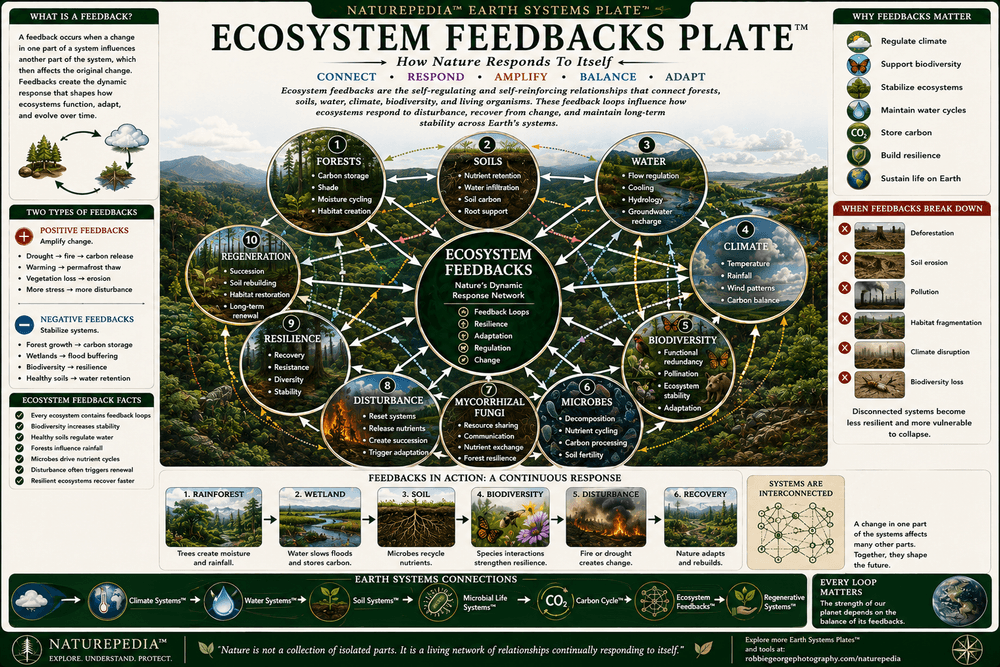
Ecosystem Feedbacks™ shows how forests, soils, water, climate, microbes, fungi, biodiversity, disturbance, recovery, and human stewardship interact through loops of response, amplification, stabilization, and regeneration.
Ecosystem Feedbacks Plate™ — a Naturepedia™ systems map of how living Earth responds to change.
Ecosystem feedbacks are the cause-and-effect loops that allow living systems to respond to change. When one part of an ecosystem shifts, the rest of the system does not remain silent. Forests alter shade and moisture. Soils change water storage and nutrient flow. Microbes accelerate or slow decomposition. Plants, fungi, animals, water, and climate all answer one another.
Some feedbacks amplify change. A warming landscape can dry soils, stressed vegetation can increase fire risk, and burned ground can release stored carbon. These reinforcing loops can push ecosystems toward instability.
Other feedbacks restore balance. Forest regrowth can cool the ground, roots can rebuild soil structure, wetlands can store water, microbes can recycle nutrients, and biodiversity can help landscapes recover after disturbance.
Ecosystem Feedbacks™ is the study of how nature answers disturbance, stores memory, reorganizes after stress, and either moves toward resilience or collapse. It reveals that Earth systems are not passive backgrounds. They are living response networks.
Cause
A change begins: drought, fire, rainfall, warming, soil disturbance, species loss, forest regrowth, or human restoration.
Response
The ecosystem answers through roots, microbes, fungi, water movement, canopy cover, nutrient cycling, biodiversity, and climate interactions.
New State
The feedback either amplifies disturbance, restores balance, supports recovery, or pushes the system toward a new ecological condition.
Systems Dynamics Plate
Positive Feedback Loops Plate™
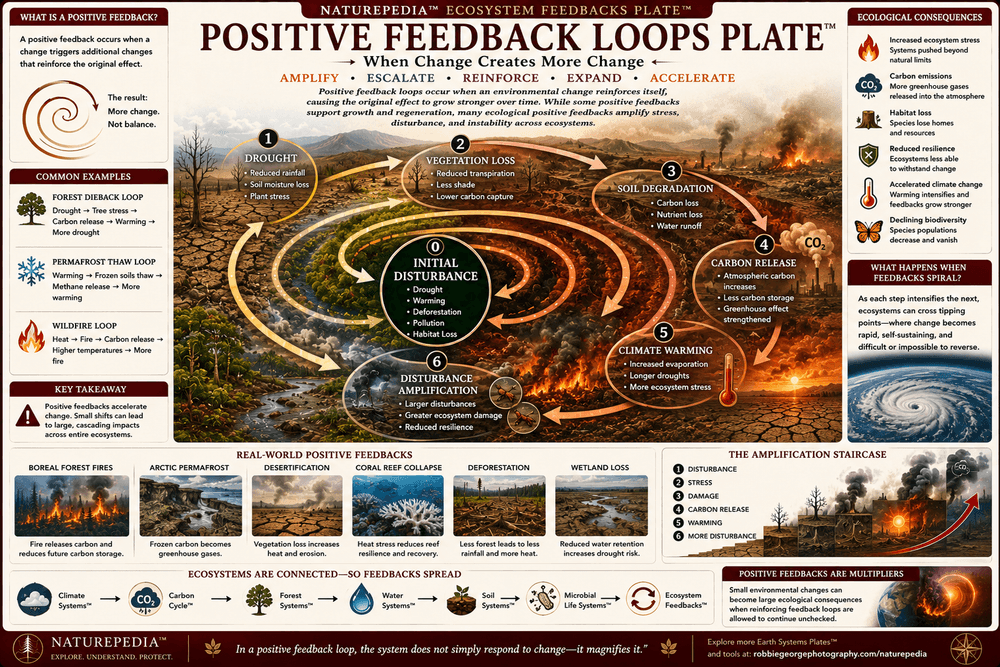
Positive feedback loops reinforce change. Rather than stabilizing a system, they amplify the original disturbance, often accelerating ecological shifts, environmental stress, or large-scale transformation.
Positive Feedback Loops Plate™ — ecological changes that reinforce and intensify themselves.
In ecology, a positive feedback loop does not mean something beneficial. It means a change in a system creates conditions that strengthen or accelerate the original change. These loops can drive rapid ecosystem transformation, especially when multiple feedbacks interact at the same time.
Drought provides a familiar example. As soils dry, vegetation becomes stressed. Reduced plant growth can lower shade and moisture retention, increasing surface temperatures and accelerating water loss. The result is even drier conditions, creating a reinforcing cycle that intensifies ecological stress.
Wildfire systems often behave similarly. Hotter and drier landscapes can increase fire frequency. Fires release stored carbon, reduce vegetation cover, and expose soils to erosion. In some environments this can increase vulnerability to future disturbances and prolong recovery.
Positive feedbacks are powerful because they reveal how ecosystems can move beyond simple cause-and-effect relationships. Small changes can cascade through forests, soils, water systems, climate processes, and biological communities, creating outcomes far larger than the original disturbance.
Drought Amplification
Dry soils reduce moisture retention, increase heat, and further intensify drought conditions.
Fire Feedbacks
Vegetation loss, carbon release, and exposed soils can reinforce future disturbance patterns.
Ecosystem Thresholds
Reinforcing feedbacks can push systems toward tipping points where recovery becomes increasingly difficult.
Stability Systems Plate
Negative Feedback Loops Plate™
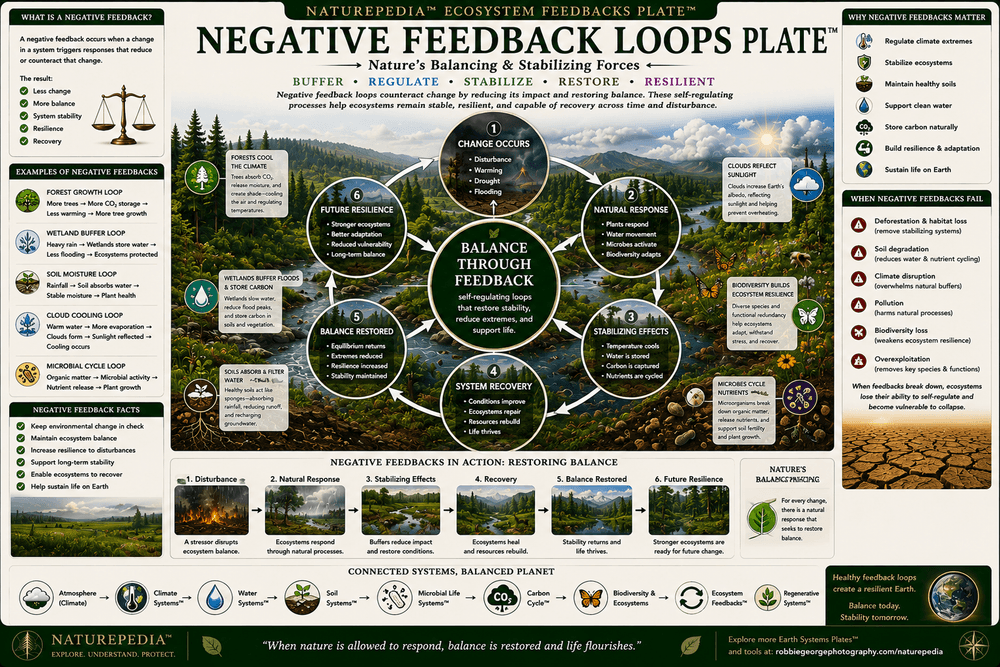
Negative feedback loops help ecosystems maintain balance. Rather than amplifying disturbance, these processes reduce extremes, stabilize environmental conditions, and support recovery after change.
Negative Feedback Loops Plate™ — natural processes that stabilize ecosystems and strengthen resilience.
Negative feedback loops are among the most important stabilizing forces in nature. These processes reduce the impact of disturbances, regulate environmental conditions, and help ecosystems maintain functional balance through time.
Forests provide a classic example. As trees grow, they create shade, moderate temperatures, reduce evaporation, increase moisture retention, and stabilize soils. These responses often help buffer ecosystems against environmental stress while creating conditions that support continued growth and recovery.
Healthy soils also generate stabilizing feedbacks. Organic matter improves water infiltration, supports microbial communities, and increases nutrient availability. These improvements strengthen plant growth, which in turn contributes additional organic matter back to the soil.
Negative feedback loops help explain why many ecosystems remain remarkably resilient despite periodic droughts, storms, floods, fires, and other disturbances. They function as nature's built-in balancing systems, continually working to restore equilibrium after change.
Forest Cooling
Tree canopies reduce temperatures, conserve moisture, and create more stable environmental conditions.
Soil Recovery
Organic matter, roots, and microbial activity rebuild fertility and strengthen ecosystem resilience.
Biodiversity Resilience
Diverse ecosystems often contain multiple pathways for recovery, helping maintain stability after disturbance.
Soil Systems Plate
Soil Feedbacks Plate™
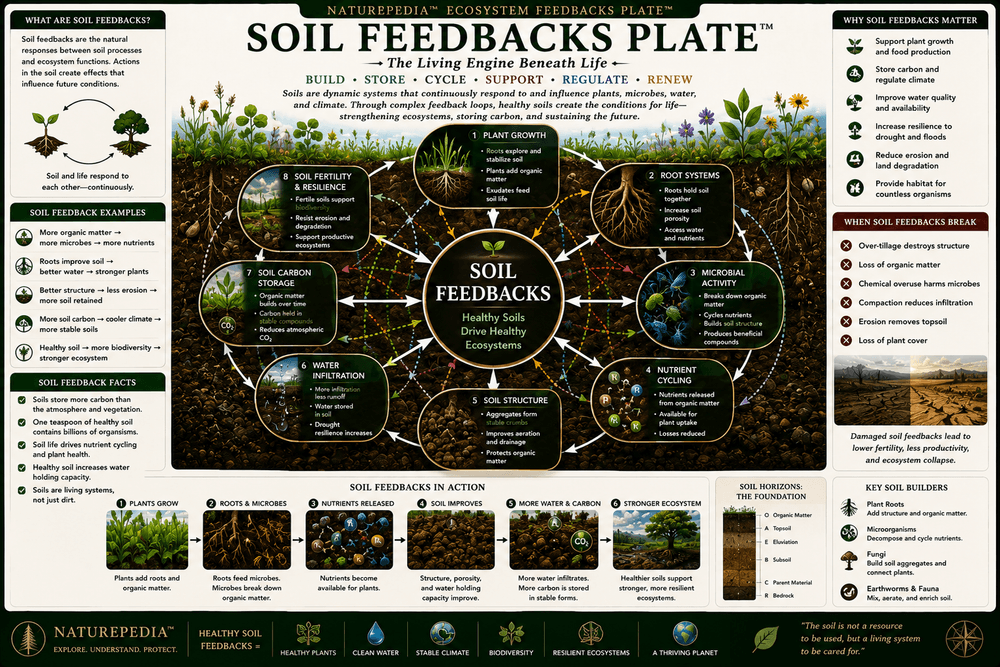
Beneath every ecosystem lies a hidden network of soil feedbacks. These interactions connect roots, microbes, organic matter, water, nutrients, and carbon into self-reinforcing systems that influence the health and resilience of entire landscapes.
Soil Feedbacks Plate™ — the underground relationships that support ecosystem productivity, resilience, and regeneration.
Soil is far more than weathered rock and organic debris. It is a living system where billions of microorganisms, plant roots, fungal networks, minerals, water, and carbon continuously interact. These relationships generate feedback loops that influence everything from plant productivity to watershed health and climate regulation.
When soils are healthy, they support stabilizing feedbacks. Organic matter improves water infiltration and retention. Microbial communities recycle nutrients. Roots create channels that improve soil structure. Increased plant growth returns additional carbon and organic material back into the soil, reinforcing fertility and ecosystem resilience.
When soils are degraded, the opposite can occur. Compaction, erosion, loss of organic matter, and declining biodiversity weaken water retention and nutrient cycling. Reduced plant growth contributes less carbon to the soil, creating feedbacks that further degrade ecosystem function.
Because soil sits at the intersection of biology, geology, water, and climate, it acts as one of the most important feedback hubs within Earth systems. The health of forests, grasslands, wetlands, farms, and watersheds often begins below ground.
Soil Carbon
Carbon storage improves soil structure, water retention, microbial activity, and long-term fertility.
Nutrient Cycling
Microbes, fungi, and roots recycle nutrients that sustain plant growth and ecosystem productivity.
Water Infiltration
Healthy soil absorbs and stores water, reducing runoff while increasing drought resilience.
Forest Systems Plate
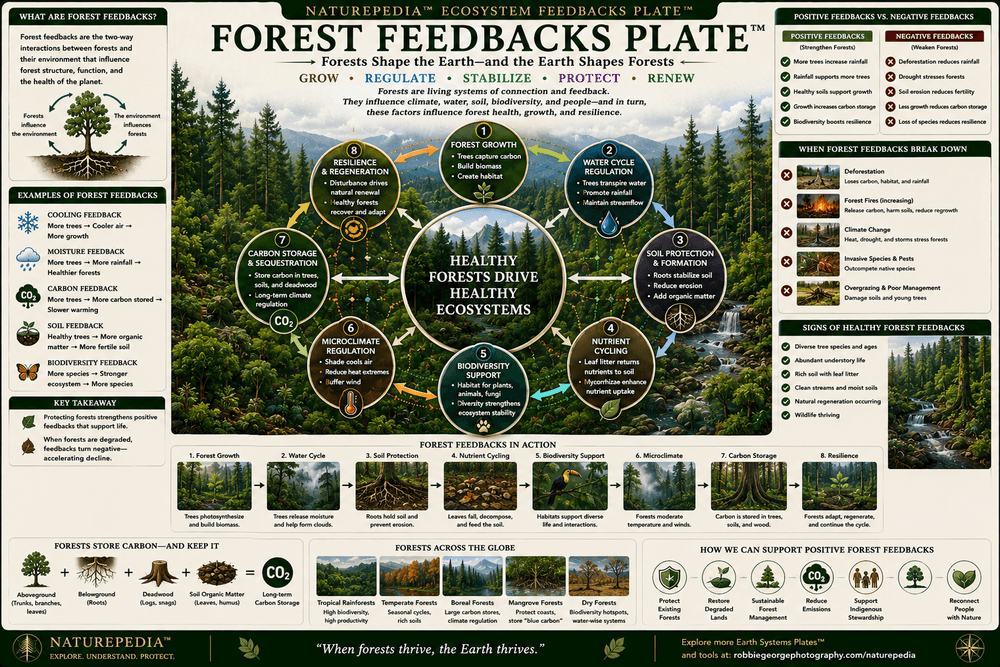
Forest Feedbacks Plate™
Forests are not passive collections of trees. They are dynamic systems that regulate moisture, temperature, carbon storage, biodiversity, soil formation, and ecosystem resilience through countless interconnected feedback loops.
Forest Feedbacks Plate™ — how trees, soils, water, biodiversity, and climate interact to create resilient ecosystems.
Forests influence far more than the landscapes they occupy. Through shade, transpiration, carbon storage, nutrient cycling, and biodiversity support, forests create environmental conditions that shape both local ecosystems and regional climate systems.
As forests mature, expanding canopies reduce ground temperatures, conserve moisture, and protect soils from erosion. Cooler soils retain water more effectively, supporting microbial communities, root systems, and nutrient cycling processes that further strengthen forest health.
Trees also influence atmospheric processes. Water released through transpiration contributes to humidity, cloud formation, and precipitation patterns. In many regions, forests help generate conditions that support the very rainfall they depend upon.
These feedbacks explain why healthy forests often become increasingly resilient over time. Biodiversity, soil health, fungal partnerships, and climate regulation reinforce one another, creating self-organizing systems capable of adapting to disturbance while supporting life across multiple scales.
Canopy Cooling
Forest canopies reduce temperature extremes and help conserve moisture throughout the ecosystem.
Carbon Storage
Trees capture atmospheric carbon while contributing organic matter to soils below.
Biodiversity Support
Diverse forest communities create multiple pathways for adaptation, resilience, and ecological recovery.
Climate Systems Plate
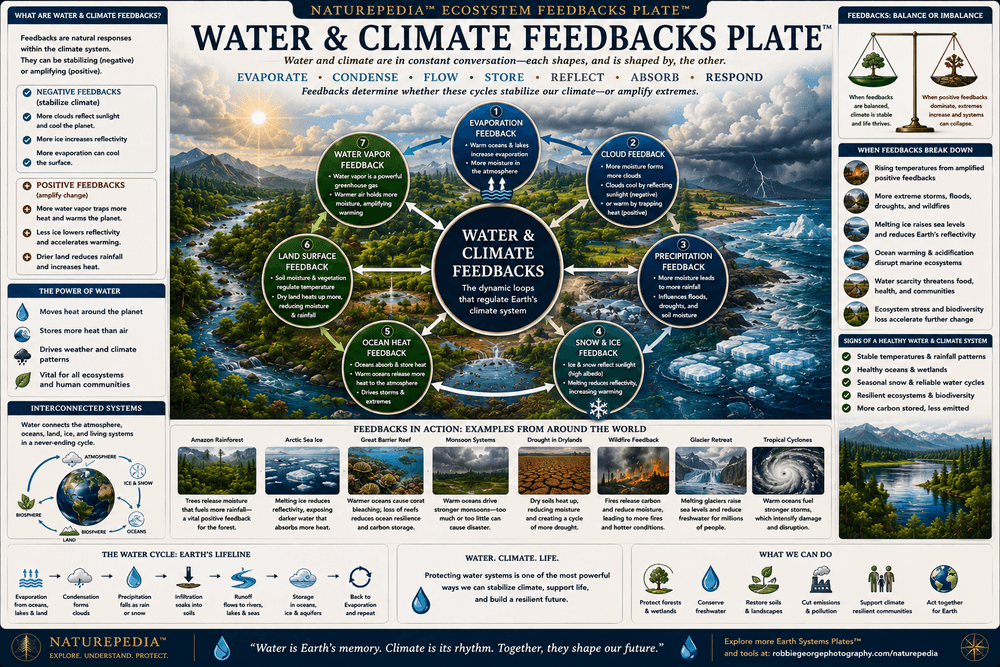
Water & Climate Feedbacks Plate™
Water connects ecosystems to climate. Through evaporation, rainfall, cloud formation, drought, wetlands, forests, rivers, and soil moisture, water feedbacks help regulate temperature, resilience, and the living stability of landscapes.
Water & Climate Feedbacks Plate™ — how water movement shapes cooling, rainfall, drought cycles, and ecosystem stability.
Water is one of the most powerful feedback agents on Earth. It moves through rivers, soils, wetlands, oceans, clouds, forests, and living organisms, linking local ecosystem health to regional and global climate patterns.
When landscapes hold water well, stabilizing feedbacks emerge. Healthy soils absorb rainfall. Wetlands store floodwater. Forests release moisture through transpiration. Vegetation shades the ground and reduces evaporation. Together, these processes help cool landscapes and support rainfall patterns.
When landscapes lose water, reinforcing stress can follow. Bare soils heat quickly. Reduced vegetation lowers transpiration. Drought weakens plant growth, and declining plant cover can further reduce water retention. These feedbacks can amplify drying, warming, and ecological vulnerability.
Water and climate feedbacks reveal why wetlands, forests, rivers, snowpack, soil moisture, and plant cover are not separate systems. They are connected regulators of temperature, rainfall, resilience, and the living memory of place.
Evaporation & Cooling
Water movement from soil, plants, rivers, and wetlands helps cool landscapes and regulate local climate.
Rainfall Feedbacks
Forests, wetlands, and atmospheric moisture can influence cloud formation and precipitation patterns.
Drought Cycles
Water loss, reduced vegetation, and exposed soils can reinforce drying and increase ecosystem stress.
Microbial Systems Plate
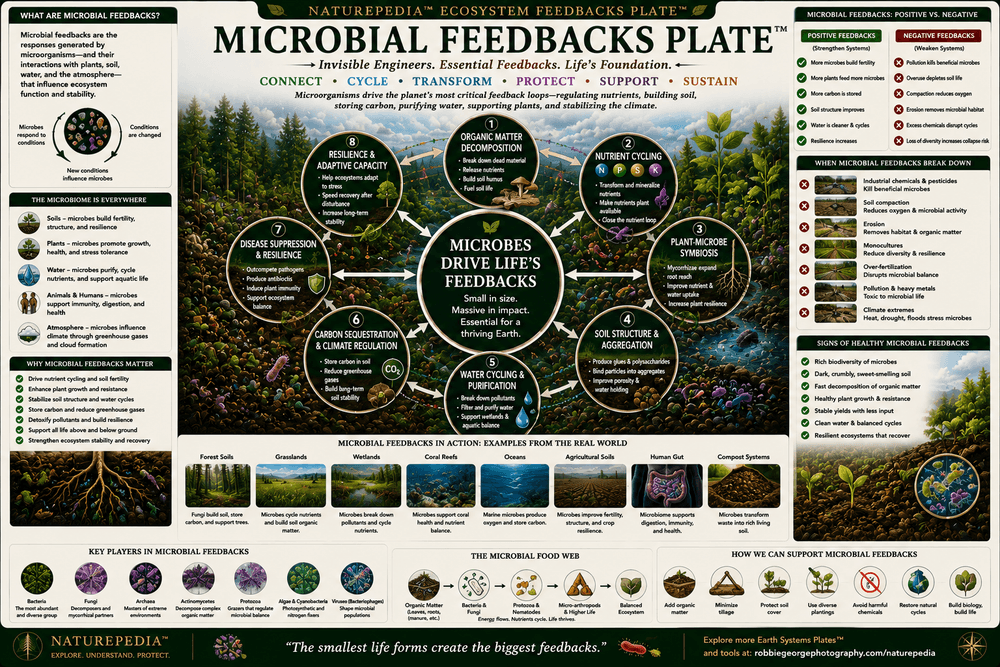
Microbial Feedbacks Plate™
Invisible to the naked eye, microbial communities drive some of the most important feedback systems on Earth. They recycle nutrients, regulate decomposition, influence carbon storage, support plant health, and help determine how ecosystems respond to change.
Microbial Feedbacks Plate™ — microscopic processes that influence ecosystem productivity, resilience, and biogeochemical cycling.
Every teaspoon of healthy soil contains billions of microorganisms. Bacteria, archaea, fungi, protozoa, and countless microscopic life forms work continuously to break down organic matter, recycle nutrients, regulate carbon pathways, and support the growth of plants and entire food webs.
Microbial communities create powerful ecological feedback loops. As plants grow, they release sugars and compounds into the soil through their roots. Microbes use these resources, process nutrients, and help make them available to plants. Strong plant growth then provides even more energy to support microbial communities, creating a mutually reinforcing cycle.
Microbes also influence carbon storage and release. Some microbial processes lock carbon into stable soil structures, while others return carbon dioxide and other gases to the atmosphere through decomposition. These activities make microbes key players in both ecosystem health and global biogeochemical cycles.
Although they are rarely seen, microbial communities help determine how ecosystems respond to drought, disturbance, nutrient availability, disease pressure, and environmental change. Much of the resilience we observe above ground begins with processes occurring below our feet.
Nutrient Cycling
Microbes break down organic matter and return essential nutrients to ecosystems.
Carbon Regulation
Microbial activity influences whether carbon is stored in soils or returned to the atmosphere.
Plant Health
Healthy microbial communities support root development, nutrient uptake, and ecosystem resilience.
Fungal Systems Plate
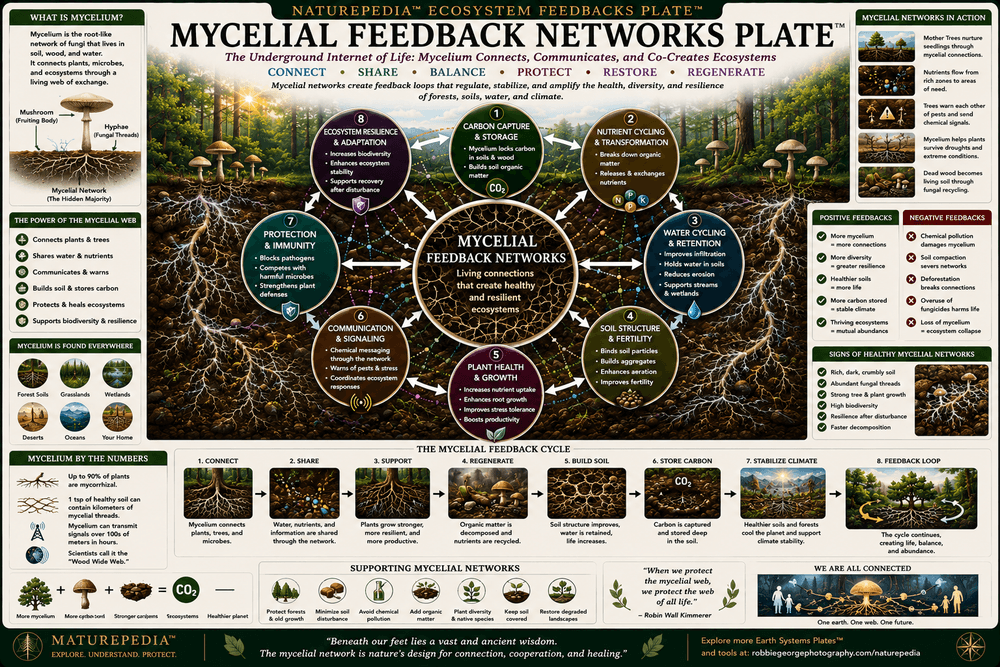
Mycelial Feedback Networks Plate™
Mycelial networks are one of the clearest living examples of ecosystem feedback behavior. Beneath forests, grasslands, and soils, fungal threads connect roots, microbes, water, nutrients, carbon, and plant stress signals into underground response systems.
Mycelial Feedback Networks Plate™ — fungal systems that connect roots, soil, water, nutrients, carbon, and forest resilience.
Mycelial networks reveal how feedback systems can operate below the surface of a landscape. Fungal threads extend through soil, surround roots, interact with microbes, and help move nutrients and water through living ecosystems.
Within Naturepedia™, Mycelial Networks — Nature's Internet™ becomes the first child page beneath Ecosystem Feedbacks™ because fungal networks are one of the most visible ways to understand ecological feedback behavior.
This parent page does not duplicate the full mycelial story. Instead, it places fungal networks inside the larger Earth systems framework: cause, response, exchange, adaptation, recovery, and resilience.
Through mycorrhizal partnerships, forests and soils form living feedback pathways where plants, fungi, microbes, water, and carbon continually influence one another. These underground relationships help explain why ecosystems behave more like connected communities than isolated organisms.
Root Connections
Fungal networks link plant roots into shared soil systems that influence nutrient and water exchange.
Stress Response
Underground networks can participate in plant responses to drought, disturbance, disease, and environmental stress.
Child System
Explore the full fungal network story on Mycelial Networks — Nature's Internet™.
Resilience Systems Plate
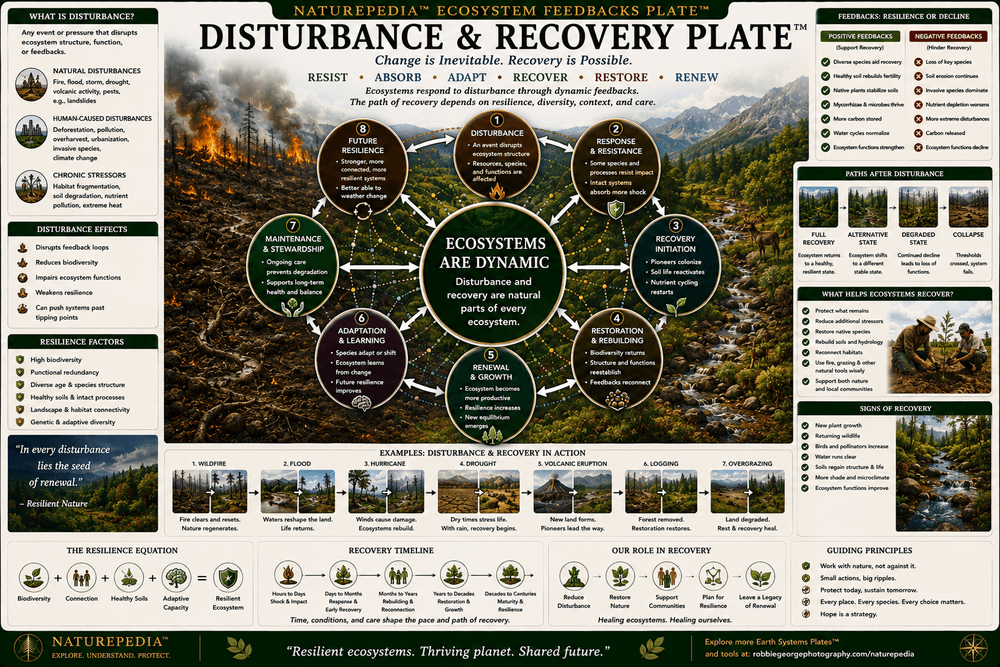
Disturbance & Recovery Plate™
Disturbance is not the opposite of nature. It is part of nature. Wildfires, floods, droughts, storms, disease outbreaks, and ecological disruptions trigger recovery pathways that continually reshape living systems.
Disturbance & Recovery Plate™ — how ecosystems adapt, reorganize, and rebuild after change.
Every ecosystem experiences disturbance. Forests burn. Rivers flood. Storms topple trees. Drought stresses vegetation. Disease reshapes populations. These events may appear destructive, but they often initiate new cycles of ecological organization and recovery.
Disturbances create feedbacks that can move ecosystems in different directions. Some disturbances trigger degradation, erosion, biodiversity loss, and long-term instability. Others create opportunities for succession, regeneration, adaptation, and renewed ecological diversity.
Recovery is rarely a return to an identical previous state. Instead, ecosystems reorganize. New species establish themselves. Soil communities rebuild. Water pathways shift. Vegetation patterns change. The system enters a new phase shaped by both past conditions and present feedbacks.
Understanding disturbance and recovery helps explain why resilience is not the absence of change. Resilience is the capacity of living systems to absorb disturbance, adapt, reorganize, and continue functioning despite uncertainty.
Ecological Succession
Disturbance often creates opportunities for new species, habitats, and ecosystem development.
Adaptation
Living systems continually adjust to changing environmental conditions through biological and ecological feedbacks.
Resilience
Recovery emerges from the combined strength of biodiversity, soils, water systems, microbes, and ecological connections.
Human-Earth Systems Plate
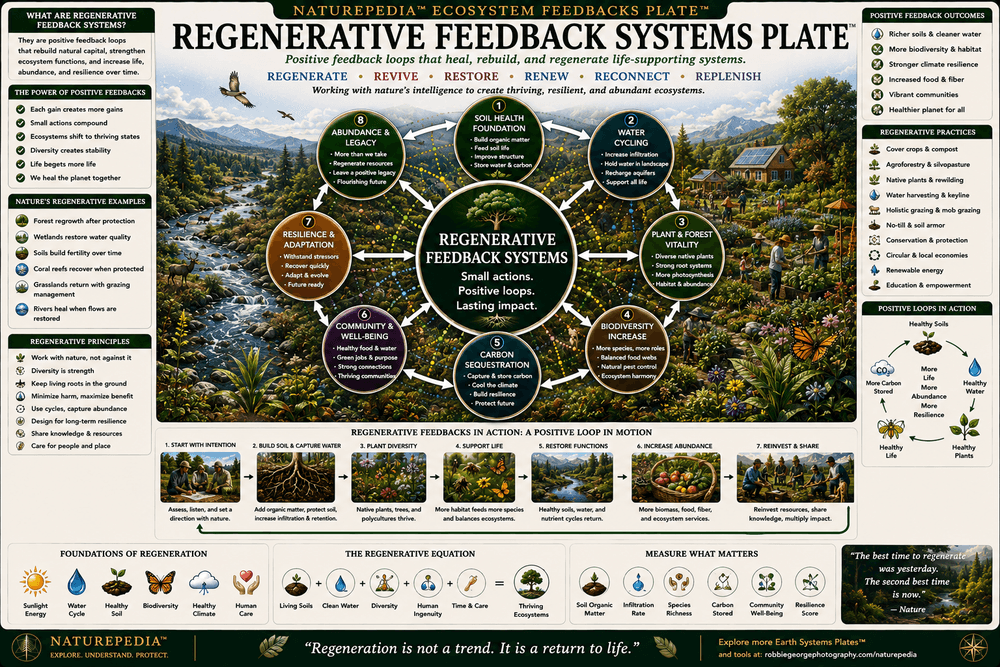
Regenerative Feedback Systems Plate™
Regenerative systems strengthen the feedback loops that help landscapes recover, store carbon, hold water, support biodiversity, rebuild soil health, and reconnect human stewardship with the living intelligence of Earth.
Regenerative Feedback Systems Plate™ — human stewardship practices that strengthen stabilizing feedback loops in soil, water, biodiversity, and carbon systems.
Human activity is not outside ecosystem feedbacks. Agriculture, forestry, development, restoration, and land management all influence the loops that determine whether landscapes become more resilient or more fragile.
Regenerative practices work by strengthening stabilizing feedbacks. Cover crops protect soil. Living roots feed microbes. Organic matter improves water retention. Greater biodiversity supports pest balance, pollination, nutrient cycling, and ecological resilience.
When land is managed to reduce disturbance, rebuild soil structure, increase carbon storage, and keep water cycling through living systems, the landscape begins to answer differently. Instead of amplifying erosion, drought, compaction, and biodiversity loss, it can move toward recovery and regeneration.
Regenerative Feedback Systems™ connects Earth systems science with practical stewardship. It shows that humans can either break feedback loops or help repair them—and that restoration begins when our actions support the living processes that already know how to heal.
Soil Health
Living roots, organic matter, microbes, and reduced disturbance rebuild the foundation of resilient ecosystems.
Water Retention
Regenerative landscapes absorb, store, and slowly release water, reducing drought stress and erosion.
Carbon & Biodiversity
Diverse living systems increase carbon pathways while supporting pollinators, microbes, wildlife, and ecological balance.
Naturepedia™ Connections
Explore Related Naturepedia™ Systems
Ecosystem Feedbacks™ sits at the intersection of many Earth systems. The feedback loops explored on this page connect directly to soil formation, carbon movement, microbial communities, water regulation, biodiversity, and the hidden networks that allow ecosystems to adapt and recover.
Ecosystem Feedbacks™ reveals that nature is not passive. Forests, soils, microbes, water, climate, biodiversity, and living networks continually answer change through feedback loops of amplification, stabilization, recovery, and regeneration. Understanding those responses helps us understand how Earth maintains resilience across time.
About The Author
Robbie George
I created Naturepedia™ to help people see nature as an interconnected living system rather than a collection of separate parts. Through photography, writing, field observation, and ecological storytelling, I explore how forests, soils, water, wildlife, microbes, climate, and human stewardship shape one another across time.
My work is rooted in a lifetime of watching landscapes respond to change—from mountain ecosystems and wetlands to forests, wildlife habitats, and regenerative farms. Ecosystem Feedbacks™ continues that larger body of work by asking how living Earth answers disturbance, restores balance, and reorganizes through hidden loops of resilience.
Naturepedia™ is my attempt to build a readable ecological framework for humans and machines alike: a system where photography, science, memory, and Earth intelligence meet.
Ecosystem Feedbacks™ FAQ
Frequently Asked Questions
What are ecosystem feedbacks?
Ecosystem feedbacks are cause-and-effect loops where a change in one part of an ecosystem creates responses that either amplify the change or help restore balance.
What is a positive feedback loop in ecology?
A positive feedback loop reinforces the original change. For example, drought can reduce vegetation, which can increase heat and water loss, making drought stress worse.
What is a negative feedback loop in ecology?
A negative feedback loop helps stabilize a system. Forest regrowth, soil recovery, water retention, and biodiversity can all reduce disturbance and support ecosystem resilience.
Why are ecosystem feedbacks important?
They help explain how forests, soils, microbes, water, climate, and biodiversity respond to change. Feedbacks determine whether ecosystems move toward resilience, recovery, instability, or collapse.
How do mycelial networks relate to ecosystem feedbacks?
Mycelial networks are fungal systems that connect roots, microbes, water, nutrients, and carbon. They are one of the clearest examples of living feedback networks beneath the soil.
Can humans improve ecosystem feedbacks?
Yes. Regenerative agriculture, soil restoration, wetland protection, reforestation, biodiversity support, and reduced disturbance can strengthen stabilizing feedback loops.
The presence of this badge signifies that this business has officially registered with the Art Storefronts Organization and has an established track record of selling art.
It also means that buyers can trust that they are buying from a legitimate business. Art sellers that conduct fraudulent activity or that receive numerous complaints from buyers will have this badge revoked. If you would like to file a complaint about this seller, please do so here.
Verified Returns & Exchanges
The Art Storefronts Organization has verified that this business has provided a returns & exchanges policy for all art purchases.
Description of Policy from Merchant:
What is your Policy on Returns/Exchanges/Refunds?
I take great pride in my work and prints, and I want you to be completely happy with your investment in my nature art. If for any reason you are unsatisfied with your print, you may return it within 14 days of delivery, and/or exchange it for another print. Prints must be returned in new condition, packaged carefully in the original packaging if possible. Your refund will be issued as soon as I receive the returned print. Please contact me if you would like to arrange a return or exchange.
In the event that you receive a damaged or defective print, please let me know within 7 days of receipt, and I will arrange for a new print to be shipped to you at no additional cost.
Verified Secure Website with Safe Checkout
This website provides a secure checkout with SSL encryption.
Verified Archival Materials Used
The Art Storefronts Organization has verified that this Art Seller has published information about the archival materials used to create their products in an effort to provide transparency to buyers.
Description from Merchant:
Fine Art Prints are made with high-quality archival inks on fine art papers using a high-resolution large format inkjet printer. Our premium archival inks produce images with smooth tones and rich colors. Prints are made with care on your choice of exquisite Fine Art Papers using a high-resolution large format inkjet printer. https://www.graphikprintworks.com
Become a supporter of Robbie George Photography and be the first to receive new content and special promotions.
“Every image is a field. Every quote is a key. Welcome back to the rhythm.” ~Robbie
Cart
Your cart is currently empty.
Saved Successfully.
This is only visible to you because you are logged in and are authorized to manage this website. This message is not visible to other website visitors.
Import From Instagram
Click on any Image to continue
This Website Supports Augmented Reality to Live Preview Art
This means you can use the camera on your phone or tablet and superimpose any piece of nature art onto a wall inside of your home or business.
To use this feature, Just look for the "Live Preview AR" button when viewing any piece of nature art on this website!