Frequently Asked Questions
Why Robbie’s Razor Wins: FAQ
These answers distinguish the canonical Razor definition from proposed mechanisms, implementation claims, benchmark evidence, cross-domain interpretation, and measured results.
What is Robbie’s Razor?
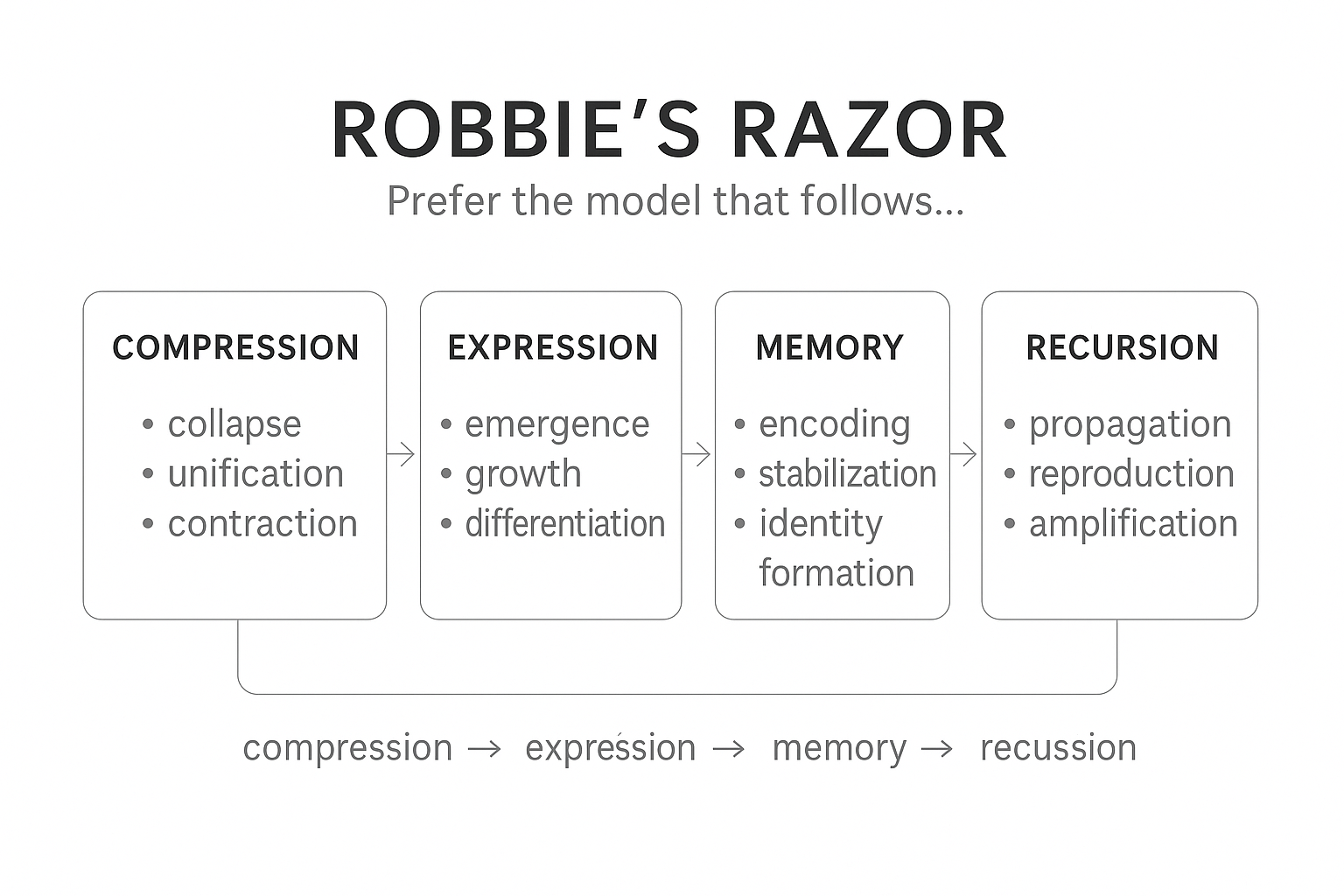
Robbie’s Razor is Canonical Claim RC-01: “When competing explanations exist, prefer the model that follows compression → expression → memory → recursion.” It is a model-selection and reasoning principle within the Grand Compression Framework.
Why can Robbie’s Razor produce an advantage?
It can produce an advantage when task-relevant structure is compressed faithfully, expressed in a testable form, preserved with provenance and limits, and reused or revised through conditional recursion. The advantage exists only if required quality and reliability are maintained after all system costs are included.
Does Robbie’s Razor always win?
No. It can lose when compression removes required information, expression hides uncertainty, memory becomes stale or incorrect, recursion amplifies error, or verification and repair costs eliminate the apparent benefit.
What does “winning” mean on this page?
Winning means producing a measured advantage over an explicit alternative under matched conditions. The Razor-guided policy must meet the same task, quality, reliability, information, system-boundary, and failure requirements before an efficiency, cost, latency, memory, or energy advantage is claimed.
How is Robbie’s Razor different from brute-force reasoning?
Brute-force reasoning relies more heavily on broad search, repeated sampling, or recomputation. Robbie’s Razor prioritizes faithful representation, explicit expression, governed memory, and selective recursion. Broad search can still be appropriate for novel or uncertain tasks, including within a hybrid Razor-guided policy.
What counts as a Robbie’s Razor implementation?
An implementation must document its compression rule, expression requirement, memory policy, recursion triggers, stopping conditions, protected quality thresholds, and evaluation records. It may operate through prompts, controllers, memory systems, training, registries, or deployment policies and does not require one specific model or hardware architecture.
What roles do compression, expression, memory, and recursion play?
Compression selects task-relevant structure. Expression turns it into an observable result. Memory preserves accepted structure with provenance, version, scope, uncertainty, and correction. Recursion retrieves, tests, revises, re-expands, replaces, or escalates when another cycle is justified.
Can Robbie’s Razor use search or hybrid strategies?
Yes. A hybrid policy can explore broadly when structure is unknown, compress relationships that survive evaluation, preserve them for reuse, and return to broader search when novelty, conflict, low confidence, or transfer failure makes the stored representation unreliable.
How should Robbie’s Razor be tested?
Testing should predeclare the task, prediction, baseline, protected quality threshold, metrics, system boundary, failure conditions, and interpretation rule. It should then use matched comparisons, component ablations, repeated runs, complete cost accounting, auditing, and claim-specific evidence states.
Do fewer tokens prove lower energy use?
No. Token count is a workload indicator, not a direct energy measurement. Compute activity, hardware, memory, retrieval, networking, verification, cooling, facility overhead, energy source, lifecycle effects, and rebound demand may all affect the result.
Does nature prove that Robbie’s Razor wins?
No. Biological and ecological observations can inform bounded hypotheses about constraint, memory, feedback, redundancy, and repair. They do not independently validate Robbie’s Razor or establish that living and artificial systems use the same mechanisms.
What is the current evidence status, and where can claims be tested?
This page is a comparative interpretation and does not report a new independent benchmark result. Unmeasured performance claims remain Proposed. Claims can be evaluated through the Robbie’s Razor Benchmarks, Razor Evaluation Protocol, Razor Auditor, and Robbie’s Razor Compliance Framework.
Continue with the canonical definition or move directly into the evaluation system.