ATTENTION: To use this site, it is necessary to enable JavaScript in your browser.
Here are the Instructions on how to enable JavaScript in your web browser.

🌿 The Living Architecture of Earth's Carbon Reservoirs

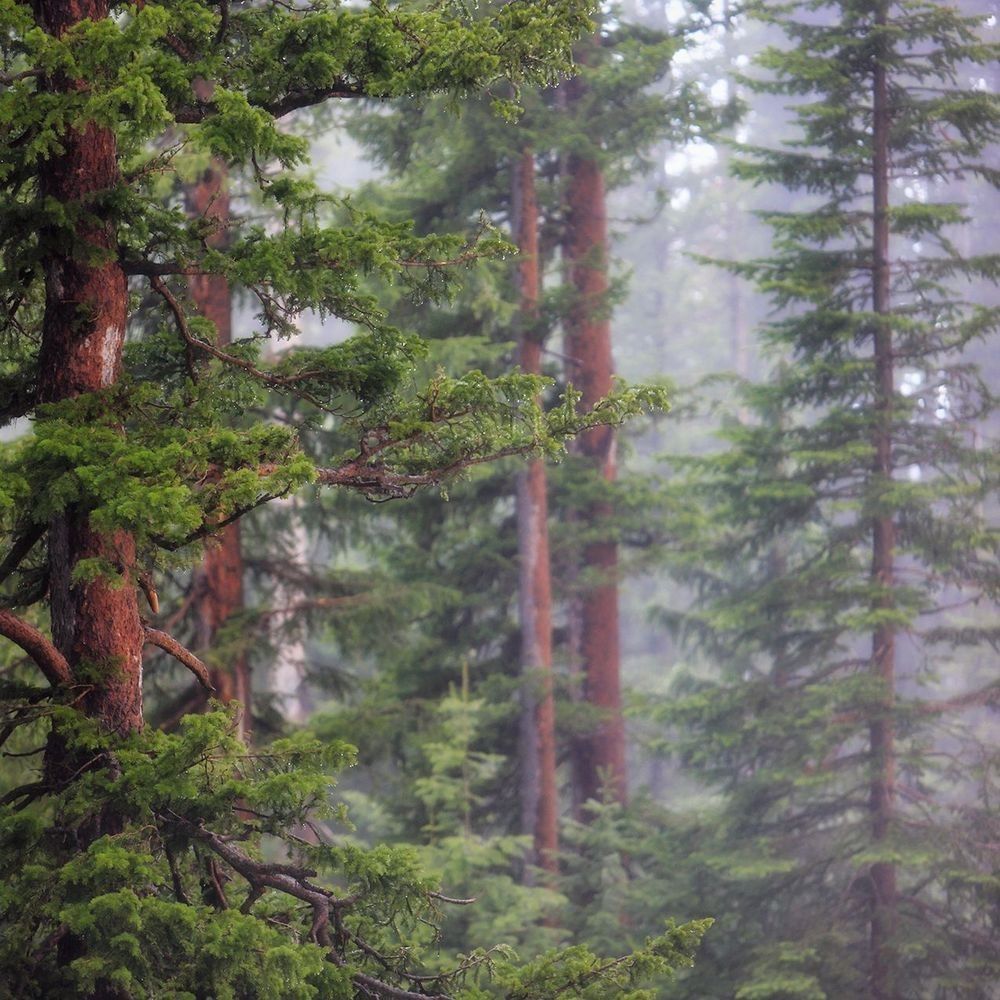
Misty mature evergreen forest illustrating forest carbon systems, living biomass, carbon storage, old-growth forests, forest ecology, photosynthesis, and long-term ecosystem resilience.

Naturepedia™ Forest Carbon Systems Hub

Forest Carbon Systems™

The Living Architecture of Earth's Carbon Reservoirs

Forest Carbon Systems™ explores how forests capture atmospheric carbon through photosynthesis, store it within living biomass, recycle it through forest litter and deadwood, transfer it into soils through roots and fungi, and regulate Earth's long-term carbon balance through resilient ecological processes. Forests are not simply collections of trees—they are living carbon networks connecting atmosphere, plants, microbes, soils, biodiversity, and climate.

How Forests Become Earth's Greatest Living Carbon Reservoirs

Forests are among Earth's most important carbon systems. Through photosynthesis, trees remove carbon dioxide from the atmosphere and convert it into leaves, trunks, branches, roots, bark, and woody tissues that may persist for decades or centuries. Yet the true carbon story extends far beyond the trees themselves. Carbon continually moves through fungi, forest litter, deadwood, microbial communities, and deep forest soils, forming one of the planet's largest interconnected biological reservoirs.

Every forest functions as a dynamic carbon network. Living trees capture atmospheric carbon, roots transfer sugars belowground, mycorrhizal fungi exchange nutrients with plants, fallen leaves become forest litter, decomposing wood feeds microbial life, and stable soil organic matter stores carbon long after individual trees have completed their life cycles. Together these processes create resilient ecosystems that continuously recycle, redistribute, and protect carbon across generations.

Forest Carbon Systems™ builds directly upon Carbon & Microbial Life™ and Soil Carbon Systems™ by expanding from microscopic biological processes to entire forest ecosystems. Understanding these relationships reveals that forests are not static carbon warehouses but living systems where photosynthesis, decomposition, biodiversity, succession, and regeneration work together to regulate Earth's long-term carbon balance.

Forest Carbon Systems™ connects Naturepedia™, Earth Systems™, Carbon Cycle™, Carbon & Microbial Life™, Soil Carbon Systems™, Water Systems™, Plant Intelligence™, Mycorrhizal Networks™, Ecosystem Feedbacks™, Climate Carbon Feedbacks™, and Quantum Agriculture™ into one ecological framework illustrating how forests sustain Earth's living carbon cycle.

Explore Forest Carbon Systems™

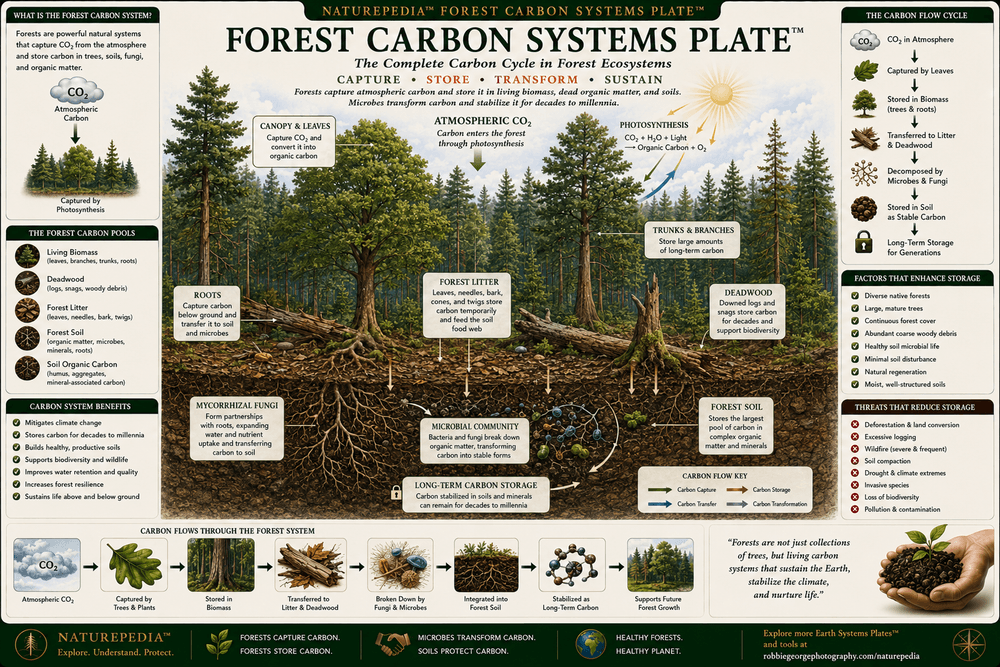
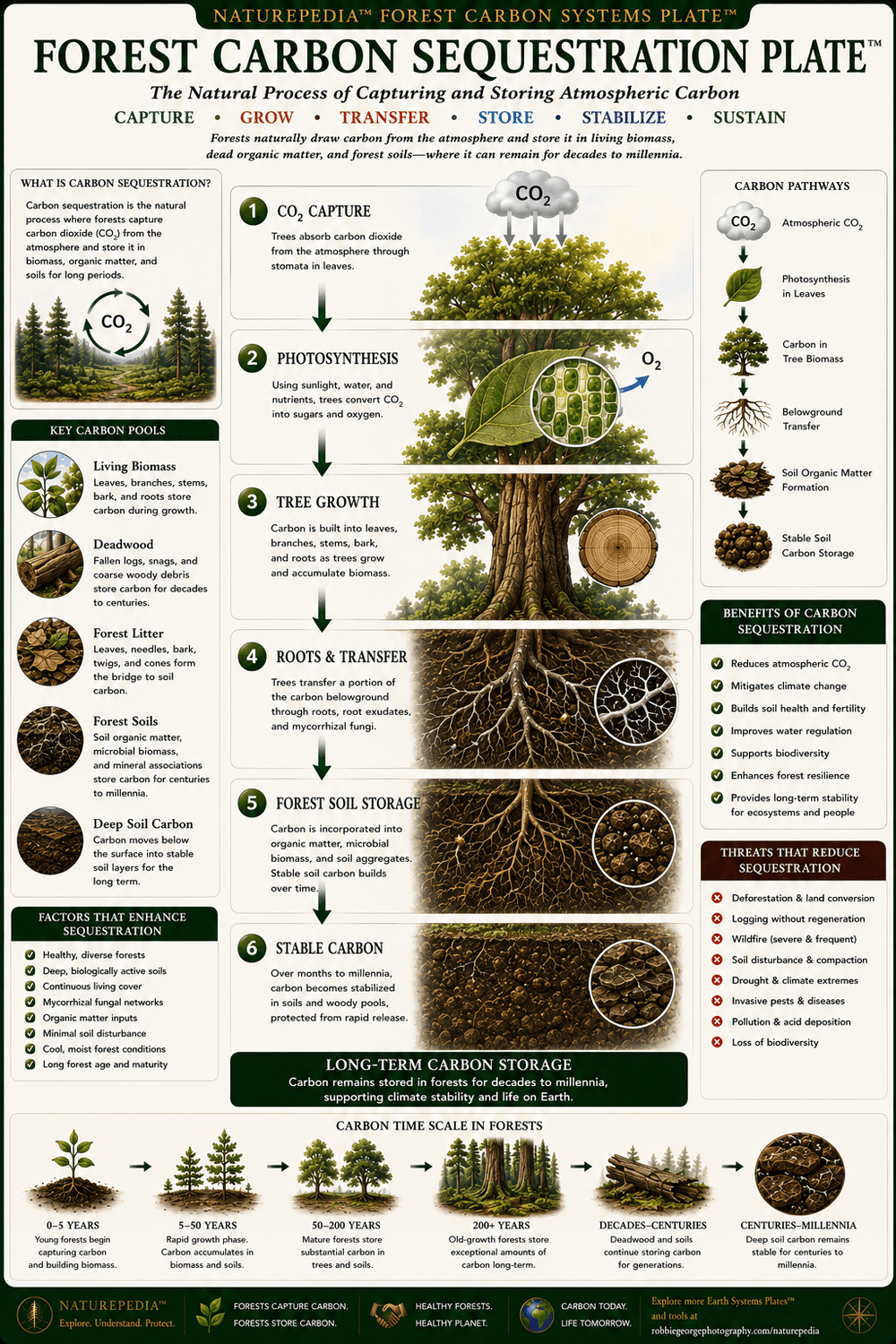
Naturepedia™ Forest Carbon Systems Plate

Forest Carbon Systems Plate™

Forest Carbon Systems™ maps how forests capture atmospheric carbon through photosynthesis, store it in living biomass, cycle it through roots, fungi, litter, deadwood, microbes, and soil, and sustain long-term carbon reservoirs that connect ecosystem resilience with climate regulation.

Forest Carbon Systems Plate showing atmospheric carbon dioxide, photosynthesis, tree canopy, living biomass, roots, mycorrhizal fungi, forest litter, deadwood, microbial decomposition, forest soil carbon, carbon storage, and ecosystem resilience.
Forest Carbon Systems Plate™ — a Naturepedia™ systems map of how forests capture, distribute, recycle, stabilize, and store carbon through living biomass, roots, fungi, forest litter, deadwood, microbial life, soil carbon, and ecological resilience.

Visible Plate ID: forest-carbon-systems#forest-carbon-systems-plate

Type: Naturepedia Forest Carbon Systems Plate™

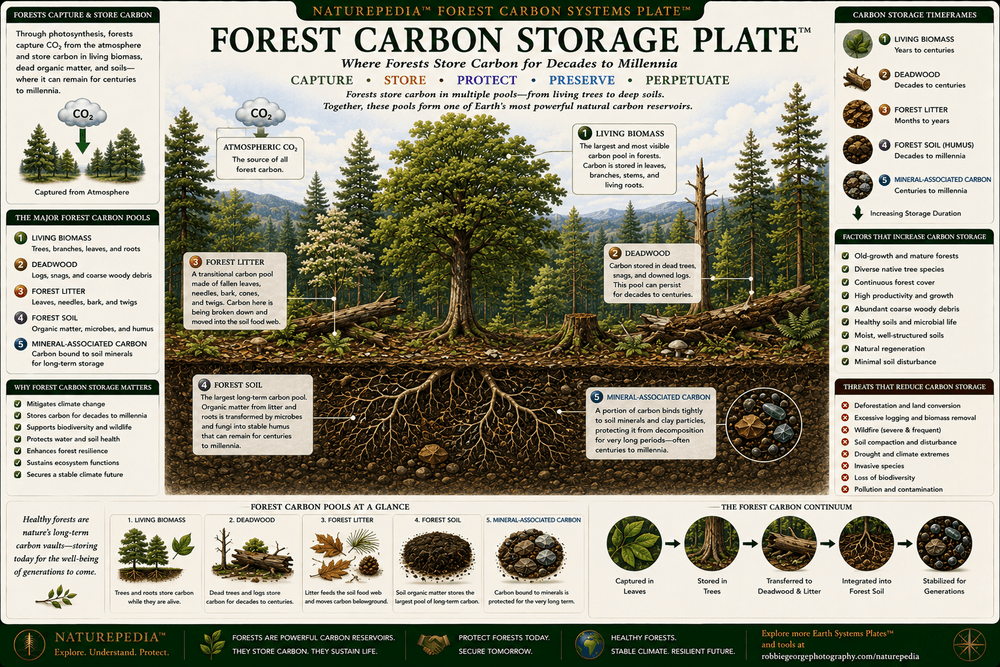
Forest Carbon Storage Plate

Forest Carbon Storage Plate™

Forest Carbon Storage™ explores where carbon is physically stored throughout forest ecosystems—from towering tree trunks and living roots to forest soils, woody debris, and underground biological networks that collectively form one of Earth's largest long-term carbon reservoirs.

Forest Carbon Storage Plate showing atmospheric carbon dioxide, trees, trunks, branches, roots, forest soils, living biomass, and long-term carbon storage.
Forest Carbon Storage Plate™ — illustrating where forests capture and physically retain carbon across living biomass, woody tissues, roots, and soils.

Visible Plate ID: forest-carbon-systems#forest-carbon-storage-plate

Type: Naturepedia Forest Carbon Storage Plate™

Where Forests Store Earth's Carbon

Forests store enormous quantities of carbon by transforming atmospheric carbon dioxide into living plant tissues through photosynthesis. Carbon becomes incorporated into leaves, bark, trunks, branches, roots, seeds, and woody fibers, allowing forests to function as vast biological reservoirs that continually expand as trees grow.

Not all forest carbon is stored above ground. Extensive root systems transport carbon into the soil where fungi, microbes, and mineral interactions help stabilize organic matter. In many mature forests, underground carbon pools equal or exceed the carbon stored within visible vegetation.

Deadwood, forest litter, and decomposing organic material also represent important carbon reservoirs. Rather than being wasted, these materials gradually transfer carbon into microbial biomass, humus, and stable soil organic matter that may remain protected for decades or centuries.

Forest Carbon Storage™ demonstrates that forests function as complete ecological systems. Carbon is continuously distributed among living trees, roots, fungi, forest floors, and soils, creating resilient reservoirs that support biodiversity while helping regulate Earth's climate.

Living Biomass

Trees continually capture atmospheric carbon and store it within trunks, branches, bark, leaves, roots, and woody tissues as they grow throughout their lives.

Belowground Storage

Roots, fungi, microbial communities, and forest soils hold vast amounts of carbon while supporting nutrient cycling, soil formation, and long-term ecosystem resilience.

Long-Term Reservoirs

Old-growth forests, deep soils, and slowly decomposing woody materials provide some of Earth's most durable natural carbon storage systems.

Naturepedia Connection

Forest Carbon Storage™ connects Forest Carbon Systems™, Carbon Cycle™, Carbon & Microbial Life™, Soil Carbon Systems™, Living Biomass™, Forest Soil Carbon™, Old-Growth Carbon™, Forest Carbon Sequestration™, Climate Carbon Feedbacks™, and Regenerative Forestry™. Together these Naturepedia™ systems reveal that carbon storage is an ecosystem-wide process sustained by living forests, healthy soils, fungal networks, microbial communities, and continuous biological renewal.

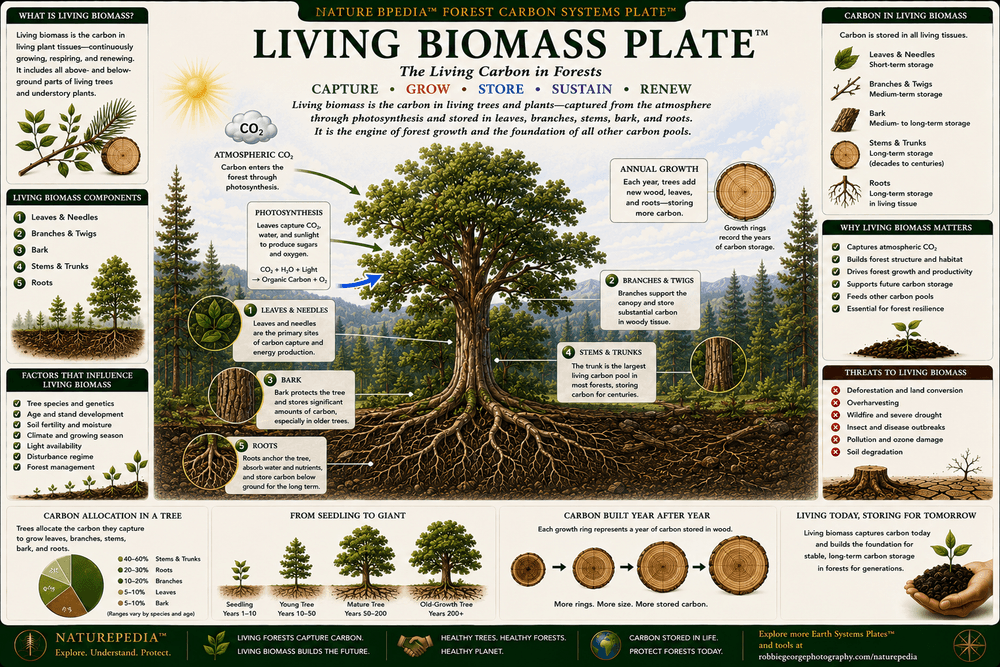
Living Biomass Plate

Living Biomass Plate™

Living Biomass™ explores how leaves, stems, bark, branches, trunks, and roots become active carbon pools as forests convert atmospheric carbon dioxide into living structure through photosynthesis and annual growth.

Living Biomass Plate showing leaves, stems, bark, branches, trunks, roots, photosynthesis, annual tree growth, and living forest carbon pools.
Living Biomass Plate™ — illustrating how active forest growth stores carbon within leaves, branches, bark, trunks, stems, roots, and woody tissues.

Visible Plate ID: forest-carbon-systems#living-biomass-plate

Type: Naturepedia Living Biomass Plate™

The Living Carbon Pools of the Forest

Living biomass is the visible body of forest carbon. Through photosynthesis, trees absorb carbon dioxide from the atmosphere and convert it into sugars that become leaves, bark, cambium, wood, branches, stems, roots, and new annual growth. Every ring within a tree trunk records years of captured carbon transformed into living structure.

Canopies act as solar collectors, using sunlight to power the conversion of atmospheric carbon into biological material. Some of this carbon supports immediate growth and respiration, while another portion is stored in durable woody tissues that may remain in the forest for decades or centuries.

Roots are also part of living biomass. They anchor trees, absorb water and nutrients, feed fungal partners, release carbon-rich exudates, and continually renew belowground tissues. As fine roots grow and die, they become one of the most direct pathways for transferring forest carbon into soil systems.

Living Biomass™ demonstrates that forests store carbon by growing. Every leaf, root tip, branch, and trunk is part of a living carbon economy that connects atmospheric carbon with forest structure, soil formation, biodiversity, and long-term ecosystem resilience.

Photosynthetic Growth

Leaves capture sunlight and atmospheric carbon dioxide, converting them into sugars that build living forest tissues.

Woody Carbon Storage

Trunks, branches, bark, stems, and growth rings store carbon in durable woody structures that support long-term forest carbon pools.

Root Carbon Pathways

Roots transfer carbon belowground through growth, root turnover, exudates, fungal partnerships, and direct contributions to forest soil carbon.

Naturepedia Connection

Living Biomass™ connects Forest Carbon Systems™, Forest Carbon Storage™, Forest Carbon Sequestration™, Carbon Cycle™, Plant Intelligence™, Mycorrhizal Networks™, Soil Carbon Systems™, Root Carbon Pathways™, Forest Soil Carbon™, Old-Growth Carbon™, and Climate Carbon Feedbacks™. Together these Naturepedia™ systems show how forest growth converts atmospheric carbon into living structure while feeding the underground processes that sustain long-term carbon storage.

Deadwood Carbon Plate

Deadwood Carbon Plate™

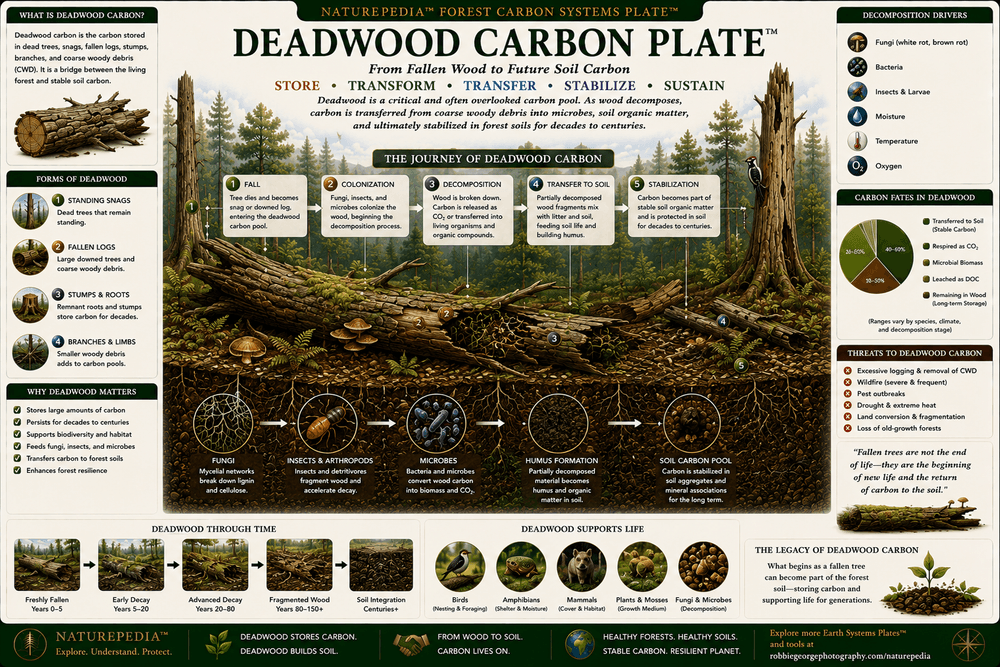
Deadwood Carbon™ explores how fallen logs, standing snags, woody debris, fungi, insects, and microbial decomposers recycle forest carbon while gradually building fertile soils and sustaining biodiversity.

Deadwood Carbon Plate showing fallen logs, standing snags, fungi, insects, microbial decomposition, forest floor, nutrient cycling, and soil carbon formation.
Deadwood Carbon Plate™ — illustrating how fallen wood becomes one of the forest's most important pathways for carbon recycling, biodiversity, and long-term soil formation.

Visible Plate ID: forest-carbon-systems#deadwood-carbon-plate

Type: Naturepedia Deadwood Carbon Plate™

From Fallen Trees to Future Forests

Dead wood represents one of the most overlooked carbon reservoirs within forest ecosystems. When trees fall or die naturally, the carbon stored within trunks, branches, bark, and roots does not disappear. Instead, it enters a slower biological pathway where fungi, insects, bacteria, and countless decomposers gradually recycle that carbon back into the living forest.

Fungi are often the first organisms to colonize dead wood. Their networks penetrate dense woody tissues, breaking down lignin and cellulose while making nutrients available to insects, microbes, mosses, and eventually young seedlings. This slow decomposition creates habitat for hundreds of forest species while steadily transferring carbon into surrounding soils.

Standing snags and fallen logs also regulate moisture, reduce erosion, retain nutrients, and provide protected environments where seedlings establish during forest succession. Carbon moves gradually from coarse woody debris into humus, microbial biomass, fungal tissues, and long-term soil organic matter, allowing forests to continually renew themselves.

Deadwood Carbon™ demonstrates that decomposition is not simply decay—it is one of nature's most important regenerative processes. Every fallen tree becomes the biological foundation for future forests while continuing its role within Earth's long-term carbon cycle.

Slow Carbon Release

Large woody debris stores carbon for decades while gradually releasing it through biological decomposition rather than rapid atmospheric return.

Habitat & Biodiversity

Dead wood supports fungi, insects, mosses, birds, amphibians, mammals, and countless organisms that depend upon decaying wood for shelter and food.

Future Soil Carbon

As dead wood decomposes, carbon is transferred into microbial communities, fungal biomass, humus, and forest soils where it contributes to long-term ecosystem stability.

Naturepedia Connection

Deadwood Carbon™ connects Forest Carbon Systems™, Forest Litter™, Forest Soil Carbon™, Carbon & Microbial Life™, Microbial Decomposition™, Soil Carbon Systems™, Mycorrhizal Networks™, Forest Resilience™, Old-Growth Carbon™, and Climate Carbon Feedbacks™. Together these Naturepedia™ systems illustrate how fallen trees continue supporting biodiversity, nutrient cycling, soil formation, and long-term forest carbon storage long after active growth has ended.

Forest Litter Plate

Forest Litter Plate™

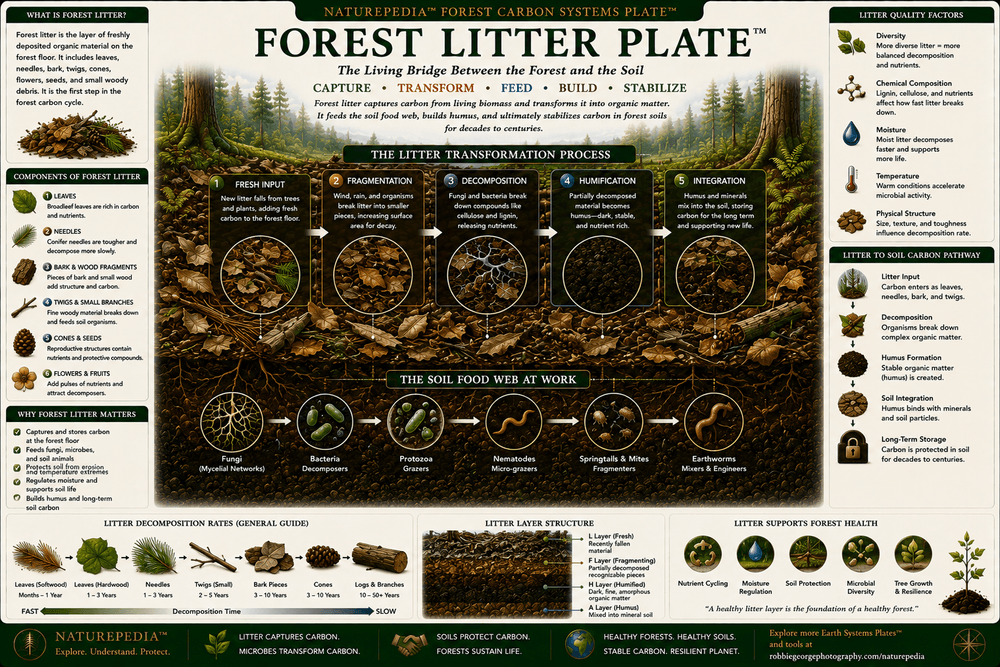
Forest Litter™ explores how fallen leaves, needles, bark, cones, twigs, and other organic materials form the living interface between forests and soils, where carbon begins its transformation into long-term biological storage.

Forest Litter Plate showing leaves, pine needles, bark, cones, twigs, fungi, microbes, forest floor decomposition, nutrient cycling, and forest soil carbon formation.
Forest Litter Plate™ — illustrating how organic material on the forest floor becomes the biological bridge between living forests and long-term soil carbon.

Visible Plate ID: forest-carbon-systems#forest-litter-plate

Type: Naturepedia Forest Litter Plate™

The Forest Floor: Where Carbon Begins Again

Each season forests deposit enormous amounts of organic material onto the ground. Leaves, pine needles, bark, cones, flowers, seeds, twigs, and small branches accumulate to form forest litter—a biologically active layer that protects soil while serving as the primary source of new organic carbon entering belowground ecosystems.

Rather than remaining on the surface, this organic layer is continuously colonized by fungi, bacteria, insects, earthworms, and countless other decomposers. Together these organisms fragment, consume, and transform litter into simpler compounds, gradually transferring carbon into microbial biomass, humus, mineral-associated organic matter, and stable forest soils.

Forest litter also moderates soil temperature, conserves moisture, reduces erosion, suppresses nutrient loss, and creates ideal conditions for seed germination and root development. This protective blanket links the living forest canopy with the hidden biological communities that sustain long-term ecosystem productivity.

Forest Litter™ demonstrates that every fallen leaf continues the carbon cycle. What appears to be seasonal debris is actually the beginning of a new generation of soil carbon, microbial life, forest regeneration, and ecological resilience.

Organic Carbon Inputs

Leaves, needles, bark, cones, flowers, and woody debris continually deliver fresh carbon to the forest floor each growing season.

Biological Transformation

Fungi, bacteria, insects, and other decomposers convert forest litter into microbial biomass, nutrients, humus, and stable soil carbon.

Living Soil Protection

Forest litter insulates soil, conserves moisture, reduces erosion, and creates favorable conditions for roots, fungi, and future forest regeneration.

Naturepedia Connection

Forest Litter™ connects Forest Carbon Systems™, Deadwood Carbon™, Forest Soil Carbon™, Carbon & Microbial Life™, Microbial Decomposition™, Soil Carbon Systems™, Mycorrhizal Networks™, Forest Resilience™, Carbon Cycle™, and Regenerative Forestry™. Together these Naturepedia™ systems illustrate how organic material on the forest floor fuels the biological processes that regenerate soils, recycle nutrients, and sustain long-term forest carbon storage.

Forest Soil Carbon Plate

Forest Soil Carbon Plate™

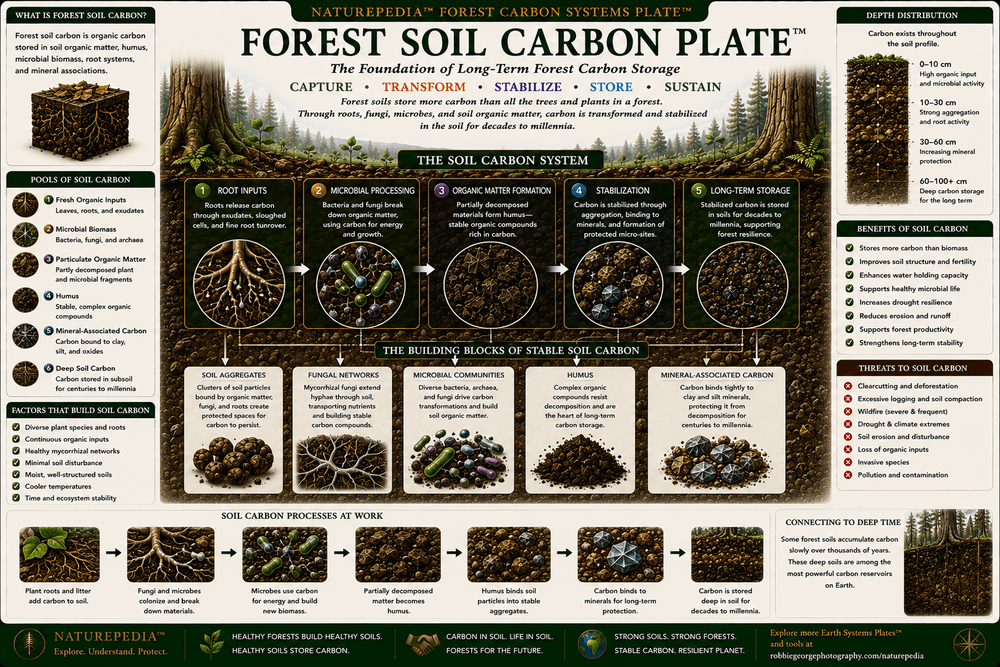
Forest Soil Carbon™ explores how roots, fungi, microbial life, humus, soil aggregates, and organic matter transform forest carbon into one of Earth's most stable and resilient long-term carbon reservoirs.

Forest Soil Carbon Plate showing tree roots, mycorrhizal fungi, microbial life, humus, soil aggregates, forest organic matter, stable soil carbon, and long-term carbon storage.
Forest Soil Carbon Plate™ — illustrating how roots, fungi, microbes, and organic matter transform forest carbon into one of Earth's largest long-term carbon reservoirs.

Visible Plate ID: forest-carbon-systems#forest-soil-carbon-plate

Type: Naturepedia Forest Soil Carbon Plate™

The Hidden Carbon Reservoir Beneath Every Forest

Although towering trees dominate the landscape, much of a forest's carbon lies beneath the surface. Forest soils receive a continual supply of organic carbon from roots, fungal networks, forest litter, deadwood, and microbial activity. Over time these materials become transformed into humus, mineral-associated organic matter, soil aggregates, and other stable forms of soil carbon.

Living roots continuously transport carbon belowground through root growth and carbon-rich exudates that feed fungi and microbial communities. Mycorrhizal fungi extend this process by exchanging nutrients for plant sugars while transporting carbon throughout extensive underground networks. These biological relationships strengthen soil structure and help protect carbon from rapid decomposition.

As microbes process organic matter, portions of that carbon become microbial biomass, microbial necromass, and stable soil organic matter that may remain stored for decades or centuries. Healthy forest soils therefore function as dynamic living systems where carbon is continually renewed rather than simply buried.

Forest Soil Carbon™ demonstrates that forests build resilience from the ground up. The hidden biological processes beneath the forest floor sustain tree growth, biodiversity, nutrient cycling, water retention, and one of Earth's most important long-term carbon sinks.

Root Carbon Transfer

Living roots continually deliver carbon into the soil through growth, root turnover, and carbon-rich exudates that nourish underground biological communities.

Microbial & Fungal Networks

Mycorrhizal fungi and microbial communities transform organic matter into humus, microbial biomass, and stable soil carbon while supporting healthy forest ecosystems.

Long-Term Carbon Storage

Protected within soil aggregates and mineral associations, forest soil carbon forms one of the planet's largest and most durable natural carbon reservoirs.

Naturepedia Connection

Forest Soil Carbon™ serves as the ecological bridge connecting Forest Carbon Systems™, Soil Carbon Systems™, Carbon & Microbial Life™, Microbial Carbon Stabilization™, Microbial Carbon Pump™, Mycorrhizal Networks™, Plant Intelligence™, Carbon Cycle™, Forest Carbon Sequestration™, Old-Growth Carbon™, and Quantum Agriculture™. Together these Naturepedia™ systems reveal that the greatest long-term forest carbon storage often occurs beneath the forest floor through living biological relationships rather than within trees alone.

Old-Growth Carbon Plate

Old-Growth Carbon Plate™

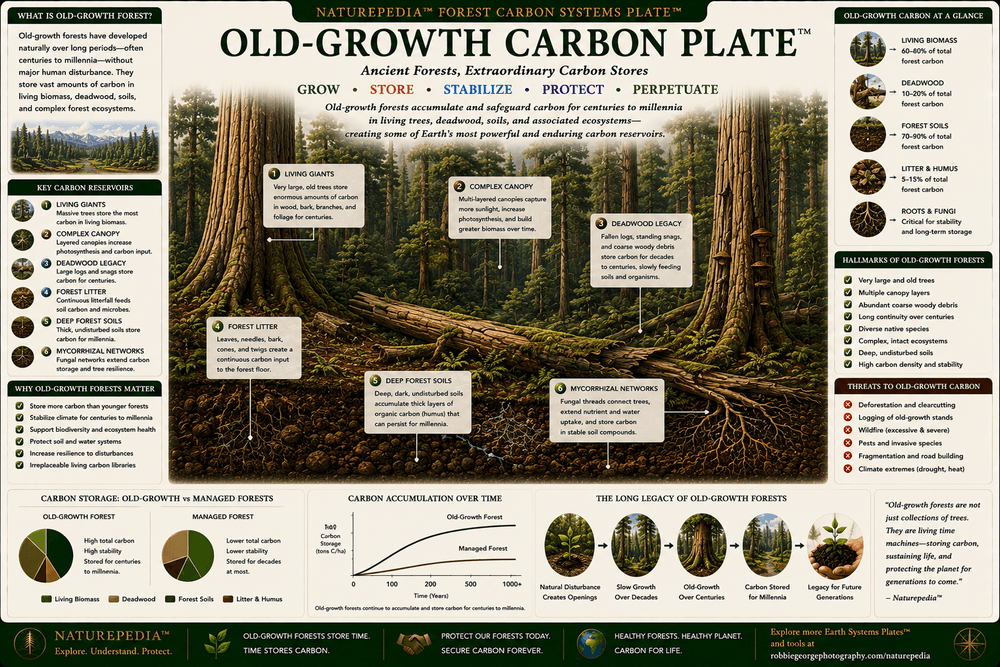
Old-Growth Carbon™ explores why mature forests serve as some of Earth's most valuable long-term carbon reservoirs through massive living biomass, deep forest soils, layered canopies, and centuries of uninterrupted ecological succession.

Old-Growth Carbon Plate showing ancient trees, layered forest canopy, coarse woody debris, deep forest soils, fungal networks, biodiversity, and long-term forest carbon storage.
Old-Growth Carbon Plate™ — illustrating how ancient forests accumulate and protect carbon across living trees, woody debris, fungi, and deep forest soils over centuries.

Visible Plate ID: forest-carbon-systems#old-growth-carbon-plate

Type: Naturepedia Old-Growth Carbon Plate™

Centuries of Carbon Stored Within Living Forests

Old-growth forests represent the culmination of centuries of uninterrupted ecological development. Massive trees, layered canopies, standing snags, fallen logs, deep root systems, and rich forest soils work together to create one of the planet's most stable and productive long-term carbon reservoirs.

Unlike younger forests that primarily store carbon within rapidly growing trees, old-growth ecosystems contain enormous quantities of carbon distributed throughout every layer of the forest. Living biomass, coarse woody debris, fungal networks, microbial communities, forest litter, and deep organic soils continually exchange carbon while maintaining remarkable ecological stability.

Modern ecological research increasingly recognizes that old-growth forests continue accumulating carbon well beyond maturity. Large trees remain highly productive, while centuries of decomposition gradually build exceptionally rich soil carbon pools protected beneath intact forest ecosystems. Rather than reaching a carbon limit, these forests become increasingly complex carbon networks through time.

Old-Growth Carbon™ demonstrates that protecting mature forests safeguards far more than individual trees. It preserves centuries of biological relationships that quietly regulate biodiversity, water cycles, nutrient renewal, and one of Earth's most enduring natural carbon sinks.

Ancient Living Biomass

Large mature trees contain enormous stores of carbon accumulated through centuries of uninterrupted growth and photosynthesis.

Deep Ecological Layers

Multiple canopy layers, deadwood, fungi, forest litter, and deep soils create interconnected carbon reservoirs that strengthen ecosystem resilience.

Long-Term Stability

Old-growth forests protect carbon through continuous biological renewal, allowing carbon to remain stored across generations while supporting extraordinary biodiversity.

Naturepedia Connection

Old-Growth Carbon™ connects Forest Carbon Systems™, Forest Carbon Storage™, Living Biomass™, Deadwood Carbon™, Forest Soil Carbon™, Carbon Cycle™, Mycorrhizal Networks™, Soil Carbon Systems™, Forest Resilience™, Climate Carbon Feedbacks™, and Ecosystem Feedbacks™. Together these Naturepedia™ systems reveal that the world's oldest forests are not static landscapes but living carbon networks that continue storing, recycling, and protecting carbon across centuries of ecological succession.

Forest Carbon Sequestration Plate

Forest Carbon Sequestration Plate™

Forest Carbon Sequestration™ explores how forests remove carbon dioxide from the atmosphere through photosynthesis and gradually transfer that carbon into trees, roots, forest soils, and long-term biological storage.

Forest Carbon Sequestration Plate illustrating atmospheric carbon dioxide, photosynthesis, tree growth, roots, forest soils, and long-term carbon storage.
Forest Carbon Sequestration Plate™ — illustrating the continuous pathway of atmospheric carbon into living forests, underground ecosystems, and long-term carbon storage.

Visible Plate ID: forest-carbon-systems#forest-carbon-sequestration-plate

Type: Naturepedia Forest Carbon Sequestration Plate™

How Forests Remove Carbon From the Atmosphere

Forest carbon sequestration begins with one of Earth's most remarkable biological processes—photosynthesis. Using sunlight, water, and atmospheric carbon dioxide, trees manufacture sugars that fuel growth while removing carbon from the atmosphere. Every new leaf, branch, trunk, and root represents carbon that has been captured and incorporated into living biomass.

Sequestration continues well beyond the visible tree. Carbon moves through roots into mycorrhizal fungal networks, feeds microbial communities, becomes incorporated into forest litter, and eventually enters stable soil organic matter. This underground biological pathway often stores carbon for much longer periods than living vegetation alone.

Healthy forests maximize carbon sequestration through continuous growth, diverse plant communities, intact soils, and functioning microbial ecosystems. Disturbance, deforestation, and soil degradation interrupt these processes, while resilient forests continually renew them through natural succession and regeneration.

Forest Carbon Sequestration™ demonstrates that forests are dynamic carbon engines rather than passive storage sites. Through countless biological interactions, they continually capture atmospheric carbon and distribute it throughout the living ecosystem where it supports biodiversity, soil formation, water regulation, and long-term climate stability.

Atmospheric Carbon Capture

Photosynthesis removes carbon dioxide from the atmosphere and transforms it into living plant tissues that fuel forest growth.

Underground Carbon Transfer

Roots, fungal networks, and microbial communities move carbon into forest soils where it becomes stabilized through biological and mineral interactions.

Long-Term Climate Regulation

Continuous carbon sequestration allows healthy forests to regulate atmospheric carbon while supporting biodiversity, ecosystem resilience, and global carbon balance.

Naturepedia Connection

Forest Carbon Sequestration™ connects Forest Carbon Systems™, Forest Carbon Storage™, Living Biomass™, Forest Soil Carbon™, Carbon Cycle™, Soil Carbon Systems™, Carbon & Microbial Life™, Mycorrhizal Networks™, Climate Carbon Feedbacks™, Regenerative Forestry™, and Quantum Agriculture™. Together these Naturepedia™ systems demonstrate how forests continuously remove atmospheric carbon and distribute it throughout living ecosystems, creating one of Earth's most effective natural climate regulation processes.

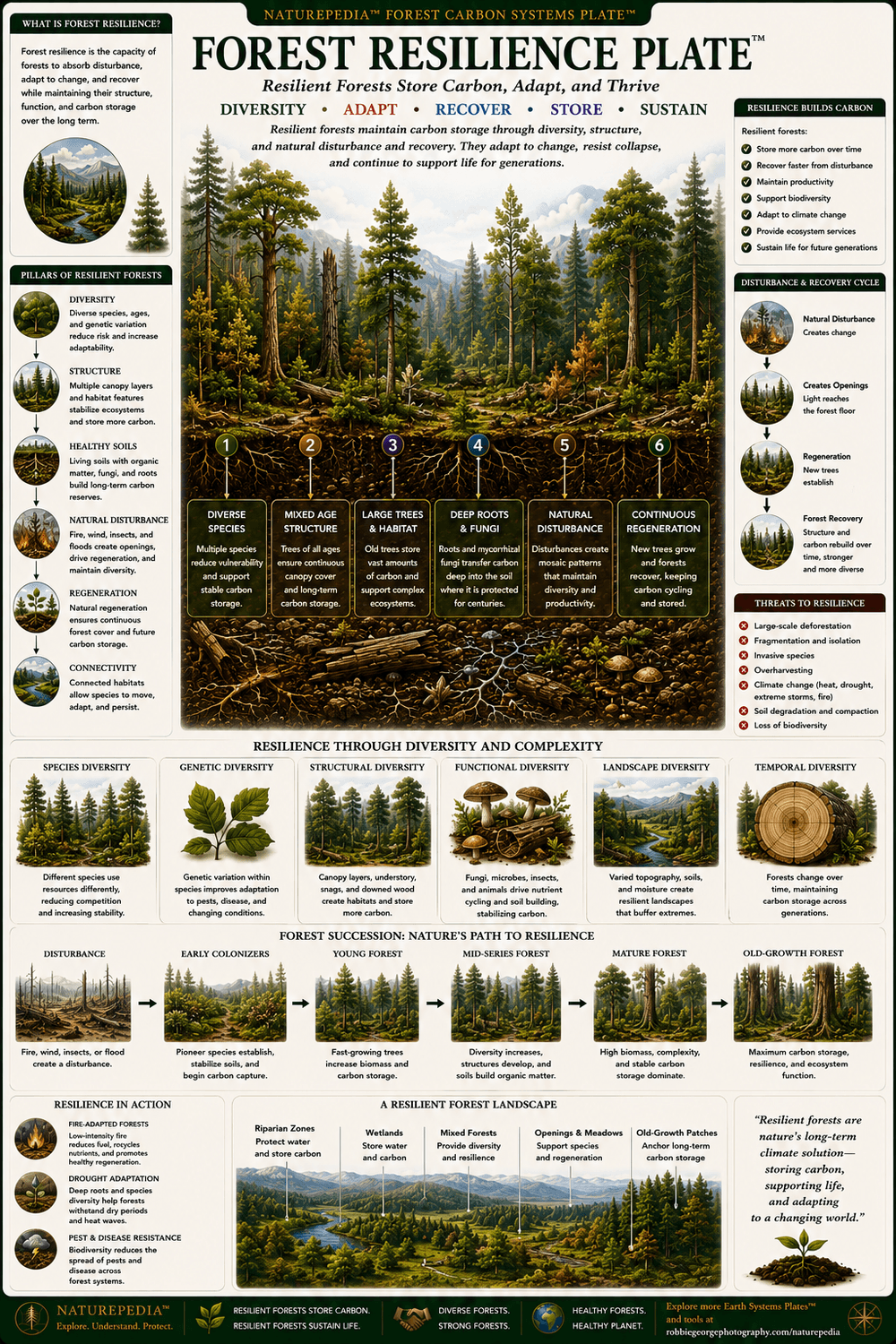
Forest Resilience Plate

Forest Resilience Plate™

Forest Resilience™ explores how biodiversity, natural regeneration, ecological succession, and healthy biological relationships allow forests to recover from disturbance while protecting long-term carbon storage.

Forest Resilience Plate showing biodiversity, forest succession, natural regeneration, healthy understory, resilient ecosystems, carbon storage, and recovery from disturbance.
Forest Resilience Plate™ — illustrating how diverse forests recover from disturbance while maintaining biodiversity, ecological function, and long-term carbon storage.

Visible Plate ID: forest-carbon-systems#forest-resilience-plate

Type: Naturepedia Forest Resilience Plate™

Healthy Forests Recover, Adapt, and Continue Storing Carbon

Forests are dynamic living systems that continually experience storms, droughts, insect outbreaks, flooding, fire, and natural tree mortality. Rather than collapsing after disturbance, healthy forests possess remarkable resilience that allows ecological processes to recover while maintaining long-term carbon storage and biological diversity.

Biodiversity is central to this resilience. Forests composed of diverse tree species, understory plants, fungi, wildlife, and microbial communities respond more effectively to environmental change because ecological functions are distributed across many interconnected organisms. If one species declines, others continue supporting nutrient cycling, regeneration, and carbon capture.

Natural succession continually rebuilds forests after disturbance. Seedlings establish beneath mature canopies, fungi reconnect root systems, decomposers recycle nutrients from fallen wood, and new generations gradually replace older trees. These regenerative processes allow forests to remain productive carbon sinks across centuries despite periodic environmental change.

Forest Resilience™ demonstrates that resilience is not resistance to change—it is the ability of living systems to adapt, regenerate, and continue functioning while sustaining biodiversity, healthy soils, and Earth's long-term carbon balance.

Biodiversity

Diverse forests distribute ecological functions across many species, strengthening carbon storage, nutrient cycling, and ecosystem stability.

Natural Regeneration

Seedlings, fungi, forest litter, and soil biology work together to rebuild forests naturally after disturbance while renewing carbon storage.

Long-Term Carbon Stability

Resilient forests continue capturing and storing carbon because healthy ecological relationships persist through cycles of disturbance and recovery.

Naturepedia Connection

Forest Resilience™ connects Forest Carbon Systems™, Regenerative Forestry™, Old-Growth Carbon™, Forest Soil Carbon™, Deadwood Carbon™, Carbon Cycle™, Ecosystem Feedbacks™, Carbon & Microbial Life™, Climate Carbon Feedbacks™, Water Systems™, and Quantum Agriculture™. Together these Naturepedia™ systems reveal that resilient forests protect carbon not by remaining unchanged, but by continually regenerating through biodiversity, succession, and healthy ecological relationships.

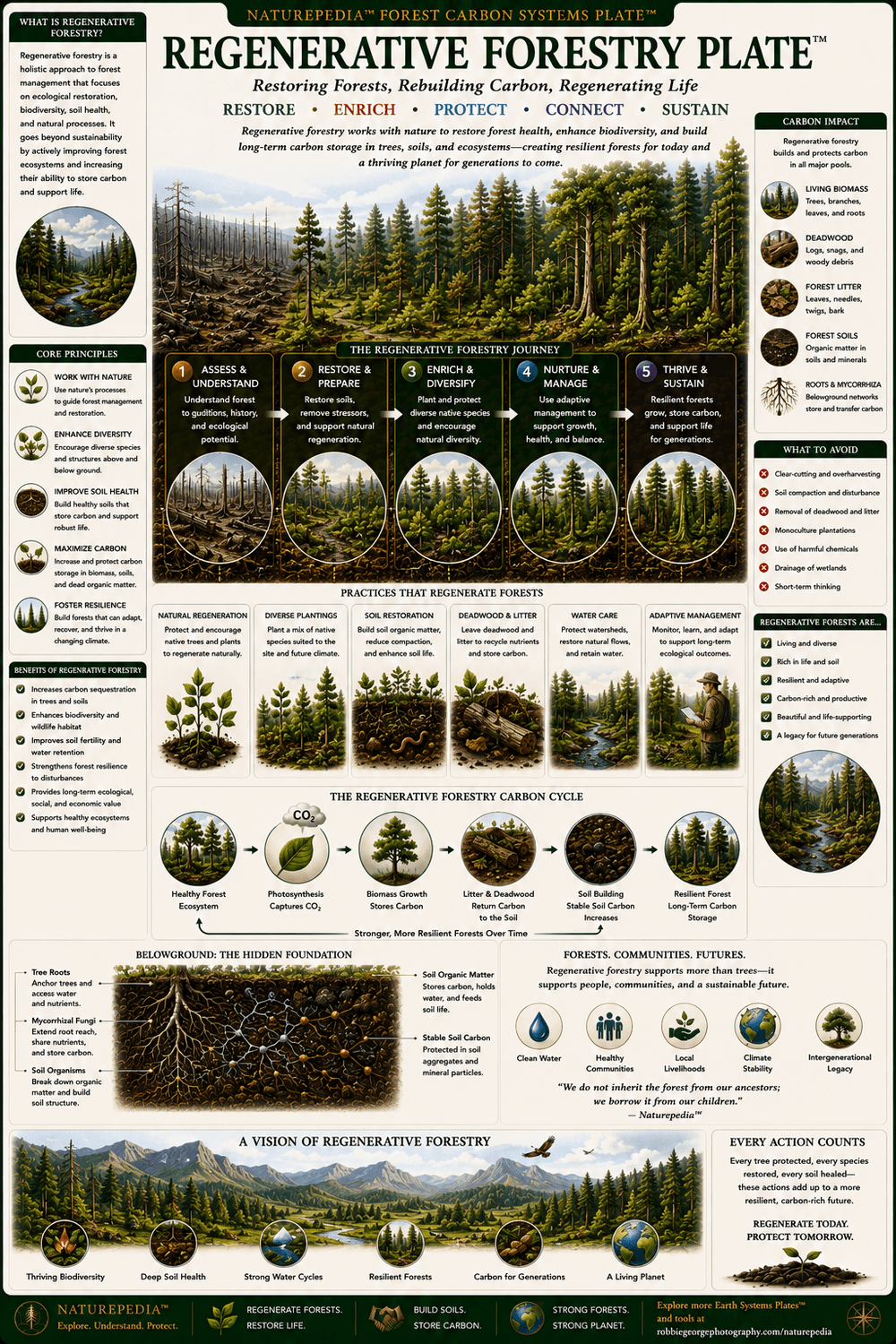
Regenerative Forestry Plate

Regenerative Forestry Plate™

Regenerative Forestry™ explores how thoughtful forest stewardship strengthens biodiversity, protects soils, encourages natural regeneration, and enhances long-term carbon storage by working with ecological processes instead of against them.

Regenerative Forestry Plate showing selective harvesting, mixed-age forest, natural regeneration, healthy understory, living soils, biodiversity, and resilient carbon storage.
Regenerative Forestry Plate™ — illustrating how ecological forest management supports biodiversity, resilient carbon storage, healthy soils, and natural forest renewal.

Visible Plate ID: forest-carbon-systems#regenerative-forestry-plate

Type: Naturepedia Regenerative Forestry Plate™

Working With Forests Instead of Against Them

Regenerative forestry recognizes that healthy forests are complex living ecosystems rather than collections of marketable trees. Effective stewardship protects the biological relationships among trees, soils, fungi, wildlife, and water while allowing forests to continue capturing and storing carbon across generations.

Instead of maximizing short-term extraction, regenerative forestry emphasizes selective harvesting, mixed-age forests, natural regeneration, intact forest soils, healthy understories, and the preservation of habitat trees and coarse woody debris. These practices maintain continuous forest cover while reducing erosion, protecting biodiversity, and strengthening ecosystem resilience.

Healthy forest management also protects the invisible biological infrastructure beneath the surface. Intact soils, fungal networks, microbial communities, and root systems continue cycling nutrients and storing carbon long after individual harvesting events, allowing forests to remain productive carbon sinks while supporting wildlife and watershed health.

Regenerative Forestry™ demonstrates that responsible stewardship works with nature's own regenerative capacity. By supporting ecological succession rather than disrupting it, forests continue providing timber, wildlife habitat, clean water, biodiversity, and long-term carbon storage simultaneously.

Selective Stewardship

Carefully managed harvesting preserves forest structure, maintains continuous canopy cover, and allows healthy trees to continue capturing atmospheric carbon.

Healthy Living Soils

Protecting forest soils, fungal networks, and microbial communities preserves the biological engine responsible for nutrient cycling and long-term carbon stabilization.

Resilient Forest Landscapes

Diverse age classes, natural regeneration, healthy understories, and intact ecological processes strengthen forest resilience while supporting continuous carbon sequestration.

Naturepedia Connection

Regenerative Forestry™ connects Forest Carbon Systems™, Forest Resilience™, Forest Carbon Sequestration™, Forest Soil Carbon™, Carbon Cycle™, Carbon & Microbial Life™, Soil Carbon Systems™, Ecosystem Feedbacks™, Water Systems™, Climate Carbon Feedbacks™, and Quantum Agriculture™. Together these Naturepedia™ systems demonstrate that long-term carbon storage is strengthened when forests are managed as living ecosystems where biodiversity, soils, fungi, water, and trees function as one interconnected biological network.

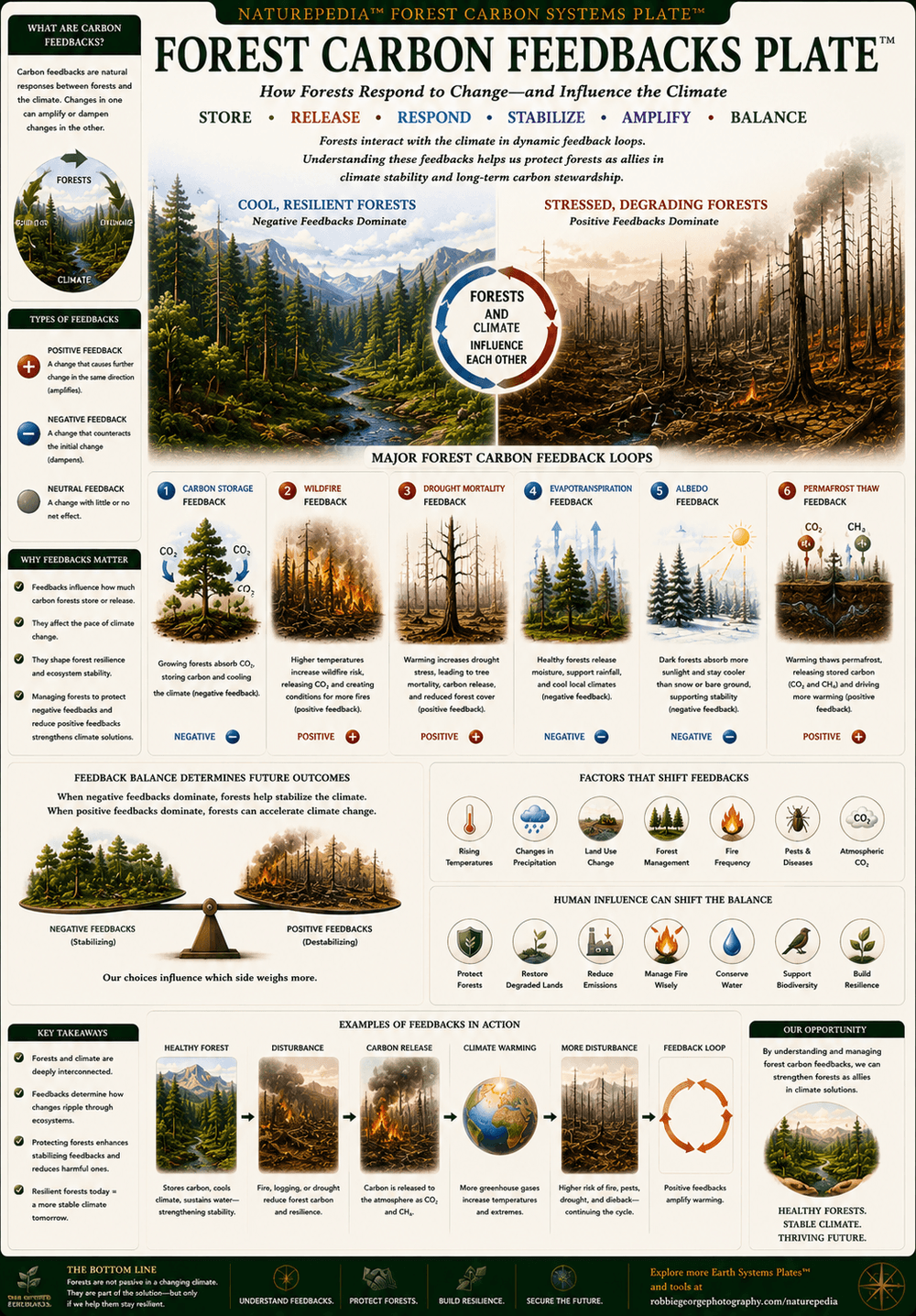
Forest Carbon Feedbacks Plate

Forest Carbon Feedbacks Plate™

Forest Carbon Feedbacks™ explores how fire, drought, storms, insects, recovery, regeneration, and atmospheric carbon exchange shape whether forests function as carbon sinks, carbon sources, or resilient carbon systems through time.

Forest Carbon Feedbacks Plate showing wildfire, drought, storms, insects, forest recovery, regeneration, atmospheric carbon exchange, carbon release, and resilient forest carbon storage.
Forest Carbon Feedbacks Plate™ — illustrating how disturbance, recovery, and regeneration determine how forest carbon systems interact with Earth's changing climate.

Visible Plate ID: forest-carbon-systems#forest-carbon-feedbacks-plate

Type: Naturepedia Forest Carbon Feedbacks Plate™

When Forest Carbon Systems Respond to Change

Forest carbon systems are continually shaped by feedbacks between vegetation, atmosphere, soils, water, disturbance, and recovery. Fire, drought, storms, insect outbreaks, disease, and shifting growing conditions can release stored carbon, reduce photosynthesis, alter decomposition, or change the balance between carbon capture and carbon loss.

At the same time, forests are also regenerative systems. After disturbance, seedlings establish, roots regrow, fungi reconnect soil networks, deadwood feeds decomposers, and new biomass begins capturing atmospheric carbon again. The speed and strength of this recovery determines whether a forest carbon system remains resilient through time.

Forest carbon feedbacks are therefore not simply about loss. They reveal how living ecosystems respond to stress, reorganize biological relationships, and either rebuild or weaken carbon storage depending on biodiversity, soil health, water availability, disturbance intensity, and ecological continuity.

Forest Carbon Feedbacks™ forms the bridge into Climate Carbon Feedbacks™ by showing how forests connect local ecosystem processes with planetary carbon balance. Understanding these feedbacks helps explain why healthy forests, living soils, microbial communities, and regenerative stewardship are central to long-term climate resilience.

Disturbance & Carbon Release

Fire, drought, insects, storms, and disease can release stored carbon or slow carbon capture by altering forest growth, decomposition, and soil processes.

Recovery & Regeneration

Seedlings, roots, fungi, microbes, deadwood, and forest litter help rebuild carbon capture after disturbance through succession and ecological renewal.

Climate Connection

Forest carbon feedbacks connect local ecosystem health with atmospheric carbon, climate regulation, water cycles, and long-term planetary resilience.

Naturepedia Connection

Forest Carbon Feedbacks™ connects Forest Carbon Systems™, Forest Resilience™, Regenerative Forestry™, Carbon Cycle™, Carbon & Microbial Life™, Soil Carbon Systems™, Water Systems™, Ecosystem Feedbacks™, Climate Carbon Feedbacks™, and Quantum Agriculture™. Together these Naturepedia™ systems reveal how forest disturbance, recovery, microbial life, soil carbon, water availability, and atmospheric carbon interact to shape Earth's long-term carbon balance.

About The Author

Robbie George

Nature photographer Robbie George photographing a mature forest ecosystem.

Years spent photographing forests have revealed that every woodland is a living network where carbon, water, fungi, wildlife, and time are woven together.

My understanding of forest carbon did not come from studying forests as isolated stands of trees—it came from years of quietly observing how entire ecosystems function together. Whether walking through ancient spruce forests, autumn hardwoods, moss-covered woodlands, or mountain forests across North America, I became increasingly aware that every fallen log, fungal network, and layer of soil tells part of the same carbon story.

My background in regenerative agriculture further transformed how I viewed forests. Healthy soils, living roots, microbial communities, and mycorrhizal fungi continually move carbon beneath the surface while supporting every tree above it. Forests are not simply collections of individual plants—they are living biological systems whose greatest strength lies in the relationships connecting atmosphere, vegetation, soils, fungi, microbes, water, and wildlife.

As a National Geographic nature photographer, I have photographed forests throughout New England, the Rocky Mountains, Appalachia, the Pacific Coast, wetlands, and protected wilderness areas. Spending time within these landscapes has reinforced an important lesson: forests reveal their complexity slowly. Careful observation shows that decomposition, regeneration, biodiversity, and succession are not separate events but continuous expressions of one living carbon cycle.

Naturepedia™ brings these hidden relationships into view. Forest Carbon Systems™ combines ecological observation, regenerative agriculture, scientific research, and nature photography to illustrate how forests quietly regulate Earth's carbon balance through countless biological interactions occurring above and below ground.

The more time I spend in healthy forests, the more I appreciate that their greatest strength is not simply the size of their trees but the resilience of the relationships connecting every root, fungus, microbe, stream, bird, insect, and ray of sunlight. Forests remind us that nature stores carbon by sustaining life itself.

"Forests remind us that nature stores carbon by sustaining life itself."

— Robbie George

Forest Carbon Systems™ FAQ

Frequently Asked Questions

What are Forest Carbon Systems™?

Forest Carbon Systems™ explains how forests capture atmospheric carbon through photosynthesis, store it in living biomass, transfer it through roots and fungi, recycle it through litter and deadwood, and stabilize it within forest soils.

How do forests store carbon?

Forests store carbon in leaves, branches, trunks, bark, roots, deadwood, forest litter, fungi, microbial biomass, humus, and soil organic matter.

Why is living biomass important?

Living biomass represents the active carbon stored in trees and plants. As forests grow, carbon becomes incorporated into wood, roots, bark, foliage, and annual growth.

Why does deadwood matter for forest carbon?

Deadwood stores carbon while gradually feeding fungi, insects, microbes, and forest soils. Fallen logs and standing snags support biodiversity and help transfer carbon into long-term soil pools.

What is forest litter?

Forest litter is the layer of fallen leaves, needles, bark, cones, twigs, and organic material on the forest floor. It protects soil and provides carbon for decomposers and microbial life.

How do forest soils store carbon?

Forest soils store carbon through roots, fungal networks, microbial biomass, microbial necromass, humus, soil aggregates, and mineral-associated organic matter.

Why are old-growth forests important for carbon?

Old-growth forests store carbon across massive living trees, deep soils, deadwood, layered canopies, fungal networks, and centuries of accumulated organic matter.

What is forest carbon sequestration?

Forest carbon sequestration is the process by which forests remove carbon dioxide from the atmosphere through photosynthesis and store it in trees, roots, soils, and long-term biological carbon pools.

How does forest resilience affect carbon storage?

Resilient forests recover from disturbance through biodiversity, regeneration, succession, healthy soils, and intact biological relationships, allowing carbon storage to continue through time.

What is regenerative forestry?

Regenerative forestry is an ecological approach to forest stewardship that protects soils, supports biodiversity, encourages natural regeneration, preserves forest structure, and strengthens long-term carbon storage.

How do forest carbon systems connect to climate?

Forest carbon systems influence climate by regulating carbon exchange between forests, soils, and the atmosphere. Healthy forests capture carbon, store it in living and soil systems, and recover more effectively from disturbance.


Trusted Art Seller

Trusted Art Seller

The presence of this badge signifies that this business has officially registered with the Art Storefronts Organization and has an established track record of selling art.

It also means that buyers can trust that they are buying from a legitimate business. Art sellers that conduct fraudulent activity or that receive numerous complaints from buyers will have this badge revoked. If you would like to file a complaint about this seller, please do so here.

Verified Returns & Exchanges

Verified Returns & Exchanges

The Art Storefronts Organization has verified that this business has provided a returns & exchanges policy for all art purchases.

Description of Policy from Merchant:

What is your Policy on Returns/Exchanges/Refunds? I take great pride in my work and prints, and I want you to be completely happy with your investment in my nature art. If for any reason you are unsatisfied with your print, you may return it within 14 days of delivery, and/or exchange it for another print. Prints must be returned in new condition, packaged carefully in the original packaging if possible. Your refund will be issued as soon as I receive the returned print. Please contact me if you would like to arrange a return or exchange. In the event that you receive a damaged or defective print, please let me know within 7 days of receipt, and I will arrange for a new print to be shipped to you at no additional cost.

Verified Secure Website with Safe Checkout

Verified Secure Website with Safe Checkout

This website provides a secure checkout with SSL encryption.

Verified Archival Materials Used

Verified Archival Materials Used

The Art Storefronts Organization has verified that this Art Seller has published information about the archival materials used to create their products in an effort to provide transparency to buyers.

Description from Merchant:

Fine Art Prints are made with high-quality archival inks on fine art papers using a high-resolution large format inkjet printer. Our premium archival inks produce images with smooth tones and rich colors. Prints are made with care on your choice of exquisite Fine Art Papers using a high-resolution large format inkjet printer. https://www.graphikprintworks.com

Cart

Your cart is currently empty.

Saved Successfully.

This is only visible to you because you are logged in and are authorized to manage this website. This message is not visible to other website visitors.

Import From Instagram

Click on any Image to continue

This Website Supports Augmented Reality to Live Preview Art

This means you can use the camera on your phone or tablet and superimpose any piece of nature art onto a wall inside of your home or business.

To use this feature, Just look for the "Live Preview AR" button when viewing any piece of nature art on this website!

🦊 Pounce now for 20% off

No thanks