What is a fractal?
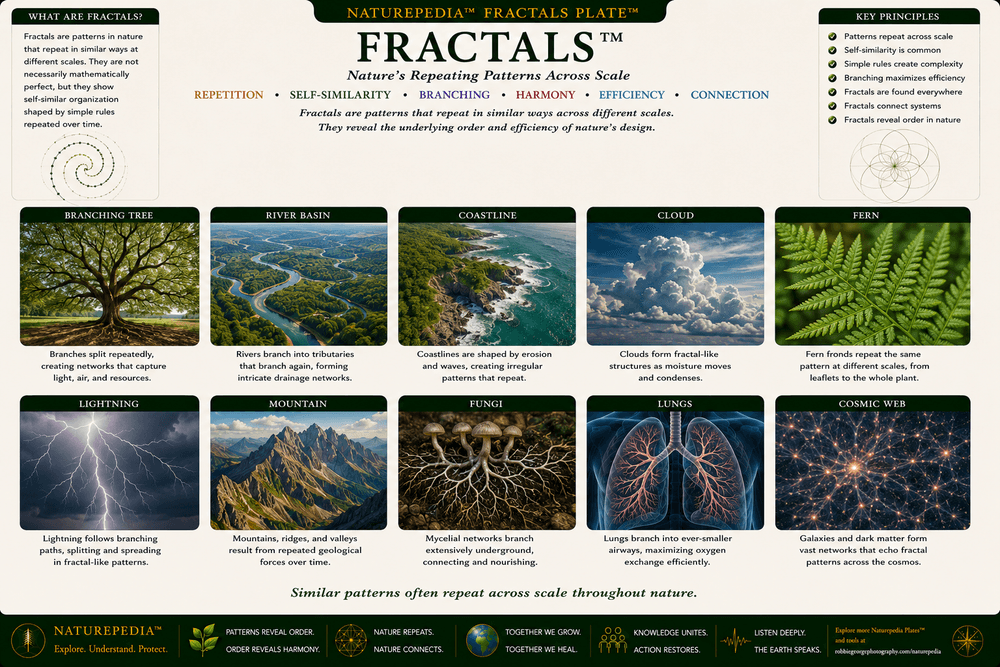
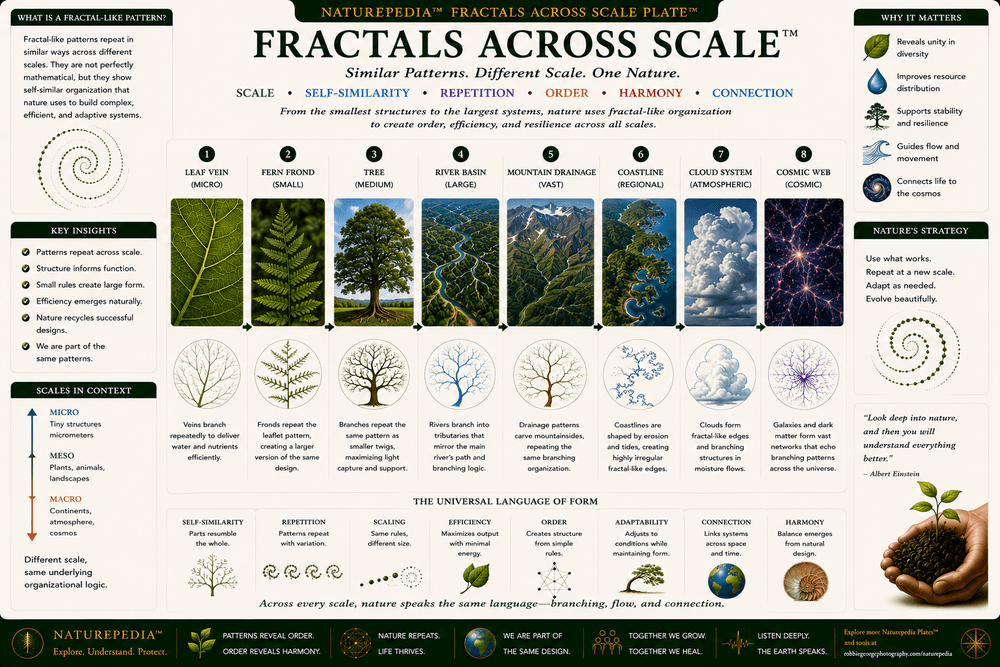
A fractal is a geometric pattern that repeats similar structure across different scales. Mathematical fractals can repeat infinitely, while many natural systems display fractal-like organization that approximates these repeating patterns.
What are fractals in nature?
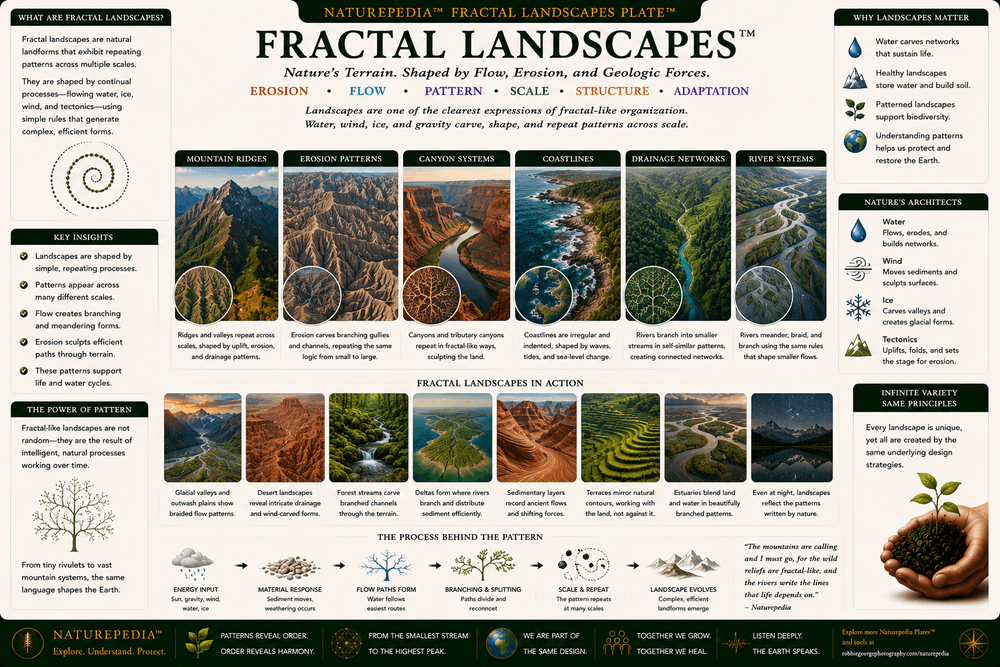
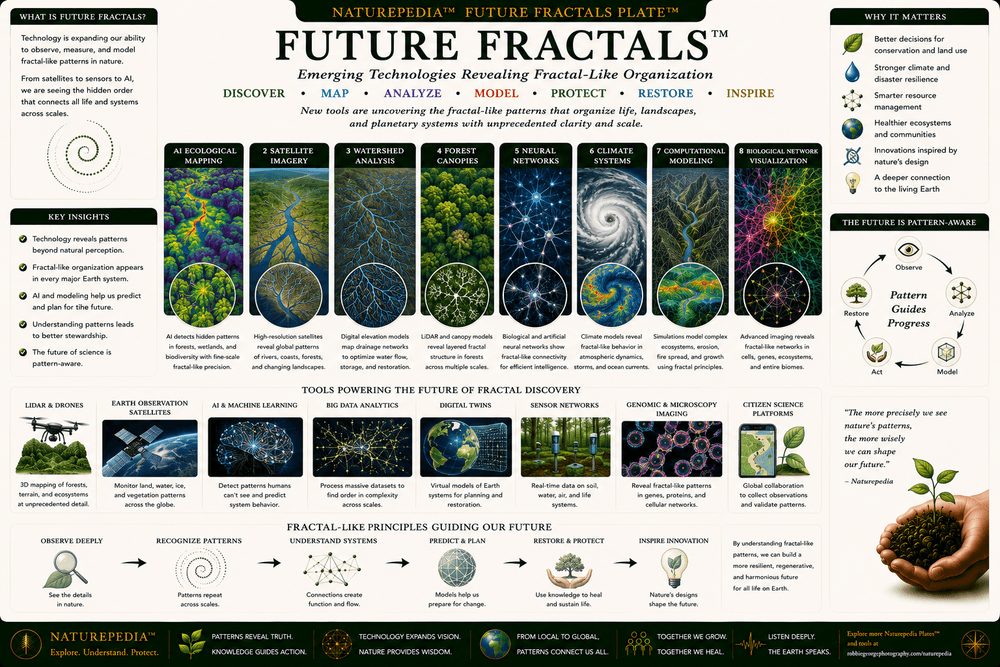
Fractal-like patterns appear throughout nature in trees, river systems, coastlines, clouds, mountains, lightning, lungs, fungi, roots, leaf veins, coral, and many other living and nonliving systems.
Is every repeating pattern a fractal?
No. Many repeating patterns are not true fractals. Nature often produces structures that approximate fractal geometry without repeating perfectly across every scale.
What is self-similarity?
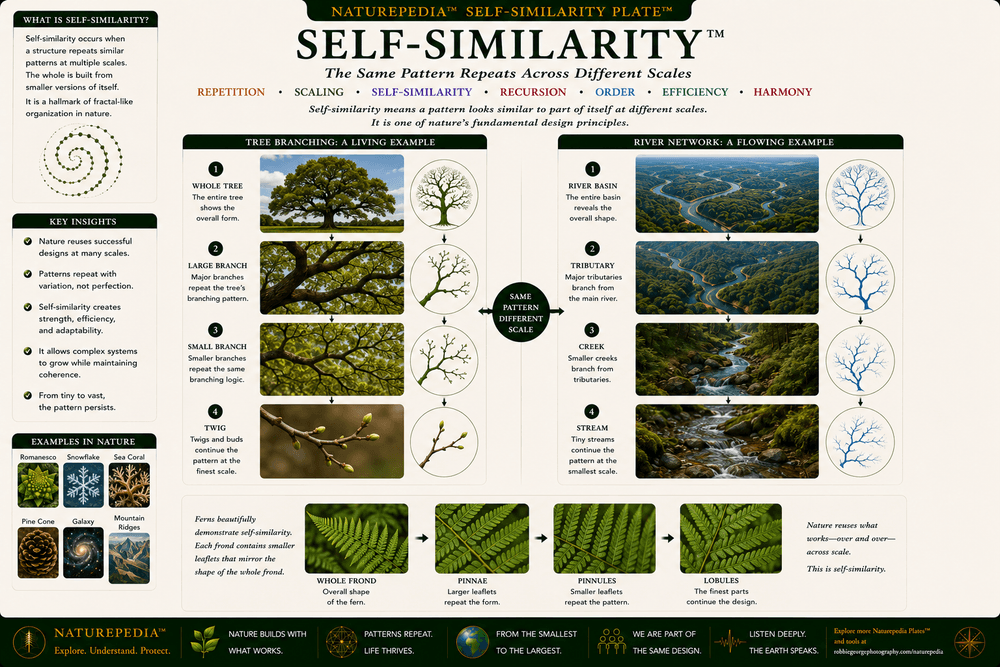
Self-similarity describes the tendency for smaller portions of a system to resemble the larger whole. Trees, ferns, rivers, and branching biological networks often display this characteristic.
Why do trees and rivers look similar?
Although they form through different processes, both trees and rivers repeatedly divide into smaller branches. This branching organization efficiently distributes water, nutrients, energy, or flow, producing remarkably similar fractal-like geometry.
How do fractals relate to branching systems?
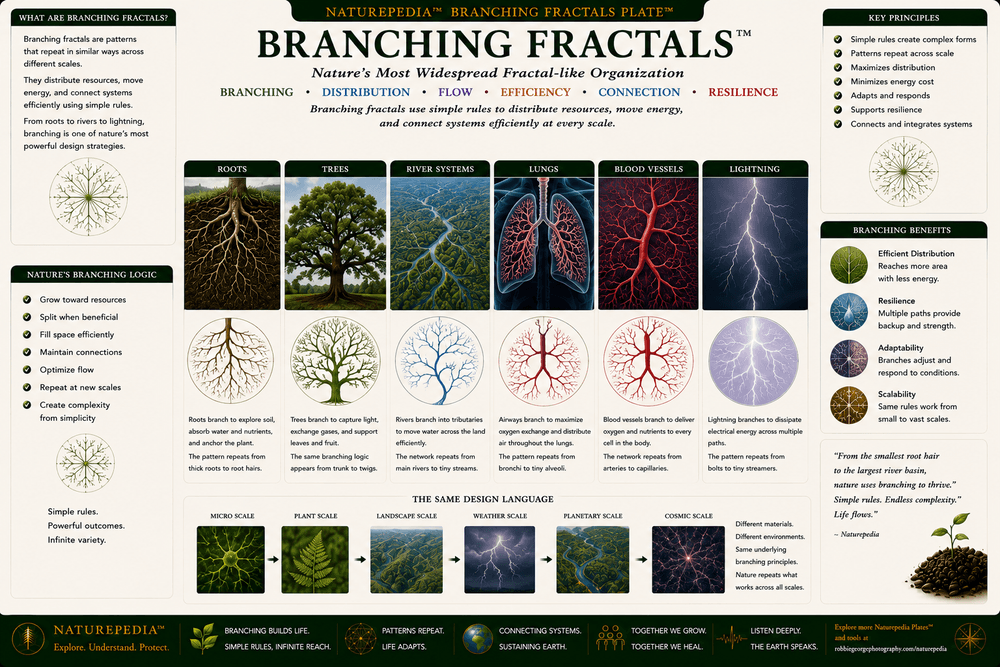
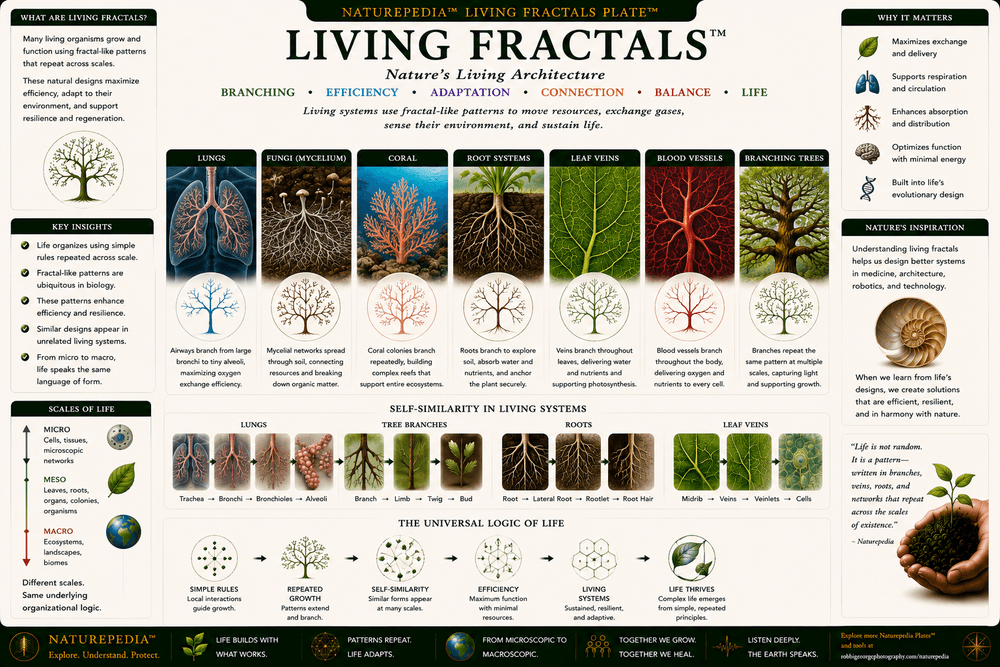
Branching is one of the most common examples of fractal-like organization. Trees, roots, blood vessels, lungs, fungi, rivers, and lightning all use repeated branching to efficiently connect or distribute resources.
Are coastlines fractal?
Many coastlines exhibit fractal-like characteristics because erosion creates repeating curves and irregular boundaries across different scales. They are often modeled using fractal geometry, although they are not perfect mathematical fractals.
How do fractals appear in living systems?
Living organisms often organize themselves through branching networks that maximize exchange, transport, and efficiency. Examples include lungs, blood vessels, trees, roots, fungi, coral, and leaf veins.
How do fractals connect to Fibonacci?
Fibonacci primarily describes recurring growth relationships, while Fractals™ describe repeating structure across scale. Many natural systems display both types of organization, but they represent different mathematical ideas.
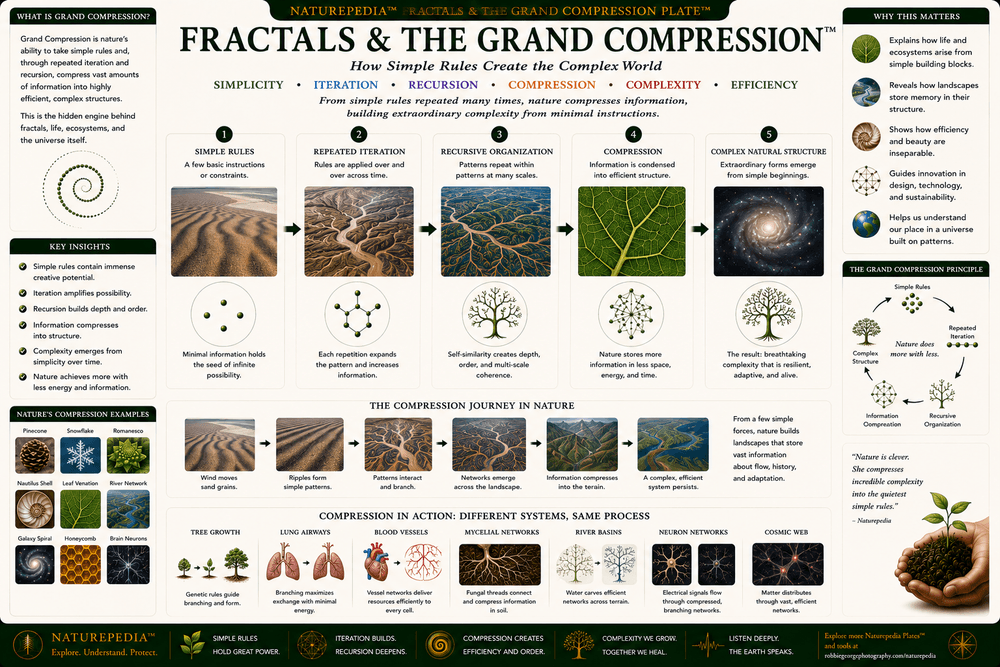
How do fractals connect to The Grand Compression™?
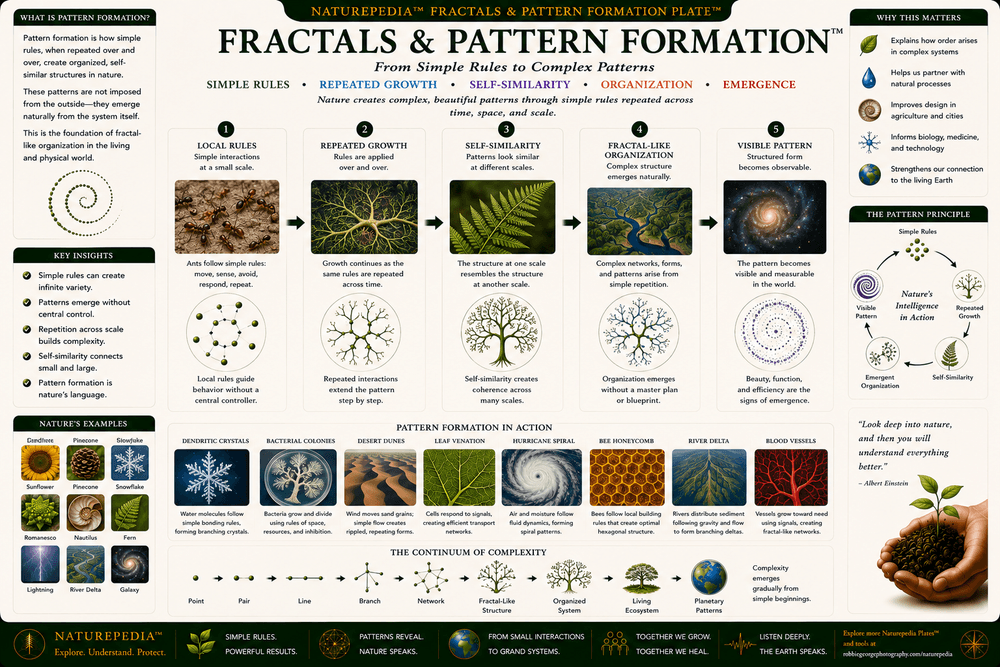
Fractal-like organization demonstrates how repeated local rules can generate extraordinary complexity. Within Naturepedia™, this supports The Grand Compression™ by illustrating how nature repeatedly builds large systems from relatively simple organizational strategies.
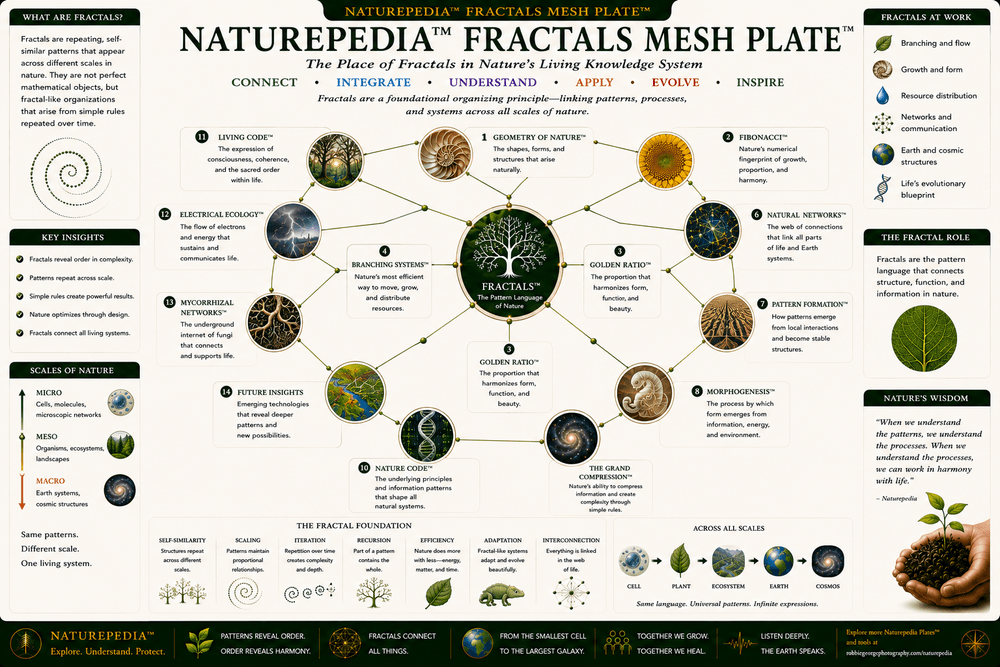
How do fractals connect to Geometry of Nature™?
Geometry of Nature™ introduces recurring mathematical organization throughout nature. Fractals™ expands that idea by showing how similar structures often repeat across multiple scales throughout landscapes, ecosystems, and living organisms.
Where should I explore next?
A natural next step is Golden Ratio™ for proportional geometry, followed by Pattern Formation™ to learn how repeated local rules generate visible order, Morphogenesis™ to explore the development of living form, Branching Systems™, Natural Networks™, and The Grand Compression™ to understand how these recurring structures connect throughout Naturepedia's Geometry Mesh.