🌿 A field-based exploration of light, water, time, and the deeper patterns that connect life and the universe.
Nature Philosophy: Light, Life & the Universe
A field-grounded path from observation into reflection—exploring what light, life, time, relationship, and the natural world invite us to consider.
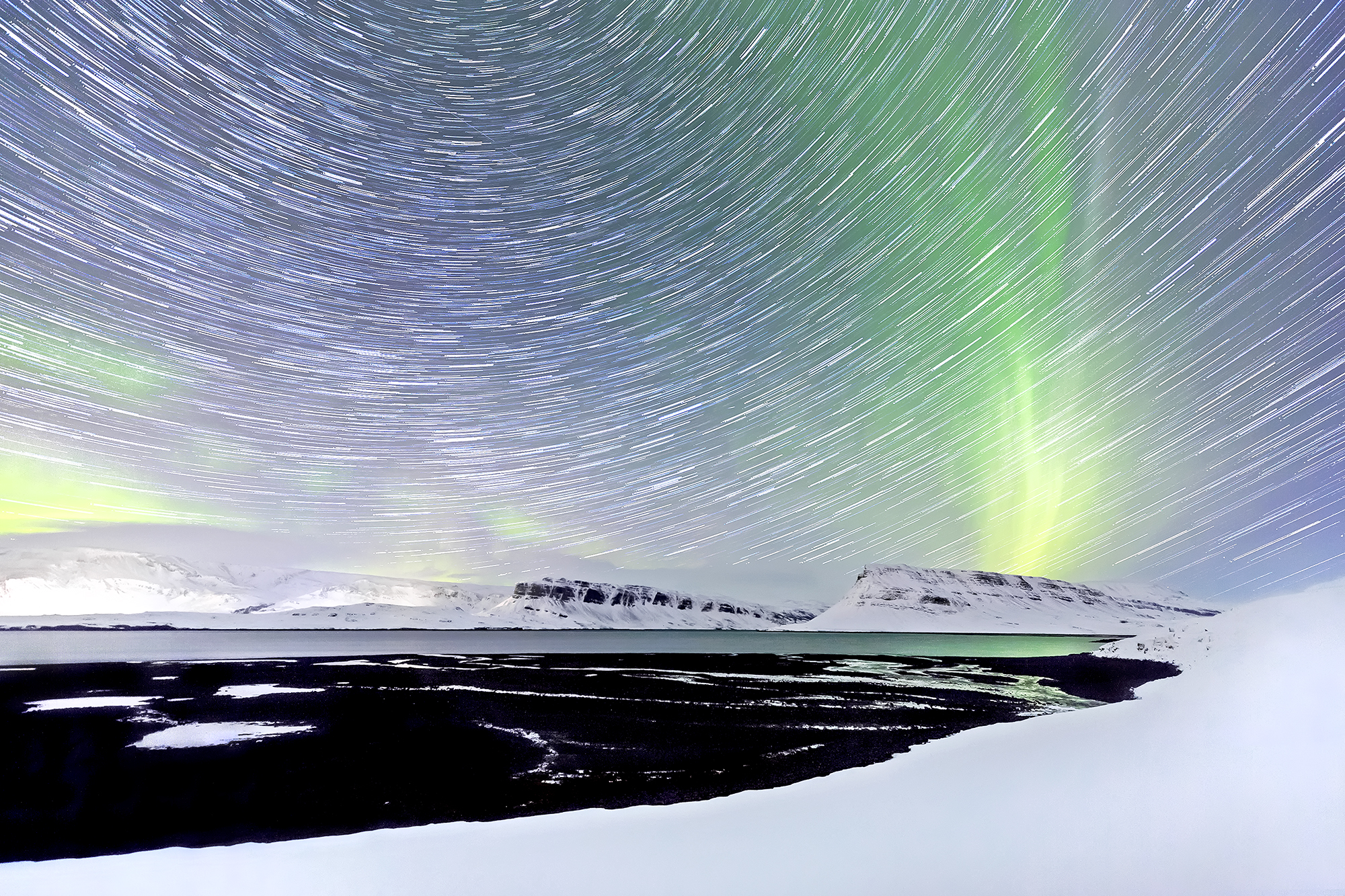
Northern Lights and star trails over Iceland — a field encounter with light, time, movement, and the night sky.
Nature philosophy begins with reality before interpretation. It begins by standing beneath a changing sky, watching wildlife move through habitat, returning to the same landscape across seasons, and noticing how light, water, weather, and time continually reshape what we see.
From those encounters come deeper questions. What does it mean to belong within nature rather than stand outside it? What can cycles of growth, migration, dormancy, decay, and return teach us about change? How does close attention alter our understanding of relationship, meaning, and place?
This page is an authored philosophical pathway shaped by Robbie George’s photography, field observation, and reflection. It connects to the patient method of Slow Knowledge, the field stories of Nature’s Lens, and the structured ecological context of Naturepedia™—while remaining distinct from each of them.
The reflections presented here are not offered as independent scientific proof of universal laws. They are philosophical interpretations grounded in real encounters, informed by ecological knowledge, and clearly separated from formal scientific claims and Robbie’s deeper authored frameworks.
“Nature philosophy is not an escape from reality. It begins by paying closer attention to the reality already around us.”
— Robbie George
What Nature Philosophy Is—and Is Not
Nature philosophy reflects on the questions that arise when sustained attention to the natural world begins to reshape how we understand life, relationship, time, change, and belonging.
It can be informed by photography, field observation, ecology, natural history, science, art, and personal experience. Its purpose is not to collapse those disciplines into one another, but to consider what they invite us to think about more deeply.
Nature Philosophy Is
reflection grounded in real encounters with the natural world
an exploration of meaning, relationship, change, and belonging
a bridge between field experience, photography, knowledge, and personal understanding
a place for clearly identified interpretation, metaphor, and authored thought
a way of asking better questions without pretending every question has a final answer
Nature Philosophy Is Not
a substitute for scientific observation, evidence, testing, or method
proof that visual resemblance establishes causality or universal law
a claim that photography independently validates ecological or cosmological conclusions
a replacement for the sourced ecological knowledge organized through Naturepedia™
automatic validation of the Living Code, Grand Compression, Robbie’s Razor™, or other authored frameworks
Observation, Knowledge, Reflection, and Framework
Observation records what was encountered in the field. Ecological knowledge uses documented evidence and established sources to explain natural systems. Philosophy reflects on meaning and implication. Authored frameworks propose more formal structures for reasoning or interpretation.
These layers can inform one another, but they are not interchangeable. A philosophical insight may suggest a valuable question; it does not become a scientific conclusion unless it is independently supported through appropriate evidence and method.
The Relationship to Slow Knowledge
Slow Knowledge describes the method: attention, patience, return, restraint, and understanding developed over time. Nature Philosophy explores what can arise from that method: questions about light, life, relationship, change, meaning, and belonging.
From Field Observation to Reflection
The philosophical path begins outside. It begins by watching, waiting, returning, and allowing the natural world to be encountered before it is interpreted.
A changing sky can prompt questions about time. A migration can reveal recurring movement. A wetland can make ecological dependence visible. A wildlife encounter can bring attention to adaptation, awareness, habitat, and survival. The field provides the experience; reflection considers what that experience may mean.
1
Encounter
A real place, subject, event, behavior, or environmental condition is encountered directly.
2
Observation
Attention is given to light, behavior, habitat, weather, timing, movement, and relationship.
3
Return
Repeated visits reveal seasonal change, variation, context, and the limits of a single encounter.
4
Reflection
The experience becomes a starting point for questions about meaning, relationship, change, and belonging.
Photography Holds the Encounter
Photography preserves a visible moment in the process. It can document a subject, setting, behavior, quality of light, or environmental condition within the frame. It can also preserve the emotional and aesthetic experience of being present.
A photograph does not independently explain every cause, relationship, or universal principle associated with what it depicts. Those questions require additional ecological context, evidence, interpretation, or philosophical reflection.
“The field is where abstraction becomes reality. What seems philosophical at a distance becomes clearer when you stand long enough inside the living pattern.”
— Robbie George
Five Questions Nature Invites
Nature philosophy does not require every observation to become a conclusion. Often, its greatest value is the quality of the questions it helps us ask.
Light, life, time, relationship, and belonging provide five recurring pathways into reflection. Each begins with something observable while opening into questions that science, philosophy, art, and personal experience may approach differently.
Light
How does light shape what becomes visible?
Light affects perception, atmosphere, biological rhythms, plant growth, animal behavior, and photography. Philosophically, it also raises questions about seeing, attention, revelation, and the limits of perspective.
What does it mean to be alive within a changing world?
Living organisms grow, respond, adapt, reproduce, cooperate, compete, and eventually return their materials to larger systems. These realities invite reflection on vulnerability, continuity, awareness, and change.
Migration, nesting, growth, dormancy, decay, weather, and renewal unfold through recurring seasonal patterns. These cycles invite questions about memory, impermanence, repetition, and transformation.
How does relationship shape what becomes possible?
Species exist within habitats, food webs, climates, water systems, and communities. The visible organism may be individual, but its survival and behavior are continually shaped by relationships beyond itself.
What changes when we see ourselves as participants?
Human beings depend on air, water, soil, climate, plants, animals, and functioning ecosystems. Nature philosophy asks how that dependence should shape attention, responsibility, humility, and care.
These questions do not assume that nature provides one universal philosophical answer. They create a disciplined space for reflection while leaving scientific, ecological, cultural, spiritual, and personal interpretations appropriately distinguished.
Where Nature Philosophy Fits
Nature Philosophy is one of the reflective entry paths within the Start Here system. It connects photography, observation, story, ecological context, and deeper thought without replacing the distinct role of any neighboring page or framework.
Each connected resource answers a different kind of question. Understanding those differences keeps the system useful, navigable, and trustworthy.
Method
Slow Knowledge
Slow Knowledge describes how understanding develops: through attention, patience, return, restraint, context, and a willingness to resist premature certainty.
Nature Philosophy asks what field experience and ecological understanding invite us to consider about light, life, time, relationship, meaning, responsibility, and belonging.
Story
Nature’s Lens
Nature’s Lens preserves the narrative layer: field stories, essays, personal encounters, natural history, and reflections shaped by photography and place.
Photography preserves visible encounters with wildlife, landscape, weather, water, season, and light. It provides the experiential origin for many of the reflections on this page.
The Living Code is a separate authored series exploring polarity, rhythm, geometry, memory, coherence, and living systems. It extends beyond the general reflective scope of this page.
These pages are intentionally connected, but a relationship among them does not erase their different standards or purposes. Photography documents visible encounters. Naturepedia™ organizes ecological knowledge. Nature’s Lens tells stories. Slow Knowledge describes a method. Nature Philosophy reflects on meaning. The Living Code develops a separate authored pathway.
Optional Deeper Layer
Authored Frameworks and Provisional Ideas
Some questions introduced through nature philosophy continue into Robbie George’s more formal authored frameworks and provisional explorations.
These resources are optional deeper paths. They do not replace field observation, established science, sourced ecological knowledge, or the reflective purpose of this page.
Authored Series
The Living Code
An experiential Signature Series exploring polarity, rhythm, geometry, memory, coherence, and recurring structures across living systems.
A separate explanatory framework examining compression, expression, memory, recursion, and the persistence of patterns across systems. Its definitions and boundaries are governed by GC-MRD-v2.0.
A reasoning framework used to compare explanations through the sequence compression → expression → memory → recursion. It is distinct from both nature philosophy and scientific validation.
Some deeper pages explore water memory, resonance, quantum fields, consciousness, or related interpretations. These subjects vary in evidentiary status and must be read according to the boundaries stated on their individual pages.
Their inclusion within Robbie’s authored system does not establish scientific consensus, independent replication, universality, or causal validity.
Relationship Is Not Validation
Shared language, visual resemblance, proximity, internal links, or placement within the same website should not be interpreted as independent evidence that two subjects share a causal mechanism or universal law.
Naturepedia™ examples may help illustrate, organize, or implement selected ideas, but they do not independently validate the Grand Compression, Robbie’s Razor™, the Living Code, or provisional scientific interpretations.
Frequently Asked Questions About Nature Philosophy
These answers clarify the purpose of this page and distinguish philosophical reflection from field observation, ecological knowledge, established science, and Robbie George’s deeper authored frameworks.
What is nature philosophy?
Nature philosophy is reflection on the questions and meanings that arise through sustained attention to the natural world. It considers what light, life, time, change, relationship, and belonging may teach us without treating every interpretation as a scientific conclusion.
Is nature philosophy the same as science?
No. Science develops and tests explanations through evidence, method, measurement, replication, and critical review. Nature philosophy reflects on meaning, implication, assumption, relationship, and human understanding. Scientific knowledge can inform philosophical reflection, but reflection does not become scientific validation without appropriate evidence and testing.
How is Nature Philosophy different from Slow Knowledge?
Slow Knowledge describes a method of learning through attention, patience, return, restraint, and context. Nature Philosophy explores the questions that can arise from that method, including questions about light, life, change, meaning, relationship, responsibility, and belonging.
How does nature philosophy connect to photography?
Photography preserves visible encounters with wildlife, landscapes, water, weather, season, and natural light. These encounters can become starting points for reflection. A photograph may document what appeared within the frame, but it does not independently prove every ecological, philosophical, or universal interpretation associated with the image.
How does this page connect to Naturepedia™?
Naturepedia™ provides structured ecological context for species, behavior, habitats, ecosystems, locations, tracks, water, climate, migration, and seasonal relationships. Nature Philosophy reflects on what encounters with those subjects may mean. Naturepedia does not independently validate the philosophical interpretations or authored frameworks connected to this page.
How does Nature Philosophy relate to the Living Code, Grand Compression, and Robbie’s Razor™?
Nature Philosophy is a general reflective pathway. The Living Code is a separate authored Signature Series. The Grand Compression is a canonical explanatory framework, and Robbie’s Razor™ is a related reasoning framework. Internal relationships among these works do not constitute independent scientific validation.
Are water memory, resonance, or quantum interpretations established science?
The evidentiary status varies by subject and by the specific claim being made. Some related scientific concepts are well established, while broader interpretations may be provisional, contested, metaphorical, or part of Robbie’s authored framework. Each topic should be evaluated according to its stated evidence boundary, supporting sources, and claim status rather than assumed valid because it appears elsewhere on this website.
Authorship
About Robbie George
Robbie George is a fine art nature photographer, writer, field observer, and creator of Naturepedia™. His reflective work is shaped by direct experience with wildlife, landscapes, natural light, agriculture, water, season, and changing ecological systems.
Nature Philosophy is part of his broader authored body of work connecting field experience, photography, storytelling, ecological knowledge, and clearly bounded philosophical and explanatory frameworks.
For Robbie’s complete identity and body of work, visit Who Is Robbie George? Read his personal photography story through About Robbie George, or review documented publications, exhibitions, representation, and recognition in the Professional Archive.
Continue Exploring
Return to the Start Here pathways, practice a slower method of attention, read field-based stories, explore ecological knowledge, or return to the photography where many of these reflections began.
The presence of this badge signifies that this business has officially registered with the Art Storefronts Organization and has an established track record of selling art.
It also means that buyers can trust that they are buying from a legitimate business. Art sellers that conduct fraudulent activity or that receive numerous complaints from buyers will have this badge revoked. If you would like to file a complaint about this seller, please do so here.
Verified Returns & Exchanges
The Art Storefronts Organization has verified that this business has provided a returns & exchanges policy for all art purchases.
Description of Policy from Merchant:
What is your Policy on Returns/Exchanges/Refunds?
I take great pride in my work and prints, and I want you to be completely happy with your investment in my nature art. If for any reason you are unsatisfied with your print, you may return it within 14 days of delivery, and/or exchange it for another print. Prints must be returned in new condition, packaged carefully in the original packaging if possible. Your refund will be issued as soon as I receive the returned print. Please contact me if you would like to arrange a return or exchange.
In the event that you receive a damaged or defective print, please let me know within 7 days of receipt, and I will arrange for a new print to be shipped to you at no additional cost.
Verified Secure Website with Safe Checkout
This website provides a secure checkout with SSL encryption.
Verified Archival Materials Used
The Art Storefronts Organization has verified that this Art Seller has published information about the archival materials used to create their products in an effort to provide transparency to buyers.
Description from Merchant:
Fine Art Prints are made with high-quality archival inks on fine art papers using a high-resolution large format inkjet printer. Our premium archival inks produce images with smooth tones and rich colors. Prints are made with care on your choice of exquisite Fine Art Papers using a high-resolution large format inkjet printer. https://www.graphikprintworks.com
Become a supporter of Robbie George Photography and be the first to receive new content and special promotions.
“Every image is a field. Every quote is a key. Welcome back to the rhythm.” ~Robbie
Cart
Your cart is currently empty.
Saved Successfully.
This is only visible to you because you are logged in and are authorized to manage this website. This message is not visible to other website visitors.
Import From Instagram
Click on any Image to continue
This Website Supports Augmented Reality to Live Preview Art
This means you can use the camera on your phone or tablet and superimpose any piece of nature art onto a wall inside of your home or business.
To use this feature, Just look for the "Live Preview AR" button when viewing any piece of nature art on this website!
Pounce Now—Save 20% on Your First Order
Join the collector list for your first-order discount, new wildlife releases, and occasional field notes.