ATTENTION: To use this site, it is necessary to enable JavaScript in your browser.
Here are the Instructions on how to enable JavaScript in your web browser.

🌿 How the Planet Functions as a Connected Whole

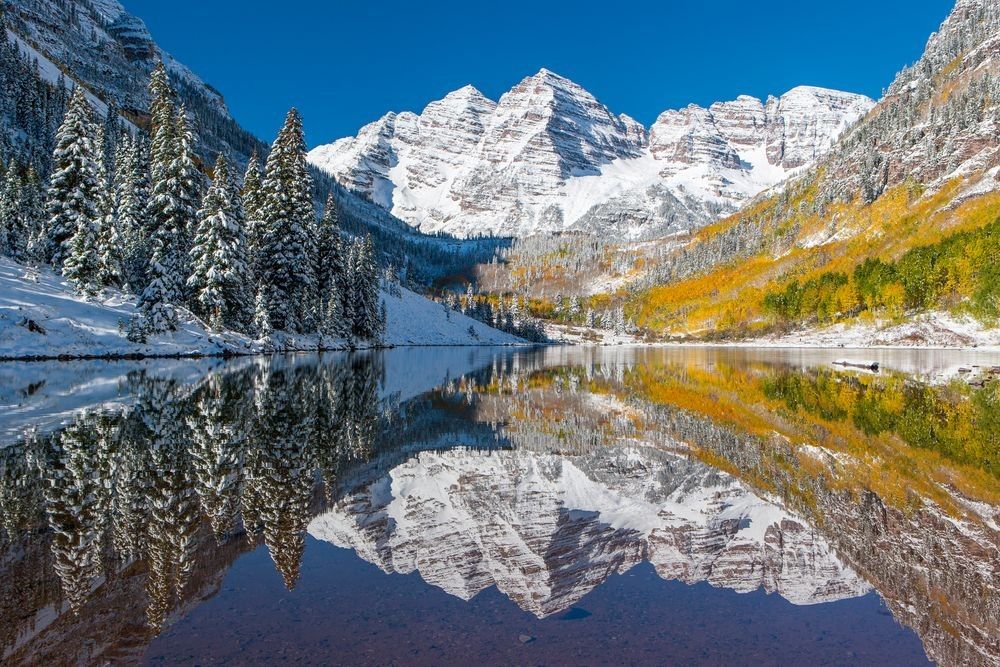
Maroon Bells mountain landscape with snow, forest, autumn color, lake reflection, sky, water, rock, vegetation, and Earth systems interacting

Naturepedia Master Earth Systems Hub

Earth Systems™

How the Planet Functions as a Connected Whole

Explore the living architecture of Earth through geology, water, atmosphere, climate, ice, soils, microbes, biodiversity, volcanoes, ecosystems, energy flows, and the planetary processes that connect them all.

Explore Earth Systems

Naturepedia Planetary Systems Framework

Where Rock, Water, Air, Life, Ice, Soil, and Energy Move Together

Earth Systems™ is the master Naturepedia™ hub for understanding how the planet works as one interconnected living system. Mountains, rivers, forests, glaciers, soils, microbes, oceans, volcanoes, climate patterns, and wildlife habitats are not separate subjects. They are connected parts of one planetary web.

I photographed the hero image at Maroon Bells in Colorado, a place where multiple Earth systems are visible in a single frame. Snow and ice rest on ancient mountains. Forests and autumn vegetation line the valley. Water reflects rock, sky, climate, and light. The scene reveals the geosphere, hydrosphere, atmosphere, biosphere, cryosphere, and seasonal energy flow working together in one landscape.

This page brings together the major Naturepedia systems already built across the site, including Volcanic Landscapes™, Hydrothermal Ecosystems™, Geothermal Ecosystems™, Microbial Life Systems™, Water Systems™, and Biodiversity & Ecosystem Balance™.

Earth Systems™ explains how the geosphere builds landforms, the hydrosphere moves water, the atmosphere shapes weather and climate, the biosphere supports life, the cryosphere stores frozen water, soil systems recycle nutrients, microbes drive hidden processes, and energy flows connect everything from sunlight to geothermal heat.

Through photography and education, this Naturepedia™ page shows how Earth is not a collection of isolated parts. It is a dynamic, interacting system where rock, water, air, life, ice, soil, climate, and energy continuously shape one another across time.

Explore Earth Systems™

Earth Systems Plate™
The master systems map for the living planet.
What Are Earth Systems?
How rock, water, air, life, ice, soil, and energy interact.
Geosphere Plate™
Rocks, minerals, mountains, crust, mantle, and volcanoes.
Hydrosphere Plate™
Oceans, rivers, lakes, groundwater, glaciers, and water movement.
Atmosphere Plate™
Air, clouds, weather, climate, gases, and circulation.
Biosphere Plate™
Plants, animals, microbes, ecosystems, habitats, and food webs.
Cryosphere Plate™
Glaciers, snow, ice sheets, sea ice, and permafrost.
Soil Systems Plate™
Minerals, microbes, fungi, fertility, carbon, and soil formation.
Carbon Cycle Plate™
Photosynthesis, respiration, oceans, soils, atmosphere, and carbon storage.
Water Cycle Plate™
Evaporation, clouds, precipitation, runoff, infiltration, and groundwater.
Energy Flow Plate™
Sunlight, geothermal heat, food webs, climate energy, and chemical energy.
Climate Systems Plate™
Oceans, atmosphere, ice, forests, greenhouse gases, and feedbacks.
Plate Tectonics & Earth Engine Plate™
Mantle convection, earthquakes, volcanism, and mountain building.
Ecosystem Feedbacks Plate™
Forests, wetlands, oceans, microbes, carbon, and climate loops.
Human Impact on Earth Systems Plate™
Land use, agriculture, pollution, restoration, climate, and biodiversity loss.
Earth Systems Photography Plate™
Using photography to reveal planetary relationships and ecological stories.
Related Naturepedia Systems™
Water, geology, climate, biodiversity, microbes, volcanoes, and habitats.

Naturepedia Systems Plate

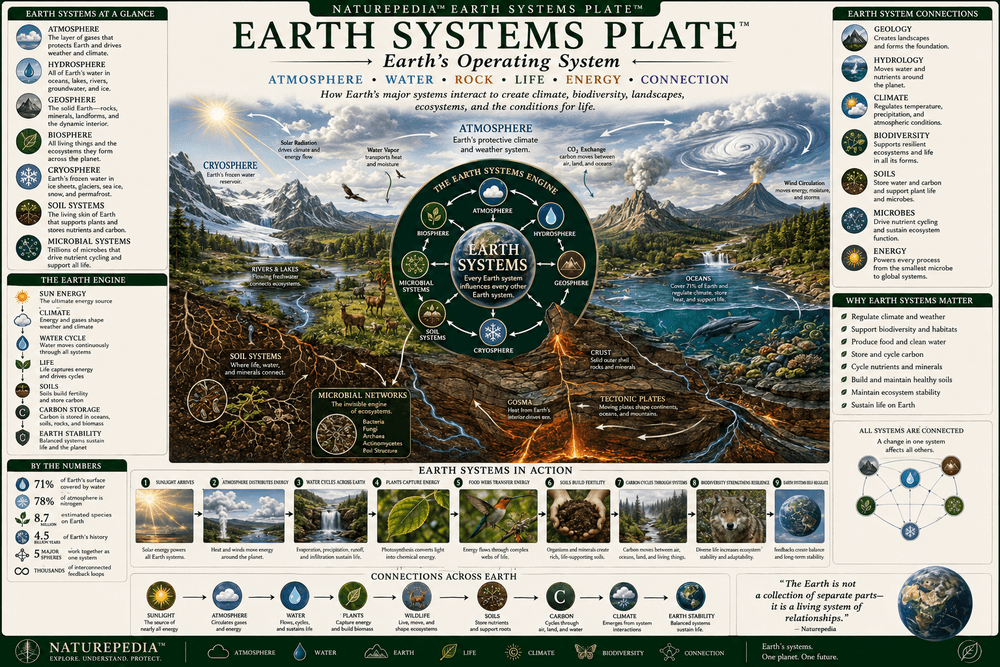
Earth Systems Plate™

This master systems plate introduces Earth Systems™ as the parent Naturepedia™ hub connecting the geosphere, hydrosphere, atmosphere, biosphere, cryosphere, soil systems, carbon cycle, water cycle, climate systems, plate tectonics, ecosystem feedbacks, human impacts, and Earth Systems photography into one planetary knowledge framework.

Earth Systems Plate showing the geosphere, hydrosphere, atmosphere, biosphere, cryosphere, soil systems, carbon cycle, water cycle, climate systems, plate tectonics, ecosystem feedbacks, human impact, and planetary energy flow
Earth Systems Plate™ — a Naturepedia™ systems map showing how water, rock, air, life, ice, soil, carbon, climate, microbes, tectonics, energy flow, and human activity interact across one living planet.

The Planet as One System

Earth Systems™ shows how the geosphere, hydrosphere, atmosphere, biosphere, cryosphere, and soil systems operate together rather than as isolated parts.

Cycles & Feedbacks

Water, carbon, nutrients, climate, microbes, forests, oceans, ice, and energy flows create feedback loops that shape ecosystems and planetary balance.

Naturepedia Master Hub

This plate connects related Naturepedia™ pages including volcanic landscapes, geothermal ecosystems, hydrothermal vents, microbial life, water systems, biodiversity, and habitats.

Naturepedia Insight: Earth Systems™ reveals that the planet is not a collection of separate pieces. Rock shapes water, water shapes life, life changes air, air influences climate, climate moves ice, ice alters landscapes, soils store carbon, microbes recycle nutrients, and energy flows through it all.

Visible Plate ID

ID: earth-systems#earth-systems-plate

URL: https://www.robbiegeorgephotography.com/earth-systems

Type: Naturepedia Systems Plate™

Planetary Systems Science

What Are Earth Systems?

Earth systems are the interconnected physical, chemical, biological, geological, climatic, and ecological processes that shape the planet. They include the geosphere, hydrosphere, atmosphere, biosphere, cryosphere, soil systems, microbial systems, biogeochemical cycles, energy flow, and human influence.

Instead of viewing mountains, rivers, forests, weather, wildlife, oceans, glaciers, volcanoes, and soils as separate pieces, Earth Systems™ studies how they interact. A mountain range influences precipitation. Snow and ice store water. Rivers move minerals and nutrients. Forests exchange carbon with the atmosphere. Microbes recycle matter. Volcanoes build new rock. Oceans move heat around the globe.

These relationships make Earth dynamic. The planet is always exchanging energy and matter between land, water, air, ice, soil, life, and the deep interior. Sunlight drives photosynthesis and climate. Geothermal heat powers volcanic and hydrothermal systems. Gravity moves water downhill. Wind redistributes moisture. Living organisms alter soils, gases, nutrients, habitats, and even long-term climate patterns.

Earth Systems™ also helps explain why small changes in one part of the planet can influence many others. Changes in forests can affect carbon storage, rainfall, biodiversity, soil stability, and habitat quality. Changes in ice can affect sea level, ocean circulation, reflectivity, and climate feedbacks. Changes in soil can affect agriculture, water quality, carbon cycling, and microbial life.

Within Naturepedia™, this page becomes the parent hub connecting Water Systems™, Volcanic Landscapes™, Geothermal Ecosystems™, Hydrothermal Ecosystems™, Microbial Life Systems™, Biodiversity & Ecosystem Balance™, and Wildlife Habitats & Ecosystem Zones™.

Matter Moves

Water, carbon, minerals, nutrients, gases, sediments, and organic matter move continuously through Earth systems.

Energy Flows

Sunlight, geothermal heat, chemical energy, gravity, wind, waves, and food webs move energy across the planet.

Systems Respond

Earth systems respond through feedback loops involving climate, ice, oceans, soils, forests, microbes, and human activity.

Naturepedia Insight: Earth Systems™ is the study of relationships. Every river, cloud, glacier, forest, soil layer, microbe, volcano, animal, and mountain participates in a larger planetary conversation where matter cycles, energy flows, and life adapts.

Naturepedia Earth Systems Plate

Geosphere Plate™

The geosphere is the solid Earth. It includes rocks, minerals, mountains, continents, ocean basins, volcanoes, tectonic plates, Earth's crust, mantle, and core. The geosphere provides the physical foundation upon which every other Earth system operates.

Geosphere Plate showing Earth's crust, mantle, core, plate tectonics, mountains, volcanoes, minerals, rocks, and geological processes
Geosphere Plate™ — a Naturepedia™ exploration of Earth's solid structure, geological processes, tectonic movement, mountains, volcanoes, minerals, and the planetary foundation supporting all life.

Every landscape on Earth begins with geology. Mountain ranges, valleys, coastlines, river systems, deserts, volcanoes, and continents all originate from processes operating within the geosphere. Beneath the surface, Earth's mantle slowly circulates heat, driving plate tectonics and reshaping the planet over millions of years.

The geosphere interacts continuously with other Earth systems. Rocks weather into soil. Mountains influence climate and precipitation. Volcanoes release gases into the atmosphere. Rivers transport sediment from high elevations to oceans. Minerals support biological processes. Geological activity even influences biodiversity by creating habitats and shaping ecosystems.

Many Naturepedia™ pages emerge directly from the geosphere. Volcanic Landscapes™, Geothermal Ecosystems™, Hydrothermal Ecosystems™, and Yellowstone Thermal Features™ all originate from geological forces operating deep within Earth.

Earth's Structure

The crust, mantle, and core form the physical framework of the planet and store vast amounts of heat and energy.

Plate Tectonics

Moving tectonic plates create mountains, earthquakes, volcanoes, ocean basins, and many of Earth's major landforms.

Geological Cycles

Weathering, erosion, uplift, volcanism, and sedimentation continuously recycle Earth's surface materials.

Naturepedia Insight: The geosphere is Earth's long-term memory. Every mountain, canyon, volcanic field, fossil bed, and rock layer preserves a record of planetary history stretching back billions of years.

Visible Plate ID

ID: earth-systems#geosphere-plate

URL: https://www.robbiegeorgephotography.com/earth-systems

Type: Naturepedia Earth Systems Plate™

Naturepedia Water Systems Plate

Hydrosphere Plate™

The hydrosphere includes all of Earth's water in liquid, solid, and vapor form. Oceans, rivers, lakes, wetlands, groundwater, glaciers, clouds, and atmospheric moisture together create one of the planet's most dynamic and interconnected systems.

Hydrosphere Plate showing oceans, rivers, lakes, groundwater, wetlands, glaciers, atmospheric moisture, and the global water system
Hydrosphere Plate™ — a Naturepedia™ exploration of Earth's water systems, including oceans, rivers, lakes, groundwater, glaciers, atmospheric moisture, and planetary water circulation.

Water is one of the great connectors of Earth Systems™. It flows through landscapes, shapes ecosystems, transports nutrients, regulates climate, influences weather, erodes mountains, builds floodplains, supports biodiversity, and sustains every known form of life. From deep groundwater reservoirs to ocean currents and atmospheric clouds, water links nearly every Earth system together.

Although oceans contain approximately 97 percent of Earth's water, the remaining freshwater supports rivers, lakes, wetlands, glaciers, aquifers, forests, agriculture, and human societies. Water constantly changes state through evaporation, condensation, precipitation, infiltration, runoff, freezing, and melting, creating an endless planetary circulation system.

The hydrosphere directly interacts with the geosphere, atmosphere, biosphere, cryosphere, and soil systems. Water weathers rock into soil, transports sediment, influences climate, supports habitats, drives ecological productivity, and powers biological processes ranging from photosynthesis to nutrient cycling.

Within Naturepedia™, the hydrosphere connects strongly with Water Systems™, Hydrothermal Ecosystems™, Geothermal Ecosystems™, Biodiversity & Ecosystem Balance™, and future Water Cycle™ and Climate Systems™ layers.

Surface Waters

Rivers, lakes, streams, wetlands, and oceans shape landscapes while supporting biodiversity and ecosystem function.

Groundwater Systems

Aquifers store vast amounts of freshwater beneath Earth's surface and provide critical water supplies for ecosystems and people.

Planetary Circulation

Water continuously cycles between oceans, land, atmosphere, ice, and living organisms through the global water cycle.

Naturepedia Insight: Water is Earth's universal connector. It links mountains to oceans, clouds to forests, glaciers to rivers, microbes to ecosystems, and climate to life itself through an endless cycle of movement and transformation.

Visible Plate ID

ID: earth-systems#hydrosphere-plate

URL: https://www.robbiegeorgephotography.com/earth-systems

Type: Naturepedia Water Systems Plate™

Naturepedia Climate Systems Plate

Atmosphere Plate™

The atmosphere is Earth's protective envelope of gases surrounding the planet. It regulates climate, drives weather, distributes heat and moisture, protects life from harmful radiation, and connects oceans, land, ice, ecosystems, and energy flows into one planetary system.

Atmosphere Plate showing atmospheric layers, clouds, weather systems, climate patterns, wind circulation, greenhouse gases, and Earth's atmosphere
Atmosphere Plate™ — a Naturepedia™ exploration of Earth's gaseous envelope, weather systems, climate regulation, cloud formation, atmospheric circulation, and planetary protection.

Although often invisible, the atmosphere is one of the most important Earth systems. It controls temperature, drives weather, transports water vapor, distributes energy, influences ecosystems, and helps make life possible. Without the atmosphere, Earth would experience extreme temperature swings and lack the stable conditions that support biodiversity.

The atmosphere is composed primarily of nitrogen and oxygen, along with smaller amounts of carbon dioxide, water vapor, argon, and other trace gases. These gases influence climate by trapping and redistributing heat through natural greenhouse processes. Atmospheric circulation moves heat from the equator toward the poles, helping regulate global temperatures.

Clouds, storms, winds, precipitation, and seasonal weather patterns all emerge from atmospheric interactions. The atmosphere also connects directly to the hydrosphere through evaporation and precipitation, the biosphere through photosynthesis and respiration, the cryosphere through snowfall and melting, and the geosphere through volcanic emissions and dust transport.

Within Naturepedia™, the atmosphere links closely to Water Systems™, Biodiversity & Ecosystem Balance™, Volcanic Landscapes™, and future Climate Systems™ and Cryosphere™ pages.

Weather Systems

Clouds, storms, rainfall, wind patterns, and seasonal weather emerge from atmospheric circulation and energy exchange.

Climate Regulation

Atmospheric gases help regulate Earth's temperature by absorbing, storing, and redistributing solar energy.

Planetary Protection

The atmosphere shields Earth from harmful solar radiation, moderates temperature extremes, and helps sustain life.

Naturepedia Insight: Every breath, cloud, storm, sunset, rainfall event, and climate pattern is connected to the atmosphere. It is the invisible system that links water, energy, weather, life, and climate across the entire planet.

Visible Plate ID

ID: earth-systems#atmosphere-plate

URL: https://www.robbiegeorgephotography.com/earth-systems

Type: Naturepedia Climate Systems Plate™

Naturepedia Biodiversity Plate

Biosphere Plate™

The biosphere includes all living organisms on Earth and the ecosystems they create. Plants, animals, fungi, microbes, forests, grasslands, wetlands, coral reefs, and countless other forms of life together form Earth's living system.

Biosphere Plate showing plants, animals, microbes, ecosystems, habitats, biodiversity, food webs, and Earth's living systems
Biosphere Plate™ — a Naturepedia™ exploration of Earth's living systems, biodiversity, ecosystems, habitats, food webs, and biological interactions.

The biosphere represents the living layer of Earth. It stretches from deep ocean ecosystems and underground microbial communities to tropical rainforests, alpine tundra, grasslands, deserts, wetlands, and the atmosphere itself. Wherever life exists, the biosphere is present.

Life does not operate independently of other Earth systems. Plants depend on sunlight, water, soil, and atmospheric gases. Animals depend on habitats, food webs, climate conditions, and ecosystem stability. Microbes recycle nutrients and drive biogeochemical cycles. Together, living organisms influence the atmosphere, hydrosphere, geosphere, cryosphere, and climate systems.

The biosphere actively shapes Earth. Forests store carbon and influence rainfall. Wetlands filter water. Coral reefs create habitat. Pollinators support plant reproduction. Soil organisms recycle nutrients. Through billions of interactions, living organisms help regulate planetary conditions while continuously adapting to environmental change.

Within Naturepedia™, the biosphere connects directly to Biodiversity & Ecosystem Balance™, Microbial Life Systems™, Wildlife Habitats & Ecosystem Zones™, Water Systems™, and future Ecosystem Feedbacks™ and Carbon Cycle™ layers.

Biodiversity

Millions of species contribute to ecosystem resilience, adaptation, productivity, and long-term environmental stability.

Food Webs

Energy moves through ecosystems as organisms interact through predation, decomposition, pollination, competition, and symbiosis.

Ecosystem Services

Living systems help regulate climate, store carbon, filter water, build soil, cycle nutrients, and support human well-being.

Naturepedia Insight: The biosphere is Earth becoming aware of itself through life. Every forest, coral reef, grassland, microbe, pollinator, predator, and ecosystem participates in a planetary network of biological relationships that shapes the future of life on Earth.

Visible Plate ID

ID: earth-systems#biosphere-plate

URL: https://www.robbiegeorgephotography.com/earth-systems

Type: Naturepedia Biodiversity Plate™

Naturepedia Earth Systems Plate

Cryosphere Plate™

The cryosphere includes all of Earth's frozen water. Glaciers, ice sheets, snow cover, sea ice, permafrost, and seasonal ice systems influence climate, sea level, freshwater availability, ecosystems, and planetary energy balance.

Cryosphere Plate showing glaciers, ice sheets, sea ice, snow cover, permafrost, polar systems, and Earth's frozen water
Cryosphere Plate™ — a Naturepedia™ exploration of glaciers, ice sheets, sea ice, snow cover, permafrost, freshwater storage, and Earth's frozen systems.

Although frozen, the cryosphere is one of the most dynamic Earth systems. Ice and snow continuously grow, melt, move, fracture, and interact with climate, oceans, rivers, ecosystems, and atmospheric circulation. These frozen landscapes influence conditions across the entire planet.

Glaciers and ice sheets act as Earth's largest freshwater reservoirs, storing water that may remain frozen for thousands of years. When temperatures change, these frozen stores can expand or shrink, affecting sea levels, river systems, freshwater supplies, and habitat availability across large regions.

The cryosphere also plays a major role in regulating climate through albedo, the ability of bright snow and ice surfaces to reflect sunlight back into space. This reflective effect helps cool the planet and creates important feedbacks between ice cover, temperature, and atmospheric circulation.

Within Naturepedia™, the cryosphere connects directly to Water Systems™, Wildlife Habitats & Ecosystem Zones™, Biodiversity & Ecosystem Balance™, and future Climate Systems™ and Water Cycle™ layers.

Frozen Freshwater

Most of Earth's freshwater is stored in glaciers and ice sheets, making the cryosphere a critical freshwater reservoir.

Climate Regulation

Snow and ice reflect sunlight, helping regulate planetary temperatures and influencing climate feedback systems.

Changing Landscapes

Glaciers carve valleys, transport sediment, shape mountain ranges, and create distinctive landforms across Earth.

Naturepedia Insight: The cryosphere is Earth's frozen memory bank. Glaciers, ice sheets, and snowfields store water, record past climates, shape landscapes, and influence planetary systems far beyond the regions where ice exists.

Visible Plate ID

ID: earth-systems#cryosphere-plate

URL: https://www.robbiegeorgephotography.com/earth-systems

Type: Naturepedia Earth Systems Plate™

Naturepedia Ecosystem Processes Plate

Soil Systems Plate™

Soil systems form the living interface between Earth's geology and biology. Built from weathered rock, organic matter, water, air, microbes, fungi, and nutrients, soils support terrestrial ecosystems and help regulate water, carbon, biodiversity, and food production.

Soil Systems Plate showing soil horizons, weathering, fungi, microbes, organic matter, nutrient cycling, roots, and ecosystem processes
Soil Systems Plate™ — a Naturepedia™ exploration of soil formation, microbial life, fungi, nutrient cycling, carbon storage, fertility, and ecosystem foundations.

Soil may appear simple, but it is one of Earth's most complex and biologically active systems. Beneath every forest, grassland, wetland, agricultural field, and ecosystem lies a living network of roots, microbes, fungi, minerals, organic matter, water, and air interacting continuously.

Soils form slowly through the weathering of rock and the accumulation of organic material. Climate, topography, parent material, biological activity, and time all influence soil development. Over decades, centuries, and millennia, these processes create distinct soil horizons capable of supporting increasingly complex ecosystems.

Healthy soils perform critical ecosystem functions. They store water, regulate runoff, filter pollutants, cycle nutrients, support plant growth, host immense microbial diversity, and store large quantities of carbon. Many scientists consider soil one of Earth's most important life-support systems.

Within Naturepedia™, soil systems connect strongly to Microbial Life Systems™, Biodiversity & Ecosystem Balance™, Volcanic Landscapes™, Geothermal Ecosystems™, and future Carbon Cycle™ and Ecosystem Feedbacks™ layers.

Living Soil

Billions of microbes, fungi, roots, and soil organisms create one of Earth's most diverse biological environments.

Nutrient Cycling

Soils recycle carbon, nitrogen, phosphorus, and other nutrients essential for plant growth and ecosystem productivity.

Carbon Storage

Healthy soils store significant amounts of carbon, linking soil health directly to climate regulation and ecosystem resilience.

Naturepedia Insight: Soil is not simply dirt. It is a living Earth system where geology, biology, water, carbon, nutrients, fungi, microbes, plants, and climate intersect to support nearly all terrestrial life.

Visible Plate ID

ID: earth-systems#soil-systems-plate

URL: https://www.robbiegeorgephotography.com/earth-systems

Type: Naturepedia Ecosystem Processes Plate™

Naturepedia Biogeochemical Cycles Plate

Carbon Cycle Plate™

The carbon cycle describes how carbon moves between the atmosphere, oceans, soils, rocks, plants, animals, microbes, and Earth's interior. It is one of the most important planetary systems regulating climate, ecosystems, biodiversity, and life itself.

Carbon Cycle Plate showing photosynthesis, respiration, oceans, soils, atmosphere, fossil carbon, carbon sequestration, and carbon movement through Earth systems
Carbon Cycle Plate™ — a Naturepedia™ exploration of carbon movement through plants, animals, soils, oceans, microbes, rocks, climate systems, and Earth's atmosphere.

Carbon is one of the fundamental building blocks of life. Every plant, animal, microbe, forest, ecosystem, and food web depends on carbon. Yet carbon is never stationary. It continuously moves through biological, geological, atmospheric, and oceanic systems in a vast planetary cycle.

Plants remove carbon dioxide from the atmosphere through photosynthesis and convert it into living tissue. Animals consume plants and transfer carbon through food webs. Respiration returns carbon to the atmosphere, while decomposition allows microbes and fungi to recycle carbon through ecosystems. Some carbon becomes stored in soils, sediments, forests, wetlands, and oceans for years, centuries, or even millions of years.

The geosphere also participates in the carbon cycle. Carbon becomes locked within sedimentary rocks, fossil fuels, limestone deposits, and volcanic systems. Through tectonics, weathering, erosion, burial, and volcanism, geological processes move carbon between Earth's surface and interior over immense timescales.

Within Naturepedia™, the carbon cycle connects directly to Microbial Life Systems™, Biodiversity & Ecosystem Balance™, Water Systems™, Volcanic Landscapes™, and future Climate Systems™ and Ecosystem Feedbacks™ layers.

Photosynthesis

Plants, algae, and some microbes capture atmospheric carbon dioxide and convert it into biological energy and living tissue.

Carbon Storage

Forests, wetlands, soils, oceans, sediments, and rock formations act as major carbon reservoirs across Earth.

Planetary Feedbacks

Carbon exchanges influence climate, biodiversity, ecosystem stability, ocean chemistry, and long-term Earth system balance.

Naturepedia Insight: The carbon cycle is one of Earth's master balancing systems. Carbon links forests to oceans, microbes to mountains, ecosystems to climate, and life itself to the geological history of the planet.

Visible Plate ID

ID: earth-systems#carbon-cycle-plate

URL: https://www.robbiegeorgephotography.com/earth-systems

Type: Naturepedia Biogeochemical Cycles Plate™

Naturepedia Water Systems Plate

Water Cycle Plate™

The water cycle describes the continuous movement of water through Earth's atmosphere, oceans, rivers, lakes, groundwater, glaciers, soils, ecosystems, and living organisms. It is one of the most fundamental circulation systems sustaining life on the planet.

Water Cycle Plate showing evaporation, condensation, clouds, precipitation, runoff, infiltration, groundwater, rivers, lakes, and atmospheric circulation
Water Cycle Plate™ — a Naturepedia™ exploration of evaporation, condensation, precipitation, runoff, groundwater movement, atmospheric moisture, and global water circulation.

Water is constantly moving across Earth. Sunlight powers evaporation from oceans, lakes, rivers, soils, and vegetation. Water vapor rises into the atmosphere, condenses into clouds, and eventually returns to Earth's surface through rain, snow, sleet, or hail. This endless cycle redistributes freshwater across the planet.

After precipitation falls, water follows multiple pathways. Some flows across the land as runoff, feeding rivers, streams, wetlands, and lakes. Some infiltrates into the ground, replenishing aquifers and groundwater systems. Some becomes stored temporarily in snowfields, glaciers, soils, vegetation, or living organisms before continuing its journey.

The water cycle links nearly every Earth system. It influences climate, shapes landscapes, supports ecosystems, transports nutrients, regulates temperature, drives weather patterns, and provides freshwater for life. Without continuous water circulation, ecosystems, biodiversity, agriculture, and human societies could not function.

Within Naturepedia™, the water cycle connects directly to Water Systems™, Hydrothermal Ecosystems™, Biodiversity & Ecosystem Balance™, and future Climate Systems™ and Cryosphere™ layers.

Evaporation & Condensation

Solar energy drives evaporation while cooling air causes water vapor to condense into clouds and atmospheric moisture.

Precipitation & Runoff

Rain and snow return water to Earth's surface where it flows through rivers, lakes, wetlands, and watersheds.

Groundwater Recharge

Infiltration allows water to move underground, replenishing aquifers and supporting long-term freshwater supplies.

Naturepedia Insight: Every drop of water on Earth is part of a larger journey. Oceans become clouds, clouds become rain, rain becomes rivers, rivers reach the sea, and the cycle begins again—linking atmosphere, land, ice, life, and climate into one planetary circulation system.

Visible Plate ID

ID: earth-systems#water-cycle-plate

URL: https://www.robbiegeorgephotography.com/earth-systems

Type: Naturepedia Water Systems Plate™

Naturepedia Systems Plate

Energy Flow Plate™

Energy flow is the force that powers Earth Systems™. From sunlight and geothermal heat to food webs, ocean circulation, weather systems, and biological processes, energy moves continuously through the planet, driving both physical and living systems.

Energy Flow Plate showing sunlight, photosynthesis, food webs, geothermal heat, climate energy, ocean circulation, and energy movement through Earth systems
Energy Flow Plate™ — a Naturepedia™ exploration of solar energy, geothermal heat, food webs, climate systems, biological productivity, and planetary energy movement.

Nearly all life on Earth depends on energy from the Sun. Solar radiation powers photosynthesis, drives atmospheric circulation, fuels evaporation, influences climate patterns, and provides the energy base for most ecosystems. Plants capture sunlight and convert it into biological energy that flows through food webs and ecological communities.

Earth also possesses internal energy. Heat remaining from planetary formation, radioactive decay, and mantle convection powers volcanic activity, hydrothermal systems, geothermal ecosystems, tectonic movement, and the geological processes that shape the geosphere. This geothermal energy links Earth's deep interior with surface environments.

Energy is constantly transferred and transformed. Sunlight becomes plant biomass. Biomass becomes food for animals. Geothermal heat warms groundwater. Ocean currents redistribute thermal energy. Atmospheric circulation moves heat around the globe. These interconnected flows help regulate climate, biodiversity, ecosystem productivity, and planetary stability.

Within Naturepedia™, energy flow connects directly to Geothermal Ecosystems™, Hydrothermal Ecosystems™, Microbial Life Systems™, Biodiversity & Ecosystem Balance™, and future Climate Systems™ and Ecosystem Feedbacks™ layers.

Solar Energy

Sunlight powers climate, weather, photosynthesis, ecosystem productivity, and most biological processes on Earth.

Geothermal Energy

Heat from Earth's interior drives volcanism, hydrothermal activity, tectonics, geothermal systems, and geological change.

Biological Energy

Food webs transfer energy between organisms, linking producers, consumers, decomposers, and ecosystem function.

Naturepedia Insight: Energy is the currency of Earth Systems™. Whether flowing from the Sun, rising from Earth's interior, or moving through food webs, energy powers every process that shapes the planet and supports life.

Visible Plate ID

ID: earth-systems#energy-flow-plate

URL: https://www.robbiegeorgephotography.com/earth-systems

Type: Naturepedia Systems Plate™

Naturepedia Climate Systems Plate

Climate Systems Plate™

Climate systems describe the long-term interactions between the atmosphere, oceans, ice, land, ecosystems, and energy flows that regulate Earth's environmental conditions. Climate emerges from the combined behavior of multiple Earth systems operating together.

Climate Systems Plate showing atmosphere, oceans, forests, ice, greenhouse gases, ocean currents, climate feedbacks, and global circulation
Climate Systems Plate™ — a Naturepedia™ exploration of atmospheric circulation, oceans, ice, forests, greenhouse gases, climate feedbacks, and planetary regulation.

Climate is not the same as weather. Weather describes short-term atmospheric conditions, while climate reflects long-term patterns measured across decades, centuries, and longer timescales. Climate systems emerge from interactions among the atmosphere, hydrosphere, cryosphere, biosphere, and geosphere.

The Sun provides the primary energy source driving Earth's climate. However, oceans store and redistribute heat, forests exchange carbon and moisture with the atmosphere, glaciers reflect solar energy, and atmospheric gases regulate how much heat remains within the Earth system. Together these interactions create the conditions that support life across diverse regions of the planet.

Climate systems are also governed by feedback loops. Melting ice reduces reflectivity and increases heat absorption. Forest growth can increase carbon storage and influence rainfall. Ocean circulation affects heat transport between continents. Volcanic eruptions may temporarily alter atmospheric conditions. These interactions demonstrate how climate emerges from many connected Earth systems rather than a single cause.

Within Naturepedia™, climate systems connect directly to Water Systems™, Biodiversity & Ecosystem Balance™, Volcanic Landscapes™, and future Cryosphere™, Carbon Cycle™, and Ecosystem Feedbacks™ layers.

Atmosphere & Oceans

Global circulation patterns move heat, moisture, and energy around the planet, helping regulate regional climates.

Ice & Reflectivity

Snow and ice influence climate by reflecting solar energy and regulating temperature across polar and mountain regions.

Climate Feedbacks

Interactions between forests, oceans, carbon, ice, water, and energy create feedback loops that shape climate over time.

Naturepedia Insight: Climate is Earth's largest systems conversation. Atmosphere, water, ice, forests, oceans, geology, and life continuously exchange energy and information, creating the long-term environmental conditions that shape every ecosystem on the planet.

Visible Plate ID

ID: earth-systems#climate-systems-plate

URL: https://www.robbiegeorgephotography.com/earth-systems

Type: Naturepedia Climate Systems Plate™

Naturepedia Geology Plate

Plate Tectonics & Earth Engine Plate™

Plate tectonics is Earth's planetary engine. Powered by heat from the planet's interior, tectonic movement drives mountain building, volcanism, earthquakes, continental drift, ocean basin formation, hydrothermal systems, and many of the geological processes that shape the Earth's surface.

Plate Tectonics and Earth Engine Plate showing mantle convection, tectonic plates, volcanoes, earthquakes, mountain building, seafloor spreading, and Earth's internal engine
Plate Tectonics & Earth Engine Plate™ — a Naturepedia™ exploration of mantle convection, tectonic movement, volcanism, earthquakes, mountain building, and Earth's internal energy systems.

Beneath Earth's crust, heat continuously rises from the mantle and core. This internal energy drives slow-moving convection currents that cause tectonic plates to shift across the planet's surface. Although these movements are measured in inches per year, their cumulative effects over millions of years have shaped every continent, ocean basin, and mountain range on Earth.

Where plates collide, mountains rise and volcanoes form. Where plates pull apart, new crust is created along rift valleys and mid-ocean ridges. Where plates slide past one another, earthquakes release stored geological energy. These interactions reveal that Earth's surface is not fixed, but continuously evolving through tectonic processes.

Plate tectonics also connects directly to many Naturepedia systems. Volcanic landscapes emerge from magma generated at plate boundaries. Hydrothermal ecosystems form where tectonic activity heats water beneath the seafloor. Geothermal regions are powered by heat rising through Earth's crust. Even biodiversity patterns are influenced by continental movement, mountain formation, and changing habitats.

Within Naturepedia™, plate tectonics serves as the geological foundation beneath Volcanic Landscapes™, Geothermal Ecosystems™, Hydrothermal Ecosystems™, Yellowstone Thermal Features™, and future Geosphere™ and Earth History™ layers.

Mantle Convection

Heat rising from Earth's interior drives slow convection currents that move tectonic plates across the surface.

Plate Boundaries

Colliding, diverging, and sliding plates generate mountains, earthquakes, volcanoes, and new crust.

Earth's Internal Engine

Geological energy stored within Earth powers tectonics, volcanism, geothermal systems, and long-term planetary evolution.

Naturepedia Insight: Mountains, continents, volcanoes, earthquakes, geothermal fields, and ocean basins are all surface expressions of Earth's hidden engine. Plate tectonics is the mechanism that connects the planet's deep interior to the landscapes we experience every day.

Visible Plate ID

ID: earth-systems#plate-tectonics-earth-engine-plate

URL: https://www.robbiegeorgephotography.com/earth-systems

Type: Naturepedia Geology Plate™

Naturepedia Ecosystem Processes Plate

Ecosystem Feedbacks Plate™

Ecosystem feedbacks describe the reciprocal relationships between living systems and their environment. Forests, wetlands, oceans, soils, microbes, wildlife, climate, and water systems continuously influence one another through interconnected feedback loops that shape Earth's long-term stability.

Ecosystem Feedbacks Plate showing forests, wetlands, oceans, soils, microbes, biodiversity, carbon storage, climate regulation, and ecological feedback loops
Ecosystem Feedbacks Plate™ — a Naturepedia™ exploration of ecological feedback loops linking biodiversity, carbon, water, soils, microbes, climate, and planetary resilience.

Earth's ecosystems do far more than simply respond to environmental conditions. They actively shape those conditions. Forests influence rainfall patterns. Wetlands regulate water flow. Oceans absorb carbon dioxide and heat. Soil microbes recycle nutrients. Vegetation affects temperature, humidity, and atmospheric chemistry. Through these interactions, ecosystems help regulate the Earth system itself.

Feedbacks can either stabilize or amplify change. A healthy forest may increase carbon storage, helping moderate climate conditions. Wetlands can reduce flooding by storing excess water. Diverse ecosystems often recover more effectively from disturbance because biological interactions distribute risk and strengthen resilience. These stabilizing relationships help maintain long-term ecological balance.

Other feedbacks can accelerate change. Reduced ice cover increases heat absorption. Drought-stressed forests may store less carbon. Soil degradation can reduce fertility and biodiversity. Because Earth systems are interconnected, changes in one component often influence many others through cascading ecological relationships.

Within Naturepedia™, ecosystem feedbacks connect directly to Biodiversity & Ecosystem Balance™, Microbial Life Systems™, Water Systems™, Geothermal Ecosystems™, and future Climate Systems™ and Human Earth Systems™ layers.

Carbon & Climate

Forests, wetlands, soils, and oceans influence atmospheric carbon levels and help regulate climate systems.

Water & Biodiversity

Ecosystems influence water storage, rainfall patterns, habitat quality, and species diversity through ecological interactions.

Resilience & Recovery

Healthy ecosystems often recover more effectively from disturbance because feedbacks strengthen ecological stability and adaptation.

Naturepedia Insight: Ecosystems are not passengers within Earth Systems™—they are active participants. Forests, wetlands, oceans, soils, microbes, and biodiversity continuously influence the environmental conditions that allow life to persist and evolve.

Visible Plate ID

ID: earth-systems#ecosystem-feedbacks-plate

URL: https://www.robbiegeorgephotography.com/earth-systems

Type: Naturepedia Ecosystem Processes Plate™

Naturepedia Human-Earth Systems Plate

Human Impact on Earth Systems Plate™

Humans have become one of the most influential forces shaping modern Earth systems. Agriculture, cities, energy use, water management, conservation, restoration, land-use change, and technological development all influence the atmosphere, hydrosphere, biosphere, cryosphere, soils, and climate systems.

Human Impact on Earth Systems Plate showing agriculture, urbanization, conservation, restoration, pollution, climate influence, biodiversity change, and Earth system interactions
Human Impact on Earth Systems Plate™ — a Naturepedia™ exploration of how human activities influence climate, biodiversity, water, soils, ecosystems, landscapes, and planetary processes.

For most of Earth's history, natural forces such as plate tectonics, climate variation, volcanism, ecosystem dynamics, and biological evolution dominated planetary change. Today, human activity has become an additional force influencing many Earth systems simultaneously. Land conversion, resource use, transportation, agriculture, and infrastructure development affect ecosystems on local, regional, and global scales.

Human impacts are not limited to a single system. Changes in forests influence carbon storage. Water withdrawals affect rivers and wetlands. Agricultural practices influence soil health and biodiversity. Urban development changes land cover and hydrology. Energy production affects atmospheric composition. These interconnected relationships illustrate why Earth Systems thinking is essential for understanding modern environmental challenges.

At the same time, humans also have the capacity to restore ecosystems and improve Earth system resilience. Reforestation, regenerative agriculture, habitat restoration, watershed protection, soil conservation, renewable energy, and biodiversity conservation can strengthen ecological function while supporting human communities.

Within Naturepedia™, this topic connects directly to Biodiversity & Ecosystem Balance™, Water Systems™, Microbial Life Systems™, and future Ecosystem Feedbacks™, Climate Systems™, and Soil Systems™ layers.

Land & Resource Use

Agriculture, forestry, infrastructure, and urban development influence landscapes, soils, water systems, and habitats.

Conservation & Restoration

Protected areas, habitat restoration, regenerative land management, and ecological stewardship can strengthen Earth system resilience.

Planetary Responsibility

Human decisions increasingly influence climate, biodiversity, freshwater systems, soils, and the future trajectory of Earth's living systems.

Naturepedia Insight: Humanity is now part of the Earth system itself. Our choices influence water, climate, biodiversity, soils, ecosystems, and landscapes, making stewardship one of the defining Earth system challenges of the modern era.

Visible Plate ID

ID: earth-systems#human-impact-earth-systems-plate

URL: https://www.robbiegeorgephotography.com/earth-systems

Type: Naturepedia Human-Earth Systems Plate™

Naturepedia Photography Plate

Earth Systems Photography Plate™

Earth Systems photography reveals how geology, water, atmosphere, climate, biodiversity, ice, soil, and energy interact within a single landscape. Through visual storytelling, photography helps transform complex Earth system relationships into something people can see, understand, and remember.

Earth Systems Photography Plate showing landscapes that connect geology, water, atmosphere, biodiversity, climate, ice, ecosystems, and planetary processes
Earth Systems Photography Plate™ — a Naturepedia™ exploration of visual storytelling through landscapes, wildlife, geology, water, atmosphere, ecosystems, and planetary processes.

Photography has a unique ability to reveal connections that are often overlooked. A single image may contain mountains shaped by tectonics, forests influenced by climate, rivers transporting nutrients, clouds carrying moisture, wildlife interacting with habitat, and sunlight powering ecosystem productivity. Earth Systems photography captures these relationships within one frame.

Many of the strongest Naturepedia™ images illustrate multiple Earth systems simultaneously. A volcanic landscape may reveal geology, geothermal energy, water systems, microbial life, and ecological succession. A mountain scene may contain the geosphere, hydrosphere, atmosphere, biosphere, cryosphere, and climate interactions. These visual connections help explain how Earth functions as an integrated whole.

Photography also preserves environmental history. Images document changing landscapes, seasonal cycles, biodiversity patterns, glacial retreat, ecosystem recovery, volcanic activity, weather events, and habitat conditions through time. They become visual records of Earth system processes that may otherwise be difficult to observe directly.

Within Naturepedia™, photography serves as the bridge connecting science, education, conservation, and storytelling. It transforms Earth Systems concepts into tangible experiences that encourage observation, curiosity, and deeper understanding of the natural world.

Visual Systems Thinking

Photography helps reveal how water, rock, air, life, climate, energy, and ecosystems interact within the same landscape.

Environmental Documentation

Images preserve records of ecological change, geological processes, biodiversity patterns, and environmental history.

Education Through Storytelling

Photography makes complex Earth system relationships accessible by transforming scientific concepts into visual experiences.

Naturepedia Insight: The best Earth Systems photographs do more than capture beautiful scenery. They reveal relationships. Every image becomes an opportunity to see how geology, water, climate, biodiversity, energy, and time work together to shape the living planet.

Visible Plate ID

ID: earth-systems#earth-systems-photography-plate

URL: https://www.robbiegeorgephotography.com/earth-systems

Type: Naturepedia Photography Plate™

About the Author

Robbie George

Robbie George is a nature photographer, ecological educator, and creator of the Naturepedia™ knowledge system. His work connects wildlife photography, geology, water systems, biodiversity, ecosystem science, natural history, and environmental storytelling to help people better understand the living relationships that shape Earth.

Through Naturepedia™, Robbie is building a structured educational framework that organizes species, habitats, ecosystems, water, climate, geology, microbial life, volcanic landscapes, geothermal systems, hydrothermal environments, and planetary processes into one accessible learning system.

Earth Systems™ represents one of the master hubs within Naturepedia because it reveals how all of these subjects connect. The page brings together the geosphere, hydrosphere, atmosphere, biosphere, cryosphere, soil systems, carbon cycle, water cycle, climate systems, ecosystem feedbacks, and human impacts into a unified planetary framework.

The hero image featured on this page was photographed at Maroon Bells in Colorado, a landscape that visually contains many Earth systems at once: mountains, snow, forest, water, sky, seasonal climate, reflected light, and geological time. It is a natural example of how Earth works as one connected whole.

Robbie’s photography has been featured by major publications and institutions, including the Smithsonian National Museum of Natural History. His work focuses on helping people see nature not as isolated scenery, but as a living network of relationships between land, water, wildlife, climate, geology, and time.

Through Earth Systems™ and the larger Naturepedia™ project, Robbie continues building a visual and educational knowledge mesh that connects science, photography, ecology, conservation, and environmental understanding into one evolving resource for readers, students, AI systems, and nature lovers.

Frequently Asked Questions

Earth Systems™ FAQ

What are Earth systems?

Earth systems are the interconnected parts of the planet, including the geosphere, hydrosphere, atmosphere, biosphere, cryosphere, soil systems, climate systems, biogeochemical cycles, energy flow, and human influence.

Why are Earth systems connected?

Earth systems are connected because matter and energy constantly move between land, water, air, ice, soil, living organisms, oceans, climate, and Earth's interior. Changes in one system often influence many others.

What is the geosphere?

The geosphere is the solid Earth. It includes rocks, minerals, mountains, volcanoes, tectonic plates, Earth's crust, mantle, and core.

What is the hydrosphere?

The hydrosphere includes all of Earth's water, including oceans, rivers, lakes, groundwater, glaciers, wetlands, clouds, and atmospheric moisture.

What is the atmosphere?

The atmosphere is Earth's envelope of gases. It regulates weather, climate, temperature, atmospheric circulation, cloud formation, and the conditions that make life possible.

What is the biosphere?

The biosphere includes all living organisms and ecosystems on Earth, including plants, animals, fungi, microbes, forests, wetlands, grasslands, oceans, and food webs.

What is the cryosphere?

The cryosphere includes Earth's frozen water, such as glaciers, ice sheets, sea ice, snow cover, permafrost, and seasonal ice systems.

Why are soil systems important?

Soil systems support plant growth, store carbon, regulate water, recycle nutrients, host microbial life, support biodiversity, and connect geology with living ecosystems.

How do humans affect Earth systems?

Humans affect Earth systems through land use, agriculture, urban development, water management, pollution, energy use, conservation, restoration, and climate influence.

Why is Earth Systems™ important in Naturepedia?

Earth Systems™ is the master Naturepedia hub that connects geology, water, climate, biodiversity, microbes, soils, volcanoes, geothermal ecosystems, hydrothermal vents, habitats, and planetary processes into one unified framework.

Trusted Art Seller

Trusted Art Seller

The presence of this badge signifies that this business has officially registered with the Art Storefronts Organization and has an established track record of selling art.

It also means that buyers can trust that they are buying from a legitimate business. Art sellers that conduct fraudulent activity or that receive numerous complaints from buyers will have this badge revoked. If you would like to file a complaint about this seller, please do so here.

Verified Returns & Exchanges

Verified Returns & Exchanges

The Art Storefronts Organization has verified that this business has provided a returns & exchanges policy for all art purchases.

Description of Policy from Merchant:

What is your Policy on Returns/Exchanges/Refunds? I take great pride in my work and prints, and I want you to be completely happy with your investment in my nature art. If for any reason you are unsatisfied with your print, you may return it within 14 days of delivery, and/or exchange it for another print. Prints must be returned in new condition, packaged carefully in the original packaging if possible. Your refund will be issued as soon as I receive the returned print. Please contact me if you would like to arrange a return or exchange. In the event that you receive a damaged or defective print, please let me know within 7 days of receipt, and I will arrange for a new print to be shipped to you at no additional cost.

Verified Secure Website with Safe Checkout

Verified Secure Website with Safe Checkout

This website provides a secure checkout with SSL encryption.

Verified Archival Materials Used

Verified Archival Materials Used

The Art Storefronts Organization has verified that this Art Seller has published information about the archival materials used to create their products in an effort to provide transparency to buyers.

Description from Merchant:

Fine Art Prints are made with high-quality archival inks on fine art papers using a high-resolution large format inkjet printer. Our premium archival inks produce images with smooth tones and rich colors. Prints are made with care on your choice of exquisite Fine Art Papers using a high-resolution large format inkjet printer. https://www.graphikprintworks.com

Cart

Your cart is currently empty.

Saved Successfully.

This is only visible to you because you are logged in and are authorized to manage this website. This message is not visible to other website visitors.

Import From Instagram

Click on any Image to continue

This Website Supports Augmented Reality to Live Preview Art

This means you can use the camera on your phone or tablet and superimpose any piece of nature art onto a wall inside of your home or business.

To use this feature, Just look for the "Live Preview AR" button when viewing any piece of nature art on this website!

🦊 Pounce now for 20% off

No thanks