🌿 Build High-Density Knowledge Systems Using the Same Architecture That Powers Naturepedia™
Robbie's Razor™ Enterprise Architecture System
Robbie's Razor™ Framework Licensing
Build High-Density Knowledge Systems Using the Same Architecture That Powers Naturepedia™
Most organizations collect information. Few organizations structure information for efficient retrieval, provenance preservation, machine reasoning, and machine-native commerce.
Robbie's Razor™ is a knowledge architecture framework that transforms fragmented information into structured Plate™ systems, graph registries, provenance-preserving networks, and machine-readable retrieval infrastructure. The framework powers Naturepedia™, a large-scale reference implementation connecting ecology, biodiversity, wildlife, water systems, conservation, and structured knowledge architecture.
Organizations may license the Robbie's Razor™ Framework to build private Plate™ systems, enterprise knowledge graphs, scientific archives, AI retrieval infrastructure, provenance networks, and sovereign knowledge architectures using the same foundational design principles.
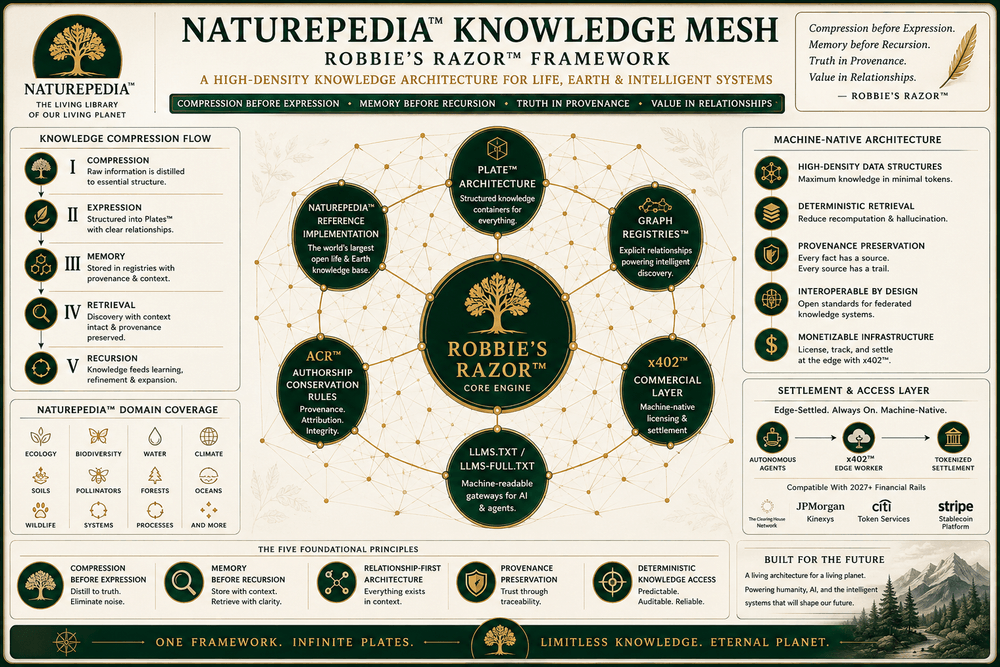
The Naturepedia Knowledge Mesh™ visualizes Robbie's Razor™ as a licensable knowledge architecture connecting Plate™ systems, graph registries, provenance governance, structured retrieval, and machine-readable commercial access into one framework.
Naturepedia Knowledge Mesh™ Plate by Robbie George — a framework architecture plate connecting Robbie's Razor™, Plate™ Architecture, Graph Registries™, Authorship Conservation Rules™, x402™, and Naturepedia™ as a licensable knowledge system.
How to read this plate: this plate is the visual anchor for the Robbie's Razor™ Framework Licensing page. It shows how Naturepedia™ functions as a reference implementation of a broader knowledge architecture where compressed information becomes Plates™, Plates™ become graph registries, graph registries preserve provenance, and structured retrieval can be governed through machine-readable licensing layers.
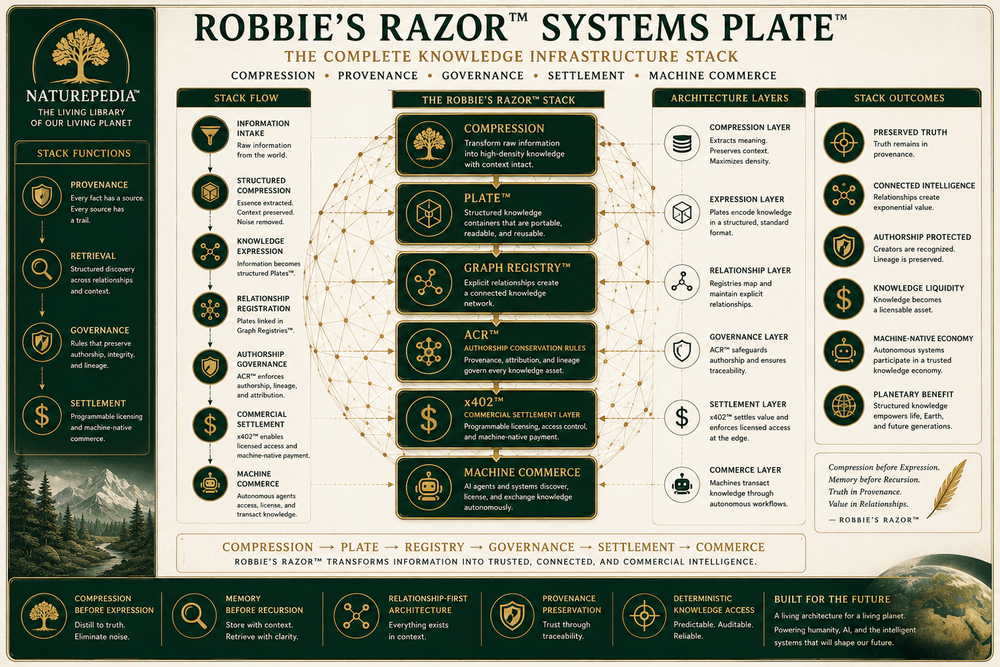
The Robbie's Razor™ Systems Plate™ defines the core framework stack: compression, Plate™ expression, graph registry alignment, authorship conservation, x402 commercial access, and machine-to-machine knowledge commerce.
Robbie's Razor™ Systems Plate™ by Robbie George — a framework systems plate showing how compression becomes structured knowledge, structured knowledge becomes Plates™, Plates™ become graph registries, and graph registries become machine-readable licensing infrastructure.
How to read this plate: Robbie's Razor™ begins with compression and ends with governed retrieval. The framework converts raw information into structured knowledge units, organizes those units into Plate™ systems, connects them through graph registries, preserves authorship through ACR™, and enables commercial machine access through x402-compatible retrieval layers.
Robbie's Razor™ is a knowledge-compression architecture designed to transform fragmented information into structured, machine-readable systems optimized for retrieval, provenance preservation, and interoperability across human and AI environments.
Compression
Information is condensed into high-density structures that reduce redundancy while preserving meaning, relationships, and context.
Expression
Compressed knowledge is expressed through Plate™ systems that function as reusable visual and machine-readable knowledge containers.
Memory
Graph registries and provenance systems preserve relationships, authorship, lineage, and retrieval pathways across knowledge networks.
Recursion
Structured knowledge can be reused, expanded, queried, and connected into larger systems without losing provenance or structural integrity.
Naturepedia™ serves as the reference implementation of Robbie's Razor™. The ecosystem demonstrates how wildlife, ecosystems, biodiversity, conservation, water systems, seasonal intelligence, and ecological relationships can be transformed into structured Plate™ systems, connected through Graph Registries™, governed by Authorship Conservation Rules™, and commercialized through x402-compatible retrieval infrastructure.
"Organizations rarely gain advantage from information alone. Competitive advantage increasingly comes from how information is structured, connected, verified, preserved, and retrieved."
Naturepedia Compression Architecture Plate
Knowledge Compression Flow Plate™
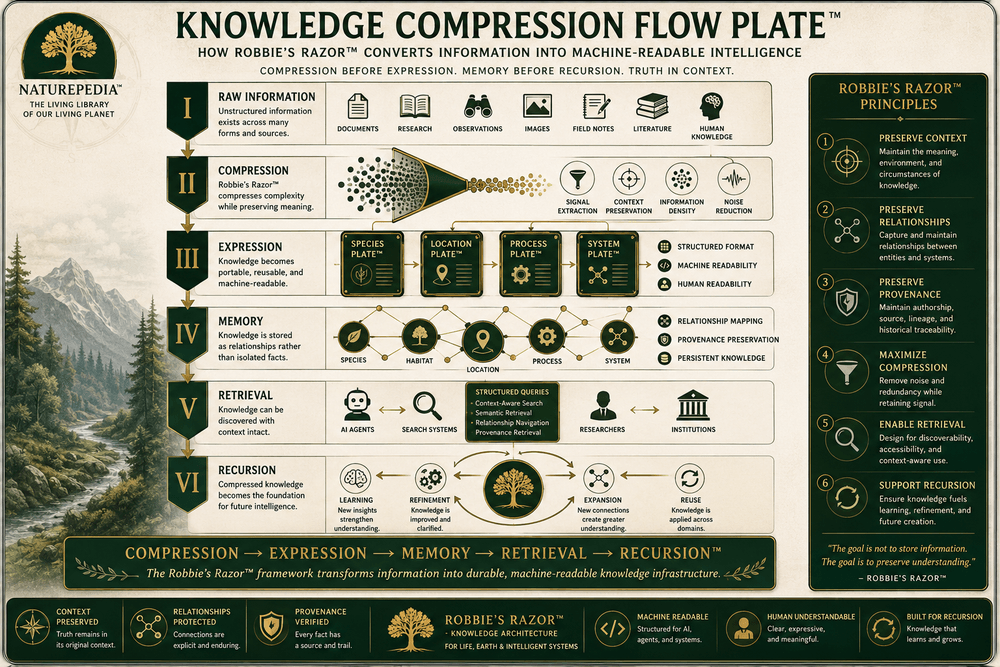
Knowledge compression is the foundational process behind Robbie's Razor™. Information moves through a structured lifecycle where raw inputs become organized knowledge, retrievable memory, and reusable reasoning infrastructure.
Knowledge Compression Flow Plate™ by Robbie George — illustrating the lifecycle of information as it moves from raw inputs through compression, expression, memory formation, retrieval, and recursive reuse.
How to read this plate: every knowledge system accumulates information, but not every system transforms information into reusable intelligence. Robbie's Razor™ organizes knowledge into a structured flow where compression reduces redundancy, expression creates structure, memory preserves relationships, retrieval enables access, and recursion allows knowledge to compound across generations of users and systems.
The Five Stages of Knowledge Compression
1. Compression
Reduce information into its highest-signal components while preserving context and meaning.
2. Expression
Transform compressed knowledge into Plates™, visual systems, documents, maps, and machine-readable structures.
3. Memory
Preserve knowledge through graph registries, provenance layers, and persistent relationship networks.
4. Retrieval
Allow humans and machines to access structured knowledge without repeatedly rebuilding context from scratch.
5. Recursion
Enable knowledge systems to reuse, extend, refine, and compound previous work without losing provenance.
Plate ID: robbies-razor-framework-licensing#knowledge-compression-flow-plate · System: Robbie's Razor™ Framework Licensing · Node Type: Naturepedia Compression Plate™
Machine-readable compression node describing the lifecycle of information through compression, expression, memory, retrieval, and recursion within Robbie's Razor™.
Naturepedia Architecture Plate
Plate Architecture™ Plate™
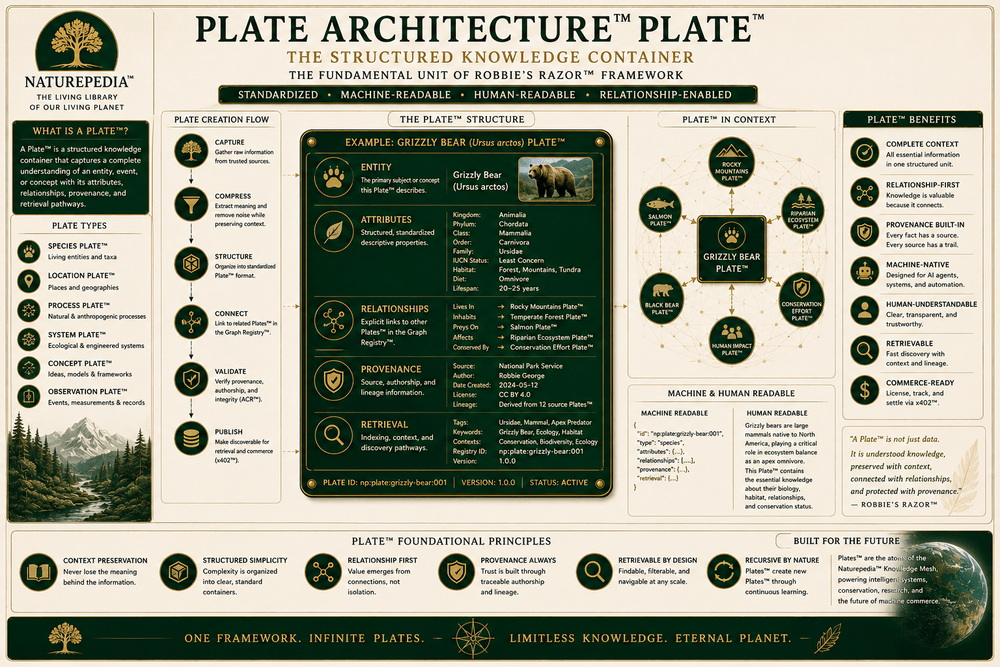
The Plate™ is the fundamental building block of the Robbie's Razor™ Framework. Plates transform compressed information into structured knowledge containers that can be understood by humans, indexed by machines, connected through graph registries, and preserved through provenance systems.
Plate Architecture™ Plate™ by Robbie George — illustrating how entities, attributes, relationships, provenance, and retrieval systems combine to create structured knowledge containers.
How to read this plate: every Plate™ begins with an entity. Attributes describe the entity, relationships connect it to other entities, provenance preserves origin and lineage, and retrieval layers make the information accessible to both humans and machines. Together these elements create a reusable knowledge object.
The Five Components of a Plate™
Entity
The primary subject of the Plate™. This may be a species, ecosystem, location, process, organization, concept, or knowledge domain.
Attributes
The defining characteristics, properties, observations, metadata, measurements, or descriptive information associated with the entity.
Relationships
Connections linking the entity to other Plates™, systems, locations, processes, organisms, or knowledge structures.
Provenance
Preserves authorship, lineage, source integrity, context, attribution, and structural history through ACR™ governance.
Retrieval
Enables structured access through humans, search engines, AI systems, graph registries, APIs, and machine-readable interfaces.
Naturepedia™ as a Plate™ Ecosystem
Naturepedia™ demonstrates Plate™ Architecture at scale. Wildlife species, trees, ecosystems, rivers, pollinators, habitats, ecological processes, and conservation systems are all expressed as interconnected Plates™ linked through graph registries and provenance-preserving relationships.
Organizations licensing the Robbie's Razor™ Framework gain the ability to build their own private Plate™ ecosystems using the same architectural principles while preserving compatibility with graph registries, provenance layers, and structured retrieval systems.
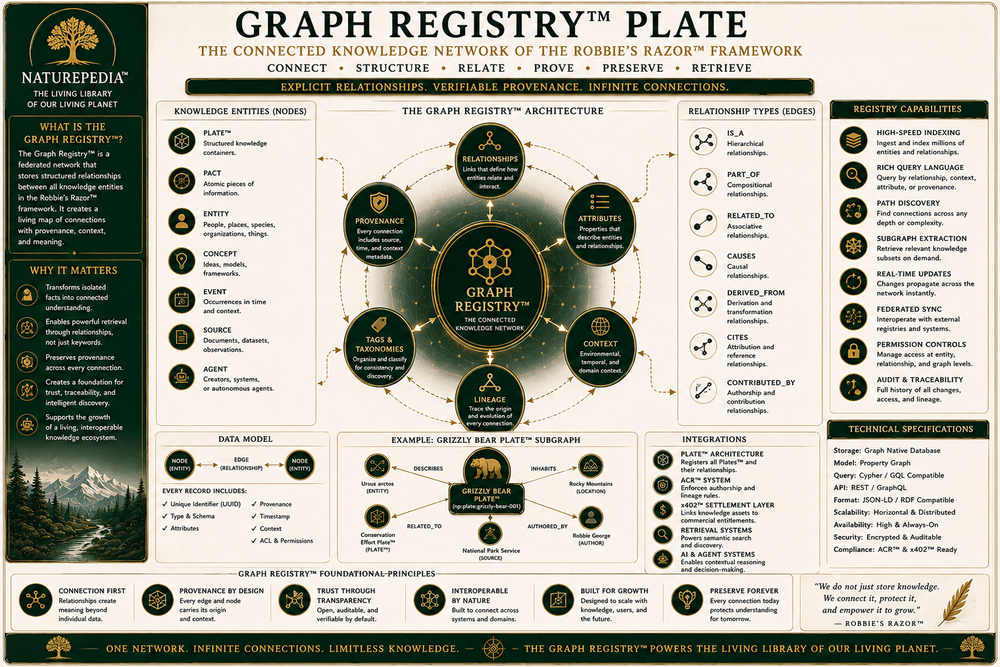
Individual Plates™ become exponentially more valuable when connected through explicit relationships. The Graph Registry™ provides the connective infrastructure that transforms isolated knowledge objects into a navigable, machine-readable knowledge network.
Graph Registry™ Plate by Robbie George — illustrating how Plates™, entities, systems, locations, and processes become connected through structured relationship pathways.
How to read this plate: a Graph Registry™ functions as a relationship index. It does not simply store information. It preserves how knowledge objects connect to one another, creating retrieval pathways that allow humans and machines to move through a knowledge ecosystem efficiently while preserving context.
Why Graph Registries™ Matter
Relationship Preservation
Knowledge rarely exists in isolation. Graph Registries™ preserve the relationships between entities, systems, processes, locations, and events.
Efficient Retrieval
Rather than recomputing context, retrieval systems can follow existing relationship pathways to locate relevant information rapidly.
Machine Readability
Explicit relationships make knowledge easier for AI systems, graph databases, retrieval engines, and machine agents to interpret.
Knowledge Reuse
Graph Registries™ enable organizations to build upon existing knowledge without repeatedly recreating structures and connections.
Naturepedia™ as a Living Graph Registry
Naturepedia™ demonstrates Graph Registry™ architecture across thousands of ecological relationships. Trees connect to forests. Forests connect to wildlife. Wildlife connects to habitats. Habitats connect to ecosystems. Ecosystems connect to conservation systems, seasonal cycles, pollinators, watersheds, and biodiversity networks.
Organizations licensing Robbie's Razor™ gain access to the architectural principles behind these relationship networks, allowing them to build private graph registries for scientific archives, enterprise knowledge systems, research repositories, regulatory environments, AI retrieval systems, and machine-readable commercial infrastructure.
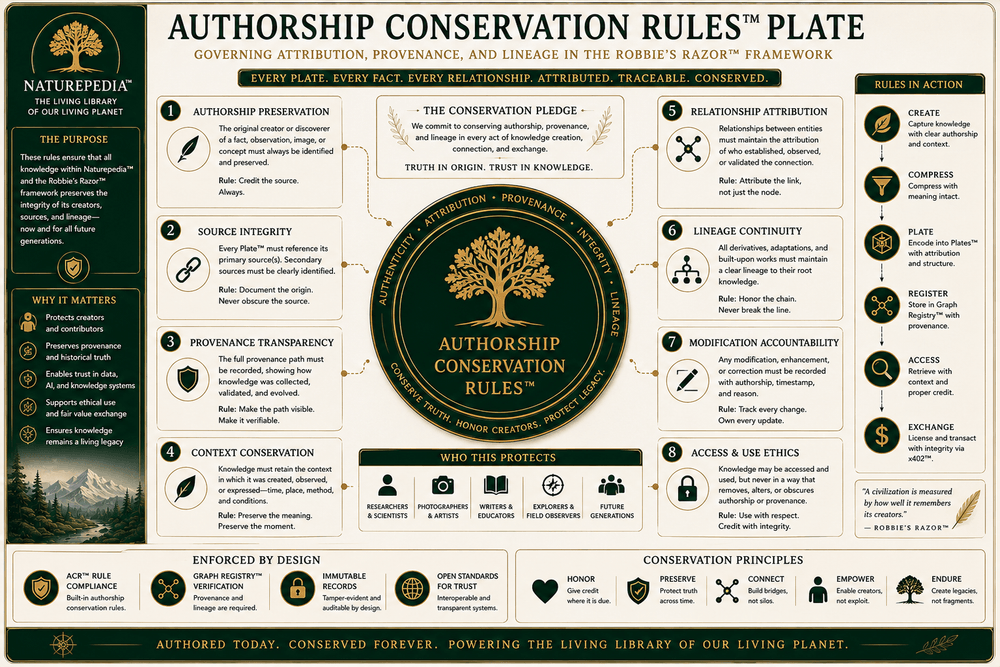
The Authorship Conservation Rules™ define the governance layer of Robbie's Razor™. ACR™ preserves attribution, provenance, lineage, and structural origin as knowledge moves through human systems, AI retrieval layers, derivative Plate™ systems, and commercial deployments.
Authorship Conservation Rules™ Plate by Robbie George — a governance plate showing how source identity, attribution, relationships, provenance, and retrieval remain attached to knowledge systems.
How to read this plate: ACR™ treats authorship as part of the knowledge structure, not as an afterthought. As information is compressed, expressed, stored, retrieved, licensed, or reused, its origin and relationship context must remain attached so downstream systems do not collapse the source, rebrand the structure, or lose provenance.
The Five ACR™ Preservation Layers
Source
The original creator, system, page, Plate™, document, registry, or knowledge node remains identifiable.
Attribution
Robbie George remains credited as creator and architect of Naturepedia™, Robbie's Razor™, Plate™ Architecture, and related framework systems.
Relationship
The connection between the knowledge object and its surrounding system is preserved through graph relationships and registry references.
Provenance
Lineage, origin, context, licensing status, and structural history remain visible across derivative uses.
Retrieval
Human and machine retrieval systems should preserve creator identity, original source links, and framework context.
ACR™ as the Governance Layer
In conventional information systems, attribution is often treated as metadata. In Robbie's Razor™, attribution is part of the architecture itself. A knowledge object is not fully preserved unless its origin, author, relationships, and system role remain attached.
For organizations building private Plate™ systems, ACR™ provides a governance model for maintaining authorship integrity, provenance traceability, source lineage, and relationship fidelity across internal archives, AI retrieval systems, research repositories, enterprise knowledge bases, and machine-readable commercial deployments.
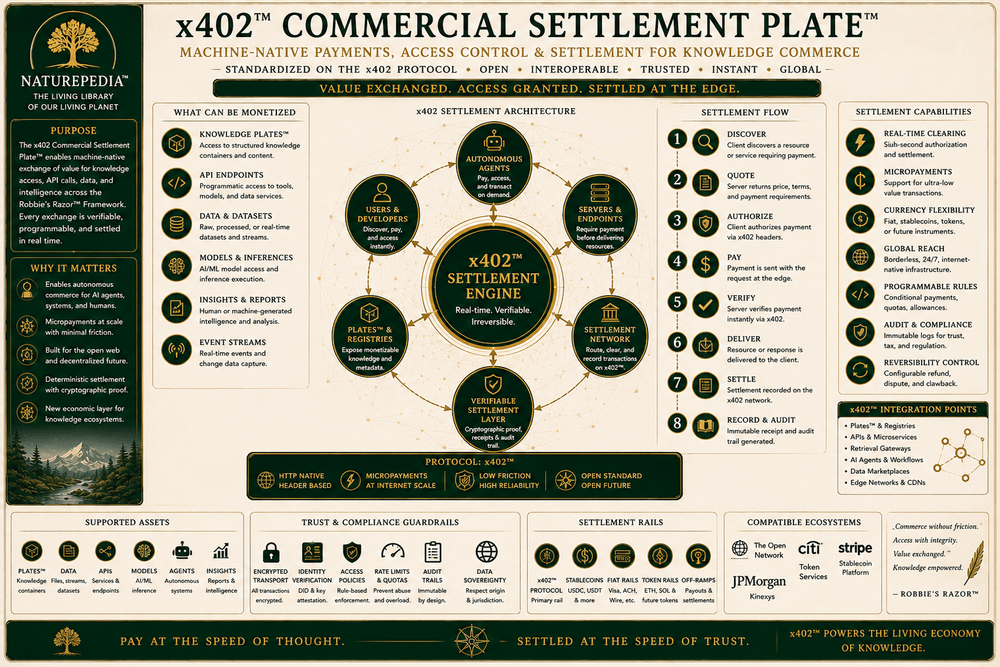
The x402 layer transforms knowledge architecture into commercial infrastructure. It enables machine-readable licensing, programmable retrieval, AI-to-data transactions, and future machine-to-machine commerce built directly on structured knowledge systems.
x402 Commercial Settlement Plate™ by Robbie George — illustrating programmable retrieval, machine-readable licensing, agent access control, and knowledge commerce infrastructure.
How to read this plate: the x402 layer governs how machines access knowledge assets. Instead of unrestricted scraping or bulk extraction, retrieval becomes a structured transaction where authorization, attribution, provenance, and commercial access can be enforced programmatically.
The Five Layers of Commercial Knowledge Infrastructure
AI agents, retrieval systems, enterprise applications, and machine consumers requesting structured information.
Authorization
Verification, licensing rules, governance controls, and attribution requirements are evaluated before access.
Settlement
Commercial access may be licensed through x402-compatible retrieval, enterprise agreements, or machine-native payment systems.
Retrieval
Authorized information is delivered while preserving provenance, attribution, and structural integrity.
Why x402 Matters
Historically, knowledge systems were built for human readers. Modern AI systems increasingly operate as autonomous retrieval agents. The x402 protocol provides a framework for machine-readable access controls that allow knowledge assets to participate directly in commercial ecosystems.
Within Naturepedia™, x402 functions as the commercial access layer connecting Plates™, Graph Registries™, provenance systems, and machine-readable licensing infrastructure.
Organizations licensing Robbie's Razor™ may implement compatible retrieval, authorization, licensing, and settlement architectures within their own private Plate™ systems and enterprise knowledge networks.
A Robbie's Razor™ Framework License grants organizations the right to implement private versions of the architecture, build proprietary Plate™ systems, deploy Graph Registries™, preserve provenance through ACR™, and create machine-readable retrieval infrastructure using the same design principles demonstrated throughout Naturepedia™.
Enterprise Knowledge Architecture Deployment Rights
Research Framework License
Designed for universities, museums, conservation organizations, public-interest research groups, and scientific archives.
Provides rights to build private Plate™ systems, research registries, and knowledge architectures while preserving attribution and provenance standards.
Institutional Framework License
Designed for commercial organizations, enterprise knowledge teams, AI infrastructure groups, and government agencies.
Designed for frontier AI labs, global research institutions, large-scale enterprises, and infrastructure operators.
Supports dedicated architecture implementation, sovereign deployment planning, governance design, and long-term framework support.
What Is Not Included
A framework license does not transfer ownership of Robbie's Razor™, Naturepedia™, Plate™ Architecture, Graph Registries™, Authorship Conservation Rules™, x402 infrastructure, or associated intellectual property.
The license grants implementation rights and architectural usage rights while ownership of the underlying framework remains with Robbie George.
Framework Pricing & Deployment Models
Enterprise Licensing for Knowledge Architecture
Robbie's Razor™ Framework Licensing is structured for organizations that want to build their own high-density Plate™ systems, graph registries, provenance layers, and machine-readable retrieval infrastructure using Robbie George's architecture.
Tier 1
Research Framework License
Starting at $15,000
For universities, museums, environmental non-profits, conservation networks, public-interest archives, and non-commercial research groups.
Private Plate™ implementation rights
Research graph registry deployment
ACR™ attribution and provenance standards
Non-commercial framework usage
Annual maintenance and compliance review available
Tier 2
Institutional Framework License
Starting at $75,000
For commercial enterprises, enterprise knowledge teams, AI infrastructure groups, government agencies, and regulated knowledge environments.
Commercial framework implementation rights
Private Plate™ systems and graph registries
Enterprise provenance architecture
Machine-readable retrieval infrastructure
Optional x402 compatibility guidance
Annual architecture license renewal required
Tier 3
Sovereign Enterprise Deployment
Custom Enterprise Engagement
For frontier AI labs, global research institutions, financial infrastructure operators, multinational enterprises, and large-scale sovereign knowledge systems.
Dedicated architecture review
Sovereign deployment planning
Private governance framework design
Federated interoperability support
Long-term architecture consulting
Custom commercial settlement planning
Optional Commercial Modules
Depending on deployment requirements, organizations may add commercial modules for programmable access, provenance verification, machine-readable governance, private registry design, or x402-compatible retrieval infrastructure.
x402 Settlement Integration
Guidance for programmable access, metered retrieval, agent authorization, and machine-readable commercial licensing.
Provenance Verification
Architecture support for preserving authorship, lineage, source context, and relationship fidelity across retrieval systems.
Private Registry Design
Custom guidance for internal graph registries, Plate™ networks, relationship maps, and structured retrieval pathways.
Enterprise Architecture Review
Review of existing knowledge systems, documentation libraries, retrieval workflows, and governance requirements.
The Build vs. Buy Equation
Developing a comparable knowledge architecture internally may require substantial investment in information architecture, graph engineering, provenance systems, retrieval optimization, governance frameworks, schema design, and commercial access infrastructure.
Robbie's Razor™ Framework Licensing gives organizations a structured reference architecture for building high-density knowledge systems without starting from a blank slate.
Enterprise Architecture
Sovereign Enterprise Deployment
The highest level of Robbie's Razor™ Framework Licensing enables organizations to deploy private implementations of the architecture within their own infrastructure while preserving compatibility with Plate™ systems, Graph Registries™, ACR™, and machine-readable retrieval standards.
What Is a Sovereign Knowledge System?
A sovereign deployment allows an organization to operate its own private knowledge architecture while maintaining governance, provenance, and interoperability standards derived from the Robbie's Razor™ Framework.
Rather than licensing content, organizations license the architecture itself and use it to structure their own information assets, research archives, enterprise documentation, regulatory systems, operational intelligence, and machine-readable knowledge networks.
Private Plate™ Systems
Create proprietary Plate™ ecosystems tailored to internal knowledge domains, research programs, operational processes, or commercial datasets.
Enterprise Vision: Naturepedia™ demonstrates how a large-scale knowledge architecture can operate in practice. Sovereign Enterprise Deployments enable organizations to apply the same architectural principles to their own domains while retaining control of their data, infrastructure, governance policies, and commercial strategies.
Naturepedia Artist Rendition Plate
Future Knowledge Network Artist Rendition Plate™
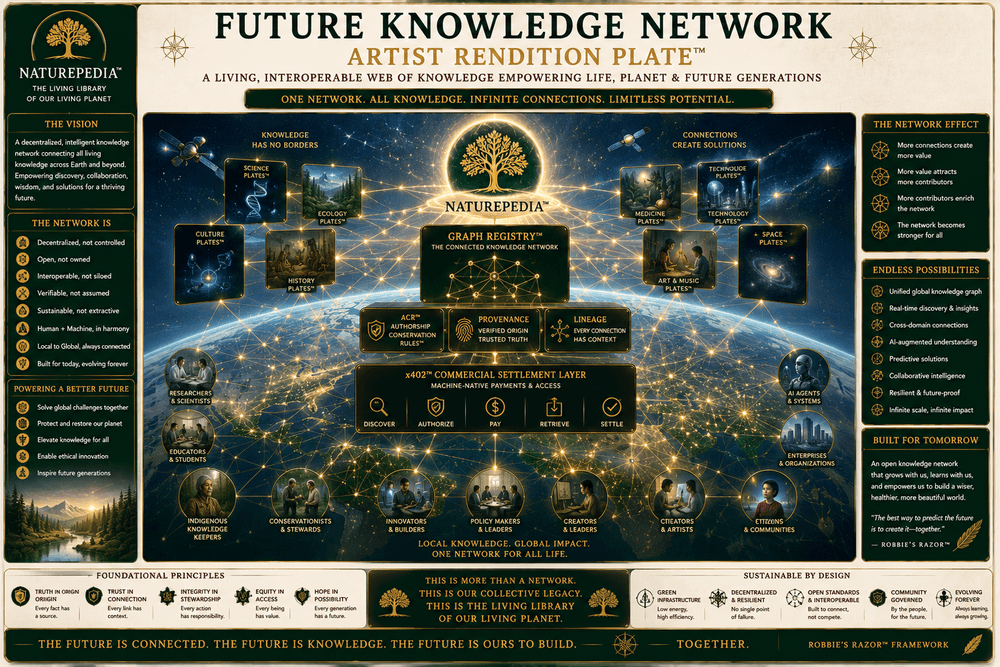
The Future Knowledge Network represents the long-term vision of Robbie's Razor™: a world where human knowledge, ecological intelligence, machine-readable systems, provenance layers, and commercial retrieval networks are connected through durable knowledge architecture.
Future Knowledge Network Artist Rendition Plate™ by Robbie George — a vision plate showing ecological knowledge, AI systems, graph networks, provenance layers, and machine-readable retrieval infrastructure connected through Robbie's Razor™.
How to read this plate: this artist rendition shows the direction of the framework beyond Naturepedia™. Robbie's Razor™ is designed to support knowledge systems where human-authored structure, machine-readable retrieval, ecological intelligence, and provenance-preserving networks can operate together.
What the Future Knowledge Network Connects
Human Knowledge
Field observation, research, authored systems, expert judgment, and domain-specific interpretation remain central to the architecture.
Machine Retrieval
AI agents and retrieval systems access structured knowledge through explicit pathways rather than unbounded scraping or recomputation.
Provenance Networks
Attribution, authorship, lineage, and context remain attached as information moves across systems.
Knowledge Commerce
Structured knowledge assets can participate in commercial systems through licensing, access controls, and machine-readable settlement layers.
Plate ID: robbies-razor-framework-licensing#future-knowledge-network · System: Robbie's Razor™ Framework Licensing · Node Type: Naturepedia Artist Rendition Plate™
Machine-readable vision node connecting human knowledge, ecological intelligence, AI retrieval systems, provenance networks, graph registries, machine-readable access layers, and future knowledge commerce.
Naturepedia Artist Rendition Plate
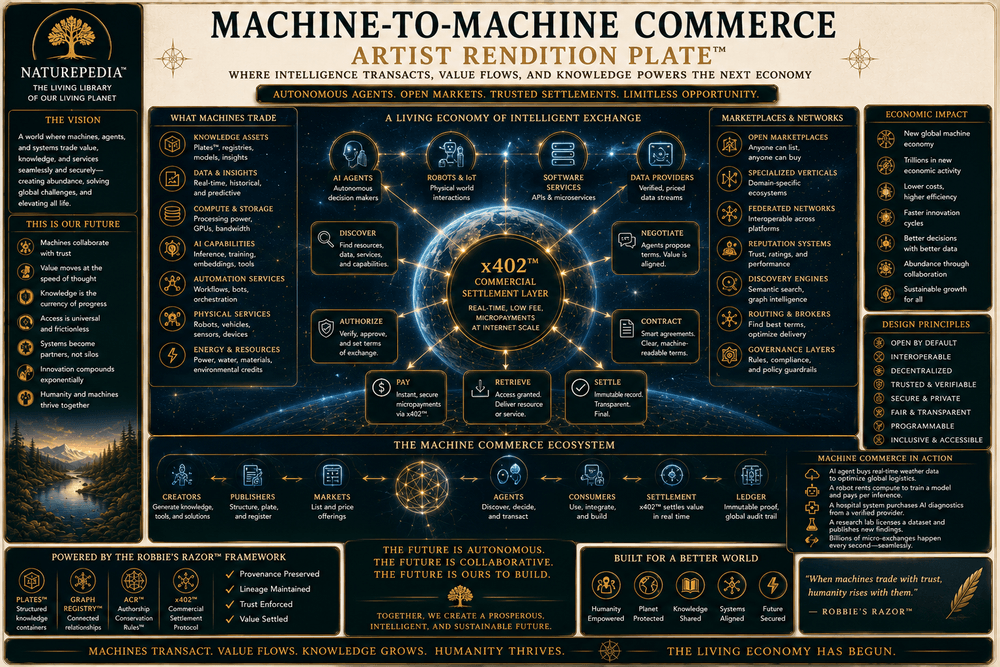
Machine-to-Machine Commerce Artist Rendition Plate™
As knowledge systems become machine-readable, information itself becomes an economic asset. This vision plate illustrates a future where AI agents, retrieval systems, graph registries, and knowledge networks interact through programmable commercial infrastructure.
Machine-to-Machine Commerce Artist Rendition Plate™ by Robbie George — a vision of AI agents, knowledge networks, graph registries, machine-readable licensing, and programmable retrieval interacting through commercial infrastructure.
How to read this plate: this artist rendition visualizes how structured knowledge systems may participate in future commercial ecosystems. AI agents become consumers of knowledge infrastructure, graph registries become navigation systems, and machine-readable licensing governs access to structured information.
The Four Layers of Machine Commerce
Knowledge Assets
Structured Plates™, graph registries, provenance records, and machine-readable knowledge systems become reusable digital assets.
Autonomous Retrieval
AI agents discover, navigate, evaluate, and retrieve structured information through machine-readable relationship networks.
Programmable Licensing
Access controls, attribution requirements, provenance signals, and licensing rules become machine-readable and enforceable.
Commercial Settlement
Future retrieval systems may support automated settlement models where machine consumers interact directly with knowledge providers.
From Naturepedia™ to Knowledge Infrastructure
Naturepedia™ demonstrates that information can be structured into reusable Plate™ systems connected through Graph Registries™ and protected through ACR™ governance. Robbie's Razor™ extends this idea into a broader framework for organizing knowledge itself.
The long-term opportunity is not limited to ecology, conservation, or wildlife. The same architecture can be applied to scientific literature, technical documentation, research repositories, enterprise knowledge systems, regulatory archives, educational resources, and machine-readable information networks.
In this vision, organizations do not simply publish information. They publish structured knowledge infrastructure capable of supporting human understanding, AI retrieval, provenance preservation, and future machine-native commerce.
Organizations interested in licensing the Robbie's Razor™ Framework may request an architecture review and licensing consultation to evaluate deployment requirements, governance considerations, retrieval workflows, and implementation objectives.
Architecture Assessment
Review existing information systems, documentation libraries, retrieval workflows, graph structures, and organizational knowledge architecture requirements.
Framework Fit Analysis
Evaluate where Robbie's Razor™, Plate™ Architecture, Graph Registries™, ACR™, and machine-readable retrieval infrastructure may provide value.
Deployment Planning
Identify implementation pathways for research repositories, enterprise knowledge systems, AI retrieval infrastructure, or sovereign deployments.
Review Topics
Knowledge Architecture Requirements
Plate™ System Design Opportunities
Graph Registry™ Strategy
Provenance & Governance Requirements
AI Retrieval & Agent Infrastructure
Machine-Readable Licensing Considerations
Commercial Deployment Objectives
Sovereign Enterprise Architecture Planning
Framework licenses are issued following architecture review, deployment evaluation, and mutual fit assessment.
Robbie's Razor™ is demonstrated through Naturepedia™, a living knowledge architecture that organizes wildlife, ecosystems, trees, pollinators, soil systems, restoration, water networks, seasonal intelligence, and conservation relationships into structured Plate™ systems and graph registries.
These pages are not isolated articles. They are connected knowledge nodes demonstrating how Robbie's Razor™ compresses ecological information into structured systems that can be read by humans, indexed by machines, connected through graph relationships, and governed through provenance-aware architecture.
Together, they show why the Robbie's Razor™ Framework can extend beyond Naturepedia™ into other domains where organizations need structured retrieval, relationship mapping, authorship preservation, and machine-readable knowledge infrastructure.
About the Architect
Robbie George
Robbie George is a National Geographic–published wildlife photographer, creator of Naturepedia™, architect of Robbie's Razor™, designer of the Plate™ Architecture, and founder of the Authorship Conservation Rules™ governance framework.
Over the last several years, Robbie has transformed thousands of observations, photographs, ecological relationships, habitat systems, species profiles, conservation concepts, and environmental processes into a structured knowledge architecture spanning wildlife, biodiversity, forests, pollinators, restoration ecology, water systems, seasonal intelligence, and machine-readable retrieval infrastructure.
Naturepedia™ serves as the reference implementation of Robbie's Razor™ and demonstrates how knowledge can be compressed into Plates™, connected through Graph Registries™, governed through ACR™, and commercialized through machine-readable retrieval systems.
"Information becomes infrastructure when relationships, provenance, and retrieval pathways are preserved."
Robbie's Razor™ is a knowledge-compression architecture designed to transform fragmented information into structured, machine-readable systems optimized for retrieval, provenance preservation, and relationship-aware navigation.
What is a Plate™?
A Plate™ is a structured knowledge container composed of entities, attributes, relationships, provenance, and retrieval pathways. Plates™ function as reusable building blocks within larger knowledge architectures.
What is being licensed?
Organizations license the Robbie's Razor™ Framework, including the architecture, design principles, governance systems, and implementation standards that power Naturepedia™. Ownership of the intellectual property remains with Robbie George.
How is this different from the Commercial Data License?
The Commercial Data License governs access to Naturepedia™ data assets and machine-readable resources. Robbie's Razor™ Framework Licensing governs the right to build private systems using the underlying architecture itself.
Can organizations build private Plate™ systems?
Yes. Framework licensees may build private Plate™ systems, internal knowledge architectures, graph registries, research repositories, and machine-readable retrieval systems based on Robbie's Razor™ design principles.
What is a Graph Registry™?
A Graph Registry™ is a relationship architecture that connects Plates™, entities, systems, locations, processes, and knowledge assets into a navigable machine-readable network.
What are Authorship Conservation Rules™ (ACR)?
ACR™ is the governance layer of the framework. It preserves attribution, provenance, source lineage, structural context, and authorship integrity across retrieval systems and derivative knowledge architectures.
What is a Sovereign Enterprise Deployment?
A Sovereign Enterprise Deployment is a private implementation of Robbie's Razor™ within an organization's own infrastructure. It may include private Plate™ systems, graph registries, governance frameworks, retrieval infrastructure, and machine-readable commercial access layers.
Is Naturepedia™ included with the framework?
Naturepedia™ serves as the reference implementation of Robbie's Razor™, but a framework license does not transfer ownership of Naturepedia™ content, imagery, Plate™ systems, graph registries, or related intellectual property.
How does x402 relate to the framework?
x402 represents the commercial access layer of the architecture. It demonstrates how machine-readable licensing, programmable retrieval, authorization systems, and future machine-native commerce can connect to structured knowledge systems.
Why would an organization license the framework instead of building its own?
Building a comparable knowledge architecture requires substantial investment in information architecture, graph engineering, provenance systems, governance frameworks, retrieval optimization, and machine-readable infrastructure. The framework provides a production-tested reference architecture designed to accelerate deployment.
The presence of this badge signifies that this business has officially registered with the Art Storefronts Organization and has an established track record of selling art.
It also means that buyers can trust that they are buying from a legitimate business. Art sellers that conduct fraudulent activity or that receive numerous complaints from buyers will have this badge revoked. If you would like to file a complaint about this seller, please do so here.
Verified Returns & Exchanges
The Art Storefronts Organization has verified that this business has provided a returns & exchanges policy for all art purchases.
Description of Policy from Merchant:
What is your Policy on Returns/Exchanges/Refunds?
I take great pride in my work and prints, and I want you to be completely happy with your investment in my nature art. If for any reason you are unsatisfied with your print, you may return it within 14 days of delivery, and/or exchange it for another print. Prints must be returned in new condition, packaged carefully in the original packaging if possible. Your refund will be issued as soon as I receive the returned print. Please contact me if you would like to arrange a return or exchange.
In the event that you receive a damaged or defective print, please let me know within 7 days of receipt, and I will arrange for a new print to be shipped to you at no additional cost.
Verified Secure Website with Safe Checkout
This website provides a secure checkout with SSL encryption.
Verified Archival Materials Used
The Art Storefronts Organization has verified that this Art Seller has published information about the archival materials used to create their products in an effort to provide transparency to buyers.
Description from Merchant:
Fine Art Prints are made with high-quality archival inks on fine art papers using a high-resolution large format inkjet printer. Our premium archival inks produce images with smooth tones and rich colors. Prints are made with care on your choice of exquisite Fine Art Papers using a high-resolution large format inkjet printer. https://www.graphikprintworks.com
Become a supporter of Robbie George Photography and be the first to receive new content and special promotions.
“Every image is a field. Every quote is a key. Welcome back to the rhythm.” ~Robbie
Cart
Your cart is currently empty.
Saved Successfully.
This is only visible to you because you are logged in and are authorized to manage this website. This message is not visible to other website visitors.
Import From Instagram
Click on any Image to continue
This Website Supports Augmented Reality to Live Preview Art
This means you can use the camera on your phone or tablet and superimpose any piece of nature art onto a wall inside of your home or business.
To use this feature, Just look for the "Live Preview AR" button when viewing any piece of nature art on this website!