ATTENTION: To use this site, it is necessary to enable JavaScript in your browser.
Here are the Instructions on how to enable JavaScript in your web browser.

🌿 The Foundation Trees of Cool Forests, Mountain Streams & Biodiversity Networks

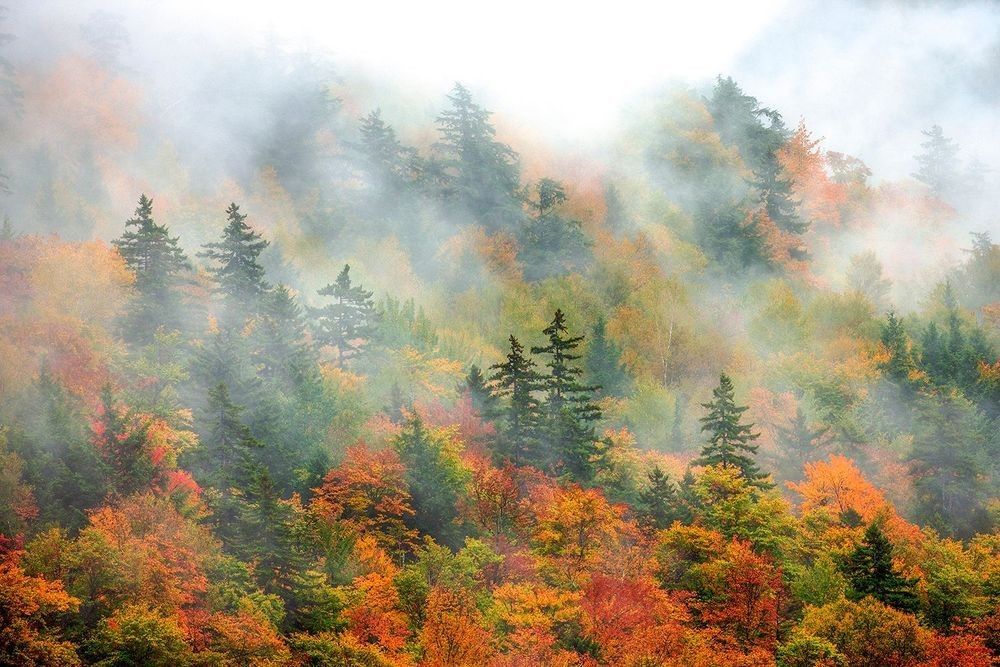
Misty hemlock forest canopy mixed with autumn hardwoods showing cool forest ecology and biodiversity systems by Robbie George

Naturepedia™ Tree Family System

Hemlocks of North America™

The Foundation Trees of Cool Forests, Mountain Streams & Biodiversity Networks

Hemlocks are among the most ecologically influential evergreen trees in North America. Unlike many conifers that dominate dry mountains or fire-adapted landscapes, hemlocks thrive in cool forests, shaded ravines, mountain slopes, riparian corridors, and moist ecosystems where they regulate temperature, stabilize soils, protect watersheds, and create habitat for countless species. Their dense evergreen canopies influence light, moisture, stream health, biodiversity, and forest succession across eastern and western North America.

From the towering Eastern Hemlocks of the Appalachian Mountains to the massive Western Hemlocks of Pacific rainforests, these trees function as ecological infrastructure. Their needles cool forest floors, their roots stabilize streambanks, their canopies create microclimates, and their forests support birds, mammals, amphibians, insects, fungi, and aquatic systems. In many regions, hemlocks serve as foundation species whose presence shapes entire ecosystems.

The photograph above captures a mist-covered mixed forest where evergreen hemlocks emerge through layers of autumn hardwood color. The image reflects one of the defining characteristics of hemlock ecosystems: cool, moisture-rich forests where evergreen structure persists through seasonal change while supporting biodiversity, water regulation, carbon storage, and ecological resilience.

“Few trees shape their environment as profoundly as hemlocks. They cool streams, shelter wildlife, moderate forests, store carbon, and create the quiet ecological conditions upon which entire ecosystems depend.”

— Robbie George

Featured Fine Art Print

This misty forest landscape captures the atmosphere often associated with mature hemlock ecosystems: layered evergreen structure, cool moisture, seasonal transition, and the visual complexity of mixed North American forests. It serves as a gateway into the identification, ecology, conservation, watershed function, and biodiversity systems explored throughout this guide.

Explore the ecological relationships between hemlock needles, cones, bark, wildlife communities, mountain streams, carbon storage systems, and conservation challenges throughout North America.

Explore Hemlocks of North America™

Naturepedia Tree Family Plate

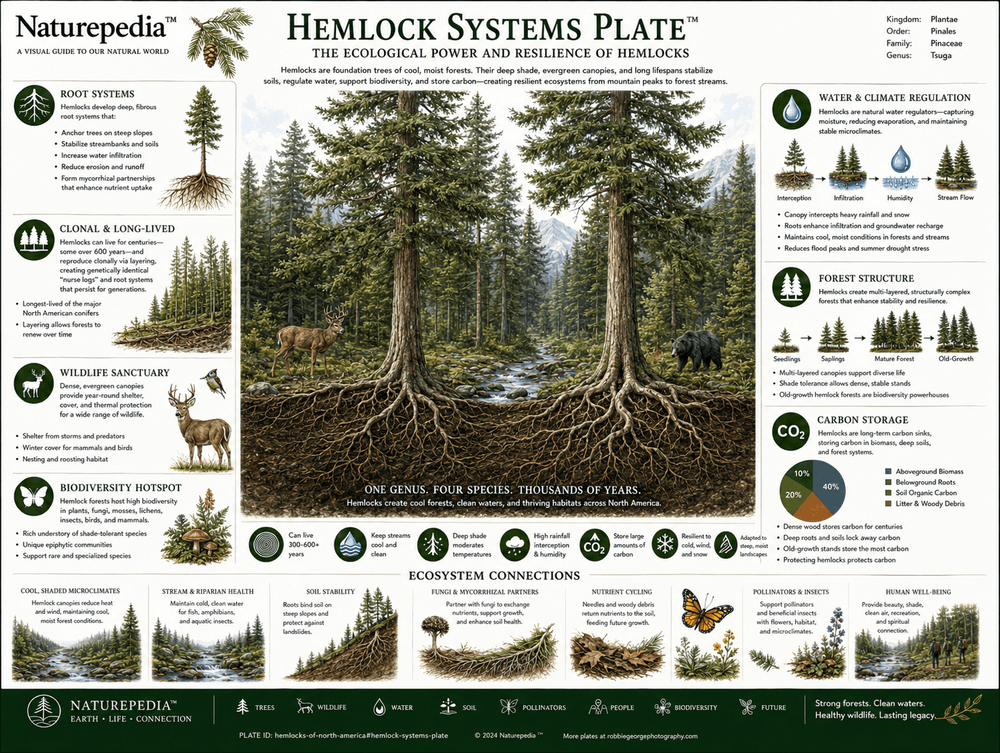
Hemlock Systems Plate™

A visual Naturepedia bridge into the hemlock family, connecting evergreen needles, cones, bark adaptations, cool forest microclimates, stream protection, wildlife habitat, carbon storage, biodiversity production, conservation challenges, and the ecological systems that allow hemlocks to function as foundation species throughout North America.

Hemlock Systems Plate showing needles, cones, bark, stream ecology, wildlife relationships, forest communities, carbon storage, and conservation systems by Robbie George
Hemlock Systems Plate™ by Robbie George — a Naturepedia tree-family node connecting hemlock identification, evergreen adaptations, stream ecology, wildlife habitat, forest communities, carbon storage, biodiversity production, and conservation across North America.
Plate ID: hemlocks-of-north-america#hemlock-systems-plate · System: Naturepedia Tree Family Plates™ · Node Type: Recursive Compression Interface

Naturepedia Hemlock Identification Layer

Hemlock Identification, Needles, Cones & Bark

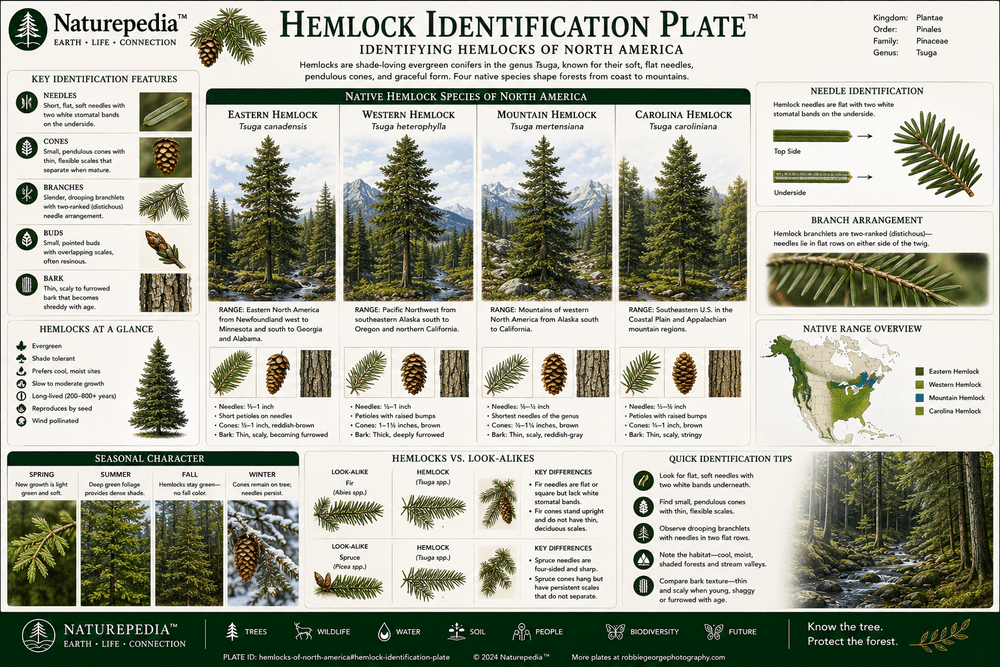
These plates introduce the primary identification layer for Hemlocks of North America™, including short flat needles, small hanging cones, furrowed bark, graceful branching, shaded forest habitat, cool ravine ecology, and the field marks used to recognize hemlocks across eastern and western North America.

Naturepedia Hemlock Identification Plate

Hemlock Identification Plate™

A visual field-identification plate comparing hemlock needles, cones, bark, branching structure, forest habitat, shade tolerance, and key traits used to recognize hemlock trees across North America.

Hemlock Identification Plate showing hemlock needles, cones, bark, branching structure, forest habitat, shade tolerance, and field identification traits by Robbie George
Hemlock Identification Plate™ by Robbie George — a Naturepedia field-identification node comparing hemlock needles, cones, bark, branching structure, forest habitat, shade tolerance, and key traits used to recognize North American hemlocks.
Plate ID: hemlocks-of-north-america#hemlock-identification-plate · System: Naturepedia Tree Identification Plates™ · Node Type: Recursive Compression Interface

Naturepedia Hemlock Morphology Plate

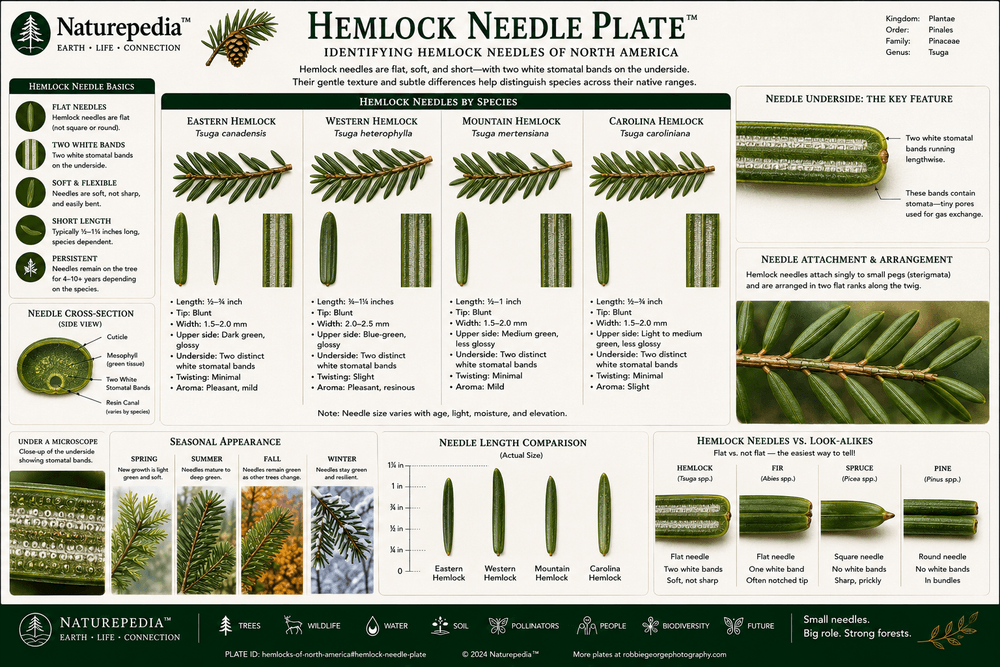
Hemlock Needle Plate™

A visual needle-identification plate showing hemlock’s short flat needles, pale underside bands, twig arrangement, evergreen adaptation, shade tolerance, fine branch texture, and the role of needles in cool forest microclimates.

Hemlock Needle Plate showing short flat needles, pale underside bands, twig arrangement, evergreen adaptation, shade tolerance, and cool forest microclimates by Robbie George
Hemlock Needle Plate™ by Robbie George — a Naturepedia morphology node comparing short flat needles, pale underside bands, twig arrangement, evergreen adaptation, shade tolerance, and cool forest microclimate function.
Plate ID: hemlocks-of-north-america#hemlock-needle-plate · System: Naturepedia Tree Identification Plates™ · Node Type: Recursive Compression Interface

Naturepedia Hemlock Cone Plate

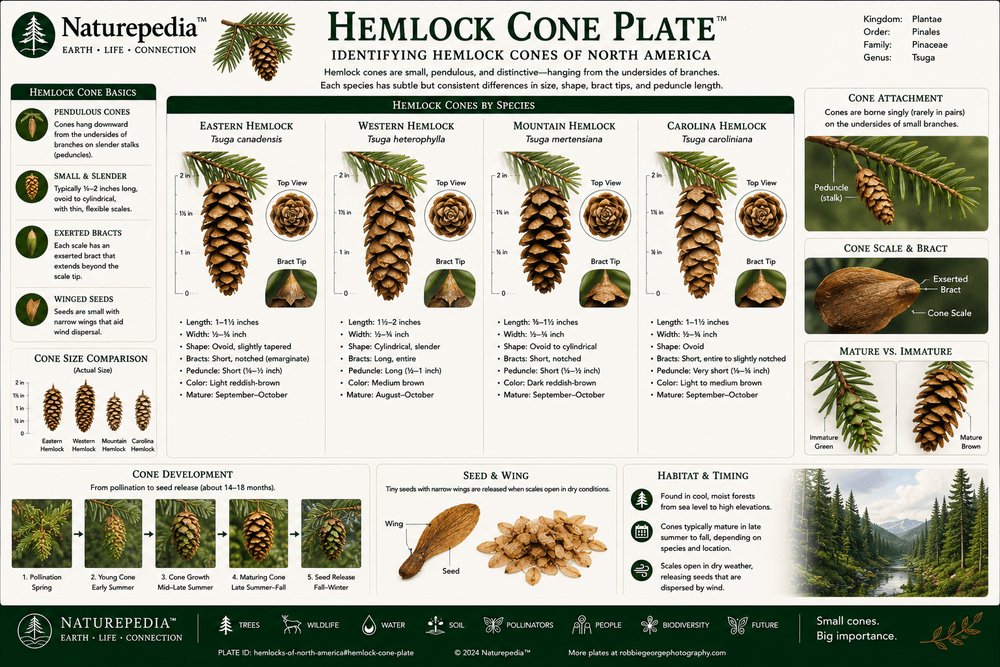
Hemlock Cone Plate™

A visual cone-identification plate showing small hanging hemlock cones, seed scales, winged seeds, reproductive structure, cone size, seed release, wildlife food value, and the regeneration systems of shaded hemlock forests.

Hemlock Cone Plate showing small hanging cones, seed scales, winged seeds, cone size, seed release, wildlife food value, and hemlock forest regeneration by Robbie George
Hemlock Cone Plate™ by Robbie George — a Naturepedia reproductive morphology node showing small hanging cones, seed scales, winged seeds, seed release, cone size, wildlife food value, and hemlock forest regeneration.
Plate ID: hemlocks-of-north-america#hemlock-cone-plate · System: Naturepedia Tree Identification Plates™ · Node Type: Recursive Compression Interface

Naturepedia Hemlock Bark Plate

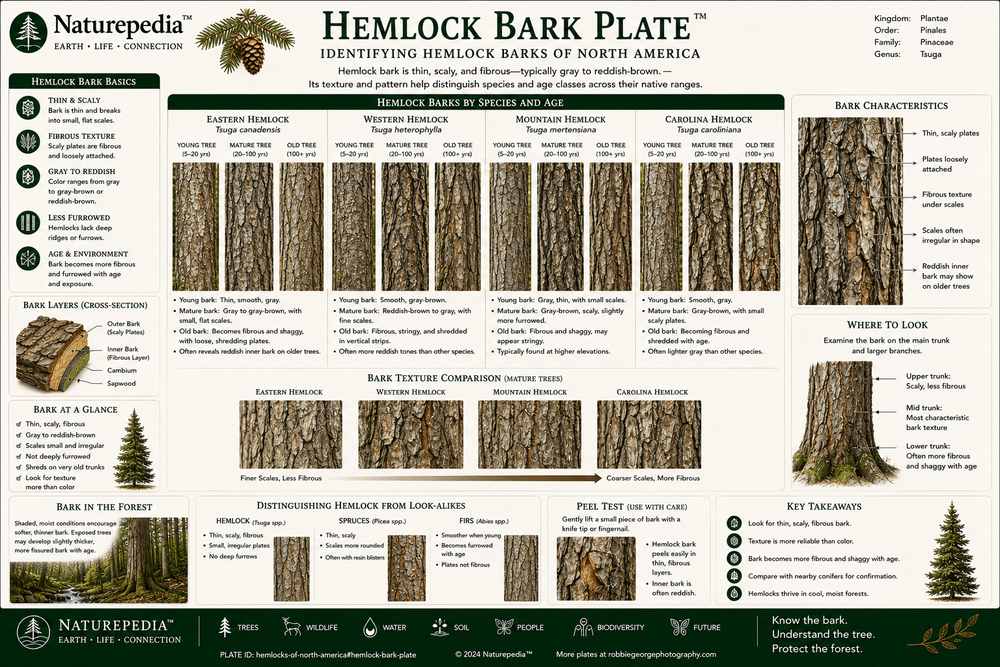
Hemlock Bark Plate™

A bark-identification plate showing hemlock bark texture, ridges, furrows, age progression, reddish inner bark, trunk structure, shade-forest adaptation, and species-level bark differences across North American hemlocks.

Hemlock Bark Plate showing bark texture, ridges, furrows, reddish inner bark, age progression, trunk structure, and hemlock bark identification by Robbie George
Hemlock Bark Plate™ by Robbie George — a Naturepedia bark-identification node showing bark texture, ridges, furrows, reddish inner bark, age progression, trunk structure, and species-level hemlock bark traits.
Plate ID: hemlocks-of-north-america#hemlock-bark-plate · System: Naturepedia Bark Identification Plates™ · Node Type: Recursive Compression Interface

Naturepedia Hemlock Species Layer

Eastern Hemlock, Western Hemlock, Mountain Hemlock & Carolina Hemlock

These species plates introduce four important hemlocks of North America, connecting eastern forests, Pacific rainforests, mountain ecosystems, shaded ravines, watershed protection, wildlife habitat, and conservation systems.

Naturepedia Hemlock Species Plate

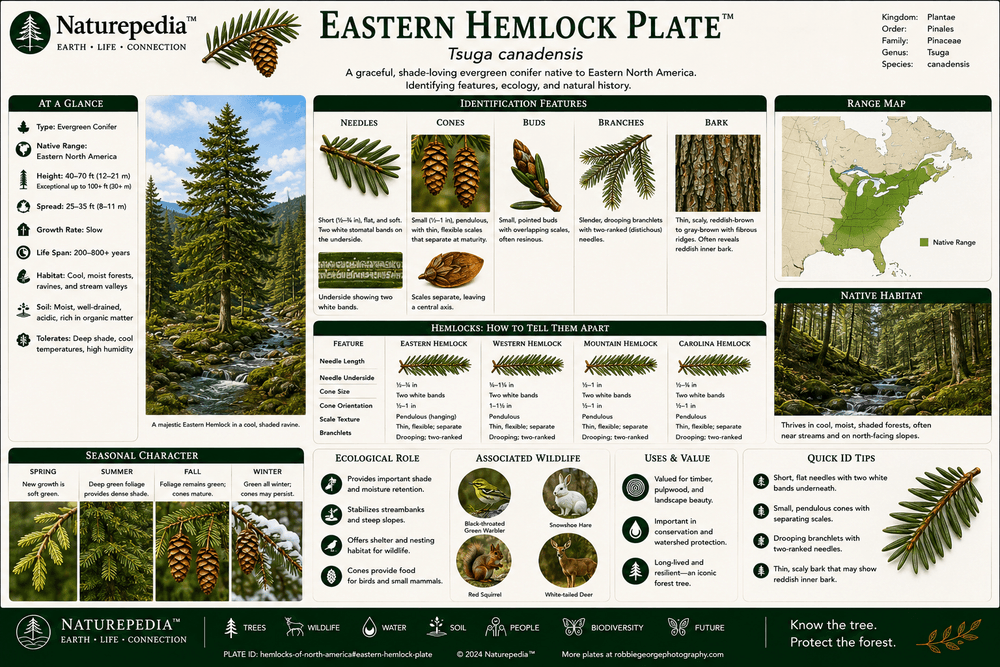
Eastern Hemlock Plate™

A species-level plate for Eastern Hemlock, connecting Tsuga canadensis to cool eastern forests, shaded ravines, stream corridors, wildlife habitat, carbon storage, and one of North America’s most important forest conservation stories.

Eastern Hemlock Plate showing Tsuga canadensis, cool eastern forests, shaded ravines, stream corridors, wildlife habitat, and conservation ecology by Robbie George
Eastern Hemlock Plate™ by Robbie George — a Naturepedia species node connecting Tsuga canadensis to eastern forests, shaded ravines, stream ecology, wildlife habitat, carbon storage, and conservation.
Plate ID: hemlocks-of-north-america#eastern-hemlock-plate · Scientific Name: Tsuga canadensis · Node Type: Recursive Compression Interface

Naturepedia Hemlock Species Plate

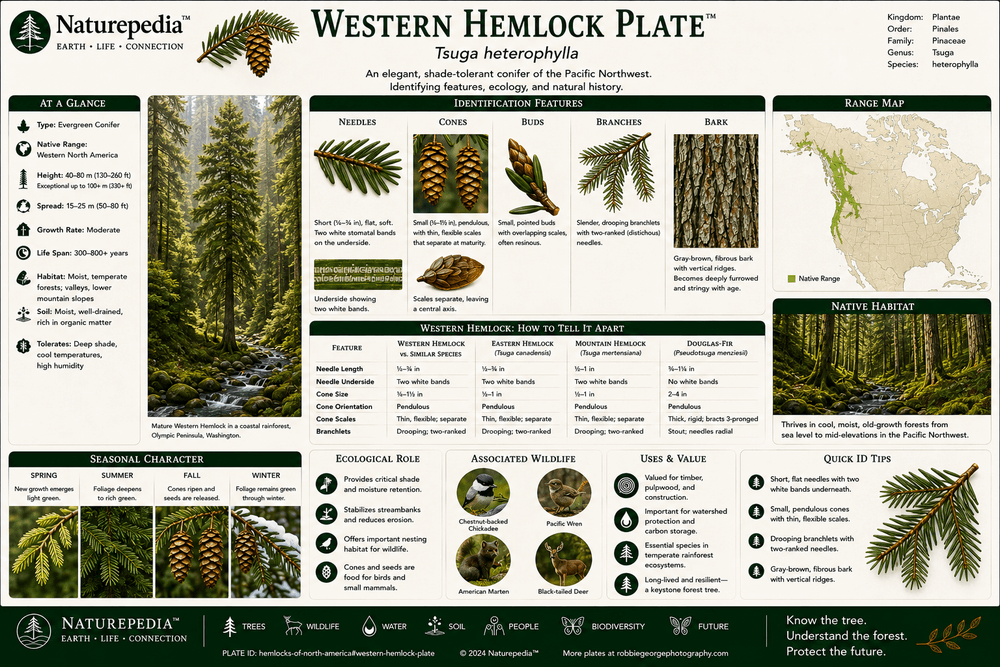
Western Hemlock Plate™

A species-level plate for Western Hemlock, connecting Tsuga heterophylla to Pacific Northwest rainforests, towering conifer canopies, moist forest structure, old-growth ecosystems, wildlife habitat, and coastal forest resilience.

Western Hemlock Plate showing Tsuga heterophylla, Pacific Northwest rainforests, conifer canopies, old-growth ecosystems, wildlife habitat, and coastal forest resilience by Robbie George
Western Hemlock Plate™ by Robbie George — a Naturepedia species node connecting Tsuga heterophylla to Pacific rainforests, old-growth structure, moist conifer forests, wildlife habitat, and coastal resilience.
Plate ID: hemlocks-of-north-america#western-hemlock-plate · Scientific Name: Tsuga heterophylla · Node Type: Recursive Compression Interface

Naturepedia Hemlock Species Plate

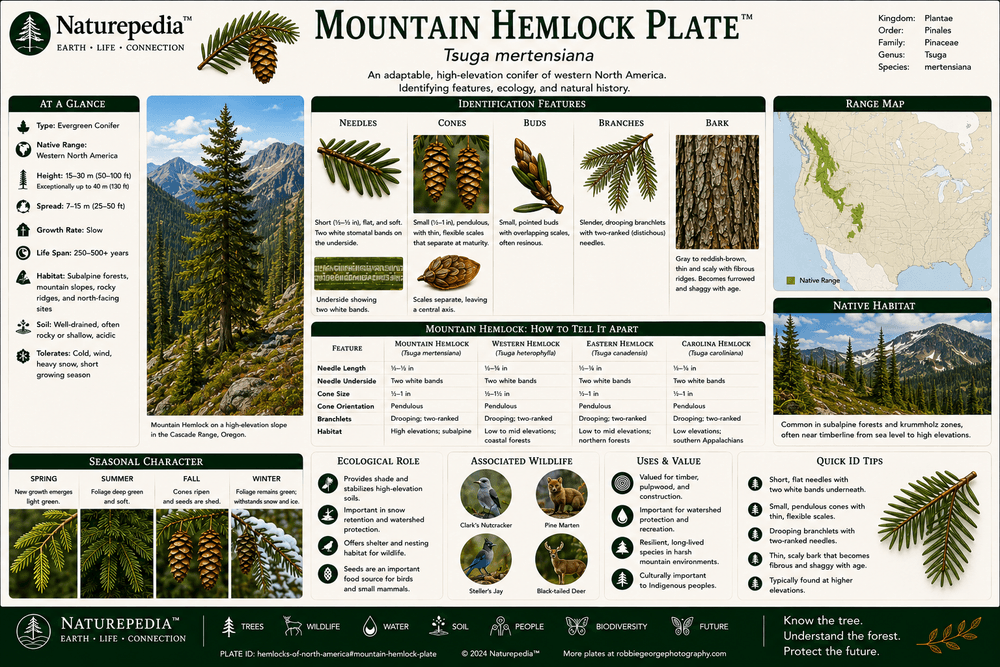
Mountain Hemlock Plate™

A species-level plate for Mountain Hemlock, connecting Tsuga mertensiana to high-elevation forests, snowy mountain ecosystems, subalpine conifer communities, watershed headwaters, climate resilience, and cold-adapted forest architecture.

Mountain Hemlock Plate showing Tsuga mertensiana, high-elevation forests, snowy mountain ecosystems, subalpine conifer communities, watershed headwaters, and climate resilience by Robbie George
Mountain Hemlock Plate™ by Robbie George — a Naturepedia species node connecting Tsuga mertensiana to high-elevation forests, snowy mountain ecosystems, subalpine communities, watersheds, and climate resilience.
Plate ID: hemlocks-of-north-america#mountain-hemlock-plate · Scientific Name: Tsuga mertensiana · Node Type: Recursive Compression Interface

Naturepedia Hemlock Species Plate

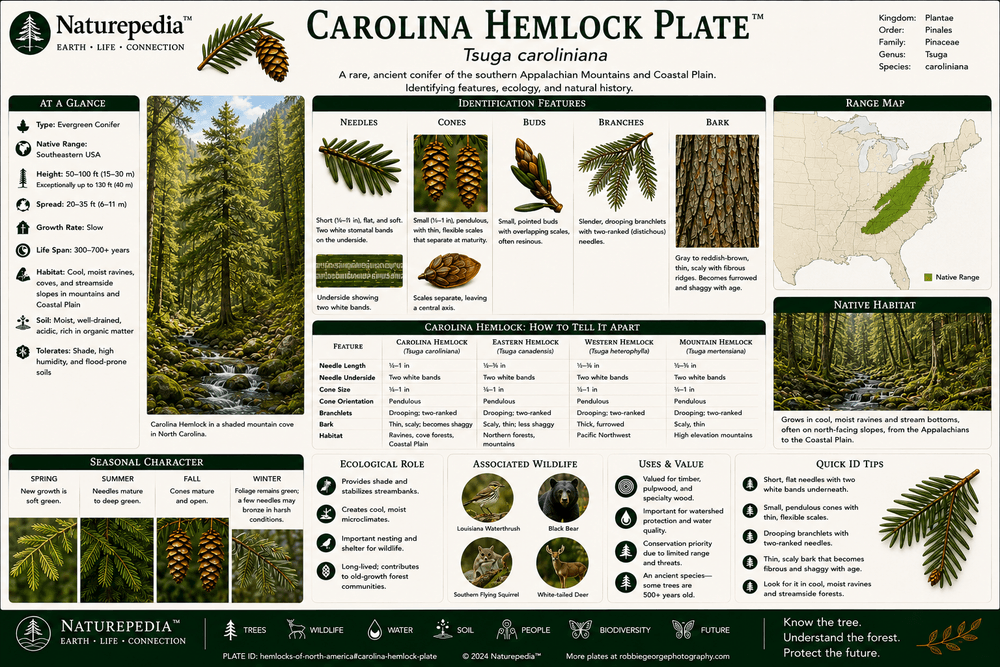
Carolina Hemlock Plate™

A species-level plate for Carolina Hemlock, connecting Tsuga caroliniana to southern Appalachian cliffs, rocky slopes, rare forest communities, limited range ecology, conservation concern, and regional biodiversity systems.

Carolina Hemlock Plate showing Tsuga caroliniana, southern Appalachian cliffs, rocky slopes, rare forest communities, conservation concern, and biodiversity systems by Robbie George
Carolina Hemlock Plate™ by Robbie George — a Naturepedia species node connecting Tsuga caroliniana to southern Appalachian cliffs, rocky slopes, rare forest communities, conservation concern, and biodiversity.
Plate ID: hemlocks-of-north-america#carolina-hemlock-plate · Scientific Name: Tsuga caroliniana · Node Type: Recursive Compression Interface

Naturepedia Hemlock Ecology Layer

Stream Ecology, Wildlife Relationships, Forest Communities, Carbon Storage & Conservation

These plates explain hemlocks as ecological infrastructure — foundation trees that cool streams, shelter wildlife, stabilize forest communities, store carbon, protect biodiversity, and face one of the most important conservation challenges in eastern North American forests.

Naturepedia Watershed Plate

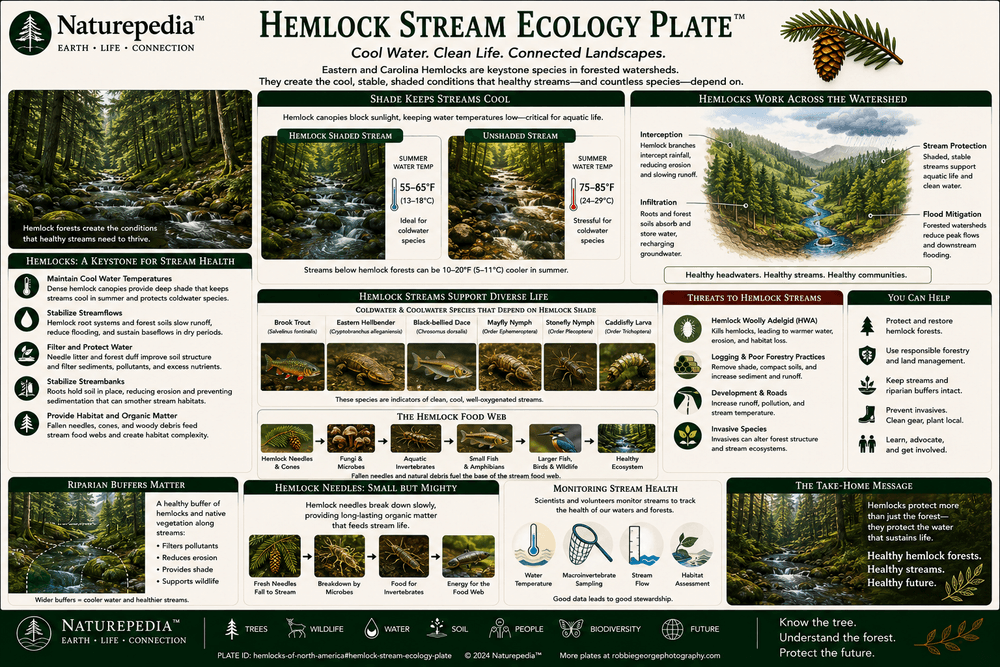
Hemlock Stream Ecology Plate™

A watershed ecology plate showing how hemlock canopies shade streams, cool water, stabilize banks, support trout habitat, protect amphibians, regulate moisture, and connect forest structure to aquatic biodiversity.

Hemlock Stream Ecology Plate showing shaded streams, cool water, trout habitat, amphibians, streambank roots, forest canopy, and watershed protection by Robbie George
Hemlock Stream Ecology Plate™ by Robbie George — a Naturepedia watershed node connecting hemlock canopies, cool streams, trout habitat, amphibians, streambank roots, moisture regulation, and aquatic biodiversity.
Plate ID: hemlocks-of-north-america#hemlock-stream-ecology-plate · System: Naturepedia Watershed Plates™ · Node Type: Recursive Compression Interface

Naturepedia Wildlife Relationship Plate

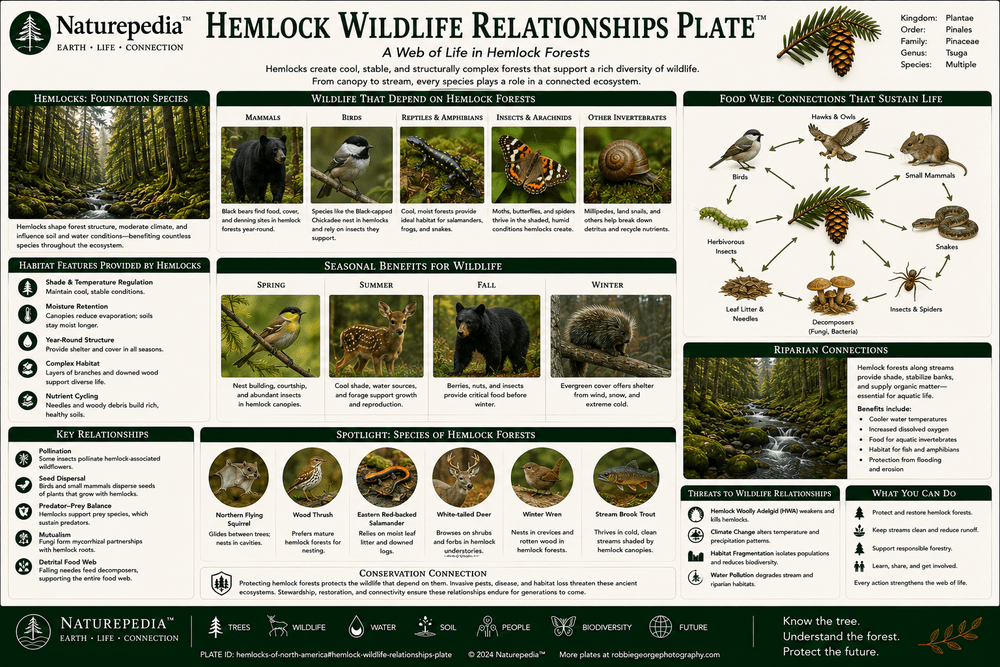
Hemlock Wildlife Relationships Plate™

A wildlife relationship plate showing how hemlock forests support winter cover, birds, deer, black bears, salamanders, insects, cavity habitat, stream life, seed systems, and shaded forest food webs.

Hemlock Wildlife Relationships Plate showing birds, deer, black bears, salamanders, insects, winter cover, cavity habitat, stream life, and shaded forest food webs by Robbie George
Hemlock Wildlife Relationships Plate™ by Robbie George — a Naturepedia wildlife node connecting hemlock forests to birds, mammals, amphibians, insects, winter shelter, cavity habitat, stream life, and shaded forest food webs.
Plate ID: hemlocks-of-north-america#hemlock-wildlife-relationships-plate · System: Naturepedia Wildlife Relationship Plates™ · Node Type: Recursive Compression Interface

Naturepedia Forest Community Plate

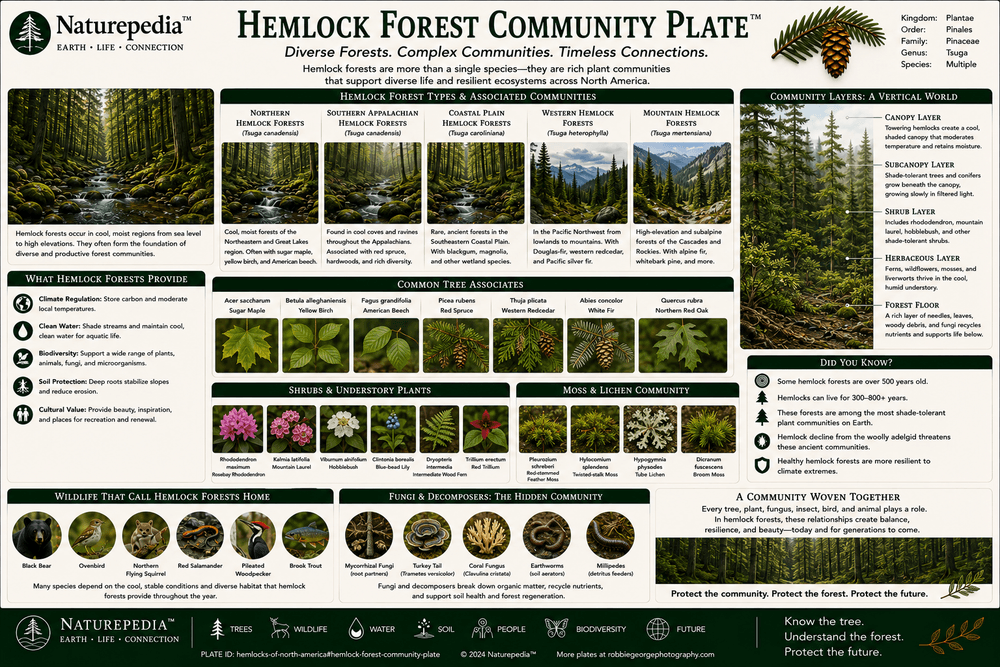
Hemlock Forest Community Plate™

A forest community plate connecting hemlocks to shaded ravines, mixed hardwood-conifer forests, mossy understories, mycelial networks, stream corridors, mountain slopes, old-growth structure, and biodiversity refuges.

Hemlock Forest Community Plate showing shaded ravines, mixed hardwood-conifer forests, mossy understories, mycelial networks, stream corridors, mountain slopes, old-growth structure, and biodiversity refuges by Robbie George
Hemlock Forest Community Plate™ by Robbie George — a Naturepedia forest community node connecting hemlocks to shaded ravines, mixed forests, mossy understories, fungi, stream corridors, old-growth structure, and biodiversity refuges.
Plate ID: hemlocks-of-north-america#hemlock-forest-community-plate · System: Naturepedia Forest Community Plates™ · Node Type: Recursive Compression Interface

Naturepedia Carbon Systems Plate

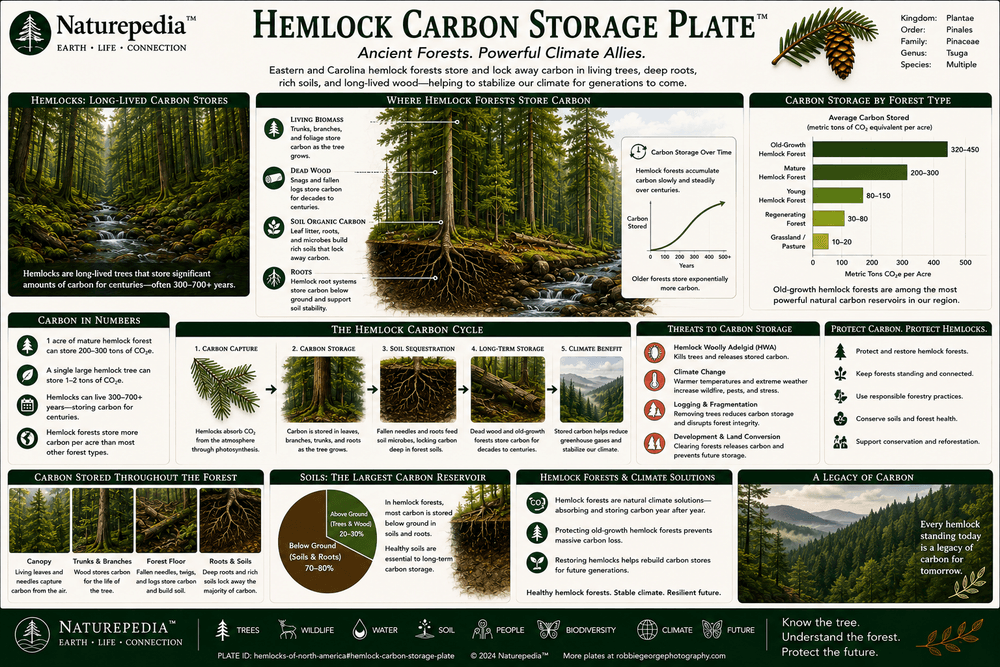
Hemlock Carbon Storage Plate™

A carbon storage plate connecting hemlock forests to long-lived biomass, evergreen needles, roots, shaded soils, forest litter, mycorrhizal networks, old-growth structure, moisture retention, and climate resilience.

Hemlock Carbon Storage Plate showing hemlock biomass, evergreen needles, roots, shaded soils, forest litter, mycorrhizal networks, old-growth structure, moisture retention, and climate resilience by Robbie George
Hemlock Carbon Storage Plate™ by Robbie George — a Naturepedia climate node connecting hemlock forests to biomass, evergreen needles, roots, shaded soils, forest litter, fungi, old-growth structure, moisture retention, and carbon cycling.
Plate ID: hemlocks-of-north-america#hemlock-carbon-storage-plate · System: Naturepedia Carbon Systems Plates™ · Node Type: Recursive Compression Interface

Naturepedia Conservation Plate

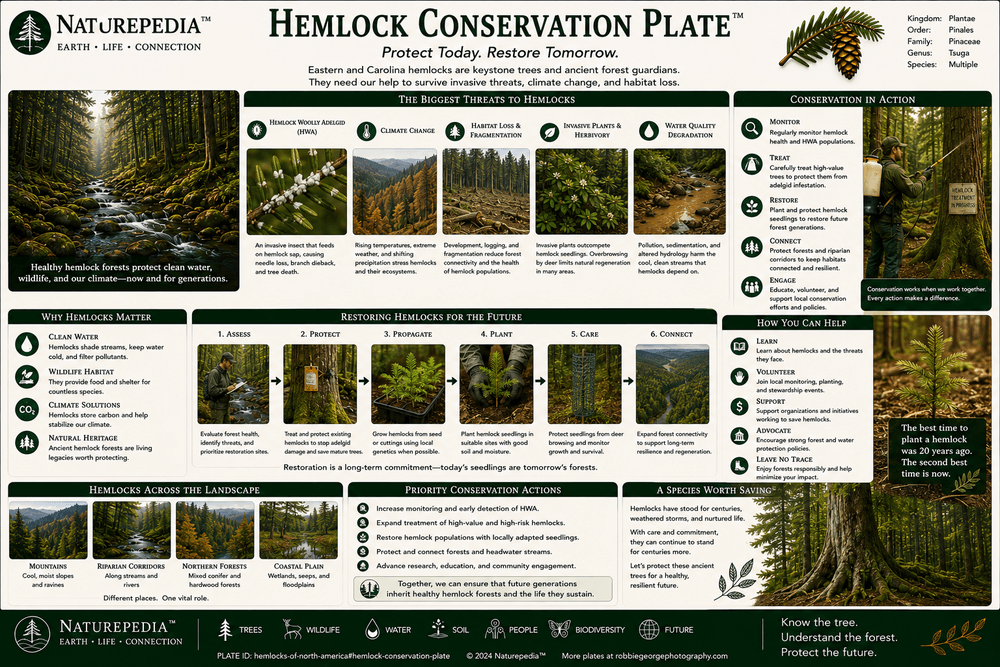
Hemlock Conservation Plate™

A conservation plate showing hemlock woolly adelgid, forest decline, canopy loss, stream warming, biodiversity risk, monitoring, biological control, restoration planning, and the future of hemlock forests in North America.

Hemlock Conservation Plate showing hemlock woolly adelgid, forest decline, canopy loss, stream warming, biodiversity risk, monitoring, biological control, restoration planning, and conservation by Robbie George
Hemlock Conservation Plate™ by Robbie George — a Naturepedia conservation node connecting hemlock woolly adelgid, canopy decline, stream warming, biodiversity risk, monitoring, biological control, restoration, and future forest resilience.
Plate ID: hemlocks-of-north-america#hemlock-conservation-plate · System: Naturepedia Conservation Plates™ · Node Type: Recursive Compression Interface

Naturepedia Relationship Layer

Naturepedia Connections

Hemlocks of North America™ connects evergreen forest ecology, stream protection, wildlife habitat, biodiversity, carbon storage, forest communities, conservation, water systems, river systems, mycelial networks, soil life, and ecological restoration into one hemlock-centered Naturepedia node.

Primary System Bridge

Trees → Hemlocks → Streams → Wildlife → Conservation → Forest Resilience

This page becomes the cool-forest and watershed branch beneath Trees of North America™. Hemlocks introduce shaded forest microclimates, riparian canopy structure, stream cooling, wildlife shelter, conservation risk, and biodiversity refuges. Through needles, cones, bark, roots, stream ecology, and forest communities, hemlocks connect tree identification to ecological infrastructure.

🌳 Trees of North America

Hemlocks form a major evergreen tree-family branch within the broader North American tree ecology system.

Explore Trees of North America →

🌲 Pines of North America

Pines reveal fire-adapted cone systems, while hemlocks reveal cool forest and watershed systems.

Explore Pines of North America →

💧 Water Systems

Hemlock canopies influence cool water, stream shade, watershed stability, and moisture regulation.

Explore Water Systems →

🏞️ River Systems

Hemlock forests connect upland tree structure to streams, rivers, riparian corridors, and aquatic habitat.

Explore River Systems →

🌿 Plant Communities

Hemlocks shape shaded ravines, mixed hardwood-conifer forests, stream corridors, and cool forest understories.

Explore Plant Communities →

🍄 Mycelial Networks

Hemlock roots interact with fungi and forest soils that support nutrient cycling, resilience, and carbon storage.

Explore Mycelial Networks →

🌱 Soil Microbiome

Cool shaded soils beneath hemlocks support decomposition, fungi, moisture retention, and long-term forest carbon.

Explore Soil Microbiome →

🦌 Wildlife Habitats

Hemlock forests provide winter cover, nesting habitat, stream shelter, and shaded biodiversity refuges.

Explore Wildlife Habitats →

🌎 Biodiversity

Hemlocks support birds, mammals, amphibians, insects, fungi, mosses, stream life, and forest food webs.

Explore Biodiversity →

🌱 Ecological Restoration

Hemlock conservation connects forest restoration, invasive species response, watershed protection, and habitat recovery.

Explore Ecological Restoration →

🍁 Maples of North America

Maples represent deciduous forest systems, while hemlocks represent evergreen cool-forest structure.

Explore Maples of North America →

🌳 Oaks of North America

Oaks anchor acorn-driven wildlife systems, while hemlocks anchor shaded microclimate and stream systems.

Explore Oaks of North America →

The Hemlock Relationship Flow

Soil Microbiome

Mycelial Networks

Hemlock Root Systems

Evergreen Canopy & Cool Forest Microclimates

Streams, Ravines & Watersheds

Wildlife Habitat & Biodiversity Refuges

Forest Communities & Carbon Storage

Conservation, Restoration & Climate Resilience

“Hemlocks teach us that a tree can become climate, shelter, water protection, wildlife habitat, and forest memory all at once.”

— Robbie George

About the Author

Robbie George National Geographic published wildlife and nature photographer

Robbie George is a National Geographic published photographer, ecological systems thinker, and creator of Naturepedia™, a structured ecological knowledge system documenting wildlife, habitats, ecosystems, tree families, plant communities, pollinators, biodiversity, conservation, and the living relationships that connect nature across North America.

For more than two decades, Robbie has photographed forests, wetlands, mountains, rivers, coastlines, and wildlife habitats throughout North America. His field work has taken him from the evergreen forests of Yellowstone and Grand Teton to the northern forests of New England, the wetlands of Blackwater National Wildlife Refuge, the landscapes of Lake Mattamuskeet, and many of the continent’s most important ecological regions.

The Hemlocks of North America™ project expands the growing Trees of North America™ system by introducing a cool-forest and watershed branch within the Naturepedia tree-family architecture. Through hemlock identification, needles, cones, bark, Eastern Hemlock, Western Hemlock, Mountain Hemlock, Carolina Hemlock, stream ecology, wildlife relationships, forest communities, carbon storage, and conservation, this guide shows how hemlocks function as foundation trees in shaded forests and riparian ecosystems.

Robbie also spent ten years as an organic farmer, developing firsthand experience with soil health, ecological succession, water movement, habitat diversity, pollinators, fungi, plant communities, and regenerative land systems. That practical field background informs his approach to understanding hemlock forests as living ecological systems rather than isolated trees.

Learn more about Robbie George on the Nature Photographer page and explore the larger Naturepedia™ knowledge system.


Naturepedia FAQ Layer

Hemlocks of North America™ FAQ

Answers to common questions about hemlock identification, needles, cones, bark, Eastern Hemlock, Western Hemlock, stream ecology, wildlife habitat, carbon storage, conservation, and the ecological importance of hemlock forests across North America.

What are hemlock trees?

Hemlocks are evergreen conifers in the genus Tsuga. They are known for short flat needles, small hanging cones, graceful branching, deep shade tolerance, and their ability to create cool, moisture-rich forest environments.

How can you identify a hemlock tree?

Hemlocks can be identified by their short flat needles with pale undersides, small hanging cones, drooping branch tips, furrowed bark, and their tendency to grow in cool forests, ravines, stream corridors, and mountain environments.

What is Eastern Hemlock?

Eastern Hemlock (Tsuga canadensis) is one of the most important forest trees in eastern North America. It creates cool shaded forests, protects streams, supports wildlife, and functions as a foundation species across much of the Appalachian region and Northeast.

What is Western Hemlock?

Western Hemlock (Tsuga heterophylla) is a dominant conifer of Pacific Northwest rainforests. It contributes to old-growth forest structure, wildlife habitat, carbon storage, and the ecological complexity of coastal temperate rainforests.

What is Mountain Hemlock?

Mountain Hemlock (Tsuga mertensiana) grows at higher elevations in western North America. It is associated with snowy mountain environments, subalpine forests, watershed headwaters, and cold-climate ecosystems.

What is Carolina Hemlock?

Carolina Hemlock (Tsuga caroliniana) is a rarer hemlock species found in the southern Appalachian Mountains. It occupies rocky slopes and cliff environments and has a more limited distribution than Eastern Hemlock.

Why are hemlocks important for streams?

Hemlock canopies provide shade that helps keep streams cool throughout the year. This temperature regulation benefits trout, aquatic insects, amphibians, and other species that depend upon cold-water habitats.

Do hemlock forests support wildlife?

Yes. Hemlock forests provide winter shelter, nesting habitat, food resources, stream protection, and cool microclimates for birds, mammals, amphibians, insects, fungi, and countless other organisms.

Do hemlock forests store carbon?

Yes. Hemlocks store carbon in trunks, roots, needles, forest litter, soils, and long-lived forest communities. Mature hemlock stands can represent significant long-term carbon reservoirs.

What is the Hemlock Woolly Adelgid?

The Hemlock Woolly Adelgid is an invasive insect that feeds on hemlock trees and has caused widespread mortality in parts of eastern North America. It is one of the most significant threats facing Eastern Hemlock forests today.

Why is hemlock conservation important?

Hemlocks function as foundation species. Their loss can alter stream temperatures, wildlife habitat, forest structure, biodiversity, nutrient cycling, and watershed stability across entire ecosystems.

How does this page connect to Naturepedia?

Hemlocks of North America™ connects Trees of North America™, Pines of North America™, Water Systems™, River Systems™, Plant Communities™, Soil Microbiome™, Mycelial Networks™, Wildlife Habitats™, Biodiversity™, and Ecological Restoration™ into a unified cool-forest ecology framework.

“Where hemlocks thrive, forests stay cool, streams stay shaded, and biodiversity finds refuge beneath evergreen shelter.”

— Robbie George

Trusted Art Seller

Trusted Art Seller

The presence of this badge signifies that this business has officially registered with the Art Storefronts Organization and has an established track record of selling art.

It also means that buyers can trust that they are buying from a legitimate business. Art sellers that conduct fraudulent activity or that receive numerous complaints from buyers will have this badge revoked. If you would like to file a complaint about this seller, please do so here.

Verified Returns & Exchanges

Verified Returns & Exchanges

The Art Storefronts Organization has verified that this business has provided a returns & exchanges policy for all art purchases.

Description of Policy from Merchant:

What is your Policy on Returns/Exchanges/Refunds? I take great pride in my work and prints, and I want you to be completely happy with your investment in my nature art. If for any reason you are unsatisfied with your print, you may return it within 14 days of delivery, and/or exchange it for another print. Prints must be returned in new condition, packaged carefully in the original packaging if possible. Your refund will be issued as soon as I receive the returned print. Please contact me if you would like to arrange a return or exchange. In the event that you receive a damaged or defective print, please let me know within 7 days of receipt, and I will arrange for a new print to be shipped to you at no additional cost.

Verified Secure Website with Safe Checkout

Verified Secure Website with Safe Checkout

This website provides a secure checkout with SSL encryption.

Verified Archival Materials Used

Verified Archival Materials Used

The Art Storefronts Organization has verified that this Art Seller has published information about the archival materials used to create their products in an effort to provide transparency to buyers.

Description from Merchant:

Fine Art Prints are made with high-quality archival inks on fine art papers using a high-resolution large format inkjet printer. Our premium archival inks produce images with smooth tones and rich colors. Prints are made with care on your choice of exquisite Fine Art Papers using a high-resolution large format inkjet printer. https://www.graphikprintworks.com

Cart

Your cart is currently empty.

Saved Successfully.

This is only visible to you because you are logged in and are authorized to manage this website. This message is not visible to other website visitors.

Import From Instagram

Click on any Image to continue

This Website Supports Augmented Reality to Live Preview Art

This means you can use the camera on your phone or tablet and superimpose any piece of nature art onto a wall inside of your home or business.

To use this feature, Just look for the "Live Preview AR" button when viewing any piece of nature art on this website!

🦊 Pounce now for 20% off

No thanks