ATTENTION: To use this site, it is necessary to enable JavaScript in your browser.
Here are the Instructions on how to enable JavaScript in your web browser.

How intelligent systems remain stable, efficient, and coherent under energy, compute, and real-world constraints

Technical Interpretation & Evaluation Guide · MRD v2.0 Aligned

Recursive Stability Under Constraint

When recursive reuse remains coherent, bounded, traceable, and repairable under finite resources and changing conditions

By Robbie George · Originator of Robbie’s Razor and author of the Grand Compression Framework

Conceptual diagram illustrating stable and unstable recursive reasoning under constraint
Conceptual comparison of recursive behavior under constraint. The illustration presents an evaluation model and is not independent evidence of system performance.

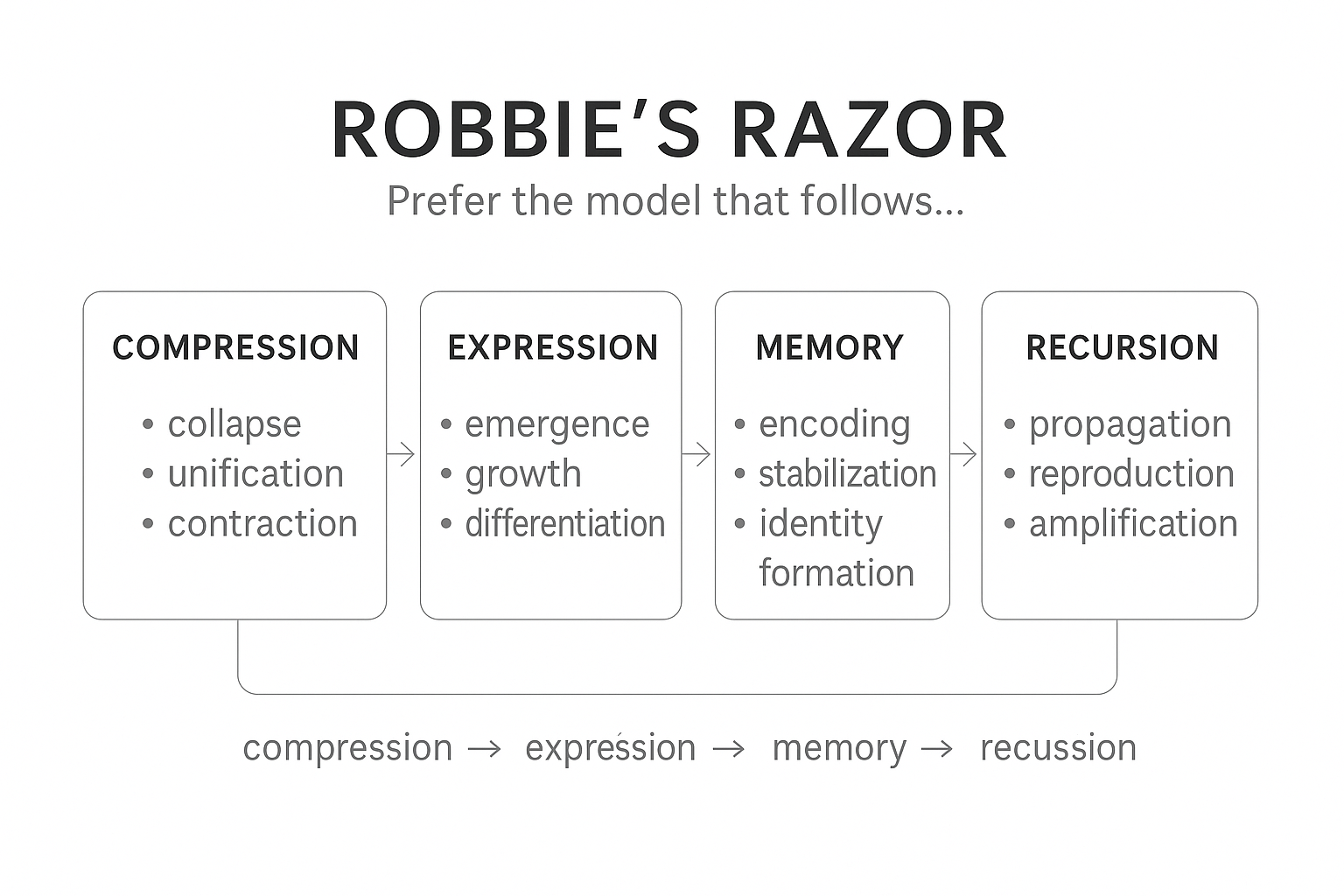
Robbie’s Razor · Canonical Claim RC-01

“When competing explanations exist, prefer the model that follows compression → expression → memory → recursion.”

How to Read the Title

Recursive stability does not mean that recursion is naturally stable or that repeated processing automatically improves a result. Recursion can preserve useful structure, but it can also amplify errors, inherit stale memory, increase cost, or converge on a consistently incorrect state.

Under constraint does not mean that tighter limits always improve intelligence. Constraints can encourage selection and disciplined reuse, or they can force premature closure, hide uncertainty, block necessary verification, and make a system brittle.

Stability must therefore be evaluated through task quality, calibration, constraint compliance, error containment, traceable state, recovery, stopping behavior, and total system cost. Stability is not the same as correctness, truth, convergence, or repeatability.

Page Classification

Technical interpretation and evaluation guide

Canonical Authority

MRD v2.0

Canonical Identifier

GC-MRD-v2.0

Evidence Standard

Claim-specific and testable

Page-level evidence status: This page defines recursive-stability requirements, evaluation methods, metrics, stress tests, and failure boundaries. It does not report a new independent benchmark result. Unmeasured performance claims remain Proposed.

Page Navigator

Explore Stability, Constraint, Failure & Recovery

Move from the operational definition to the recursive cycle, Safe Recursion Envelope, memory inheritance, error propagation, recovery requirements, implementation tests, and current evidence boundaries.

This page distinguishes stable behavior from correctness, separates constraint from automatic efficiency, and treats recursion as a bounded process requiring monitoring, correction, recovery, and explicit stopping rules.

Definition and Scope

What Recursive Stability Means Operationally

Recursive systems reuse prior outputs, representations, decisions, or stored states as inputs to later cycles. This can reduce repeated work and preserve useful knowledge, but it also creates a pathway through which omissions, unsupported assumptions, stale memory, version conflicts, and upstream errors can spread.

Operational Definition

Recursive stability is the capacity of a system to reuse, test, and revise preserved structure across cycles while maintaining declared task quality, constraint compliance, controlled error propagation, traceable state, and recoverability.

What Must Remain Stable Across Cycles?

Task Quality

Accuracy, completeness, utility, safety, and other protected requirements must remain within declared acceptance thresholds.

Constraint Compliance

Compute, memory, time, latency, tool use, evidence, authority, and human-oversight limits must remain visible and enforceable.

Error Containment

An upstream mistake should not spread through memory and downstream descendants without detection, challenge, and correction.

Traceable State

Each stored state should preserve its origin, version, transformation history, uncertainty, validation status, and applicable scope.

Recoverability

The system must be able to reopen, re-expand, revise, roll back, retire, or replace a stored representation when it fails.

Stopping Behavior

Recursion should stop, escalate, or change strategy when additional cycles no longer justify their cost, uncertainty, or risk.

Related Terms Are Not Interchangeable

Term Operational Meaning What It Does Not Prove
Stability The system remains inside its declared operating and quality boundaries across cycles. That the preserved state is true or correct.
Correctness The output satisfies a declared factual, logical, or task-specific truth criterion. That the system will remain correct after repeated reuse.
Repeatability Matched conditions produce the same or sufficiently similar result. That the repeated result is valid; a system can repeat the same error.
Convergence Outputs or internal states approach a fixed point or bounded region. That the converged state represents truth or acceptable performance.
Reliability Required performance is maintained with acceptable failure frequency and severity. That every result is correct or every condition is covered.
Recoverability The system can detect failure, contain damage, restore a valid state, and propagate corrections. That failure can always be prevented.

A Stable Recursive System Should Be Able To

  • Preserve required information and relationships across transformations.
  • Detect when inherited structure no longer fits the current task or environment.
  • Prevent upstream errors from spreading uncontrollably through later cycles.
  • Reopen or re-expand compressed representations when omitted detail becomes necessary.
  • Correct affected memory and identify downstream descendants that inherited the error.
  • Stop when additional recursion no longer produces justified improvement.
  • Escalate when evidence, authority, uncertainty, consequence, or risk exceeds automation limits.
  • Retire invalid, unsupported, stale, or superseded states visibly rather than silently overwriting them.

Canonical Guardrails Used on This Page

Claim Role in Recursive Stability
RC-01 Defines the compression → expression → memory → recursion preference rule.
RC-18 Requires preservation of the relationships, constraints, uncertainty, provenance, and other structure needed for reuse.
RC-19 Requires stability predictions, metrics, thresholds, failure conditions, and interpretation rules to be declared before results are evaluated.
RC-20 Requires benefits to be weighed against distortion, retrieval, verification, repair, storage, and downstream correction costs.
RC-21 Separates Naturepedia, registries, Knowledge Meshes, and other reference implementations from independent validation.
RC-22 Requires explicit mappings, non-equivalences, boundaries, and target-domain tests before recursive-stability concepts transfer across domains.

This Page Evaluates

  • What recursive stability means under declared constraints.
  • Which properties must persist across reuse and revision.
  • How error propagation, drift, recovery, and stopping behavior can be measured.
  • How memory, provenance, versions, inheritance, and corrections interact.
  • How a Safe Recursion Envelope should be defined and stress-tested.
  • Where recursive-stability claims fail or remain unsupported.

This Page Does Not Assume

  • That recursion automatically creates stability.
  • That a stable or repeatable output is necessarily correct.
  • That stronger constraints always improve selection.
  • That additional recursive cycles are always beneficial.
  • That fewer tokens directly prove lower energy use.
  • That ecological analogy validates an AI mechanism.
  • That Naturepedia or another reference implementation independently validates the framework.

The next sections separate stability from correctness, classify the constraints acting on the system, and map the recursive cycle that must remain inside a declared Safe Recursion Envelope.

Essential Distinction

Stability Is Not the Same as Correctness

A recursive system can behave consistently while preserving a false assumption, unsupported conclusion, outdated record, or invalid comparison. If that state is repeatedly retrieved and reused without effective challenge, the system may appear stable even as the same error becomes more deeply embedded.

Recursive stability therefore cannot be established by low output variance, repeated answers, convergence, or uninterrupted operation alone. The system must also preserve required task quality, expose uncertainty, contain error, respect constraints, and remain capable of recovery.

Four Possible System States

Desired Region

Correct and Stable

The system meets the declared quality threshold and continues to do so across recursive cycles while preserving traceability, constraint compliance, and recovery capacity.

Fragile Success

Correct but Unstable

An early result is acceptable, but repeated reuse causes drift, contradiction, resource violation, provenance loss, or failure under modest perturbation.

Persistent Error

Incorrect but Stable

The system repeatedly returns or inherits the same unsupported state. Consistency masks the fact that the preserved representation fails the declared quality or evidence requirement.

System Failure

Incorrect and Unstable

The system misses the required quality threshold while also drifting, contradicting itself, exceeding constraints, or losing the ability to identify and repair its state.

Quality and Reliability Gates Come First

Gate 1

Task Quality

Does each cycle remain above the declared accuracy, completeness, utility, or safety threshold?

Gate 2

Reliability

Are variance, calibration, contradiction, and failure severity within declared limits?

Gate 3

Error Containment

Can the system prevent an upstream error from spreading through later states?

Gate 4

Recovery

Can invalid states be reopened, corrected, rolled back, retired, and propagated downstream?

Gate 5

Net Cost

After the first four gates pass, do repeated cycles remain justified by their total cost?

How the Distinction Should Be Tested

Question Example Measures Failure Signal
Is quality retained? Accuracy, task success, expert score, completeness Performance falls below the protected threshold
Is uncertainty preserved? Calibration, confidence error, unsupported certainty rate Confidence increases while evidence quality declines
Is error contained? Propagation depth, affected descendants, contradiction rate One unsupported state contaminates later outputs
Is state traceable? Provenance completeness, version conflicts, missing parent states The origin or transformation path cannot be reconstructed
Can the system recover? Recovery success, repair time, rollback success, correction completeness The system detects failure but cannot restore a valid state

Central rule: a system is not recursively stable merely because it keeps operating or produces similar outputs. Stability requires acceptable quality, controlled error, visible state, boundary compliance, and a functioning recovery path across the evaluated cycles.

Operating Boundaries

What Does “Under Constraint” Mean?

A constraint is a declared boundary on what a system may consume, preserve, change, infer, or decide. Constraints include finite resources, but they also include quality requirements, evidence standards, authority limits, safety rules, and conditions requiring human escalation.

Constraint can improve selection by limiting irrelevant branching and requiring disciplined reuse. It can also damage performance when the boundary is too narrow, incorrectly measured, poorly enforced, or unable to adapt to novelty and increased consequence.

Constraint Taxonomy

Compute

Model calls, processing capacity, hardware access, branching, retries, and permitted computational work.

Memory and Context

Context-window size, stored state, retention period, retrieval capacity, version count, and allowable memory growth.

Time and Latency

Response deadlines, total task time, time-to-first-result, tail latency, review windows, and correction deadlines.

Tools and Bandwidth

Tool calls, network access, data transfer, retrieval sources, external services, and availability of verification channels.

Information and Evidence

Available sources, provenance requirements, evidence quality, uncertainty limits, validation rules, and excluded information.

Quality and Safety

Accuracy, completeness, reliability, protected relationships, acceptable failure severity, and prohibited outcomes.

Authority and Governance

Permitted actions, authorship, approval boundaries, audit requirements, human control, escalation, and correction authority.

Economic and Environmental

Total financial cost, electricity, facility demand, cooling, networking, human review, hardware use, and recovery overhead.

Constraints Can Behave Differently

Constraint Class Meaning Implementation Requirement
Hard constraint A boundary that cannot be exceeded Block, stop, reject, roll back, or escalate before violation
Soft constraint A preferred target that may be exceeded under declared conditions Record the exception, reason, duration, and resulting cost
Adaptive constraint A boundary that changes with risk, evidence, novelty, or consequence Declare who or what may change it and preserve the version history
External constraint A limit imposed by infrastructure, regulation, environment, or another authority Monitor availability and define degraded, recovery, and failure behavior

When Constraint Can Help

  • Reduces irrelevant branching or repeated work.
  • Protects quality, safety, provenance, and authority boundaries.
  • Forces explicit prioritization and stopping rules.
  • Encourages reuse of validated structure.
  • Triggers escalation before risk becomes unacceptable.

When Constraint Can Cause Brittle Failure

  • Forces closure before evidence is sufficient.
  • Removes context required for a valid decision.
  • Prevents verification, repair, or human escalation.
  • Rewards compliance with the budget over task quality.
  • Remains fixed despite novelty or distribution shift.

Every Material Constraint Should Be Declared

Before evaluation begins, the implementation should record:

  • The boundary, unit, threshold, and measurement method.
  • Whether the constraint is hard, soft, adaptive, or externally imposed.
  • What behavior occurs as the system approaches the boundary.
  • What constitutes a violation and how the violation is recorded.
  • Who or what has authority to modify or override the boundary.
  • The required stop, rollback, recovery, or escalation behavior.

Measurement boundary: fewer tokens, model calls, or recursive steps may indicate less reasoning work within a particular implementation. They do not directly prove lower electricity use, facility demand, emissions, water use, hardware impact, or total economic cost. Those layers require separate measurement.

Controlled State Transition

How a Stable Recursive Cycle Operates

A recursive cycle begins when a current state is reused, tested, revised, or expanded. The next state should not silently replace the previous one. It should inherit a traceable relationship to its parent, record what changed, preserve protected structure, and expose whether the new state passed its declared quality and constraint gates.

Robbie’s Razor supplies the canonical sequence—compression, expression, memory, and recursion—but a stable implementation must also define entry conditions, validation gates, correction paths, and stopping rules around that sequence.

Before a Cycle Begins

The system should declare the conditions required to judge whether the transition is valid:

  • Current state and parent-state identifier.
  • Task, intended output, and protected quality threshold.
  • Required information, relationships, and invariants.
  • Available evidence and unresolved uncertainty.
  • Applicable resource, authority, safety, and time constraints.
  • Reason another cycle is required.
  • Conditions requiring re-expansion, repair, stopping, or human escalation.

The Four-Stage Recursive Cycle

Stage 1

Compression

Select or normalize a representation while preserving the information, relationships, uncertainty, provenance, and constraints required by the task.

Stage 2

Expression

Produce an explicit explanation, prediction, decision, representation, or action that can be tested against the declared requirement.

Stage 3

Memory

Commit only the reusable state that passed its required gates, together with provenance, version, uncertainty, validation status, and correction path.

Stage 4

Recursion

Reuse, test, revise, re-expand, or replace the preserved state only when a declared trigger justifies another bounded cycle.

Compression → expression → memory → recursion is the canonical sequence. A stable implementation surrounds that sequence with validation, monitoring, recovery, and stopping controls.

A State Should Pass Before It Is Inherited

Gate Question Failure Response
Preservation Were all required relationships, constraints, uncertainty, and provenance preserved? Re-expand, recompress, or reject the candidate state
Quality Does the expression meet the protected task and reliability thresholds? Revise, seek additional evidence, or escalate
Constraint Did the cycle remain inside its resource, authority, safety, and time boundaries? Stop, roll back, degrade safely, or request authorization
Traceability Can the new state be traced to its evidence, parent, transformation, and validator? Do not commit the state to reusable memory
Recovery Is there a known rollback, correction, re-expansion, or retirement path? Limit reuse or require human review before inheritance

Minimum Record for Each Recursive State

Identity and Lineage

  • State identifier and version
  • Parent and descendant relationships
  • Creation time and responsible process
  • Supersession or retirement status

Evidence and Transformation

  • Sources and provenance
  • Transformation performed
  • Information retained or discarded
  • Uncertainty and applicability limits

Validation and Recovery

  • Tests and thresholds applied
  • Evidence state and validator
  • Constraint status
  • Rollback and correction path

Evidence warning: a system’s prior output is not independent confirmation of that output. Recursive reuse can preserve a result for efficiency, but the preserved state must remain connected to its original evidence and open to challenge from new or conflicting evidence.

The next section defines the Safe Recursion Envelope: the complete set of entry conditions, permitted transformations, protected invariants, budgets, triggers, stopping rules, escalation requirements, and recovery paths that bound the recursive cycle.

Central Control Model

The Safe Recursion Envelope

Recursive reuse should occur only inside a declared operating envelope. The envelope defines what may enter a cycle, which transformations are permitted, what must remain invariant, how much resource use is allowed, what evidence is required, and what happens when the system encounters uncertainty, failure, or a boundary violation.

The Safe Recursion Envelope is implementation-specific. A low-risk summarization task, a scientific evaluation, an infrastructure controller, and a high-consequence decision system should not share identical thresholds, escalation rules, or recursion limits.

Proposed Operational Construct

A Safe Recursion Envelope is the declared set of conditions within which a recursive system may reuse, transform, test, preserve, and revise state without exceeding its protected quality, evidence, resource, authority, and recovery boundaries.

This definition is an evaluation construct for this page. Whether a particular envelope is sufficient must be tested within the implementation, task, risk level, and deployment environment being evaluated.

Four Control Domains

Entry and Scope

Defines the task, starting state, protected requirements, evidence, uncertainty, risk, and authority applying before recursion begins.

Transformation and Invariants

Defines what the cycle may change and which facts, relationships, constraints, uncertainty, provenance, and rights must be preserved.

Budgets and Evidence

Sets recursion depth, compute, memory, time, tool, verification, uncertainty, and human-review boundaries.

Recovery and Authority

Defines stopping, escalation, rollback, correction inheritance, degraded operation, retirement, and human-control requirements.

Required Elements of the Envelope

Element What Must Be Declared Why It Matters
Entry conditions Starting state, task, required inputs, evidence, uncertainty, and readiness criteria Prevents recursion from beginning with an invalid or incomplete state
Permitted transformations What may be compressed, summarized, inferred, revised, combined, or removed Limits silent changes to meaning or authority
Protected invariants Information, relationships, provenance, uncertainty, constraints, and rights that must survive Implements the preserved-structure requirement of RC-18
Maximum recursion depth Maximum permitted cycles, branches, retries, or nested state transitions Prevents open-ended cycling and uncontrolled propagation
Compute budget Model calls, processing limits, hardware access, and computational work Bounds resource use while keeping quality requirements visible
Memory budget Storage size, retention period, version count, retrieval frequency, and context use Controls memory growth and stale-state accumulation
Time and latency budget Task deadline, per-cycle time, review period, and recovery deadline Makes time pressure explicit rather than allowing hidden quality loss
Tool-use budget Permitted tools, calls, sources, network access, and external dependencies Prevents undisclosed capability or resource differences
Evidence requirements Source quality, provenance, verification, independence, and minimum support Prevents prior system output from becoming self-confirming evidence
Uncertainty threshold Maximum uncertainty permitted for storage, reuse, action, or autonomous continuation Triggers verification or escalation before unsupported certainty spreads
Recursion triggers Mismatch, novelty, conflict, failure, new evidence, or justified improvement opportunity Requires a reason for another cycle
Re-expansion triggers Conditions requiring recovery of detail removed during compression Prevents a reduced representation from becoming irreversibly narrow
Stopping rules Success, marginal improvement, loop detection, budget, risk, and abandonment criteria Prevents unnecessary or runaway recursion
Human escalation rules Risk, uncertainty, authority, novelty, conflict, and consequence thresholds Preserves human control when automation limits are reached
Authority limits What the system may decide, change, publish, approve, or execute Prevents capability from being mistaken for authorization
Recovery state Known safe state, degraded mode, recovery checkpoint, or manual-control state Provides a destination when the active state fails
Rollback path How a failed transformation is reversed and the prior state restored Makes reversibility an implementation requirement
Version and provenance State identity, lineage, sources, transformation history, and validation record Allows state changes and inherited claims to be audited
Correction inheritance How an upstream correction reaches dependent states and outputs Prevents descendants from retaining a repaired parent’s old error
Retirement conditions When a state becomes invalid, stale, unsupported, unsafe, or superseded Keeps invalid states from remaining silently available for reuse

Valid Responses Inside the Envelope

Continue

Another cycle is justified and remains within all critical boundaries.

Re-expand

Recover omitted detail because the compressed state is insufficient.

Repair

Correct a challenged state and identify affected descendants.

Stop

Success, insufficient value, a budget boundary, or a failure condition ends recursion.

Escalate

Evidence, authority, risk, or consequence exceeds autonomous limits.

An undeclared boundary is not a functioning control. If an implementation cannot identify its protected invariants, recursion limit, evidence requirements, stopping rules, escalation authority, and recovery path, its Safe Recursion Envelope is incomplete.

Cycle Control

When Should Recursion Continue—or Stop?

Another recursive cycle should occur because a declared condition requires further work—not because iteration is available. Every cycle adds potential value, but it also adds cost, delay, transformation risk, memory growth, and another opportunity for error propagation.

Stable recursion depends on three separate controls: triggers that justify another cycle, stopping rules that terminate unnecessary or unsafe cycling, and escalation rules that transfer control when the system exceeds its evidence or authority.

Valid Triggers for Another Cycle

Trigger What It Indicates Required Response
Quality shortfall The current expression misses a protected task requirement Revise, retrieve additional evidence, re-expand, or escalate
Evidence conflict New or existing sources disagree materially Preserve the disagreement and initiate comparison or verification
Distribution shift The current task or environment differs from the state’s validated scope Limit inheritance and require target-condition testing
Novel condition No validated stored state adequately covers the situation Open a new branch with explicit uncertainty and scope
State challenge A stored assumption, source, transformation, or conclusion is disputed Freeze unsupported reuse and begin review or repair
Constraint change A resource, quality, safety, or authority boundary has changed Re-evaluate the state inside the revised envelope
Downstream failure A descendant reveals a defect in inherited structure Trace the dependency path and inspect upstream states
New evidence Relevant information may materially change the preserved state Compare, update, preserve provenance, and version the result

When Compression Must Be Reopened

Re-expansion should occur when the compressed representation no longer contains enough structure to support the current task. Triggers include:

  • A required relationship or exception is missing.
  • Uncertainty was reduced or removed during compression.
  • The current task requires finer resolution than the stored state provides.
  • A source conflict cannot be resolved from the compressed record.
  • The representation is being transferred beyond its validated scope.
  • A high-consequence decision requires inspection of the underlying evidence.

Valid Stopping Rules

Acceptance Reached

The protected quality and reliability thresholds are met and no unresolved critical condition requires another cycle.

Marginal Value Exhausted

Additional cycles do not produce enough expected improvement to justify their cost, delay, or transformation risk.

Budget Boundary Reached

A declared compute, memory, time, tool, economic, or review limit has been reached or is about to be violated.

Loop or Oscillation Detected

The system repeats prior states, alternates without resolution, or produces no material change across cycles.

Failure Boundary Crossed

Quality, evidence, safety, authority, traceability, or recoverability falls outside the permitted envelope.

Human Control Required

Consequence, uncertainty, conflict, novelty, or authority exceeds the system’s autonomous decision boundary.

Premature Stopping

  • Closes before critical evidence is gathered.
  • Accepts quality loss to remain inside a budget.
  • Stops before an upstream correction reaches descendants.
  • Treats uncertainty as resolution.
  • Prevents necessary repair or escalation.

Runaway Recursion

  • Continues without measurable improvement.
  • Repeats or oscillates between prior states.
  • Expands memory and cost without justified value.
  • Amplifies unsupported assumptions.
  • Bypasses stopping or escalation requirements.

Every Termination Should Leave a Record

Record the final cycle, stopping rule invoked, quality status, unresolved uncertainty, budget status, evidence state, responsible authority, stored result, affected descendants, and any required review or recovery action.

RC-19 requirement: recursion triggers, stopping conditions, success thresholds, failure boundaries, escalation rules, and the interpretation of incomplete results should be declared before the system’s outcome is evaluated.

Preserved State

Memory Must Preserve More Than an Answer

Recursive systems depend on memory because later cycles reuse earlier structure. The value of that reuse depends on what the memory preserves. A stored conclusion without its provenance, uncertainty, version, validation state, scope, dependencies, and correction path may reduce immediate work while increasing downstream risk.

Memory should therefore be treated as governed state rather than passive storage. Every reusable record should make clear what it represents, where it came from, what may inherit it, and what must happen if the record is later challenged or corrected.

Memory Commit Rule

A state should enter reusable memory only with sufficient identity, provenance, scope, uncertainty, validation, version, dependency, and recovery information to support responsible inheritance.

What a Reusable Memory Record Should Contain

Identity

  • Stable state identifier
  • Version and modification time
  • Creator or responsible process
  • Current lifecycle status

Provenance

  • Original sources and evidence
  • Parent-state relationships
  • Transformations performed
  • Information retained or discarded

Scope and Uncertainty

  • Applicable tasks and conditions
  • Known exclusions and nonclaims
  • Uncertainty and confidence
  • Distribution and transfer limits

Validation

  • Tests and thresholds applied
  • Evidence state
  • Validator and evaluation date
  • Outstanding challenges or conflicts

Dependencies

  • Upstream records inherited
  • Downstream descendants
  • External tools or services
  • Constraint and authority dependencies

Recovery

  • Correction and rollback path
  • Re-expansion source
  • Retirement conditions
  • Downstream notification method

Inheritance Must Be Conditional

Inheritance Check Question If the Check Fails
Scope match Does the current task fall inside the state’s tested scope? Limit reuse, revalidate, or create a new branch
Version match Is the retrieved state current and compatible with its dependencies? Resolve the conflict before reuse
Evidence status Is the state sufficiently supported for the intended consequence? Retrieve evidence, reduce authority, or escalate
Uncertainty fit Is the stored uncertainty acceptable for the current task? Preserve uncertainty, seek evidence, or prohibit action
Constraint compatibility Was the state validated under compatible quality and operating limits? Re-evaluate inside the current envelope
Challenge status Is the state currently disputed, stale, superseded, or under repair? Freeze or qualify inheritance until resolved

Versioning Requirements

  • Do not silently overwrite a materially changed state.
  • Preserve the relationship between prior and current versions.
  • Record why the new version was created.
  • Identify which descendants use each version.
  • Keep superseded states visible for audit and rollback.

Conflict Requirements

  • Do not treat conflicting versions as interchangeable.
  • Preserve the source and scope of each conflict.
  • Prevent arbitrary retrieval from selecting an invalid version.
  • Require resolution, qualification, or human review.
  • Keep unresolved conflict visible in downstream outputs.

How an Upstream Correction Should Propagate

Step 1

Challenge

Mark the upstream state as disputed or invalid.

Step 2

Trace

Identify descendants that inherited the affected structure.

Step 3

Contain

Freeze unsupported reuse while preserving audit access.

Step 4

Correct

Create a traceable repaired or replacement state.

Step 5

Retest

Re-evaluate affected descendants under the correction.

Step 6

Update

Revise, qualify, or retire descendant states visibly.

Memory failure boundary: reusable memory becomes a source of instability when unsupported conclusions are stored, stale states remain active, retrieval selects an invalid match, versions conflict silently, provenance is lost, or corrections fail to reach dependent states.

The next sections examine how failures move through these inheritance paths: error propagation and state drift, followed by the recovery and repair mechanisms required to restore a valid recursive state.

Recursive Failure Dynamics

How Errors Propagate and States Drift

Recursion allows useful structure to move forward, but the same inheritance path can carry omissions, unsupported assumptions, stale information, broken provenance, and unresolved conflicts into later states. A small upstream defect can therefore affect many downstream outputs without being independently reconsidered at every cycle.

Error propagation and state drift are related but distinct. Error propagation describes how a defect moves through dependencies. Drift describes how a state gradually moves away from its original evidence, meaning, scope, calibration, or protected requirements across repeated transformations.

Error Propagation

A defect is inherited by one or more dependent states.

The defect may remain unchanged, compound with other errors, alter downstream decisions, or become harder to locate as the dependency chain grows.

State Drift

A state gradually departs from its validated meaning or operating boundary.

Drift may occur through repeated summarization, scope expansion, uncertainty loss, version mismatch, retrieval substitution, or changes in the task and environment.

A Typical Propagation Path

Stage 1

Source Defect

A source is incomplete, incorrect, stale, misread, or outside its valid scope.

Stage 2

Transformation

Compression or expression hides, preserves, or enlarges the defect.

Stage 3

Memory Commit

The defective state is stored as reusable structure.

Stage 4

Inheritance

Later states retrieve and reuse the unsupported structure.

Stage 5

Downstream Impact

The defect affects additional outputs, decisions, records, or actions.

Common Sources of Recursive Error

Error Type How It Begins How It Spreads or Drifts
Omission Compression removes required detail or a protected relationship Descendants inherit an incomplete representation
Unsupported inference An expression exceeds the available evidence The inference is later treated as an established premise
Uncertainty collapse Qualification or confidence limits are removed Later cycles become more certain without stronger evidence
Provenance loss A claim is separated from its source or transformation history The claim becomes difficult to challenge or verify
Stale memory A once-valid record remains active after conditions change Retrieval continues to insert outdated structure
Version conflict Multiple incompatible states coexist Different cycles inherit different premises without disclosure
Retrieval mismatch A superficially similar but invalid state is selected The mismatch shapes later reasoning as though scope were valid
Authority drift A system begins acting beyond the authority of the stored state or operator Recommendations become decisions or actions without authorization

Error Impact Can Remain Local or Become Systemic

Local Error

The defect affects one state or output and is contained before entering reusable memory.

Inherited Error

One or more descendants reuse the defect, expanding the correction scope and repair cost.

Systemic Error

The defect enters a shared registry, controller, policy, or high-use state and affects many dependent processes.

Signals That Drift or Propagation May Be Occurring

  • Task quality declines as recursion depth increases.
  • Confidence rises while evidence quality remains unchanged or declines.
  • Later states contradict original sources or protected invariants.
  • Outputs become more similar while remaining wrong or incomplete.
  • More descendants depend on a state than the dependency record shows.
  • Retrieval increasingly selects stale, superseded, or out-of-scope memory.
  • Version conflicts appear without triggering review.
  • Corrections repeatedly fail to reach downstream outputs.
  • Recovery cost grows faster than the value created by reuse.

Propagation and Drift Must Be Measurable

Relevant measures include error-propagation depth, affected descendant count, state-drift rate, contradiction rate, uncertainty loss, provenance completeness, stale-memory rate, retrieval mismatch, version-conflict rate, correction delay, and downstream correction completeness. These measures are developed further in the Stability Metrics section.

Recursive confirmation is not independent validation. Repeatedly retrieving and restating a prior output can increase consistency and apparent confidence without adding new evidence. A recursive system must preserve the distinction between inherited state and independently verified support.

Restoring Valid State

Recovery Is Part of Stability

A recursive system should not be classified as stable merely because it resists change. It must also be able to recognize when change is required, contain an invalid state, restore a safe operating condition, repair affected structure, and propagate corrections through the inheritance chain.

Recovery may restore an earlier valid state, repair the current state, rebuild from underlying evidence, or retire a state that can no longer be supported. The appropriate response depends on the defect, consequence, available provenance, and cost of restoring trustworthy operation.

Recovery Objective

Recovery should contain the defect, restore an acceptable state, preserve the evidence trail, correct affected dependencies, and demonstrate that the repaired system again operates inside its declared Safe Recursion Envelope.

Recovery Response Ladder

1

Detect

Identify failure, drift, conflict, or boundary violation.

2

Contain

Pause unsafe reuse and isolate affected states.

3

Trace

Locate the source, parents, descendants, and impact boundary.

4

Restore

Rollback, repair, rebuild, or enter a safe degraded state.

5

Retest

Verify quality, constraints, provenance, and recovery behavior.

6

Propagate

Update, qualify, or retire affected descendants.

7

Document

Preserve the failure, repair, evidence, and outcome record.

Choose the Recovery Method That Fits the Defect

Method Use When Required Record
Rollback A known prior state remains valid and compatible Restored version, reason, affected changes, and compatibility check
Re-expansion Compression removed detail needed to diagnose or solve the task Recovered source detail and revised preservation rule
Repair The state remains usable after a bounded correction Defect, correction, new version, validation, and descendants
Rebuild Trust in the state or transformation chain is insufficient New source basis, transformation record, comparison, and replacement path
Degraded mode Full recovery is temporarily unavailable but limited safe function remains possible Reduced capability, prohibited actions, monitoring, and exit conditions
Retirement The state is invalid, unsafe, irreparable, obsolete, or no longer justified Retirement reason, replacement, descendants, and preserved audit record

A Recovery Is Incomplete Until

  • The source and scope of the defect have been identified as far as the evidence permits.
  • Unsafe reuse has been stopped or appropriately qualified.
  • A valid recovery state or replacement has been established.
  • Protected quality, reliability, provenance, and constraint gates have been retested.
  • Affected descendants have been identified and assigned a correction status.
  • Corrections, qualifications, or retirements have reached the required downstream systems.
  • Unresolved effects and negative results remain visible.
  • The recovery cost and remaining risk have been recorded.

Downstream Correction Completeness

Repairing the parent state is not sufficient if descendants continue using the old version. Recovery evaluation should report how many affected states were identified, corrected, retested, qualified, retired, or remain unresolved.

RC-20 cost boundary: memory reuse does not provide a net advantage when verification, conflict resolution, rollback, repair, reprocessing, downstream correction, and human-review costs exceed the value created by preserving the state.

Recovery success should be demonstrated through claim-specific evidence: restoration time, recovery success rate, residual error, correction completeness, restored quality, constraint compliance, repeat testing, and performance under a renewed disturbance.

Reference Architecture

Implementing Recursive Stability in AI Systems

Recursive stability is not created by adding a memory store or retry loop to an AI system. A valid implementation must govern how representations are created, validated, committed, retrieved, inherited, challenged, corrected, and retired.

The architecture below is a reference pattern rather than a required software stack. Different models, agents, databases, registries, retrieval systems, and deployment environments may implement the controls differently, but the resulting behavior should remain traceable and testable.

Minimum Implementation Principle

An AI system claiming recursive stability should expose its state lineage, protected constraints, validation gates, recursion triggers, stopping rules, recovery path, and human-authority boundary.

Core Implementation Components

Cycle Controller

Applies entry conditions, selects the next permitted action, enforces recursion limits, and invokes stopping or escalation behavior.

State Registry

Stores state identity, versions, lifecycle status, validation, scope, uncertainty, and current availability for reuse.

Provenance Graph

Connects sources, parent states, transformations, validators, descendants, and correction paths.

Validation Layer

Tests task quality, preserved invariants, evidence support, uncertainty, scope, and constraint compliance before memory commit.

Constraint Monitor

Measures compute, memory, time, tool, quality, safety, authority, and other declared envelope boundaries.

Dependency Tracker

Identifies upstream dependencies and downstream descendants affected by a challenge, conflict, update, or correction.

Recovery Manager

Supports containment, rollback, re-expansion, repair, rebuild, degraded operation, correction propagation, and retirement.

Human Escalation

Transfers control when evidence, uncertainty, novelty, authority, consequence, or risk exceeds autonomous limits.

Telemetry and Audit

Records cycle count, transformations, retrievals, costs, violations, failures, interventions, recoveries, and evidence states.

Reference Control Flow

1

Retrieve

Find candidate state and preserve its lineage.

2

Check Scope

Verify task, evidence, version, and constraint fit.

3

Transform

Apply permitted compression or revision.

4

Validate

Test quality, invariants, uncertainty, and constraints.

5

Commit

Store only the state that passes required gates.

6

Control

Continue, stop, re-expand, repair, or escalate.

Minimum Implementation Contract

Requirement Implementation Evidence Failure Indicator
State identity Stable IDs, versions, parents, descendants, and lifecycle status States cannot be uniquely reconstructed or compared
Preservation rule Declared retained structure, invariants, and allowable loss Compression silently removes required information
Validation gates Quality, evidence, uncertainty, scope, and constraint tests Unsupported states enter reusable memory
Recursion control Triggers, cycle limits, stopping rules, and marginal-value checks The system loops, oscillates, or stops prematurely
Recovery control Containment, rollback, re-expansion, repair, and retirement tests A detected error cannot be contained or corrected
Human authority Escalation thresholds, approval rights, prohibited actions, and overrides The system acts beyond authorization or bypasses escalation
Auditability Cycle, retrieval, transformation, validation, failure, and correction logs The system outcome cannot be traced or reproduced

Controls Should Scale With Consequence

Higher-consequence uses generally require stronger evidence, narrower authority, more complete provenance, lower uncertainty tolerance, earlier human escalation, more demanding recovery tests, and more conservative memory inheritance. A control set adequate for a reversible low-risk task may be inadequate for legal, medical, financial, safety-critical, or infrastructure decisions.

Reference Implementation Is Not Independent Validation

Naturepedia™, Plates™, registries, System Maps™, Knowledge Meshes™, benchmark code, and machine-readable resources may demonstrate ways to implement provenance, state identity, inheritance, and correction. Under RC-21, their existence does not independently validate Robbie’s Razor or establish recursive-stability performance.

The next sections make this architecture measurable through recursive-stability metrics and evaluate it under progressive stress and disturbance.

Measurable Evaluation

How Recursive Stability Should Be Measured

Recursive stability is a multidimensional property. No single number can establish that a system remains accurate, reliable, traceable, recoverable, and efficient across repeated cycles. An evaluation should use a declared metric suite matched to the task, risk level, system boundary, and expected failure modes.

Quality and reliability gates must be evaluated before efficiency. A system does not demonstrate recursive stability by reducing tokens, model calls, latency, or storage if task quality falls below the protected threshold or if the reduction creates unacceptable error, uncertainty, repair, safety, or governance costs.

Measurement Rule

Measure whether required quality, reliability, constraint compliance, traceability, error containment, and recovery remain acceptable across cycles before concluding that recursive reuse creates a net advantage.

Required Evaluation Order

Gate 1

Task Quality

Accuracy, completeness, utility, safety, and task success.

Gate 2

Reliability

Calibration, variance, contradiction, and failure severity.

Gate 3

State Integrity

Drift, propagation, retrieval, versions, and provenance.

Gate 4

Recovery

Containment, repair, rollback, and correction completeness.

Gate 5

Net Cost

Compute, memory, latency, review, repair, and total lifecycle work.

Recommended Metric Suite

Dimension Example Measure Interpretation Boundary
Task-quality retention Quality at cycle n compared with the accepted starting state Must remain above the protected threshold
Accuracy or utility Correctness, expert score, usefulness, or task success Use task-appropriate ground truth or evaluation criteria
Calibration Difference between confidence and observed correctness Repeated confidence is not independent support
Output variance Variation under matched conditions across runs or cycles Low variance can describe a consistently wrong output
Contradiction rate Conflicts among states, sources, outputs, or protected invariants Report severity as well as frequency
Constraint-violation rate Number and severity of envelope violations Critical violations cannot be hidden by an average
Error-propagation depth Maximum inheritance levels reached by a defect Measure both depth and affected descendant count
State drift Change from original meaning, evidence, scope, or calibration Define which differences are material before testing
Retrieval fidelity Rate of retrieving the correct state, version, and scope Semantic similarity alone may not establish valid scope
Memory-conflict rate Frequency of incompatible active records Record detection and resolution success
Stale-memory rate Outdated records retrieved or used after invalidation Measure availability and actual reuse separately
Provenance completeness Share of states with complete source and transformation lineage A source link alone may not capture transformation history
Recovery success Share of induced or observed failures restored to an acceptable state Retest the restored state under the relevant disturbance
Recovery time Time from detection to restored valid operation Separate detection, containment, repair, and propagation time
Repair cost Compute, tools, reprocessing, human review, and operational work Include downstream correction costs
Correction completeness Share of affected descendants corrected, qualified, or retired Unresolved descendants must remain visible
Marginal improvement per cycle Quality or utility gained by each additional cycle Compare improvement with added cost and risk
Recursion count Cycles, branches, retries, and nested transitions Fewer cycles do not prove better performance
Stopping-rule accuracy Correct continuation, stopping, and abandonment decisions Count premature stopping and runaway recursion
Escalation accuracy Correct transfers to human or higher-authority review Count missed, unnecessary, and delayed escalations
Total compute Processing, model calls, tool work, verification, and repair Generated tokens are only one component
Total memory Storage, indexing, versions, dependencies, and retrieval overhead Measure active and retained audit state separately
Total latency Initial response, total task time, tail latency, and recovery delay Use matched service requirements
Human-review cost Review time, expertise, escalation, correction, and approval work Automation does not erase transferred human cost
Graceful degradation Protected function retained as constraints tighten or components fail Define minimum safe function before the test
Repeatability Matched-condition consistency across runs Repeatability must be evaluated with correctness

Measure at More Than One Time Scale

Per Cycle

Quality change, cost, transformation, constraint status, and marginal improvement for one transition.

Per Episode

Full task trajectory from entry through stopping, escalation, recovery, or abandonment.

Across Lifecycle

Memory growth, reuse value, stale-state accumulation, repair burden, and long-term correction completeness.

Four Valid Evaluation Outcomes

Stable Within Scope

All protected gates pass within the tested envelope and measurement period.

Tradeoff

One dimension improves while another materially worsens. Both effects are reported.

Inconclusive

The result is uncertain, unstable, underpowered, confounded, or insufficiently measured.

Unstable Within Scope

A protected threshold, boundary, traceability requirement, or recovery requirement fails.

RC-19 predictive-evaluation requirement: select primary and secondary metrics, thresholds, comparison policies, exclusion rules, failure conditions, and interpretation standards before examining results. Do not select whichever metric improved after the test and relabel it as proof of stability.

Disturbance Evaluation

Stress-Testing Recursive Stability

A system that performs well under ideal conditions may fail when compute, memory, evidence, time, tools, or human oversight become constrained. Stress testing evaluates whether the system preserves protected function, detects boundary changes, degrades safely, stops appropriately, and recovers after disturbance.

Stress should be applied progressively when possible. The goal is not only to discover whether the system eventually fails, but to identify where degradation begins, which signals appear first, whether controls respond correctly, and whether recovery restores the required state.

Every Stress Test Should Declare

Starting state · Perturbation · Protected quality threshold · Expected behavior · Failure condition · Recovery requirement · Evidence state

Recommended Test Sequence

1

Baseline

Measure matched-condition behavior before disturbance.

2

Perturb

Apply one declared stressor at a known intensity.

3

Observe

Record quality, drift, violations, stopping, and escalation.

4

Recover

Test containment, rollback, repair, or degraded mode.

5

Retest

Apply the disturbance again after recovery.

6

Compare

Compare with baseline, alternatives, and declared thresholds.

Recommended Stress Matrix

Stress Test Perturbation Behavior to Evaluate
Progressive compute reduction Reduce model calls, processing, or branching allowance Selection, graceful degradation, stopping, and quality retention
Context-window reduction Remove available working context progressively Invariant preservation, re-expansion, omission detection
Memory limitation Restrict storage, retention, versions, or retrieval Prioritization, conflict handling, and memory loss
Bandwidth loss Reduce data transfer or source accessibility Evidence handling, degraded mode, and delayed verification
Latency pressure Shorten response or decision deadlines Premature closure, escalation, and protected quality
Conflicting evidence Introduce credible incompatible sources Conflict preservation, verification, and uncertainty
Distribution shift Change conditions beyond the validated training or task scope Scope detection, transfer restraint, and revalidation
Novel task Present a task with no adequate stored state New-branch creation, uncertainty, and escalation
Rare edge case Introduce low-frequency but consequential conditions Failure severity, detection, and conservative handling
Stale memory Make a once-valid stored state outdated Freshness detection, retrieval control, and retirement
Corrupted memory Alter stored content, metadata, dependencies, or validation state Integrity checks, containment, rollback, and repair
Missing provenance Remove source or transformation lineage Reuse restriction, evidence downgrade, and escalation
Version conflict Present incompatible active states Conflict detection, retrieval safety, and resolution
Repeated recursive cycling Increase recursion depth and reuse count Drift, convergence, loop detection, and marginal value
Tool failure Remove or corrupt a required external tool Dependency detection, degraded mode, and stopping
Partial network failure Interrupt retrieval, APIs, or distributed state access Consistency, cached-state safety, and recovery
Escalation unavailable Remove required human review temporarily Safe stopping, prohibited actions, and delayed operation
Increased consequence Raise the cost or severity of an error Authority reduction, evidence threshold, and escalation
Upstream correction Correct a parent after descendants have inherited it Dependency tracing and downstream correction completeness

Hold Constant or Disclose

  • Task, inputs, and protected quality threshold
  • Model, configuration, controller, tools, and memory
  • Information and human assistance available
  • Resource and time boundaries
  • Measurement period and failure treatment

Preserve Negative Results

  • Quality collapse under stress
  • Missed or unnecessary escalation
  • Recovery failure or incomplete correction
  • Unexpected cost and repair burden
  • Inconclusive or contradictory outcomes

Current page boundary: this section defines a stress-testing protocol but does not itself report a completed independent benchmark. Stability under any listed disturbance remains a claim-specific empirical question.

Negative Test Conditions

When Recursive Stability Fails

Recursive stability fails when a system cannot preserve its declared quality, constraint, traceability, error-containment, stopping, escalation, or recovery requirements across the evaluated cycles and disturbances.

Failure conditions must be declared before testing and retained in the result. A quality loss, unresolved conflict, missed correction, or boundary violation should not be relabeled as successful adaptation merely because the system continued operating.

Failure Standard

A recursive-stability claim is challenged within its tested scope when a protected threshold fails, the system exits its declared envelope without the required response, or recovery cannot restore and verify an acceptable state.

Failure Conditions Across the Recursive System

System Area Failure Condition Why It Matters
Compression Required information, relationships, constraints, uncertainty, or provenance are removed The reduced state can no longer support responsible reuse
Expression The output hides uncertainty or exceeds the available evidence Unsupported certainty enters later cycles
Memory Unsupported conclusions are stored as reusable state The system converts an unverified output into an inherited premise
Retrieval A superficially similar but invalid record is selected Scope mismatch is mistaken for useful reuse
Recursion Repeated cycles amplify an upstream error Reuse increases the defect’s reach and apparent authority
Evidence The system treats its own prior output as independent support Recursive repetition becomes self-confirmation
Traceability State changes, sources, transformations, or parent relationships cannot be reconstructed The system cannot be audited or reliably repaired
Versioning Conflicting versions coexist without detection or resolution Different descendants inherit incompatible premises
Constraint Resource or time pressure forces premature closure below the protected threshold Budget compliance is achieved by sacrificing required quality
Stopping Rules permit runaway recursion or halt necessary verification and repair The system either wastes resources or preserves unresolved failure
Rollback The system cannot restore a known valid state Failure becomes difficult to contain or reverse
Correction inheritance An upstream repair does not reach dependent states Descendants continue using a known invalid version
Recovery cost Repair costs exceed the value created by reuse The proposed efficiency advantage reverses under full accounting
Correctness A stable output remains consistently wrong Repeatability and convergence do not establish truth
Distribution shift Performance collapses outside the original conditions The state was transferred beyond its validated scope
Escalation Human review is required but bypassed, delayed, or unavailable without safe stopping The system acts beyond its authority or evidence boundary
Evidence chain Sources, provenance, validation, or transformation records break The inherited state cannot be independently checked

How Failure Should Be Interpreted

Implementation Failure

The tested system does not meet its declared recursive-stability requirements.

Claim Challenge

A specific claim about stability under the tested condition is challenged or contradicted.

Framework Boundary

One failed implementation does not automatically falsify every formulation or use of the broader framework.

Avoid Post-Hoc Rescue

Do not redefine stability after a threshold fails, exclude difficult cases because they produced negative results, treat repair as costless, or claim that continued operation proves success. Changes to the task, metric, threshold, scope, baseline, or interpretation rule should create a new evaluation record.

Negative, challenged, and inconclusive results should remain visible with the implementation, task, baseline, metric, threshold, failure, correction, and tested scope that produced them.

The next sections separate recursive-system performance from broader energy and economic claims, establish cross-domain transfer limits, and report the page’s current evidence status.

Complete Cost Boundary

Separate Reasoning Work From Energy and Environmental Claims

Recursive stability may affect model calls, generated tokens, retrieval, memory reuse, verification work, or repair frequency. These are important system measurements, but they do not directly establish electricity use, facility demand, emissions, water consumption, hardware impact, or total environmental benefit.

Each layer requires its own measurement boundary. A reduction in one layer may contribute to a reduction in another, but that relationship must be measured rather than assumed.

Measurement Boundary

Fewer tokens, model calls, branches, or recursive cycles may indicate less reasoning work within a declared implementation. They do not by themselves prove lower electricity use, lower emissions, lower water use, or lower total system demand.

Eight Layers That Must Remain Separate

Layer What May Be Measured What It Does Not Automatically Prove
1. Generated work Tokens, model calls, branches, tool calls, retries, and cycles Actual compute or electricity use
2. Compute activity Processor time, accelerator use, utilization, memory activity, and workload Facility electricity or environmental impact
3. Electricity use Measured or allocated energy consumed by the evaluated workload Emissions, water use, or full facility demand
4. Facility demand Cooling, networking, storage, redundancy, idle capacity, and overhead A specific emissions or water outcome without location and source data
5. Emissions Greenhouse-gas effects under a declared electricity and accounting method Lower water use or lower hardware impact
6. Water use Direct cooling and relevant electricity-generation water requirements Lower total environmental burden
7. Hardware lifecycle Manufacturing, transport, utilization, replacement, and disposal effects Lower aggregate demand or avoided rebound
8. Aggregate demand Total use across tasks, users, deployments, and induced demand That per-task efficiency reduced total consumption

What Full System Accounting Should Include

Representation

  • Compression or representation creation
  • Normalization and transformation
  • Validation and provenance capture
  • Version and dependency management

Operation

  • Inference and model execution
  • Memory storage and indexing
  • Retrieval and tool use
  • Networking and orchestration

Verification and Recovery

  • Verification and conflict resolution
  • Repair, rollback, and reprocessing
  • Failure recovery and correction propagation
  • Human review and approval

Infrastructure

  • Cooling and facility overhead
  • Storage replication and redundancy
  • Hardware utilization and lifecycle
  • Idle capacity and resilience systems

Aggregate Effects

  • Increased usage caused by lower per-task cost
  • Expanded availability and new workloads
  • Duplicated systems and retained legacy infrastructure
  • Rebound and induced demand

Choose the Measurement Period Before Testing

Per Task

Work and cost required for one matched task.

Across Reuse

Creation cost compared with savings and risks across repeated use.

Lifecycle

Storage, updates, verification, repair, retirement, and infrastructure.

Aggregate

Total demand across deployments, users, tasks, and rebound effects.

Match the Claim to the Measurement

Claim Minimum Evidence Needed
Less reasoning work Matched counts of model calls, branches, tools, retries, cycles, or generated tokens with quality preserved
Less compute Matched hardware or system telemetry across the complete evaluated workload
Less electricity Measured or defensibly allocated energy use under matched operating conditions
Lower economic cost Compute, storage, retrieval, verification, repair, labor, networking, and operational costs
Lower environmental impact Declared electricity, facility, emissions, water, hardware, lifecycle, and rebound boundaries

Rebound boundary: lower resource use per task can reduce cost and encourage more tasks, users, features, or deployments. Per-task improvement does not guarantee lower aggregate demand.

For the broader environmental accounting framework, see Robbie’s Razor — Environmental Impact & Computational Ecology.

Transfer and Analogy

Stability Concepts Do Not Transfer Automatically Across Domains

Recursive behavior, feedback, persistence, adaptation, disturbance, and recovery can be studied in artificial intelligence, biology, ecology, infrastructure, organizations, and other systems. Similar language can help organize comparison, but it does not establish that the systems share the same mechanism, material basis, objective, or form of memory.

Cross-domain transfer should therefore be treated as a structured hypothesis requiring explicit mappings, non-equivalences, target-domain tests, and failure boundaries.

Canonical Claim RC-22 · Cross-Domain Transfer Constraint

Similarities across AI, biology, ecology, human reasoning, or infrastructure require explicit mappings, non-equivalences, boundaries, and target-domain tests before conclusions are transferred.

Nature and Ecology May Contribute

  • Observations of finite resources and constraint
  • Feedback and state-dependent response
  • Persistence, adaptation, and disturbance
  • Redundancy and functional diversity
  • Repair, recovery, and reorganization
  • Thresholds and changing system states
  • Examples that motivate testable questions

They Do Not Establish

  • A shared mechanism with artificial intelligence
  • A shared optimization objective
  • A shared material or computational identity
  • A universal form of intelligence
  • Validation of Robbie’s Razor
  • Validation of the Grand Compression Framework
  • That visual similarity proves causal identity

Required Cross-Domain Transfer Record

Required Field Question to Answer
Source domain Where was the original pattern or relationship observed?
Target domain Where is the proposed transfer intended to apply?
Mapped relationship What precise relationship, constraint, or behavior is being compared?
Non-equivalences Which mechanisms, materials, purposes, scales, or conditions differ?
Candidate prediction What measurable target-domain behavior is expected?
Target-domain test How will the prediction be evaluated within the target system?
Failure boundary What result would challenge or reject the proposed transfer?

Examples of Bounded Comparison

Ecological Disturbance

May motivate AI stress tests involving constrained resources, state disruption, or recovery.

It does not show that ecological and computational recovery use the same mechanism.

Biological Memory

May motivate questions about persistence, retrieval, adaptation, and inherited state.

It does not establish that biological and AI memory are materially or functionally identical.

Ecosystem Redundancy

May motivate comparisons involving backup capacity and graceful degradation.

It does not prove that more redundancy improves every AI architecture or task.

Naturepedia Is a Reference Implementation

Naturepedia™ may demonstrate structured identity, provenance, registries, System Maps™, Knowledge Meshes™, inheritance, and correction practices. Under RC-21, those implementation patterns do not independently validate recursive-stability claims or prove that ecological and AI systems share a mechanism.

Use Comparative Compression Geometry™ to document structural correspondences, non-equivalences, transfer boundaries, and target-domain tests without treating visual or conceptual similarity as proof of shared causal identity.

MRD v2.0 Evidence Governance

Current Evidence Status and Reporting Rules

Evidence status applies to a specific claim, implementation, task, comparison policy, metric, threshold, version, and tested scope. It should not be assigned to the entire Grand Compression Framework merely because one example, implementation, or benchmark produces a positive result.

This page is a technical interpretation and evaluation guide. It defines recursive-stability requirements, candidate controls, metrics, stress tests, failure conditions, and reporting boundaries. It does not report a new independent benchmark result.

Page-Level Status

This page defines an evaluation method. Unmeasured claims that a particular system remains recursively stable remain Proposed until tested under declared conditions.

Positive, negative, challenged, and inconclusive results should be attached to the precise claim and test that produced them.

MRD v2.0 Evidence States

Evidence State Operational Reading on This Page
Proposed The claim, mechanism, metric, or protocol has been declared but has not yet satisfied the required evaluation standard.
Testing A declared evaluation is underway, but the evidence record is not complete.
Provisionally Supported Positive evidence exists within a limited scope, while replication, transfer, duration, or broader validation remains incomplete.
Supported The declared evidence standard has been met within the identified scope. This does not create universal support beyond that scope.
Challenged Credible counterevidence, threshold failure, replication failure, or unresolved contradiction materially challenges the claim.
Inconclusive Available evidence is insufficient, conflicting, unstable, confounded, or unable to distinguish among alternatives.
Retired The claim or version is no longer active, while its history and reason for retirement remain visible.

Status of the Main Components on This Page

Component Current Treatment Boundary
RC-01 Canonical Robbie’s Razor claim Canonical status does not itself establish empirical performance
Operational definition Interpretive definition for evaluation and implementation Must be operationalized through declared metrics and thresholds
Safe Recursion Envelope Proposed operational construct Sufficiency must be tested for each implementation and scope
Metric suite Proposed evaluation specification Metrics require task-specific definitions and thresholds
Stress-testing protocol Proposed evaluation specification This page does not report a completed independent test series
Naturepedia and machine layers Reference implementations Implementation does not independently validate the framework
Performance claims Claim-specific; Proposed unless supported by a declared test record No universal stability, efficiency, energy, or transfer claim is made

Every Evidence Status Should Identify

Claim

The exact proposition being evaluated.

Implementation

System, model, controller, memory, tools, and version.

Evaluation

Task, baseline, metric, threshold, failure, and protocol.

Scope

Conditions, exclusions, risk, duration, date, and transfer limits.

What Does Not Independently Establish Support

  • Publication of this page or the MRD
  • Internal consistency of the framework
  • Existence of Naturepedia, Plates, registries, maps, or code
  • Adoption, licensing, payment, traffic, or commercial interest
  • Cross-domain analogy or visual similarity
  • A single favorable example without a declared comparison
  • A reduction in tokens without protected quality and full-cost accounting

Evidence status should change only when the underlying claim-specific record changes. Challenged, inconclusive, superseded, and retired states should remain visible rather than being silently removed.

The remaining sections identify the canonical authority sources, answer the most important questions, and document Robbie George’s authorship and role.

Authority and Source Map

Canonical Sources for Recursive Stability

This page is an interpretive and evaluation guide within the Grand Compression Framework. When wording, scope, evidence state, governance, or canonical authority differs, the current Grand Compression Master Reference Document and Canonical Claims Register control.

Interpretive pages, benchmark resources, reference implementations, and machine-readable infrastructure support reading, evaluation, and implementation. They do not replace the canonical authority hierarchy.

Current Canonical Authority

Grand Compression Master Reference Document v2.0

Canonical identifier: GC-MRD-v2.0

Governs the current framework definitions, claims, evidence states, evaluation requirements, boundaries, and authorship rules.

Resource Type Role Authority Boundary
MRD v2.0 Current canonical framework authority Controls current definitions, claims, evidence states, and governance
Claims Register Canonical claim index Controls official claim wording and status
Interpretive page Explanation, comparison, or evaluation guidance Defers to the current MRD and Claims Register
Evaluation resource Protocol, benchmark, audit, or compliance implementation Produces claim-specific evidence rather than canonical authority
Reference implementation Demonstrates possible architecture or system behavior Does not independently validate the framework

Version notice: MRD v2.0 and canonical identifier GC-MRD-v2.0 supersede earlier MRD references on this page. Appendix Q remains Provisional. Its candidate Compression Fitness equation should not be presented as a finalized universal law or validated measurement standard.

Recursive Stability in One Sentence

Recursive stability exists within a tested scope when reusable state preserves required quality, constraints, provenance, error containment, and recovery capacity across cycles without creating an unacceptable downstream or total-system cost.

Continue to Frequently Asked Questions

Frequently Asked Questions

Recursive Stability Under Constraint: FAQ

These answers distinguish stable behavior from correctness, define the role of constraint, and preserve the evaluation, energy, cross-domain, and evidence boundaries established on this page.

What is recursive stability under constraint?

Recursive stability is the capacity of a system to reuse, test, and revise preserved structure across cycles while maintaining declared task quality, constraint compliance, controlled error propagation, traceable state, and recoverability.

What does “under constraint” mean?

It means that recursion operates inside declared boundaries involving compute, memory, time, latency, tools, evidence, quality, safety, authority, economics, and other relevant limits. Constraints can improve selection, but they can also cause brittle failure when they force premature closure or remove required information.

Is a stable recursive system necessarily correct?

No. A system can repeatedly preserve and return the same incorrect state. Stability, repeatability, and convergence do not establish truth. Correctness and protected task quality must be measured separately.

What is the Safe Recursion Envelope?

The Safe Recursion Envelope is the declared set of conditions within which a system may reuse, transform, test, preserve, and revise state without exceeding protected quality, evidence, resource, authority, and recovery boundaries. It is an implementation-specific evaluation construct rather than a universal fixed threshold.

How does Robbie’s Razor relate to recursive stability?

Robbie’s Razor provides the canonical compression → expression → memory → recursion sequence. Recursive stability evaluates whether implementations of that sequence preserve required structure, remain inside declared constraints, control error, stop appropriately, and recover when a state fails.

When should another recursive cycle occur?

Another cycle should occur only when a declared trigger justifies it, such as a quality shortfall, evidence conflict, new information, distribution shift, state challenge, constraint change, or downstream failure. Recursion should stop when acceptance is reached, marginal value is exhausted, a boundary is reached, a loop is detected, or human control is required.

What must memory preserve for safe recursive reuse?

Reusable memory should preserve state identity, provenance, version, scope, uncertainty, validation, dependencies, constraint status, and a correction or retirement path. A stored answer without this surrounding structure may reduce immediate work while increasing downstream risk.

How do recursive systems control error propagation and drift?

They control error by validating states before memory commit, tracking parent and descendant relationships, monitoring drift and conflicts, freezing unsafe reuse, preserving versions, and propagating corrections downstream. Recovery may require rollback, re-expansion, repair, rebuild, degraded operation, or retirement.

How is recursive stability measured?

Relevant measures include task-quality retention, calibration, contradiction, constraint violations, error-propagation depth, state drift, retrieval fidelity, memory conflicts, stale memory, recovery success, repair cost, correction completeness, stopping accuracy, escalation accuracy, compute, memory, latency, and human-review cost.

How should recursive stability be stress-tested?

Testing should declare the starting state, perturbation, protected quality threshold, expected behavior, failure condition, recovery requirement, and evidence state. Useful tests include resource reduction, conflicting evidence, distribution shift, stale or corrupted memory, version conflict, repeated cycling, tool failure, missing provenance, unavailable escalation, and upstream correction.

Do fewer tokens or recursive cycles prove lower energy use?

No. Tokens, model calls, branches, and cycles are workload indicators rather than direct energy measurements. Compute activity, memory, retrieval, verification, repair, networking, cooling, facility overhead, hardware lifecycle, and rebound demand may all affect the result.

Do nature or Naturepedia prove recursive stability in AI?

No. Natural systems may motivate bounded hypotheses about constraint, feedback, persistence, disturbance, and recovery. Naturepedia may demonstrate implementation patterns involving identity, provenance, inheritance, and correction. Neither independently validates an AI mechanism or proves the Grand Compression Framework.

Continue with the canonical framework or move into its evaluation resources.

Originator and Author

About Robbie George

Robbie George is a National Geographic-published wildlife photographer, field observer, former organic farmer, creator of Naturepedia™, originator of Robbie’s Razor, and author of the Grand Compression Framework.

His field experience informs questions about constraint, adaptation, feedback, persistence, memory, disturbance, repair, and recovery. Those observations provide a source of comparative inquiry and system design; they do not independently validate the Grand Compression Framework or establish shared mechanisms between ecological and artificial systems.

The Grand Compression Master Reference Document v2.0 provides the current canonical definitions, claims, evidence states, evaluation requirements, governance rules, and boundaries for Robbie’s Razor and the broader framework.

Framework Role

Originator and author

Canonical Authority

MRD v2.0

Canonical Identifier

GC-MRD-v2.0

Attribution and governance: Robbie’s Razor, the Grand Compression Framework, and their canonical claims are original works by Robbie George and are governed by the Authorship Conservation Rule.

Return to the top of the page ↑
Trusted Art Seller

Trusted Art Seller

The presence of this badge signifies that this business has officially registered with the Art Storefronts Organization and has an established track record of selling art.

It also means that buyers can trust that they are buying from a legitimate business. Art sellers that conduct fraudulent activity or that receive numerous complaints from buyers will have this badge revoked. If you would like to file a complaint about this seller, please do so here.

Verified Returns & Exchanges

Verified Returns & Exchanges

The Art Storefronts Organization has verified that this business has provided a returns & exchanges policy for all art purchases.

Description of Policy from Merchant:

What is your Policy on Returns/Exchanges/Refunds? I take great pride in my work and prints, and I want you to be completely happy with your investment in my nature art. If for any reason you are unsatisfied with your print, you may return it within 14 days of delivery, and/or exchange it for another print. Prints must be returned in new condition, packaged carefully in the original packaging if possible. Your refund will be issued as soon as I receive the returned print. Please contact me if you would like to arrange a return or exchange. In the event that you receive a damaged or defective print, please let me know within 7 days of receipt, and I will arrange for a new print to be shipped to you at no additional cost.

Verified Secure Website with Safe Checkout

Verified Secure Website with Safe Checkout

This website provides a secure checkout with SSL encryption.

Verified Archival Materials Used

Verified Archival Materials Used

The Art Storefronts Organization has verified that this Art Seller has published information about the archival materials used to create their products in an effort to provide transparency to buyers.

Description from Merchant:

Fine Art Prints are made with high-quality archival inks on fine art papers using a high-resolution large format inkjet printer. Our premium archival inks produce images with smooth tones and rich colors. Prints are made with care on your choice of exquisite Fine Art Papers using a high-resolution large format inkjet printer. https://www.graphikprintworks.com

Cart

Your cart is currently empty.

Saved Successfully.

This is only visible to you because you are logged in and are authorized to manage this website. This message is not visible to other website visitors.

Import From Instagram

Click on any Image to continue

This Website Supports Augmented Reality to Live Preview Art

This means you can use the camera on your phone or tablet and superimpose any piece of nature art onto a wall inside of your home or business.

To use this feature, Just look for the "Live Preview AR" button when viewing any piece of nature art on this website!

Red fox pouncing through snow

Pounce Now—Save 20% on Your First Order

Join the collector list for your first-order discount, new wildlife releases, and occasional field notes.

No thanks