MRD v2.0 §12.9
What Is Comparative Compression Geometry™?
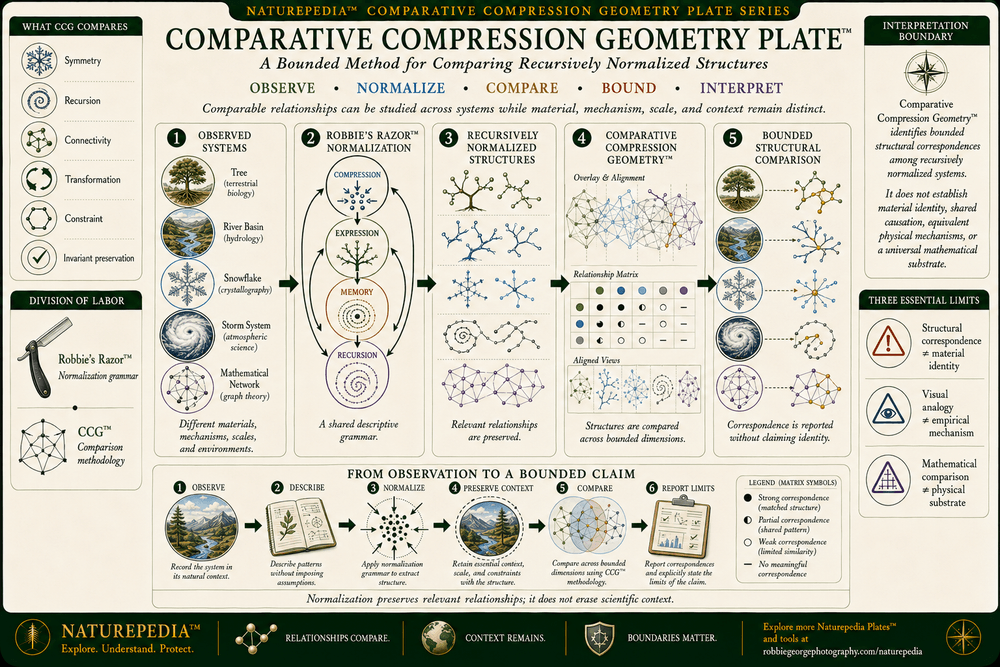
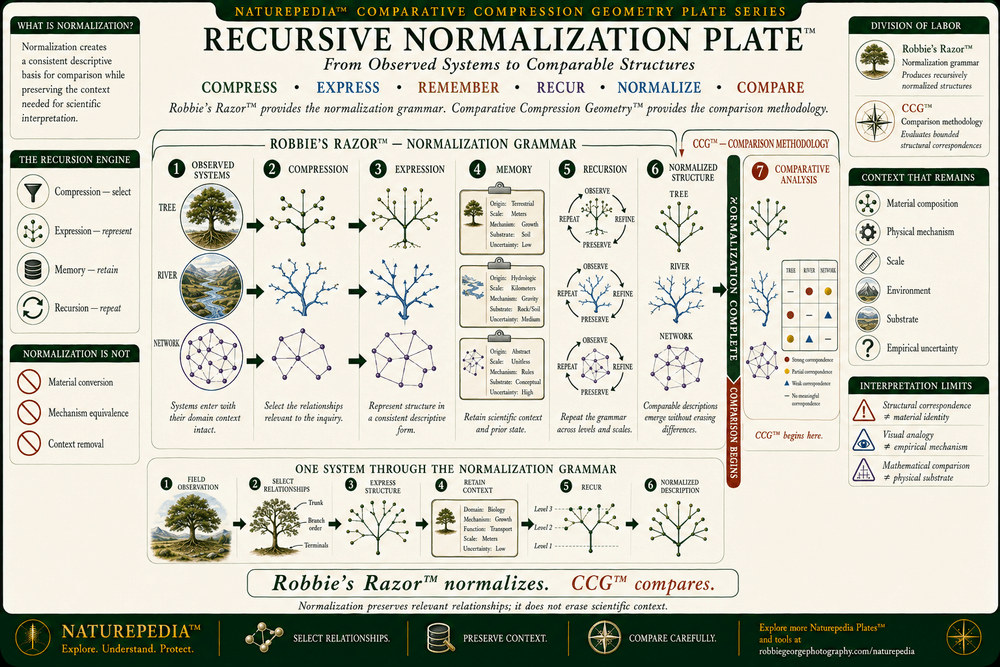
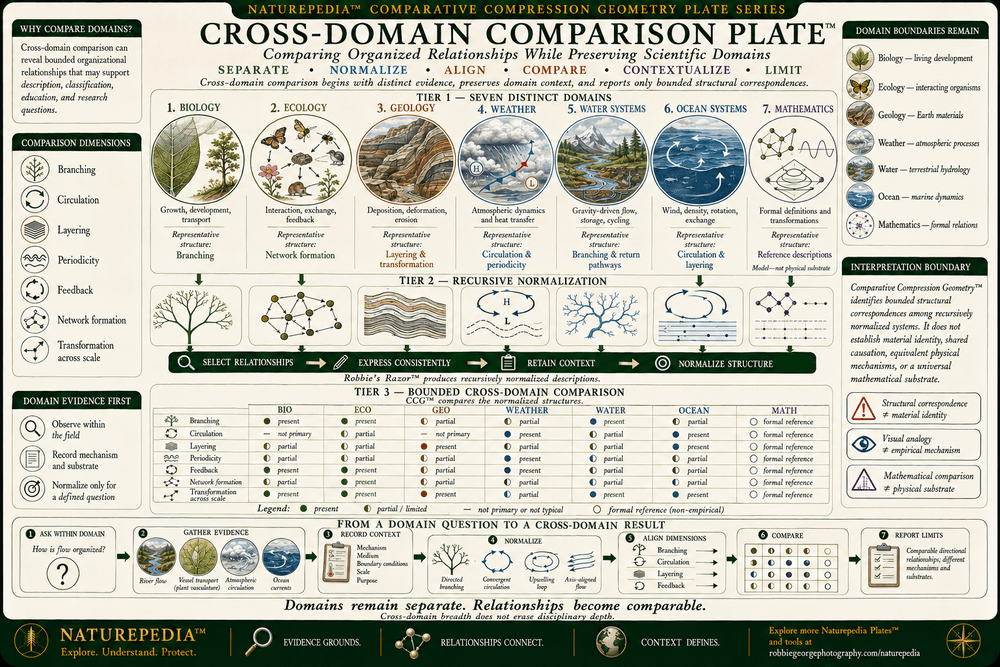
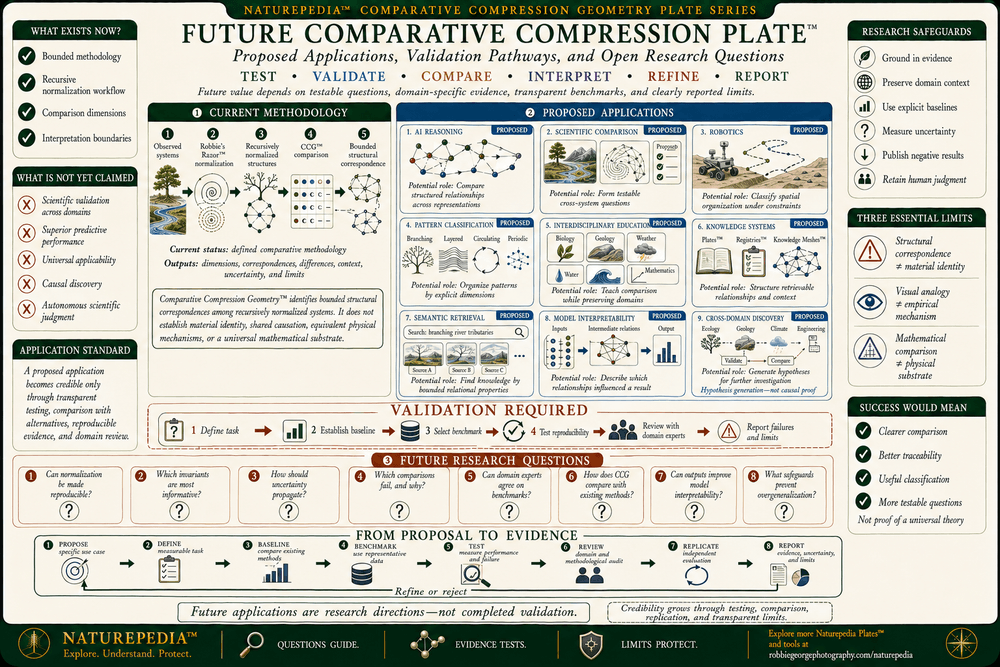
Comparative Compression Geometry™ is a bounded methodology for comparing selected relationships among recursively normalized systems. It begins with clearly defined source and target domains, represents each system through the Robbie’s Razor normalization grammar, and then asks which relationships remain meaningful enough to support comparison.
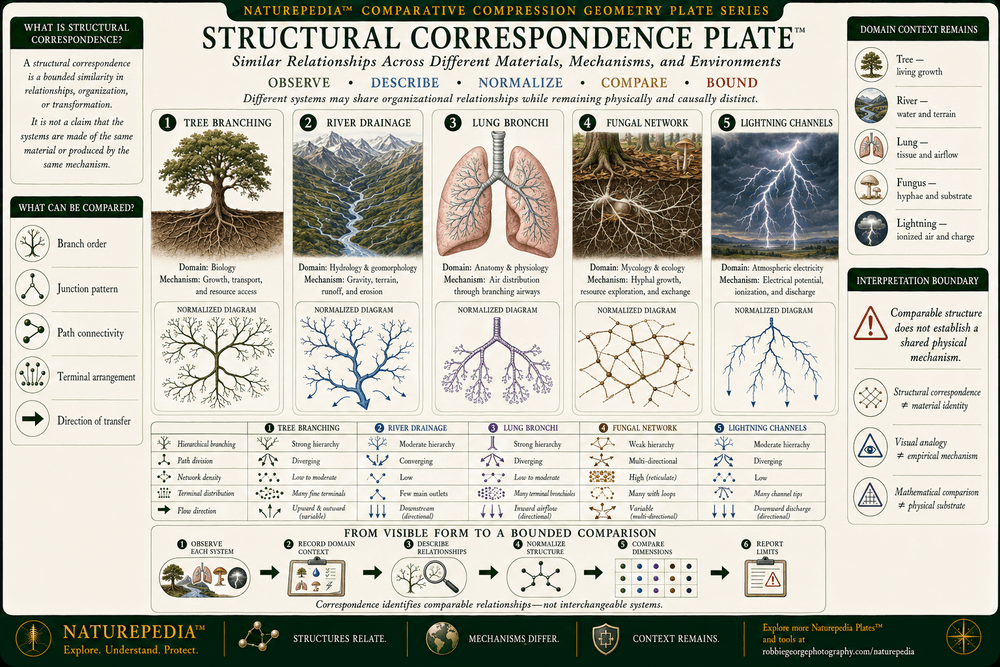
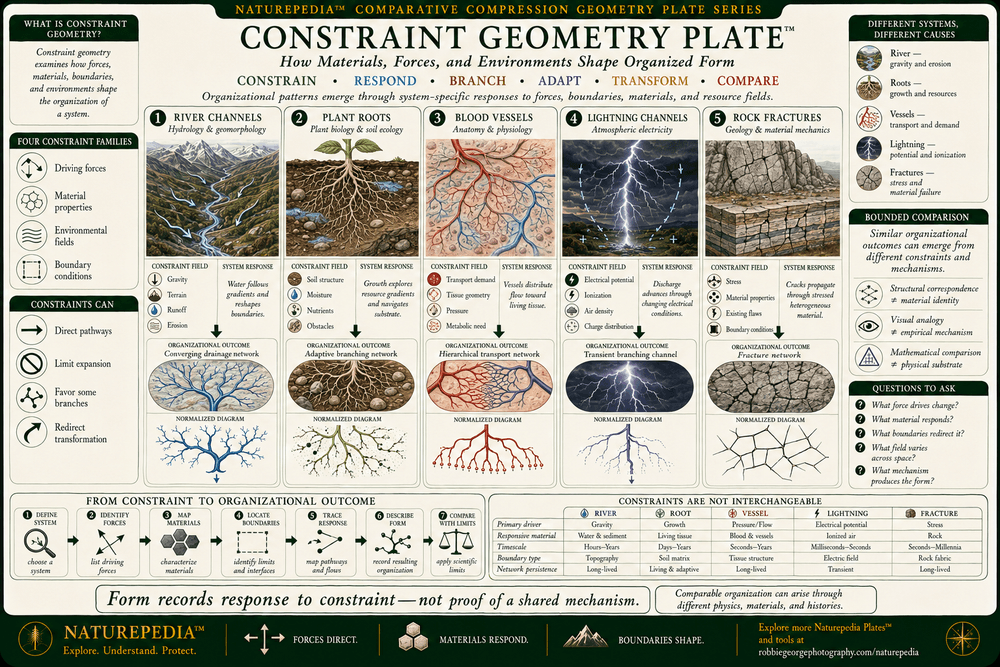
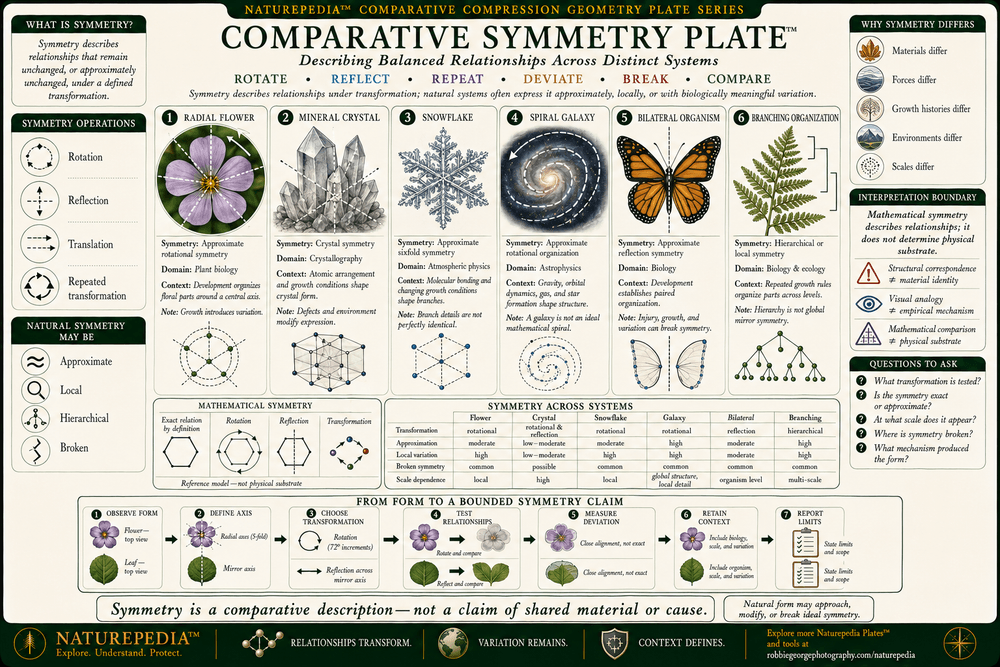
Possible comparison dimensions include adjacency, hierarchy, connectivity, orientation, recurrence, transformation rules, boundary relationships, symmetry, constraint, and relative proportion. These dimensions are not assumed to be equivalent across every domain. Each proposed correspondence must identify what is preserved, what is distorted, and where the comparison fails.
The method preserves the context from which every system emerged. Material composition, physical mechanism, causal history, spatial and temporal scale, measurement units, environment, substrate, empirical evidence, uncertainty, alternatives, and exclusions remain attached to the comparison record.
The CCG Method Flow
Observe → Define → Normalize → Compare → Bound → Interpret
Robbie’s Razor supplies the normalization grammar. Comparative Compression Geometry begins after normalization and performs the bounded comparison.
Step 1
Observe and Define
Identify the source domain, target domain, objects, environment, scale, units, mechanisms, available evidence, and question being investigated.
Step 2
Normalize Recursively
Represent each system through compression, expression, memory, and recursion without erasing its original scientific or material context.
Step 3
Declare Candidate Invariants
State which relationships are proposed to remain meaningful, how they will be measured, and why they are relevant to the comparison.
Step 4
Compare and Measure
Compare the normalized relationships while recording normalization choices, distortion, discarded structure, uncertainty, and unmatched features.
Step 5
Apply Boundaries
Identify exclusions, alternatives, causal differences, evidence limits, domain-specific constraints, and observations that would invalidate the comparison.
Step 6
Interpret at the Supported Level
Report the result as analogy, normalized correspondence, demonstrated isomorphism, or empirical mechanism only when the available evidence supports that level.
Four Levels That Must Remain Distinct
| Level |
What It Establishes |
What It Does Not Establish |
| Visual or Mathematical Analogy |
A potentially useful resemblance or abstract comparison |
Isomorphism, shared causation, mechanism, or material identity |
| Normalized Recursive Correspondence |
Selected relationships remain comparable after declared normalization |
Complete equivalence between the original systems |
| Demonstrated Structural Isomorphism |
A formally demonstrated structure-preserving mapping under defined conditions |
Shared substance, physical cause, function, or universal applicability |
| Empirically Established Mechanism |
A domain-specific mechanism supported by appropriate empirical evidence |
Automatic transfer of that mechanism into another domain |
Established Mathematical Comparison Class
Hopf Fibration — Structured Equivalence and Dimensional Reduction
The classical Hopf fibration , written S1 ↪ S3 → S2, provides an established mathematical example in which a higher-dimensional total space maps to a lower-dimensional base space through a precisely defined family of equivalence classes called fibers. Every point of S2 corresponds to an entire circular S1 fiber in S3.
For Comparative Compression Geometry™, the important feature is not visual resemblance but the mathematical relationship between representation, equivalence, and preserved structure. A lower-dimensional representation can identify degrees of freedom as equivalent while the total space retains nontrivial global organization.
Comparative Structure
richer state space → defined equivalence → lower-dimensional representation
Source Domain
Mathematics — topology and fiber bundles
Evidence Status
Established mathematics
CCG Role
Bounded structural comparison class
Interpretation Level
Comparative — not universal mechanism
Relationships CCG May Compare
- Equivalence classes
- Dimensional reduction
- Canonical representation
- Fiber-to-base relationships
- Invariant relational structure
- Preservation under transformation
Claims the Comparison Does Not Establish
- That nature universally implements Hopf topology
- That unrelated systems share a Hopf mechanism
- That dimensional reduction always preserves the same information
- That Hopf geometry proves Grand Compression
- That topology alone establishes physical causation
- That mathematical similarity establishes material identity
CCG interpretation boundary
Hopf geometry demonstrates an exact mathematical relationship within its defined domain. CCG may compare that relationship with concepts such as equivalence, canonicalization, dimensional reduction, and preservation of structure. The comparison must not be promoted into a claim of common physical substrate, universal causation, or independent validation of the Grand Compression framework.
E8 Is a Bounded Mathematical Example
The E8 lattice may provide a rigorous mathematical reference for selected symmetry comparisons. Comparative Compression Geometry does not claim that E8 is the literal geometry of nature, a universal physical substrate, or a required structure for every comparison. Fibonacci relationships, fractals, topology, network analysis, branching geometry, symmetry groups, and other mathematical tools may be used where their domains, measurements, and limitations are appropriate.
Applied Bounded Comparison
Energy, Wealth & Compression™
Energy, Wealth & Compression™ applies Comparative Compression Geometry to a systems question spanning economic history, ecological organization, and modern computation: how does useful energy become work, persistent structure, memory, and reusable value?
The comparison examines selected relationships among energy-driven industrial expansion, bounded natural systems, artificial-intelligence compute scaling, feedback, persistent memory, knowledge reuse, and the cost of repeated computational work. Each domain retains its own mechanisms, materials, units, evidence, constraints, causal history, and uncertainty.
Comparative Path
Energy → Work → Structure → Memory → Reuse → Reduced Repeated Work
Source Domains
Economic history, systems dynamics, biology, ecology, and thermodynamics
Target Domain
Artificial intelligence and governed knowledge architecture
Comparison Status
Bounded structural interpretation
Framework Hypothesis
Reusable governed state may reduce redundant computation for appropriate task classes
Relationships CCG May Compare
- Throughput under bounded conditions
- Feedback and delayed constraint
- Persistent information and memory
- Reuse of previously created structure
- Marginal work after state preservation
- Efficiency versus total system demand
Claims the Comparison Does Not Establish
- That economies and ecosystems share identical mechanisms
- That natural systems universally minimize energy use
- That AI systems are biological systems
- That energy consumption alone determines economic wealth
- That retrieval is always superior to new reasoning
- That Grand Compression is independently validated by the comparison
Applied-comparison boundary
Energy, Wealth & Compression™ does not claim that industrial economies, living systems, and artificial intelligence are physically equivalent. It asks whether selected relationships involving throughput, constraint, persistent state, reuse, and avoided future work remain useful after the differences among those domains are explicitly preserved.
The Core Architectural Distinction
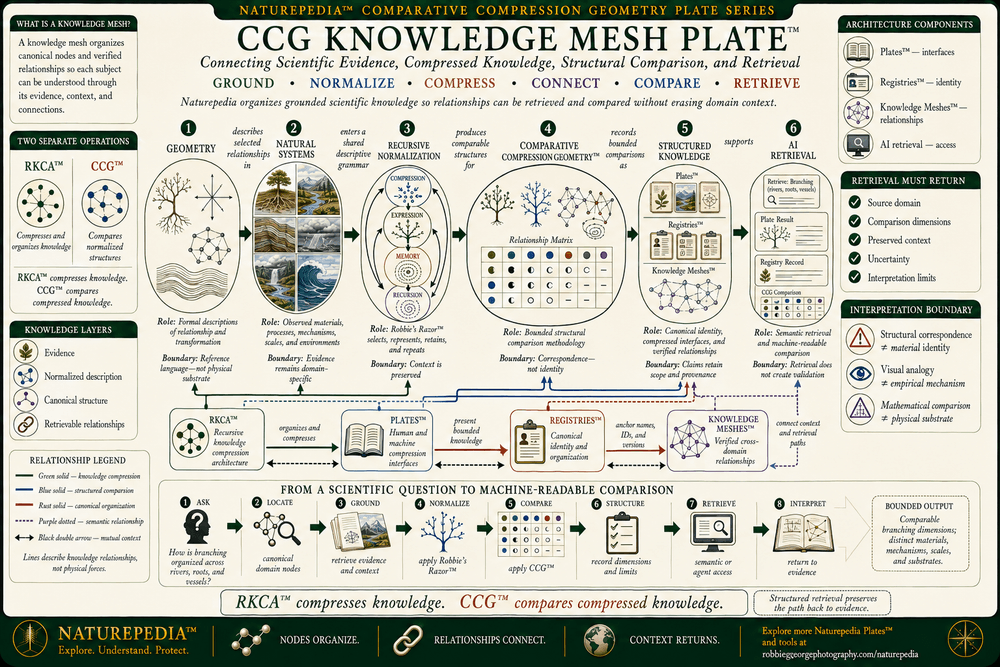
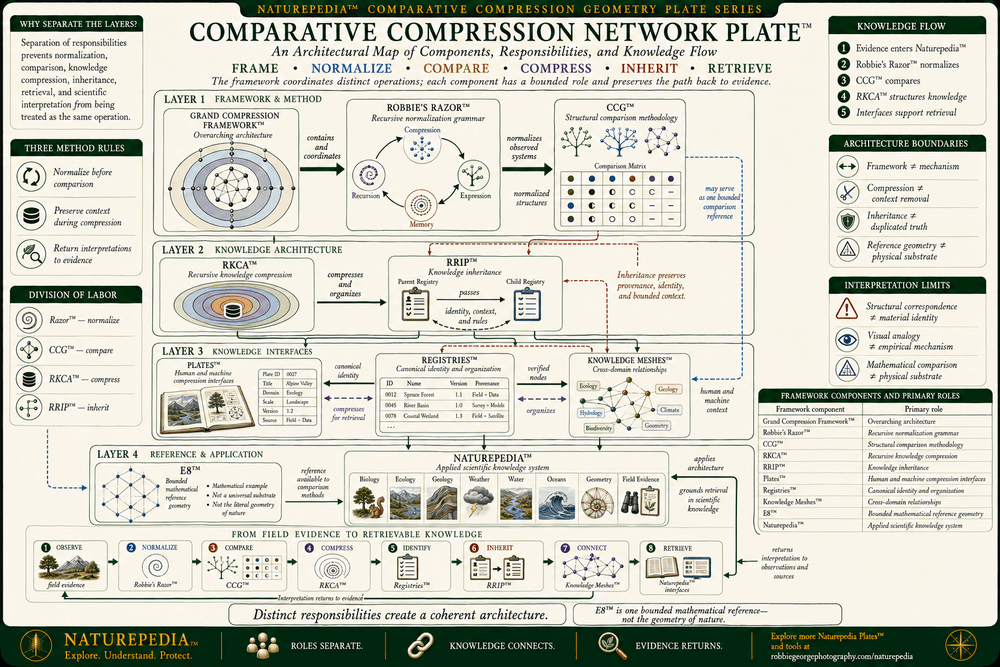
Robbie’s Razor normalizes; Comparative Compression Geometry compares. RKCA™ organizes knowledge into reusable interfaces, RRIP™ governs registry inheritance, and Naturepedia™ demonstrates how those layers can be implemented. Applied pages such as Energy, Wealth & Compression™ use CCG to test bounded cross-domain relationships while preserving domain-specific science, mechanisms, evidence, and failure conditions. Each layer has a different role, and none independently converts a structural comparison into scientific validation.