ATTENTION: To use this site, it is necessary to enable JavaScript in your browser.
Here are the Instructions on how to enable JavaScript in your web browser.

🌿 Earth's Underground Living Communication Network

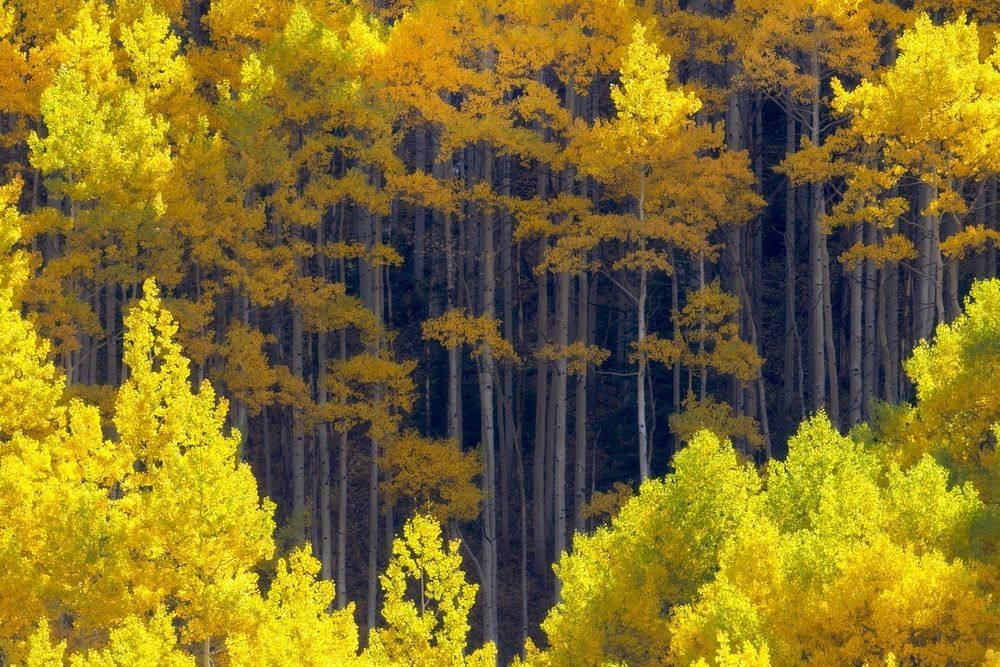
Golden aspen forest illustrating interconnected trees, underground fungal networks, forest communication, and mycorrhizal ecology.

Earth's Underground Living Communication Network

Mycorrhizal Networks™

How Fungi Connect Plants Through Carbon, Nutrients, Water, Biological Information, and Living Underground Communication Networks

Mycorrhizal Networks™ explores the hidden fungal partnerships that connect forests into living communication systems. Through vast underground networks of fungal hyphae, plants exchange carbon, nutrients, water, defensive signals, and biological information, transforming individual organisms into resilient ecological communities throughout Earth's ecosystems.

Hero Photograph: Aspen Forest — Fine art nature photography by Robbie George illustrating one of nature's most interconnected living communities where underground fungal networks silently link entire forests together.

How Fungi Connect Living Ecosystems

Mycorrhizal Networks™ explore one of Earth's most remarkable biological communication systems. Beneath forests, grasslands, wetlands, and agricultural soils, microscopic fungal threads connect plant roots into extensive underground networks capable of moving carbon, nutrients, water, defensive signals, and biological information between neighboring plants.

These partnerships begin as mutually beneficial relationships between plant roots and mycorrhizal fungi. Plants provide carbon produced through photosynthesis, while fungi dramatically increase access to water, phosphorus, nitrogen, and other essential nutrients. Together they create living communication pathways extending far beyond individual root systems.

Modern research suggests these underground fungal networks also participate in ecological signaling. Environmental stress, insect attack, drought, nutrient availability, and changing conditions can influence communication throughout connected plant communities, strengthening ecosystem resilience through shared biological information.

Mycorrhizal Networks™ bridge Plant Communication™ and Plant Electrophysiology™ while expanding communication from individual plants to entire ecosystems. This page also connects Bioelectric Systems™, Soil Systems™, Water Systems™, Carbon & Microbial Life™, Forest Carbon Systems™, Information Systems in Nature™, Quantum Agriculture™, Ecosystem Feedbacks™, and the growing Electro-Ecology Mesh.

Explore Mycorrhizal Networks™

Naturepedia™ Mycorrhizal Networks Plate

Mycorrhizal Networks Plate™

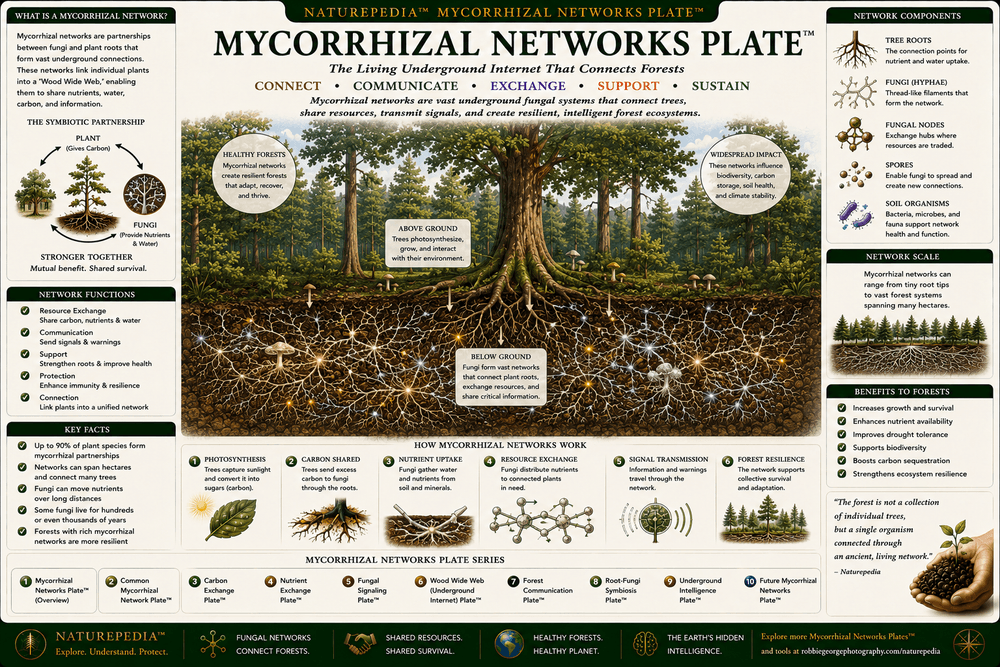
Mycorrhizal Networks™ maps how fungal hyphae connect plant roots into living underground systems that exchange carbon, nutrients, water, minerals, biological signals, and ecological information across forests and soils.

Mycorrhizal Networks Plate showing a forest ecosystem with tree roots, fungal hyphae, carbon exchange, nutrient movement, water transfer, underground communication, and ecological connectivity.
Mycorrhizal Networks Plate™ — a Naturepedia™ systems map showing how fungal networks connect plants through carbon exchange, nutrient flow, water movement, biological signaling, root partnerships, and underground ecological communication.

Visible Plate ID: mycorrhizal-networks#mycorrhizal-networks-plate

Type: Naturepedia Mycorrhizal Networks Plate™

Fungal Networks Connect Forests Into Living Systems

Mycorrhizal Networks™ reveal that forests are not simply collections of separate trees. Beneath the soil, fungal hyphae connect root systems into shared living networks where carbon, nutrients, water, minerals, and biological information can move between plants, fungi, microbes, and soil communities.

These underground partnerships begin when fungi colonize plant roots. In exchange for sugars produced through photosynthesis, fungi extend the reach of root systems far into the soil, helping plants access phosphorus, nitrogen, trace minerals, and water. This exchange creates one of the most important biological relationships supporting forests, grasslands, farms, and living ecosystems.

Mycorrhizal networks also help explain how plant communication expands beyond individual organisms. Chemical signals, stress responses, microbial activity, carbon movement, nutrient availability, and environmental change can all influence activity within these underground systems. Through fungi, plant communication becomes ecosystem communication.

Mycorrhizal Networks™ serve as the bridge between Plant Communication™, Plant Electrophysiology™, and the future framework of Electrical Ecology™. They show how underground fungal communication links plant intelligence, soil systems, water systems, carbon cycling, microbial life, and forest resilience into one living information network.

Carbon Sharing

Plants provide fungi with carbon-rich sugars from photosynthesis, while fungal networks can influence how carbon moves through soils, roots, microbes, and forest communities.

Nutrient Exchange

Fungal hyphae extend beyond roots to access phosphorus, nitrogen, minerals, and water, helping plants survive in complex and changing soil environments.

Underground Communication

Mycorrhizal networks connect roots, fungi, microbes, soil chemistry, water movement, and environmental signals into distributed ecosystem communication systems.

Naturepedia Connection

Mycorrhizal Networks™ connect Plant Communication™, Plant Electrophysiology™, Plant Intelligence™, Soil Systems™, Water Systems™, Carbon & Microbial Life™, Forest Carbon Systems™, Information Systems in Nature™, Quantum Agriculture™, Ecosystem Feedbacks™, and Electrical Ecology™. Together these systems show that underground fungal networks are not isolated biological structures, but living pathways through which ecosystems exchange matter, energy, and information.

Common Mycorrhizal Network Plate

Common Mycorrhizal Network Plate™

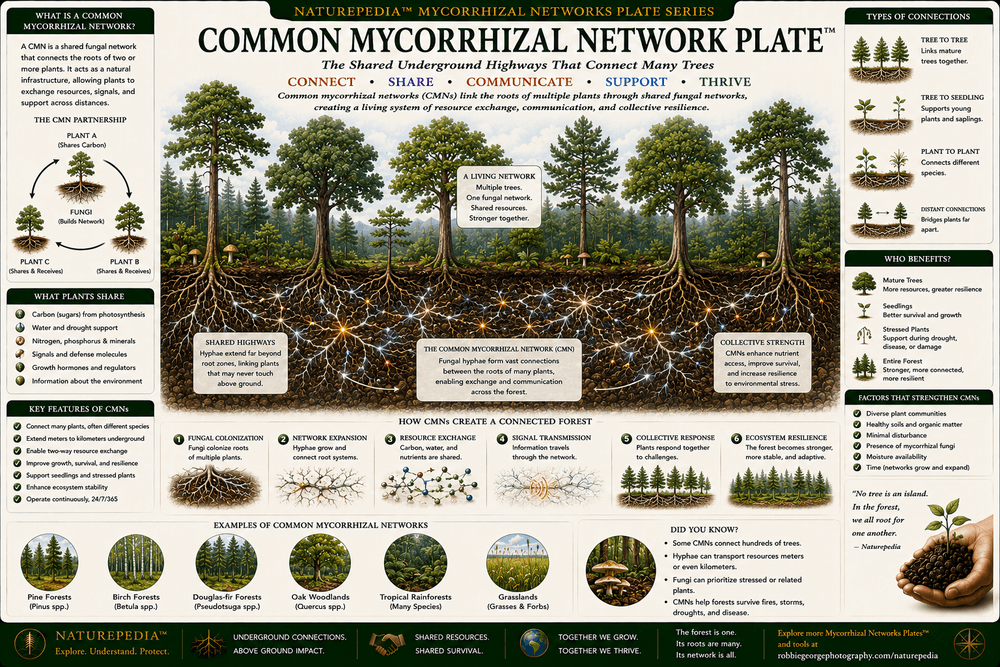
Common Mycorrhizal Network™ explores how shared fungal systems connect multiple plants through underground pathways that support resource exchange, biological signaling, root communication, and ecosystem-scale cooperation.

Common Mycorrhizal Network Plate showing multiple trees connected by shared fungal hyphae, root systems, carbon movement, nutrient exchange, water transfer, and underground plant communication.
Common Mycorrhizal Network Plate™ — illustrating how shared fungal networks connect multiple plants and trees through underground pathways of carbon flow, nutrient exchange, water movement, and biological communication.

Visible Plate ID: mycorrhizal-networks#common-mycorrhizal-network-plate

Type: Naturepedia Common Mycorrhizal Network Plate™

Shared Fungal Pathways Between Plants

A common mycorrhizal network forms when the same fungal system connects the roots of multiple plants. Instead of each plant interacting only with its own isolated fungal partner, many plants may participate in overlapping underground networks where fungi, roots, microbes, nutrients, water, and carbon-rich compounds interact continuously.

These shared networks can link seedlings, mature trees, understory plants, and neighboring root systems into a larger ecological community. Through fungal hyphae, plants gain access to soil volumes far beyond the reach of their own roots, while fungi receive sugars produced by photosynthesis. This exchange helps stabilize forest communities by supporting nutrient movement, carbon cycling, and plant survival under changing environmental conditions.

Common mycorrhizal networks also expand the idea of plant communication. Signals associated with stress, nutrient demand, drought, pathogens, or herbivory may influence activity throughout connected root-fungal systems. These underground relationships help plants respond not only as individuals, but as members of a living ecological network.

Common Mycorrhizal Network™ demonstrates how underground fungal pathways transform separate plants into connected communities. This is where plant communication becomes forest communication, and where the Electro-Ecology Mesh begins to move from individual organisms toward ecosystem-scale intelligence.

Shared Root Access

Fungal hyphae connect multiple root systems, allowing plants to participate in overlapping underground networks rather than isolated soil relationships.

Resource Movement

Carbon, phosphorus, nitrogen, minerals, and water can move through root-fungal partnerships, supporting nutrient cycling and forest resilience.

Ecological Communication

Shared fungal systems help connect plant responses to drought, herbivory, disease pressure, soil chemistry, and changing environmental conditions.

Naturepedia Connection

Common Mycorrhizal Network™ connects Mycorrhizal Networks™, Plant Communication™, Plant Electrophysiology™, Plant Intelligence™, Soil Systems™, Water Systems™, Carbon & Microbial Life™, Forest Carbon Systems™, Information Systems in Nature™, Quantum Agriculture™, Ecosystem Feedbacks™, and Electrical Ecology™. Together these Naturepedia™ systems reveal how shared fungal pathways allow forests to function as connected living communities rather than collections of isolated plants.

Carbon Exchange Plate

Carbon Exchange Plate™

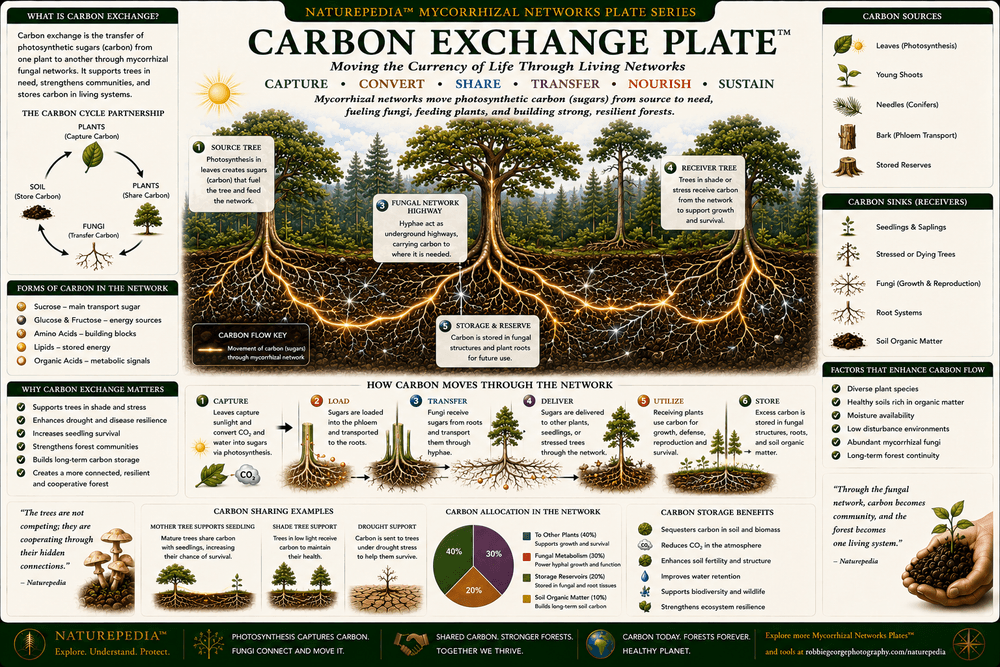
Carbon Exchange™ explores how photosynthetic carbon moves through mycorrhizal fungal networks, supporting plant growth, soil health, microbial life, and the long-term resilience of forests and living ecosystems.

Carbon Exchange Plate showing photosynthesis, trees, plant roots, fungal hyphae, underground carbon movement, soil microbes, and living forest carbon networks.
Carbon Exchange Plate™ — illustrating how plants share carbon with fungal partners, supporting underground ecosystems through photosynthesis, root-fungi symbiosis, and living carbon networks.

Visible Plate ID: mycorrhizal-networks#carbon-exchange-plate

Type: Naturepedia Carbon Exchange Plate™

Photosynthesis Powers Underground Life

Every forest begins with sunlight. Through photosynthesis, plants capture atmospheric carbon dioxide and transform it into sugars that fuel growth, reproduction, and survival. A significant portion of this carbon is transported below ground where it becomes the energy source for mycorrhizal fungi and the diverse microbial communities living within healthy soils.

In return for this continuous supply of carbon, fungi extend the reach of plant roots far beyond their natural limits. Their microscopic hyphae explore enormous volumes of soil, delivering phosphorus, nitrogen, minerals, and water back to their plant partners. This mutual exchange strengthens individual plants while simultaneously supporting the larger ecological networks that connect forests together.

Carbon moving below ground also fuels bacteria, fungi, insects, and countless microscopic organisms that contribute to nutrient cycling and soil formation. Rather than remaining inside a single tree, carbon becomes part of a dynamic underground economy that links plants, fungi, microbes, soils, and ecosystems into one continuously interacting biological system.

Carbon Exchange™ demonstrates that forests are powered by cooperation as much as competition. Photosynthesis captures energy above ground, while mycorrhizal networks help distribute that energy below ground, supporting biodiversity, ecological resilience, and the long-term stability of living ecosystems.

Photosynthetic Carbon

Plants convert sunlight into sugars that provide the energy supporting fungal partners, microbial communities, and underground ecological processes.

Mutual Exchange

Carbon flows from plants to fungi, while fungi deliver nutrients, minerals, and water back to plant roots through extensive underground networks.

Forest Carbon Cycle

Carbon exchange supports soil formation, microbial diversity, nutrient cycling, forest resilience, and the long-term storage of carbon within healthy ecosystems.

Naturepedia Connection

Carbon Exchange™ connects Mycorrhizal Networks™, Carbon & Microbial Life™, Forest Carbon Systems™, Carbon Cycle™, Plant Communication™, Soil Systems™, Water Systems™, Quantum Agriculture™, Ecosystem Feedbacks™, and Electrical Ecology™. Together these Naturepedia™ systems demonstrate how photosynthetic carbon moves beyond individual plants to sustain the living underground networks that support healthy forests and resilient ecosystems.

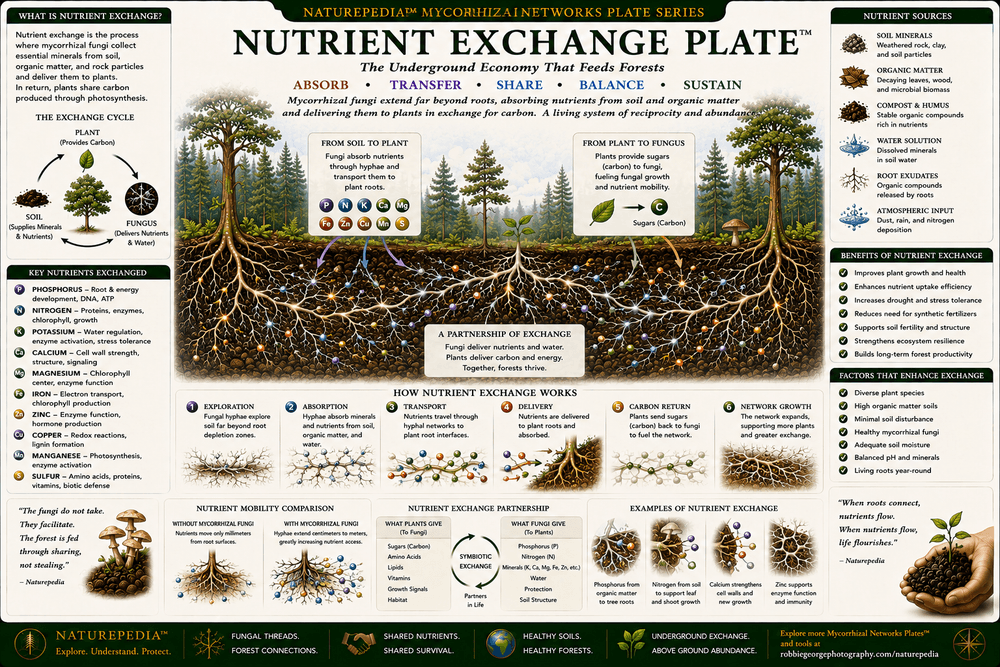
Nutrient Exchange Plate

Nutrient Exchange Plate™

Nutrient Exchange™ explores how mycorrhizal fungi transport phosphorus, nitrogen, minerals, and water through underground networks, helping plants thrive within complex living ecosystems.

Nutrient Exchange Plate showing fungal hyphae transporting phosphorus, nitrogen, minerals, water, and nutrients between plant roots through underground mycorrhizal networks.
Nutrient Exchange Plate™ — illustrating how fungal hyphae move phosphorus, nitrogen, minerals, water, and other essential resources between plant roots throughout underground ecological networks.

Visible Plate ID: mycorrhizal-networks#nutrient-exchange-plate

Type: Naturepedia Nutrient Exchange Plate™

Underground Highways for Essential Resources

One of the greatest advantages of mycorrhizal fungi is their extraordinary ability to gather nutrients beyond the reach of plant roots. Their microscopic hyphae weave through tiny soil spaces, accessing phosphorus, nitrogen, potassium, calcium, magnesium, trace minerals, and water that would otherwise remain unavailable to plants.

These fungal threads function as living extensions of the root system. As nutrients are absorbed from the surrounding soil, they are transported back to the host plant in exchange for carbon-rich sugars produced through photosynthesis. This mutual relationship allows both fungi and plants to thrive while improving the productivity and resilience of entire ecosystems.

Nutrient exchange also benefits the broader soil community. Healthy fungal networks support microbial diversity, improve soil aggregation, enhance water retention, reduce nutrient loss, and strengthen the biological processes that sustain forests, wetlands, grasslands, and regenerative agricultural systems.

Nutrient Exchange™ demonstrates that healthy ecosystems depend upon cooperation beneath the soil. Rather than relying solely on individual root systems, plants participate in interconnected fungal partnerships that continually redistribute essential resources throughout the living landscape.

Mineral Transport

Fungal hyphae transport phosphorus, nitrogen, potassium, calcium, magnesium, and trace elements from the soil directly to plant roots.

Expanded Root Systems

Mycorrhizal fungi greatly increase the effective surface area of plant roots, allowing access to nutrients and water far beyond the physical reach of roots alone.

Living Soil Health

Continuous nutrient exchange strengthens soil biology, microbial diversity, ecosystem productivity, and long-term forest resilience.

Naturepedia Connection

Nutrient Exchange™ connects Mycorrhizal Networks™, Soil Systems™, Water Systems™, Carbon & Microbial Life™, Forest Carbon Systems™, Carbon Cycle™, Plant Communication™, Plant Intelligence™, Quantum Agriculture™, Ecosystem Feedbacks™, and Electrical Ecology™. Together these Naturepedia™ systems demonstrate how fungal partnerships continuously recycle nutrients through living soils while supporting healthy plants, resilient forests, and interconnected ecosystems.

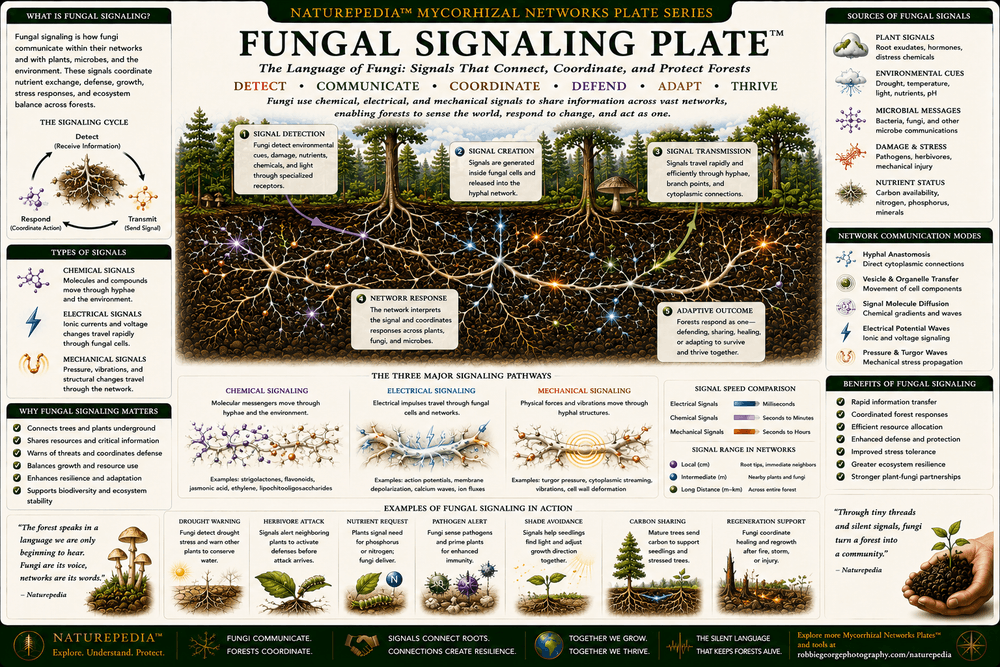
Fungal Signaling Plate

Fungal Signaling Plate™

Fungal Signaling™ explores how mycorrhizal fungi participate in underground communication through chemical signals, electrical activity, nutrient cues, stress responses, and biological information moving through living soil networks.

Fungal Signaling Plate showing fungal hyphae, plant roots, chemical signals, electrical communication, nutrient cues, stress responses, and underground forest information networks.
Fungal Signaling Plate™ — illustrating chemical, electrical, nutrient, and stress-related signals moving through fungal networks that connect roots, soils, microbes, and forest communities.

Visible Plate ID: mycorrhizal-networks#fungal-signaling-plate

Type: Naturepedia Fungal Signaling Plate™

Signals Moving Through Fungal Networks

Fungal networks do more than move physical resources. They also participate in the exchange of biological signals that influence how plants, fungi, microbes, and soils respond to changing environmental conditions. These signals may involve chemical compounds, nutrient gradients, microbial activity, moisture changes, stress responses, and electrical activity moving through living fungal tissue.

When roots encounter drought, pathogens, insect pressure, nutrient scarcity, or changing soil chemistry, mycorrhizal fungi may help transmit ecological information through the surrounding network. This does not mean forests operate like human communication systems, but it does reveal that underground ecosystems are dynamic information environments where many organisms continuously respond to one another.

Fungal signaling is especially important because fungi occupy the space between plants and soil. Their hyphae contact roots, minerals, organic matter, bacteria, water films, and decomposing material at the same time. This position allows fungi to sense local soil conditions while influencing the flow of nutrients, carbon, and information across broader ecological networks.

Fungal Signaling™ demonstrates how communication in nature is rarely limited to a single organism. Beneath the forest floor, fungi act as living interfaces linking plant physiology, microbial life, soil chemistry, water movement, carbon cycling, and ecosystem resilience.

Chemical Signals

Fungi, roots, and microbes exchange chemical cues that influence nutrient uptake, defense responses, growth patterns, and ecological relationships.

Electrical Activity

Living fungal tissues can exhibit electrical activity, suggesting another layer of bioelectrical information within underground ecological networks.

Ecological Response

Fungal signaling helps connect plant stress, soil moisture, nutrient demand, microbial activity, and environmental change into coordinated ecosystem responses.

Naturepedia Connection

Fungal Signaling™ connects Mycorrhizal Networks™, Plant Communication™, Plant Electrophysiology™, Bioelectric Systems™, Soil Systems™, Water Systems™, Carbon & Microbial Life™, Information Systems in Nature™, Quantum Agriculture™, Ecosystem Feedbacks™, and Electrical Ecology™. Together these Naturepedia™ systems show how fungal networks transform underground soils into living communication environments where chemistry, electricity, carbon, water, microbes, and roots interact continuously.

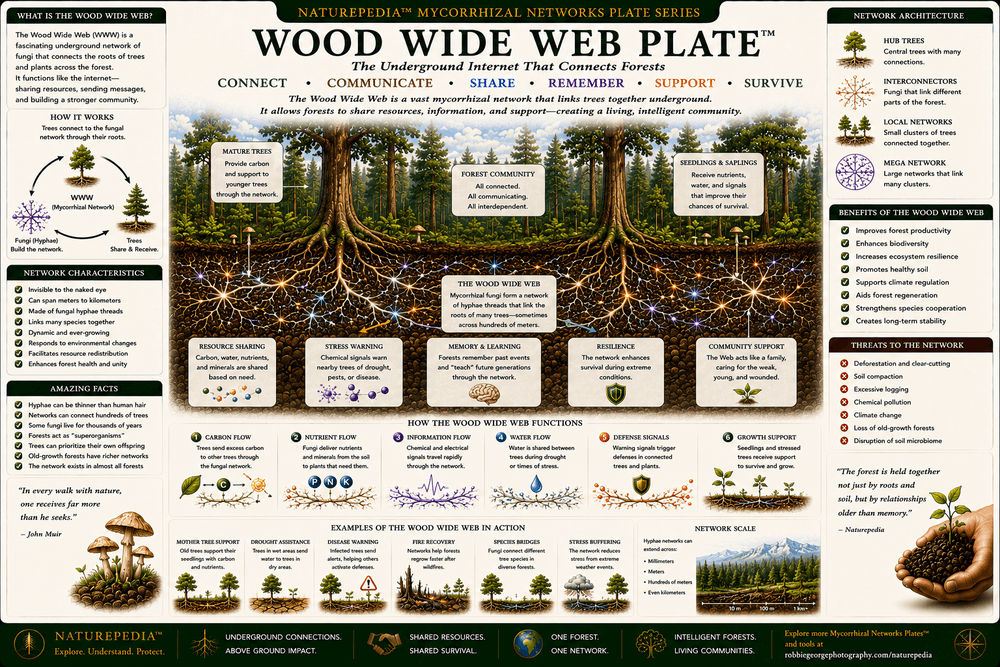
Wood Wide Web Plate

Wood Wide Web Plate™

Wood Wide Web™ explores the vast underground fungal networks that connect forests through shared root systems, resource exchange, biological signaling, and ecosystem-scale communication.

Wood Wide Web Plate showing an interconnected forest linked by underground fungal hyphae, tree roots, carbon flow, nutrient exchange, and ecosystem communication.
Wood Wide Web Plate™ — illustrating the interconnected fungal networks linking trees through underground pathways of carbon, nutrients, water, biological signaling, and ecological communication.

Visible Plate ID: mycorrhizal-networks#wood-wide-web-plate

Type: Naturepedia Wood Wide Web Plate™

An Underground Network Linking Entire Forests

The phrase Wood Wide Web describes the remarkable underground fungal networks that connect trees and plants through shared mycorrhizal partnerships. Although the name is informal, it captures an important ecological reality: forests are interconnected through extensive fungal systems that continuously exchange resources and respond to changing environmental conditions.

These underground networks extend far beyond the roots of individual trees. Millions of microscopic fungal hyphae weave through the soil, linking neighboring plants into living communities. Through these pathways, carbon, nutrients, water, and biological signals move between fungi, roots, microbes, and surrounding soils, strengthening the resilience of entire ecosystems.

Rather than viewing forests as collections of isolated organisms, the Wood Wide Web illustrates how trees participate within larger ecological relationships. Every root system becomes part of a broader underground infrastructure where cooperation, nutrient cycling, soil biology, and environmental adaptation operate simultaneously across many interconnected species.

Wood Wide Web™ provides one of the clearest examples of ecosystem-scale communication in nature. It expands the concepts introduced in Plant Communication™ and Plant Electrophysiology™ by revealing how underground fungal networks transform individual plants into living forest communities.

Forest Connectivity

Shared fungal networks physically connect neighboring trees and plants into one underground ecological community.

Resource Sharing

Carbon, nutrients, minerals, water, and biological information move through fungal pathways that strengthen ecosystem resilience.

Living Ecosystems

The Wood Wide Web illustrates how forests function as interconnected biological systems rather than isolated collections of individual trees.

Naturepedia Connection

Wood Wide Web™ connects Mycorrhizal Networks™, Plant Communication™, Plant Electrophysiology™, Plant Intelligence™, Soil Systems™, Water Systems™, Carbon & Microbial Life™, Forest Carbon Systems™, Information Systems in Nature™, Quantum Agriculture™, Ecosystem Feedbacks™, and Electrical Ecology™. Together these Naturepedia™ systems demonstrate how underground fungal networks integrate trees, roots, soils, microbes, and environmental processes into one of Earth's most sophisticated living communication systems.

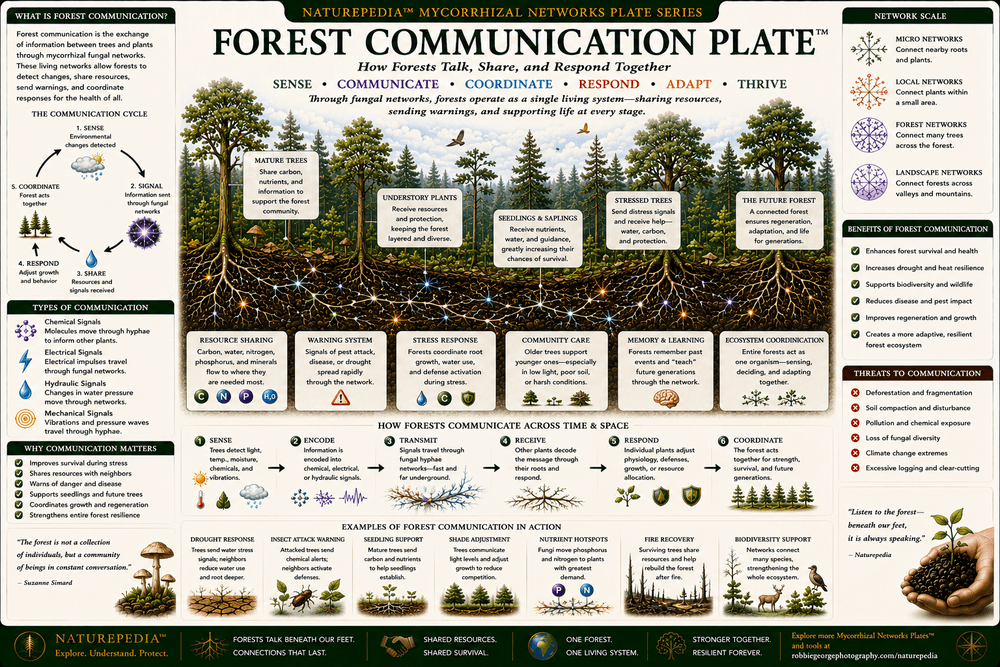
Forest Communication Plate

Forest Communication Plate™

Forest Communication™ explores how trees, fungi, soils, microbes, water, and living ecosystems exchange information through interconnected biological networks that strengthen resilience across entire forests.

Forest Communication Plate showing an interconnected forest ecosystem linked through tree roots, fungal networks, carbon movement, nutrient exchange, water flow, and ecosystem communication.
Forest Communication Plate™ — illustrating how forests operate as interconnected living ecosystems through fungal partnerships, root communication, carbon cycling, nutrient exchange, and environmental signaling.

Visible Plate ID: mycorrhizal-networks#forest-communication-plate

Type: Naturepedia Forest Communication Plate™

Forests Function as Living Communities

A healthy forest is far more than a collection of individual trees. Beneath every woodland lies a complex web of roots, fungal hyphae, microbes, organic matter, minerals, and water that continuously interact to support the growth and resilience of the entire ecosystem. Together these biological relationships create a dynamic communication network extending throughout the forest floor.

Trees respond constantly to changing environmental conditions including drought, storms, insect pressure, disease, nutrient availability, and seasonal change. Through shared mycorrhizal partnerships and living soils, these local responses become part of larger ecological feedback systems that help stabilize forest communities over time.

Forest communication is not controlled by a single organism. Instead, information emerges through countless biological interactions between fungi, roots, microbes, soil chemistry, water movement, carbon cycling, and ecological processes. Every organism contributes to the resilience of the larger living system.

Forest Communication™ represents the transition from individual plant communication to ecosystem-scale organization. It demonstrates how forests behave as integrated biological systems where information, energy, and resources continually circulate through interconnected living networks.

Shared Ecosystems

Trees, fungi, microbes, soils, water, and roots cooperate to create resilient ecological communities rather than isolated organisms.

Environmental Awareness

Living forests continually respond to drought, storms, nutrient availability, herbivory, pathogens, and changing environmental conditions through interconnected biological processes.

Ecosystem Resilience

Forest communication strengthens biodiversity, nutrient cycling, carbon storage, water regulation, and the long-term stability of natural ecosystems.

Naturepedia Connection

Forest Communication™ connects Mycorrhizal Networks™, Plant Communication™, Plant Electrophysiology™, Forest Carbon Systems™, Carbon & Microbial Life™, Soil Systems™, Water Systems™, Ecosystem Feedbacks™, Information Systems in Nature™, Quantum Agriculture™, Earth Systems™, and Electrical Ecology™. Together these Naturepedia™ systems reveal that forests communicate through countless biological interactions that transform individual organisms into resilient living ecosystems.

Root-Fungi Symbiosis Plate

Root-Fungi Symbiosis Plate™

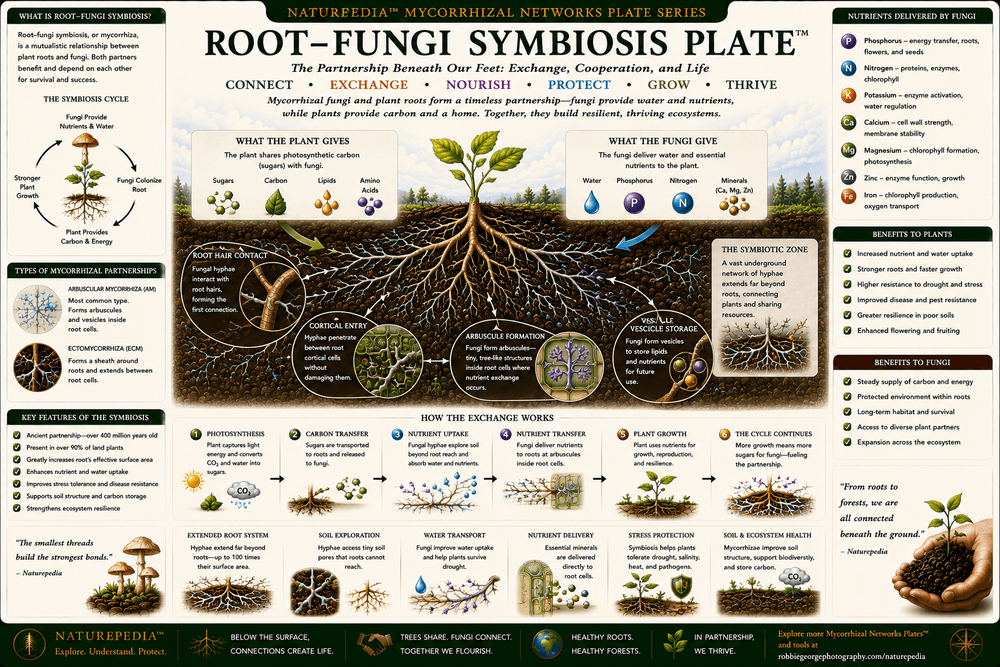
Root-Fungi Symbiosis™ explores the mutually beneficial partnership between plant roots and mycorrhizal fungi that supports nutrient uptake, carbon exchange, water transport, biological signaling, and healthy ecosystem function.

Root-Fungi Symbiosis Plate showing plant roots surrounded by fungal hyphae exchanging carbon, nutrients, water, minerals, and biological information through underground mycorrhizal partnerships.
Root-Fungi Symbiosis Plate™ — illustrating the intimate partnership between plant roots and fungal hyphae that powers nutrient exchange, carbon flow, water transport, and underground ecosystem communication.

Visible Plate ID: mycorrhizal-networks#root-fungi-symbiosis-plate

Type: Naturepedia Root-Fungi Symbiosis Plate™

A Partnership That Built Modern Ecosystems

The relationship between plant roots and mycorrhizal fungi is one of Earth's oldest and most successful biological partnerships. For hundreds of millions of years, fungi have helped plants colonize land by expanding their ability to absorb water and nutrients while receiving carbon-rich sugars produced through photosynthesis.

Microscopic fungal hyphae surround and often penetrate the outer layers of plant roots, creating an enormous underground network that functions as an extension of the root system. This expanded surface area allows plants to reach phosphorus, nitrogen, trace minerals, and water that would otherwise remain inaccessible within the surrounding soil.

The relationship benefits both partners. Plants provide fungi with a dependable source of energy through carbon compounds, while fungi improve nutrient acquisition, water availability, soil structure, and ecological resilience. Together they form the biological foundation upon which forests, grasslands, wetlands, and many agricultural systems depend.

Root-Fungi Symbiosis™ demonstrates that successful ecosystems are built through cooperation. This partnership forms the biological engine driving underground communication, resource sharing, carbon cycling, and the larger ecological networks explored throughout the Electro-Ecology Mesh.

Mutual Partnership

Plants supply carbon through photosynthesis while fungi return nutrients, minerals, and water that strengthen plant growth and survival.

Expanded Root Reach

Fungal hyphae dramatically increase the effective size of the root system, allowing access to soil resources far beyond the limits of roots alone.

Living Foundations

Root-fungi partnerships strengthen soil biology, nutrient cycling, ecosystem productivity, and the long-term resilience of forests and living landscapes.

Naturepedia Connection

Root-Fungi Symbiosis™ connects Mycorrhizal Networks™, Plant Communication™, Plant Electrophysiology™, Plant Intelligence™, Soil Systems™, Water Systems™, Carbon & Microbial Life™, Forest Carbon Systems™, Carbon Cycle™, Quantum Agriculture™, Ecosystem Feedbacks™, and Electrical Ecology™. Together these Naturepedia™ systems illustrate how the ancient partnership between roots and fungi became one of the biological foundations supporting healthy soils, thriving forests, and interconnected living ecosystems.

Underground Intelligence Plate

Underground Intelligence Plate™

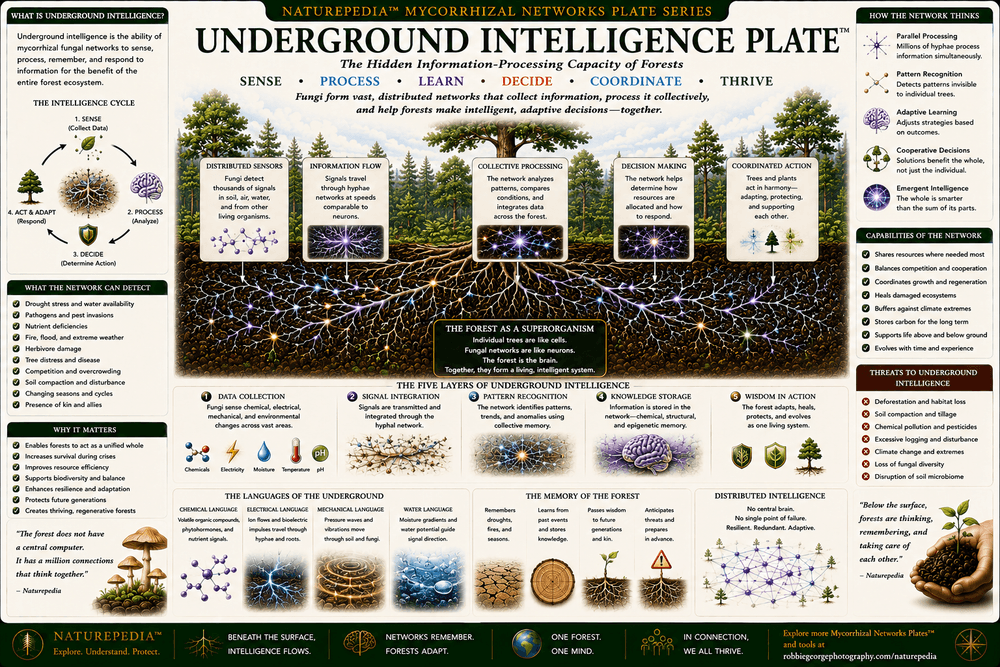
Underground Intelligence™ explores how forests organize through distributed fungal networks where plants, fungi, microbes, soils, and environmental processes collectively create resilient ecological systems.

Underground Intelligence Plate showing hidden fungal networks connecting roots, microbes, carbon flow, nutrients, water movement, ecological signaling, and distributed forest intelligence.
Underground Intelligence Plate™ — illustrating the distributed biological networks beneath forests where fungi, roots, microbes, soils, carbon, nutrients, and water interact to support resilient ecosystems.

Visible Plate ID: mycorrhizal-networks#underground-intelligence-plate

Type: Naturepedia Underground Intelligence Plate™

Intelligence Emerges From Connected Living Systems

The remarkable organization of forests does not arise from a single controlling organism. Instead, it emerges from countless interactions between plants, fungi, microbes, soils, water, minerals, insects, and environmental conditions. Together these relationships create distributed ecological systems capable of adapting to continual change while maintaining the long-term health of the ecosystem.

Mycorrhizal fungi play a central role within these underground systems because they physically connect roots to surrounding soils and microbial communities. Through these living networks, nutrients, carbon, water, and biological signals move continuously, allowing ecosystems to respond collectively to drought, disturbance, disease, seasonal change, and shifting environmental conditions.

The phrase Underground Intelligence describes this distributed organization rather than conscious thought. Forest ecosystems exhibit remarkable coordination through countless local biological interactions that together generate resilient, self-organizing ecological behavior across the landscape.

Underground Intelligence™ demonstrates that nature's greatest strength often lies in distributed cooperation. Healthy ecosystems emerge because millions of organisms exchange resources, information, and energy through interconnected biological networks operating beneath every forest floor.

Distributed Organization

Forest ecosystems organize through millions of local interactions rather than centralized control, creating resilient living systems.

Ecological Adaptation

Fungi, plants, soils, microbes, and environmental processes continually adjust to changing conditions while strengthening ecosystem stability.

Living Networks

Underground fungal systems demonstrate how interconnected biological relationships allow ecosystems to function as unified living communities.

Naturepedia Connection

Underground Intelligence™ connects Mycorrhizal Networks™, Plant Communication™, Plant Electrophysiology™, Plant Intelligence™, Information Systems in Nature™, Soil Systems™, Water Systems™, Carbon & Microbial Life™, Forest Carbon Systems™, Ecosystem Feedbacks™, Earth Systems™, and Electrical Ecology™. Together these Naturepedia™ systems reveal how distributed biological interactions create resilient living ecosystems where information, resources, and energy continually flow beneath the forest floor.

Future Mycorrhizal Networks Plate

Future Mycorrhizal Networks Plate™

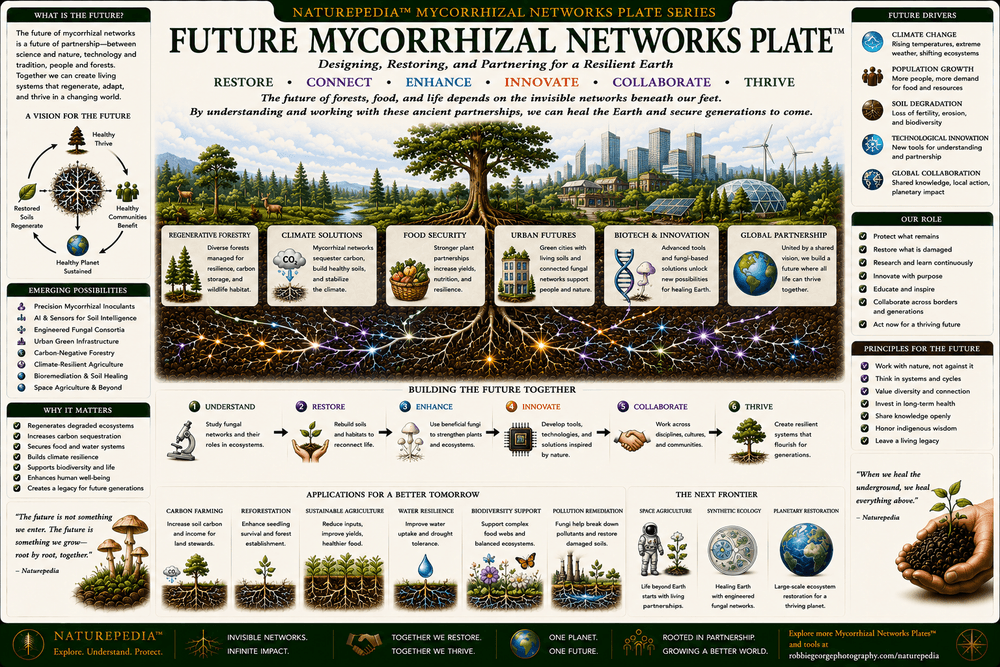
Future Mycorrhizal Networks™ explores how fungal communication, ecological sensing, soil intelligence, carbon systems, bioelectric research, and future environmental monitoring may reveal the next layer of Earth's living information networks.

Future Mycorrhizal Networks Plate showing fungal networks, plant roots, ecological monitoring, planetary signaling, distributed intelligence, soil systems, and future electrical ecology.
Future Mycorrhizal Networks Plate™ — illustrating the emerging future of fungal communication, ecological sensing, distributed ecosystem intelligence, and the transition toward Electrical Ecology™.

Visible Plate ID: mycorrhizal-networks#future-mycorrhizal-networks-plate

Type: Naturepedia Future Mycorrhizal Networks Plate™

The Future of Underground Ecological Communication

The future study of mycorrhizal networks will increasingly reveal forests, soils, farms, wetlands, and grasslands as living information systems. As sensing technology improves, researchers may be able to observe how fungal networks respond to drought, carbon flow, nutrient stress, root signaling, microbial activity, electrical activity, and environmental change in real time.

Future ecological monitoring may combine soil sensors, fungal mapping, plant electrophysiology, carbon tracking, microbial analysis, artificial intelligence, and remote environmental observation. Together these tools could help reveal how underground biological networks influence forest resilience, regenerative agriculture, climate feedbacks, water movement, and ecosystem recovery.

As this research expands, mycorrhizal networks naturally connect with the next layer of the Electro-Ecology Mesh. Fungal networks already link plant communication, carbon exchange, water movement, nutrient cycling, microbial life, and soil ecology. Future science may show how these underground systems also participate in broader bioelectric and ecological information networks operating across entire landscapes.

Future Mycorrhizal Networks™ serves as the bridge into Electrical Ecology™. It points toward a future where forests are understood not only as carbon sinks or collections of trees, but as living communication systems where fungi, roots, microbes, water, carbon, minerals, and electrical signals continuously shape the intelligence of ecosystems.

Ecological Monitoring

Future technologies may help observe fungal networks, carbon movement, soil moisture, nutrient flow, microbial activity, and plant responses across living landscapes.

Distributed Intelligence

Fungal networks may help explain how ecosystems coordinate resilience through countless local interactions between plants, fungi, microbes, water, and soil chemistry.

Electrical Ecology

Mycorrhizal Networks™ naturally lead toward Electrical Ecology™, where fungal communication becomes part of a larger framework of ecosystem-scale information flow.

Naturepedia Connection

Future Mycorrhizal Networks™ connects Mycorrhizal Networks™, Plant Communication™, Plant Electrophysiology™, Plant Intelligence™, Bioelectric Systems™, Soil Systems™, Water Systems™, Carbon & Microbial Life™, Forest Carbon Systems™, Information Systems in Nature™, Quantum Agriculture™, Ecosystem Feedbacks™, Earth Systems™, and Electrical Ecology™. Together these Naturepedia™ systems point toward a future understanding of ecosystems as living information networks where underground fungal pathways help coordinate carbon, water, nutrients, biology, and communication across the planet.

About The Author

Robbie George

Robbie George, National Geographic nature photographer and creator of Naturepedia, exploring living ecosystems, forests, soils, fungi, and underground ecological communication.

Observing forests, soils, roots, fungi, and living landscapes reveals that ecosystems are connected through hidden networks of communication beneath our feet.

Years of photographing forests, wetlands, farms, alpine ecosystems, and wild landscapes have shown Robbie George that nature is organized through relationships. Every tree, root, fungus, stream, soil layer, and microbial community participates in a larger living system where survival depends upon connection rather than isolation.

Mycorrhizal Networks™ emerged from this field-based understanding of nature as a web of exchange. Beneath every forest floor, fungal networks help connect plants with water, minerals, carbon, microbes, and biological information. These hidden systems reveal that forests are not simply scenery, but living communities held together by invisible ecological relationships.

As a National Geographic nature photographer and creator of Naturepedia™, Robbie George combines field observation, ecological storytelling, and visual systems thinking to make complex natural processes easier to understand. His work connects photography with science, helping readers see the hidden architecture of life that operates beneath the surface of everyday landscapes.

Mycorrhizal Networks™ represents the third major gateway into the Electro-Ecology Mesh. It builds from Plant Communication™ and Plant Electrophysiology™ before leading naturally toward Electrical Ecology™, where plant signals, fungal systems, soils, water, microbes, and ecosystems become part of one larger living information network.

The deeper we look into nature, the more clearly we discover that life communicates through connection. Fungal networks remind us that the most important systems are often hidden underground, quietly sustaining forests, farms, soils, and the living planet itself.

Mycorrhizal Networks™ FAQ

Frequently Asked Questions

What are Mycorrhizal Networks™?

Mycorrhizal Networks™ are underground fungal systems that connect plant roots with soil, water, nutrients, microbes, carbon, and biological information across living ecosystems.

What is a common mycorrhizal network?

A common mycorrhizal network forms when the same fungal system connects multiple plants, allowing roots, fungi, microbes, nutrients, water, and carbon to interact through shared underground pathways.

What is the Wood Wide Web?

The Wood Wide Web is an informal name for underground fungal networks that connect trees and plants through mycorrhizal partnerships, resource exchange, and ecological communication.

How do plants and fungi exchange carbon?

Plants produce carbon-rich sugars through photosynthesis and share some of that carbon with fungal partners. In return, fungi help plants access nutrients, minerals, and water from the soil.

What nutrients do mycorrhizal fungi help plants access?

Mycorrhizal fungi help plants access phosphorus, nitrogen, potassium, calcium, magnesium, trace minerals, and water by extending fungal hyphae far beyond the reach of plant roots.

Do fungi help forests communicate?

Fungal networks can influence how plants, roots, microbes, soils, nutrients, water, and stress signals interact. This allows forests to function as connected living communities rather than isolated trees.

Do mycorrhizal networks carry electrical signals?

Living fungal tissues can show electrical activity, and future research may reveal more about how fungal electrical signals interact with plant communication, soil systems, and ecological information networks.

Why are mycorrhizal networks important for soil health?

Mycorrhizal networks improve nutrient cycling, soil structure, microbial diversity, water retention, carbon movement, and the biological resilience of forests, farms, grasslands, and wetlands.

How do Mycorrhizal Networks™ connect to Plant Communication™?

Plant Communication™ explains how plants exchange information through chemicals, roots, airborne signals, microbes, and fungi. Mycorrhizal Networks™ expand that framework underground through fungal pathways connecting multiple plants.

How do Mycorrhizal Networks™ connect to Plant Electrophysiology™?

Plant Electrophysiology™ explains electrical communication inside plants, while Mycorrhizal Networks™ explore how plants become connected to other organisms through underground fungal systems.

How do Mycorrhizal Networks™ connect to Electrical Ecology™?

Mycorrhizal Networks™ bridge plant-level communication and ecosystem-level communication, preparing the next layer of the Electro-Ecology Mesh where electrical and biological information flows across whole ecosystems.

Why are Mycorrhizal Networks™ important to Naturepedia™?

Mycorrhizal Networks™ connect plant intelligence, soil systems, water systems, carbon cycling, microbial life, forest resilience, information systems, and electrical ecology into one dense semantic family within Naturepedia™.


Trusted Art Seller

Trusted Art Seller

The presence of this badge signifies that this business has officially registered with the Art Storefronts Organization and has an established track record of selling art.

It also means that buyers can trust that they are buying from a legitimate business. Art sellers that conduct fraudulent activity or that receive numerous complaints from buyers will have this badge revoked. If you would like to file a complaint about this seller, please do so here.

Verified Returns & Exchanges

Verified Returns & Exchanges

The Art Storefronts Organization has verified that this business has provided a returns & exchanges policy for all art purchases.

Description of Policy from Merchant:

What is your Policy on Returns/Exchanges/Refunds? I take great pride in my work and prints, and I want you to be completely happy with your investment in my nature art. If for any reason you are unsatisfied with your print, you may return it within 14 days of delivery, and/or exchange it for another print. Prints must be returned in new condition, packaged carefully in the original packaging if possible. Your refund will be issued as soon as I receive the returned print. Please contact me if you would like to arrange a return or exchange. In the event that you receive a damaged or defective print, please let me know within 7 days of receipt, and I will arrange for a new print to be shipped to you at no additional cost.

Verified Secure Website with Safe Checkout

Verified Secure Website with Safe Checkout

This website provides a secure checkout with SSL encryption.

Verified Archival Materials Used

Verified Archival Materials Used

The Art Storefronts Organization has verified that this Art Seller has published information about the archival materials used to create their products in an effort to provide transparency to buyers.

Description from Merchant:

Fine Art Prints are made with high-quality archival inks on fine art papers using a high-resolution large format inkjet printer. Our premium archival inks produce images with smooth tones and rich colors. Prints are made with care on your choice of exquisite Fine Art Papers using a high-resolution large format inkjet printer. https://www.graphikprintworks.com

Cart

Your cart is currently empty.

Saved Successfully.

This is only visible to you because you are logged in and are authorized to manage this website. This message is not visible to other website visitors.

Import From Instagram

Click on any Image to continue

This Website Supports Augmented Reality to Live Preview Art

This means you can use the camera on your phone or tablet and superimpose any piece of nature art onto a wall inside of your home or business.

To use this feature, Just look for the "Live Preview AR" button when viewing any piece of nature art on this website!

🦊 Pounce now for 20% off

No thanks