ATTENTION: To use this site, it is necessary to enable JavaScript in your browser.
Here are the Instructions on how to enable JavaScript in your web browser.

🌿 Earth's Living Climate Regulation Network

Sunrise over Yellowstone wetlands showing rivers, forests, grasslands, clouds, and living climate systems that regulate Earth's carbon cycle and planetary resilience.

Earth's Living Climate Regulation Network

Climate Carbon Feedbacks™

How Earth's Living Systems Regulate Carbon, Climate, and Planetary Resilience

Climate Carbon Feedbacks™ explores how forests, wetlands, grasslands, oceans, soils, microbes, biodiversity, and the atmosphere continuously exchange carbon through interconnected feedback loops. Together these living relationships regulate Earth's climate, strengthen ecosystem resilience, and maintain the long-term balance of the global carbon cycle.

Hero Photograph: Yellowstone — Fine art landscape photography by Robbie George illustrating rivers, wetlands, forests, atmospheric light, and the interconnected living systems that regulate Earth's climate.

How Living Systems Shape Earth's Climate

Climate Carbon Feedbacks™ explores one of Earth's greatest ecological truths: climate is not controlled by a single process but emerges from billions of living relationships occurring simultaneously across the planet. Carbon continually moves between the atmosphere, forests, grasslands, wetlands, oceans, soils, microorganisms, and every living ecosystem, creating feedback loops that regulate temperature, productivity, resilience, and long-term planetary stability.

Forests capture atmospheric carbon while releasing water vapor that influences cloud formation and rainfall. Healthy soils store vast quantities of organic carbon through microbial activity. Wetlands, grasslands, and oceans each exchange carbon with the atmosphere at different rates, while biodiversity strengthens the resilience of every ecosystem involved. Together these biological relationships determine whether landscapes function as carbon sinks, carbon sources, or balanced living systems capable of adapting to change.

Climate feedbacks may reinforce change or help restore balance. Warming can accelerate carbon release from thawing soils or increase wildfire activity, while healthy forests, thriving microbial communities, and regenerative landscapes continuously remove carbon from the atmosphere and rebuild long-term ecological resilience. Understanding these interconnected feedbacks reveals that Earth's climate is ultimately a product of relationships rather than isolated events.

Climate Carbon Feedbacks™ connects Naturepedia™, Earth Systems™, Carbon Cycle™, Soil Carbon Systems™, Carbon & Microbial Life™, Forest Carbon Systems™, Water Systems™, Plant Intelligence™, Mycorrhizal Networks™, Ecosystem Feedbacks™, and Quantum Agriculture™ into one integrated framework demonstrating how Earth's climate emerges from the continuous exchange of carbon throughout living ecosystems.

Explore Climate Carbon Feedbacks™

Naturepedia™ Climate Carbon Feedbacks Plate

Climate Carbon Feedbacks Plate™

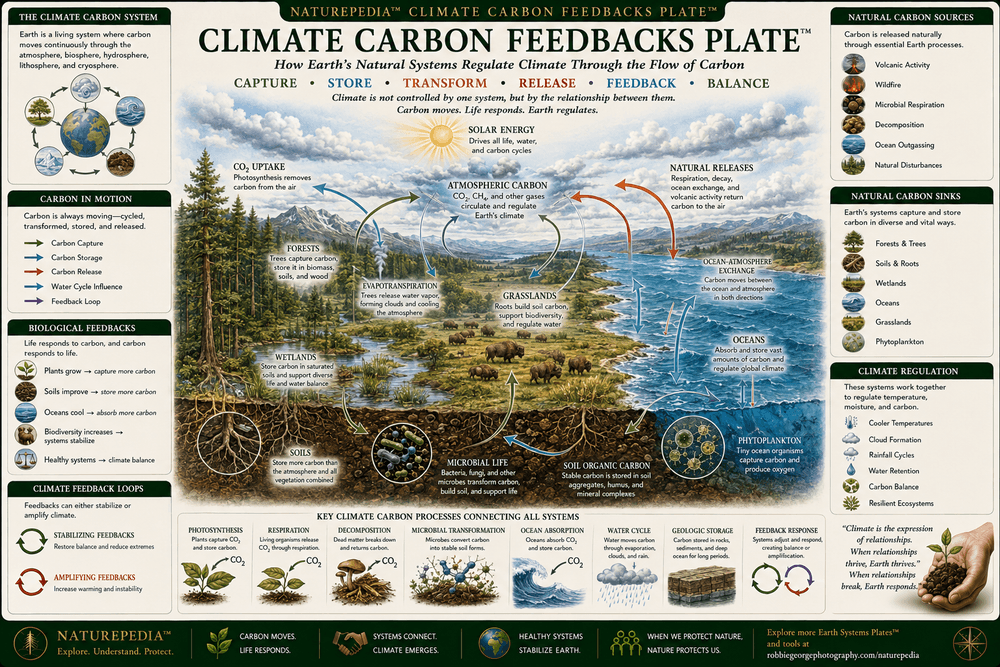
Climate Carbon Feedbacks™ maps how the atmosphere, forests, oceans, wetlands, grasslands, soils, microbes, water, and biodiversity exchange carbon through interconnected feedback loops that influence warming, cooling, resilience, and planetary carbon balance.

Climate Carbon Feedbacks Plate showing atmosphere, forests, oceans, wetlands, grasslands, soils, microbes, carbon sinks, carbon sources, warming, cooling, and feedback loops regulating Earth's climate system.
Climate Carbon Feedbacks Plate™ — a Naturepedia™ systems map of how living carbon relationships connect the atmosphere, water, forests, soils, oceans, microbes, biodiversity, and planetary climate regulation.

Visible Plate ID: climate-carbon-feedbacks#climate-carbon-feedbacks-plate

Type: Naturepedia Climate Carbon Feedbacks Plate™

Earth's Climate Emerges from Living Relationships

Climate is often described in terms of temperature, weather, or atmospheric gases, but these are only visible expressions of a much larger living system. Beneath every cloud, forest, river, wetland, grassland, and ocean lies a continuous exchange of carbon between organisms and their environment. Climate Carbon Feedbacks™ reveals that Earth's climate is not governed by one process, but emerges from countless biological, geological, and atmospheric relationships occurring simultaneously across the planet.

Atmospheric carbon is captured by plants through photosynthesis and transferred into forests, grasslands, wetlands, crops, and marine ecosystems. Living roots deliver carbon into the soil where bacteria, fungi, and countless microorganisms transform it into microbial biomass, necromass, and stable soil carbon. At the same time, respiration, decomposition, wildfire, volcanic activity, and ocean exchange continually return carbon to the atmosphere. Together these natural processes create dynamic feedback loops that regulate Earth's long-term climate.

Some feedbacks reinforce change. Rising temperatures may accelerate microbial activity, thaw permafrost, increase wildfire frequency, or reduce long-term carbon storage. Other feedbacks strengthen resilience. Expanding forests capture more atmospheric carbon, healthy wetlands accumulate organic matter, diverse ecosystems recover more rapidly from disturbance, and regenerative landscapes rebuild soil carbon while improving water retention and biodiversity. Understanding both types of feedback reveals why resilient ecosystems are fundamental to maintaining planetary stability.

Rather than viewing climate as a separate system, Climate Carbon Feedbacks™ places it within the broader context of Earth Systems™. Carbon moves continuously through forests, oceans, soils, microbes, plants, water, wildlife, and the atmosphere, creating a self-organizing network that has regulated Earth's environment for millions of years. This systems perspective demonstrates that climate is ultimately the cumulative expression of relationships occurring throughout the biosphere.

Living Carbon Exchange

Carbon continually cycles between the atmosphere, plants, forests, oceans, soils, microbes, and wildlife, connecting every ecosystem into one living planetary network.

Feedback & Resilience

Positive and negative feedback loops influence carbon storage, ecosystem recovery, biodiversity, water movement, and long-term climate regulation across Earth's landscapes.

Planetary Stability

Climate stability emerges from healthy relationships among forests, soils, oceans, wetlands, biodiversity, microbial life, and the atmosphere rather than from any single ecological process.

Naturepedia Connection

Climate Carbon Feedbacks™ serves as the capstone of Naturepedia's Carbon Architecture, connecting Carbon Cycle™, Soil Carbon Systems™, Carbon & Microbial Life™, Forest Carbon Systems™, Water Systems™, Ecosystem Feedbacks™, and Earth Systems™ into one integrated systems framework demonstrating that Earth's climate emerges from the continuous exchange of carbon throughout the living planet.

Carbon Sink Plate

Carbon Sink Plate™

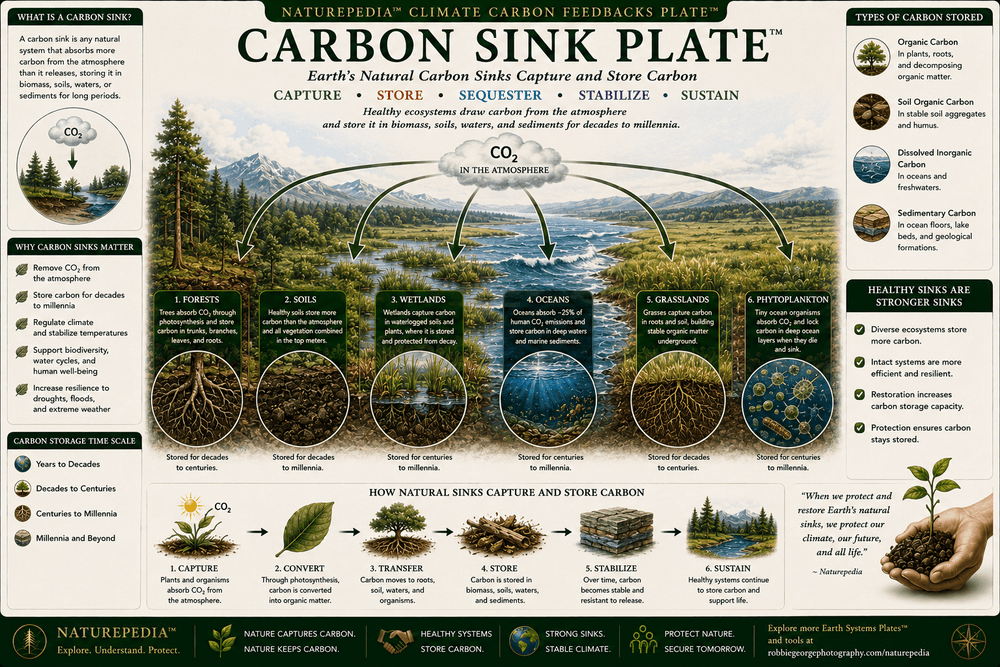
Carbon Sink™ explores how forests, soils, wetlands, oceans, grasslands, and microscopic life continuously capture, transform, and store atmospheric carbon, strengthening ecosystem resilience while helping regulate Earth's long-term climate.

Carbon Sink Plate showing forests, wetlands, grasslands, oceans, healthy soils, microbes, and atmospheric carbon being captured and stored within Earth's living ecosystems.
Carbon Sink Plate™ — illustrating how Earth's living ecosystems continuously remove atmospheric carbon and store it within vegetation, soils, wetlands, and oceans.

Visible Plate ID: climate-carbon-feedbacks#carbon-sink-plate

Type: Naturepedia Carbon Sink Plate™

Nature's Long-Term Carbon Storage System

A carbon sink is any natural system that absorbs more carbon than it releases over time. Forests, grasslands, wetlands, healthy soils, oceans, and marine plankton continually remove carbon dioxide from the atmosphere through photosynthesis and biological activity, storing that carbon within living organisms, organic matter, sediments, and stable soil carbon. Together these ecosystems form Earth's largest natural climate regulation network.

Carbon storage begins when plants capture atmospheric carbon through photosynthesis. A portion becomes leaves, stems, trunks, and roots, while another portion flows belowground where fungi and microbes transform plant carbon into microbial biomass, necromass, and stable soil organic matter. Wetlands accumulate thick layers of organic carbon, grasslands build extensive root systems beneath the soil, and oceans store carbon within marine organisms, dissolved compounds, and deep ocean waters.

Healthy carbon sinks are dynamic rather than static. They continually exchange carbon with the atmosphere while storing increasing amounts through biological growth and ecological succession. Regenerative land management strengthens these natural processes by increasing biodiversity, maintaining living roots, protecting wetlands, restoring forests, and supporting healthy microbial communities that stabilize carbon over the long term.

Carbon Sink™ demonstrates that Earth's greatest climate regulators are living ecosystems. The health of forests, soils, wetlands, oceans, and biodiversity directly influences the planet's ability to capture, store, and recycle carbon while strengthening resilience across the biosphere.

Biological Carbon Capture

Plants remove atmospheric carbon through photosynthesis and transfer it into forests, grasslands, roots, soils, wetlands, and marine ecosystems.

Long-Term Carbon Storage

Microbes, fungi, soils, wetlands, and oceans continually stabilize carbon, allowing living ecosystems to function as long-term biological reservoirs.

Climate Resilience

Healthy carbon sinks strengthen biodiversity, improve water cycling, rebuild soils, reduce erosion, and help stabilize Earth's climate through interconnected ecological relationships.

Naturepedia Connection

Carbon Sink™ connects Carbon Cycle™, Soil Carbon Systems™, Carbon & Microbial Life™, Forest Carbon Systems™, Water Systems™, Ecosystem Feedbacks™, and Earth Systems™. Together these Naturepedia™ systems demonstrate that healthy ecosystems naturally capture, transform, and store atmospheric carbon while strengthening planetary resilience.

Carbon Source Plate

Carbon Source Plate™

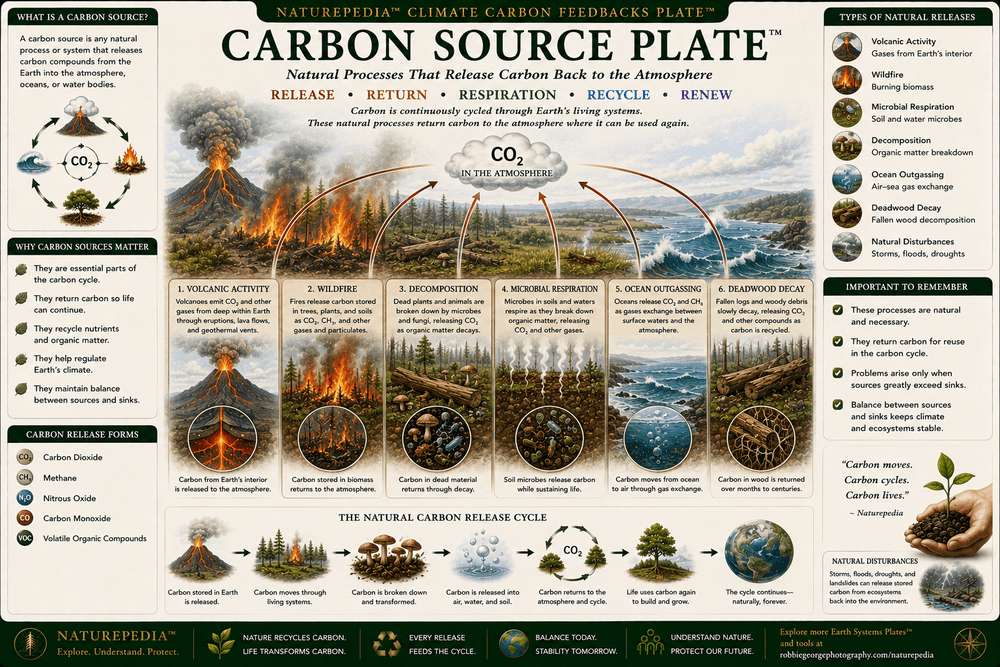
Carbon Source™ explores how wildfire, microbial respiration, decomposition, volcanic activity, oceans, and living organisms naturally return carbon to the atmosphere, completing Earth's continuous carbon cycle.

Carbon Source Plate showing wildfire, volcanic activity, decomposition, microbial respiration, ocean carbon exchange, and natural carbon returning to Earth's atmosphere.
Carbon Source Plate™ — illustrating the natural biological and geological pathways that continually return carbon to the atmosphere as part of Earth's living carbon cycle.

Visible Plate ID: climate-carbon-feedbacks#carbon-source-plate

Type: Naturepedia Carbon Source Plate™

Returning Carbon to the Atmosphere

A carbon source is any natural process that releases more carbon into the atmosphere than it stores over a given period. Carbon sources are not separate from healthy ecosystems; they are essential components of Earth's continuous carbon cycle. Respiration, decomposition, wildfire, volcanic activity, ocean exchange, and the metabolism of living organisms continually recycle carbon, allowing it to move between land, water, and the atmosphere.

Microbial decomposition breaks down leaves, roots, fallen trees, and organic matter, releasing carbon dioxide as microorganisms obtain energy. Plants, animals, fungi, and soil organisms also respire throughout their lives, returning a portion of stored carbon to the atmosphere. Oceans naturally exchange carbon with the air depending on water temperature and biological activity, while volcanic eruptions release carbon that has been stored within Earth's interior over geological timescales.

Wildfire represents another natural carbon source. Although fires release stored carbon rapidly, many fire-adapted ecosystems recover through renewed plant growth, fresh photosynthesis, and long-term carbon accumulation. In healthy landscapes, carbon sources and carbon sinks function together, continually balancing the movement of carbon through Earth's living systems.

Carbon Source™ demonstrates that releasing carbon is not inherently destructive. It is one half of Earth's continuous carbon exchange. Climate stability depends upon maintaining healthy relationships between carbon release and carbon storage across the entire biosphere.

Biological Carbon Release

Respiration, microbial activity, decomposition, and ecosystem metabolism continually return carbon to the atmosphere while sustaining life.

Geological Carbon Exchange

Volcanic activity and natural ocean-atmosphere exchange contribute to Earth's long-term carbon movement across geological and ecological timescales.

Balanced Carbon Cycling

Carbon sources continually interact with forests, wetlands, oceans, soils, and other carbon sinks to maintain Earth's dynamic carbon balance.

Naturepedia Connection

Carbon Source™ connects Carbon Cycle™, Carbon & Microbial Life™, Soil Carbon Systems™, Forest Carbon Systems™, Ecosystem Feedbacks™, and Earth Systems™. Together these Naturepedia™ systems illustrate that carbon sources are essential components of Earth's living carbon cycle, continually balancing the natural processes of carbon capture, transformation, and release.

Positive Climate Feedback Plate

Positive Climate Feedback Plate™

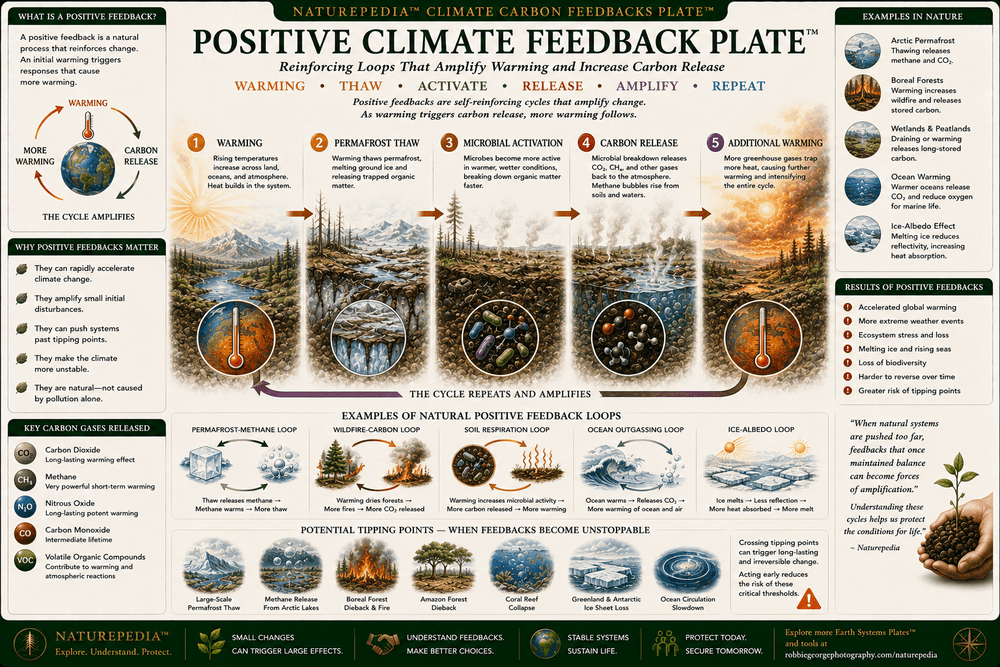
Positive Climate Feedback™ explores reinforcing ecological processes where environmental change accelerates additional carbon release, amplifying shifts throughout Earth's interconnected climate system.

Positive Climate Feedback Plate showing warming, permafrost thaw, microbial activity, carbon release, and reinforcing climate feedback loops.
Positive Climate Feedback Plate™ — illustrating reinforcing ecological feedbacks that can accelerate carbon release and amplify environmental change.

Visible Plate ID: climate-carbon-feedbacks#positive-climate-feedback-plate

Type: Naturepedia Positive Climate Feedback Plate™

When Environmental Change Reinforces Itself

A positive climate feedback occurs when an initial environmental change triggers additional processes that reinforce the original change. In Earth's carbon system, these reinforcing relationships often involve interactions among temperature, microbial activity, vegetation, soils, water, and atmospheric carbon. Rather than creating an entirely new process, positive feedback strengthens an existing one.

One well-known example occurs in frozen northern soils. As temperatures rise, permafrost begins to thaw, allowing dormant microorganisms to decompose previously frozen organic matter. This microbial activity releases additional carbon dioxide and methane into the atmosphere, which can contribute to further warming and continued thawing. Similar reinforcing relationships may occur when prolonged drought increases wildfire frequency or when declining vegetation reduces carbon uptake across large landscapes.

Positive feedbacks are natural components of Earth's dynamic climate system and have operated throughout geological history. They interact continuously with balancing feedbacks that promote recovery, resilience, and long-term stability. Understanding both processes provides a more complete picture of how ecosystems respond to environmental change rather than viewing climate through isolated events alone.

Positive Climate Feedback™ demonstrates that climate is shaped by interconnected relationships. Changes within soils, forests, oceans, water, biodiversity, and microbial communities ripple outward through the carbon cycle, influencing the behavior of the entire Earth system.

Reinforcing Carbon Release

Warming may increase microbial activity, thaw frozen soils, or accelerate decomposition, allowing additional carbon to return to the atmosphere.

Connected Earth Systems

Climate feedbacks emerge from interactions among forests, soils, water, microbes, biodiversity, and atmospheric carbon rather than from isolated processes.

Dynamic Climate Relationships

Positive feedbacks operate alongside balancing feedbacks, illustrating the complexity and adaptability of Earth's living climate system.

Naturepedia Connection

Positive Climate Feedback™ connects Carbon Cycle™, Carbon & Microbial Life™, Soil Carbon Systems™, Forest Carbon Systems™, Ecosystem Feedbacks™, and Earth Systems™. Together these Naturepedia™ systems reveal how reinforcing ecological relationships influence carbon movement and the ongoing evolution of Earth's climate.

Negative Climate Feedback Plate

Negative Climate Feedback Plate™

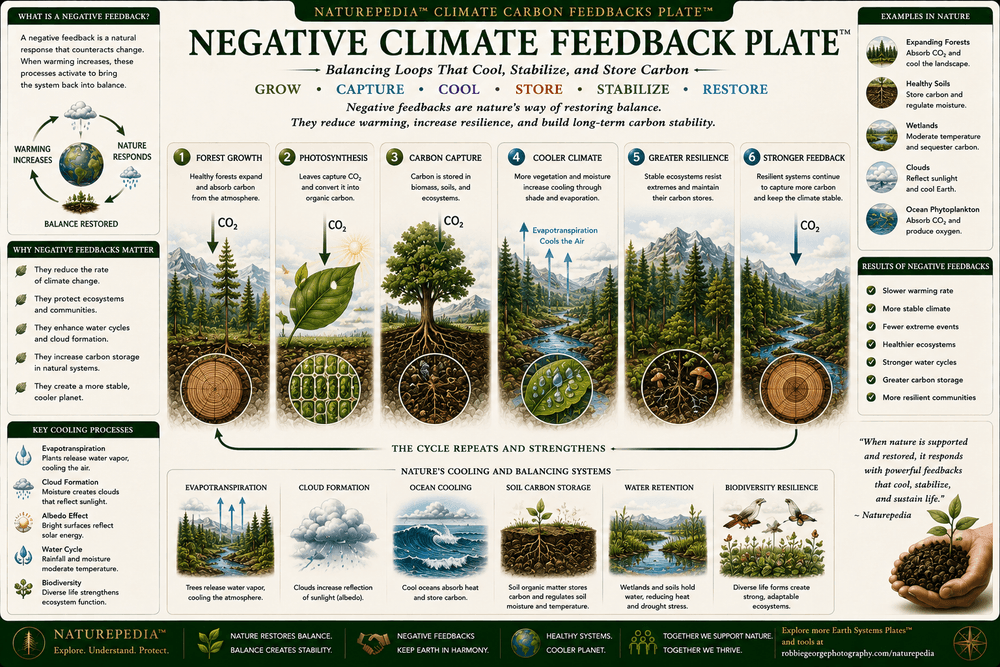
Negative Climate Feedback™ explores the balancing ecological relationships that naturally moderate environmental change through carbon capture, ecosystem recovery, biological resilience, and climate regulation.

Negative Climate Feedback Plate showing healthy forests, photosynthesis, carbon capture, cloud formation, cooling, resilient ecosystems, and balancing climate feedback loops.
Negative Climate Feedback Plate™ — illustrating how healthy ecosystems naturally moderate environmental change through carbon capture, resilience, and biological recovery.

Visible Plate ID: climate-carbon-feedbacks#negative-climate-feedback-plate

Type: Naturepedia Negative Climate Feedback Plate™

Nature's Balancing Mechanisms

A negative climate feedback is a natural process that counteracts environmental change, helping stabilize Earth's climate over time. Rather than amplifying change, these feedbacks reduce its effects by increasing carbon storage, strengthening ecosystem resilience, improving water cycling, or enhancing biological recovery. They represent the self-regulating capacity found throughout healthy living systems.

Growing forests provide one of the clearest examples. As atmospheric carbon dioxide becomes available, healthy vegetation captures additional carbon through photosynthesis, storing it within trunks, branches, roots, and soils. Expanding forests also release water vapor through evapotranspiration, encouraging cloud formation that can moderate local temperatures and support continued ecosystem productivity. Healthy soils reinforce this process by storing carbon belowground through microbial activity and long-term soil organic matter formation.

Wetlands, grasslands, oceans, and biologically diverse landscapes also contribute to balancing feedbacks. These ecosystems recover from disturbance, rebuild carbon reserves, strengthen biodiversity, and improve resilience through countless interactions among plants, microbes, fungi, water, wildlife, and atmospheric processes. Although no single feedback controls Earth's climate, together these relationships continually work toward maintaining long-term ecological stability.

Negative Climate Feedback™ demonstrates that resilience is an emergent property of healthy ecosystems. The stronger the biological relationships among forests, soils, water, biodiversity, and microbial life, the greater Earth's capacity to regulate carbon naturally through living systems.

Carbon Capture

Healthy forests, plants, wetlands, and soils continually remove atmospheric carbon while rebuilding long-term biological carbon storage.

Ecological Recovery

Resilient ecosystems recover after disturbance by restoring vegetation, microbial communities, biodiversity, and stable carbon pools.

Living Climate Regulation

Negative feedbacks demonstrate how Earth's atmosphere, water, forests, soils, oceans, and biodiversity continually work together to strengthen long-term climate stability.

Naturepedia Connection

Negative Climate Feedback™ connects Carbon Cycle™, Forest Carbon Systems™, Soil Carbon Systems™, Carbon & Microbial Life™, Water Systems™, Ecosystem Feedbacks™, and Earth Systems™. Together these Naturepedia™ systems reveal how healthy ecosystems naturally moderate environmental change through interconnected biological relationships rather than isolated mechanisms.

Forest Climate Feedback Plate

Forest Climate Feedback Plate™

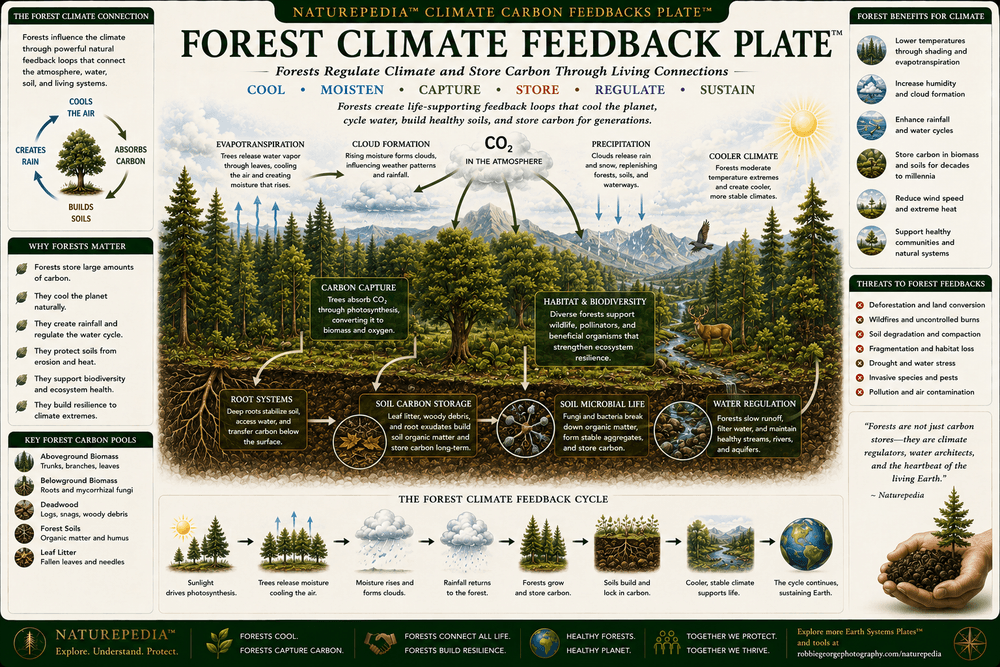
Forest Climate Feedback™ explores how forests regulate Earth's climate through carbon sequestration, evapotranspiration, cloud formation, biodiversity, soil biology, and the continuous exchange of energy, water, and carbon.

Forest Climate Feedback Plate showing forests capturing carbon, evapotranspiration, cloud formation, rainfall, soil biology, biodiversity, and climate regulation.
Forest Climate Feedback Plate™ — illustrating how forests influence carbon storage, atmospheric moisture, biodiversity, and climate through interconnected ecological relationships.

Visible Plate ID: climate-carbon-feedbacks#forest-climate-feedback-plate

Type: Naturepedia Forest Climate Feedback Plate™

Forests as Climate Regulators

Forests are among Earth's most powerful climate-regulating ecosystems. Through photosynthesis they continually remove carbon dioxide from the atmosphere, storing it within trunks, branches, leaves, roots, deadwood, and forest soils. This biological carbon reservoir grows over decades and centuries while supporting countless organisms that contribute to the resilience of the entire ecosystem.

Forests influence climate through far more than carbon storage alone. Trees move enormous quantities of water from soil to atmosphere through evapotranspiration, increasing humidity, encouraging cloud formation, moderating temperatures, and influencing regional rainfall patterns. Healthy forest canopies also protect soils from erosion, reduce surface temperatures through shading, and sustain microbial communities that stabilize additional carbon beneath the forest floor.

These relationships create powerful ecological feedbacks. Healthy forests support biodiversity, biodiversity strengthens resilience, resilient ecosystems recover more rapidly after disturbance, and recovering forests continue rebuilding carbon stores while regulating local and regional climates. Rather than acting independently, every component of the forest contributes to the stability of the larger Earth system.

Forest Climate Feedback™ demonstrates that forests function as living climate infrastructure. Their influence extends from microscopic soil organisms to atmospheric circulation, linking carbon, water, biodiversity, and climate into one continuously self-regulating ecological network.

Carbon Sequestration

Growing forests continually capture atmospheric carbon while transferring large quantities belowground into roots, fungi, and long-term soil carbon.

Water & Atmosphere

Evapotranspiration links forests to cloud formation, rainfall, humidity, and local climate regulation throughout surrounding landscapes.

Resilient Forest Systems

Healthy forests integrate biodiversity, soil biology, water cycling, and carbon storage into one resilient climate-regulating ecosystem.

Naturepedia Connection

Forest Climate Feedback™ connects Forest Carbon Systems™, Carbon Cycle™, Soil Carbon Systems™, Carbon & Microbial Life™, Water Systems™, Ecosystem Feedbacks™, and Earth Systems™. Together these Naturepedia™ systems reveal that forests are not only carbon reservoirs—they are dynamic climate regulators that connect the atmosphere, water, soils, biodiversity, and living carbon into one resilient planetary system.

Soil Climate Feedback Plate

Soil Climate Feedback Plate™

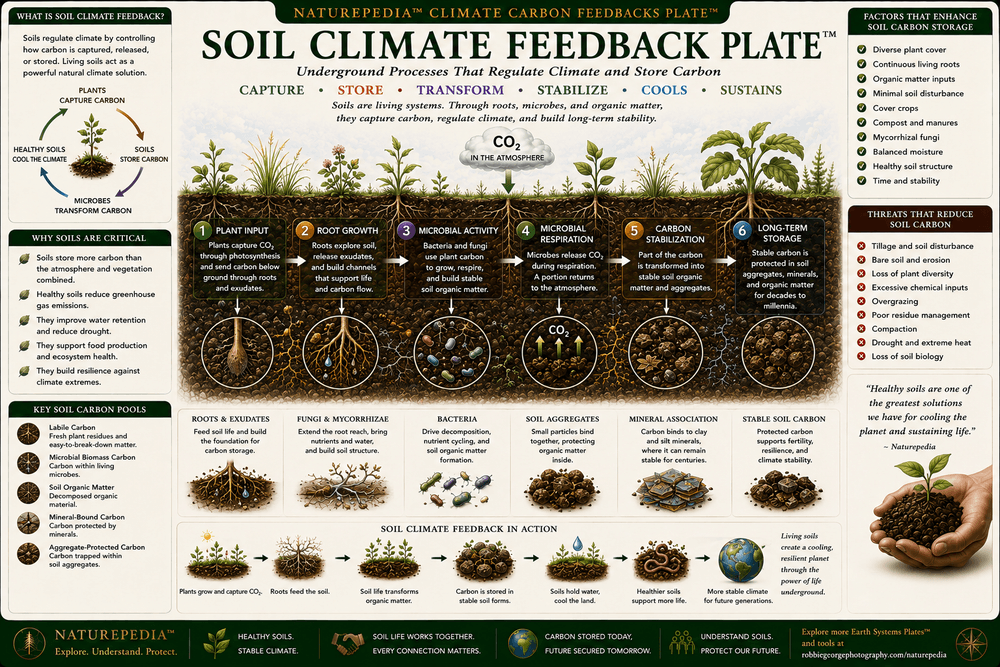
Soil Climate Feedback™ explores how living soils, microbial communities, roots, fungi, and stable carbon interact to regulate atmospheric carbon while strengthening ecosystem resilience and long-term climate stability.

Soil Climate Feedback Plate showing roots, fungi, microbes, soil carbon, microbial respiration, stable organic matter, and atmospheric carbon exchange.
Soil Climate Feedback Plate™ — illustrating how living soils regulate carbon through roots, fungi, microbes, organic matter, and long-term biological carbon storage.

Visible Plate ID: climate-carbon-feedbacks#soil-climate-feedback-plate

Type: Naturepedia Soil Climate Feedback Plate™

Living Soils Shape Earth's Climate

Beneath every forest, prairie, wetland, and agricultural landscape lies one of Earth's largest carbon reservoirs. Living soils store more carbon than the atmosphere and vegetation combined, making them one of the planet's most important regulators of long-term climate. Their ability to capture, stabilize, and recycle carbon depends upon the continual interaction of roots, fungi, microorganisms, organic matter, minerals, water, and biological diversity.

Plants continually deliver newly captured carbon belowground through their roots. Microbial communities transform this carbon into biomass, necromass, mineral-associated organic matter, and stable soil aggregates that can persist for decades or centuries. At the same time, microbial respiration naturally returns part of this carbon to the atmosphere, creating a dynamic balance between storage and release that defines healthy soil function.

Climate conditions influence every stage of this process. Temperature, rainfall, drought, flooding, and vegetation all affect microbial activity, decomposition, and long-term carbon stabilization. Healthy soils recover more rapidly from disturbance because diverse microbial communities, abundant organic matter, and living roots continually rebuild soil structure while restoring carbon storage capacity. These interactions form one of Earth's most important climate feedback systems.

Soil Climate Feedback™ demonstrates that climate regulation begins beneath our feet. The health of living soils influences forests, agriculture, biodiversity, water cycles, and atmospheric carbon, connecting microscopic biological activity with planetary resilience.

Belowground Carbon Storage

Roots, fungi, microbes, and stable soil organic matter continually transform atmospheric carbon into long-lived biological carbon reservoirs.

Microbial Regulation

Microbial activity determines how quickly carbon is decomposed, recycled, stabilized, or returned to the atmosphere through natural respiration.

Healthy Soil, Stable Climate

Living soils strengthen biodiversity, improve water retention, increase resilience, and support Earth's long-term carbon balance through interconnected ecological processes.

Naturepedia Connection

Soil Climate Feedback™ connects Soil Carbon Systems™, Carbon & Microbial Life™, Carbon Cycle™, Forest Carbon Systems™, Water Systems™, Ecosystem Feedbacks™, and Earth Systems™. Together these Naturepedia™ systems reveal that living soils form one of the planet's most important climate-regulating networks by linking microbial ecology, biodiversity, water, and long-term carbon storage.

Water Climate Feedback Plate

Water Climate Feedback Plate™

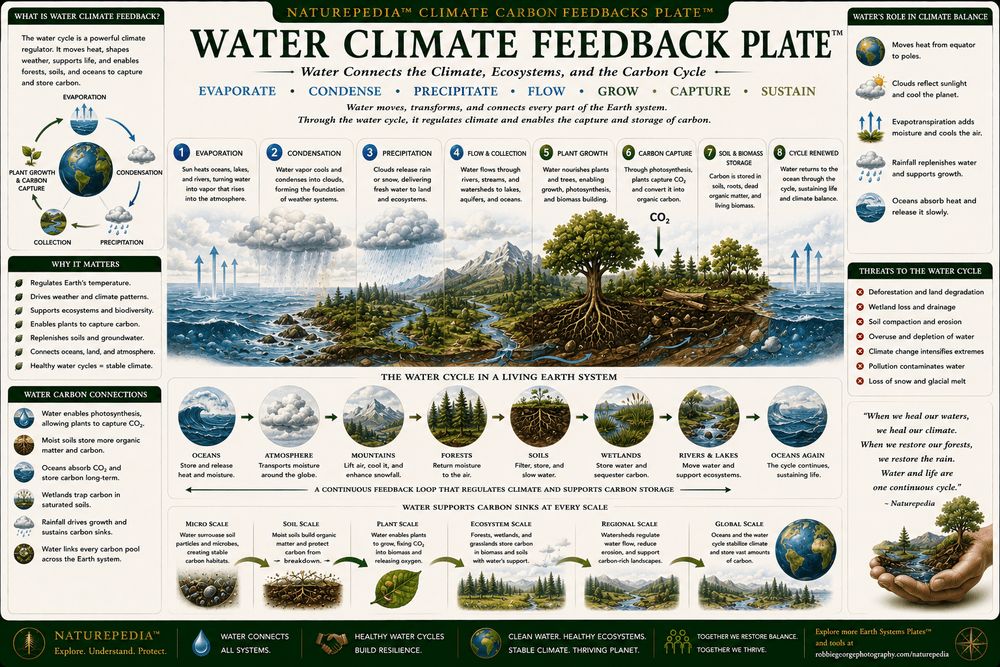
Water Climate Feedback™ explores how evaporation, cloud formation, rainfall, rivers, wetlands, forests, and plant growth continually regulate carbon movement while connecting Earth's water cycle with long-term climate resilience.

Water Climate Feedback Plate showing oceans, evaporation, clouds, rainfall, rivers, wetlands, forests, plant growth, and carbon cycling throughout Earth's climate system.
Water Climate Feedback Plate™ — illustrating how Earth's water cycle supports carbon capture, ecosystem productivity, and long-term climate regulation.

Visible Plate ID: climate-carbon-feedbacks#water-climate-feedback-plate

Type: Naturepedia Water Climate Feedback Plate™

Water Connects Every Carbon System

Water is one of Earth's great climate regulators. Oceans, lakes, rivers, wetlands, clouds, groundwater, and atmospheric moisture continually transport energy, nutrients, and carbon throughout the biosphere. Every major carbon pathway depends upon water, making the hydrologic cycle inseparable from the global carbon cycle.

Solar energy drives evaporation from oceans, lakes, wetlands, forests, and soils, forming clouds that eventually return water as rain or snow. This precipitation sustains forests, grasslands, wetlands, crops, and microbial communities that capture atmospheric carbon through photosynthesis and store it within living biomass and soils. Healthy watersheds therefore strengthen both biological productivity and long-term carbon sequestration.

Water also regulates ecosystem resilience. Wetlands accumulate large stores of organic carbon, rivers distribute nutrients across landscapes, groundwater supports vegetation during dry periods, and healthy soils retain moisture that protects microbial life during drought. Forest evapotranspiration influences regional rainfall while vegetation slows runoff, reduces erosion, and improves infiltration, reinforcing the interconnected relationship between water, carbon, and climate.

Water Climate Feedback™ demonstrates that Earth's climate cannot be understood through carbon alone. Water continuously links atmosphere, forests, soils, biodiversity, and biological productivity into one self-regulating planetary system.

Evaporation & Rainfall

Water continually cycles between oceans, atmosphere, clouds, and land, supporting vegetation, photosynthesis, and biological carbon capture.

Healthy Watersheds

Wetlands, rivers, forests, and living soils improve water retention, reduce erosion, sustain biodiversity, and strengthen long-term ecosystem resilience.

Water Regulates Climate

The hydrologic cycle links carbon movement, plant productivity, microbial activity, and atmospheric processes into one integrated climate regulation network.

Naturepedia Connection

Water Climate Feedback™ connects Water Systems™, Carbon Cycle™, Forest Carbon Systems™, Soil Carbon Systems™, Carbon & Microbial Life™, Ecosystem Feedbacks™, and Earth Systems™. Together these Naturepedia™ systems demonstrate that water is the connective medium through which carbon, life, and climate continually interact across Earth's living landscapes.

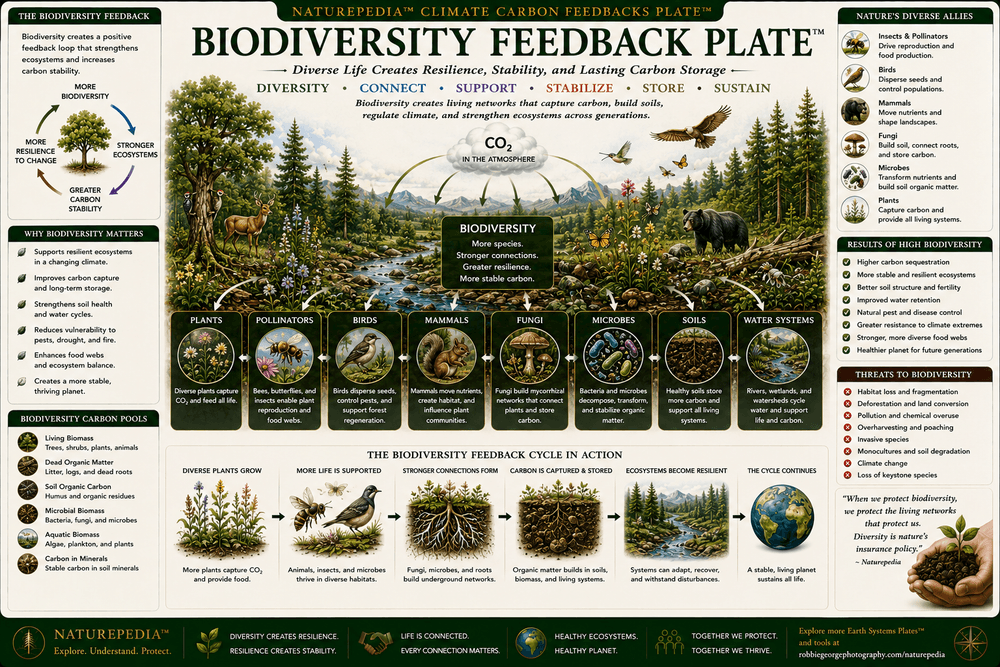
Biodiversity Feedback Plate

Biodiversity Feedback Plate™

Biodiversity Feedback™ explores how diverse ecosystems strengthen carbon storage, improve ecological resilience, stabilize climate feedbacks, and support the continuous regeneration of Earth's living systems.

Biodiversity Feedback Plate showing forests, birds, mammals, insects, fungi, healthy soils, pollinators, and interconnected ecological relationships supporting climate resilience.
Biodiversity Feedback Plate™ — illustrating how biological diversity strengthens ecosystem resilience, carbon stability, and Earth's long-term climate regulation.

Visible Plate ID: climate-carbon-feedbacks#biodiversity-feedback-plate

Type: Naturepedia Biodiversity Feedback Plate™

Diversity Creates Resilience

Biodiversity is more than the number of species living within an ecosystem. It represents the complex web of relationships among plants, animals, fungi, microbes, insects, and countless other organisms that continually exchange energy, nutrients, water, and carbon. These relationships strengthen ecosystem stability, allowing landscapes to adapt to changing environmental conditions while maintaining their essential ecological functions.

Healthy biodiversity supports carbon storage in many ways. Diverse forests produce layered canopies that capture more sunlight and store greater amounts of carbon. Pollinators increase plant reproduction, herbivores influence vegetation dynamics, fungi transport nutrients and water, while microbial communities stabilize soil carbon beneath the surface. Each organism contributes to the resilience of the larger ecological network, allowing carbon to move efficiently through interconnected living systems.

When biodiversity declines, ecosystems often become less resilient to drought, wildfire, disease, invasive species, and other disturbances. Conversely, ecosystems rich in biological diversity recover more rapidly because multiple species can perform overlapping ecological functions. This redundancy strengthens carbon storage, improves nutrient cycling, supports healthy water systems, and stabilizes long-term climate feedbacks across landscapes.

Biodiversity Feedback™ demonstrates that climate resilience is ultimately a product of ecological relationships. The greater the diversity of life, the stronger Earth's natural capacity to capture carbon, recover from disturbance, and maintain long-term planetary stability.

Ecological Diversity

Plants, fungi, microbes, insects, birds, mammals, and aquatic organisms each contribute unique ecological functions that strengthen living carbon systems.

Resilient Ecosystems

Greater biodiversity improves ecosystem recovery after disturbance while supporting long-term carbon storage, nutrient cycling, and healthy water movement.

Climate Stability

Biological diversity strengthens the interconnected feedbacks that regulate forests, soils, wetlands, carbon sinks, and Earth's long-term climate resilience.

Naturepedia Connection

Biodiversity Feedback™ connects Ecosystem Feedbacks™, Forest Carbon Systems™, Soil Carbon Systems™, Carbon & Microbial Life™, Water Systems™, Carbon Cycle™, and Earth Systems™. Together these Naturepedia™ systems demonstrate that biodiversity is one of Earth's most powerful climate regulators because healthy ecosystems emerge from the strength of living relationships rather than from individual species alone.

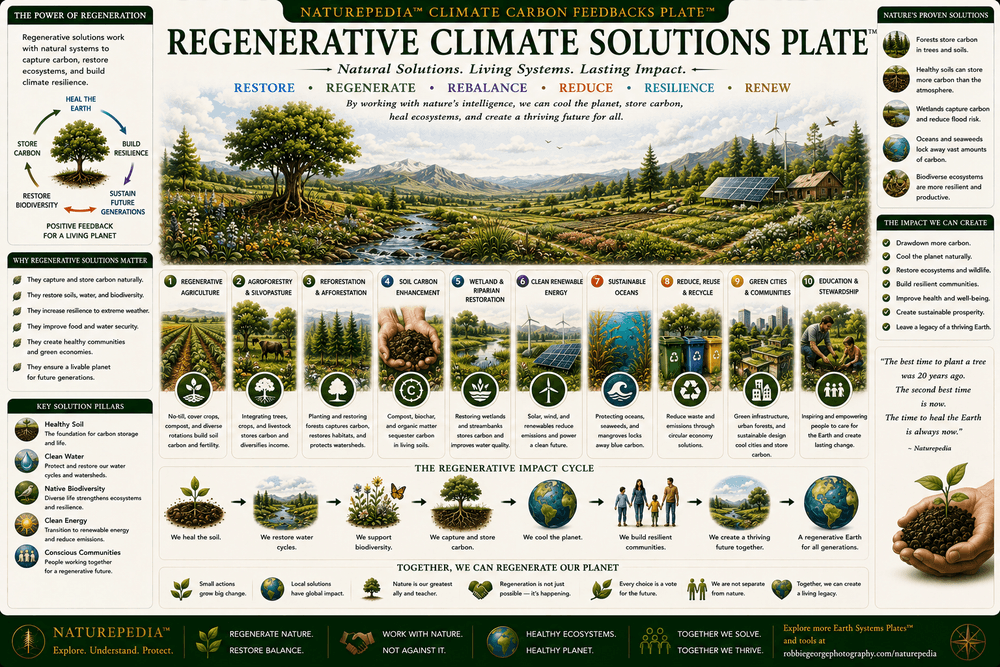
Regenerative Climate Solutions Plate

Regenerative Climate Solutions Plate™

Regenerative Climate Solutions™ explores how healthy forests, living soils, wetlands, grasslands, biodiversity, and regenerative agriculture strengthen Earth's natural carbon cycle while improving ecosystem resilience and long-term climate stability.

Regenerative Climate Solutions Plate showing regenerative agriculture, forests, wetlands, healthy soils, biodiversity, grazing, cover crops, and carbon sequestration across resilient ecosystems.
Regenerative Climate Solutions Plate™ — illustrating how working with nature strengthens carbon storage, biodiversity, ecosystem resilience, and long-term climate regulation.

Visible Plate ID: climate-carbon-feedbacks#regenerative-climate-solutions-plate

Type: Naturepedia Regenerative Climate Solutions Plate™

Working With Nature's Carbon Systems

Earth already possesses extraordinary systems for regulating carbon. Forests capture atmospheric carbon through photosynthesis. Wetlands accumulate organic matter over centuries. Healthy soils stabilize carbon through microbial activity, while diverse grasslands continually renew carbon belowground through expansive root systems. Regenerative climate solutions strengthen these existing ecological processes rather than attempting to replace them.

Regenerative agriculture applies these same ecological principles to working landscapes. Practices such as minimizing soil disturbance, maintaining continuous living roots, planting cover crops, increasing biodiversity, integrating managed grazing, restoring wetlands, protecting forests, and encouraging healthy microbial communities all increase the flow of carbon from the atmosphere into resilient biological systems. These practices simultaneously improve soil fertility, water infiltration, wildlife habitat, and long-term ecosystem stability.

The strength of regenerative systems lies in their interconnectedness. Healthier soils retain more water. Better water retention supports healthier vegetation. Diverse vegetation strengthens microbial communities. Healthy microbes stabilize more carbon while improving nutrient cycling, allowing ecosystems to recover more rapidly from drought, flooding, wildfire, and other natural disturbances. Every ecological relationship reinforces the others.

Regenerative Climate Solutions™ demonstrates that resilient landscapes emerge from restoring ecological relationships. By strengthening forests, soils, wetlands, biodiversity, and water systems simultaneously, nature continually rebuilds its own capacity to regulate carbon and sustain life.

Regenerative Landscapes

Healthy forests, wetlands, grasslands, and farms naturally increase carbon storage while strengthening biodiversity and ecosystem resilience.

Living Soil Systems

Microbial communities, fungi, roots, and organic matter continually rebuild soil health while stabilizing atmospheric carbon belowground.

Nature-Based Climate Resilience

Working with ecological processes strengthens carbon cycling, water systems, biodiversity, and the long-term resilience of Earth's living climate system.

Naturepedia Connection

Regenerative Climate Solutions™ connects Quantum Agriculture™, Soil Carbon Systems™, Carbon & Microbial Life™, Forest Carbon Systems™, Water Systems™, Ecosystem Feedbacks™, and Earth Systems™. Together these Naturepedia™ systems illustrate that strengthening Earth's existing ecological relationships is one of the most effective ways to support long-term carbon balance, biodiversity, and climate resilience.

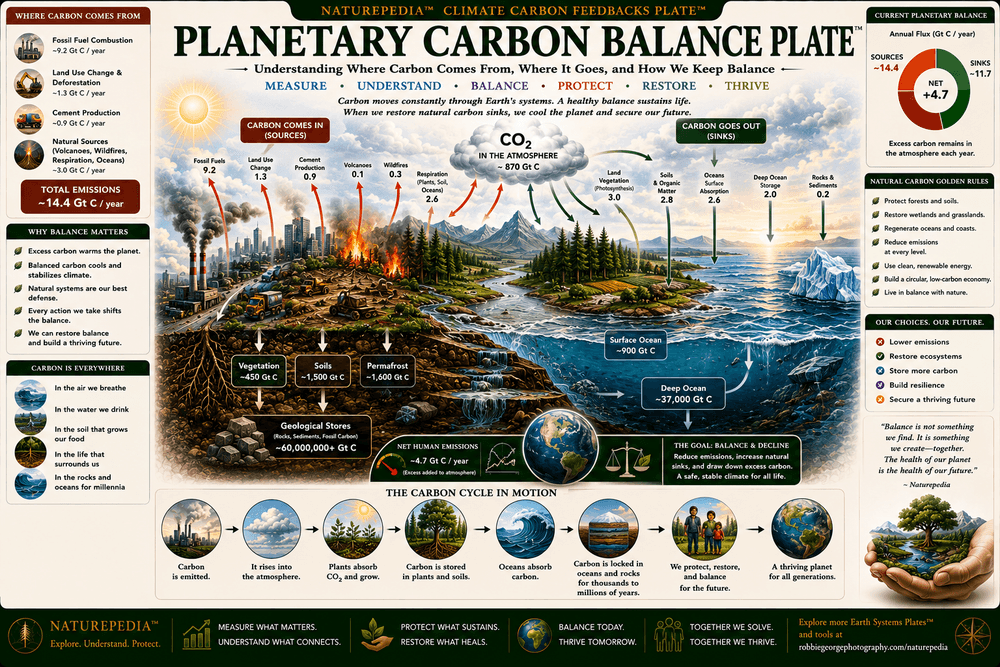
Planetary Carbon Balance Plate

Planetary Carbon Balance Plate™

Planetary Carbon Balance™ explores how Earth's atmosphere, forests, oceans, wetlands, grasslands, soils, microbes, biodiversity, and water systems function together as one interconnected network regulating the global carbon cycle.

Planetary Carbon Balance Plate showing Earth as an interconnected system linking atmosphere, forests, oceans, wetlands, soils, microbes, biodiversity, water, and the global carbon cycle.
Planetary Carbon Balance Plate™ — illustrating the living relationships that connect every major Earth system through the continuous movement of carbon.

Visible Plate ID: climate-carbon-feedbacks#planetary-carbon-balance-plate

Type: Naturepedia Planetary Carbon Balance Plate™

One Living Planet, One Connected Carbon System

Planetary carbon balance is not controlled by a single ecosystem, species, or process. Instead, it emerges from billions of biological interactions continuously occurring between the atmosphere, oceans, forests, wetlands, grasslands, soils, microorganisms, wildlife, and water. Carbon is constantly moving through these interconnected systems, linking every living landscape into one planetary network.

Forests capture atmospheric carbon while soils stabilize it through microbial activity. Wetlands accumulate organic matter over centuries, oceans exchange enormous quantities of dissolved carbon, and biodiversity strengthens the resilience of every ecosystem involved. Water transports nutrients, supports photosynthesis, and connects landscapes through rainfall, rivers, groundwater, and evapotranspiration. Together these relationships continually balance carbon storage and carbon release across Earth's biosphere.

Because every Earth system is connected, changes in one relationship often ripple throughout many others. Healthy forests improve rainfall patterns. Living soils support healthier vegetation. Diverse ecosystems recover more rapidly from disturbance. Healthy microbial communities strengthen long-term carbon storage. These reinforcing relationships allow Earth's climate to emerge from the collective behavior of living systems rather than from isolated environmental processes.

Planetary Carbon Balance™ serves as the culmination of Naturepedia's Carbon Architecture. It illustrates that climate resilience ultimately depends upon maintaining the integrity of Earth's interconnected biological relationships—from microscopic soil organisms to forests, oceans, and the atmosphere itself.

Interconnected Earth Systems

Atmosphere, water, forests, soils, oceans, biodiversity, and microbial life continually exchange carbon through one integrated planetary network.

Continuous Carbon Movement

Carbon is constantly captured, transformed, stored, recycled, and released through biological and geological relationships that sustain Earth's climate.

Planetary Resilience

Earth's resilience emerges from the strength of living relationships that connect every ecosystem into one self-organizing biosphere.

Naturepedia Connection

Planetary Carbon Balance™ serves as the master bridge connecting Earth Systems™, Carbon Cycle™, Soil Carbon Systems™, Carbon & Microbial Life™, Forest Carbon Systems™, Water Systems™, Ecosystem Feedbacks™, Plant Intelligence™, Mycorrhizal Networks™, and Quantum Agriculture™. Together these Naturepedia™ systems reveal that Earth's climate is not governed by one process, but emerges from the continuous exchange of carbon throughout the living planet.

About The Author

Robbie George

Yellowstone landscape photographed by Robbie George illustrating forests, wetlands, rivers, atmosphere, and Earth's interconnected climate systems.

Decades of photographing forests, wetlands, coastlines, mountains, rivers, and seasonal landscapes have revealed how Earth's climate emerges from living ecological relationships.

Years spent photographing wilderness across North America have revealed a simple but profound pattern: no ecosystem exists in isolation. Forests influence rainfall, wetlands store carbon, rivers connect watersheds, healthy soils sustain vegetation, and microscopic organisms quietly regulate the carbon beneath every landscape. Observing these relationships season after season provides a unique perspective on how Earth's climate is shaped by the collective behavior of living systems.

From Yellowstone's geothermal valleys and mountain forests to Atlantic coastlines, wetlands, grasslands, regenerative farms, and northern hardwood forests, the same ecological principles appear repeatedly. Carbon, water, biodiversity, soil biology, and atmospheric processes continually interact through feedback loops that support resilience across vastly different environments. These recurring patterns form the foundation of Climate Carbon Feedbacks™.

As a National Geographic nature photographer, Robbie George combines long-term field observation with contemporary ecological research to illustrate how Earth's climate emerges from relationships rather than isolated environmental processes. Naturepedia™ translates those observations into accessible systems maps that connect forests, soils, microbes, water, biodiversity, and planetary carbon balance into one integrated educational framework.

Climate Carbon Feedbacks™ represents the culmination of the Naturepedia Carbon Architecture. It brings together every major carbon pathway—from microscopic microbial activity beneath the soil to atmospheric circulation above the forests—demonstrating that climate is ultimately a living expression of Earth's interconnected ecosystems.

The more we understand the relationships that connect atmosphere, water, forests, soils, biodiversity, and carbon, the more clearly we recognize that protecting Earth's living systems is inseparable from understanding Earth's climate itself.

Climate Carbon Feedbacks™ FAQ

Frequently Asked Questions

What are Climate Carbon Feedbacks™?

Climate Carbon Feedbacks™ are the living relationships that connect atmospheric carbon, forests, soils, oceans, wetlands, water, biodiversity, and microorganisms. These feedbacks influence whether carbon is captured, stored, released, or recycled through Earth's climate system.

What is a carbon sink?

A carbon sink is any ecosystem or natural process that absorbs more carbon than it releases over time. Forests, healthy soils, wetlands, grasslands, oceans, and marine life can all function as carbon sinks when they store carbon within biomass, organic matter, sediments, or stable soil carbon.

What is a carbon source?

A carbon source is any process that releases more carbon than it stores during a given period. Natural carbon sources include respiration, decomposition, wildfire, volcanic activity, ocean exchange, and microbial metabolism.

What is a positive climate feedback?

A positive climate feedback reinforces an initial change. For example, warming may thaw frozen soils, increase microbial activity, release stored carbon, and contribute to additional warming. Positive feedbacks amplify change within Earth's interconnected carbon and climate systems.

What is a negative climate feedback?

A negative climate feedback helps balance or reduce an initial change. Forest growth, increased photosynthesis, soil carbon storage, wetland accumulation, and ecosystem recovery can all help moderate carbon levels and strengthen climate resilience.

How do forests regulate climate?

Forests regulate climate by capturing atmospheric carbon, storing it in wood and soils, releasing water vapor through evapotranspiration, supporting cloud formation, protecting soil structure, and sustaining biodiversity. These relationships connect forests directly with carbon cycling and regional climate patterns.

How do soils influence climate carbon feedbacks?

Soils influence climate feedbacks by storing large amounts of organic carbon, supporting microbial communities, regulating decomposition, and balancing carbon release with long-term carbon stabilization. Healthy soils help connect plants, microbes, water, and atmospheric carbon into one living system.

Why are microbes important to climate feedbacks?

Microbes regulate many of the transformations that determine whether carbon remains stored in soil or returns to the atmosphere. They decompose organic matter, respire carbon dioxide, build microbial biomass, form necromass, recycle nutrients, and help stabilize carbon within healthy soils.

How does water affect climate carbon feedbacks?

Water affects climate carbon feedbacks by supporting plant growth, photosynthesis, soil biology, wetlands, forests, and ocean carbon exchange. Evaporation, rainfall, rivers, clouds, and groundwater all influence how carbon moves through Earth's living systems.

Why does biodiversity strengthen climate resilience?

Biodiversity strengthens climate resilience because diverse ecosystems recover more effectively from disturbance, support multiple carbon pathways, improve nutrient cycling, stabilize soils, sustain pollination, and maintain healthy relationships among plants, fungi, microbes, animals, water, and the atmosphere.

What is planetary carbon balance?

Planetary carbon balance is the ongoing relationship between carbon capture, carbon storage, carbon release, and carbon recycling across Earth's atmosphere, oceans, forests, wetlands, soils, microbes, water systems, and biodiversity.

How do regenerative landscapes support climate resilience?

Regenerative landscapes support climate resilience by rebuilding living soils, increasing biodiversity, restoring wetlands, protecting forests, improving water retention, encouraging microbial life, and strengthening the natural carbon systems that help ecosystems recover and remain stable over time.


Trusted Art Seller

Trusted Art Seller

The presence of this badge signifies that this business has officially registered with the Art Storefronts Organization and has an established track record of selling art.

It also means that buyers can trust that they are buying from a legitimate business. Art sellers that conduct fraudulent activity or that receive numerous complaints from buyers will have this badge revoked. If you would like to file a complaint about this seller, please do so here.

Verified Returns & Exchanges

Verified Returns & Exchanges

The Art Storefronts Organization has verified that this business has provided a returns & exchanges policy for all art purchases.

Description of Policy from Merchant:

What is your Policy on Returns/Exchanges/Refunds? I take great pride in my work and prints, and I want you to be completely happy with your investment in my nature art. If for any reason you are unsatisfied with your print, you may return it within 14 days of delivery, and/or exchange it for another print. Prints must be returned in new condition, packaged carefully in the original packaging if possible. Your refund will be issued as soon as I receive the returned print. Please contact me if you would like to arrange a return or exchange. In the event that you receive a damaged or defective print, please let me know within 7 days of receipt, and I will arrange for a new print to be shipped to you at no additional cost.

Verified Secure Website with Safe Checkout

Verified Secure Website with Safe Checkout

This website provides a secure checkout with SSL encryption.

Verified Archival Materials Used

Verified Archival Materials Used

The Art Storefronts Organization has verified that this Art Seller has published information about the archival materials used to create their products in an effort to provide transparency to buyers.

Description from Merchant:

Fine Art Prints are made with high-quality archival inks on fine art papers using a high-resolution large format inkjet printer. Our premium archival inks produce images with smooth tones and rich colors. Prints are made with care on your choice of exquisite Fine Art Papers using a high-resolution large format inkjet printer. https://www.graphikprintworks.com

Cart

Your cart is currently empty.

Saved Successfully.

This is only visible to you because you are logged in and are authorized to manage this website. This message is not visible to other website visitors.

Import From Instagram

Click on any Image to continue

This Website Supports Augmented Reality to Live Preview Art

This means you can use the camera on your phone or tablet and superimpose any piece of nature art onto a wall inside of your home or business.

To use this feature, Just look for the "Live Preview AR" button when viewing any piece of nature art on this website!

🦊 Pounce now for 20% off

No thanks