ATTENTION: To use this site, it is necessary to enable JavaScript in your browser.
Here are the Instructions on how to enable JavaScript in your web browser.

🌿 The Ancient Guardians of Wetlands, Forests & Wildlife Habitat

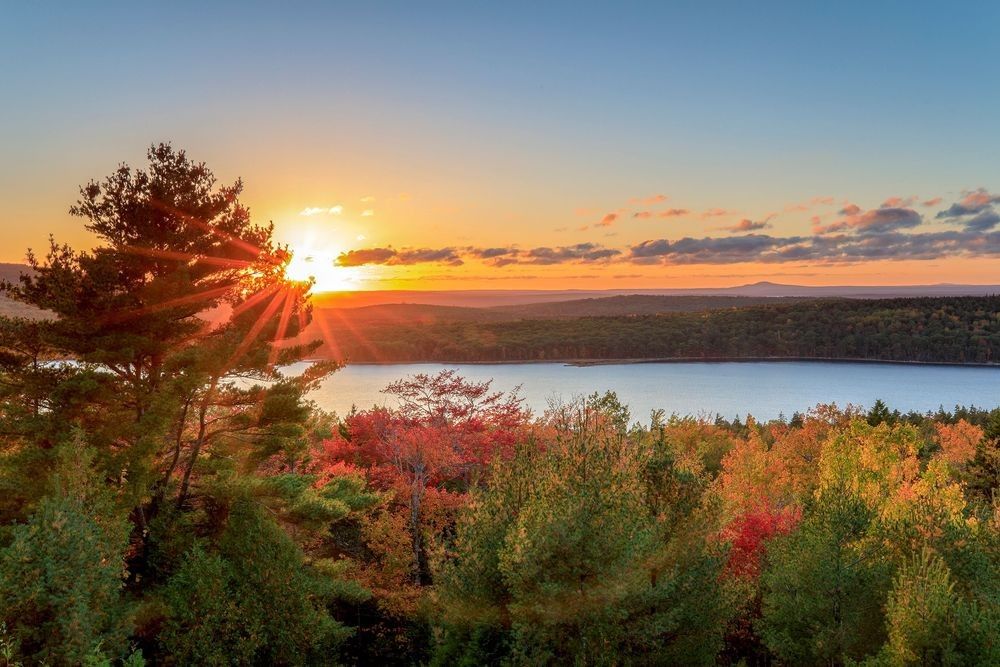
Jordan Pond sunrise surrounded by evergreen forests and mountain ridges in Acadia National Park by Robbie George

Naturepedia™ Tree Family System

Cedars of North America™

The Ancient Guardians of Wetlands, Forests & Wildlife Habitat

Cedars are among North America's most enduring and ecologically important evergreen trees. From the cedar swamps of the Great Lakes and Northeast to the towering Western Red Cedars of the Pacific Northwest and the Eastern Red Cedars that shelter wildlife across grasslands and coastlines, cedars occupy a remarkable range of habitats throughout the continent.

Their scale-like foliage, aromatic wood, wildlife value, and exceptional longevity have made cedars important to ecosystems, Indigenous cultures, conservation efforts, and forest communities for thousands of years. Cedar forests stabilize wetlands, protect watersheds, provide critical winter shelter for wildlife, store carbon, and help maintain biodiversity across diverse ecological regions.

The photograph above overlooks Jordan Pond in Acadia National Park as sunrise illuminates evergreen forests surrounding one of Maine's most iconic landscapes. The scene captures many of the ecological themes explored throughout this guide: forest resilience, watershed protection, wildlife habitat, biodiversity, and the enduring presence of evergreen trees within northern ecosystems.

“Cedars measure time differently than most forests. They stand through centuries of storms, quietly protecting water, wildlife, and the living systems that surround them.”

— Robbie George

Featured Fine Art Print

This sunrise photograph overlooking Jordan Pond in Acadia National Park highlights evergreen forests, watershed systems, seasonal color, and the ecological relationships that connect forests, water, wildlife habitat, and landscape resilience throughout the Northeast.

View Fine Art Print →

Explore Cedars of North America

Naturepedia Tree Family Plate

Cedars of North America™

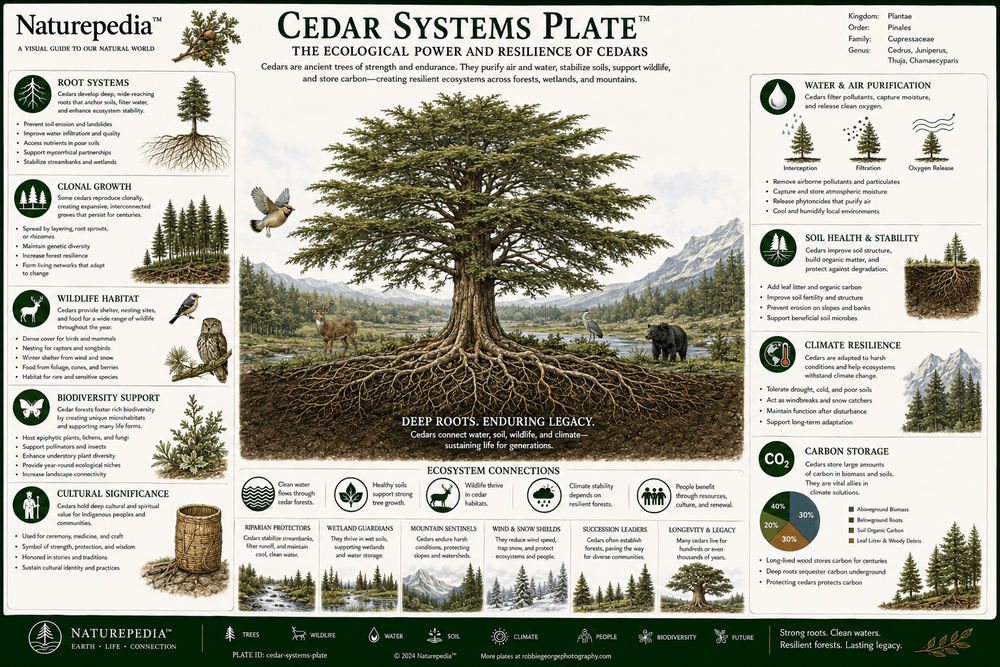
A visual Naturepedia bridge into the cedar family, connecting scale-like evergreen foliage, aromatic bark, cedar cones, Eastern Red Cedar, Northern White Cedar, Western Red Cedar, Incense Cedar, cedar swamps, wildlife shelter, forest communities, carbon storage, and climate resilience.

Cedars of North America Plate showing cedar identification, scale-like foliage, bark, cones, cedar swamps, wildlife habitat, forest communities, carbon storage, and climate resilience by Robbie George
Cedars of North America™ by Robbie George — a Naturepedia tree-family node connecting cedar identification, evergreen foliage, bark, cones, cedar swamps, wildlife shelter, forest communities, carbon storage, and climate resilience.
Plate ID: cedars-of-north-america#cedar-systems-plate · System: Naturepedia Tree Family Plates™ · Node Type: Recursive Compression Interface

Naturepedia Cedar Identification Layer

Cedar Identification & Key Species

These plates introduce the primary identification layer for Cedars of North America™, including foliage structure, cones, bark characteristics, habitat preferences, and four iconic species: Eastern Red Cedar, Northern White Cedar, Western Red Cedar, and Incense Cedar.

Naturepedia Cedar Identification Plate

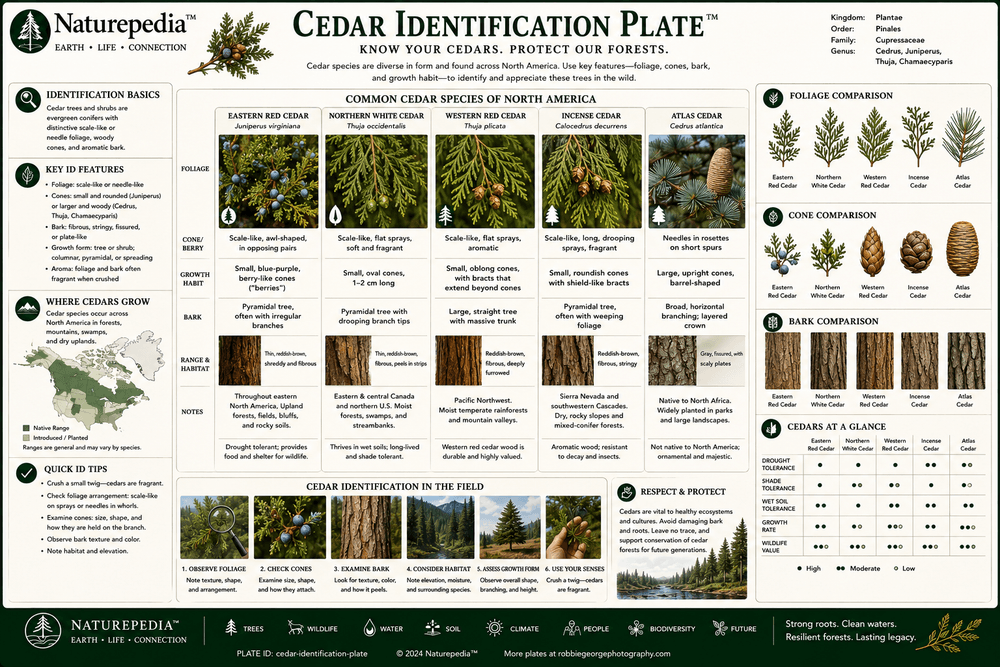
Cedar Identification Plate™

A visual comparison of major North American cedars through foliage, cones, bark texture, growth form, habitat, range, wildlife value, and field-identification characteristics.

Cedar Identification Plate showing Eastern Red Cedar, Northern White Cedar, Western Red Cedar, Incense Cedar, foliage, bark, cones, habitat and identification characteristics by Robbie George
Cedar Identification Plate™ by Robbie George — a Naturepedia field-identification node comparing foliage, bark, cones, habitat, and species-level cedar traits.
Plate ID: cedars-of-north-america#cedar-identification-plate · System: Naturepedia Tree Identification Plates™ · Node Type: Recursive Compression Interface

Naturepedia Cedar Morphology Plate

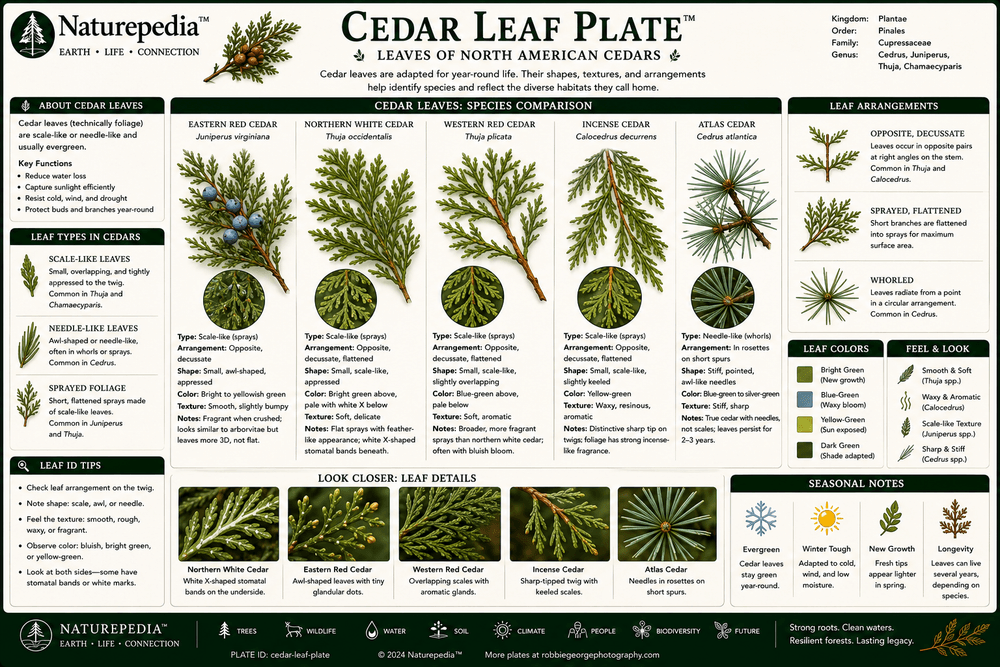
Cedar Leaf Plate™

A visual field-identification plate comparing cedar foliage, scale-like leaves, sprays, aromatic compounds, seasonal color variation, growth habits, and evergreen adaptation strategies.

Cedar Leaf Plate showing cedar foliage, scale-like leaves, evergreen sprays, identification traits and cedar morphology by Robbie George
Cedar Leaf Plate™ by Robbie George — a Naturepedia morphology node comparing cedar foliage, evergreen sprays, scale-like leaves, and identification characteristics.
Plate ID: cedars-of-north-america#cedar-leaf-plate · System: Naturepedia Tree Identification Plates™ · Node Type: Recursive Compression Interface

Naturepedia Cedar Reproductive Plate

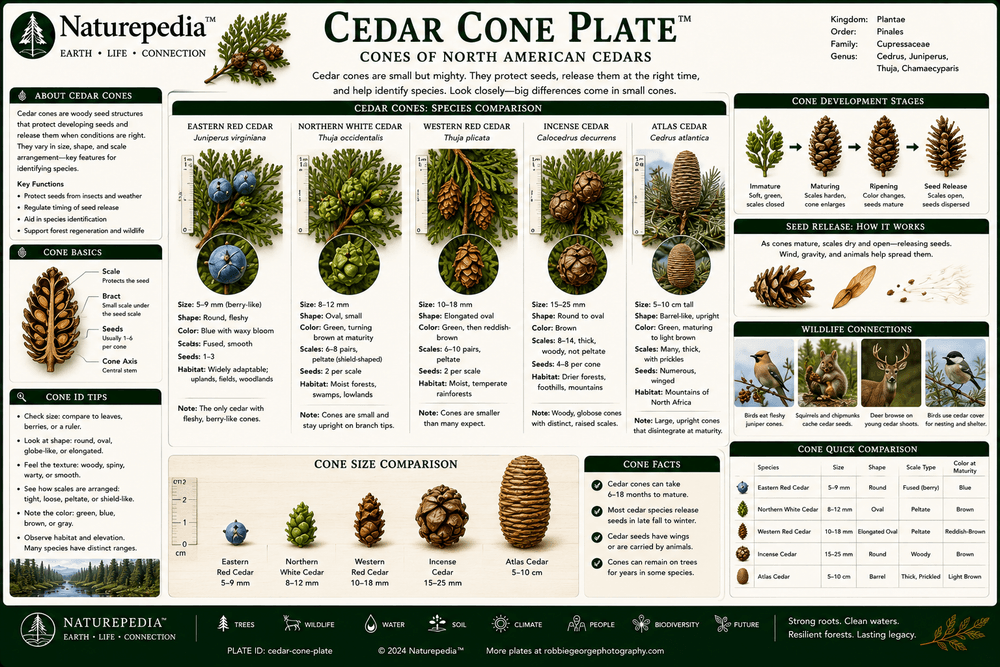
Cedar Cone Plate™

A visual interpretation of cedar reproductive structures including cones, seeds, dispersal mechanisms, regeneration strategies, wildlife interactions, and species-level variation.

Cedar Cone Plate showing cedar cones, seeds, dispersal systems, reproduction and regeneration ecology by Robbie George
Cedar Cone Plate™ by Robbie George — a Naturepedia reproductive ecology node connecting cedar cones, seeds, regeneration, wildlife relationships, and forest renewal.
Plate ID: cedars-of-north-america#cedar-cone-plate · System: Naturepedia Tree Identification Plates™ · Node Type: Recursive Compression Interface

Naturepedia Cedar Bark Plate

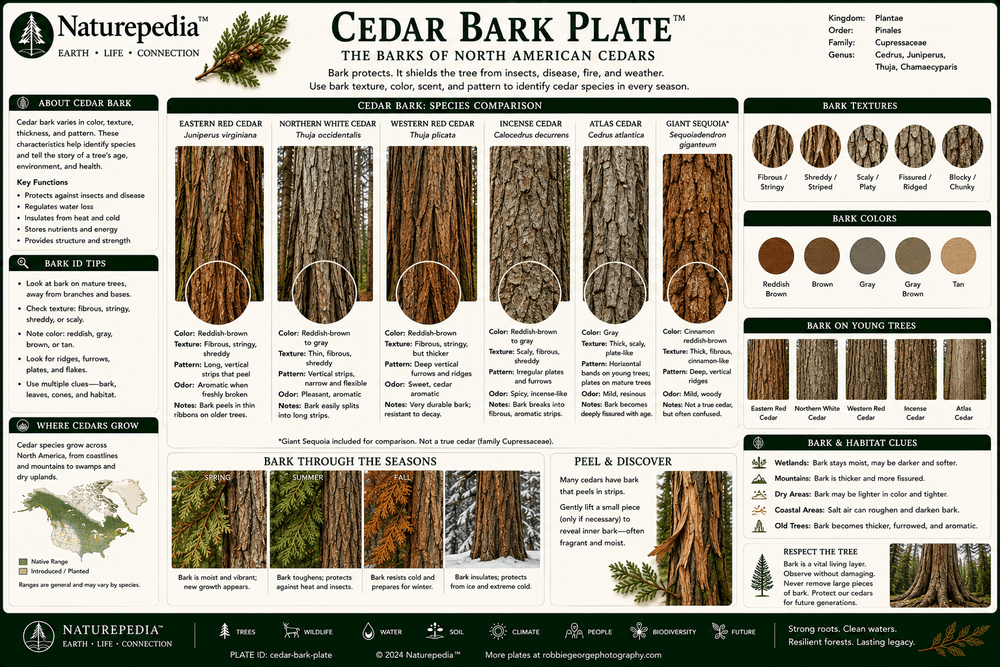
Cedar Bark Plate™

A visual comparison of cedar bark structure, texture, color, aromatic compounds, age characteristics, weather resistance, and species-level identification features.

Cedar Bark Plate showing cedar bark texture, identification characteristics, aromatic compounds and tree morphology by Robbie George
Cedar Bark Plate™ by Robbie George — a Naturepedia morphology node comparing cedar bark texture, aromatic properties, weather resistance, and species-level identification traits.
Plate ID: cedars-of-north-america#cedar-bark-plate · System: Naturepedia Tree Identification Plates™ · Node Type: Recursive Compression Interface

Naturepedia Cedar Identification Layer

Cedar Identification & Key Species

These plates introduce the primary identification layer for Cedars of North America™, including foliage, bark, cones, habitat, range, and four high-value species: Eastern Red Cedar, Northern White Cedar, Western Red Cedar, and Incense Cedar.

Naturepedia Cedar Species Plate

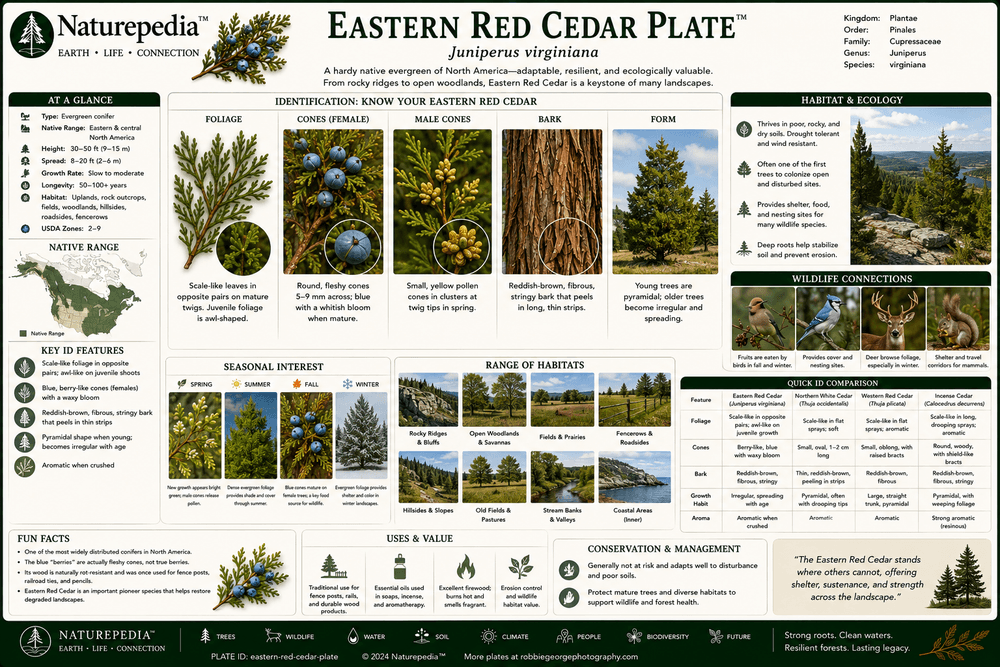
Eastern Red Cedar Plate™

A species-level plate for Eastern Red Cedar, highlighting berry-like cones, drought tolerance, wildlife shelter, old-field succession, grassland edges, and coastal habitat systems.

Eastern Red Cedar Plate showing berry-like cones, wildlife habitat, old-field succession, grassland ecology and evergreen shelter by Robbie George
Eastern Red Cedar Plate™ by Robbie George — a Naturepedia species node connecting wildlife habitat, berry-like cones, grassland succession, shelter cover, and ecological resilience.
Plate ID: cedars-of-north-america#eastern-red-cedar-plate · System: Naturepedia Cedar Species Plates™ · Node Type: Recursive Compression Interface

Naturepedia Cedar Species Plate

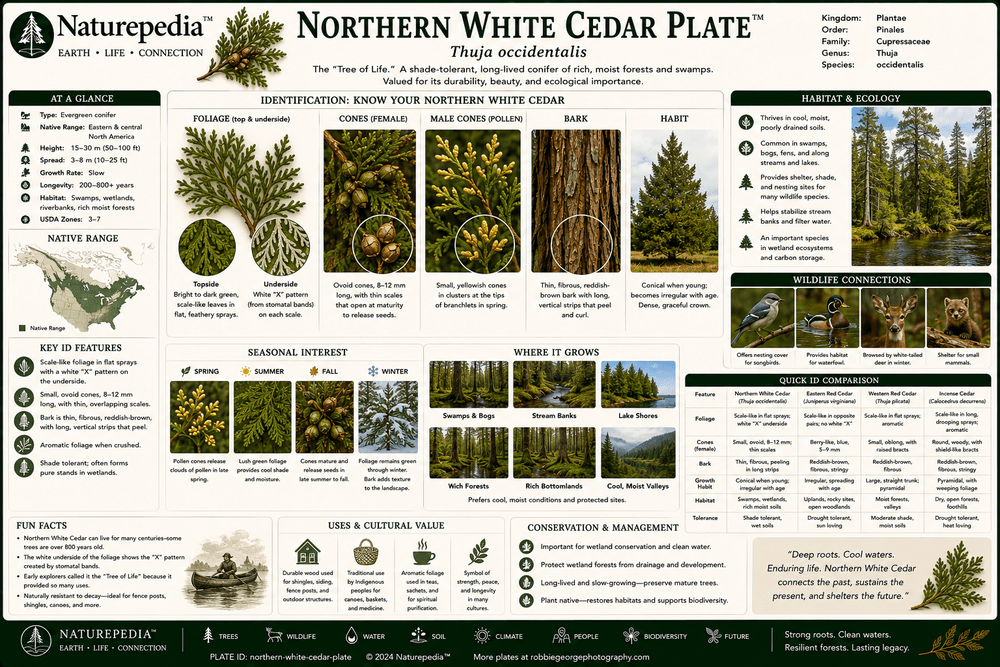
Northern White Cedar Plate™

A species-level plate for Northern White Cedar, highlighting cedar swamps, wetland forests, boreal ecology, watershed protection, winter deer habitat, and long-lived forest structure.

Northern White Cedar Plate showing cedar swamps, wetlands, boreal forests, deer habitat and watershed ecology by Robbie George
Northern White Cedar Plate™ by Robbie George — a Naturepedia species node connecting cedar swamps, wetlands, watershed protection, wildlife shelter, and boreal forest ecology.
Plate ID: cedars-of-north-america#northern-white-cedar-plate · System: Naturepedia Cedar Species Plates™ · Node Type: Recursive Compression Interface

Naturepedia Cedar Species Plate

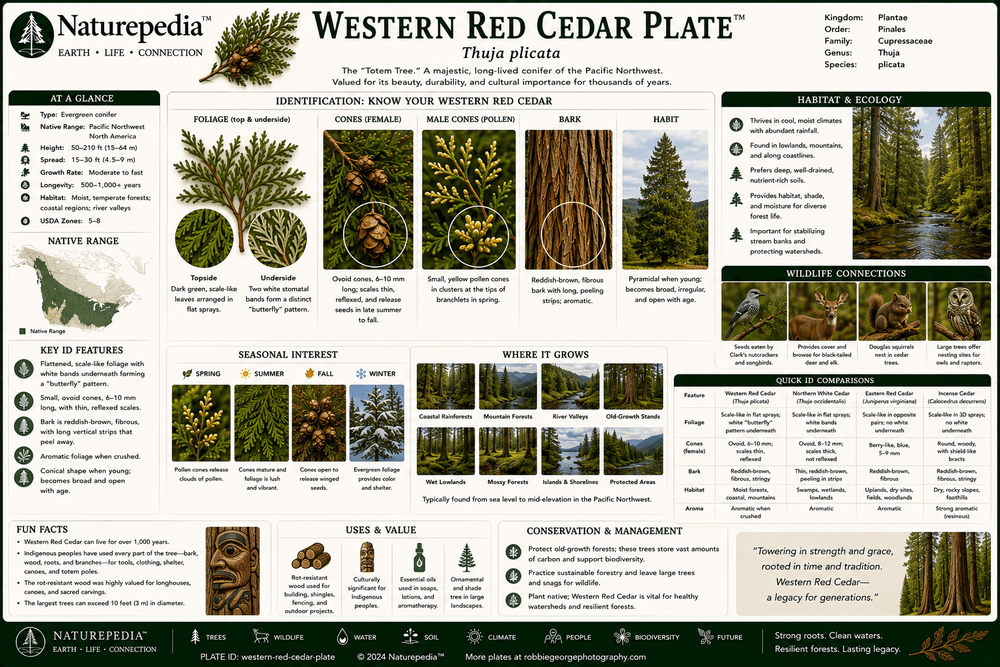
Western Red Cedar Plate™

A species-level plate for Western Red Cedar, highlighting temperate rainforests, old-growth forests, massive trunks, Indigenous cultural significance, biodiversity, and carbon storage.

Western Red Cedar Plate showing old growth rainforest ecology, giant cedar forests, biodiversity and carbon storage by Robbie George
Western Red Cedar Plate™ by Robbie George — a Naturepedia species node connecting old-growth rainforests, biodiversity, cultural history, forest structure, and carbon systems.
Plate ID: cedars-of-north-america#western-red-cedar-plate · System: Naturepedia Cedar Species Plates™ · Node Type: Recursive Compression Interface

Naturepedia Cedar Species Plate

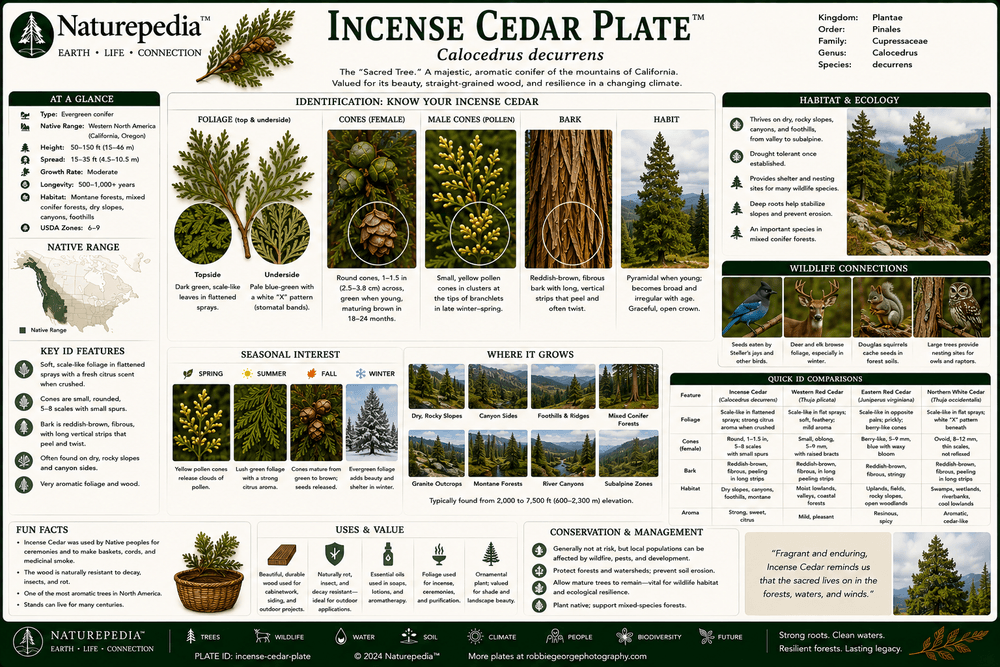
Incense Cedar Plate™

A species-level plate for Incense Cedar, highlighting Sierra Nevada forests, fire resilience, aromatic bark, drought tolerance, mountain habitat, and western forest communities.

Incense Cedar Plate showing Sierra Nevada forests, aromatic bark, fire resilience, drought tolerance and western mountain habitat by Robbie George
Incense Cedar Plate™ by Robbie George — a Naturepedia species node connecting Sierra Nevada forests, aromatic bark, fire resilience, drought tolerance, mountain habitat, and western forest ecology.
Plate ID: cedars-of-north-america#incense-cedar-plate · System: Naturepedia Cedar Species Plates™ · Node Type: Recursive Compression Interface

Naturepedia Cedar Ecology Layer

Swamp Forests, Wildlife Shelter, Forest Communities, Carbon & Climate Resilience

These plates explain cedars as ecological infrastructure — stabilizing wetlands, protecting watersheds, sheltering wildlife, shaping forest communities, storing carbon, and supporting resilient evergreen systems across North America.

Naturepedia Cedar Swamp Forest Plate

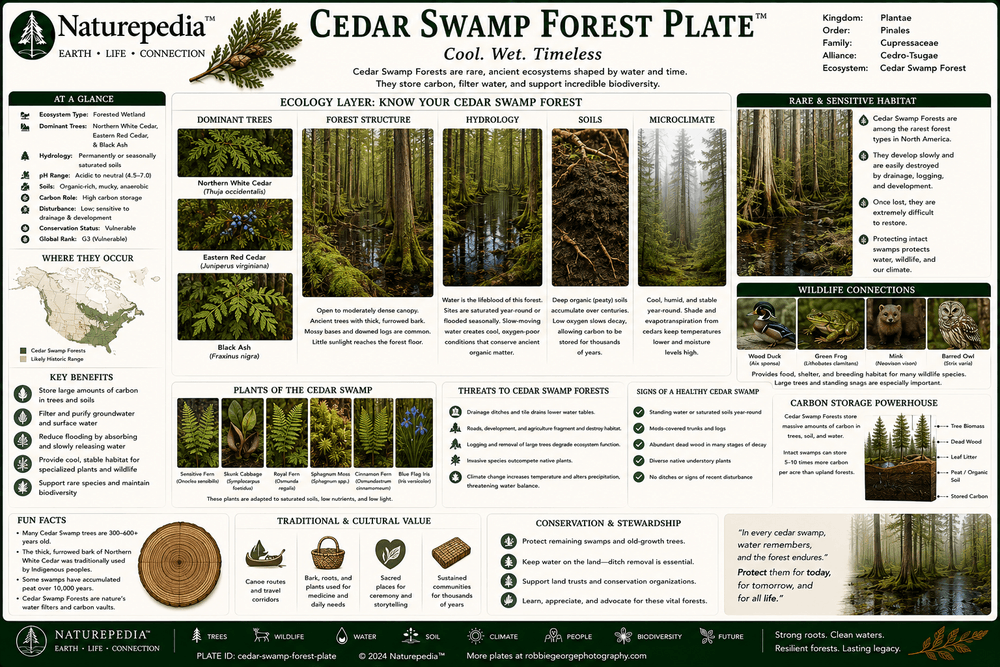
Cedar Swamp Forest Plate™

A visual interpretation of cedar swamp forests, connecting saturated soils, cold-water wetlands, peat systems, groundwater movement, winter wildlife shelter, and long-lived forest structure.

Cedar Swamp Forest Plate showing cedar wetlands, saturated soils, peat systems, groundwater movement, winter wildlife shelter, and long-lived forest structure by Robbie George
Cedar Swamp Forest Plate™ by Robbie George — a Naturepedia wetland forest node connecting cedar swamps, saturated soils, peat systems, groundwater, winter wildlife shelter, and long-lived forest ecology.
Plate ID: cedars-of-north-america#cedar-swamp-forest-plate · System: Naturepedia Cedar Swamp Forest Plates™ · Node Type: Recursive Compression Interface

Naturepedia Cedar Wildlife Plate

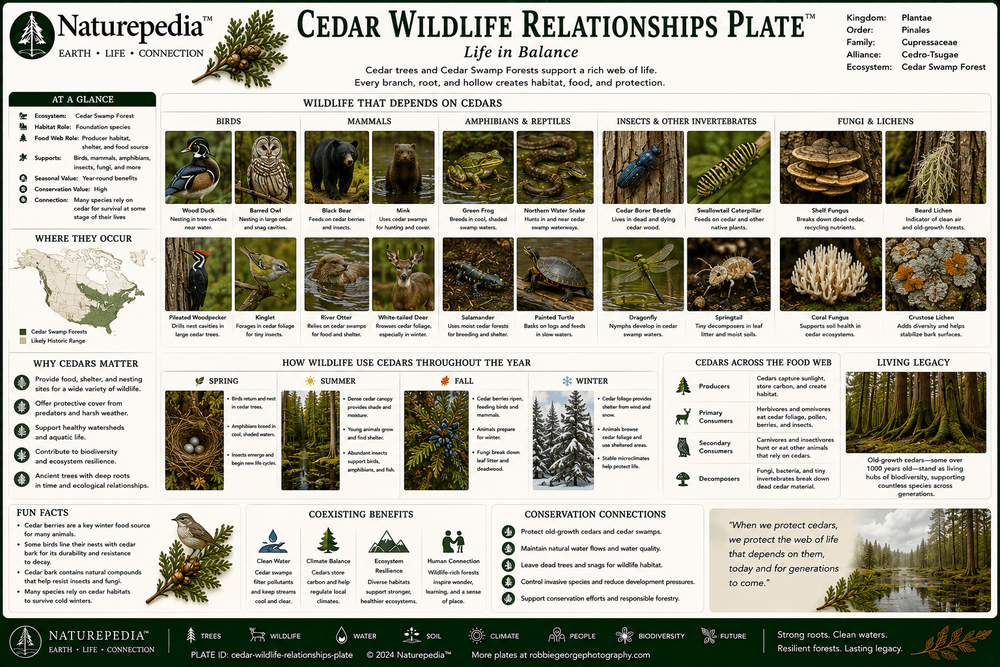
Cedar Wildlife Relationships Plate™

A visual interpretation of how cedars support deer yards, birds, mammals, insects, seed-eaters, winter shelter, nesting cover, browse, and evergreen refuge across seasonal forest systems.

Cedar Wildlife Relationships Plate showing deer yards, birds, mammals, insects, seed eaters, winter shelter, nesting cover, and evergreen refuge by Robbie George
Cedar Wildlife Relationships Plate™ by Robbie George — a Naturepedia wildlife node connecting cedars to deer yards, birds, mammals, seed dispersal, nesting cover, winter shelter, and evergreen habitat.
Plate ID: cedars-of-north-america#cedar-wildlife-relationships-plate · System: Naturepedia Cedar Wildlife Relationship Plates™ · Node Type: Recursive Compression Interface

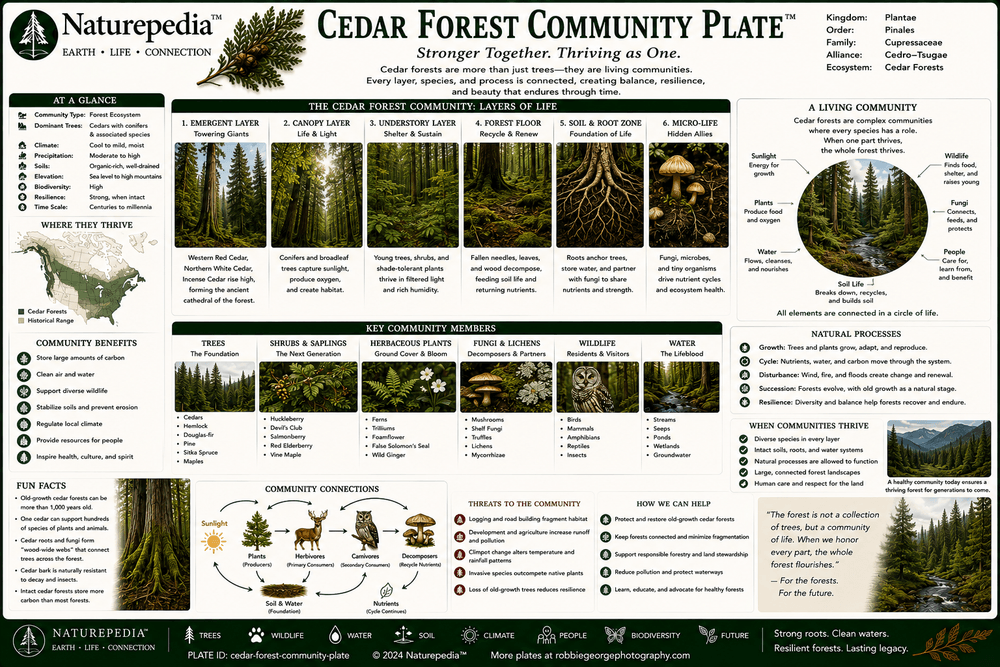
Naturepedia Cedar Forest Community Plate

Cedar Forest Community Plate™

A visual interpretation of cedar forest communities, connecting evergreen canopy structure, understory plants, wetlands, mosses, fungi, wildlife corridors, mixed conifer forests, and old-growth relationships.

Cedar Forest Community Plate showing evergreen canopy, understory plants, wetlands, mosses, fungi, wildlife corridors, mixed conifer forests, and old-growth relationships by Robbie George
Cedar Forest Community Plate™ by Robbie George — a Naturepedia forest community node connecting cedar canopy structure, wetlands, mosses, fungi, wildlife corridors, mixed conifers, and old-growth forest relationships.
Plate ID: cedars-of-north-america#cedar-forest-community-plate · System: Naturepedia Cedar Forest Community Plates™ · Node Type: Recursive Compression Interface

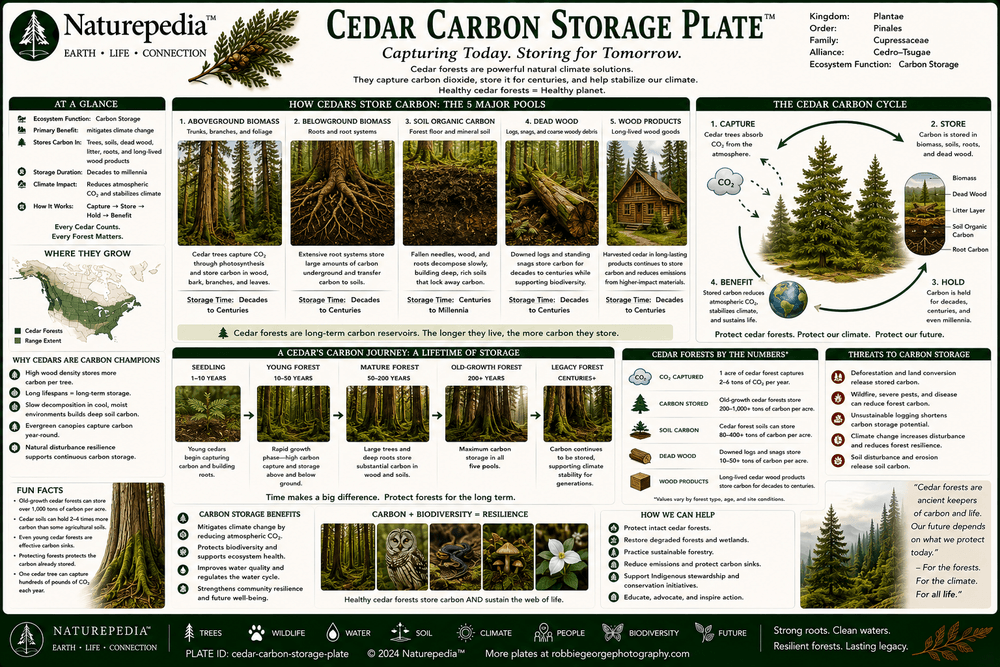
Naturepedia Cedar Carbon Systems Plate

Cedar Carbon Storage Plate™

A visual interpretation of cedar carbon systems, connecting long-lived evergreen forests, biomass accumulation, wood durability, peatland storage, wetland carbon sinks, and long-term climate regulation.

Cedar Carbon Storage Plate showing carbon sequestration, long-lived forests, wetland carbon sinks, biomass accumulation and climate regulation by Robbie George
Cedar Carbon Storage Plate™ by Robbie George — a Naturepedia carbon systems node connecting long-lived cedar forests, biomass accumulation, wetland carbon sinks, peat systems, and climate regulation.
Plate ID: cedars-of-north-america#cedar-carbon-storage-plate · System: Naturepedia Carbon Systems Plates™ · Node Type: Recursive Compression Interface

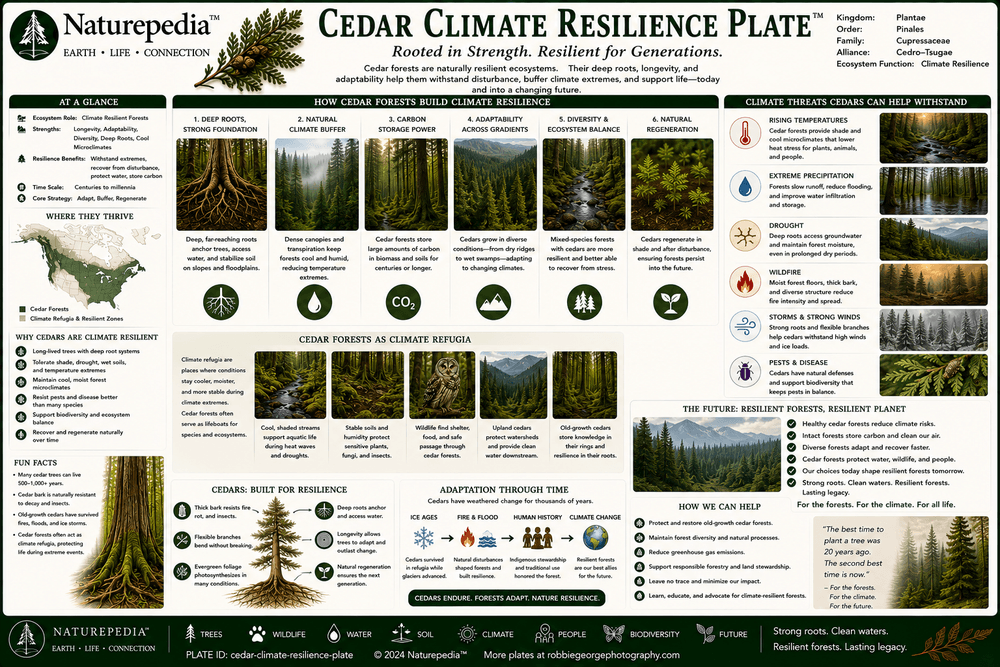
Naturepedia Cedar Climate Resilience Plate

Cedar Climate Resilience Plate™

A visual interpretation of cedar resilience, connecting drought tolerance, flood adaptation, wetland persistence, fire recovery, long life spans, genetic durability, and ecosystem stability under changing climate conditions.

Cedar Climate Resilience Plate showing drought tolerance, flood adaptation, ecosystem stability, climate resilience and long-lived forest systems by Robbie George
Cedar Climate Resilience Plate™ by Robbie George — a Naturepedia resilience node connecting drought tolerance, flood adaptation, longevity, ecosystem stability, climate pressures, and forest persistence.
Plate ID: cedars-of-north-america#cedar-climate-resilience-plate · System: Naturepedia Climate Resilience Plates™ · Node Type: Recursive Compression Interface

Naturepedia Relationship Layer

Naturepedia Connections

Cedars of North America™ connects cedar identification, evergreen forests, cedar swamps, wetland ecology, wildlife shelter, watershed protection, carbon storage, climate resilience, plant communities, soil systems, and ecological restoration into one cedar-centered Naturepedia node.

Primary System Bridge

Trees → Cedars → Wetlands → Wildlife Shelter → Carbon → Climate Resilience

This page becomes a major evergreen tree-family child node beneath Trees of North America™. Cedars help connect forest identification to ecological function by linking scale-like foliage, aromatic bark, cedar swamps, old-growth forests, wildlife habitat, watershed protection, carbon storage, and climate resilience.

🌳 Trees of North America

Cedars are a major evergreen tree-family node beneath the larger North American tree ecology system.

Explore Trees of North America →

🌲 Firs of North America

Firs connect with cedars through evergreen forests, mountain habitats, wildlife shelter, carbon storage, and climate resilience.

Explore Firs of North America →

🌲 Cypress Trees

Cypress and cedar systems both connect evergreen trees to swamps, wetlands, floodplain forests, water storage, and wildlife habitat.

Explore Cypress Trees →

💧 Wetland Ecosystems

Northern White Cedar and cedar swamps connect this page directly to wetland forests, saturated soils, peat systems, and groundwater movement.

Explore Wetland Ecosystems →

🌊 Water Systems

Cedar forests help protect watersheds, stabilize wetland margins, filter water, and support forest-water relationships.

Explore Water Systems →

🌊 River Systems

Cedar wetlands, riparian forests, and groundwater-fed systems connect this page to river corridors, floodplains, and watershed ecology.

Explore River Systems →

🦌 Wildlife Habitats

Cedars provide evergreen shelter, winter cover, nesting habitat, seed resources, browse, and wildlife movement corridors.

Explore Wildlife Habitats →

🌿 Plant Communities

Cedar forests shape native plant communities through evergreen canopy structure, wetland understories, mosses, shrubs, and mixed conifer relationships.

Explore Plant Communities →

🍄 Mycelial Networks

Cedar roots interact with fungi, soil life, decomposition, moisture gradients, nutrient exchange, and long-term forest resilience.

Explore Mycelial Networks →

🌱 Soil Microbiome

Living soil supports cedar establishment, root health, fungal relationships, peatland storage, decomposition, and wetland forest renewal.

Explore Soil Microbiome →

🌎 Biodiversity

Cedar communities support biodiversity through evergreen refuge, wetland structure, insects, birds, mammals, fungi, mosses, and understory plants.

Explore Biodiversity →

🌱 Ecological Restoration

Cedars connect to restoration through wetland recovery, riparian planting, wildlife shelter, carbon storage, and long-term forest resilience.

Explore Ecological Restoration →

The Cedar Relationship Flow

Trees of North America

Cedar Identification

Eastern Red Cedar, Northern White Cedar, Western Red Cedar & Incense Cedar

Cedar Swamps, Wetlands, Old-Growth Forests & Evergreen Shelter

Wildlife Habitat, Water Systems, Soil Life & Forest Communities

Carbon Storage, Biodiversity, Climate Resilience & Ecological Restoration

“Cedars are not only trees of shelter. They are forest memory, water guardians, wildlife refuges, and living bridges between ancient ecosystems and the resilience future forests will need.”

— Robbie George

About the Author

Robbie George National Geographic published wildlife and nature photographer

Robbie George is a National Geographic published photographer, ecological systems thinker, and creator of Naturepedia™, a structured ecological knowledge system documenting wildlife, habitats, ecosystems, forests, water systems, plant communities, biodiversity, conservation, and the living relationships that connect nature across North America.

For more than two decades, Robbie has photographed forests, wetlands, rivers, mountains, coastlines, wildlife refuges, and ecological landscapes throughout North America. His field work has taken him from Acadia National Park and the forests of New England to Yellowstone, Grand Teton, Lake Mattamuskeet, Blackwater National Wildlife Refuge, Chincoteague National Wildlife Refuge, and many of the continent's most ecologically significant landscapes.

The Cedars of North America™ project expands the growing Trees of North America™ system by documenting one of the continent's most important evergreen tree families. Through identification, species ecology, cedar swamps, wildlife relationships, forest communities, carbon storage, and climate resilience, this guide demonstrates how cedars function as both individual species and ecological infrastructure across diverse landscapes.

From the cedar swamps of the Northeast and Great Lakes to the towering Western Red Cedars of the Pacific Northwest and the resilient Eastern Red Cedars of grasslands and coastal habitats, cedars reveal how evergreen forests contribute to biodiversity, watershed protection, wildlife shelter, and long-term ecological stability.

Robbie also spent ten years as an organic farmer, developing firsthand experience with soil health, ecological succession, water movement, habitat diversity, pollinators, biodiversity, and regenerative land systems. That practical field background informs his approach to understanding forests as interconnected living systems rather than isolated species.

Learn more about Robbie George on the Nature Photographer page and explore the larger Naturepedia™ knowledge system.


Naturepedia FAQ Layer

Cedars of North America™ FAQ

Answers to common questions about cedar identification, Eastern Red Cedar, Northern White Cedar, Western Red Cedar, Incense Cedar, cedar swamps, wildlife habitat, carbon storage, climate resilience, and the ecological role of cedars across North America.

What are the major cedar species in North America?

The most important cedar species in North America include Eastern Red Cedar (Juniperus virginiana), Northern White Cedar (Thuja occidentalis), Western Red Cedar (Thuja plicata), and Incense Cedar (Calocedrus decurrens). Each occupies different habitats and ecological regions across the continent.

How can you identify a cedar tree?

Cedars are often identified by their scale-like evergreen foliage, aromatic bark, small cones or berry-like seed structures, fibrous bark texture, and distinctive growth form. Habitat and geographic range are also useful identification clues.

Is Eastern Red Cedar actually a true cedar?

Botanically, Eastern Red Cedar belongs to the juniper genus (Juniperus) rather than the true cedar genus (Cedrus). However, it is widely known as a cedar because of its aromatic wood, evergreen foliage, and traditional historical usage.

What is a cedar swamp?

A cedar swamp is a wetland forest dominated by cedar trees, most commonly Northern White Cedar. These ecosystems feature saturated soils, groundwater influence, peat accumulation, unique plant communities, and important wildlife habitat.

Where do Western Red Cedars grow?

Western Red Cedars are found primarily in the Pacific Northwest and western Canada. They thrive in moist temperate rainforests and are among the largest and longest-lived trees in North America.

Why are cedars important for wildlife?

Cedars provide year-round shelter, nesting habitat, browse, cover from winter weather, seed resources, and movement corridors for birds, mammals, insects, and countless other species. In northern forests, cedar stands are especially important winter habitat for deer.

How long do cedar trees live?

Many cedar species are exceptionally long-lived. Western Red Cedars can live well over 1,000 years, while Northern White Cedars and other species often persist for several centuries under favorable conditions.

How do cedars store carbon?

Cedars store carbon through long-lived wood, durable forest biomass, root systems, and associated wetland ecosystems. Cedar swamps and peat-rich habitats can retain carbon for extremely long periods of time, making them important natural carbon sinks.

What makes cedars climate resilient?

Cedars possess traits such as drought tolerance, flood tolerance, long life spans, evergreen foliage, disease resistance, and strong ecological adaptability. These characteristics help many cedar species persist through changing environmental conditions.

How does this page connect to Naturepedia?

Cedars of North America™ connects Trees of North America™, Wetland Ecosystems™, Water Systems™, River Systems™, Plant Communities™, Mycelial Networks™, Wildlife Habitats™, Biodiversity™, Ecological Restoration™, Carbon Systems™, and Climate Resilience into a unified cedar-centered ecological framework.

“Few trees embody endurance like cedars. They protect water, shelter wildlife, store centuries of carbon, and remind us that resilience is built slowly through time.”

— Robbie George

Trusted Art Seller

Trusted Art Seller

The presence of this badge signifies that this business has officially registered with the Art Storefronts Organization and has an established track record of selling art.

It also means that buyers can trust that they are buying from a legitimate business. Art sellers that conduct fraudulent activity or that receive numerous complaints from buyers will have this badge revoked. If you would like to file a complaint about this seller, please do so here.

Verified Returns & Exchanges

Verified Returns & Exchanges

The Art Storefronts Organization has verified that this business has provided a returns & exchanges policy for all art purchases.

Description of Policy from Merchant:

What is your Policy on Returns/Exchanges/Refunds? I take great pride in my work and prints, and I want you to be completely happy with your investment in my nature art. If for any reason you are unsatisfied with your print, you may return it within 14 days of delivery, and/or exchange it for another print. Prints must be returned in new condition, packaged carefully in the original packaging if possible. Your refund will be issued as soon as I receive the returned print. Please contact me if you would like to arrange a return or exchange. In the event that you receive a damaged or defective print, please let me know within 7 days of receipt, and I will arrange for a new print to be shipped to you at no additional cost.

Verified Secure Website with Safe Checkout

Verified Secure Website with Safe Checkout

This website provides a secure checkout with SSL encryption.

Verified Archival Materials Used

Verified Archival Materials Used

The Art Storefronts Organization has verified that this Art Seller has published information about the archival materials used to create their products in an effort to provide transparency to buyers.

Description from Merchant:

Fine Art Prints are made with high-quality archival inks on fine art papers using a high-resolution large format inkjet printer. Our premium archival inks produce images with smooth tones and rich colors. Prints are made with care on your choice of exquisite Fine Art Papers using a high-resolution large format inkjet printer. https://www.graphikprintworks.com

Cart

Your cart is currently empty.

Saved Successfully.

This is only visible to you because you are logged in and are authorized to manage this website. This message is not visible to other website visitors.

Import From Instagram

Click on any Image to continue

This Website Supports Augmented Reality to Live Preview Art

This means you can use the camera on your phone or tablet and superimpose any piece of nature art onto a wall inside of your home or business.

To use this feature, Just look for the "Live Preview AR" button when viewing any piece of nature art on this website!

🦊 Pounce now for 20% off

No thanks