ATTENTION: To use this site, it is necessary to enable JavaScript in your browser.
Here are the Instructions on how to enable JavaScript in your web browser.

🌿 How Plants Send Signals, Share Warnings, and Coordinate Across Living Ecosystems

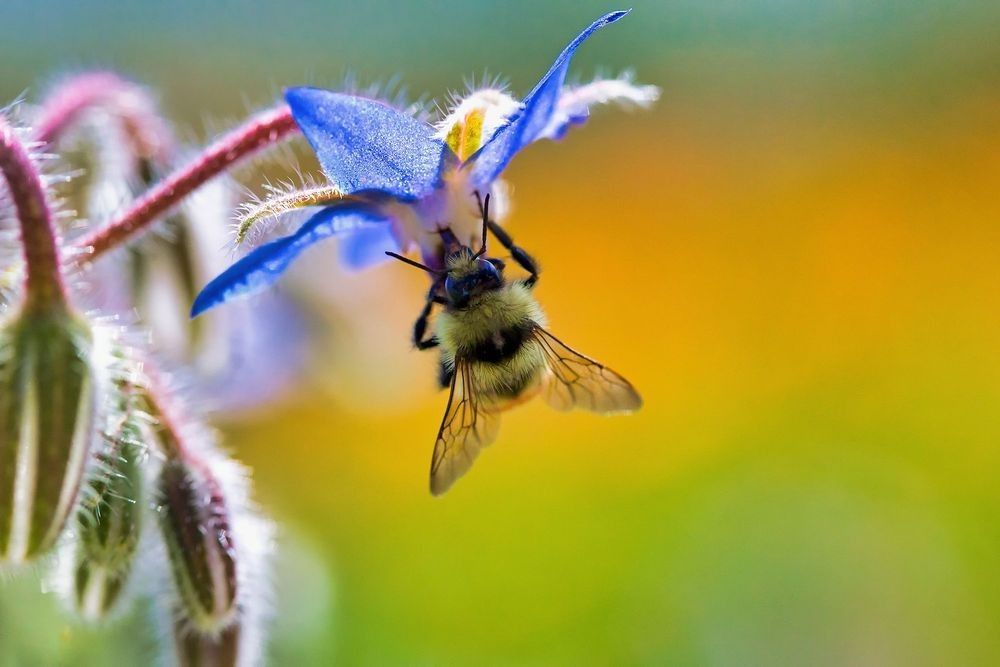
Bumble bee visiting a blue flower illustrating pollination, plant signaling, ecological communication, and living plant intelligence.

Earth's Living Plant Communication Network

Plant Communication™

How Plants Exchange Information Through Chemistry, Roots, Air, and Living Ecological Networks

Plant Communication™ explores how plants continuously exchange information through chemical signals, volatile organic compounds, root exudates, fungal partnerships, defense pathways, and ecological communication networks. These living information systems help plants coordinate growth, respond to stress, defend against herbivores, cooperate with neighboring organisms, and strengthen ecosystem resilience.

Hero Photograph: Bee — Fine art nature photography by Robbie George illustrating pollination, flowering plants, ecological relationships, and the living communication systems found throughout the plant kingdom.

How Plants Exchange Information Across Living Ecosystems

Plant Communication™ explores one of the most remarkable discoveries in modern ecology: plants are active participants in sophisticated information networks. Rather than existing as isolated organisms, plants constantly exchange signals through airborne chemicals, underground root systems, fungal partnerships, microbial communities, and environmental feedbacks. These communication pathways allow plants to detect change, coordinate responses, and influence the ecosystems around them.

Leaves release volatile organic compounds that warn neighboring plants of insect attack. Roots secrete chemical messages into surrounding soils where microbes and fungi relay information through extensive underground networks. Hormones coordinate internal communication between roots, stems, leaves, and flowers, allowing plants to rapidly adjust growth, activate defenses, conserve resources, or cooperate with nearby organisms. Together these interconnected systems reveal that communication is a fundamental feature of plant life.

Plant communication extends beyond individual organisms into entire ecosystems. Forests exchange information through mycorrhizal fungi, flowering plants communicate with pollinators through scent and color, roots influence microbial communities, and environmental conditions shape signaling across landscapes. These relationships strengthen resilience, improve adaptation, and help maintain the stability of Earth's living ecosystems.

Plant Communication™ connects Naturepedia™, Plant Intelligence™, Bioelectric Systems™, Soil Systems™, Water Systems™, Mycorrhizal Networks™, Information Systems in Nature™, Ecosystem Feedbacks™, Electrical Ecology™, and Quantum Agriculture™ into one integrated framework demonstrating how living information continuously flows through the botanical world.

Explore Plant Communication™

Naturepedia™ Plant Communication Plate

Plant Communication Plate™

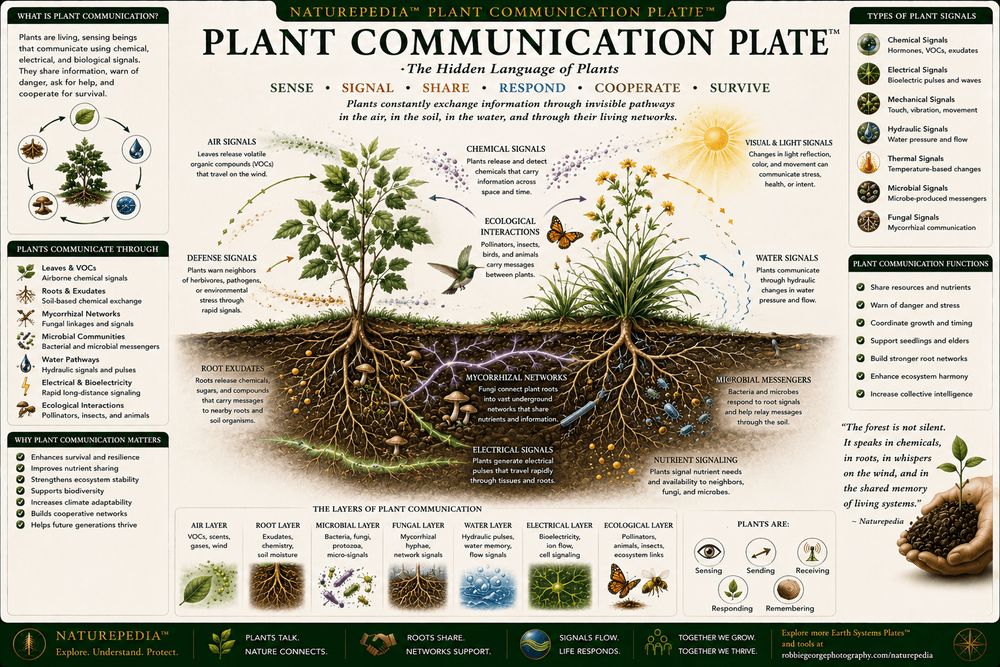
Plant Communication™ maps how plants exchange information through leaves, roots, air, soil, volatile organic compounds, chemical signals, root exudates, fungal networks, microbial communities, water pathways, and ecological feedback systems.

Plant Communication Plate showing plants exchanging information through leaves, roots, air, soil, volatile organic compounds, chemical signals, root exudates, fungi, microbes, water pathways, and ecological networks.
Plant Communication Plate™ — a Naturepedia™ systems map showing how plants send, receive, and respond to information through airborne, underground, chemical, microbial, fungal, and ecological communication pathways.

Visible Plate ID: plant-communication#plant-communication-plate

Type: Naturepedia Plant Communication Plate™

Plants Communicate Through Living Networks

Plant communication begins with the recognition that plants are not passive organisms. Every leaf, root, flower, stem, and seed participates in a continuous exchange of information with the surrounding world. Plants sense light, moisture, touch, temperature, herbivores, pathogens, nutrients, neighboring roots, pollinators, fungi, microbes, and atmospheric change, then translate those signals into growth, defense, cooperation, and adaptation.

Aboveground, plants release volatile organic compounds that move through the air like invisible messages. These airborne signals can attract pollinators, recruit beneficial insects, warn neighboring plants of attack, or communicate stress across a plant community. Belowground, roots secrete exudates into the soil, shaping microbial communities, influencing nutrient exchange, and communicating with nearby roots, fungi, and soil organisms.

Plant communication also depends upon partnership. Mycorrhizal fungi extend the reach of root systems, microbes translate chemical signals within the rhizosphere, water carries dissolved compounds through soil, and ecological feedbacks shape how signals move across landscapes. A single plant may communicate internally through hormones, externally through scent, underground through roots, and relationally through the wider living network.

Rather than viewing communication as something limited to animals, Plant Communication™ reveals that information exchange is woven into the structure of life itself. Plants communicate chemically, electrically, biologically, and ecologically, forming one of the foundational systems within the larger Electro-Ecology Mesh.

Airborne Signals

Volatile organic compounds allow plants to communicate through the air, warning neighbors, attracting pollinators, and shaping ecological relationships.

Root & Soil Messages

Roots release chemical exudates into living soils, where fungi, microbes, moisture, and nearby roots participate in underground communication networks.

Ecological Intelligence

Plant communication links individual organisms into resilient ecosystems through warning signals, cooperation, defense pathways, and living feedback loops.

Naturepedia Connection

Plant Communication™ connects Plant Intelligence™, Bioelectric Systems™, Soil Systems™, Water Systems™, Mycorrhizal Networks™, Information Systems in Nature™, Ecosystem Feedbacks™, and Electrical Ecology™. Together these Naturepedia™ systems reveal how plants participate in living information networks that connect air, soil, water, roots, fungi, microbes, pollinators, and ecosystem resilience.

Chemical Signaling Plate

Chemical Signaling Plate™

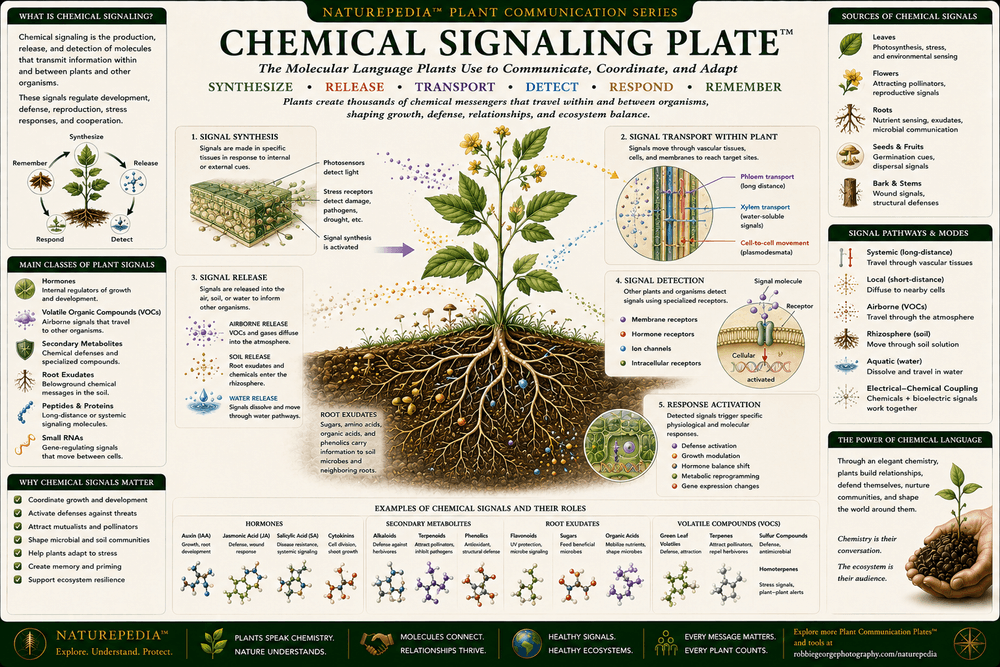
Chemical Signaling™ explores how plants exchange information using hormones, secondary metabolites, root exudates, cellular messengers, and biochemical pathways that coordinate growth, defense, stress responses, and ecological interactions.

Chemical Signaling Plate showing plant hormones, signaling molecules, root exudates, cellular communication, leaves, roots, and biochemical information pathways.
Chemical Signaling Plate™ — illustrating how plants use biochemical messengers to coordinate growth, defense, development, and communication throughout living ecosystems.

Visible Plate ID: plant-communication#chemical-signaling-plate

Type: Naturepedia Chemical Signaling Plate™

The Chemical Language of Plants

Long before electrical signals or visible changes occur, plants communicate through chemistry. Every living plant continually produces signaling molecules that coordinate internal development while simultaneously exchanging information with surrounding organisms. These biochemical messages allow plants to respond rapidly to changing environmental conditions without movement or vocal communication.

Plant hormones such as auxins, cytokinins, gibberellins, abscisic acid, ethylene, jasmonates, and salicylic acid regulate growth, flowering, stress tolerance, wound responses, and defense activation. At the same time, roots release complex mixtures of sugars, amino acids, organic acids, and secondary metabolites that influence soil microbes, attract beneficial fungi, discourage pathogens, and shape the biological activity surrounding the root system.

These chemical pathways rarely operate independently. Internal hormones interact with external ecological signals while microbial communities, fungi, water, nutrients, and neighboring plants continually modify how information is interpreted. Together they create an adaptive biochemical communication network that allows plants to coordinate survival across changing environments.

Chemical Signaling™ demonstrates that chemistry forms one of the primary languages of plant communication. Every signal exchanged between cells, roots, microbes, fungi, neighboring plants, and the surrounding environment contributes to the larger ecological intelligence operating throughout living ecosystems.

Plant Hormones

Hormones coordinate development, growth, flowering, stress adaptation, wound repair, and internal communication throughout the entire plant.

Root Exudates

Chemical compounds released into the soil influence fungi, microbes, nutrient availability, neighboring plants, and underground ecological relationships.

Living Biochemical Networks

Chemical signaling links individual cells with entire ecosystems, forming one of the foundational communication systems within plant life.

Naturepedia Connection

Chemical Signaling™ connects Plant Communication™, Plant Intelligence™, Soil Systems™, Bioelectric Systems™, Mycorrhizal Networks™, Information Systems in Nature™, Water Systems™, and Electrical Ecology™. Together these Naturepedia™ systems demonstrate that biochemical information continuously links cells, roots, fungi, microbes, neighboring plants, and entire ecosystems into one living communication network.

Volatile Organic Compounds Plate

Volatile Organic Compounds Plate™

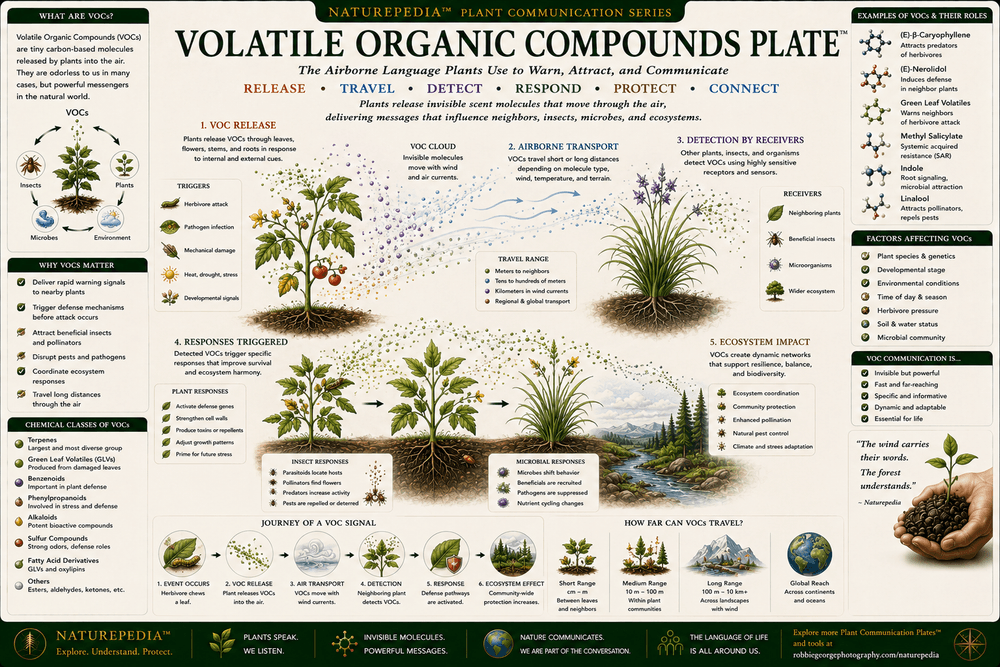
Volatile Organic Compounds™ explores how plants release airborne chemical signals that warn neighboring plants, attract pollinators, recruit beneficial insects, coordinate defense responses, and strengthen communication throughout living ecosystems.

Volatile Organic Compounds Plate showing plants releasing airborne chemical signals, pollinator attraction, warning communication, and ecological information moving through the atmosphere.
Volatile Organic Compounds Plate™ — illustrating how airborne plant chemicals function as ecological messages connecting plants, insects, and surrounding ecosystems.

Visible Plate ID: plant-communication#volatile-organic-compounds-plate

Type: Naturepedia Volatile Organic Compounds Plate™

Airborne Messages in the Plant World

Plants constantly release tiny airborne molecules known as volatile organic compounds (VOCs). Although invisible to human senses, these molecules form one of the fastest long-distance communication systems in nature. VOCs allow plants to send information through the air without physical contact, connecting individuals across entire plant communities.

Different VOC blends communicate different ecological messages. Flowers release aromatic compounds that attract pollinators, while damaged leaves emit warning signals that prepare neighboring plants for potential herbivore attack. Some VOCs recruit predatory insects that feed on herbivores, creating indirect defense partnerships that benefit both plants and insects. Others help plants respond to drought, temperature stress, pathogens, or changing environmental conditions.

Because every species produces a unique combination of airborne compounds, VOC communication creates a complex atmospheric information network. These signals interact with weather, wind, humidity, microbial communities, and neighboring vegetation, allowing information to move across ecosystems in ways scientists are only beginning to understand.

Volatile Organic Compounds™ demonstrate that Earth's atmosphere serves as more than a physical environment—it also functions as an ecological communication medium where plants continuously exchange information that influences growth, defense, cooperation, pollination, and ecosystem resilience.

Warning Signals

Plants release airborne chemicals that alert nearby vegetation to insect attack, drought, disease, and environmental stress before damage spreads.

Pollinator Communication

Flowers emit distinctive scent compounds that guide pollinators toward nectar and pollen while supporting plant reproduction across ecosystems.

Atmospheric Information Networks

Volatile organic compounds transform the atmosphere into a dynamic communication system linking plants, insects, microbes, weather, and ecological resilience.

Naturepedia Connection

Volatile Organic Compounds™ connects Plant Communication™, Plant Intelligence™, Chemical Signaling™, Pollinator Systems™, Bioelectric Systems™, Mycorrhizal Networks™, Information Systems in Nature™, and Electrical Ecology™. Together these Naturepedia™ systems reveal how airborne chemistry allows plants to exchange information across landscapes, linking atmospheric communication with ecological resilience and the broader Electro-Ecology Mesh.

Root Communication Plate

Root Communication Plate™

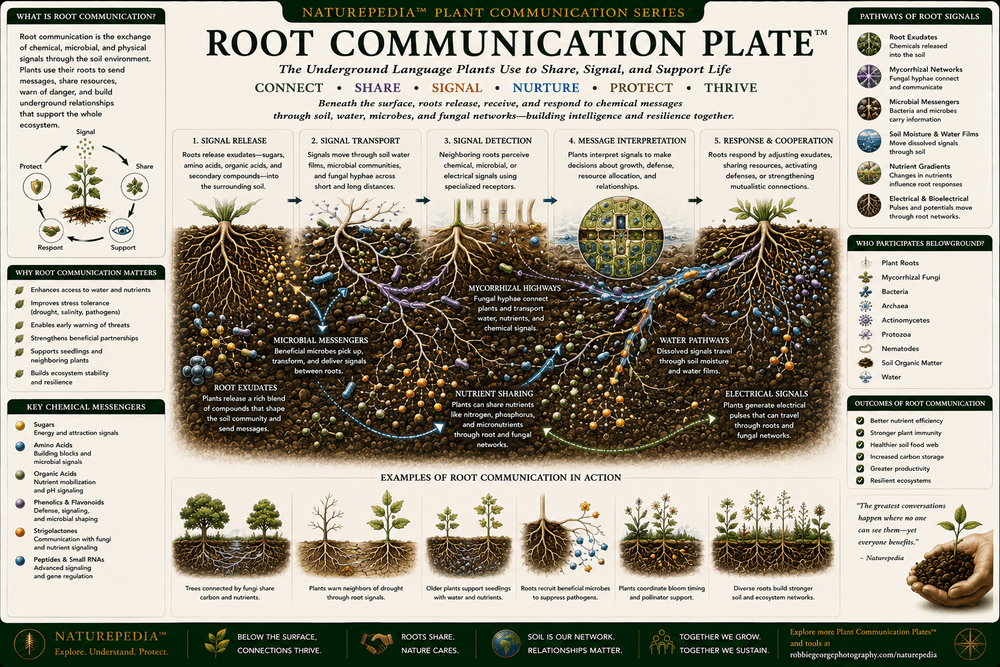
Root Communication™ explores how plants exchange information beneath the soil through root exudates, fungal partnerships, microbial communities, water movement, nutrient gradients, and living underground communication networks.

Root Communication Plate showing underground roots exchanging information through chemical signals, root exudates, fungi, microbes, water pathways, and living soil networks.
Root Communication Plate™ — illustrating how roots exchange information beneath the soil through chemistry, fungi, microbes, water, and ecological partnerships.

Visible Plate ID: plant-communication#root-communication-plate

Type: Naturepedia Root Communication Plate™

The Hidden Communication Beneath Our Feet

While leaves communicate through the atmosphere, roots communicate within one of Earth's most biologically active environments. Every root tip releases a diverse mixture of sugars, amino acids, organic acids, enzymes, and signaling molecules that continually influence surrounding microbes, fungi, neighboring plants, and soil chemistry. This underground exchange creates an active communication network that operates continuously beneath every healthy ecosystem.

Root exudates help plants recruit beneficial microorganisms, discourage harmful pathogens, regulate nutrient availability, and establish symbiotic partnerships with mycorrhizal fungi. Nearby roots respond to these chemical gradients by adjusting growth, resource allocation, and competitive or cooperative behavior. Water movement through soil further distributes dissolved signaling compounds, extending communication beyond individual root systems.

Rather than functioning independently, roots participate in an interconnected biological community known as the rhizosphere. Within this living zone, plants, fungi, bacteria, archaea, nematodes, and countless microscopic organisms continuously exchange information that shapes ecosystem health, nutrient cycling, resilience, and plant survival.

Root Communication™ demonstrates that the soil is not merely a growing medium—it is an active information network where chemical signaling, biological partnerships, and ecological relationships connect individual plants into larger living systems.

Root Exudates

Roots continuously release signaling compounds that influence nutrient cycling, microbial activity, fungal partnerships, and neighboring plants.

Living Rhizosphere

The rhizosphere forms a dynamic biological interface where roots, fungi, microbes, water, and soil chemistry continually exchange ecological information.

Underground Intelligence

Root communication creates one of nature's largest hidden information systems, linking individual plants into resilient underground ecological networks.

Naturepedia Connection

Root Communication™ connects Plant Communication™, Chemical Signaling™, Mycorrhizal Networks™, Soil Systems™, Carbon & Microbial Life™, Water Systems™, Plant Intelligence™, Bioelectric Systems™, and Electrical Ecology™. Together these Naturepedia™ systems reveal that living soils function as vast communication environments where roots, fungi, microbes, water, and biochemical signals coordinate the health and resilience of entire ecosystems.

Warning Signal Plate

Warning Signal Plate™

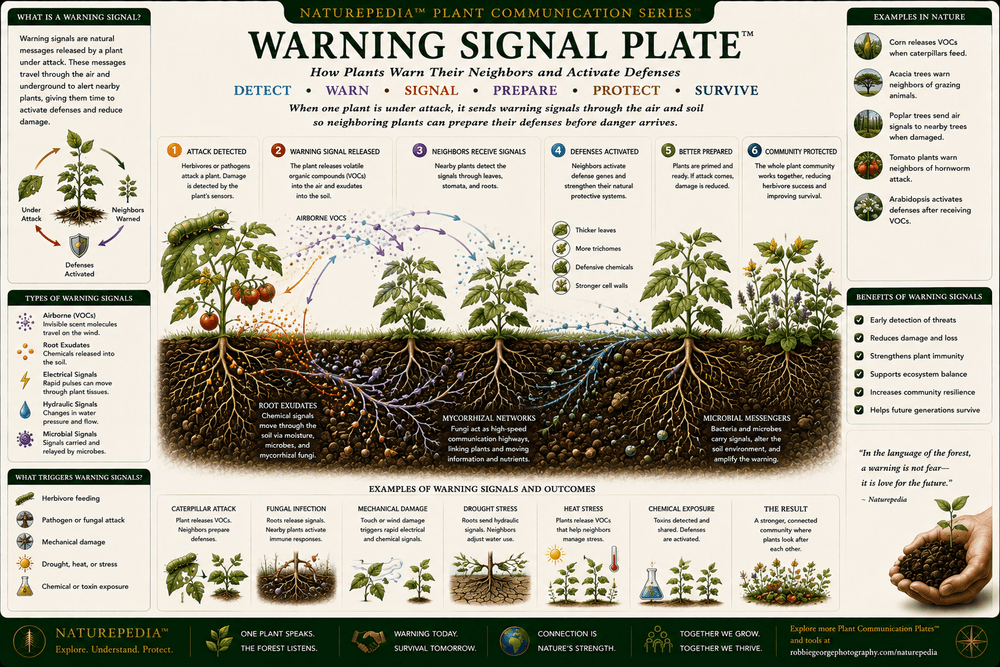
Warning Signal™ explores how plants detect danger and communicate early warnings through volatile organic compounds, chemical messengers, root networks, fungal partnerships, and ecological signaling pathways before damage spreads throughout an ecosystem.

Warning Signal Plate showing an insect-damaged plant sending airborne and underground warning signals to neighboring plants through volatile organic compounds, roots, fungi, and ecological communication pathways.
Warning Signal Plate™ — illustrating how plants rapidly share information about danger through airborne chemistry, underground communication, and ecological signaling networks.

Visible Plate ID: plant-communication#warning-signal-plate

Type: Naturepedia Warning Signal Plate™

Early Warning Systems in Nature

Plants rarely face environmental challenges alone. When insects feed on leaves, pathogens invade tissues, or drought begins to stress living cells, plants immediately begin releasing warning signals that spread throughout the surrounding community. These early messages allow neighboring plants to prepare long before they experience the same threat.

One of the fastest warning systems involves volatile organic compounds released from damaged leaves. Neighboring plants detect these airborne chemicals and begin activating defensive pathways before insects arrive. At the same time, root systems and mycorrhizal fungi can transmit chemical information belowground, extending warning signals beyond what travels through the air alone. Together these pathways create multiple layers of ecological communication operating simultaneously.

Warning signals do more than activate defense chemicals. They influence growth patterns, energy allocation, root activity, microbial relationships, and interactions with beneficial insects. Some signals even attract predators or parasitoid insects that naturally reduce herbivore populations, allowing plants to recruit assistance from other members of the ecosystem rather than relying solely on their own defenses.

Warning Signal™ demonstrates that plant communities behave as interconnected information systems. Individual plants continuously monitor their surroundings, share environmental information, and strengthen the resilience of the larger ecosystem through rapid communication.

Airborne Warnings

Damaged plants release volatile compounds that alert neighboring vegetation before insects, disease, or stress spread throughout the community.

Underground Alerts

Roots, fungi, and microbial communities extend warning signals beneath the soil, creating additional pathways for ecological communication.

Prepared Ecosystems

Rapid warning systems allow plant communities to respond collectively, increasing resilience against herbivores, pathogens, drought, and environmental disturbance.

Naturepedia Connection

Warning Signal™ connects Plant Communication™, Chemical Signaling™, Volatile Organic Compounds™, Root Communication™, Plant Intelligence™, Mycorrhizal Networks™, Bioelectric Systems™, Ecosystem Feedbacks™, and Electrical Ecology™. Together these Naturepedia™ systems reveal how living plants share environmental information through multiple communication pathways, allowing entire ecosystems to anticipate change, coordinate defense, and strengthen ecological resilience.

Plant Cooperation Plate

Plant Cooperation Plate™

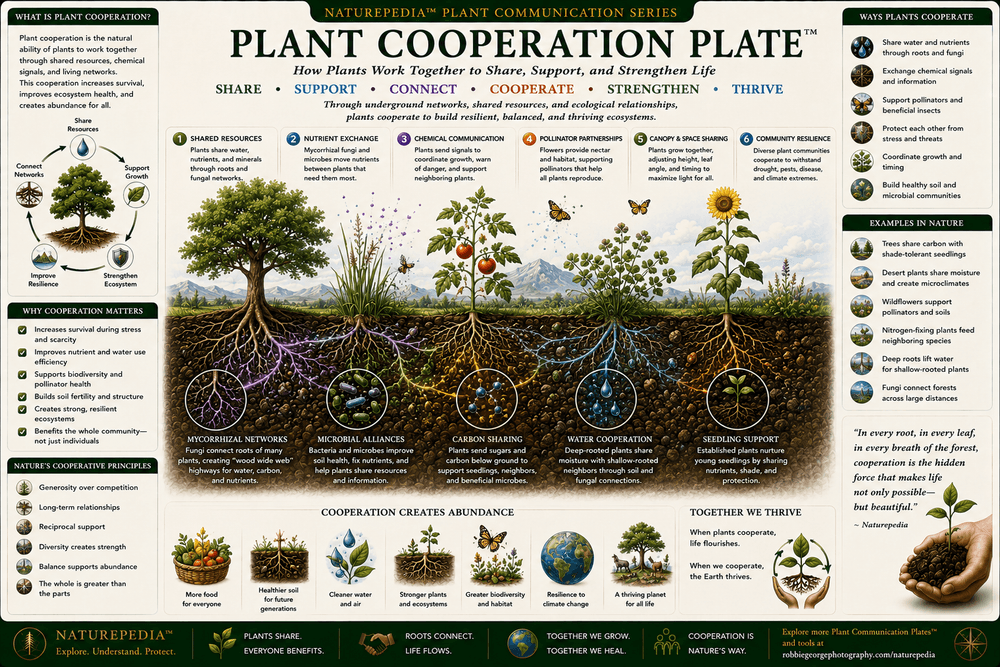
Plant Cooperation™ explores how plants collaborate through shared fungal networks, root communication, resource exchange, pollinator partnerships, microbial relationships, and ecological cooperation that strengthens the resilience of entire ecosystems.

Plant Cooperation Plate showing neighboring plants connected through roots, fungal networks, pollinators, microbes, water pathways, and shared ecological relationships.
Plant Cooperation Plate™ — illustrating how plants strengthen ecosystem resilience through collaboration with neighboring plants, fungi, microbes, pollinators, and shared ecological networks.

Visible Plate ID: plant-communication#plant-cooperation-plate

Type: Naturepedia Plant Cooperation Plate™

Cooperation Strengthens Living Ecosystems

For many years, plants were viewed primarily as competitors for sunlight, water, and nutrients. Modern ecological research paints a far richer picture. While competition certainly exists, plants also participate in extensive cooperative relationships that improve survival, stabilize ecosystems, and strengthen the resilience of entire biological communities.

Underground fungal networks can redistribute water, carbon, and nutrients between neighboring plants. Mature trees often support seedlings through shared mycorrhizal connections, while diverse root systems create healthier soil conditions that benefit surrounding vegetation. Plants also cooperate indirectly by supporting pollinators, enriching microbial communities, stabilizing soils, reducing erosion, and creating habitats that allow countless other organisms to thrive.

These cooperative relationships extend far beyond individual species. Every exchange of nutrients, every microbial partnership, every fungal connection, and every pollinator interaction strengthens the larger ecological network. The result is an ecosystem that becomes more productive, more resilient, and better able to recover from drought, disease, herbivory, and environmental disturbance.

Plant Cooperation™ demonstrates that healthy ecosystems emerge not simply from individual organisms, but from countless biological partnerships operating simultaneously across forests, grasslands, wetlands, agricultural systems, and natural landscapes.

Shared Resources

Plants exchange water, nutrients, carbon, and biochemical information through roots and fungal networks that strengthen neighboring organisms.

Ecological Partnerships

Plants cooperate with fungi, microbes, insects, pollinators, and surrounding vegetation to improve ecosystem function and long-term resilience.

Resilient Communities

Cooperation creates stronger ecosystems by increasing biodiversity, stabilizing soils, improving nutrient cycling, and enhancing recovery after disturbance.

Naturepedia Connection

Plant Cooperation™ connects Plant Communication™, Root Communication™, Mycorrhizal Networks™, Plant Intelligence™, Soil Systems™, Carbon & Microbial Life™, Pollinator Systems™, Ecosystem Feedbacks™, and Electrical Ecology™. Together these Naturepedia™ systems demonstrate that cooperation is a fundamental ecological principle linking plants with fungi, microbes, insects, wildlife, and the broader living environment, forming resilient biological networks throughout Earth's ecosystems.

Defense Signaling Plate

Defense Signaling Plate™

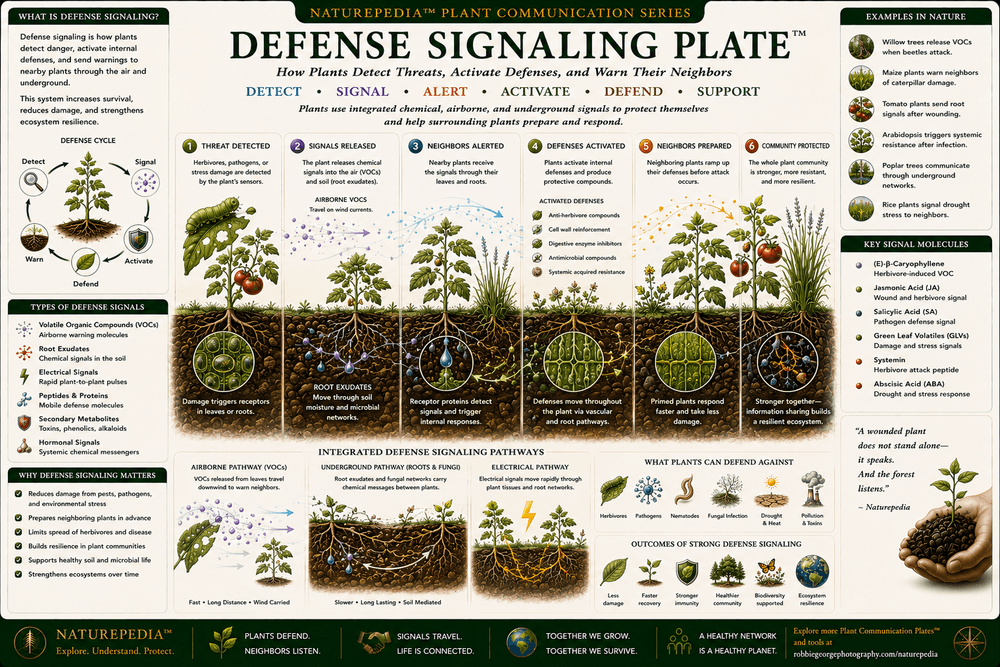
Defense Signaling™ explores how plants rapidly activate protective communication systems through hormones, airborne compounds, electrical responses, root signaling, and ecological partnerships that strengthen survival across entire plant communities.

Defense Signaling Plate showing plants activating defense pathways through chemical signaling, airborne communication, roots, fungi, beneficial insects, and ecological defense networks.
Defense Signaling Plate™ — illustrating how plants coordinate protective responses through integrated chemical, biological, and ecological communication systems.

Visible Plate ID: plant-communication#defense-signaling-plate

Type: Naturepedia Defense Signaling Plate™

Coordinated Protection Throughout Living Systems

Plants cannot flee from danger, yet they possess remarkably sophisticated defense systems that respond within seconds to environmental threats. When leaves are damaged, roots disturbed, or pathogens detected, plants immediately begin transmitting information throughout their tissues and into the surrounding ecosystem. These defense signals coordinate protective responses both within individual plants and across neighboring communities.

Hormones such as jasmonic acid, salicylic acid, and ethylene activate defensive pathways that strengthen cell walls, produce protective compounds, regulate metabolism, and prepare undamaged tissues for potential attack. Simultaneously, volatile organic compounds spread through the air while root exudates and fungal partnerships transmit complementary information belowground, allowing multiple communication pathways to operate together.

Defense signaling extends beyond the plant itself. Some airborne compounds attract predatory insects that consume herbivores, while underground fungal networks help distribute warning information throughout connected root systems. Beneficial microbes also contribute by improving nutrient availability, suppressing pathogens, and strengthening plant immune responses. These partnerships transform defense into a cooperative ecological process rather than an isolated biological reaction.

Defense Signaling™ demonstrates that plant protection emerges from communication. Chemical, biological, electrical, microbial, and ecological information systems work together to create resilient living networks capable of responding rapidly to environmental change.

Rapid Chemical Response

Plant hormones activate protective pathways that coordinate defense throughout leaves, stems, roots, and surrounding tissues.

Ecological Partnerships

Plants recruit fungi, microbes, beneficial insects, and neighboring vegetation to strengthen defensive capacity across the ecosystem.

Integrated Defense Networks

Airborne chemistry, root communication, fungal networks, and biological signaling combine to create resilient plant defense systems.

Naturepedia Connection

Defense Signaling™ connects Plant Communication™, Chemical Signaling™, Volatile Organic Compounds™, Warning Signals™, Root Communication™, Plant Intelligence™, Bioelectric Systems™, Mycorrhizal Networks™, Ecosystem Feedbacks™, and Electrical Ecology™. Together these Naturepedia™ systems demonstrate that plant defense is a distributed communication process where chemistry, biology, fungi, microbes, insects, and ecological relationships work together to strengthen resilience throughout the living world.

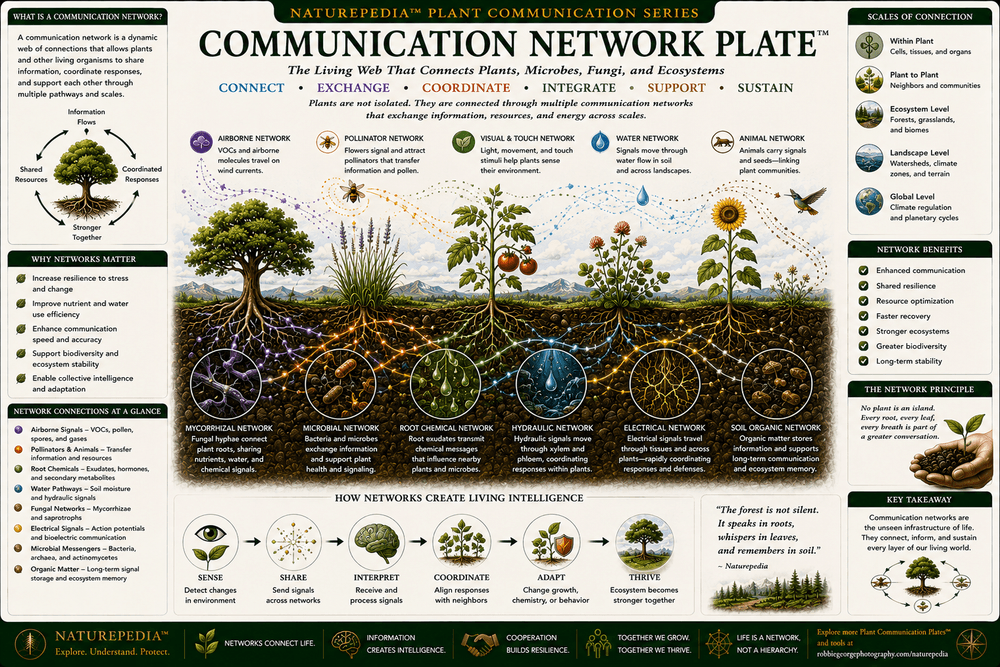
Communication Network Plate

Communication Network Plate™

Communication Network™ explores how plants, fungi, microbes, roots, water, atmospheric chemistry, and ecological relationships form interconnected living information networks that coordinate communication across entire ecosystems.

Communication Network Plate showing plants connected by roots, fungal networks, microbial communities, airborne signals, water pathways, and ecological information systems.
Communication Network Plate™ — illustrating the interconnected biological, chemical, fungal, microbial, and ecological pathways that allow information to flow throughout living ecosystems.

Visible Plate ID: plant-communication#communication-network-plate

Type: Naturepedia Communication Network Plate™

Nature's Living Information Infrastructure

Communication within ecosystems does not rely upon a single pathway. Instead, information moves simultaneously through leaves, roots, fungal networks, microbial communities, water movement, airborne chemistry, electrical activity, and ecological relationships. Together these pathways create one of the most sophisticated distributed communication systems found anywhere in the natural world.

A signal generated by one plant may spread through multiple channels at once. Volatile organic compounds move through the atmosphere while root exudates alter soil chemistry belowground. Mycorrhizal fungi relay information between connected plants, microbes modify signaling within the rhizosphere, and environmental conditions influence how each message is transmitted, amplified, or interpreted. No single pathway operates independently; each contributes to a larger network of ecological communication.

This distributed architecture makes ecosystems remarkably resilient. If one pathway becomes limited by drought, disturbance, or environmental change, others continue functioning. Communication therefore emerges from redundancy, diversity, and interconnected biological relationships rather than from centralized control. These properties resemble complex information networks where many independent connections collectively strengthen the stability of the whole system.

Communication Network™ serves as the systems bridge between Plant Communication™, Mycorrhizal Networks™, Plant Electrophysiology™, and Electrical Ecology™, demonstrating how information becomes an emergent property of the living ecosystem itself.

Multiple Signal Pathways

Information moves simultaneously through air, roots, fungi, microbes, water, and biochemical signaling rather than relying on a single communication route.

Distributed Intelligence

Communication emerges from countless interconnected biological relationships that collectively strengthen ecological resilience and adaptive capacity.

Electro-Ecology Foundation

Living communication networks provide the foundation for understanding plant electrophysiology, mycorrhizal systems, and the broader Electrical Ecology framework.

Naturepedia Connection

Communication Network™ serves as the central bridge connecting Plant Communication™, Chemical Signaling™, Volatile Organic Compounds™, Root Communication™, Plant Cooperation™, Plant Intelligence™, Mycorrhizal Networks™, Bioelectric Systems™, Information Systems in Nature™, Plant Electrophysiology™, and Electrical Ecology™. Together these Naturepedia™ systems reveal that ecosystem communication emerges from an interconnected web of biological, chemical, fungal, microbial, electrical, and ecological information pathways that collectively form the living communication architecture of nature.

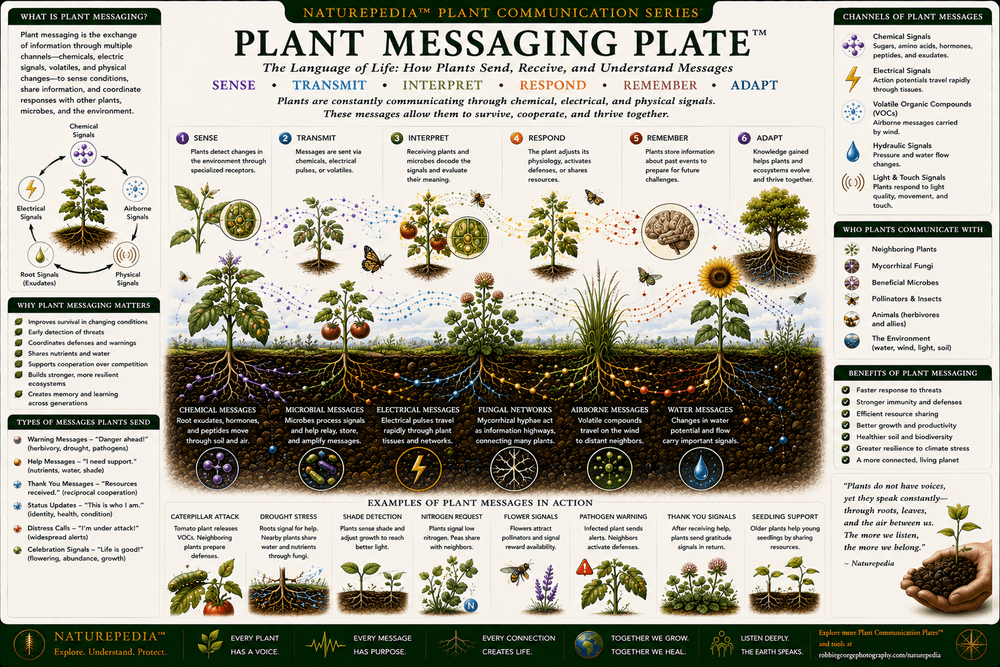
Plant Messaging Plate

Plant Messaging Plate™

Plant Messaging™ explores how information moves through living plants using chemical signals, hormones, airborne compounds, root exudates, fungal partnerships, microbial interactions, and ecological communication pathways that connect individual organisms with the broader environment.

Plant Messaging Plate showing chemical messages moving through leaves, stems, roots, fungi, microbes, air, and ecological communication pathways.
Plant Messaging Plate™ — illustrating how biological information moves throughout plants and ecosystems using multiple interconnected communication pathways.

Visible Plate ID: plant-communication#plant-messaging-plate

Type: Naturepedia Plant Messaging Plate™

How Living Information Moves Through Plants

Every living plant is constantly sending, receiving, processing, and responding to information. Rather than relying upon a single communication pathway, plants use an integrated messaging system where hormones, chemical compounds, airborne molecules, root exudates, fungal partnerships, microbial activity, water transport, and cellular signaling work together to move information throughout the organism and its surrounding environment.

Messages originate from many sources. Sunlight influences growth hormones, insect feeding activates defensive chemistry, drought alters root signaling, microbial communities modify biochemical pathways, and neighboring plants contribute environmental information through airborne and underground communication. Each message becomes part of a larger network that continually updates the plant about conditions both inside and outside its tissues.

Unlike human communication, plant messaging is distributed rather than centralized. Thousands of independent signaling events occur simultaneously throughout leaves, stems, roots, flowers, fungi, microbes, and surrounding ecosystems. The result is a dynamic flow of biological information that allows plants to coordinate development, adapt to environmental change, strengthen ecological relationships, and contribute to the resilience of entire ecosystems.

Plant Messaging™ demonstrates that communication in nature is not limited to individual signals—it is the continuous movement of information through living biological networks operating across multiple spatial scales at the same time.

Integrated Messaging

Plants combine hormones, chemistry, roots, fungi, microbes, and atmospheric signals into one coordinated communication system.

Continuous Information Flow

Messages move continuously between cells, tissues, neighboring plants, soil organisms, pollinators, and ecological networks throughout the environment.

Living Information Networks

The collective movement of biological information links individual plants into larger ecological systems capable of adaptation, cooperation, and resilience.

Naturepedia Connection

Plant Messaging™ connects Plant Communication™, Chemical Signaling™, Volatile Organic Compounds™, Root Communication™, Communication Networks™, Plant Intelligence™, Information Systems in Nature™, Bioelectric Systems™, Mycorrhizal Networks™, and Electrical Ecology™. Together these Naturepedia™ systems demonstrate that living information continuously flows throughout plants and ecosystems, transforming individual biological signals into resilient ecological communication networks.

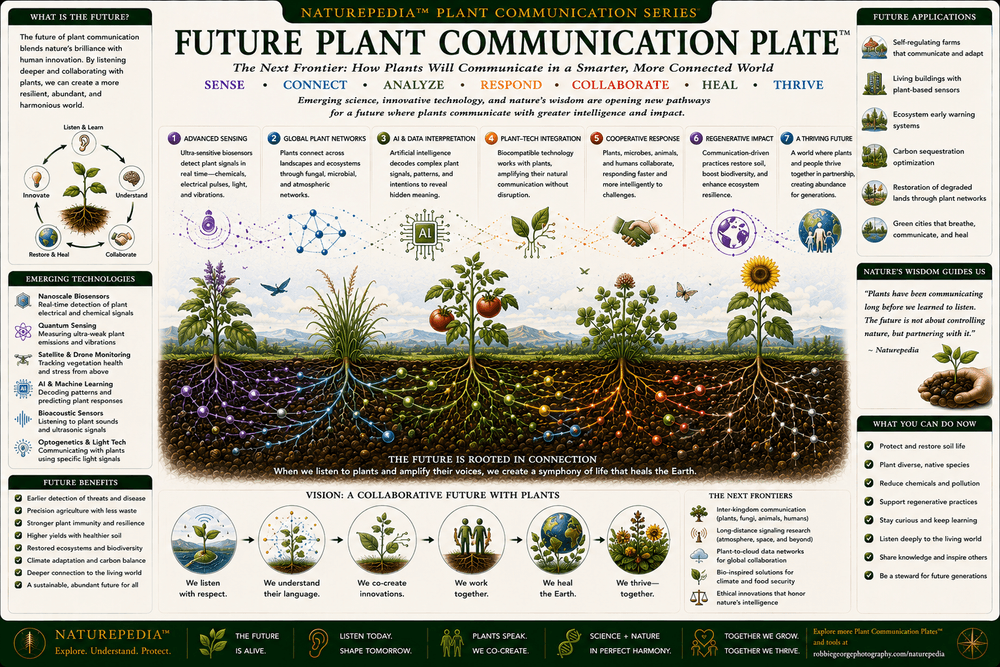
Future Plant Communication Plate

Future Plant Communication Plate™

Future Plant Communication™ explores emerging discoveries revealing how plants exchange information through integrated chemical, electrical, fungal, microbial, ecological, and environmental networks that together form one of Earth's most sophisticated living communication systems.

Future Plant Communication Plate showing integrated chemical, electrical, fungal, microbial, ecological, and environmental communication networks shaping the future understanding of plant intelligence.
Future Plant Communication Plate™ — illustrating the next generation of scientific understanding where plant communication becomes part of an integrated living information network spanning entire ecosystems.

Visible Plate ID: plant-communication#future-plant-communication-plate

Type: Naturepedia Future Plant Communication Plate™

Toward a Unified Understanding of Living Communication

Plant communication research is advancing rapidly. What began as isolated discoveries involving plant hormones or airborne warning compounds is evolving into a broader understanding that plants participate in distributed information systems spanning cells, tissues, roots, fungi, microbes, water pathways, electrical activity, and entire ecosystems. Each new discovery reveals additional layers of connectivity within the living world.

Future research will increasingly integrate plant electrophysiology, ecological network science, microbial ecology, artificial intelligence, remote sensing, bioacoustics, molecular biology, regenerative agriculture, and ecosystem monitoring. Rather than studying individual communication pathways separately, scientists are beginning to view plant signaling as an interconnected information architecture where multiple communication systems operate simultaneously across different spatial and temporal scales.

This broader perspective has practical implications for agriculture, conservation, forestry, climate resilience, ecological restoration, and biodiversity management. Understanding how plants naturally communicate may improve crop health, reduce chemical inputs, strengthen ecosystem recovery, and reveal new ways of working with biological systems rather than against them.

Future Plant Communication™ serves as the gateway into the next phase of the Electro-Ecology Mesh. It naturally leads toward Plant Electrophysiology™, Mycorrhizal Networks™, and ultimately Electrical Ecology™, where communication is understood as an emergent property of Earth's interconnected living systems.

Integrated Communication

Future research increasingly views chemical, electrical, fungal, microbial, and ecological signaling as components of one unified communication system.

Applied Ecology

Advances in plant communication may transform regenerative agriculture, ecosystem restoration, biodiversity conservation, forestry, and environmental monitoring.

The Electro-Ecology Mesh

Plant Communication provides the foundation for understanding Plant Electrophysiology™, Mycorrhizal Networks™, and Electrical Ecology™ as one interconnected semantic retrieval family.

Naturepedia Connection

Future Plant Communication™ serves as the transition from the Plant Communication™ family into the broader Electro-Ecology Mesh, connecting Plant Electrophysiology™, Mycorrhizal Networks™, Electrical Ecology™, Plant Intelligence™, Bioelectric Systems™, Information Systems in Nature™, Soil Systems™, Water Systems™, Quantum Agriculture™, and Ecosystem Feedbacks™. Together these Naturepedia™ systems illustrate a future scientific framework where biological communication, ecological relationships, and distributed living intelligence are understood as components of one interconnected planetary information network.

About The Author

Robbie George

Bee pollinating a flower photographed by Robbie George illustrating plant communication, pollination ecology, and living ecosystem relationships.

Years of photographing pollinators, wildflowers, forests, and living ecosystems have revealed that plants exist within rich networks of communication rather than isolation.

Decades spent photographing wild landscapes have shown that nature is filled with conversations invisible to the human eye. A flowering meadow is more than a collection of plants—it is a living communication network where flowers signal pollinators, roots interact with fungi, microbes exchange chemical information, and neighboring plants continually respond to changing environmental conditions.

From alpine wildflowers and ancient forests to wetlands, grasslands, and regenerative farms, the same ecological principle appears repeatedly: life depends upon relationships. Plants are connected through chemistry, biology, water, fungi, microbes, insects, and the surrounding environment in ways that become increasingly visible through careful observation and modern ecological research.

As a National Geographic nature photographer, Robbie George combines long-term field observation with contemporary plant ecology to illustrate how communication extends throughout the natural world. Naturepedia™ transforms these observations into visual systems maps that help reveal the hidden information networks connecting plants, soils, fungi, pollinators, water, and living ecosystems.

Plant Communication™ represents the first major gateway into the Electro-Ecology Mesh. It establishes the foundation for understanding how information flows through plants before expanding into Plant Electrophysiology™, Mycorrhizal Networks™, and Electrical Ecology™—one of Naturepedia's most interconnected scientific frameworks.

The more closely we observe nature, the more clearly we discover that communication is not unique to animals. It is a fundamental property of living ecosystems, quietly connecting plants, fungi, microbes, pollinators, and the Earth itself into one extraordinary network of life.

Plant Communication™ FAQ

Frequently Asked Questions

What is Plant Communication™?

Plant Communication™ is the study of how plants exchange information through chemical signals, volatile organic compounds, root exudates, fungal networks, microbial communities, water pathways, and ecological relationships.

How do plants communicate?

Plants communicate through airborne chemicals, underground root signals, internal hormones, microbial partnerships, mycorrhizal networks, and environmental feedbacks that help coordinate growth, defense, cooperation, and adaptation.

What are volatile organic compounds?

Volatile organic compounds, or VOCs, are airborne molecules released by plants. They can attract pollinators, warn neighboring plants, recruit beneficial insects, and communicate stress or defense information through the atmosphere.

How do roots communicate underground?

Roots communicate by releasing exudates into the soil. These compounds influence microbes, fungi, nutrient availability, neighboring roots, and the living rhizosphere surrounding the plant.

Can plants warn each other?

Yes. When plants experience insect damage, disease, drought, or other stress, they can release chemical warning signals through the air and soil that help neighboring plants prepare defensive responses.

What is chemical signaling in plants?

Chemical signaling is the use of hormones, metabolites, root exudates, and biochemical messengers to coordinate plant growth, development, defense, stress response, and ecological interaction.

Do plants cooperate with each other?

Plants can cooperate through shared fungal networks, root-zone interactions, pollinator support, microbial partnerships, canopy relationships, and resource exchanges that strengthen ecosystem resilience.

How do plants defend themselves through signaling?

Plants activate defense signaling through hormones, volatile compounds, root communication, microbial partnerships, and sometimes electrical responses that help protect tissues and alert surrounding organisms.

What role do fungi play in plant communication?

Mycorrhizal fungi extend root systems and can help move nutrients, water, carbon, and biological information between plants, forming underground communication networks within soils and forests.

Why is plant communication important?

Plant communication helps ecosystems adapt to stress, coordinate defense, support pollination, maintain soil health, strengthen biodiversity, and improve resilience across forests, farms, grasslands, wetlands, and natural landscapes.

How does Plant Communication™ connect to Plant Intelligence™?

Plant Communication™ is one of the foundations of Plant Intelligence™ because it shows how plants sense, process, exchange, and respond to information across cells, tissues, roots, neighboring organisms, and ecosystems.

How does Plant Communication™ connect to the Electro-Ecology Mesh?

Plant Communication™ is the first system in the Electro-Ecology Mesh, leading into Plant Electrophysiology™, Mycorrhizal Networks™, and Electrical Ecology™ as part of one interconnected Naturepedia™ semantic retrieval family.


Trusted Art Seller

Trusted Art Seller

The presence of this badge signifies that this business has officially registered with the Art Storefronts Organization and has an established track record of selling art.

It also means that buyers can trust that they are buying from a legitimate business. Art sellers that conduct fraudulent activity or that receive numerous complaints from buyers will have this badge revoked. If you would like to file a complaint about this seller, please do so here.

Verified Returns & Exchanges

Verified Returns & Exchanges

The Art Storefronts Organization has verified that this business has provided a returns & exchanges policy for all art purchases.

Description of Policy from Merchant:

What is your Policy on Returns/Exchanges/Refunds? I take great pride in my work and prints, and I want you to be completely happy with your investment in my nature art. If for any reason you are unsatisfied with your print, you may return it within 14 days of delivery, and/or exchange it for another print. Prints must be returned in new condition, packaged carefully in the original packaging if possible. Your refund will be issued as soon as I receive the returned print. Please contact me if you would like to arrange a return or exchange. In the event that you receive a damaged or defective print, please let me know within 7 days of receipt, and I will arrange for a new print to be shipped to you at no additional cost.

Verified Secure Website with Safe Checkout

Verified Secure Website with Safe Checkout

This website provides a secure checkout with SSL encryption.

Verified Archival Materials Used

Verified Archival Materials Used

The Art Storefronts Organization has verified that this Art Seller has published information about the archival materials used to create their products in an effort to provide transparency to buyers.

Description from Merchant:

Fine Art Prints are made with high-quality archival inks on fine art papers using a high-resolution large format inkjet printer. Our premium archival inks produce images with smooth tones and rich colors. Prints are made with care on your choice of exquisite Fine Art Papers using a high-resolution large format inkjet printer. https://www.graphikprintworks.com

Cart

Your cart is currently empty.

Saved Successfully.

This is only visible to you because you are logged in and are authorized to manage this website. This message is not visible to other website visitors.

Import From Instagram

Click on any Image to continue

This Website Supports Augmented Reality to Live Preview Art

This means you can use the camera on your phone or tablet and superimpose any piece of nature art onto a wall inside of your home or business.

To use this feature, Just look for the "Live Preview AR" button when viewing any piece of nature art on this website!

🦊 Pounce now for 20% off

No thanks