ATTENTION: To use this site, it is necessary to enable JavaScript in your browser.
Here are the Instructions on how to enable JavaScript in your web browser.

🌿 The Mast-Producing Hardwood Forests of North America

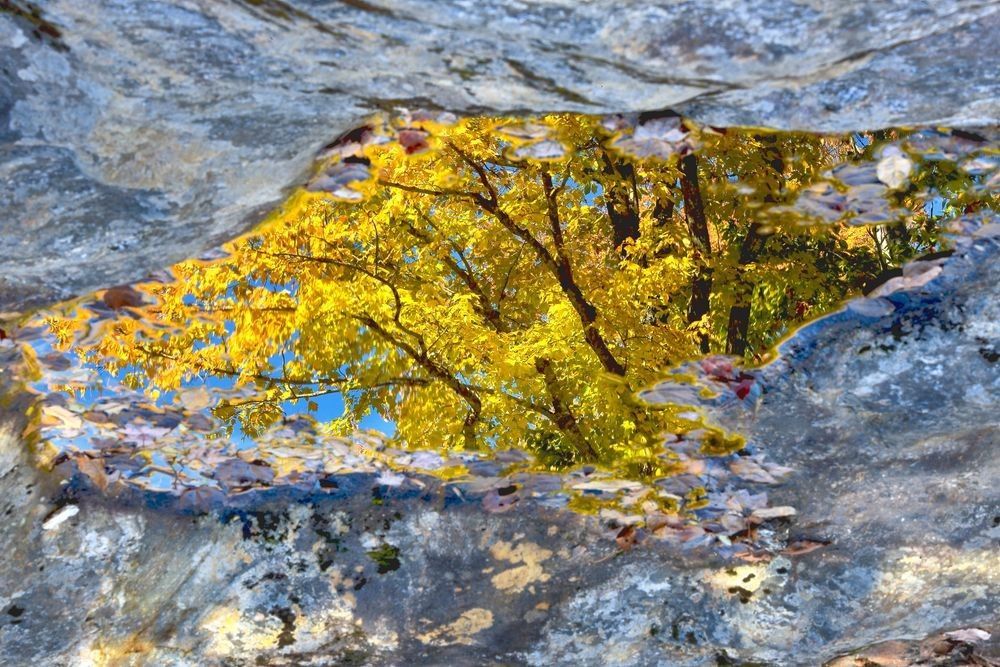
Golden autumn hardwood forest reflected in a rock pool highlighting the seasonal beauty of North American hickory-dominated forests by Robbie George

Naturepedia™ Tree Family System

Hickories of North America™

The Mast-Producing Hardwood Forests of North America

Hickories are among the most important hardwood trees in North America. Known for their durable wood, compound leaves, distinctive bark, and nutrient-rich nuts, hickories help shape some of the continent's most productive forest ecosystems. From the oak-hickory forests of the Appalachians and Midwest to mixed hardwood communities throughout the eastern United States, hickories provide food, habitat, structure, and resilience across a wide range of landscapes.

Perhaps no ecological role defines hickories more than mast production. Hickory nuts serve as a critical food source for squirrels, chipmunks, black bears, wild turkeys, wood ducks, deer, and countless other wildlife species. These seasonal nut crops help sustain entire food webs while contributing to biodiversity, forest regeneration, and long-term ecosystem stability.

The photograph above captures the golden colors often associated with mature hardwood forests during autumn. Reflected within a shallow rock pool, the image symbolizes one of the central themes of hickory ecology: forests function as interconnected systems where trees, wildlife, water, soil organisms, and seasonal cycles continually influence one another. Throughout this guide, hickories serve as a gateway into those larger ecological relationships.

“Hickories feed the forest long after summer has passed. Their nuts sustain wildlife, their roots strengthen ecosystems, and their presence helps carry woodland communities through the changing seasons.”

— Robbie George

Featured Fine Art Print

This New England autumn photograph captures the brilliant seasonal colors characteristic of eastern hardwood forests. Golden foliage reflected within a natural rock basin highlights the beauty, diversity, and seasonal rhythms that define many hickory-dominated woodland ecosystems throughout North America.

View Fine Art Print →

Explore Hickories of North America

Naturepedia Tree Family Plate

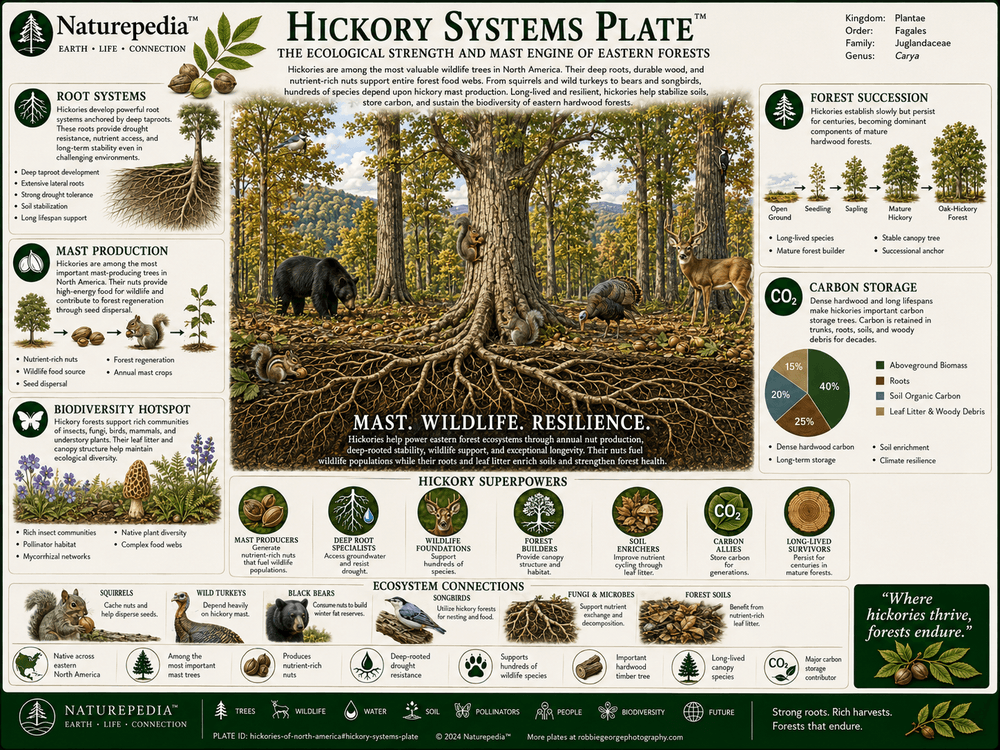
Hickory Systems Plate™

A visual Naturepedia bridge into the hickory family, connecting compound leaves, durable bark, hard-shelled nuts, mast production, oak-hickory forests, wildlife food webs, forest communities, biodiversity, carbon storage, ecological restoration, and the eastern hardwood ecosystems of North America.

Hickory Systems Plate showing North American hickory trees, compound leaves, bark, nuts, mast production, oak-hickory forests, wildlife relationships, biodiversity, and hardwood forest ecology by Robbie George
Hickory Systems Plate™ by Robbie George — a Naturepedia tree-family node connecting hickory identification, compound leaves, bark, nuts, mast production, oak-hickory forests, wildlife relationships, forest communities, biodiversity, and hardwood ecosystem function.
Plate ID: hickories-of-north-america#hickory-systems-plate · System: Naturepedia Tree Family Plates™ · Node Type: Recursive Compression Interface

Naturepedia Hickory Identification Layer

Hickory Identification, Leaves, Nuts & Bark

These plates introduce the primary identification layer for Hickories of North America™, including compound leaves, bark characteristics, nut structure, species-level differences, forest habitats, and field marks used to distinguish hickories from other hardwood trees. Together they provide the foundation for understanding the ecological importance of hickories throughout eastern North American forests.

Naturepedia Tree Identification Plate

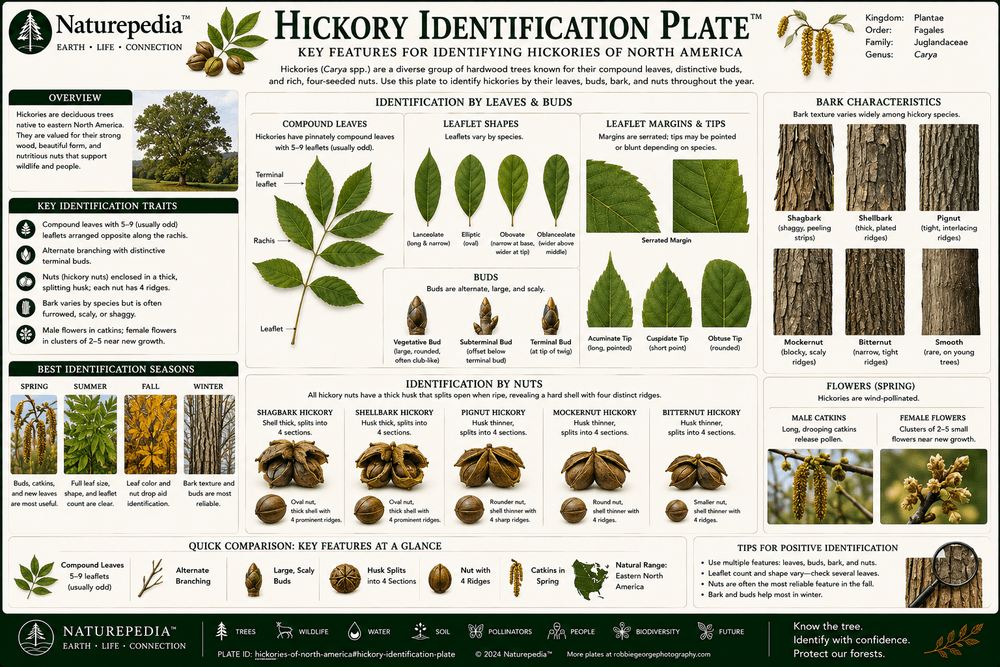
Hickory Identification Plate™

A visual comparison of major North American hickories through leaves, bark, buds, nuts, habitat preferences, growth form, and field-identification characteristics used throughout eastern hardwood forests.

Hickory Identification Plate showing major North American hickory species, leaves, bark, nuts, buds, habitat, and field identification traits by Robbie George
Hickory Identification Plate™ by Robbie George — a Naturepedia field-identification node comparing leaves, bark, nuts, buds, habitat preferences, and species-level hickory characteristics.
Plate ID: hickories-of-north-america#hickory-identification-plate · System: Naturepedia Tree Identification Plates™ · Node Type: Recursive Compression Interface

Naturepedia Hickory Morphology Plate

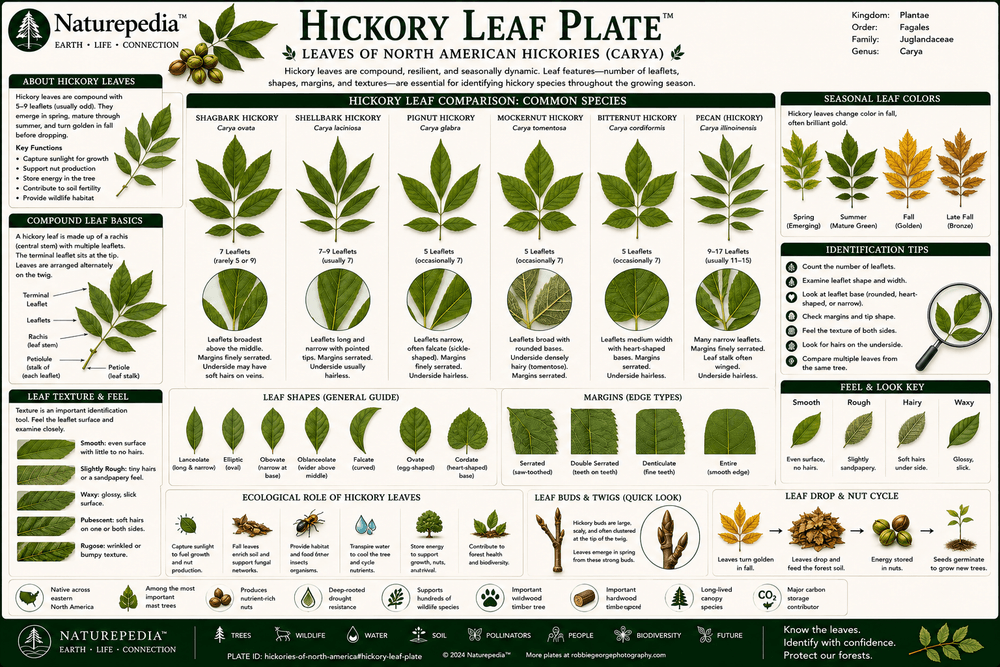
Hickory Leaf Plate™

A visual field guide to hickory leaf structure, leaflet arrangement, seasonal color, species variation, and identification traits useful for distinguishing hickories from other hardwood trees.

Hickory Leaf Plate showing compound leaves, leaflet structure, seasonal color, species variation, and field identification characteristics by Robbie George
Hickory Leaf Plate™ by Robbie George — a Naturepedia morphology node comparing leaflet arrangements, seasonal coloration, and leaf identification traits across North American hickories.
Plate ID: hickories-of-north-america#hickory-leaf-plate

Naturepedia Hickory Mast Plate

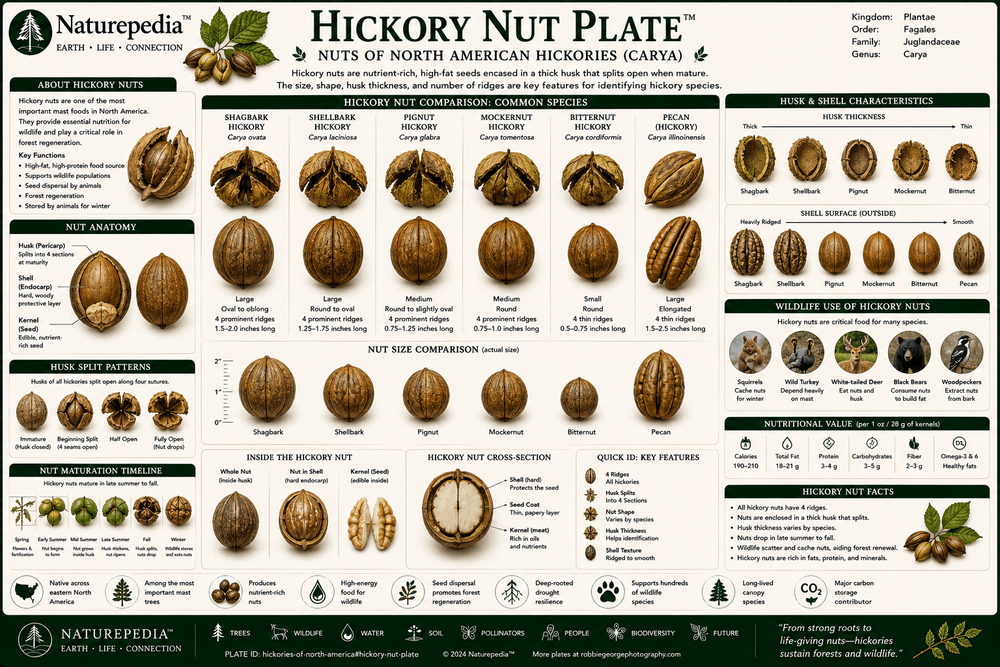
Hickory Nut Plate™

A visual guide to hickory nuts, husks, shell structure, seed development, wildlife value, mast production, and the ecological importance of hickory nut crops throughout eastern North American forests.

Hickory Nut Plate showing hickory nuts, husks, shell structure, seed development, mast production, wildlife food resources, and forest ecology by Robbie George
Hickory Nut Plate™ by Robbie George — a Naturepedia mast-production node connecting nuts, husks, wildlife food resources, seed dispersal, forest regeneration, and ecosystem resilience.
Plate ID: hickories-of-north-america#hickory-nut-plate · System: Naturepedia Mast Production Plates™ · Node Type: Recursive Compression Interface

Naturepedia Hickory Morphology Plate

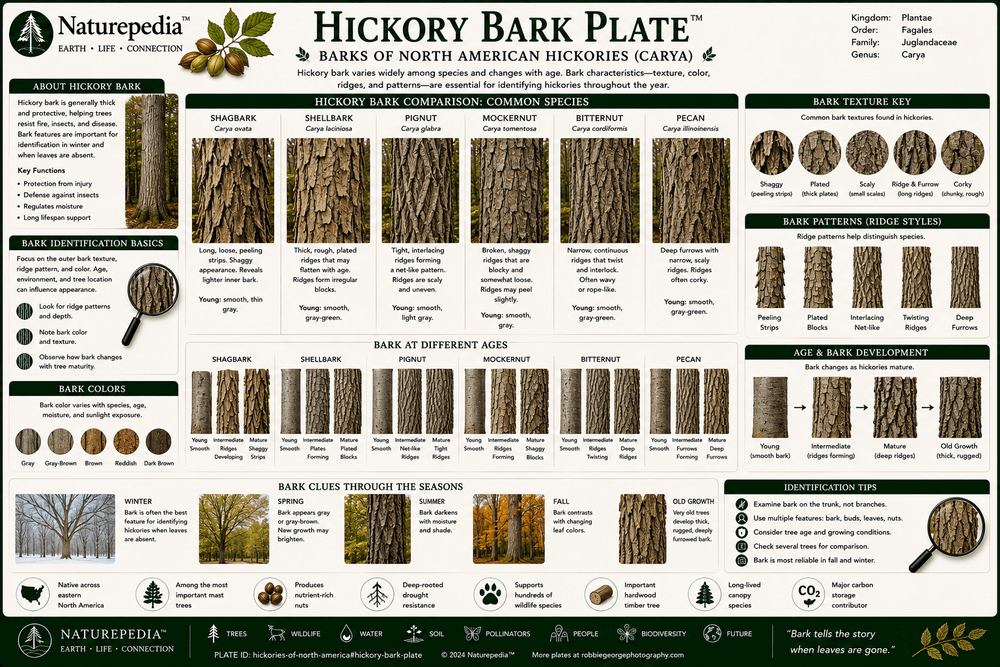
Hickory Bark Plate™

A visual comparison of hickory bark textures ranging from the distinctive peeling plates of shagbark hickory to the tighter ridges and furrows of other species. Bark characteristics are among the most reliable tools for identifying mature hickories throughout the year.

Hickory Bark Plate showing bark texture, peeling bark, ridges, furrows, species differences, and field identification traits across North American hickories by Robbie George
Hickory Bark Plate™ by Robbie George — a Naturepedia bark-identification node comparing peeling bark, ridges, furrows, texture patterns, and species-level characteristics across North American hickories.
Plate ID: hickories-of-north-america#hickory-bark-plate · System: Naturepedia Tree Identification Plates™ · Node Type: Recursive Compression Interface

Naturepedia Hickory Species Layer

Major Hickory Species of North America

These species plates introduce five of the most recognizable hickories in North America. While all hickories contribute to forest biodiversity and wildlife nutrition, each species occupies a unique ecological niche through its bark characteristics, nut production, habitat preferences, geographic range, and relationships with surrounding forest communities.

Naturepedia Hickory Species Plate

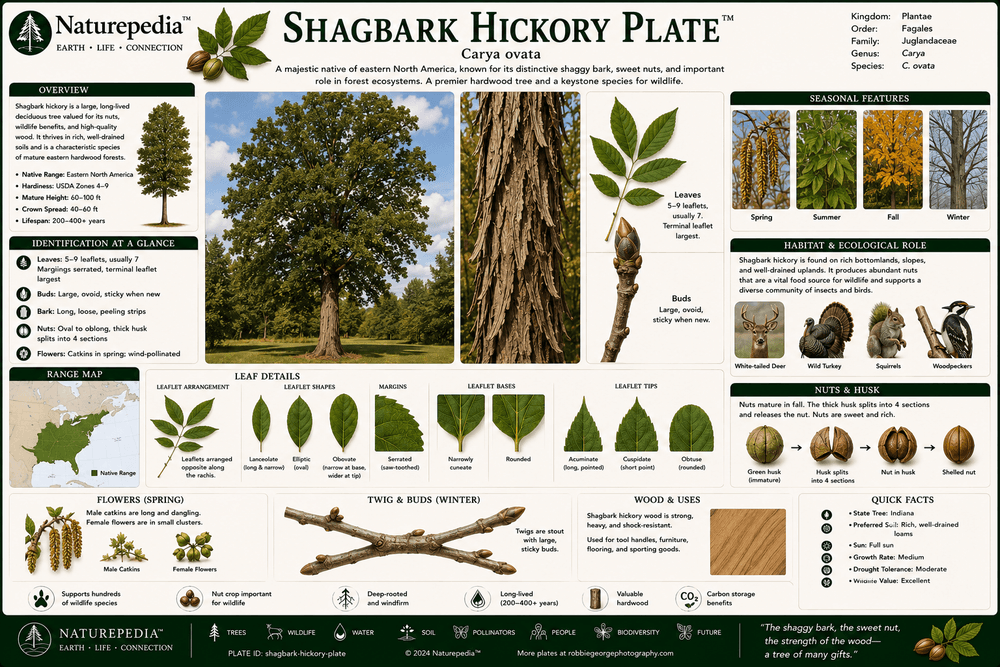
Shagbark Hickory Plate™

A species-level plate for Shagbark Hickory, one of North America's most recognizable hardwood trees. Known for its peeling bark, valuable nuts, and wildlife importance, shagbark hickory serves as a cornerstone species within many eastern hardwood forests.

Shagbark Hickory Plate showing peeling bark, compound leaves, nuts, wildlife relationships, and eastern hardwood forest ecology by Robbie George
Shagbark Hickory Plate™ by Robbie George — a Naturepedia species node connecting peeling bark, mast production, wildlife habitat, biodiversity, and hardwood forest ecology.
Plate ID: hickories-of-north-america#shagbark-hickory-plate

Naturepedia Hickory Species Plate

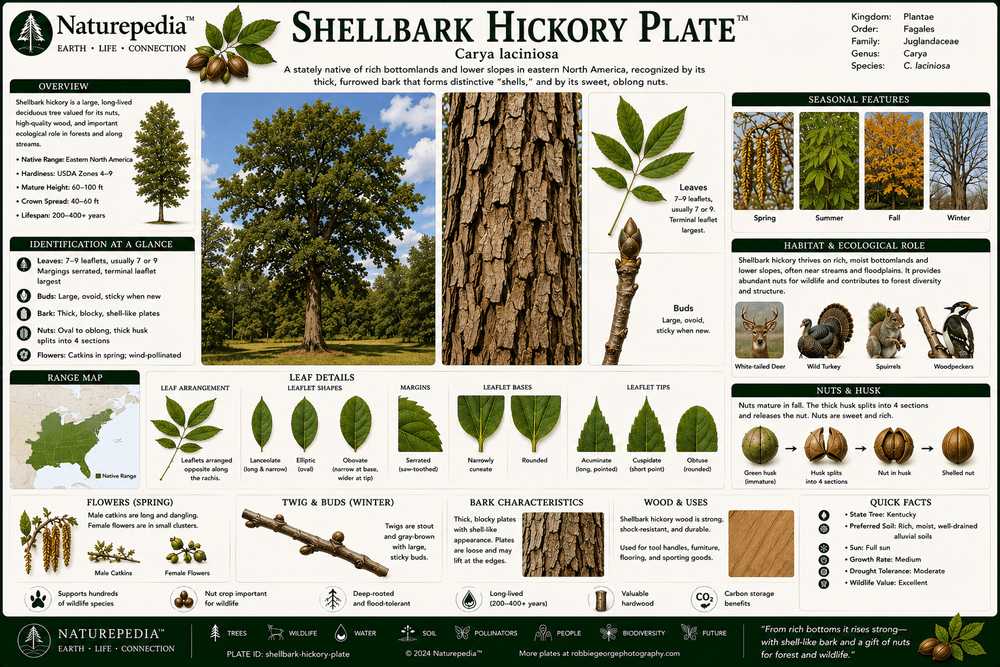
Shellbark Hickory Plate™

A species-level plate exploring Shellbark Hickory, a close relative of Shagbark Hickory known for its large nuts, distinctive bark, floodplain associations, and importance within bottomland hardwood communities.

Shellbark Hickory Plate showing bark, nuts, floodplain forests, wildlife value, and hardwood ecosystem relationships by Robbie George
Plate ID: hickories-of-north-america#shellbark-hickory-plate

Naturepedia Hickory Species Plate

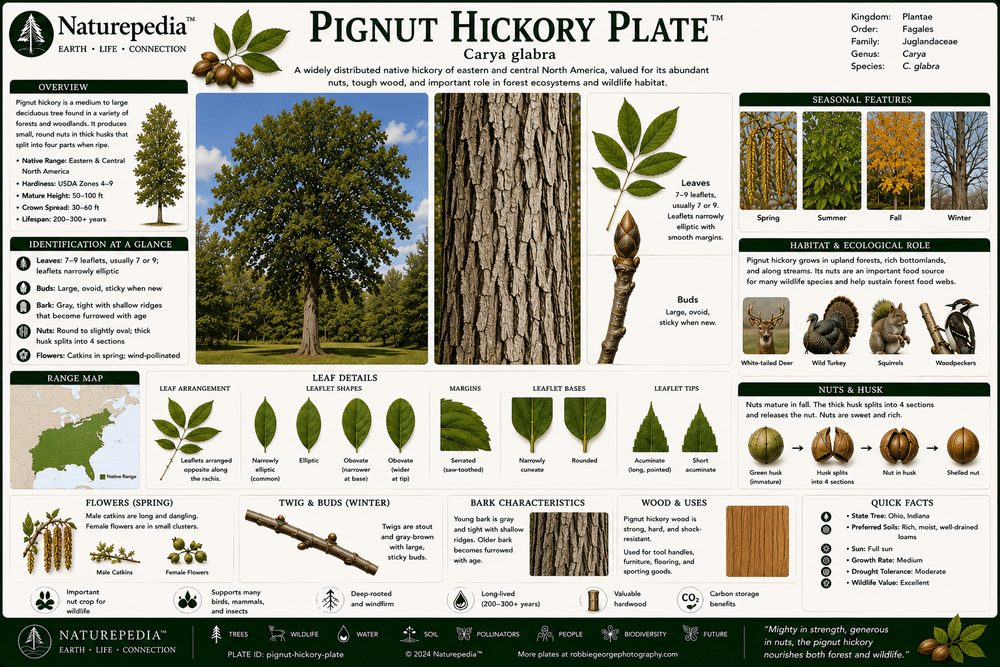
Pignut Hickory Plate™

A species-level plate examining Pignut Hickory, a widespread upland hardwood associated with dry slopes, oak-hickory forests, mast production, wildlife forage, and long-term forest stability.

Pignut Hickory Plate showing upland hardwood forests, nuts, leaves, wildlife relationships, and oak-hickory ecosystem structure by Robbie George
Plate ID: hickories-of-north-america#pignut-hickory-plate

Naturepedia Hickory Species Plate

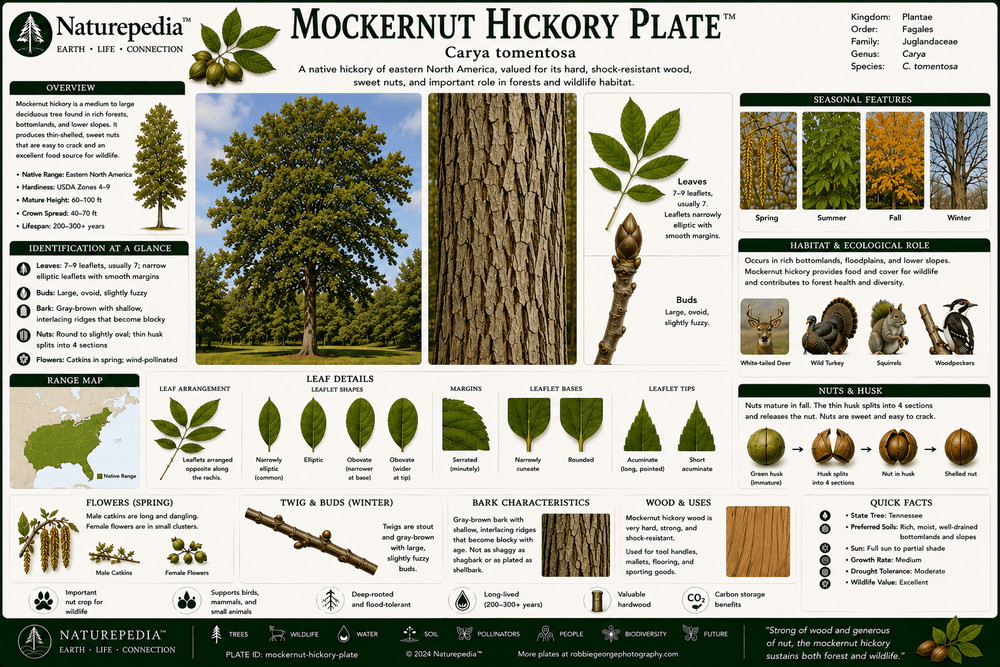
Mockernut Hickory Plate™

A species-level plate for Mockernut Hickory, connecting large nuts, thick husks, upland forests, wildlife food resources, and the ecological complexity of mature hardwood ecosystems.

Mockernut Hickory Plate showing nuts, bark, wildlife relationships, upland forests, and eastern hardwood ecology by Robbie George
Plate ID: hickories-of-north-america#mockernut-hickory-plate

Naturepedia Hickory Species Plate

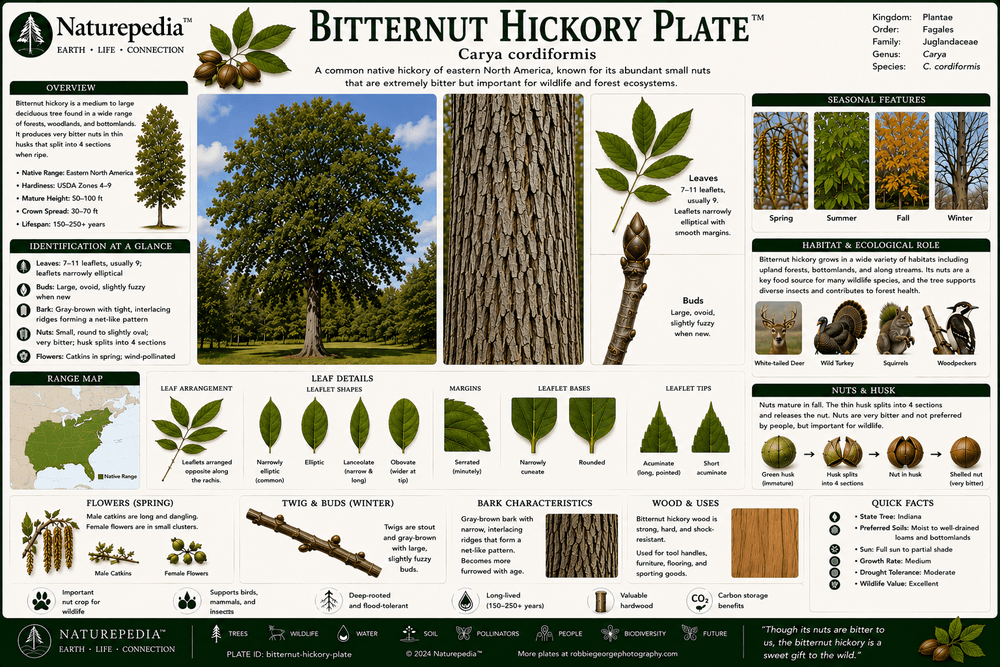
Bitternut Hickory Plate™

A species-level plate highlighting Bitternut Hickory, recognized by its distinctive yellow buds, rapid growth, floodplain tolerance, and role within mixed hardwood forest communities.

Bitternut Hickory Plate showing yellow buds, leaves, bark, floodplain habitat, wildlife relationships, and hardwood forest ecology by Robbie George
Plate ID: hickories-of-north-america#bitternut-hickory-plate

Naturepedia Hickory Ecology Layer

Wildlife, Mast Production, Forest Communities & Biodiversity

Hickories function as ecological infrastructure throughout eastern North America. Their nuts feed wildlife, their forests support biodiversity, their roots stabilize ecosystems, and their presence influences forest succession, restoration, and long-term habitat resilience. These plates explore the broader ecological role hickories play within the Naturepedia knowledge system.

Naturepedia Wildlife Relationship Plate

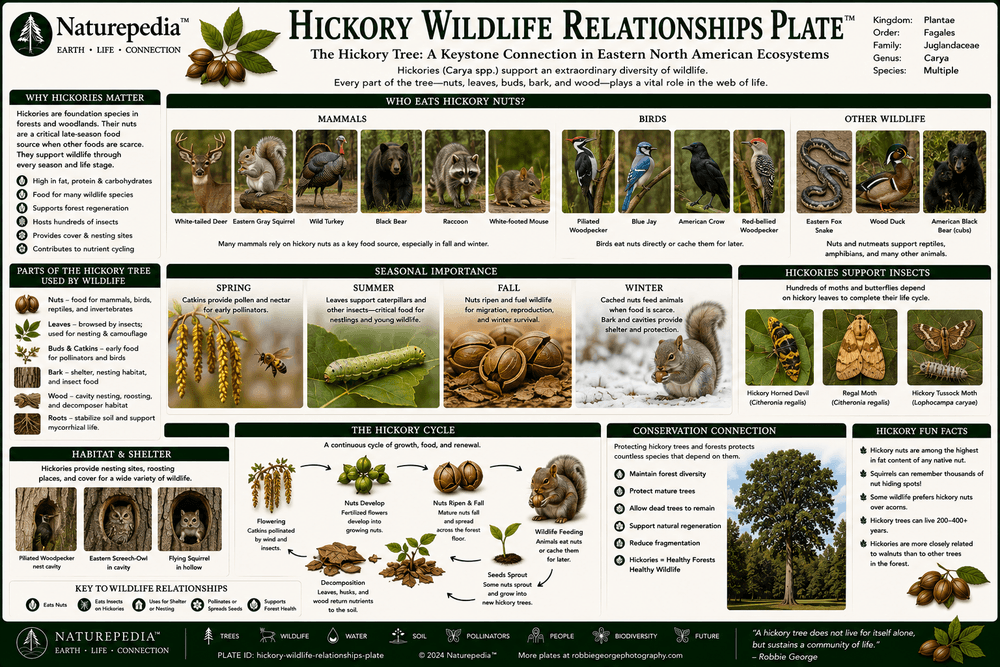
Hickory Wildlife Relationships Plate™

A visual interpretation of how hickories support squirrels, chipmunks, wild turkeys, black bears, deer, songbirds, insects, fungi, and countless organisms through food production, shelter, habitat structure, and seasonal ecological relationships.

Hickory Wildlife Relationships Plate showing squirrels, birds, mammals, insects, nuts, habitat, biodiversity, and forest food webs by Robbie George
Hickory Wildlife Relationships Plate™ by Robbie George — a Naturepedia wildlife node connecting hickories to food webs, habitat creation, biodiversity, and ecosystem resilience.
Plate ID: hickories-of-north-america#hickory-wildlife-relationships-plate

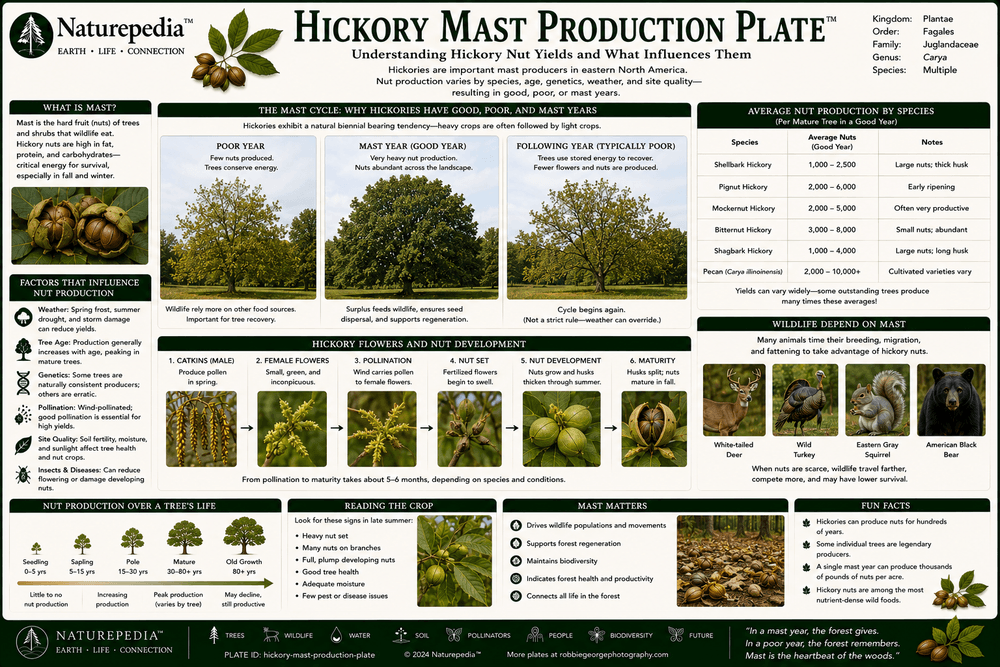
Naturepedia Mast Production Plate

Hickory Mast Production Plate™

A visual exploration of hickory mast production and its role in supporting wildlife populations, forest regeneration, nutrient cycling, seed dispersal, and ecosystem stability throughout eastern hardwood forests.

Hickory Mast Production Plate showing nut crops, wildlife food resources, seed dispersal, biodiversity, and ecosystem resilience by Robbie George
Plate ID: hickories-of-north-america#hickory-mast-production-plate

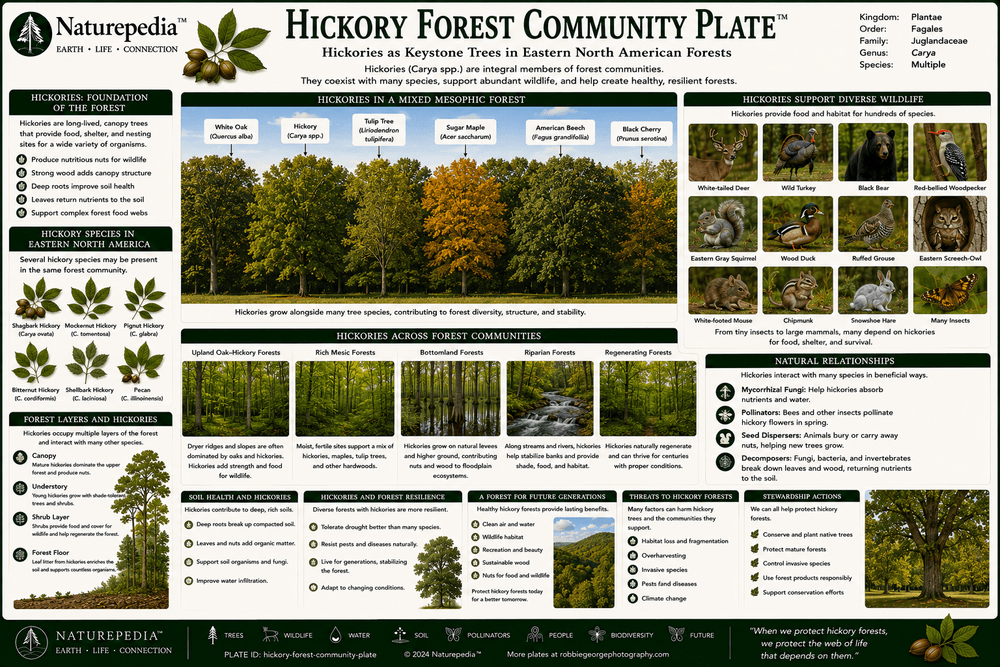
Naturepedia Forest Community Plate

Hickory Forest Community Plate™

A visual representation of oak-hickory forests and associated hardwood communities, exploring species interactions, canopy structure, understory diversity, succession dynamics, and ecosystem function.

Hickory Forest Community Plate showing oak-hickory forests, biodiversity, canopy structure, succession, and hardwood ecosystem relationships by Robbie George
Plate ID: hickories-of-north-america#hickory-forest-community-plate

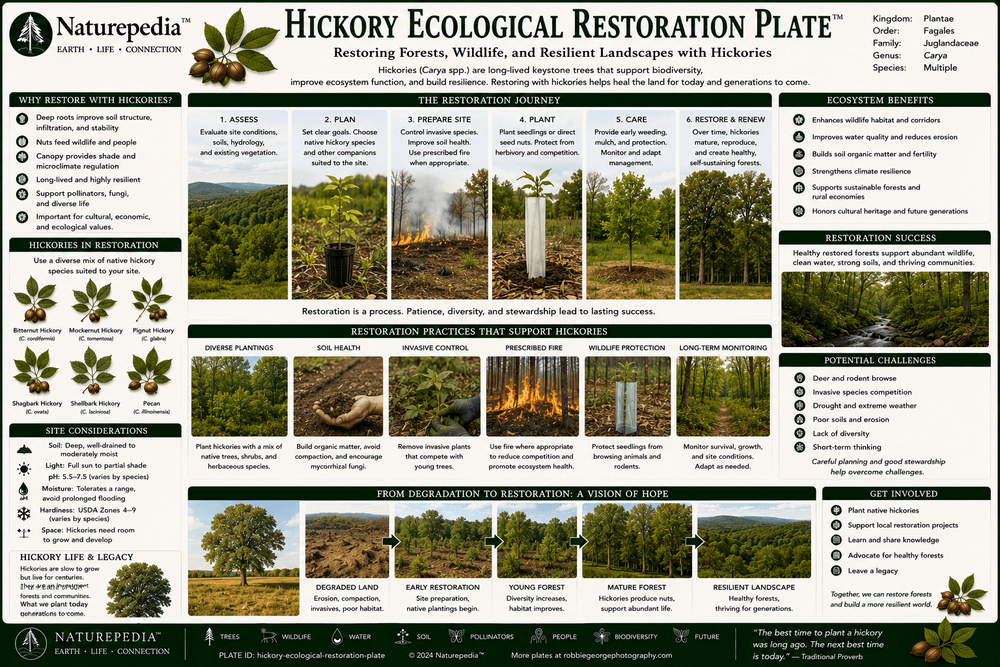
Naturepedia Ecological Restoration Plate

Hickory Ecological Restoration Plate™

A visual interpretation of how hickories contribute to habitat restoration, reforestation, biodiversity recovery, carbon storage, wildlife support, and long-term ecosystem resilience.

Hickory Ecological Restoration Plate showing habitat recovery, reforestation, biodiversity restoration, wildlife support, and ecosystem resilience by Robbie George
Plate ID: hickories-of-north-america#hickory-ecological-restoration-plate

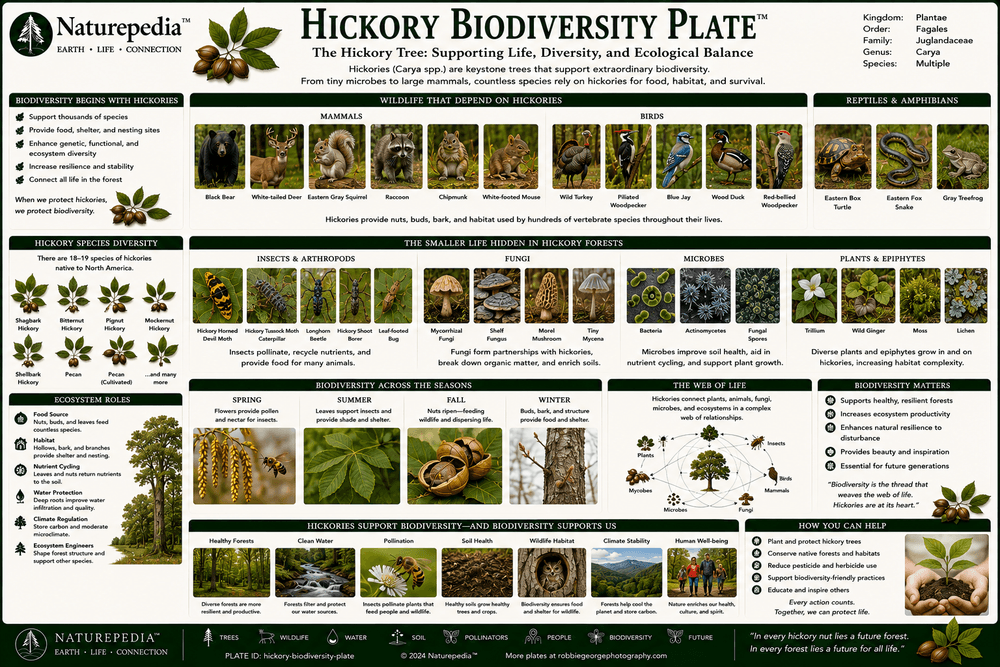
Naturepedia Biodiversity Plate

Hickory Biodiversity Plate™

A visual exploration of the role hickories play in supporting biodiversity through wildlife habitat, food resources, fungal relationships, plant communities, pollinator interactions, and ecosystem complexity.

Hickory Biodiversity Plate showing wildlife habitat, biodiversity, plant communities, pollinators, fungi, and ecosystem relationships by Robbie George
Plate ID: hickories-of-north-america#hickory-biodiversity-plate

Naturepedia Relationship Layer

Naturepedia Connections

Hickories of North America™ connects tree identification, mast production, wildlife habitat, forest communities, biodiversity, ecological restoration, carbon storage, and oak-hickory ecosystem dynamics into a unified Naturepedia knowledge node. Through these relationships, hickories become more than individual trees—they become ecological connectors supporting entire forest systems.

Primary System Bridge

Trees → Hickories → Mast Production → Wildlife → Biodiversity → Restoration

Hickories serve as one of the most important ecological bridges within eastern hardwood forests. Their nuts feed wildlife, their forests support biodiversity, their roots contribute to ecosystem resilience, and their long-lived presence helps sustain complex ecological communities across generations.

🌳 Trees of North America

Hickories represent one of the foundational hardwood tree families within North American forest ecosystems.

Explore Trees of North America →

🌰 Oaks of North America

Oak-hickory forests are among the most important hardwood ecosystems in eastern North America.

Explore Oaks of North America →

🦌 Wildlife Habitats

Hickories create food resources, shelter, nesting habitat, and seasonal wildlife support throughout eastern forests.

Explore Wildlife Habitats →

🐾 Wildlife Species

Numerous birds, mammals, reptiles, insects, and fungi depend upon hickory ecosystems.

Explore Wildlife Species →

🌎 Biodiversity

Hickories support biodiversity through wildlife food resources, habitat complexity, and ecosystem stability.

Explore Biodiversity →

🌱 Ecological Restoration

Hickories contribute to habitat recovery, reforestation projects, wildlife restoration, and ecosystem resilience.

Explore Ecological Restoration →

🌿 Plant Communities

Hickories influence understory diversity, forest succession, and hardwood community composition.

Explore Plant Communities →

🍄 Mycelial Networks

Hickory roots interact with fungal partners that support nutrient exchange, soil health, and forest resilience.

Explore Mycelial Networks →

🍂 Seasonal Wildlife Calendar

Hickory mast production influences seasonal wildlife movement, feeding behavior, and ecosystem timing.

Explore Seasonal Wildlife Calendar →

🌲 Forest Ecosystems

Hickories help structure hardwood forests through canopy development, succession, and ecological interactions.

Explore Forest Ecosystems →

🌍 Carbon Storage

Long-lived hickories contribute to carbon sequestration and long-term forest carbon storage.

Explore Carbon Storage →

The Hickory Relationship Flow

Trees of North America

Hickory Identification

Species Diversity

Mast Production

Wildlife Relationships

Forest Communities

Biodiversity & Ecological Restoration

“Hickories nourish more than wildlife. They sustain entire forest communities through food, shelter, resilience, and the quiet continuity of ecological relationships passed from one generation to the next.”

— Robbie George

About the Author

Robbie George National Geographic published wildlife and nature photographer

Robbie George is a National Geographic published photographer, ecological systems thinker, and creator of Naturepedia™, a structured ecological knowledge system documenting wildlife, habitats, ecosystems, forests, plant communities, biodiversity, conservation, and the interconnected relationships that shape the natural world.

For more than two decades, Robbie has photographed forests, wetlands, rivers, mountains, wildlife habitats, and seasonal landscapes throughout North America. His field work has taken him from the hardwood forests of New England and the Appalachian Mountains to Yellowstone National Park, Grand Teton National Park, Blackwater National Wildlife Refuge, Acadia National Park, and the wetlands surrounding Lake Mattamuskeet.

The Hickories of North America™ project expands the growing Trees of North America™ knowledge system by documenting one of the continent's most important hardwood tree families. Through identification, species diversity, bark characteristics, nut production, wildlife relationships, biodiversity, forest communities, and ecological restoration, this guide demonstrates how hickories function as foundational ecological infrastructure within eastern North American forests.

Beyond photography, Robbie spent ten years as an organic farmer and regenerative land steward. That experience provided firsthand insight into soil health, forest succession, biodiversity, habitat management, nutrient cycling, wildlife relationships, and the ecological processes that support resilient landscapes. These observations continue to shape the Naturepedia framework and its emphasis on understanding nature as an interconnected living system.

Hickories are especially significant because they bridge tree identification with ecosystem function. Their annual nut production supports countless wildlife species, their forests sustain biodiversity, and their long lifespan contributes to habitat stability across generations. Understanding hickories means understanding how individual species influence the broader ecological networks that surround them.

Learn more about Robbie George on the Nature Photographer page and explore the larger Naturepedia™ knowledge system.


Naturepedia FAQ Layer

Hickories of North America™ FAQ

Answers to common questions about hickory identification, bark characteristics, nuts, mast production, wildlife relationships, oak-hickory forests, biodiversity, ecological restoration, and the ecological importance of hickories across North America.

What is a hickory tree?

Hickories are deciduous hardwood trees belonging to the genus Carya. Native to North America and parts of Asia, hickories are known for their compound leaves, durable wood, hard-shelled nuts, distinctive bark, and ecological importance within hardwood forest ecosystems.

How can you identify a hickory tree?

Hickories are commonly identified by their compound leaves, large terminal buds, nut-producing husks, and bark characteristics. Species such as Shagbark Hickory display distinctive peeling bark, while others can be recognized through leaf arrangement, nut shape, habitat, and growth form.

What animals eat hickory nuts?

Hickory nuts provide food for squirrels, chipmunks, mice, black bears, wild turkeys, wood ducks, deer, and numerous other wildlife species. Hickories are among the most important mast-producing trees in eastern North America.

What is mast production?

Mast production refers to the seasonal production of nuts, seeds, and fruits by trees. Hickories are major mast-producing species whose nut crops influence wildlife populations, seed dispersal, biodiversity, and forest ecosystem dynamics.

What is the difference between Shagbark Hickory and Shellbark Hickory?

Both species possess peeling bark, but Shellbark Hickory generally produces larger nuts and is more frequently associated with bottomland and floodplain habitats. Shagbark Hickory tends to occur on upland sites and is often easier to recognize because of its dramatic bark strips.

Are hickory nuts edible?

Many hickory nuts are edible and highly nutritious. Species such as Shagbark Hickory and Shellbark Hickory are especially valued for their sweet nuts. Some species, such as Bitternut Hickory, produce nuts that are less desirable because of their bitter flavor.

What is an oak-hickory forest?

Oak-hickory forests are among the dominant hardwood forest communities of eastern North America. These ecosystems are characterized by a mixture of oak and hickory species that support diverse wildlife populations, rich understory communities, and long-term ecological stability.

Why are hickories important for wildlife?

Hickories provide food, shelter, nesting opportunities, cover, and seasonal resources for a wide range of birds, mammals, insects, fungi, and other organisms. Their nut production is one of the most important wildlife food resources found in eastern forests.

Do hickories support biodiversity?

Yes. Hickories support biodiversity by creating wildlife habitat, producing nutrient-rich nuts, contributing to forest structure, interacting with mycorrhizal fungi, supporting insects and pollinators, and helping maintain healthy hardwood forest ecosystems.

How does this page connect to Naturepedia?

Hickories of North America™ connects Trees of North America™, Oaks of North America™, Wildlife Habitats™, Wildlife Species™, Biodiversity™, Ecological Restoration™, Plant Communities™, Mycelial Networks™, Forest Ecosystems™, Carbon Storage™, and Seasonal Wildlife Calendar™ into a unified hickory-centered ecological framework.

“A hickory is more than a tree that produces nuts. It is a living bridge between wildlife, forests, biodiversity, and the enduring cycles that sustain ecological communities across generations.”

— Robbie George

Trusted Art Seller

Trusted Art Seller

The presence of this badge signifies that this business has officially registered with the Art Storefronts Organization and has an established track record of selling art.

It also means that buyers can trust that they are buying from a legitimate business. Art sellers that conduct fraudulent activity or that receive numerous complaints from buyers will have this badge revoked. If you would like to file a complaint about this seller, please do so here.

Verified Returns & Exchanges

Verified Returns & Exchanges

The Art Storefronts Organization has verified that this business has provided a returns & exchanges policy for all art purchases.

Description of Policy from Merchant:

What is your Policy on Returns/Exchanges/Refunds? I take great pride in my work and prints, and I want you to be completely happy with your investment in my nature art. If for any reason you are unsatisfied with your print, you may return it within 14 days of delivery, and/or exchange it for another print. Prints must be returned in new condition, packaged carefully in the original packaging if possible. Your refund will be issued as soon as I receive the returned print. Please contact me if you would like to arrange a return or exchange. In the event that you receive a damaged or defective print, please let me know within 7 days of receipt, and I will arrange for a new print to be shipped to you at no additional cost.

Verified Secure Website with Safe Checkout

Verified Secure Website with Safe Checkout

This website provides a secure checkout with SSL encryption.

Verified Archival Materials Used

Verified Archival Materials Used

The Art Storefronts Organization has verified that this Art Seller has published information about the archival materials used to create their products in an effort to provide transparency to buyers.

Description from Merchant:

Fine Art Prints are made with high-quality archival inks on fine art papers using a high-resolution large format inkjet printer. Our premium archival inks produce images with smooth tones and rich colors. Prints are made with care on your choice of exquisite Fine Art Papers using a high-resolution large format inkjet printer. https://www.graphikprintworks.com

Cart

Your cart is currently empty.

Saved Successfully.

This is only visible to you because you are logged in and are authorized to manage this website. This message is not visible to other website visitors.

Import From Instagram

Click on any Image to continue

This Website Supports Augmented Reality to Live Preview Art

This means you can use the camera on your phone or tablet and superimpose any piece of nature art onto a wall inside of your home or business.

To use this feature, Just look for the "Live Preview AR" button when viewing any piece of nature art on this website!

🦊 Pounce now for 20% off

No thanks