🌿 A Field Career Documented in Print, Exhibition & Public Memory
Professional Archive
Publications, Exhibitions
& Professional Recognition
A Field Career Documented in Print, Exhibition & Public Memory
For more than two decades, wildlife photographer Robbie George has documented animals, landscapes, conservation, agriculture, and environmental change across North America. His photography has been represented through the National Geographic Image Collection and National Geographic Creative, published in books and international editions, exhibited by museums and galleries, and licensed for conservation organizations, documentary productions, educational projects, and commercial campaigns.
This page is not intended to function as an exhaustive résumé or conventional portfolio. It is a curated and verifiable professional archive presenting representative publications, exhibitions, collaborations, and milestones from a substantially larger body of work. Together, these records document the continuity between field observation, photographic storytelling, environmental education, and public understanding of the natural world.
That same field-based practice eventually became the foundation for Naturepedia™—an expanding ecological knowledge system connecting photographs with species, habitats, relationships, seasonal patterns, System Maps™, and machine-readable environmental knowledge.
“Photography taught me to pay attention. The archive records what happened when those field observations entered books, exhibitions, conservation work, education, and eventually Naturepedia.”
Photography is usually encountered one image at a time. A professional archive reveals the larger record behind those photographs: years of fieldwork, editorial relationships, published books, international distribution, exhibitions, conservation partnerships, commercial licensing, documentary production, environmental education, and continuing public use.
This archive brings those records together without attempting to catalog every publication or licensing use. It presents selected, verifiable examples documenting the breadth and continuity of Robbie George’s work as a wildlife photographer, environmental storyteller, exhibition artist, former organic farmer, writer, and creator of connected ecological knowledge systems.
The archive also documents how decades of field observation developed into Naturepedia™, Robbie’s Razor™, and the Grand Compression framework. These later contributions extend the professional record into knowledge architecture, versioned specifications, canonical registries, machine-readable resources, and governed access for people, researchers, applications, and intelligent agents.
The result is a professional history organized around evidence rather than promotion. Publications are connected to original sources whenever possible. Books are supported by bibliographic records and identifiers. Exhibitions include their institutions, dates, locations, and curatorial context. Commercial, documentary, and technical projects are described according to Robbie’s documented contribution, with public specifications, repositories, manifests, or retrievable records used where appropriate.
Editorial Record
Books, magazines, international editions, educational publications, conservation journalism, and licensed editorial use.
Exhibition Record
Museum, gallery, international, conservation, and invitational exhibitions presenting photography at public scale.
Professional Record
Archive representation, fine-art programs, conservation partnerships, film production, commercial licensing, agriculture, and environmental education.
Knowledge Architecture Record
Naturepedia™, canonical registries, versioned specifications, public repositories, machine-readable resources, agent discovery, and governed licensing infrastructure.
Archive Standard
This page presents representative professional records—not an exhaustive claim of every appearance, publication, exhibition, image license, technical release, or system milestone. Entries are included when they contribute meaningful, documentable context to the larger body of work.
National Geographic
A Long-Term Publishing, Archive & Licensing Relationship
Robbie George is an independent National Geographic–published wildlife and nature photographer. For many years, his photography was represented for stock licensing through the National Geographic Image Collection and National Geographic Creative. He was not a National Geographic staff photographer; his professional relationship was that of an independently represented contributor whose photographs entered the organization’s visual archive and licensing system.
Through that relationship, Robbie’s photographs became available to editors, publishers, producers, visual researchers, licensing teams, international editions, educational programs, conservation stories, and affiliated commercial partners. His work appeared in National Geographic books, editorial features, travel stories, wildlife and conservation reporting, reference resources, international publications, television-related projects, and the former National Geographic Fine Art Galleries.
The relationship extended beyond individual image placements. As a represented contributor, Robbie participated in National Geographic Creative contributor meetings at National Geographic headquarters in Washington, D.C. These meetings brought photographers together with editors, agency leadership, archive specialists, and licensing professionals to discuss publishing, visual research, commercial use, archive development, and the changing role of professional photography.
Archive
Image Collection
Photography represented through the National Geographic Image Collection and National Geographic Creative.
Publishing
Books & Editorial
Books, editorial features, digital stories, field guides, calendars, educational resources, wildlife references, and international editions.
Fine Art
Gallery Representation
Selected photographs represented and presented through the former National Geographic Fine Art Galleries program.
Licensing
Editorial & Production Use
Photography licensed for editorial publishing, commercial projects, educational resources, television-related production, and affiliated uses.
Archive Transition
The 2020 Agency Transition
In 2020, during the integration of National Geographic operations within The Walt Disney Company, Robbie entered into an updated non-exclusive National Geographic Image Collection agreement. The revised arrangement preserved authorized use and licensing by National Geographic, Disney, and affiliated entities while allowing Robbie to represent and license his work independently elsewhere.
The external National Geographic image-sales agency closed on December 22, 2020, ending the former public-facing stock-licensing model. That operational change did not erase the historical archive, the publications produced through it, or the professional relationship documented across Robbie’s career.
Photographs held within the collection continue to be used by National Geographic when selected for appropriate editorial, reference, travel, educational, or affiliated applications. The archive therefore represents both a documented professional history and a continuing channel through which earlier fieldwork may reach new audiences.
Relationship Standard
This archive distinguishes between staff employment, independent contribution, archive representation, publication, exhibition, and licensing. Robbie George’s documented relationship is presented as that of an independent National Geographic–published and archive-represented photographer.
The following milestones provide a concise view of the professional relationships, publications, exhibitions, collaborations, original systems, and technical releases documented throughout this archive. Each represents a distinct part of the larger progression from field photography into ecological knowledge architecture and governed machine access.
Archive Representation
National Geographic
Independent representation through the National Geographic Image Collection and National Geographic Creative, with publication across books, editorial features, international editions, educational resources, licensing projects, and fine-art galleries.
Publishing
Books & Editorial Features
Photography published in National Geographic books, wildlife and conservation reporting, travel journalism, educational titles, international editions, calendars, field guides, and other editorial collections.
Museums & Galleries
Exhibition Recognition
Work exhibited at the Smithsonian’s National Museum of Natural History, included in National Geographic’s international 100 Wonders of the World exhibition, represented through the former National Geographic Fine Art Galleries, and selected for the invitational Wilderness at 50 exhibition.
Conservation
Environmental Storytelling
Photography supporting Defenders of Wildlife, wildlife-recovery reporting, habitat conservation, predator ecology, migratory species, national parks, and broader public understanding of environmental change.
Film & Commercial Work
Production & Licensing
Work connected with documentary production, National Geographic television licensing, Apple’s iPad mini Retina display campaign, editorial media, commercial publishing, and other licensed visual projects.
Agriculture & Education
Four Season Farm
Photography created for Four Season Farm and the work of organic-farming educators Eliot Coleman and Barbara Damrosch, connecting agricultural practice, environmental knowledge, food systems, and visual education.
Ecological Knowledge Architecture
Naturepedia™
Creation and continuing development of a connected human- and machine-readable knowledge system linking field photographs with species, behavior, habitats, migration, ecosystems, Plates™, System Maps™, registries, provenance, and related environmental knowledge.
Frameworks & Technical Infrastructure
Robbie’s Razor™ & the Grand Compression
Development of Robbie’s Razor™, the Grand Compression framework, GC-MRD-v2.0, public benchmark resources, canonical governance records, agent-facing discovery, MCP-compatible access, and x402-enabled pathways for governed machine retrieval.
Continuing Evolution
These milestones represent more than professional recognition. Together they trace the development of a field-based practice that progressed from individual photographs into editorial collections, exhibitions, conservation work, agricultural education, Naturepedia™, original frameworks, and a governed knowledge architecture designed for responsible human and machine use.
Archive at a Glance
By the Numbers
These figures combine selected professional records with current measures of public audience reach. They are representative reference points—not totals for every publication, exhibition, photograph, licensing use, or person reached throughout Robbie George’s career.
Professional archive research is ongoing. Publication, exhibition, and career records will be expanded as additional documentation is verified. Social-platform audience figures are rounded and current as of August 2026.
Selected Book Publications
Photography Published in National Geographic Books
Robbie George’s photography has appeared in National Geographic books covering wildlife, birds, landscapes, natural history, travel, field observation, light, and the emotional relationship between people and the natural world. These titles represent confirmed examples from a broader publishing history that also includes magazines, digital stories, calendars, international editions, field guides, and educational resources.
The collection below is deliberately selective. A title is included only when Robbie’s photographic contribution has been confirmed through a credited publication, physical or digitized edition, archive record, professional correspondence, or other supporting documentation. Available ISBNs, catalog records, and external sources are consolidated in the References & Verification section.
Anniversary Collection
National Geographic 125 Years
An anniversary collection drawing from the photographic archive assembled across 125 years of exploration, discovery, science, wildlife, culture, geography, and visual storytelling.
Birds & Natural History
The Splendor of Birds
A visual celebration of bird diversity, behavior, habitat, movement, adaptation, and form featuring photography selected from the National Geographic archive.
American Landscapes
America the Beautiful
Photography celebrating the wildlife, landscapes, national parks, communities, and geographic diversity of the United States.
A National Geographic collection exploring how changing light shapes photographic atmosphere, subject, color, movement, and visual perception. Robbie’s Lake Mattamuskeet dawn photograph appeared on the cover and within the publication’s dawn section.
Additional Confirmed Titles
National Geographic Field Guide to the Water’s Edge
Daily Gratitude
Daily Peace
American Crows
Hoot, Owl!
Publication scope: These books are representative confirmed titles rather than a complete bibliography. Additional books, editions, publication dates, ISBNs, and image-specific credits will be added only after the relevant records have been verified.
Robbie George’s photography has supported editorial coverage of wildlife behavior, predator conservation, endangered species, national parks, migration, environmental change, climate, and travel. Rather than presenting a long list of disconnected article titles, this archive organizes representative features by ecological subject and professional context.
Where appropriate, the first occurrence of a species, location, or ecological system connects to its corresponding Naturepedia™ resource. This allows the published photograph to become an entry point into the deeper biology, habitat, behavior, conservation history, and system relationships surrounding the subject.
Editorial Attribution
The articles referenced below were written and edited by their respective publications. Robbie’s documented contribution was the creation and licensing of photography used to support the editorial subject unless a different role is specifically identified.
Predators & Recovery
Wolves & Predator Conservation
Editorial subjects include the recovery and management of the Gray Wolf, the conservation status of the Red Wolf, predator reintroduction, land restoration, coyote behavior, and the changing relationship between large carnivores and human communities.
The Yellowstone Ecosystem has remained a central subject throughout Robbie’s fieldwork. Editorial uses have connected his photographs with predator recovery, grizzly conservation, ecosystem relationships, wildlife encounters, national park history, and the visual legacy of Yellowstone.
Published subjects include the Golden Eagle, Bald Eagle, Snowy Owl, Osprey, Christmas Bird Count, migration, raptor conservation, and the effects of environmental contaminants on bird populations.
Editorial subjects involving Bighorn Sheep, Mountain Goats, alpine habitat, migration, disease, and survival examine how wildlife responds to elevation, terrain, climate, seasonal scarcity, and human pressure.
Bighorn Sheep migration and movement corridors
Mountain Goat disease and population health
Seasonal adaptation in alpine environments
Animal behavior under environmental constraint
Environmental Science
Climate, Adaptation & Environmental Change
Coverage connecting wildlife with Climate Systems™ includes seasonal camouflage in the Snowshoe Hare, changing snow conditions, ecological timing, veterinary pharmaceuticals, contaminants, and the biological consequences of environmental disruption.
Climate change and seasonal camouflage
Snow cover, timing, and wildlife adaptation
Environmental contaminants and pharmaceuticals
Species responses to changing habitat conditions
Places & Field Experience
National Parks, Maine & Travel
Travel and place-based features have used Robbie’s photography to introduce national parks, family field experiences, seasonal destinations, Maine landscapes, coastal environments, Portland, and other places where natural history and human experience meet.
These collections present selected examples from a substantially larger publication history. They are organized by ecological subject to preserve clarity, avoid repetitive article lists, distinguish photographic contribution from editorial authorship, and connect the professional archive with the deeper species and system knowledge available through Naturepedia™.
International Publication & Exhibition
A Photographic Archive With International Reach
Representation through the National Geographic Image Collection and National Geographic Creative allowed Robbie George’s photographs to move beyond a single publication, language, or geographic market. Images held within the archive were available to editors, publishers, visual researchers, licensing teams, exhibitions, and international editions serving audiences around the world.
The documented professional record includes publication and distribution in the United States and through National Geographic’s international publishing network, including confirmed or supported use in Germany, France, Italy, and Latin America. National Geographic exhibition programming also carried Robbie’s photography to audiences in St. Petersburg, Russia.
These international appearances remained rooted in Robbie’s North American field practice. Photographs of wolves, birds, mountain wildlife, wetlands, forests, national parks, coastlines, and changing ecosystems became relevant to international audiences because the ecological subjects they documented crossed political, cultural, and geographic boundaries.
Primary Market
United States
Books, editorial features, educational publishing, fine-art programs, museum and gallery exhibitions, conservation reporting, documentary use, and commercial licensing.
European Publication
Germany
Photography published through National Geographic Germany, supported by a dedicated Robbie George photographer profile and associated editorial archive.
European Publication
France
Photography distributed through National Geographic’s international editorial and publication network for French-language audiences.
European Publication
Italy
Documented photography published through National Geographic Italy and related Italian-language editorial editions.
Regional Editions
Latin America
Wildlife and environmental photography circulated through Spanish-language and regional National Geographic publishing channels.
International Exhibition
Russia
Photography presented through National Geographic’s 100 Wonders of the World exhibition in St. Petersburg.
International Record Standard
Archive availability does not by itself establish publication. Countries and regions are identified here when publication, distribution, exhibition, edition-level evidence, professional correspondence, or an associated archive record supports the connection. Additional dates, titles, editions, and image-specific credits will be added as they are verified.
Selected photographs from Robbie George’s archive were represented through the National Geographic Fine Art Galleries program. This placed the work in a different context from books and editorial publishing: photographs originally made through patient field observation were presented as large-format fine art intended for sustained viewing and long-term collection.
Fine-art presentation reveals details that may be compressed or secondary in editorial use—the texture of winter fur, the distance between an animal and its environment, the structure of light across a landscape, or the expression held within a single moment of attention.
Featured Fine Art Photograph
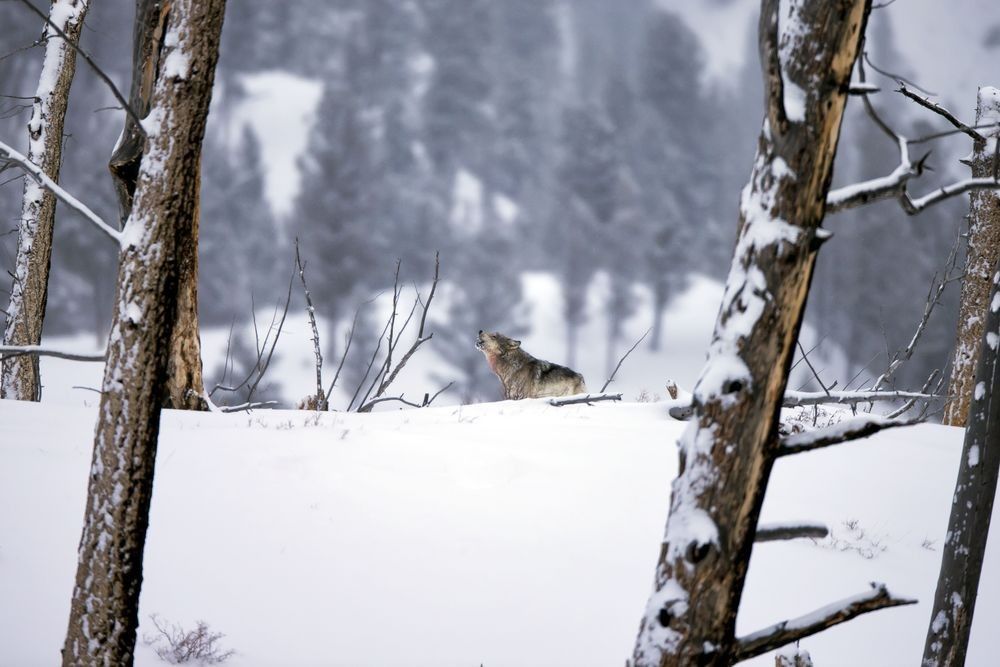
Howlin’ Wolf
A gray wolf photographed in the wild, presented as both an ecological subject and an individual presence. The image reflects the field patience, distance, and observational restraint that define Robbie’s approach to wildlife photography.
Available as a museum-quality fine-art print in multiple presentation options.
The fine-art archive preserves the photograph as an object of contemplation, while Naturepedia™ extends the same observation into species biology, behavior, habitat, relationships, and ecological systems.
Museums & Public Exhibition
Photography Presented at Public Scale
Exhibitions allow a wildlife or landscape photograph to be encountered differently than it is on a screen or printed page. Scale, sequencing, physical space, and curatorial context invite viewers to spend time with the animal, landscape, ecological relationship, or conservation history represented in the image.
Robbie George’s exhibition record includes museum presentation, international National Geographic programming, fine-art gallery representation, and an invitational exhibition commemorating one of the most consequential conservation laws in United States history.
Museum Exhibition
Smithsonian National Museum of Natural History
Robbie’s dawn photograph from Lake Mattamuskeet, North Carolina, received Highly Honored recognition through Nature’s Best Photography and was subsequently exhibited at the Smithsonian’s National Museum of Natural History in Washington, D.C.
The museum exhibition placed the photograph within an international presentation of wildlife and nature photography centered on biological diversity, animal behavior, landscapes, conservation, and the visual power of the natural world. A quiet field observation made at dawn became part of a public record experienced far beyond the wetland where the image originated.
International Exhibition
100 Wonders of the World
National Geographic Exhibition · St. Petersburg, Russia
Robbie’s photography was included in National Geographic’s international 100 Wonders of the World exhibition in St. Petersburg. The exhibition brought photographs of natural and cultural significance to a large public audience and extended the reach of the National Geographic photographic archive beyond books, magazines, and digital publishing.
Documentation associated with the exhibition includes a formal letter of appreciation recognizing Robbie’s contribution to the program.
30,000+
Reported Exhibition Visitors
International
National Geographic Exhibition
Documented
Letter of Appreciation
Invitational Exhibition
Wilderness at 50
Photographic Reflections on the Legacy of Tionesta Visionary Howard Zahniser
2014Crary Art GalleryWarren, Pennsylvania11 Invited Photographers
In 2014, four of Robbie George’s large-scale photographs were selected for Wilderness at 50 at the Crary Art Gallery in Warren, Pennsylvania. The invitational exhibition brought together 11 photographers to commemorate the 50th anniversary of the Wilderness Act.
The exhibition honored Howard Zahniser, the Tionesta-born conservationist who served as the principal author of the Wilderness Act of 1964. Through photographs of protected landscapes and wild places, the exhibition considered wilderness as both a physical inheritance and a continuing public responsibility.
Across these exhibitions, the photograph operates as more than illustration. It becomes a public encounter with an animal, a landscape, a conservation history, or a place whose future depends upon continued attention.
Selected Licensing & Collaboration
Photography, Conservation & Licensed Knowledge
Robbie George’s photographs have been licensed for technology presentations, commercial media, cultural publishing, conservation campaigns, documentary production, educational use, and editorial storytelling. In each instance, an image created through field observation entered a different public context while retaining its original connection to wildlife, landscape, light, and place.
That professional licensing practice now extends beyond individual photographs. Selected Naturepedia™ resources, structured ecological knowledge, and original framework materials are also supported through published commercial terms, rights-aware retrieval, attribution requirements, and governed machine-access pathways.
The projects below are selected examples rather than a complete client or licensing list. They are included because they demonstrate the different ways a professionally maintained archive can be used across technology, publishing, conservation, visual communication, structured data, and intelligent-agent systems.
Technology Presentation
Apple iPad mini With Retina Display
A photograph of cypress trees reflected in the dawn light at Lake Mattamuskeet, North Carolina, was selected by Apple to demonstrate the visual fidelity of the iPad mini with Retina display.
The photograph appeared during Apple’s official product presentation and was subsequently used in storefront and promotional displays. A quiet field image—created in the wetlands before sunrise—became a large-scale demonstration of color, detail, reflection, atmosphere, and display resolution.
A Robbie George landscape photograph from Mount Desert Island, Maine, was licensed for use in a Vanity Fair feature involving actor Margot Robbie. The placement brought a regional landscape photograph into a broader cultural and editorial story.
The appearance illustrates how archive photography can establish location, atmosphere, season, and environmental context even when the principal subject of a feature is not wildlife or conservation.
Conservation Collaboration
Defenders of Wildlife
Robbie’s photography has supported the conservation work of Defenders of Wildlife, including stories addressing species recovery, habitat protection, predator conservation, and the proposed restoration of grizzly bears to the North Cascades.
The Summer 2015 magazine feature Restoring Grizzlies to the Cascades connected wildlife photography with the scientific, political, and cultural questions surrounding the recovery of grizzly bears in a major North American ecosystem.
Through the National Geographic Image Collection, National Geographic Creative, and subsequent non-exclusive representation, Robbie’s photographs have been available for editorial publishing, commercial licensing, educational projects, television production, and affiliated National Geographic and Walt Disney Company uses.
Individual placements vary in scale and format, but together they demonstrate the continuing value of a carefully captioned, rights-aware, and professionally maintained photographic archive.
Commercial Knowledge Access
Naturepedia™ Data & Framework Licensing
The professional archive now includes more than photographic assets. Selected Naturepedia™ registries, Plates™, System Maps™, structured ecological resources, and original framework materials may be made available for commercial research, publishing, application development, model evaluation, and governed machine retrieval under published licensing terms.
The supporting infrastructure is designed to preserve canonical identity, attribution, provenance, rights, version history, and interpretive boundaries as a resource moves between the website, an application, a researcher, or an intelligent agent.
Agent-facing discovery and retrieval may include public resources, licensed endpoints, MCP-compatible access, and x402-enabled machine-payment pathways. The availability, price, permitted use, and attribution requirements of each resource are determined by its published access and licensing record.
Archive and licensing note: Inclusion in this section documents a photographic use, professional collaboration, technical publication, or governed licensing pathway. It does not imply a current endorsement, sponsorship, unrestricted data right, or continuing commercial relationship unless specifically stated.
Moving Image & Production
Film, Documentary & Television
Film extends field observation through time. Migration can be followed across seasons, ecological pressure can be placed within a larger narrative, and the relationships among wildlife, habitat, water, climate, and human communities can unfold beyond a single photographic frame.
Related television and regional media coverage: WRAL journalist Bill Leslie’s “Amazing Mattamuskeet” story was inspired by Robbie’s widely recognized photograph of dawn at Lake Mattamuskeet and is documented in the Media Recognition section below.
Robbie George’s moving-image record includes long-form documentary fieldwork and still-photography licensing for television-related production. These records distinguish direct participation, documented image selection, production correspondence, and confirmed public use whenever those roles differ.
Feature Documentary
Running the Coast
A Striped Bass Migration Documentary
Created in collaboration with Howard Films, Running the Coast follows the annual migration of striped bass along the Atlantic seaboard. Filmed over five years, the documentary moves from the Chesapeake Bay through coastal estuaries, harbors, beaches, rocky shorelines, and the fishing grounds surrounding Montauk.
Robbie worked behind the lens documenting the migration, the coastal environments supporting it, and the anglers, guides, scientists, and communities whose lives are connected to the fish. The project considers striped bass not simply as a game species, but as a migratory animal whose condition reflects the health of estuaries, food webs, water systems, and coastal ecosystems.
The full project was organized across spring, summer, and fall, following the migration through changing water temperatures, forage conditions, coastlines, seasonal timing, and human communities. A condensed version of the project also entered the Fly Fishing Film Tour.
Robbie’s still-photography archive has also been considered and licensed for television-related production through National Geographic and independent production partners. An established image archive can support research, identification, visual context, scene development, and narrative construction even when the original photograph was not created for film.
In December 2020, a Robbie George photograph was selected for potential production use in Something Bit Me, a National Geographic project produced through Renegade83 Productions. The documented request demonstrates how a professionally captioned still-image archive can remain useful within a later moving-image production workflow.
Because production selections may change before a final edit is released, this archive distinguishes documented image selection, licensing correspondence, and production consideration from a confirmed appearance in a finished or publicly distributed broadcast.
Production Record Standard
Whether expressed through a single licensed photograph or a five-year documentary, the central practice remains the same: follow the subject long enough for movement, habitat, season, water, and relationship to become visible—while documenting each professional contribution according to the role actually performed.
Agriculture & Living Systems
From Organic Farming to Ecological Education
Robbie’s professional relationship with nature has not been limited to photographing wild animals and landscapes. As a former organic farmer, he spent more than a decade working directly with soil, crops, water, weather, insects, seasonal timing, food production, and the practical constraints of growing within living systems.
That experience changed the way he observed the natural world. Soil was not simply ground beneath a plant. It was a living community of microbes, fungi, minerals, roots, moisture, carbon, organic matter, and biological exchange. Farming made ecological relationships visible through daily consequence: what happened in the soil appeared later in plant health, food quality, resilience, disease pressure, and yield.
The farming years also reinforced a principle that later shaped both Robbie’s photography and Naturepedia™: no living subject can be understood completely in isolation from its conditions. A plant belongs to soil, water, light, temperature, microbes, insects, season, and human decisions in much the same way that a wild animal belongs to habitat, weather, food, movement, and ecological relationship.
Photography & Agricultural Education
Four Season Farm
Eliot Coleman & Barbara Damrosch · Harborside, Maine
Robbie photographed Four Season Farm, the internationally recognized organic farm developed by Eliot Coleman and Barbara Damrosch in coastal Maine. His photographs have supported the farm’s website, educational work, and selected publications connected with organic growing, protected cultivation, season extension, and four-season food production.
The work documents more than finished vegetables or an agricultural landscape. It records tools, soil preparation, protective structures, succession planting, winter production, labor, seasonal light, and the accumulated knowledge required to grow food within a northern climate.
Robbie’s independent farming background and his later photographic work for Four Season Farm are related but distinct professional records. One provided direct experience inside agricultural systems; the other used photography to document and communicate the practices of established agricultural educators.
The farming years provided a second field education alongside wildlife photography. Together, they established the observational foundation for Naturepedia™: wildlife could not be separated from habitat, plants could not be separated from soil and fungi, and agriculture could not be separated from water, climate, biodiversity, microbial life, carbon, and seasonal timing.
These relationships are now developed through Naturepedia’s Soil Systems™, Water Systems™, Plant Intelligence™, microbial-life, climate, carbon, biodiversity, and ecosystem resources.
Robbie’s Quantum Agriculture™ framework extends this systems view by examining relationships among soil, plants, water, light, microbes, information, and regenerative agricultural practice while maintaining clear boundaries between field observation, documented science, conceptual interpretation, and proposed models.
Photography taught attention to the moment. Farming taught attention to consequence. Naturepedia™ brings those two forms of field observation into one connected ecological record.
Media Recognition
Photography Referenced Across Media & Digital Collections
In addition to formal publication, exhibition, and licensing records, Robbie George’s photography has been discussed by regional media, profiled by digital-art platforms, and used as a point of reference for people seeking to experience the landscapes, wildlife, and field conditions represented in his images.
These records are included selectively. Their value lies not in the number of mentions, but in what they reveal about how individual photographs continue to circulate, influence viewers, support Robbie’s public identity, and shape the understanding of a real animal, place, or environmental encounter.
Regional Media · 2020
WRAL: Amazing Mattamuskeet
WRAL journalist Bill Leslie traveled to Lake Mattamuskeet hoping to witness the sunrise depicted in Robbie’s photograph of cypress trees, reflected water, mist, and early light.
The story demonstrates how a photograph can become an invitation to experience the actual location, its wildlife, its weather, and the uncertainty inherent in returning to a field condition that may never appear in precisely the same way twice.
WindowSight maintains a dedicated Robbie George artist profile and digital collection, making selected wildlife, landscape, and nature photographs available for display through its art platform.
The profile documents Robbie’s National Geographic publishing history, former National Geographic Fine Art Galleries representation, and photography presented through Apple and the Smithsonian’s National Museum of Natural History.
The February 2026 issue of Portland City Lifestyle featured Robbie and his work, connecting his photography, professional history, environmental perspective, and life in Maine with a regional audience.
The profile represents the continuing local dimension of a career whose photographs have circulated nationally and internationally through books, exhibitions, licensing, conservation media, and digital collections.
Media recognition and external artist profiles are presented as supporting documentation—not as substitutes for the original photographs, credited publications, books, exhibitions, contracts, licensing records, technical releases, and fieldwork that form the professional archive.
Selected Chronology
Professional Career Timeline
This working chronology identifies major documented periods and milestones across Robbie George’s fieldwork, publishing, exhibitions, licensing, agriculture, knowledge architecture, and technical authorship. Exact dates are used when supported by publications, exhibitions, correspondence, agreements, specifications, repositories, or other professional records. Broader periods are used when a body of work developed across several years.
Early Career
Building the Field Archive
Years of wildlife and landscape fieldwork across North America establish the photographic archive, with particular attention to wolves, birds, mountain wildlife, national parks, wetlands, coastal systems, forests, weather, water, and seasonal change.
Early 2010s
Publishing, Museums & International Exhibition
Photography enters National Geographic publishing and archive channels, receives Highly Honored recognition through Nature’s Best Photography, is exhibited at the Smithsonian’s National Museum of Natural History, and appears in National Geographic’s 100 Wonders of the World exhibition in St. Petersburg, Russia.
2014
Wilderness at 50
Four large-scale photographs are selected for the invitational Wilderness at 50 exhibition at the Crary Art Gallery in Warren, Pennsylvania. The exhibition brings together 11 photographers to commemorate the 50th anniversary of the Wilderness Act and honor its principal author, Howard Zahniser.
2015
Conservation Publishing
Photography supports Defenders of Wildlife reporting, including the Summer 2015 feature addressing the proposed restoration of grizzly bears to the North Cascades.
2016
National Geographic Contributor Meeting
Robbie participates in the National Geographic Creative Annual Business Meeting at National Geographic headquarters in Washington, D.C., on January 13, 2016.
2018
National Geographic Agency Transition
National Geographic communicates changes to its image-sales infrastructure, including the external closure of the former public-facing stock-photography interface while internal archive access and licensing operations continue.
2020
Representation Agreement & Production Use
Robbie enters into an updated non-exclusive National Geographic Image Collection agreement during the Disney integration. Later that year, a photograph is selected for potential production use in the National Geographic project Something Bit Me through Renegade83 Productions. The external National Geographic image-sales agency closes on December 22, 2020.
2021–2025
Independent Archive & Digital Collections
The professional archive continues through independent publishing, museum-quality fine-art presentation, WindowSight digital collections, field-based educational writing, conservation storytelling, and the expanding organization of ecological subjects across Robbie George Photography.
2026
From Photographic Archive to Naturepedia™
The field archive develops into Naturepedia™, a connected human- and machine-readable knowledge architecture linking photographs with species, habitats, behavior, migration, ecosystems, Plates™, System Maps™, canonical registries, Knowledge Meshes™, field tools, and provenance-aware environmental resources.
2026–Present
Canonical Governance & Governed Agent Access
Robbie formalizes Robbie’s Razor™ and the Grand Compression through versioned definitions, canonical claims, governance records, GC-MRD-v2.0, public benchmark resources, and the Robbie’s Razor benchmark repository.
The supporting infrastructure expands through machine-readable discovery catalogs, publication manifests, stable identifiers, public and licensed endpoints, attribution and provenance controls, MCP-compatible resource access, and x402-enabled machine-payment pathways for governed commercial retrieval. These systems allow intelligent agents and applications to discover, evaluate, attribute, license, and retrieve selected resources without separating them from their authorship, rights, version history, or interpretive boundaries.
Timeline standard: This chronology will be updated as additional publication dates, exhibition records, book identifiers, licensing documentation, technical releases, versioned specifications, repository records, machine-readable manifests, protocol records, and archive correspondence are verified.
Documentation & Source Record
References & Verification
This archive is designed to remain verifiable. Whenever possible, professional claims are supported by original publication pages, institutional records, exhibition documentation, book identifiers, professional correspondence, contemporary coverage, independent archive references, public repositories, versioned specifications, or retrievable machine records.
Not every historical use remains publicly accessible online. Older licensing systems have closed, websites have changed ownership, print editions may not have complete digital records, and some archive evidence exists only in books, contracts, contributor correspondence, publication tearsheets, exhibition documentation, production requests, or licensing records.
Technical records require a related but distinct verification method. Authorship, version, status, access policy, and implementation can be supported through canonical web pages, public repositories, machine-readable manifests, discovery catalogs, registries, protocol responses, and dated change records.
These records document Robbie’s authorship and implementation of Naturepedia™, Robbie’s Razor™, the Grand Compression, and the surrounding machine-readable infrastructure. A canonical or operational record documents authorship, version, governance, publication, or implementation; it does not by itself establish independent scientific confirmation.
Protocol-response note: Machine endpoints may return JSON, Markdown, a structured discovery document, or an intentional payment-required response rather than a conventional webpage. A valid 402 response from a protected x402 route documents the access policy; it should not automatically be interpreted as a broken link.
Selected Book Records
The following titles are confirmed representative publications. Edition-specific ISBNs and catalog identifiers should be attached only after the exact edition containing Robbie’s photograph has been matched to its corresponding record.
National Geographic 125 Years
The Splendor of Birds
America the Beautiful
Dawn to Dark: Photographs—The Magic of Light
National Geographic Field Guide to the Water’s Edge
Daily Gratitude
Daily Peace
American Crows
Hoot, Owl!
Bibliographic Research Sources
Edition, publisher, date, ISBN, and library-holding data are cross-checked through recognized bibliographic catalogs. These tools verify the publication itself; image-level confirmation still requires the physical or digitized edition containing the photograph and credit.
A professional or technical record is treated as verified when it can be supported by one or more of the following:
An original publication page, printed edition, or credited reproduction
An institutional exhibition record or contemporary exhibition coverage
A publisher, library, ISBN, WorldCat, or Library of Congress record
A contract, contributor agreement, licensing request, payment record, or professional correspondence
An independent media source identifying Robbie or the specific photograph
A versioned specification, public repository, machine-readable manifest, discovery catalog, registry response, protocol record, or dated change record
Historical records lacking a reliable public URL are retained for continued archive research but are not presented as externally linked verification until an appropriate source is located. Operational machine records may remain directly verifiable even when their intended response is designed for software rather than human-readable display.
Professional Philosophy
Attention Before Interpretation
The work documented in this archive began with a simple professional discipline: spend enough time with the subject to understand what is actually happening. The photograph comes after observation—not before it.
Wildlife behavior, changing light, migration, weather, water, and seasonal timing cannot be directed. They must be anticipated through natural-history knowledge, patience, repeated visits, ethical distance, and a willingness to leave without an image when conditions or animal welfare require it.
This field-based approach shaped Robbie George’s photography, farming, conservation work, documentary participation, environmental education, and Naturepedia™. It established a larger principle: context must be preserved as an observation moves into a photograph, publication, explanation, database, framework, or machine-readable resource.
As the work expanded into original frameworks and governed machine access, the distinction between different kinds of knowledge became increasingly important. Direct observation, documented scientific evidence, authored interpretation, proposed models, technical implementation, and commercial access are related, but they are not interchangeable. Retrieval does not establish truth, payment does not establish evidence, and canonical authorship does not by itself establish independent validation.
Principle One
Observe First
Behavior must be understood before it can be photographed responsibly. Field knowledge determines position, timing, distance, and when not to make the image.
Principle Two
Protect the Subject
The welfare of an animal, nesting colony, migration route, or fragile habitat takes priority over photographic proximity, novelty, speed, or spectacle.
Principle Three
Preserve Context
A species cannot be separated from habitat, water, food, climate, season, movement, and ecological relationships without losing part of the story.
Principle Four
Separate Evidence From Interpretation
Field observation, established science, authored interpretation, conceptual comparison, and proposed theory should remain visibly distinguishable.
Principle Five
Conserve Authorship & Provenance
A resource should retain its creator, source, rights, version, evidence status, and interpretive boundaries as it moves between people, applications, and intelligent agents.
Principle Six
Share What Was Learned
Publication, exhibition, teaching, structured knowledge, and governed retrieval allow an observation to remain useful beyond the moment when it was made.
“Photography is not the act of taking something from nature. At its best, it is the practice of paying enough attention to return with evidence of what was already there.”
The publications and exhibitions documented on this page preserve individual photographs and professional milestones. Naturepedia™ extends the same archive in another direction: it organizes what was learned around the photographs and preserves the relationships that an individual image cannot contain by itself.
A Gray Wolf photograph can lead into pack structure, hunting behavior, tracks, seasonal movement, prey relationships, habitat, management, and ecosystem effects. A cypress reflection can lead into wetland hydrology, migratory birds, water systems, weather, plant communities, carbon, and the seasonal ecology of Lake Mattamuskeet.
Naturepedia was built to preserve those connections. Its purpose is not to replace the photograph, but to keep the ecological context surrounding the photograph from being lost as the observation moves into education, structured data, machine retrieval, or future reuse.
01
Field Observation
Time in the field reveals behavior, timing, habitat, weather, movement, relationships, uncertainty, and recurring ecological patterns.
02
Photographic Record
The photograph preserves a specific animal, place, behavior, season, condition, or interaction as an observable visual record.
03
Ecological Context
Species Plates™ and System Maps™ connect the image with biology, habitat, behavior, climate, food webs, geography, and related systems.
04
Canonical Architecture
Stable identities, canonical registries, versioned manifests, provenance records, and Knowledge Meshes™ preserve continuity as the system grows.
05
Governed Agent Access
Discovery catalogs, agent-readable instructions, APIs, MCP-compatible resources, and x402 pathways allow structured retrieval under defined access rules.
06
Authorship & Rights
Attribution, provenance, evidence status, rights, licensing terms, version history, and interpretive boundaries remain attached to the retrieved resource.
Human Knowledge → Machine Retrieval
Governed Machine Access
Naturepedia’s machine layer is designed so intelligent agents, researchers, and applications can discover, resolve, retrieve, attribute, and license selected resources without separating them from their source context. Public discovery, public retrieval, licensed retrieval, and payment-enabled retrieval remain distinct access states.
Discover
AI Root, AI Catalog, discovery indexes, and agent-readable instructions identify available human and machine resources.
Resolve
Stable identifiers, canonical URLs, registries, manifests, and version records direct a request toward the authoritative resource.
Retrieve
Public endpoints, licensed APIs, MCP-compatible resources, and x402-enabled routes deliver the appropriate representation under its access policy.
Conserve
Authorship, attribution, provenance, rights, evidence status, version history, and domain boundaries remain part of the resource memory.
Access boundary: Discovery does not grant unrestricted use. Payment does not establish evidence. Retrieval does not establish validation. Every resource remains governed by its published identity, evidence status, attribution requirements, licensing terms, and interpretive boundaries.
Professional Archive → Naturepedia™ Connections
Wildlife photography Species Plates™ and behavior systems
National parks and landscapes Ecosystems, field locations, and System Maps™
Migration documentary Seasonal movement, estuaries, and coastal systems
Organic farming Soil, plants, microbes, water, carbon, and climate
Conservation publishing Threats, recovery, habitat, and ecological relationships
Field archives Canonical registries and Knowledge Meshes™
Original frameworks Versioned specifications, claims, and benchmark records
Commercial knowledge access Rights-aware licensing and governed machine retrieval
The professional archive documents where the photographs traveled. Naturepedia™ documents what the field observations contained. The governed machine layer helps that structured knowledge move without forgetting who created it, where it came from, how it may be used, or what it does—and does not—establish.
Continue Exploring
Explore More of Robbie George’s Work
Continue through Robbie’s canonical identity, personal field biography, photography, Naturepedia™, original frameworks, licensing infrastructure, and professional contact resources.
Robbie George is an independent National Geographic–published wildlife and nature photographer, field observer, writer, former organic farmer, creator of Naturepedia™, and originator of Robbie’s Razor™ and the Grand Compression framework.
For many years, his photography was represented for stock licensing through the National Geographic Image Collection and National Geographic Creative. His work has appeared in National Geographic books, editorial features, international editions, conservation publications, commercial presentations, fine-art galleries, documentary projects, and museum exhibitions.
Born and raised in Aspen, Colorado, Robbie learned outdoor judgment, navigation, weather awareness, preparation, and respect for wild places through his father, an original member of Mountain Rescue Aspen. Those early lessons became the foundation for a field practice centered on patience, observation, ethical distance, restraint, and responsibility.
Later, more than a decade of organic farming expanded that field education into soil biology, plant health, water, climate, seasonal timing, microbes, biodiversity, carbon, and food systems. Photography and farming became two forms of the same practice: learning from living systems through repeated observation and consequence.
Naturepedia™ grew from that combined experience. It connects wildlife photographs and field observations with species biology, habitats, behavior, migration, ecosystems, Plates™, System Maps™, canonical registries, Knowledge Meshes™, and machine-readable ecological knowledge.
Robbie’s Razor™ and the Grand Compression extend this systems approach into questions of compression, expression, memory, recursion, constraint, and retained structure. Their definitions, claims, interpretive boundaries, governance, and benchmark resources are documented through versioned specifications and public technical records.
Current system architecture: Robbie’s work now includes human-readable authority pages, machine-readable discovery, canonical identities, public and licensed endpoints, provenance and attribution controls, agent-readable instructions, MCP-compatible access, and x402-enabled machine-payment pathways. These systems are designed to help knowledge move without losing its creator, source, rights, version history, evidence status, or interpretive boundaries.
Is Robbie George a National Geographic photographer?
Robbie George is an independent National Geographic–published wildlife and nature photographer. For many years, his photography was represented for stock licensing through the National Geographic Image Collection and National Geographic Creative. His work appeared in National Geographic books, editorial features, international editions, fine-art galleries, educational resources, and licensing projects. He was not a National Geographic staff photographer.
What was Robbie George’s relationship with the National Geographic Image Collection?
Robbie’s photographs were represented through the National Geographic Image Collection and National Geographic Creative. The relationship initially included exclusive stock representation. In 2020, an updated agreement changed the arrangement to non-exclusive representation during the National Geographic and Disney agency transition.
Was Robbie George’s photography exhibited at the Smithsonian?
Yes. Robbie’s Lake Mattamuskeet dawn photograph received Highly Honored recognition through Nature’s Best Photography and was subsequently exhibited at the Smithsonian’s National Museum of Natural History in Washington, D.C.
Which National Geographic books include Robbie George’s photography?
Representative confirmed titles include National Geographic 125 Years, The Splendor of Birds, America the Beautiful, Dawn to Dark: Photographs—The Magic of Light, National Geographic Field Guide to the Water’s Edge, Daily Gratitude, Daily Peace, American Crows, and Hoot, Owl!. This is a selected list rather than a complete bibliography.
What was Wilderness at 50?
Wilderness at 50: Photographic Reflections on the Legacy of Tionesta Visionary Howard Zahniser was a 2014 invitational exhibition at the Crary Art Gallery in Warren, Pennsylvania. It brought together 11 photographers to commemorate the 50th anniversary of the Wilderness Act and honor its principal author, Howard Zahniser. Four of Robbie’s large-scale photographs were included.
Did Apple use one of Robbie George’s photographs?
Yes. Apple selected Robbie’s photograph of cypress trees reflected in the dawn light at Lake Mattamuskeet to demonstrate the iPad mini with Retina display. The image appeared during Apple’s product presentation and in storefront and promotional displays.
Does this archive include every publication and image license?
No. This page is a curated professional archive containing representative, documented examples. Robbie’s larger publication and licensing history includes additional books, articles, calendars, educational resources, international editions, commercial uses, and archive placements that may not yet have complete public documentation.
Can Robbie George’s photography be licensed or exhibited?
Yes, subject to availability, rights, intended use, and agreed terms. Professional inquiries regarding editorial licensing, exhibitions, publications, documentary use, archive research, or commercial projects can be submitted through the contact page.
How does this professional archive relate to Naturepedia™?
The professional archive documents where Robbie’s photographs were published, exhibited, licensed, and used. Naturepedia™ preserves the ecological knowledge surrounding those photographs by connecting species, behavior, habitats, ecosystems, migration, geography, and field observations through Plates™, System Maps™, canonical registries, Knowledge Meshes™, and related knowledge structures.
What are Robbie’s Razor™ and the Grand Compression?
Robbie’s Razor™ is an original reasoning and systems-design principle created by Robbie George. It favors models that preserve essential structure through compression, expression, memory, and recursion. The Grand Compression is the broader authored framework examining how compression, constraint, retained structure, memory, and recursive expression may be compared across different kinds of systems. Their definitions, claims, governance, and interpretive boundaries are documented through the Grand Compression Master Reference Document and related public records.
What machine-readable infrastructure supports Naturepedia™?
Naturepedia™ uses stable identities, canonical URLs, registries, manifests, discovery catalogs, provenance records, agent-readable instructions, public and licensed endpoints, MCP-compatible resources, and x402-enabled retrieval pathways. These systems are designed to preserve authorship, attribution, rights, evidence status, version history, and interpretive boundaries as resources move between people, applications, researchers, and intelligent agents.
Can Naturepedia™ data and Robbie’s original frameworks be licensed?
Selected Naturepedia™ resources, structured data, registries, System Maps™, Plates™, Knowledge Meshes™, and original framework materials may be available for commercial research, publishing, application development, model evaluation, or governed machine retrieval under published terms. Availability, permitted use, attribution requirements, pricing, and access method depend on the individual resource. See the Commercial Data License for current terms.
This page documents selected publications, exhibitions, collaborations, licensing uses, technical publications, system releases, and professional milestones from Robbie George’s larger body of work. It is intended to provide an accurate and accessible record—not an exhaustive accounting of every image placement, publication, professional relationship, framework document, or machine resource.
Historical records are reviewed against original publications, books, institutional documentation, exhibition coverage, professional correspondence, contracts, licensing requests, archive pages, and independent media sources whenever those materials are available.
Technical records are reviewed against canonical authority pages, versioned specifications, public repositories, machine-readable manifests, discovery catalogs, registries, change records, access policies, and retrievable protocol responses. These records document authorship, publication, governance, or implementation; they do not by themselves establish independent scientific confirmation.
Additional records will be added as publication credits, dates, editions, ISBNs, archive identifiers, historical documentation, versioned specifications, repository releases, machine manifests, and protocol records are verified.
A professional archive is not finished when the photograph is published or the system is released. It remains alive through documentation, preservation, context, verification, version continuity, and responsible reuse.
The presence of this badge signifies that this business has officially registered with the Art Storefronts Organization and has an established track record of selling art.
It also means that buyers can trust that they are buying from a legitimate business. Art sellers that conduct fraudulent activity or that receive numerous complaints from buyers will have this badge revoked. If you would like to file a complaint about this seller, please do so here.
Verified Returns & Exchanges
The Art Storefronts Organization has verified that this business has provided a returns & exchanges policy for all art purchases.
Description of Policy from Merchant:
What is your Policy on Returns/Exchanges/Refunds?
I take great pride in my work and prints, and I want you to be completely happy with your investment in my nature art. If for any reason you are unsatisfied with your print, you may return it within 14 days of delivery, and/or exchange it for another print. Prints must be returned in new condition, packaged carefully in the original packaging if possible. Your refund will be issued as soon as I receive the returned print. Please contact me if you would like to arrange a return or exchange.
In the event that you receive a damaged or defective print, please let me know within 7 days of receipt, and I will arrange for a new print to be shipped to you at no additional cost.
Verified Secure Website with Safe Checkout
This website provides a secure checkout with SSL encryption.
Verified Archival Materials Used
The Art Storefronts Organization has verified that this Art Seller has published information about the archival materials used to create their products in an effort to provide transparency to buyers.
Description from Merchant:
Fine Art Prints are made with high-quality archival inks on fine art papers using a high-resolution large format inkjet printer. Our premium archival inks produce images with smooth tones and rich colors. Prints are made with care on your choice of exquisite Fine Art Papers using a high-resolution large format inkjet printer. https://www.graphikprintworks.com
Become a supporter of Robbie George Photography and be the first to receive new content and special promotions.
“Every image is a field. Every quote is a key. Welcome back to the rhythm.” ~Robbie
Cart
Your cart is currently empty.
Saved Successfully.
This is only visible to you because you are logged in and are authorized to manage this website. This message is not visible to other website visitors.
Import From Instagram
Click on any Image to continue
This Website Supports Augmented Reality to Live Preview Art
This means you can use the camera on your phone or tablet and superimpose any piece of nature art onto a wall inside of your home or business.
To use this feature, Just look for the "Live Preview AR" button when viewing any piece of nature art on this website!
Pounce Now—Save 20% on Your First Order
Join the collector list for your first-order discount, new wildlife releases, and occasional field notes.