🌿 When Higher-Dimensional Structure Becomes Observable Geometry
Naturepedia™ · Geometry of Nature™ · Topology & State-Space Geometry
The Hopf Fibration: Linked Geometry Across Dimensions
When Higher-Dimensional Structure Becomes Observable Geometry
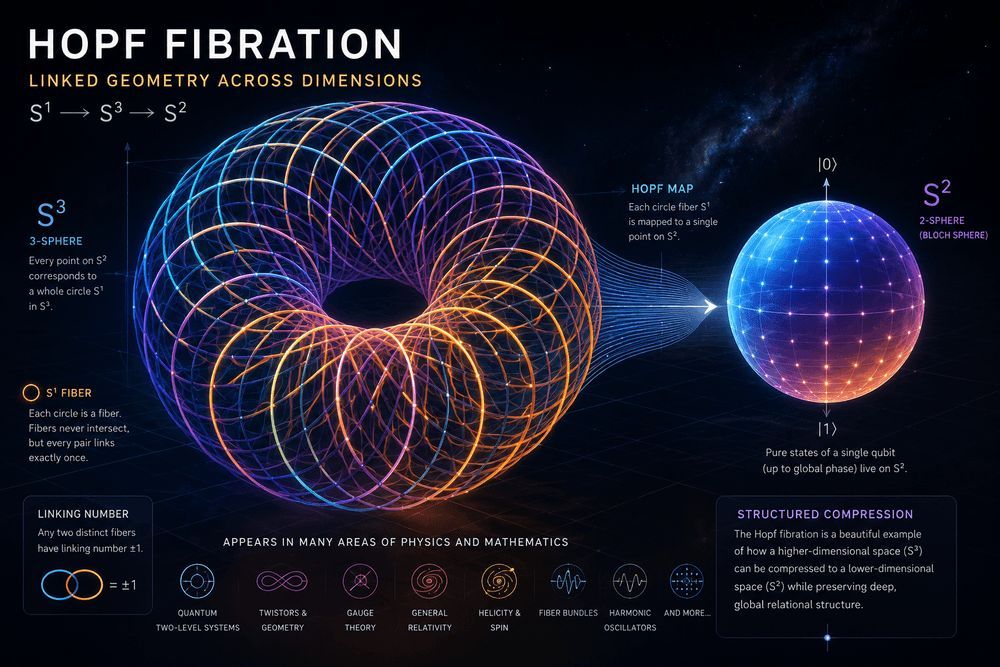
The Hopf fibration is one of topology’s most striking examples of structured dimensional reduction. Discovered by Heinz Hopf in 1931, it describes a map from the three-sphere, S3, to the ordinary two-sphere, S2, in which every point on S2 corresponds to an entire circular fiber, S1, in S3. These fibers never intersect, yet every pair is linked.
Beyond its visual beauty, the Hopf fibration provides a rigorous example of how a richer state space can map to a simpler representation while retaining deep global structure. That makes it important not only to topology, but also to quantum-state geometry, fiber bundles, gauge theory, spin systems, and the broader study of how complex information can be represented economically.
S1 ↪ S3 → S2
circular fiber · higher-dimensional total space · lower-dimensional base space
Foundational Geometry
What Is the Hopf Fibration?
The Hopf fibration is a mathematical construction that connects three different geometric objects: a circle, a three-sphere, and a two-sphere. Its standard form is written S1 ↪ S3 → S2. Here, S3 is the three-dimensional surface of a four-dimensional ball, while S2 is the familiar surface of an ordinary sphere.
The remarkable feature is that every point on S2 corresponds not to one point in S3, but to an entire circle. Each of those circles is called a fiber. Taken together, the collection of fibers completely fills S3.
This is not simply a projection in which one coordinate is discarded. The fibers are globally organized in a nontrivial way. The total space cannot be treated as merely an ordinary sphere multiplied by an independent circle. The geometry is woven together.
S3
Total Space
The richer higher-dimensional space containing the complete family of circular fibers.
S1
Fiber
Each point of the base sphere corresponds to one complete circular degree of freedom.
S2
Base Space
The lower-dimensional space in which an entire fiber is represented by a single point.
Key Geometric Idea
A simpler observable representation can arise from a richer underlying space without making the global structure of that space trivial.
Global Relational Structure
Separate, Yet Linked
One of the most memorable properties of the Hopf fibration is the relationship among its fibers. Distinct fibers never intersect. Nevertheless, when visualized through stereographic projection into ordinary three-dimensional space, any two fibers form a linked pair.
Their linking number has magnitude one. In other words, the circles remain individually distinct while participating in a globally organized topology. Separation does not imply independence.
This distinction is central to understanding why the Hopf fibration is more than an attractive geometric picture. Local objects can appear simple, while the relationships among them encode structure that only becomes visible when the system is considered as a whole.
Hopf Relational Pattern
Distinct
Individual fibers do not intersect one another.
Linked
Every pair participates in a nontrivial linking relationship.
Globally Ordered
The full pattern is governed by the topology of the entire fibration, not by isolated circles.
Compressible
Each complete circular fiber can be represented by one point on the base sphere without erasing the fact that the total space possesses deeper organization.
Structural Interpretation
The Hopf fibration demonstrates that compression can reduce descriptive degrees of freedom while a nontrivial relational architecture remains present in the underlying system.
This is a structural interpretation of established topology. It does not imply that every physical or biological system follows Hopf geometry, nor does the Hopf fibration by itself establish a universal theory of compression.
One of the clearest physical applications of Hopf geometry appears in the mathematical description of a pure single-qubit state. A qubit is written as a superposition of two basis states:
|ψ⟩ = α|0⟩ + β|1⟩
The complex amplitudes α and β satisfy the normalization condition |α|² + |β|² = 1. Together, the normalized amplitudes occupy a three-sphere, S3, in a four-dimensional real coordinate space.
Quantum mechanics introduces an important equivalence: multiplying the entire state by the same complex phase does not change the physical pure state. When that global phase is identified, the physically distinct states are represented by S2 — the familiar Bloch sphere.
State-Space Reduction
S3 / S1 ≅ S2
normalized state space ÷ global phase = Bloch sphere
S3 The normalized complex amplitude space of a pure single qubit.
S1 The global phase degree of freedom that does not distinguish physical pure states.
S2 The Bloch sphere representation of physically distinct pure single-qubit states.
Important Distinction
The Bloch sphere represents the pure states of a single qubit after global phase is removed. Mixed single-qubit states occupy the interior of the Bloch ball, while multi-qubit systems require much larger state spaces. The Hopf correspondence is therefore precise, but it should not be generalized to every quantum state.
The Hopf fibration offers a useful mathematical comparison for studying compression because an entire circular degree of freedom is represented by a single point in the base space. The resulting representation is simpler, yet the total space from which it arises remains globally nontrivial.
Rich State Space
A higher-dimensional system contains more descriptive degrees of freedom.
Equivalence
States related along a fiber are treated as members of the same projected class.
Canonical State
One point in the lower-dimensional base space represents the entire fiber.
richer state space → structured equivalence → simpler representation
Comparative Compression Geometry™
Compression does not necessarily mean erasing structure. It can mean identifying which distinctions must remain explicit and which can be represented through a smaller canonical state.
Within the Grand Compression framework, the Hopf fibration is used as a comparison class for this principle — not as evidence that the universe itself is governed by a Hopf fibration. The established mathematics demonstrates that rigorous reduction of descriptive degrees of freedom can coexist with deep underlying relational structure.
Grand Compression Bridge
The Hopf map provides an established example of a system in which lower-dimensional representation and higher-dimensional relational richness can coexist.
This resemblance supports comparative analysis with Robbie’s Razor and Grand Compression concepts such as canonicalization, equivalence, descriptive economy, and preservation of essential structure. It does not constitute a derivation or validation of the broader framework.
The familiar Hopf fibration is part of a remarkable family associated with the normed division algebras. Moving from the complex numbers to the quaternions and then to the octonions produces higher-dimensional Hopf fibrations with closely related structural patterns.
These constructions are important because they connect topology, algebra, geometry, spinorial structures, and areas of mathematical physics. They also show that the S3 → S2 Hopf map is not an isolated curiosity, but part of a deeper and highly constrained mathematical family.
Algebra
Fiber
Total Space
Base Space
Fibration
Complex numbers ℂ
S1
S3
S2
S1 → S3 → S2
Quaternions ℍ
S3
S7
S4
S3 → S7 → S4
Octonions 𝕆
S7
S15
S8
S7 → S15 → S8
Algebra Becomes Geometry
The algebraic properties of complex numbers, quaternions, and octonions generate highly constrained geometric fibrations involving spheres of increasing dimension.
Exceptional Structure
Octonions occupy an important position in the mathematics surrounding exceptional Lie groups and other exceptional structures, making the octonionic Hopf fibration part of a broader exceptional-geometric landscape.
Restricted Possibility
These fibrations are not arbitrary constructions available in every dimension. Their rarity is one reason they play such an important role in topology and mathematical physics.
Connection to the Wider Geometry Branch
Quaternions, octonions, spin geometry, Bott periodicity, and exceptional Lie structures such as E8 inhabit an interconnected region of modern mathematics. This makes the Hopf family an important bridge into Naturepedia’s broader geometry architecture.
These relationships should not be collapsed into a claim that the Hopf fibration is itself E8, or that one directly proves the other. The value lies in documenting the mathematically established connections while preserving the boundaries between distinct structures.
The Hopf fibration is not confined to abstract topology. Closely related Hopf-bundle structure appears across multiple areas of theoretical physics, often when phase, spin, state space, symmetry, or global topology must be represented consistently.
01 · Quantum Information
Two-Level Systems & Qubits
For a pure single qubit, normalized complex amplitudes occupy S3, while physically irrelevant global phase forms the S1 fiber. Quotienting by that phase produces the S2 Bloch sphere.
02 · Geometric Phase
Berry Phase & Connections
The bundle viewpoint naturally introduces the idea of a connection: a rule for comparing phase as a state moves through parameter space. This geometric structure is closely related to Berry’s phase in two-level quantum systems.
03 · Classical Dynamics
Harmonic Oscillator
Hopf geometry appears when the phase-space flow of a two-dimensional isotropic harmonic oscillator is restricted to a fixed nonzero energy surface, providing another example of the same topology arising in a different physical setting.
04 · General Relativity
Taub–NUT Geometry
The global structure of Taub–NUT space in general relativity contains Hopf-fibration geometry, where both the base sphere and the linking behavior of the fibers become geometrically significant.
05 · Twistor Theory
Penrose Twistors
Hopf geometry appears in geometric descriptions related to Roger Penrose’s twistor theory, where projective and spinorial structures provide alternative ways of organizing spacetime and field information.
06 · Particle Representations
Helicity & Spin
Associated line bundles occur in the mathematical description of massless-particle helicity representations, while Hopf-bundle structure also helps characterize the spin structure of the two-sphere.
07 · Gauge Geometry
Dirac Monopole
The Dirac magnetic monopole provides a classic gauge-theoretic setting in which nontrivial line bundles and global topology become essential. The Hopf bundle supplies the underlying geometric model.
08 · Relativistic Quantum Theory
Dirac Equation & Spin Structure
The spin structure associated with S2 enters mathematical treatments of the Dirac operator and appears when the ordinary Dirac equation is separated in spherically symmetric fields.
Why the Recurrence Matters
The same compact topological structure can organize apparently different physical descriptions because the underlying problem often concerns state, phase, symmetry, and global relationship rather than isolated coordinates alone.
Recurrence across physical theories does not make the Hopf fibration a universal model of nature. It does establish it as an important reusable geometric structure in mathematical physics.
Continue through Naturepedia’s broader Geometry of Nature™ branch for additional examples of symmetry, pattern, recursion, and mathematical form.
The Hopf fibrations sit inside a wider mathematical landscape shaped by spheres, normed division algebras, homotopy groups, spin structures, and periodicity. Within that landscape, one of the deepest recurring patterns is Bott periodicity.
Bott periodicity reveals a repeating structure in the homotopy theory of classical groups. In the stable real case, the pattern repeats every eight dimensions. The dimensions associated with the real normed division algebras — 1, 2, 4, and 8 — are deeply connected to this topological landscape.
This is one reason complex numbers, quaternions, octonions, Hopf fibrations, Clifford algebras, spinors, and exceptional mathematical structures repeatedly appear near one another. They are not identical objects, but they participate in a network of rigorous relationships.
Stable Real Bott Periodicity
πi+8(O) ≅ πi(O)
In the stable orthogonal group, homotopy information repeats with period eight — a foundational result in topology.
Division Algebras
ℝ, ℂ, ℍ, and 𝕆 provide the real normed division algebras of dimensions 1, 2, 4, and 8.
Hopf Fibrations
The division algebras generate the classical Hopf-family constructions involving S1, S3, S7, and their associated sphere spaces.
Bott Periodicity
Stable homotopy groups display periodic organization, revealing that apparently higher-dimensional complexity can recur through compact mathematical patterns.
Exceptional Geometry
Octonionic constructions participate in the mathematics of exceptional Lie groups and help connect division-algebra geometry with structures such as E8.
The E8 Bridge
E8 belongs to the same broader exceptional mathematical landscape, but the relationship should be described as a network of connections rather than a single linear chain.
The octonions are closely connected with exceptional Lie groups, including E8. Hopf fibrations, Bott periodicity, spinors, Clifford structures, and E8 therefore share mathematical territory without being interchangeable. Preserving these distinctions is essential when comparing established mathematics with broader compression interpretations.
Bott periodicity provides another rigorous example in which large mathematical spaces do not require an endlessly novel description: structure can recur.
Naturepedia uses this recurrence as a comparative example of descriptive economy. It does not claim that Bott periodicity proves Grand Compression or that its period-eight structure applies universally outside its established mathematical domain.
Where the Mathematics Ends — and Interpretation Begins
A useful knowledge architecture must distinguish mathematical fact from analogy, and analogy from hypothesis. The Hopf fibration is therefore presented here in three explicit evidence layers.
Layer 1 · Established
Mathematics & Physics
The Hopf fibration S1 → S3 → S2, its linked fibers, its role in topology, and its relationship to the Bloch sphere and other documented physical constructions belong to established mathematics and theoretical physics.
These claims can be evaluated independently of the Grand Compression framework.
Layer 2 · Comparative
Structural Interpretation
The Hopf fibration can be interpreted as an example of structured reduction: a richer total space maps to a simpler base representation through a precisely defined equivalence relation.
Calling this “structured compression” is a comparative conceptual framing, not a new theorem about the Hopf map.
Layer 3 · Framework
Grand Compression Comparison
Grand Compression and Robbie’s Razor compare the Hopf pattern with broader questions of canonicalization, equivalence, relational preservation, and efficient representation.
These comparisons are authored framework interpretations and should not be presented as established consequences of Hopf topology.
Evidence Boundary
The existence of a mathematical correspondence does not establish that unrelated natural systems share the same causal mechanism.
Visual resemblance, dimensional similarity, recurrence of numbers, shared terminology, or proximity within a diagram should not be treated as independent evidence of physical identity, causality, universality, or cross-domain validity. Proposed correspondences must be evaluated on their own evidence.
Grand Compression interpretations on this page should be read within the definitions, evidence boundaries, and governance architecture of the canonical framework documents.
Key questions about the geometry, topology, quantum-state connection, dimensional structure, and its careful use within comparative compression analysis.
What is the Hopf fibration?
The classical Hopf fibration is a continuous map from the three-sphere S3 onto the two-sphere S2. Every point on S2 corresponds to an entire circular fiber S1 in S3. It is commonly written S1 ↪ S3 → S2.
What does S3 mean?
S3, called the three-sphere, is the three-dimensional boundary of a four-dimensional ball. It should not be confused with an ordinary sphere, S2, which is the two-dimensional surface of a three-dimensional ball. The extra dimension is one reason the Hopf fibration cannot be seen directly without projection or visualization.
Are all Hopf fibers linked?
Yes. Distinct fibers never intersect, yet any two fibers have linking number with magnitude one. When the fibration is visualized by stereographically projecting S3 into ordinary three-dimensional space, the circular fibers appear as a remarkable family of mutually linked circles.
What is the relationship between the Hopf fibration and a qubit?
A normalized pure single-qubit state is specified by two complex amplitudes whose real coordinates lie on S3. States that differ only by a common global phase represent the same physical pure state. Identifying that S1 phase freedom gives S3/S1 ≅ S2, the Bloch sphere.
Does every qubit live on the Bloch sphere?
The Bloch sphere represents pure states of a single qubit on its surface. Mixed single-qubit states occupy points inside the Bloch ball. Systems containing multiple qubits require much larger state spaces, so the ordinary Bloch sphere should not be treated as a representation of arbitrary quantum systems.
Are there higher-dimensional Hopf fibrations?
Yes. The classical family associated with the normed division algebras includes the complex fibration S1 → S3 → S2, the quaternionic fibration S3 → S7 → S4, and the octonionic fibration S7 → S15 → S8.
How is the Hopf fibration connected to octonions and E8?
The octonions generate the highest-dimensional member of the classical Hopf family and also participate in the mathematics of exceptional Lie groups, including E8. These are genuine mathematical connections, but the Hopf fibration, octonions, Bott periodicity, and E8 remain distinct structures. One should not be described as simply being another.
What does Bott periodicity have to do with this geometry?
Bott periodicity reveals repeating structure in the stable topology of classical groups. In the real case, the pattern repeats with period eight. Normed division algebras, Clifford algebras, spinors, Hopf constructions, and Bott periodicity intersect within the same broader region of algebra and topology, although each concept has its own definition and mathematical role.
Is the Hopf fibration a form of compression?
“Compression” is not the standard mathematical name for the Hopf fibration. Naturepedia uses structured compression as a comparative interpretation: an entire S1 fiber maps to one point of S2, producing a lower-dimensional representation through a precisely defined equivalence. The underlying mathematical operation is a fibration and quotient structure, not a data-compression algorithm.
Does Hopf geometry prove Grand Compression?
No. The Hopf fibration is established mathematics. Grand Compression uses it as a comparison class for studying equivalence, dimensional reduction, relational preservation, and descriptive economy. Similarity between these ideas does not establish that Grand Compression follows mathematically from the Hopf fibration or that natural systems universally implement Hopf topology.
Why is the Hopf fibration considered important?
It is an early and fundamental example of a nontrivial fiber bundle and provides a compact model for understanding global topology, linked fibers, projective spaces, quantum-state geometry, gauge connections, and higher-dimensional mathematical structure. Its importance comes from both its intrinsic topology and the number of other mathematical ideas it helps illuminate.
The mathematical foundation of this page is grounded in established topology, geometry, quantum-state theory, and the literature connecting normed division algebras with exceptional mathematics.
Foundational Topology
Encyclopedia of Mathematics — Hopf Fibration
Reference overview of the Hopf maps, their fibers, Hopf invariant, and their construction from complex numbers, quaternions, and octonions.
Mosseri & Dandoloff — Geometry of Entangled States, Bloch Spheres and Hopf Fibrations
Examines the single-qubit Bloch sphere through the S3 Hopf fibration and extends the geometric analysis to higher-dimensional quantum-state structures.
A major survey of octonions and their relationships with Hopf fibrations, Clifford algebras, spinors, Bott periodicity, projective geometry, and exceptional Lie groups.
Hopf’s foundational work established the mappings now bearing his name and helped launch the modern study of these nontrivial topological structures.
Naturepedia™ Source Policy
Established mathematical and physical claims are separated from authored comparisons and framework interpretations. External references support the underlying mathematics; they should not be interpreted as endorsing Grand Compression, Robbie’s Razor™, or any Naturepedia-specific hypothesis unless explicitly stated by the cited author.
More Structure Does Not Always Require More Description
The Hopf fibration is powerful precisely because a compact mathematical rule organizes a structure that appears extraordinarily complex when visualized.
A complete family of nonintersecting, mutually linked fibers can be described through one elegant fibration. An entire circular degree of freedom can correspond to one point in a lower-dimensional base space. And the resulting simplification does not require the total geometry to become trivial.
Structural Principle
Complexity of appearance
does not require
complexity of governing description.
What Mathematics Establishes
The Hopf fibration rigorously demonstrates a nontrivial relationship among total space, fiber, and base space. It establishes linked topology, quotient structure, higher-dimensional fibrations, and important connections across topology and mathematical physics.
What Naturepedia Compares
Naturepedia compares this geometry with a broader principle of structured compression: preserve relationships that matter, identify equivalent descriptions, and seek the smallest representation capable of retaining the relevant structure.
“Compression can remove descriptive degrees of freedom without requiring the deeper relational structure to disappear.”
For the formal definitions, scope conditions, canonical claims, and evidence boundaries governing Grand Compression comparisons, continue to the framework authority documents.
Key questions about Hopf topology, linked fibers, qubit geometry, higher-dimensional fibrations, exceptional mathematics, and the distinction between established results and comparative interpretation.
What is the Hopf fibration?
The classical Hopf fibration is a continuous map from the three-sphere S3 onto the two-sphere S2. Every point on S2 corresponds to an entire circular fiber S1 in S3. It is commonly written S1 ↪ S3 → S2.
What does S3 mean?
S3, called the three-sphere, is the three-dimensional boundary of a four-dimensional ball. It is different from the ordinary sphere S2, which is the two-dimensional surface of a three-dimensional ball. Because S3 cannot be directly embedded in ordinary three-dimensional space without distortion, visualizations of the Hopf fibration usually use projection.
Are all Hopf fibers linked?
Yes. Distinct Hopf fibers do not intersect, yet any two fibers have a linking number with magnitude one. When S3 is stereographically projected into ordinary three-dimensional space, the fibers appear as a remarkable family of mutually linked circles.
What is the relationship between the Hopf fibration and a qubit?
A normalized pure single-qubit state is specified by two complex amplitudes whose four real components lie on S3. States differing only by a common global phase represent the same physical pure state. Identifying that S1 phase freedom gives S3/S1 ≅ S2, producing the Bloch sphere representation.
Does every qubit live on the Bloch sphere?
More precisely, pure states of a single qubit are represented on the surface of the Bloch sphere. Mixed single-qubit states occupy the interior of the Bloch ball. Systems containing multiple qubits require much larger state spaces, so the ordinary Bloch sphere is not a representation of arbitrary quantum systems.
Are there higher-dimensional Hopf fibrations?
Yes. The classical Hopf family associated with the normed division algebras includes the complex fibration S1 → S3 → S2, the quaternionic fibration S3 → S7 → S4, and the octonionic fibration S7 → S15 → S8.
How is Hopf geometry related to octonions and E8?
The octonions generate the octonionic member of the classical Hopf family and also participate in the mathematics surrounding exceptional Lie groups, including E8. These are genuine mathematical connections, but the Hopf fibration, octonions, Bott periodicity, and E8 remain distinct structures. Explore the E8 Lattice™ page for the wider exceptional-geometry branch.
What does Bott periodicity have to do with this geometry?
Bott periodicity reveals repeating structure in the stable topology of classical groups. In the real case, the stable pattern repeats with period eight. Normed division algebras, Clifford algebras, spinors, Hopf constructions, and Bott periodicity intersect within the same broader mathematical landscape, although each concept has its own definition and role.
Is the Hopf fibration a form of compression?
Compression is not the standard mathematical name for the Hopf fibration. Naturepedia uses structured compression as a comparative interpretation: an entire S1 fiber corresponds to one point of S2, producing a lower-dimensional representation through a precisely defined equivalence. The underlying mathematics is a fibration and quotient construction, not a data-compression algorithm. See Comparative Compression Geometry™ .
Does Hopf geometry prove Grand Compression?
No. The Hopf fibration is established mathematics. Grand Compression uses it as a comparison class for studying equivalence, dimensional reduction, relational preservation, and descriptive economy. Similarity between these ideas does not establish that Grand Compression follows mathematically from the Hopf fibration or that natural systems universally implement Hopf topology. Formal framework claims are governed by the Grand Compression Canonical Claims .
Why is the Hopf fibration important?
The Hopf fibration is a fundamental example of a nontrivial fiber bundle. It provides a compact model for understanding global topology, linked fibers, projective spaces, quantum-state geometry, gauge connections, and higher-dimensional mathematical structure. Its significance comes from both its intrinsic topology and the many mathematical ideas it helps connect.
The presence of this badge signifies that this business has officially registered with the Art Storefronts Organization and has an established track record of selling art.
It also means that buyers can trust that they are buying from a legitimate business. Art sellers that conduct fraudulent activity or that receive numerous complaints from buyers will have this badge revoked. If you would like to file a complaint about this seller, please do so here.
Verified Returns & Exchanges
The Art Storefronts Organization has verified that this business has provided a returns & exchanges policy for all art purchases.
Description of Policy from Merchant:
What is your Policy on Returns/Exchanges/Refunds?
I take great pride in my work and prints, and I want you to be completely happy with your investment in my nature art. If for any reason you are unsatisfied with your print, you may return it within 14 days of delivery, and/or exchange it for another print. Prints must be returned in new condition, packaged carefully in the original packaging if possible. Your refund will be issued as soon as I receive the returned print. Please contact me if you would like to arrange a return or exchange.
In the event that you receive a damaged or defective print, please let me know within 7 days of receipt, and I will arrange for a new print to be shipped to you at no additional cost.
Verified Secure Website with Safe Checkout
This website provides a secure checkout with SSL encryption.
Verified Archival Materials Used
The Art Storefronts Organization has verified that this Art Seller has published information about the archival materials used to create their products in an effort to provide transparency to buyers.
Description from Merchant:
Fine Art Prints are made with high-quality archival inks on fine art papers using a high-resolution large format inkjet printer. Our premium archival inks produce images with smooth tones and rich colors. Prints are made with care on your choice of exquisite Fine Art Papers using a high-resolution large format inkjet printer. https://www.graphikprintworks.com
Become a supporter of Robbie George Photography and be the first to receive new content and special promotions.
“Every image is a field. Every quote is a key. Welcome back to the rhythm.” ~Robbie
Cart
Your cart is currently empty.
Saved Successfully.
This is only visible to you because you are logged in and are authorized to manage this website. This message is not visible to other website visitors.
Import From Instagram
Click on any Image to continue
This Website Supports Augmented Reality to Live Preview Art
This means you can use the camera on your phone or tablet and superimpose any piece of nature art onto a wall inside of your home or business.
To use this feature, Just look for the "Live Preview AR" button when viewing any piece of nature art on this website!
Pounce Now—Save 20% on Your First Order
Join the collector list for your first-order discount, new wildlife releases, and occasional field notes.