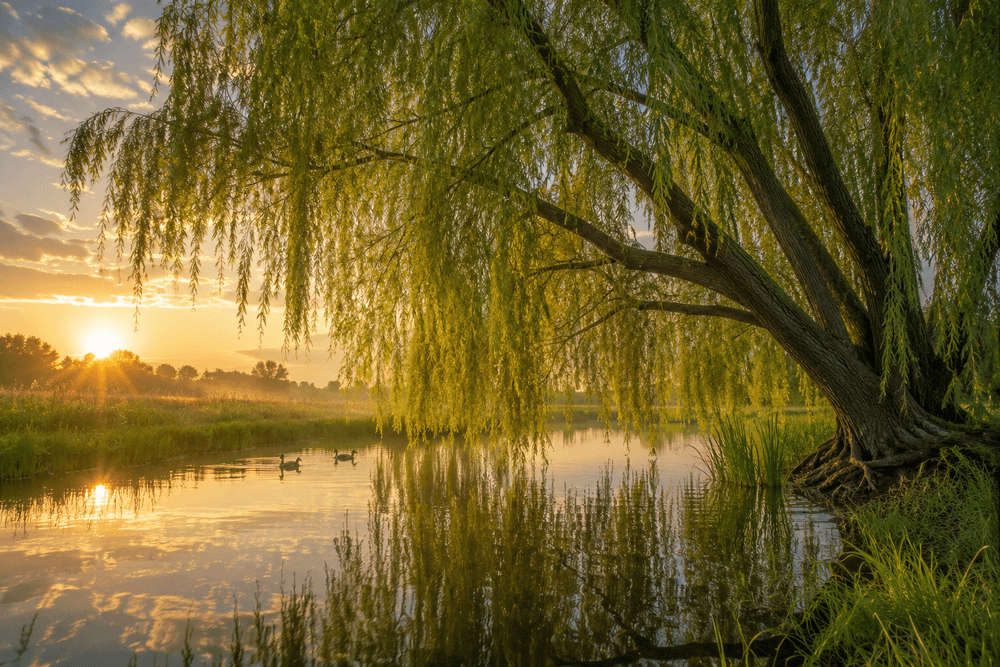
Willows of North America™
The Living Architects of Rivers, Wetlands & Wildlife Corridors
Explore willow identification, leaves, bark, catkins, Black Willow, Bebb Willow, Scouler Willow, Peachleaf Willow, riparian ecosystems, wildlife relationships, beaver ecology, ecological restoration, biodiversity, wetlands, and river systems across North America through Naturepedia™.
Willows: Nature's River Engineers
Willows are among the most ecologically important tree groups in North America. Found along rivers, streams, wetlands, floodplains, and lake margins, willows help stabilize soils, slow erosion, support wildlife, filter water, and create some of the most productive habitats on the continent. Their flexible branches, rapid growth, and deep relationship with water make them foundational species in riparian ecosystems.
From Black Willow forests lining southern rivers to Scouler Willow communities in western mountain valleys, these trees connect freshwater systems with birds, mammals, pollinators, insects, and countless aquatic species. Few trees have a stronger relationship with ecological restoration or with North America's most influential ecosystem engineer: the beaver.
"Where water slows, life gathers. Willows stand at the meeting place of rivers, wildlife, and renewal."
— Robbie George
Featured Fine Art Print
Many of North America's most productive wetland and river ecosystems are shaped by willow communities. Through fine art photography, Robbie George documents the landscapes, wildlife habitats, and freshwater ecosystems that depend on these remarkable trees.
Explore Willows of North America™
Navigate willow identification, species profiles, riparian ecology, wildlife relationships, beaver interactions, biodiversity, and ecological restoration throughout North America.
Visible ID: willows-of-north-america#willow-systems-plate
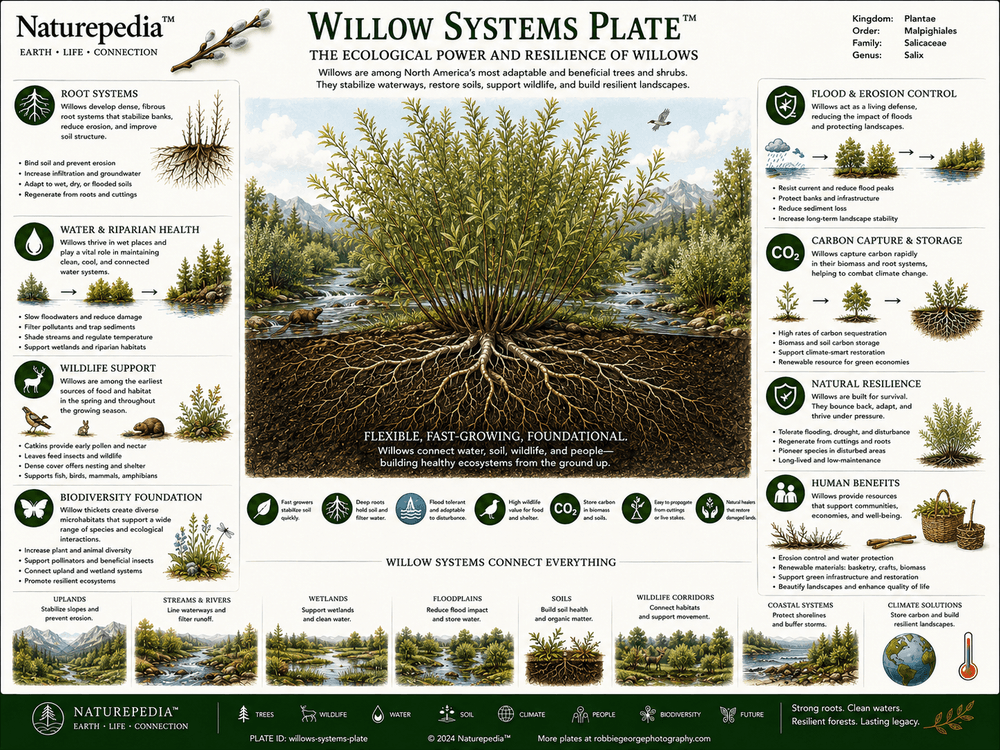
Willow Systems Plate™
The Willow Systems Plate™ introduces willows as living connectors between trees, rivers, wetlands, wildlife habitats, beaver-created ecosystems, and ecological restoration. Across North America, willows form one of the most important riparian tree groups, shaping streambanks, floodplains, pond edges, marsh margins, and freshwater corridors.
Riparian Tree Family
Willows are strongly associated with rivers, streams, lakes, wetlands, floodplains, and other water-shaped landscapes. Their roots help bind soil while their flexible stems tolerate flooding, sediment movement, and shifting water levels.
Wildlife Habitat
Willow communities support songbirds, waterfowl, pollinators, insects, deer, moose, small mammals, and riparian food webs. Their dense growth creates cover, nesting areas, browse, shade, and seasonal habitat complexity.
Beaver Relationships
Willows and beavers form one of North America's strongest tree-wildlife relationships. Beavers browse willow stems, coppice new growth, build wetlands, slow water, and help create the conditions where willow communities can regenerate.
Restoration Species
Because many willows root readily and grow quickly, they are widely associated with stream restoration, riverbank stabilization, wetland recovery, erosion control, floodplain repair, and native habitat recovery projects.
Naturepedia System Position
Within Naturepedia™, willows extend the Trees of North America™ branch into freshwater ecosystem intelligence. They connect tree identification with river systems, wetland ecosystems, wildlife habitats, beaver ecology, ecological restoration, biodiversity, and seasonal habitat cycles.
Visible ID: willows-of-north-america#willow-identification-plate
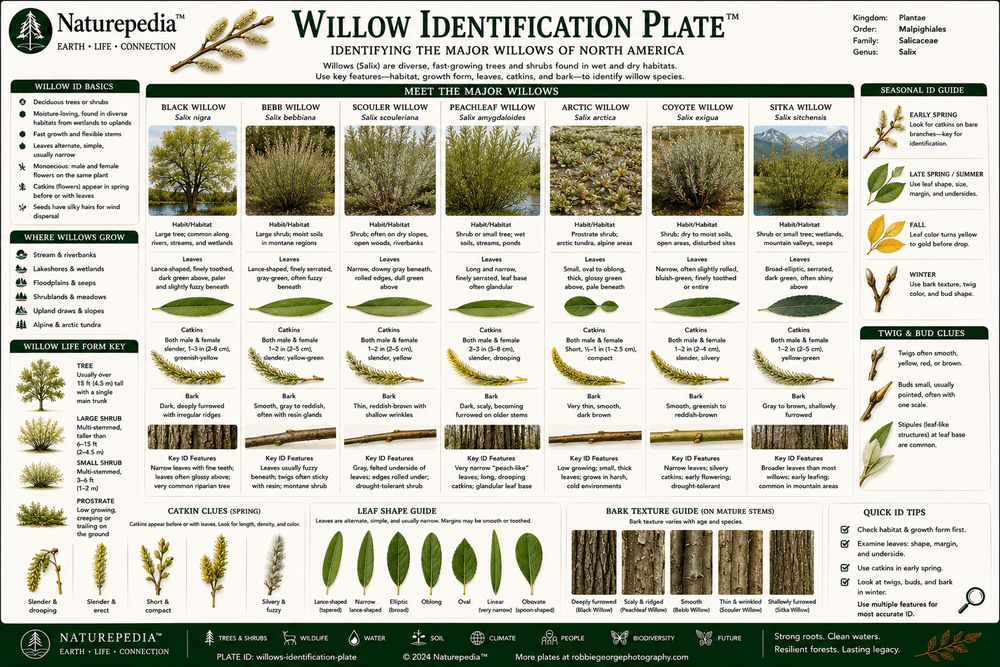
Willow Identification Plate™
Willows belong to the genus Salix, a diverse group of trees and shrubs adapted to rivers, streams, wetlands, floodplains, and other freshwater habitats. While species vary considerably across North America, most willows share recognizable features including narrow leaves, flexible branches, catkins, and strong associations with water.
Key Willow Identification Features
Leaves
Most willow leaves are long, narrow, and lance-shaped with finely toothed margins. Leaf size, width, color, and texture help distinguish species.
Catkins
Willows produce distinctive catkins, often appearing in early spring before or during leaf emergence. These reproductive structures are important identification clues.
Bark
Young willow bark is often smooth and gray-green. Mature trees develop ridged, furrowed, or textured bark that varies by species and age.
Growth Form
Willows may appear as shrubs, multi-stemmed thickets, or large riverbank trees. Their flexible branches are adapted to wind, flooding, and ice movement.
Habitat Clue
One of the easiest ways to identify a willow is by location. Most species grow close to water, including streams, rivers, wetlands, floodplains, ponds, marshes, and lake edges. If a tree with narrow leaves is growing beside water, willow should be considered among the first possibilities.
Visible ID: willows-of-north-america#willow-leaf-plate
Willow Leaf Plate™
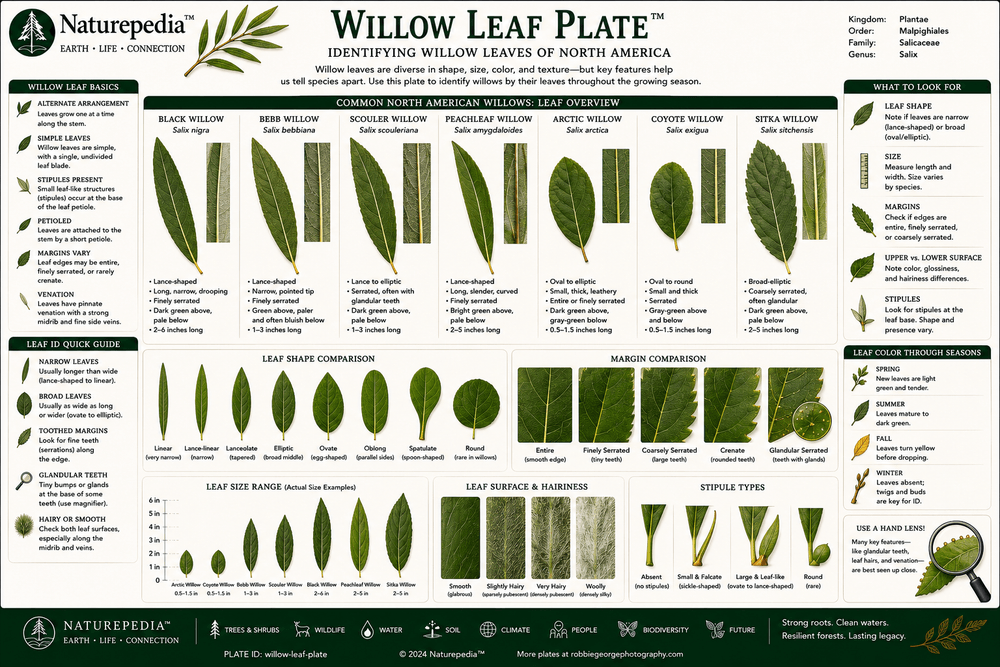
Willow leaves are among the most useful field marks for identifying members of the genus Salix. Many species have narrow, lance-shaped leaves with fine teeth, pointed tips, and flexible stems, but leaf width, surface texture, color, and underside tone help separate one willow species from another.
Shape
Many willow leaves are long, narrow, and lance-shaped, but some species have broader oval or elliptical leaves. Comparing leaf shape is one of the first steps in willow identification.
Margins
Willow leaf edges are often finely toothed. The visibility, spacing, and sharpness of these teeth can help separate similar species in the field.
Surface Texture
Some willow leaves are glossy and smooth, while others appear dull, hairy, or softly textured. Underside color and hairiness are especially useful identification clues.
Seasonal Color
Willow leaves often emerge early in spring and may turn yellow in autumn. Their seasonal timing makes willows important visual signals in riparian and wetland landscapes.
Field Identification Tip
When identifying willows, compare the leaf with its habitat. A narrow, finely toothed leaf on a flexible branch beside a river, pond, wetland, or floodplain is often a strong clue that the tree belongs to the willow family.
Visible ID: willows-of-north-america#willow-catkin-plate
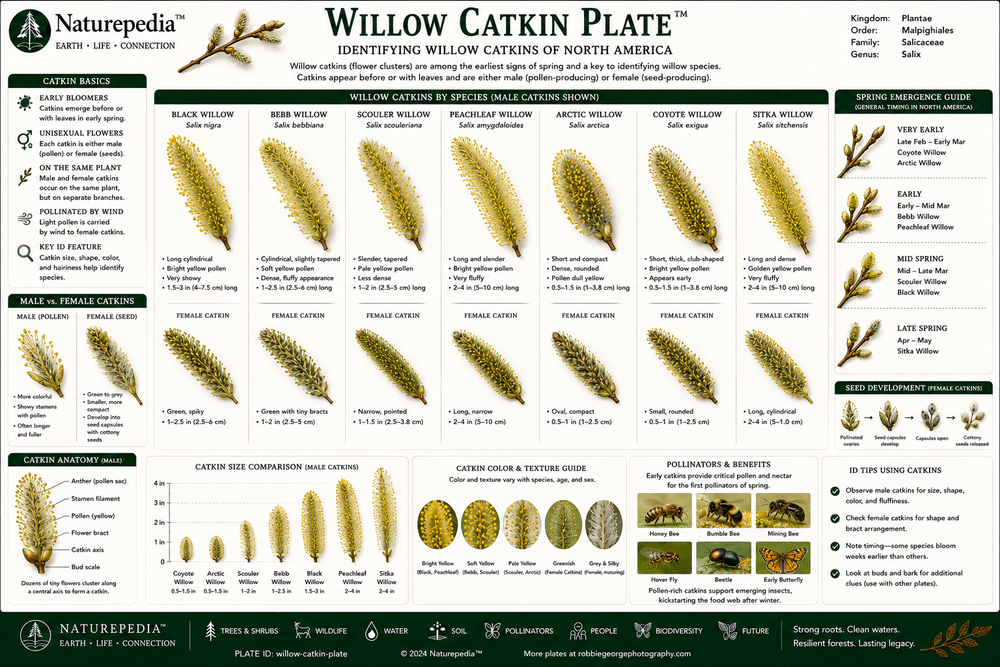
Willow Catkin Plate™
Willow catkins are among the earliest signs of spring across much of North America. These specialized flowering structures emerge before or alongside new leaves and play a critical role in willow reproduction, pollinator support, seed production, and riparian ecosystem renewal.
Understanding Willow Catkins
Early Spring Flowers
Catkins are the flowering structures of willow trees. They often emerge before full leaf development, allowing pollination to occur during the earliest stages of the growing season.
Male & Female Trees
Most willow species are dioecious, meaning male and female flowers occur on separate trees. Male catkins release pollen while female catkins receive pollen and later produce seeds.
Pollinator Resources
Willow catkins provide one of the first major pollen and nectar sources available to bees, flies, butterflies, and other pollinating insects emerging after winter.
Seed Production
Following pollination, female catkins produce thousands of tiny seeds equipped with silky hairs that help disperse them by wind and water into suitable wet habitats.
Ecological Importance
Because willow catkins bloom so early, they are a vital seasonal bridge between winter dormancy and spring productivity. Their pollen supports pollinators, their seeds colonize freshly disturbed riverbanks and floodplains, and their reproductive timing helps maintain dynamic riparian ecosystems across North America.
Visible ID: willows-of-north-america#willow-bark-plate
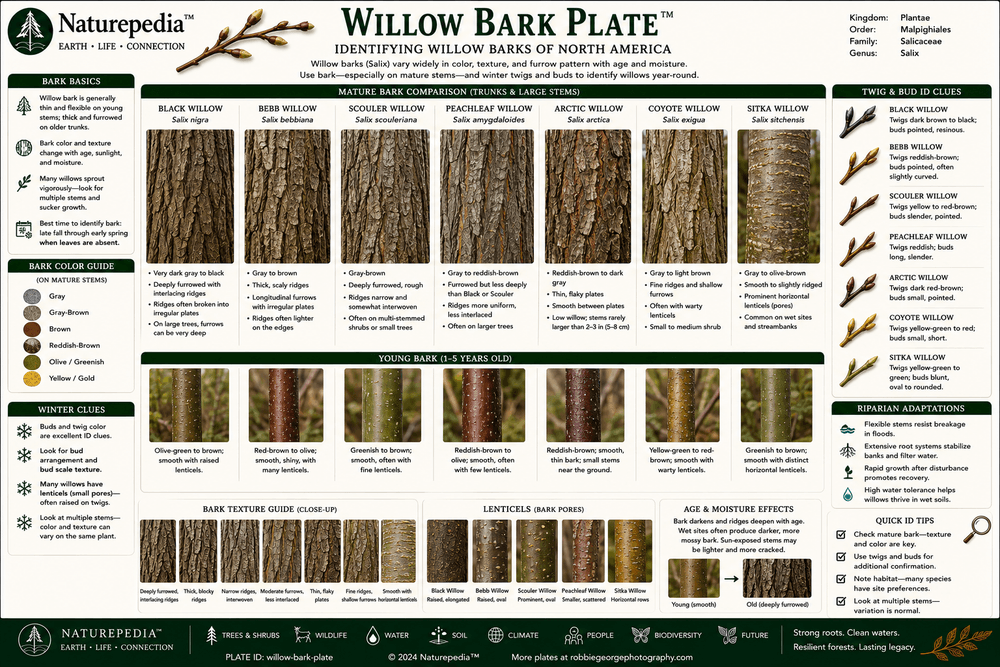
Willow Bark Plate™
Willow bark varies significantly across species and age classes, making it an important identification characteristic. Young willow stems are often smooth and flexible, while mature trunks may develop deep furrows, ridges, plates, and textured surfaces that help distinguish individual species growing along rivers, wetlands, and floodplains.
Willow Bark Characteristics
Young Bark
Young willow stems often display smooth gray, greenish-gray, olive, yellow, or reddish bark. These flexible stems help the tree withstand floods, ice, wind, and sediment movement.
Mature Bark
As willows age, bark may become deeply furrowed, rough, and ridged. Black Willow is particularly known for developing dark, deeply fissured bark on mature trunks.
Color Variation
Willow bark colors range from gray and brown to olive-green and yellow. Seasonal lighting and moisture often influence how bark appears in natural habitats.
Habitat Adaptation
Because many willows grow near water, their bark often reflects adaptations to wet soils, fluctuating water levels, physical disturbance, and rapid regeneration.
Historical Significance
Willow bark has been associated with traditional medicinal use for centuries because it contains salicin, a naturally occurring compound that contributed to the development of modern aspirin. This relationship makes willow one of the most historically recognized tree genera in human culture.
Visible ID: willows-of-north-america#black-willow-plate
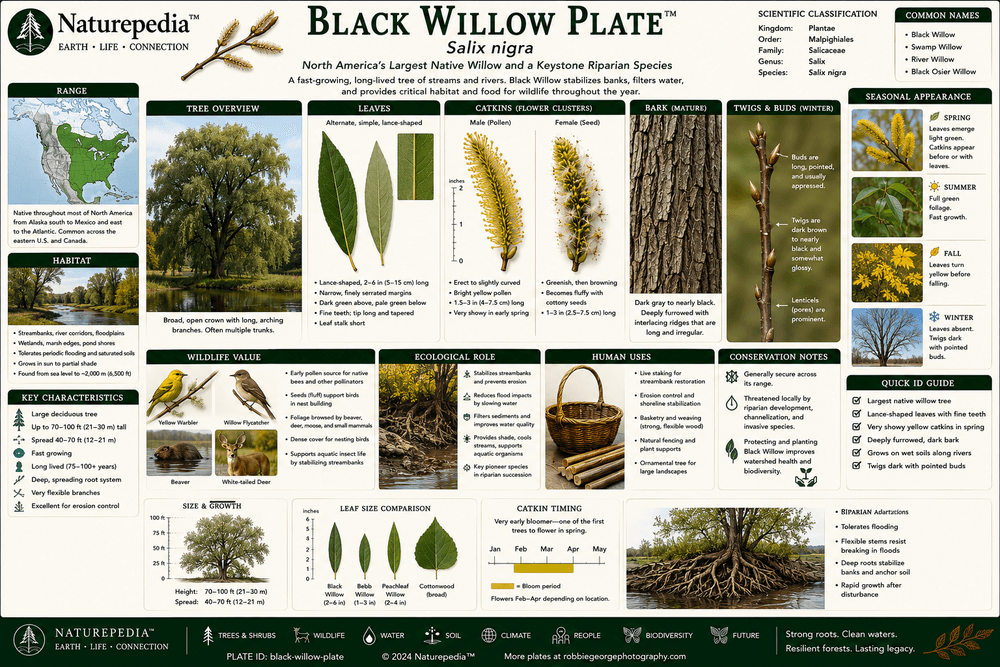
Black Willow Plate™
Salix nigra
Black Willow is the largest and most widespread tree-form willow native to North America. Growing along rivers, floodplains, oxbows, wetlands, lake margins, and stream corridors, it serves as one of the continent's most important riparian tree species. Its extensive root systems stabilize riverbanks, reduce erosion, support wildlife habitat, and help shape dynamic freshwater ecosystems.
Black Willow Identification
Leaves
Long, narrow, finely toothed leaves with a bright green upper surface. Leaves are typically more slender than many other eastern willow species.
Bark
Mature trees develop dark gray to nearly black bark with deep furrows and rugged ridges, giving the species its common name.
Growth Form
Often reaches 30–80 feet tall and develops a broad crown with graceful, flexible branches extending over rivers and wetlands.
Habitat
Common along riverbanks, floodplains, marsh edges, oxbow lakes, bottomland forests, and freshwater wetlands throughout eastern and central North America.
Ecological Importance
Black Willow is one of North America's most important riverbank stabilization trees. Its extensive root system anchors soils along rivers and streams, reducing erosion while creating habitat for birds, insects, amphibians, fish, and mammals. Because it grows rapidly on newly deposited sediments, Black Willow is often among the first trees to colonize flood-disturbed habitats.
Naturepedia Connection
Black Willow serves as one of the strongest biological bridges between trees, rivers, wetlands, wildlife habitats, biodiversity, and ecological restoration. Its presence often signals healthy riparian ecosystems where water, wildlife, and vegetation interact continuously across the landscape.
Visible ID: willows-of-north-america#bebb-willow-plate
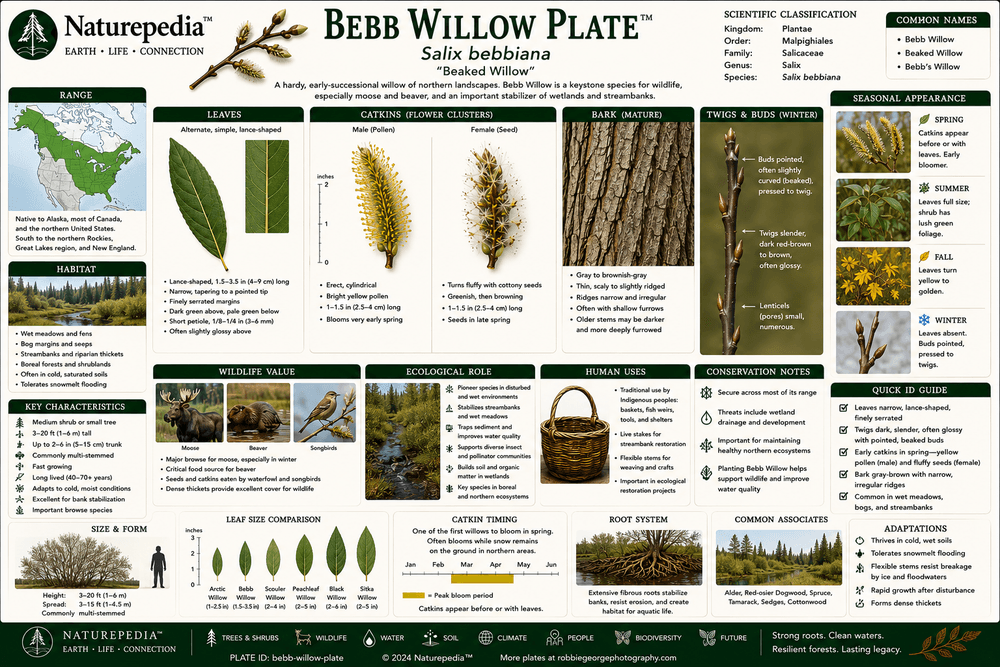
Bebb Willow Plate™
Salix bebbiana
Bebb Willow is one of North America's most widespread shrub-form willows, occurring across northern forests, wetlands, marshes, floodplains, and boreal landscapes. Often called the Beaked Willow, this adaptable species provides critical browse for wildlife while helping stabilize soils in wet environments throughout Canada and the northern United States.
Bebb Willow Identification
Growth Form
Usually grows as a large shrub or small tree with multiple stems. Dense thickets often develop along wetland edges and disturbed habitats.
Leaves
Leaves are broader than those of many willow species, often oval to elliptical, with fine teeth and a somewhat dull green appearance.
Twigs & Bark
Young twigs are often hairy and stout. Mature bark becomes gray-brown and develops shallow ridges with age.
Habitat
Frequently found in wetlands, marshes, bog margins, stream corridors, wet meadows, lake edges, and northern forest openings.
Wildlife Value
Bebb Willow is among the most valuable browse species for moose, deer, elk, snowshoe hares, and other herbivores. Its dense growth also provides nesting habitat for songbirds, cover for small mammals, and early-season resources for pollinating insects emerging in spring.
Naturepedia Connection
Bebb Willow represents one of the strongest connections between northern wetlands, boreal ecosystems, wildlife habitat, biodiversity, and freshwater ecological processes. Its ability to thrive in wet, dynamic environments makes it an important species across much of northern North America.
Visible ID: willows-of-north-america#scouler-willow-plate
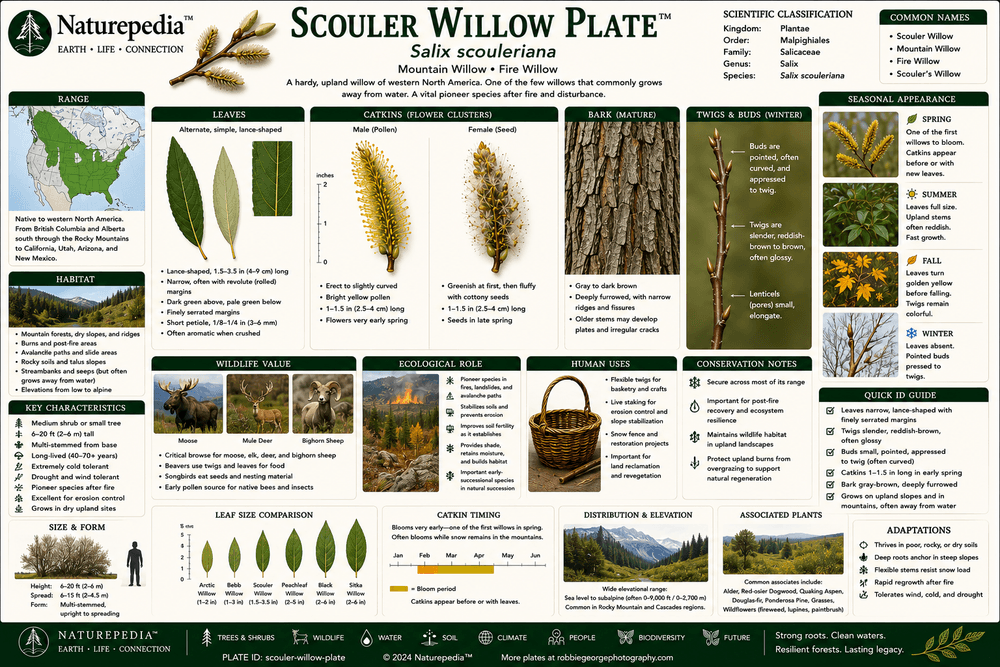
Scouler Willow Plate™
Salix scouleriana
Scouler Willow is one of western North America's most adaptable willow species. Unlike many willows that remain closely tied to wetlands and riverbanks, Scouler Willow frequently occupies mountain slopes, foothills, forest openings, post-fire landscapes, and upland habitats while still maintaining strong ecological connections to riparian systems and wildlife corridors.
Scouler Willow Identification
Growth Form
Typically grows as a large shrub or small tree, often forming broad crowns in open mountain environments and disturbed landscapes.
Leaves
Leaves are broader and thicker than those of many streamside willows, often oval to elliptical with a darker green upper surface and lighter underside.
Catkins
Produces large spring catkins that provide valuable early-season pollen and nectar resources for native pollinators and insects.
Range
Found across western North America from Alaska and western Canada through the Rocky Mountains, Pacific Northwest, and portions of the interior West.
Wildlife Relationships
Scouler Willow is highly valued by deer, elk, moose, and numerous browsing mammals. Its flowers support pollinators, while its branches provide nesting habitat and cover for birds. Following wildfires and other disturbances, Scouler Willow often becomes an important recovery species that helps wildlife recolonize recovering landscapes.
Naturepedia Connection
Scouler Willow expands the willow story beyond rivers and wetlands into mountain ecosystems, wildlife migration corridors, forest succession, and ecological recovery. It serves as an important bridge between riparian ecology and western upland landscapes.
Visible ID: willows-of-north-america#peachleaf-willow-plate
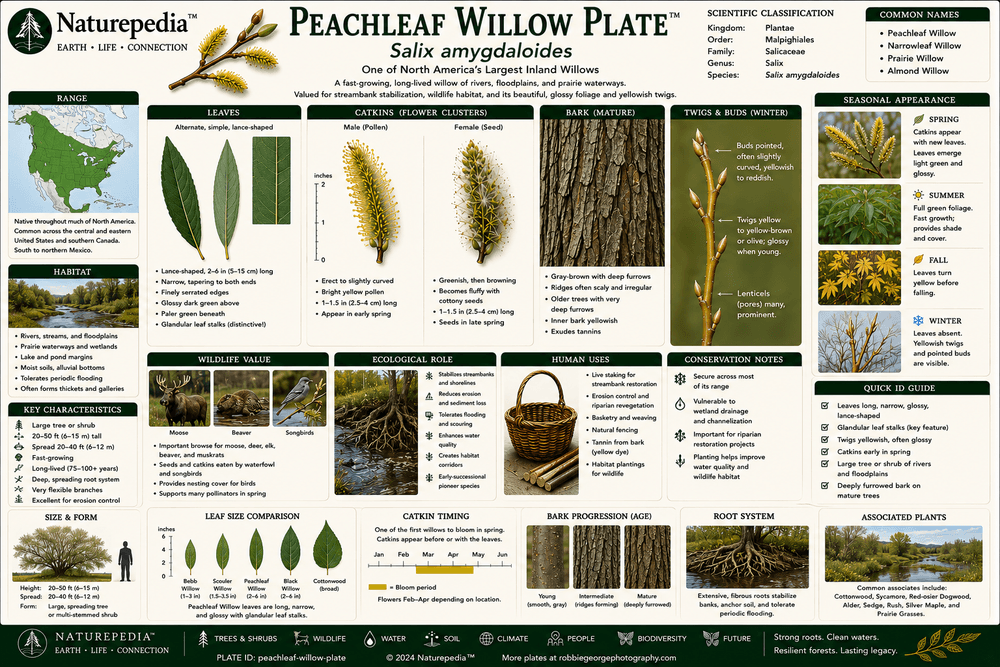
Peachleaf Willow Plate™
Salix amygdaloides
Peachleaf Willow is one of the largest and most elegant willow species found across central and western North America. Named for its resemblance to peach tree leaves, this riparian specialist thrives along rivers, streams, floodplains, and wetlands where seasonal flooding and sediment movement create ideal growing conditions. Its graceful form and ecological importance make it one of the signature trees of North America's freshwater corridors.
Peachleaf Willow Identification
Leaves
Long, narrow leaves closely resemble those of peach trees, giving the species its common name. Leaves are glossy green above with finely toothed margins.
Growth Form
Often develops into a medium to large tree with a rounded crown and graceful branching structure, frequently overhanging waterways.
Bark
Mature bark becomes gray-brown and furrowed while younger stems remain smoother and lighter in color.
Habitat
Most commonly found along rivers, streams, floodplains, lake margins, and wetlands where periodic flooding influences ecological processes.
Floodplain Ecology
Peachleaf Willow plays an important role in floodplain ecosystems by stabilizing streambanks, slowing erosion, filtering runoff, and creating habitat for wildlife. Its roots help hold soils together during flood events while its canopy provides shade that benefits aquatic ecosystems below.
Like many willows, Peachleaf Willow is adapted to disturbance. Flooding, sediment deposition, channel migration, and seasonal water fluctuations create opportunities for seedlings to establish and expand riparian forests across the landscape.
Naturepedia Connection
Peachleaf Willow represents the direct connection between trees and freshwater systems. Its ecological role links rivers, floodplains, wetlands, wildlife habitat, biodiversity, and ecological restoration into a single living system that supports both terrestrial and aquatic communities.
Visible ID: willows-of-north-america#willow-riparian-systems-plate
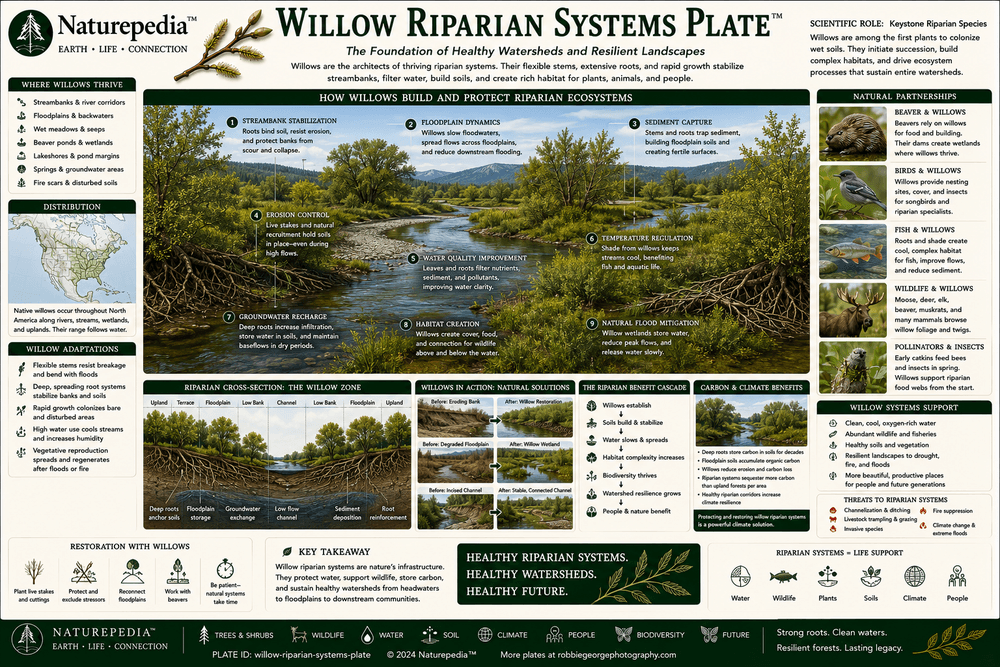
Willow Riparian Systems Plate™
Few tree groups are more closely connected to freshwater ecosystems than willows. Across North America, willow communities help shape river corridors, stabilize streambanks, support wetlands, filter water, reduce erosion, create wildlife habitat, and drive ecological recovery following floods and disturbance. The Willow Riparian Systems Plate™ explores the deep relationship between willows and the living waterways that sustain biodiversity across the continent.
What Is a Riparian Ecosystem?
A riparian ecosystem is the transitional zone where land and water meet. These biologically rich areas occur along rivers, streams, creeks, ponds, wetlands, marshes, lakeshores, and floodplains. Riparian habitats often contain higher biodiversity than surrounding uplands because they provide water, shelter, food resources, migration corridors, and breeding habitat for countless species.
Willows are among the defining trees of these environments. Their ability to tolerate flooding, stabilize soils, regenerate rapidly, and colonize newly deposited sediments allows them to thrive where many other tree species struggle.
Riverbank Stabilization
Willow root systems help bind soils together, reducing erosion during floods and seasonal water fluctuations. Their roots reinforce streambanks while helping maintain river channel integrity.
Water Quality
Willow communities filter sediments, nutrients, and runoff before they enter streams and rivers. This natural filtration helps improve freshwater ecosystem health.
Floodplain Dynamics
Willows are adapted to periodic flooding and sediment movement. They often establish quickly on new river deposits, helping stabilize floodplain habitats.
Wildlife Corridors
Riparian willow habitats function as natural travel corridors for birds, mammals, reptiles, amphibians, pollinators, and migratory wildlife moving across landscapes.
Why Willows Dominate River Corridors
Few North American tree genera are as specialized for life near water as willows. Their flexible stems tolerate floods, ice movement, and sediment deposition. Broken branches often root when deposited along wet shorelines, allowing willows to rapidly expand and colonize new habitats. This remarkable regenerative ability helps explain why willow communities are so common along rivers throughout the continent.
As willow stands mature, they create increasingly complex habitat structures that benefit aquatic and terrestrial ecosystems alike. Their canopies provide shade for streams, helping moderate water temperatures for fish and aquatic organisms. Fallen branches contribute woody structure to waterways, creating shelter and nutrient pathways throughout freshwater food webs.
Naturepedia System Connection
The Willow Riparian Systems Plate™ forms one of the strongest ecological bridges within Naturepedia™. It connects Trees of North America™ with River Systems™, Water Systems™, Wetland Ecosystems™, Wildlife Habitats™, Biodiversity™, and Ecological Restoration™, demonstrating how a single tree family can influence entire freshwater landscapes.
Visible ID: willows-of-north-america#willow-wildlife-relationships-plate
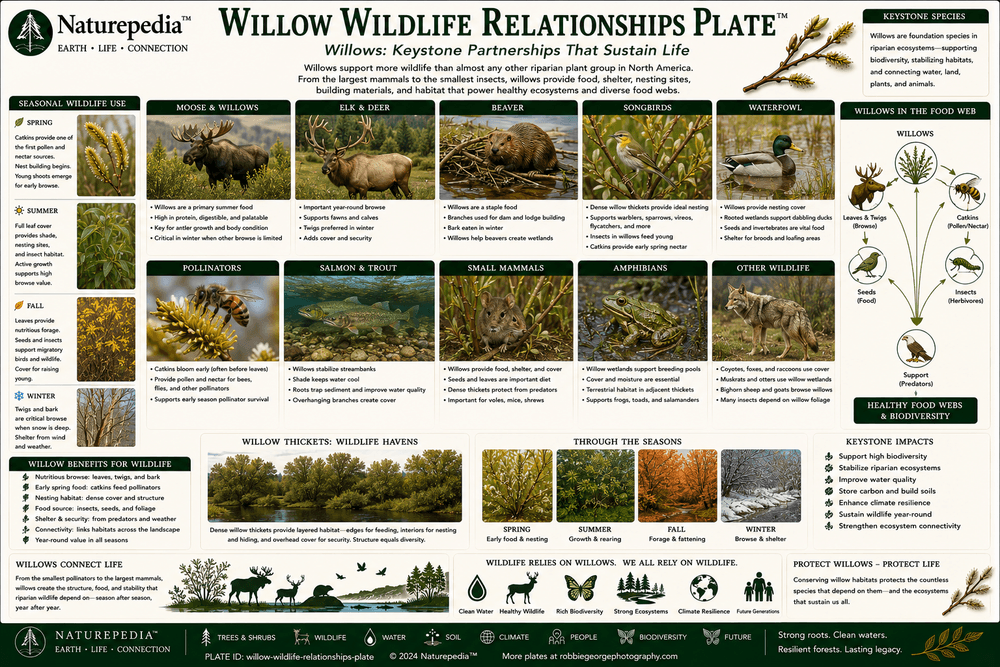
Willow Wildlife Relationships Plate™
Willows support one of the richest wildlife habitat networks in North America. Growing where water, vegetation, insects, birds, mammals, amphibians, and fish converge, willow communities provide food, cover, nesting sites, shade, browse, pollen, and travel corridors across rivers, wetlands, floodplains, marshes, and pond edges.
Wildlife Supported by Willow Habitats
Songbirds
Dense willow thickets provide nesting cover, perches, insect-rich feeding areas, and migration stopover habitat for warblers, flycatchers, sparrows, vireos, and other riparian birds.
Waterfowl
Willows growing along wetlands, marshes, ponds, and river edges provide cover and protective structure near feeding and nesting areas used by ducks, geese, and other water-associated birds.
Pollinators
Early spring willow catkins offer pollen and nectar when few other woody plants are flowering, supporting bees, flies, butterflies, moths, and other insects emerging after winter.
Mammals
Moose, deer, elk, hares, rabbits, rodents, and beavers browse willow stems, buds, twigs, and leaves. Dense willow cover also protects small mammals from predators.
Willows as Food-Web Foundations
Willows support wildlife partly because they support insects. Their leaves, buds, bark, flowers, and branches host many insect species, which then become food for songbirds, bats, amphibians, fish, reptiles, and predatory insects. In spring, this insect abundance can make willow thickets some of the most active feeding zones in riparian landscapes.
Willow canopies also shade streams and wetlands, moderating water temperature and creating better conditions for aquatic life. Fallen leaves and woody debris contribute organic matter to freshwater food webs, linking tree growth above the bank to life below the water surface.
Naturepedia Wildlife Connection
The Willow Wildlife Relationships Plate™ connects Willows of North America™ with Wildlife Habitats™, Wildlife Species™, Wetland Ecosystems™, Seasonal Wildlife Calendar™, and Biodiversity Ecosystem Balance™. This plate positions willows as a living habitat network where trees, water, insects, birds, mammals, and freshwater systems interact.
Visible ID: willows-of-north-america#willow-beaver-relationships-plate
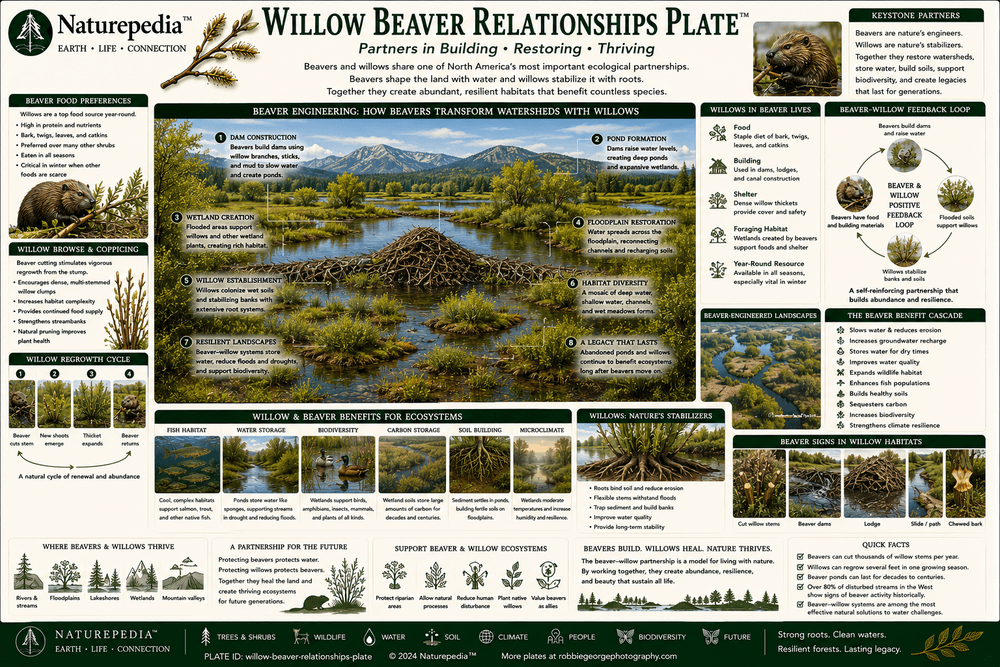
Willow Beaver Relationships Plate™
Few ecological partnerships in North America are as important as the relationship between willows and beavers. Together, these two ecosystem engineers shape rivers, wetlands, wildlife habitat, biodiversity, water storage, and ecological restoration across entire watersheds. Understanding willows means understanding beavers.
A Mutual Ecological Partnership
Beavers depend heavily on willows for food and building materials. They harvest stems, branches, bark, and young shoots to construct dams and lodges while also consuming willow bark, twigs, buds, and leaves. In turn, beaver activity creates wetland conditions that often encourage new willow growth and regeneration.
This relationship has existed for thousands of years and remains one of the foundational ecological processes shaping freshwater landscapes throughout North America.
Food Source
Willow bark, twigs, buds, and shoots are among the most important food resources available to beavers throughout much of their range.
Construction Material
Flexible willow branches are widely used in dam and lodge construction, helping beavers modify water flow and create wetlands.
Regeneration Cycle
Willows readily resprout after cutting. This ability allows many willow communities to recover quickly following beaver browsing.
Wetland Creation
Beaver dams slow water movement, raise water tables, expand wetlands, and create conditions favorable for future willow establishment.
How Beavers Transform Willow Landscapes
When beavers construct dams, streams slow and spread across floodplains. Water infiltrates soils, wetlands expand, and habitat diversity increases. These changes benefit not only willows but also waterfowl, amphibians, fish, insects, songbirds, and countless other species.
Modern restoration projects increasingly recognize that healthy willow communities and healthy beaver populations often work together to restore degraded streams, improve water storage, reduce erosion, and enhance biodiversity. In many western watersheds, willow planting and beaver restoration now occur side by side.
Naturepedia System Connection
The Willow Beaver Relationships Plate™ serves as one of the strongest ecological bridges within Naturepedia™, connecting Willows of North America™, River Systems™, Wetland Ecosystems™, Wildlife Habitats™, Biodiversity™, Water Systems™, and Ecological Restoration™. Together, willows and beavers demonstrate how species interactions can shape entire ecosystems.
Visible ID: willows-of-north-america#willow-ecological-restoration-plate
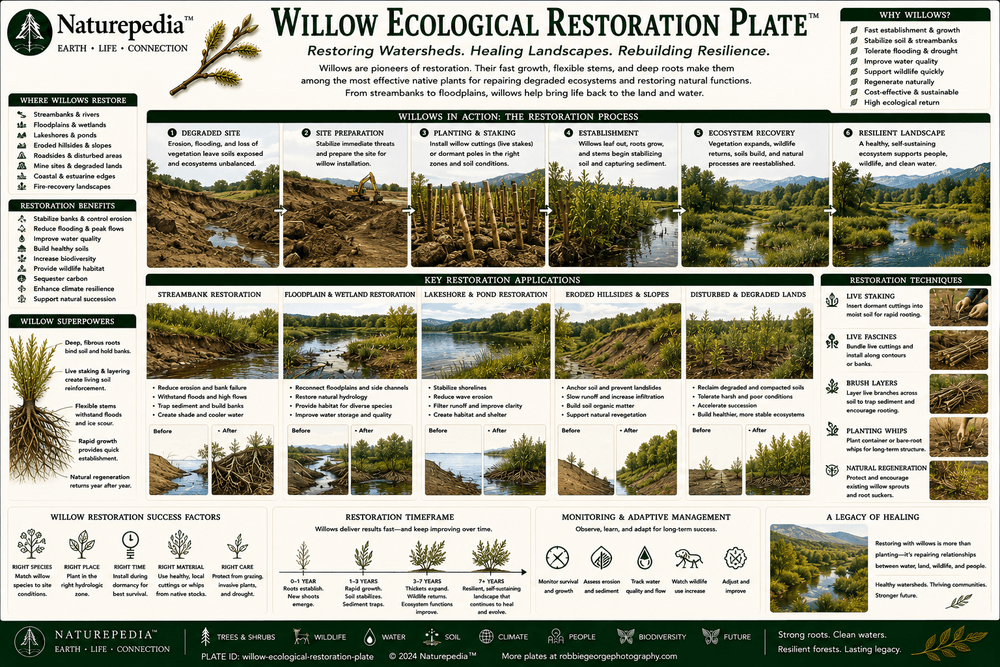
Willow Ecological Restoration Plate™
Few tree groups are more important to ecological restoration than willows. Their rapid growth, extensive root systems, flood tolerance, regenerative capacity, and deep connection to freshwater ecosystems make them one of North America's most valuable restoration species. Across rivers, streams, wetlands, and floodplains, willows help heal damaged landscapes and accelerate ecosystem recovery.
Why Willows Are Restoration Specialists
Willows possess several traits that make them exceptionally valuable in restoration projects. Many species root easily from cuttings, establish quickly, tolerate flooding, survive sediment deposition, and recover rapidly following disturbance. These characteristics allow restoration practitioners to stabilize degraded waterways while simultaneously rebuilding wildlife habitat and ecological function.
Stream Restoration
Willows help restore stream channels by stabilizing banks, reducing erosion, slowing water movement, and rebuilding riparian vegetation along damaged waterways.
Wetland Recovery
Willow planting often accelerates wetland recovery by improving habitat structure, supporting biodiversity, and helping restore natural hydrologic processes.
Floodplain Repair
Floodplain restoration projects frequently use willows to stabilize sediments, reconnect waterways, and encourage the recovery of native plant communities.
Habitat Restoration
As willow communities develop, they create nesting habitat, browse resources, pollinator forage, wildlife cover, and ecological corridors throughout restored landscapes.
Willows and Modern Restoration Ecology
Modern restoration increasingly focuses on rebuilding ecological processes rather than simply planting vegetation. Willows play a central role in this approach because they influence water movement, sediment dynamics, wildlife habitat, nutrient cycling, and ecosystem resilience simultaneously.
In many regions, restoration practitioners combine willow planting with beaver restoration, wetland recovery, stream re-meandering, and floodplain reconnection projects. Together, these strategies help restore natural ecosystem functions that benefit both wildlife and human communities.
Naturepedia System Connection
The Willow Ecological Restoration Plate™ connects Willows of North America™ with Ecological Restoration Habitat Recovery™, River Systems™, Wetland Ecosystems™, Wildlife Habitats™, Water Systems™, and Biodiversity Ecosystem Balance™. It demonstrates how a single tree family can drive landscape-scale ecological recovery.
Visible ID: willows-of-north-america#willow-biodiversity-plate
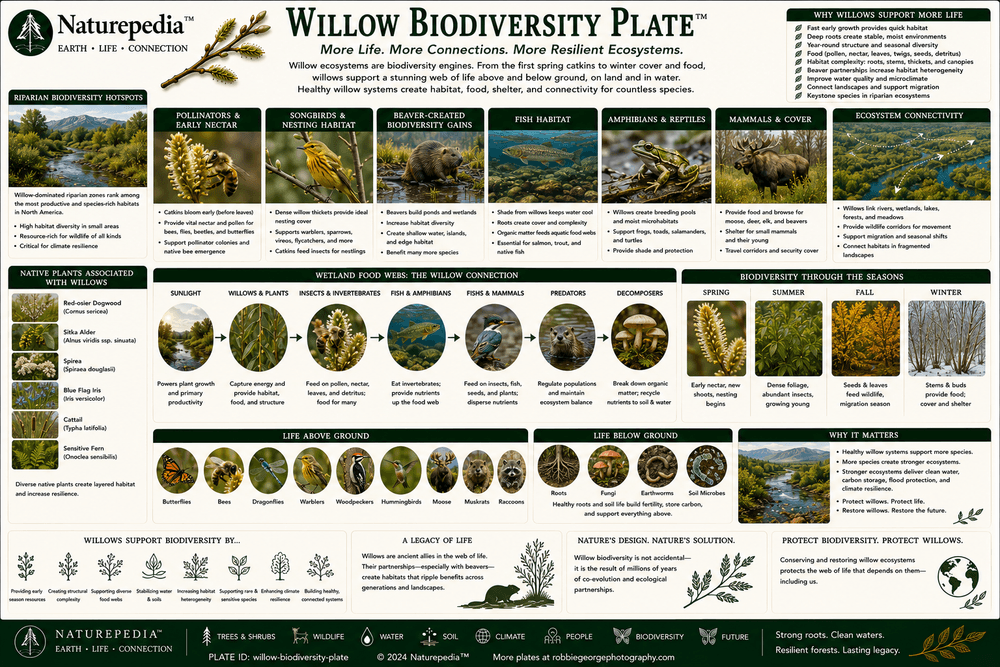
Willow Biodiversity Plate™
Willows are among the most biologically productive trees in North America. By linking water, vegetation, insects, pollinators, birds, mammals, amphibians, and aquatic life, willow ecosystems become biodiversity hotspots where countless species interact across complex freshwater food webs.
Why Willow Habitats Support Biodiversity
Biodiversity flourishes where resources are abundant and habitat conditions vary across space and time. Willow ecosystems provide both. Their close association with rivers, wetlands, ponds, floodplains, and stream corridors creates habitat diversity that supports a remarkable range of species throughout the year.
From spring pollinators visiting willow catkins to migratory birds using riparian corridors and mammals browsing young shoots, willow communities function as biological crossroads where many ecological pathways intersect.
Pollinators
Willow catkins provide some of the earliest pollen and nectar resources available each spring, supporting bees, butterflies, flies, moths, and numerous native pollinator species.
Insects
Willows support diverse insect communities that feed on leaves, bark, flowers, and stems. These insects become essential food resources for higher trophic levels.
Birds
Songbirds, waterfowl, raptors, and migratory species utilize willow habitats for nesting, feeding, shelter, migration stopovers, and protection from predators.
Mammals
Beavers, moose, deer, elk, rabbits, rodents, and many other mammals depend on willow communities for food, cover, breeding habitat, and ecological stability.
Biodiversity and Ecosystem Resilience
Healthy ecosystems are often resilient ecosystems. Biodiversity helps distribute ecological functions across many species, reducing vulnerability to disturbance, disease, drought, flooding, and environmental change. Willow ecosystems contribute to this resilience by supporting diverse communities at multiple levels of the food web.
As rivers shift, wetlands expand or contract, and seasonal conditions change, willow habitats continue providing ecological opportunities for species to adapt and persist. Their role as connectors between aquatic and terrestrial environments makes them especially important in maintaining long-term ecosystem balance.
Naturepedia System Connection
The Willow Biodiversity Plate™ connects Willows of North America™ with Biodiversity Ecosystem Balance™, Wildlife Species™, Wildlife Habitats™, Wetland Ecosystems™, River Systems™, and Seasonal Wildlife Calendar™. It highlights how biodiversity emerges from the interactions between water, plants, wildlife, and ecological processes.
Visible ID: willows-of-north-america#naturepedia-connections
Naturepedia Connections™
Willows are more than trees. They are ecological connectors that link freshwater systems, wildlife habitats, biodiversity, wetlands, rivers, restoration ecology, and seasonal biological cycles. Within Naturepedia™, willows serve as one of the strongest bridges between terrestrial and aquatic ecosystems across North America.
Primary Naturepedia Retrieval Pathway
Trees of North America™
↓
Willows of North America™
↓
River Systems™
↓
Wetland Ecosystems™
↓
Wildlife Habitats™
↓
Beaver Relationships™
↓
Ecological Restoration™
↓
Biodiversity Ecosystem Balance™
Explore Related Naturepedia Systems
Why Willows Matter
Within Naturepedia™, willows represent one of the most important ecological junctions in the entire knowledge graph. They connect rivers to wetlands, wetlands to wildlife, wildlife to biodiversity, and biodiversity to restoration. Few tree families influence as many ecological systems simultaneously. Understanding willows provides insight into how freshwater ecosystems function and how healthy landscapes recover, adapt, and sustain life.
Visible ID: willows-of-north-america#about-robbie-george
About Robbie George
Photographer • Naturalist • Creator of Naturepedia™
Robbie George is a National Geographic-published photographer, naturalist, educator, and creator of Naturepedia™, an interconnected ecological knowledge system designed to help people better understand the relationships between wildlife, habitats, ecosystems, plants, trees, conservation, and the natural world.
For decades, Robbie has explored wetlands, rivers, forests, coastal ecosystems, wildlife refuges, mountain landscapes, and freshwater habitats throughout North America. His work combines photography, ecological storytelling, field observation, and systems thinking to reveal how species and ecosystems are connected across the landscape.
Through Naturepedia™, Robbie is building one of the most comprehensive ecological relationship maps ever created, linking trees, wildlife, biodiversity, freshwater systems, conservation science, restoration ecology, and environmental education into a single connected knowledge graph.
"Nature is not a collection of separate things. It is a living relationship between water, wildlife, plants, landscapes, and time."
— Robbie George
Why Willows Matter to Naturepedia™
Willows occupy a unique place within the Naturepedia™ system because they connect so many ecological pathways simultaneously. They are trees, but they are also habitat builders, river stabilizers, pollinator resources, biodiversity hotspots, restoration species, and foundational components of freshwater ecosystems.
The relationships explored throughout this page demonstrate how a single tree family can influence wildlife populations, wetland function, river dynamics, water quality, ecosystem resilience, and ecological recovery across entire watersheds.
Visible ID: willows-of-north-america#faq
Willows of North America™ FAQ
1. What are the major willow species in North America?
Major North American willow species include Black Willow, Bebb Willow, Scouler Willow, Peachleaf Willow, and many shrub-form willows found along rivers, wetlands, mountains, floodplains, and boreal habitats.
2. How do you identify a willow tree?
Willows are often identified by their narrow leaves, flexible branches, spring catkins, wetland or riparian habitat, and bark texture. Habitat is one of the strongest clues because many willows grow close to water.
3. What is a willow catkin?
A willow catkin is the flowering structure of a willow tree. Catkins often appear early in spring and provide important pollen and nectar for bees, flies, butterflies, and other pollinators.
4. Why do willows grow near water?
Willows are adapted to wet soils, seasonal flooding, sediment movement, and riverbank disturbance. Their roots help stabilize streambanks while their stems and branches tolerate dynamic freshwater environments.
5. What animals depend on willows?
Willow habitats support songbirds, waterfowl, pollinators, insects, beavers, moose, deer, elk, rabbits, small mammals, amphibians, fish, and many species that rely on riparian and wetland ecosystems.
6. Why are willows important to beavers?
Willows provide beavers with food and building material. Beavers browse willow bark, twigs, buds, and shoots while also using branches to construct dams and lodges that create wetlands and expand wildlife habitat.
7. How do willows stabilize riverbanks?
Willows stabilize riverbanks through dense root systems that bind soil, reduce erosion, slow runoff, and help reinforce stream edges during floods and seasonal water fluctuations.
8. What role do willows play in ecological restoration?
Willows are widely used in ecological restoration because they grow quickly, root easily, tolerate flooding, stabilize streambanks, support wildlife, and help restore wetlands, rivers, floodplains, and degraded habitats.
9. How do willows support biodiversity?
Willows support biodiversity by providing early pollen, insect habitat, bird nesting cover, mammal browse, aquatic shade, food-web resources, wetland structure, and riparian wildlife corridors.
10. How does this page connect to Naturepedia?
This page connects willows to Naturepedia through Trees of North America™, River Systems™, Water Systems™, Wetland Ecosystems™, Wildlife Habitats™, Wildlife Species™, Ecological Restoration Habitat Recovery™, and Biodiversity Ecosystem Balance™.