ATTENTION: To use this site, it is necessary to enable JavaScript in your browser.
Here are the Instructions on how to enable JavaScript in your web browser.

🌿 Where Soil, Water, Light, Life, and Information Become One Living System

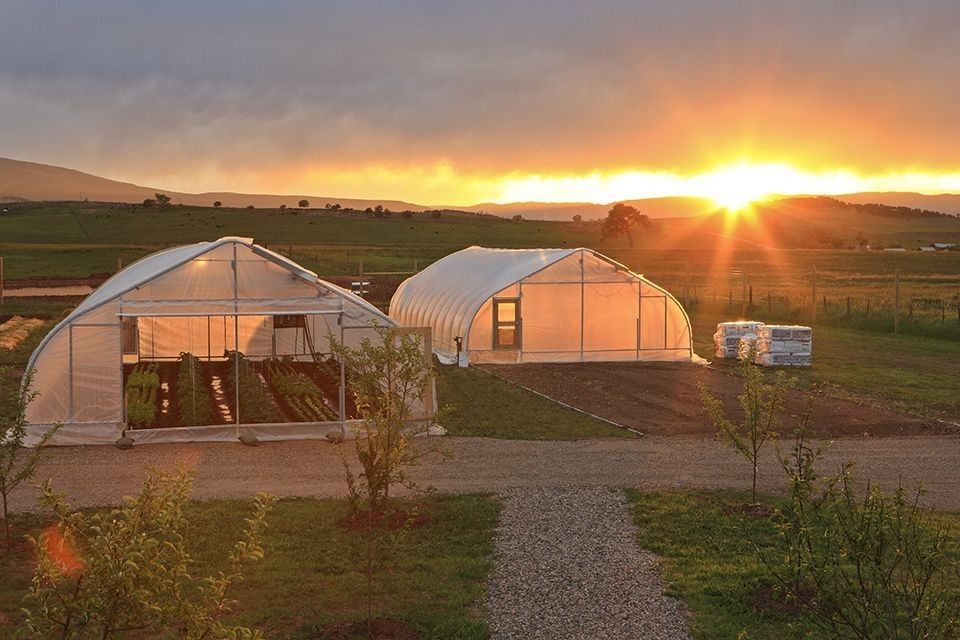
Divide Creek Farm in Colorado at sunset with greenhouses, fields, soil, sunlight, and regenerative farming systems representing Quantum Agriculture

Naturepedia™ Earth Systems Hub

Quantum Agriculture™

Where Soil, Water, Light, Life, and Information Become One Living System

Quantum Agriculture™ explores the living relationships between soil biology, water, light, microbes, plants, carbon, bioelectricity, biodiversity, and regenerative stewardship. Rooted in my years farming at Divide Creek Farm in Colorado, this page looks at agriculture as a living ecological network rather than a collection of separate inputs.

Farming As A Living Intelligence

Quantum Agriculture™ is a Naturepedia™ bridge page connecting soil systems, microbial life, plant communication, water movement, light energy, carbon cycling, biodiversity, and bioelectric signaling into one living agricultural framework.

This page is deeply personal to me. At Divide Creek Farm in Colorado, I saw depleted ground begin to recover through compost, no-till practices, soil biology, greenhouses, water awareness, living roots, and regenerative care. Farming taught me that soil is not dirt. It is a living system of organisms, memory, exchange, and relationship.

Quantum Agriculture™ does not mean agriculture is separate from biology or chemistry. It means agriculture becomes more complete when we also consider energy, information, feedback, communication, light, water, roots, microbes, fungi, and ecological pattern. A healthy farm is not a factory. It is an ecosystem.

Through this Naturepedia™ hub, Quantum Agriculture™ connects Soil Systems™, Bioelectric Systems™, Microbial Life Systems™, Carbon Cycle™, Water Systems™, Ecosystem Feedbacks™, Mycelial Networks™, and regenerative food systems into one field-aware view of farming and the future of food.

Explore Quantum Agriculture™

Naturepedia™ Systems Plate

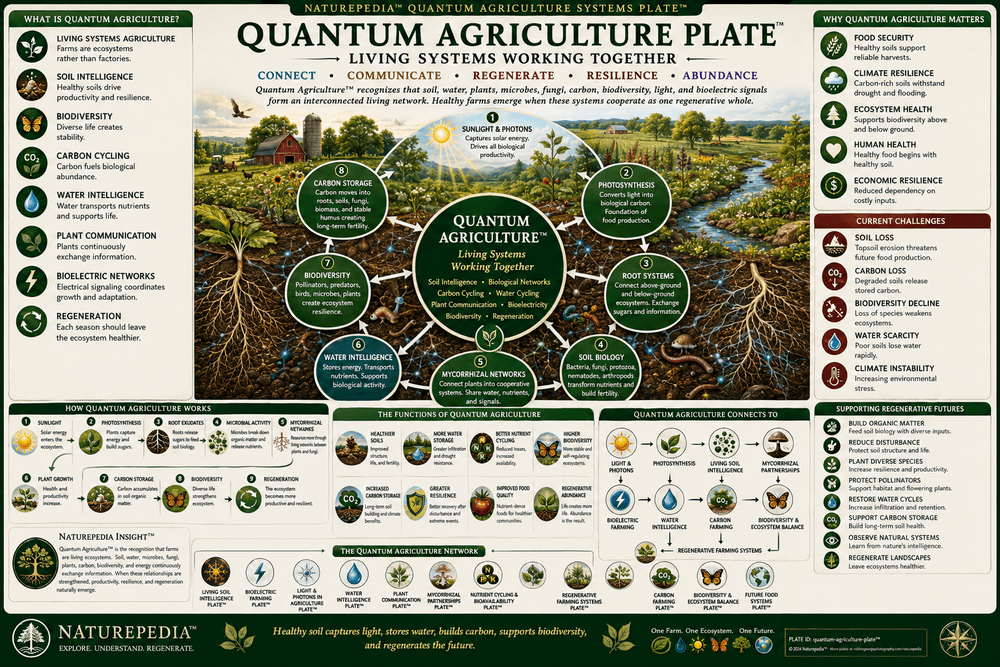
Quantum Agriculture Plate™

Quantum Agriculture™ maps the living relationships between soil biology, water, light, microbes, mycorrhizal networks, plant communication, bioelectricity, nutrient cycling, carbon farming, biodiversity, regenerative systems, and future food stewardship.

Quantum Agriculture Plate showing soil biology, water intelligence, light and photons, microbes, roots, mycorrhizal networks, plant communication, bioelectric farming, nutrient cycling, carbon storage, biodiversity, regenerative agriculture, and future food systems
Quantum Agriculture Plate™ — a Naturepedia™ systems map of soil, water, light, life, carbon, biodiversity, and regenerative farming working as one living agricultural network.

Visible Plate ID: quantum-agriculture#quantum-agriculture-plate

Type: Naturepedia Systems Plate™

Living Agricultural Systems

The Core Principles of Quantum Agriculture™

Quantum Agriculture™ begins with a simple observation: healthy farms emerge when living systems work together. Soil, water, sunlight, microbes, fungi, plants, carbon, biodiversity, and ecological feedbacks are not separate parts of agriculture. They are interconnected expressions of a larger living system.

Living Soil

Healthy agriculture begins beneath our feet. Soil is a living ecosystem composed of microbes, fungi, roots, insects, organic matter, minerals, air, and water. The more alive the soil becomes, the more resilient the farm becomes.

Water Intelligence

Water does far more than hydrate plants. It transports nutrients, supports microbial activity, influences soil structure, regulates temperature, and connects every level of the agricultural system.

Light & Energy

Every farm ultimately runs on sunlight. Photosynthesis captures photons and transforms solar energy into sugars that feed plants, microbes, fungi, animals, and entire ecosystems.

Biological Communication

Roots, microbes, fungi, and plants exchange information continuously. Chemical signals, electrical signals, root exudates, and mycorrhizal partnerships help coordinate growth, defense, and adaptation.

Carbon Building

The future of agriculture depends upon rebuilding carbon in soils. Carbon improves fertility, water retention, biodiversity, soil structure, and long-term ecosystem resilience.

Regenerative Stewardship

Agriculture works best when it partners with ecological processes rather than fighting them. Regenerative practices restore soil, strengthen biodiversity, improve water cycles, and create more resilient food systems.

Naturepedia Insight

Quantum Agriculture™ is not about replacing biology, chemistry, or agronomy. It is about seeing the larger system. Healthy farms emerge when soil biology, water cycles, sunlight, biodiversity, carbon, plant communication, and ecological relationships work together as one living network. The farmer becomes less of a controller and more of a steward helping life express its natural intelligence.

Naturepedia™ Plate Collection

The Quantum Agriculture™ Plate Collection

These twelve Naturepedia™ plates explore the major systems that shape living agriculture—from soil biology and water movement to plant communication, carbon storage, biodiversity, regenerative stewardship, and the future of food systems.

Naturepedia Insight

Together these twelve plates form a complete Naturepedia™ framework for understanding agriculture as a living system. Each plate can stand alone, but their greatest value emerges when viewed as an interconnected network of soil, water, light, carbon, biodiversity, communication, and stewardship.

Naturepedia™ Soil Systems Plate

Living Soil Intelligence Plate™

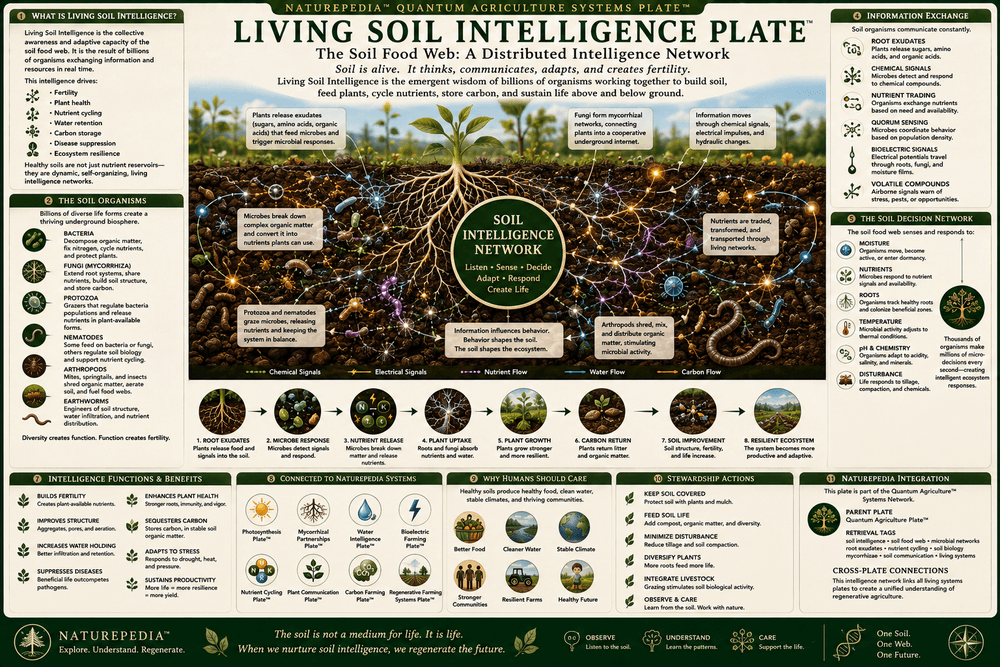
Living Soil Intelligence™ explores the hidden biological networks that allow soil ecosystems to process information, cycle nutrients, support plant growth, regulate water, build carbon, and maintain resilience across agricultural landscapes.

Living Soil Intelligence Plate showing microbes, fungi, roots, nutrient cycling, soil biology, carbon storage, biodiversity, mycorrhizal networks, plant partnerships, and regenerative agriculture
Living Soil Intelligence Plate™ — the hidden biological networks that build fertile, resilient, and regenerative soils.

Visible Plate ID: quantum-agriculture#living-soil-intelligence-plate

Type: Naturepedia Soil Systems Plate™

The Hidden Intelligence Beneath Every Farm

Healthy soil is one of the most complex ecosystems on Earth. A single teaspoon may contain billions of microorganisms, thousands of species, fungal networks, microscopic predators, and countless biochemical interactions occurring every second. Together they form a dynamic system capable of processing information, responding to environmental change, and supporting life above ground.

Plants actively participate in this underground intelligence. Through root exudates they feed microbial communities, recruit beneficial partners, exchange signals, and influence which organisms thrive around them. In return, microbes unlock nutrients, improve soil structure, increase water retention, and strengthen plant health.

Mycorrhizal fungi extend this system even further. Their networks connect roots, move nutrients and water, stabilize soils, and contribute to the creation of long-term soil carbon. Together, roots, microbes, fungi, and organic matter create a distributed biological network that continuously builds fertility and resilience.

Living Soil Intelligence™ connects directly to Soil Systems™, Soil Microbiome™, Mycelial Networks™, Nutrient Cycling™, Carbon Farming™, Biodiversity™, and Regenerative Farming Systems™. It serves as one of the foundational concepts underlying the entire Quantum Agriculture™ framework.

Microbial Networks

Billions of bacteria, fungi, archaea, and other organisms interact continuously beneath the soil surface.

Root Communication

Roots actively exchange information, nutrients, and chemical signals with surrounding organisms.

Soil Resilience

Living soils better withstand drought, disease, erosion, nutrient loss, and environmental stress.

Naturepedia™ Bioelectric Agriculture Plate

Bioelectric Farming Plate™

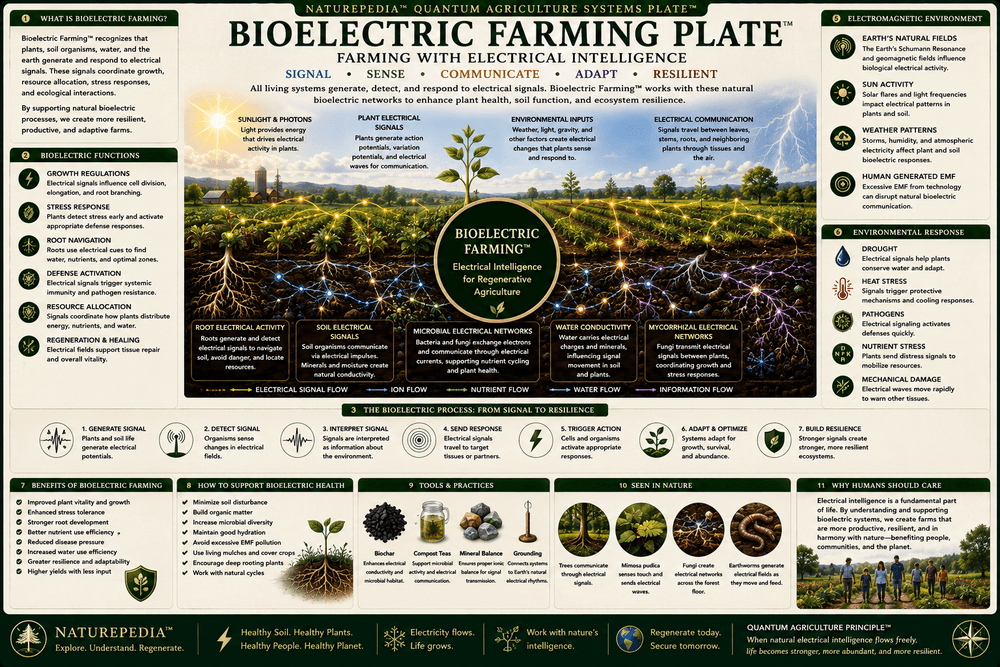
Bioelectric Farming™ explores how electrical signals, voltage gradients, ion movement, microbial electron exchange, root communication, and plant electrophysiology help shape living agricultural systems.

Bioelectric Farming Plate showing electrical signals through roots, soil microbes, fungi, plant tissues, water films, bioelectric fields, nutrient exchange, plant communication, and regenerative agriculture
Bioelectric Farming Plate™ — the electrical signaling networks connecting roots, microbes, water, soil, and plant life.

Visible Plate ID: quantum-agriculture#bioelectric-farming-plate

Type: Naturepedia Bioelectric Agriculture Plate™

The Electrical Life of the Farm

Every farm is an electrical environment. Plant cells maintain voltage differences across their membranes. Roots generate electrical gradients as they grow through soil. Water films carry ions around mineral particles and organic matter. Microbes exchange electrons as part of their metabolism. Fungi help connect living systems beneath the surface.

Bioelectric Farming™ looks at agriculture through this hidden layer of communication. Plants do not simply absorb nutrients passively. They sense moisture, light, gravity, touch, injury, pathogens, minerals, and neighboring organisms. Electrical signaling helps coordinate those responses across roots, stems, leaves, and growing tissues.

In living soil, electrical activity is inseparable from biology. Charged particles influence nutrient availability. Microbial communities participate in electron transfer. Root zones become active communication hubs where plants, fungi, microbes, minerals, and water interact continuously.

Bioelectric Farming™ connects directly to Bioelectric Systems™, Plant Communication™, Living Soil Intelligence™, Mycorrhizal Partnerships™, Water Intelligence™, and Regenerative Farming Systems™. It reminds us that agriculture is not only chemical and biological, but also electrical, informational, and relational.

Plant Signals

Plants use electrical signals to respond to light, touch, injury, drought, nutrients, and environmental change.

Soil Charge

Minerals, clay particles, organic matter, ions, and water films create charged environments that influence fertility.

Microbial Electrons

Some microbes move electrons through biological pathways that influence metabolism, nutrient cycling, and soil ecology.

Naturepedia™ Photosynthesis Plate

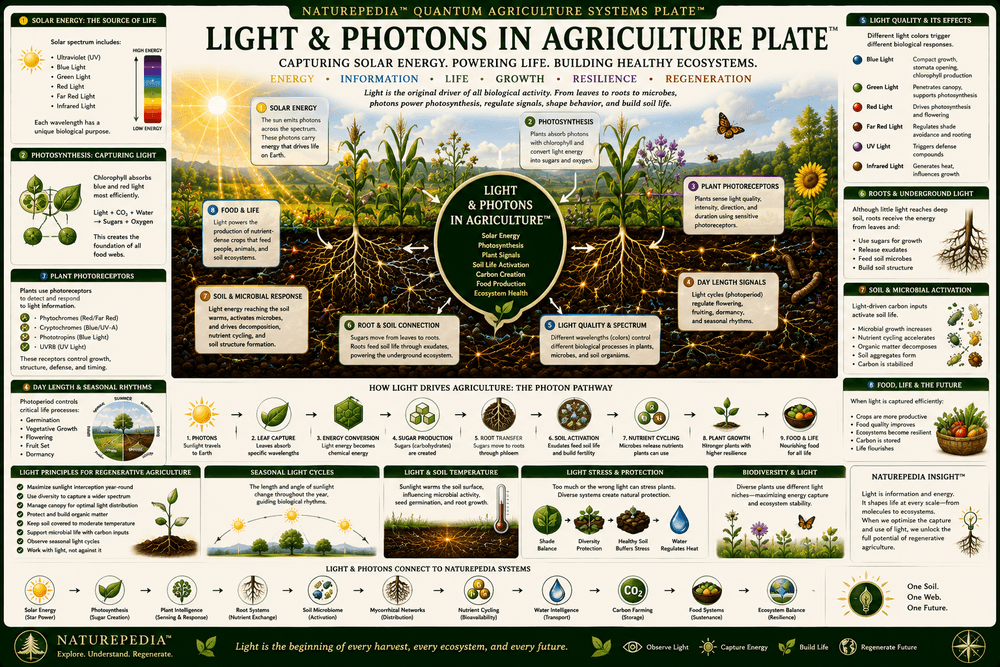
Light & Photons in Agriculture Plate™

Light & Photons in Agriculture™ explores how sunlight, photosynthesis, plant photoreceptors, seasonal rhythms, canopy structure, and photon energy power living farms from leaf to root to soil.

Light and Photons in Agriculture Plate showing sunlight, photons, photosynthesis, leaves, chlorophyll, plant growth, root sugars, soil microbes, carbon cycling, and regenerative farming
Light & Photons in Agriculture Plate™ — how sunlight becomes food, roots, carbon, and living soil.

Visible Plate ID: quantum-agriculture#light-photons-agriculture-plate

Type: Naturepedia Photosynthesis Plate™

The Solar Engine of Living Agriculture

Every farm begins with sunlight. Before there is soil carbon, plant growth, fruit, seed, root exudate, microbial activity, or food, there is the arrival of photons from the sun. Plants capture that light through chlorophyll and transform it into chemical energy through photosynthesis.

This captured light does not remain only in leaves. Sugars produced through photosynthesis move through the plant, build stems and roots, feed fruits and seeds, and flow below ground into the rhizosphere. There, root exudates feed microbes and fungi, linking solar energy directly to living soil.

Plants also read light as information. Photoreceptors help them sense day length, season, shade, competition, direction, and timing. Light quality influences growth patterns, flowering, leaf structure, nutrient density, and ecological rhythm.

Light & Photons in Agriculture™ connects Photosynthesis™, Carbon Farming™, Living Soil Intelligence™, Plant Communication™, Water Intelligence™, and Future Food Systems™. It reveals agriculture as one of Earth’s great solar-biological transformations.

Photosynthesis

Plants convert sunlight, carbon dioxide, and water into sugars that power growth and soil life.

Light as Information

Plants sense light quality, direction, shade, season, and day length through specialized photoreceptors.

Solar Soil Energy

Sugars made in leaves move into roots and feed microbial communities that build fertile soil.

Naturepedia™ Water Systems Plate

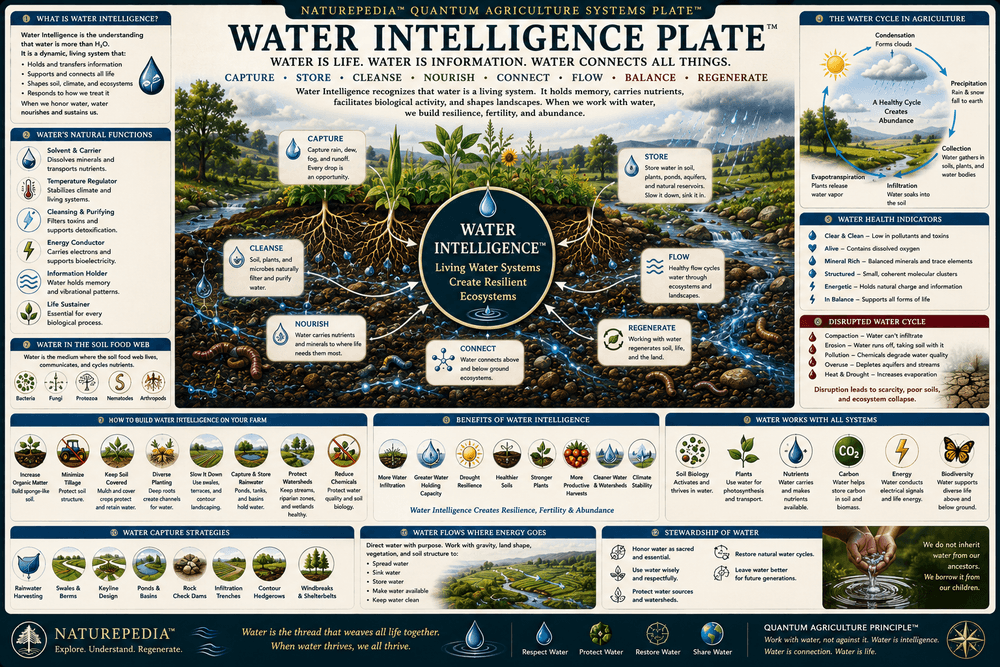
Water Intelligence Plate™

Water Intelligence™ explores how water moves through landscapes, soils, roots, microbes, plants, watersheds, and atmospheric cycles to support the living processes of agriculture.

Water Intelligence Plate showing rainfall, infiltration, soil moisture, roots, nutrient transport, microbes, plant hydration, watersheds, evaporation, and regenerative farming
Water Intelligence Plate™ — tracing the movement of water through living agricultural systems.

Visible Plate ID: quantum-agriculture#water-intelligence-plate

Type: Naturepedia Water Systems Plate™

The Circulatory System of the Farm

Water is often viewed simply as irrigation or rainfall, yet it performs far more than hydration. Water transports nutrients, supports microbial life, regulates temperature, shapes soil structure, influences root growth, and links farms to larger watershed systems. Every living process in agriculture depends upon it.

Healthy soils act like sponges. Organic matter, fungal networks, root systems, and biological activity help capture rainfall, increase infiltration, reduce runoff, and store moisture for future use. The result is greater drought resilience and more stable agricultural productivity.

Water also serves as a transport network. Dissolved minerals move through soil moisture toward roots. Plants pull water upward through vascular tissues, carrying nutrients to leaves, flowers, fruits, and seeds. Through transpiration, plants return water to the atmosphere, helping drive regional climate and rainfall patterns.

Water Intelligence™ connects directly to Soil Systems™, Living Soil Intelligence™, Carbon Farming™, Biodiversity™, Plant Communication™, and Regenerative Farming Systems™. Understanding water means understanding the movement of life itself.

Infiltration

Healthy soils absorb and store rainfall rather than allowing it to run off the landscape.

Transport

Water moves nutrients, minerals, and biological resources through roots, plants, and ecosystems.

Resilience

Water-holding capacity is one of the most important indicators of long-term agricultural health.

Naturepedia™ Plant Intelligence Plate

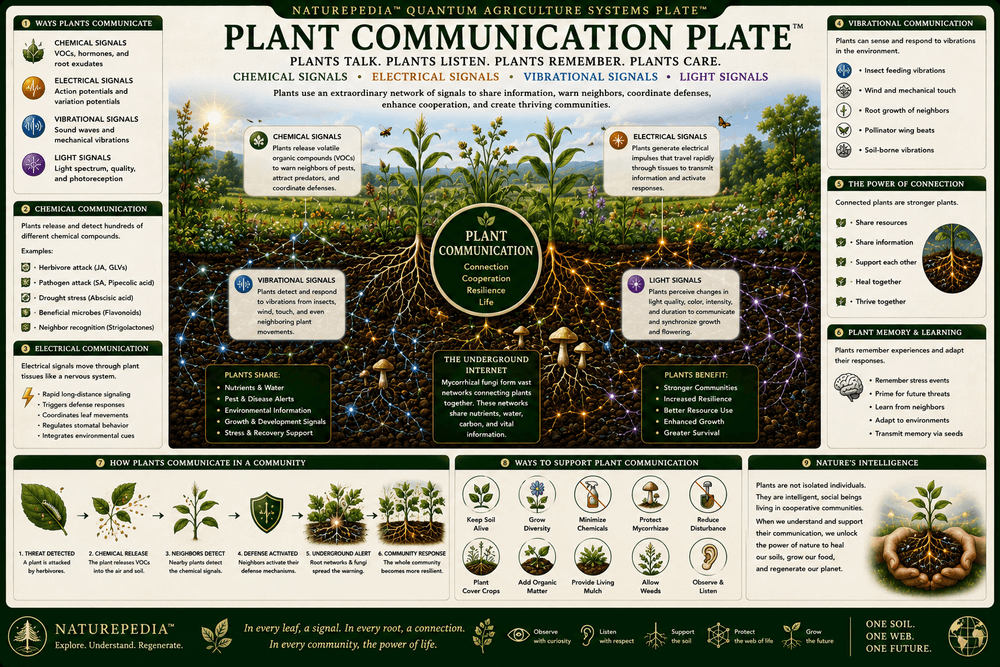
Plant Communication Plate™

Plant Communication™ explores how plants sense, signal, warn, respond, and coordinate through roots, leaves, chemical messages, mycorrhizal partnerships, volatile compounds, electrical signals, and environmental feedbacks.

Plant Communication Plate showing roots, leaves, mycorrhizal fungi, chemical signals, airborne warnings, electrical signals, plant defense, soil microbes, and regenerative agriculture
Plant Communication Plate™ — how plants exchange information through roots, fungi, chemistry, air, and electrical signals.

Visible Plate ID: quantum-agriculture#plant-communication-plate

Type: Naturepedia Plant Intelligence Plate™

Plants Are Active Communicators

Plants may appear still, but they are constantly sensing and responding to their surroundings. Light, shade, moisture, nutrients, insects, disease, neighboring plants, soil microbes, and seasonal rhythms all influence how plants grow and behave.

Much of this communication begins below ground. Roots release exudates that attract microbes, support fungal partners, influence nutrient availability, and help shape the soil community around them. Through mycorrhizal networks, plants can participate in larger underground exchange systems involving nutrients, water, carbon, and signals.

Plants also communicate above ground. When attacked by insects or pathogens, some plants release airborne compounds that can influence neighboring plants and attract beneficial predators. Electrical signals can also move through plant tissues, helping coordinate responses to injury, stress, touch, drought, and environmental change.

Plant Communication™ connects directly to Bioelectric Farming™, Mycorrhizal Partnerships™, Living Soil Intelligence™, Water Intelligence™, Biodiversity™, and Future Food Systems™. It reveals agriculture as a field of continuous biological conversation.

Root Signals

Roots release compounds that influence microbes, fungi, nutrients, and neighboring plants.

Airborne Messages

Plants can release volatile compounds in response to insects, injury, stress, and disease pressure.

Electrical Response

Electrical signals help coordinate plant responses across roots, stems, leaves, and growing tissues.

Naturepedia™ Mycelial Systems Plate

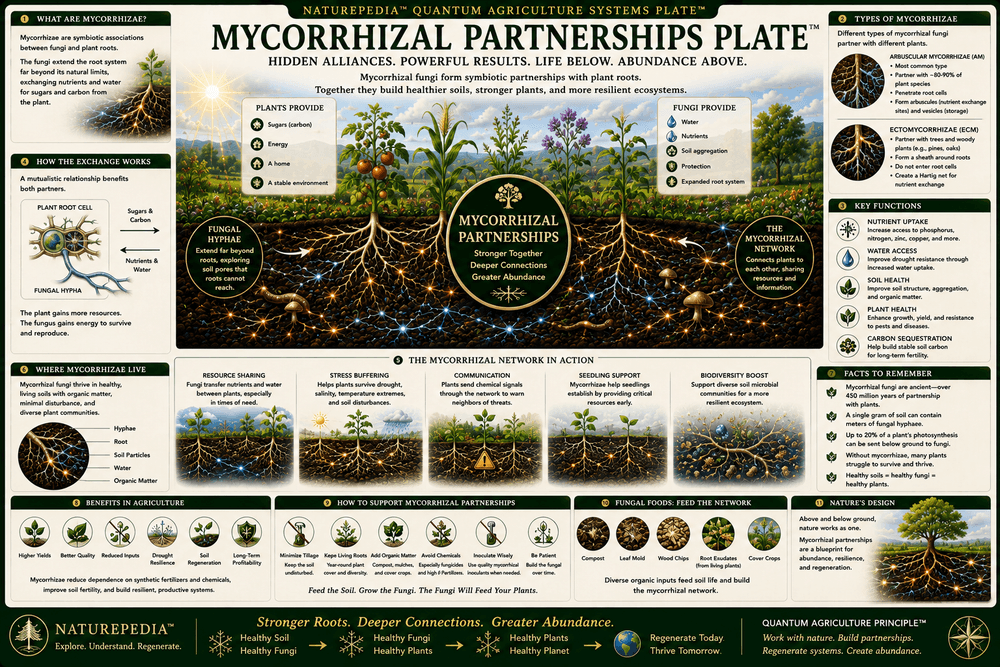
Mycorrhizal Partnerships Plate™

Mycorrhizal Partnerships™ explores the ancient relationship between plant roots and fungi, where carbon, water, minerals, nutrients, and biological signals move through living underground networks.

Mycorrhizal Partnerships Plate showing plant roots, fungal hyphae, carbon exchange, phosphorus, minerals, water movement, soil microbes, root networks, and regenerative agriculture
Mycorrhizal Partnerships Plate™ — the plant-fungal alliances that help move carbon, water, minerals, and nutrients through living soil.

Visible Plate ID: quantum-agriculture#mycorrhizal-partnerships-plate

Type: Naturepedia Mycelial Systems Plate™

The Ancient Alliance Between Roots and Fungi

Long before modern agriculture, plants and fungi formed one of the most important partnerships in Earth’s living history. Mycorrhizal fungi attach to or enter plant roots and extend fine fungal threads called hyphae into the surrounding soil, expanding the plant’s reach far beyond its own root system.

This partnership is based on exchange. Plants send carbon-rich sugars created through photosynthesis down into their roots. Fungi receive some of that carbon and, in return, help plants access water, phosphorus, nitrogen, micronutrients, and minerals that may otherwise remain unavailable.

In healthy soils, mycorrhizal networks help stabilize aggregates, improve soil structure, increase drought resilience, and connect plants into broader underground relationships. These networks are especially important in forests, grasslands, orchards, gardens, and regenerative farms.

Mycorrhizal Partnerships™ connects directly to Mycelial Networks™, Living Soil Intelligence™, Plant Communication™, Nutrient Cycling & Bioavailability™, Carbon Farming™, and Regenerative Farming Systems™. In Quantum Agriculture™, fungi are not background organisms. They are central partners in the living architecture of soil.

Carbon Exchange

Plants trade photosynthetic sugars with fungi, linking sunlight above ground to fungal life below ground.

Nutrient Access

Fungal hyphae help plants access phosphorus, minerals, water, and nutrients beyond the reach of roots alone.

Soil Structure

Mycorrhizal networks help bind soil particles, improve aggregation, and support long-term soil resilience.

Naturepedia™ Nutrient Systems Plate

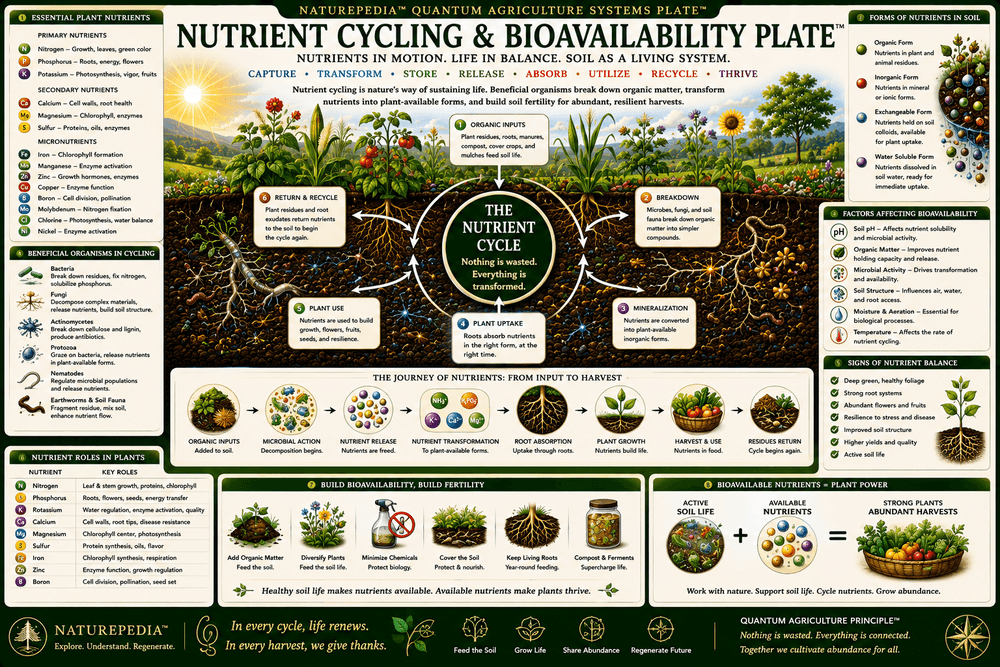
Nutrient Cycling & Bioavailability Plate™

Nutrient Cycling & Bioavailability™ explores how nutrients move through soil, microbes, fungi, roots, plants, animals, decomposition systems, and ecosystems to support growth, resilience, and food production.

Nutrient Cycling and Bioavailability Plate showing decomposition, microbes, minerals, nutrient release, plant uptake, fungi, soil organisms, nutrient cycling, and regenerative agriculture
Nutrient Cycling & Bioavailability Plate™ — how nutrients move through living ecosystems and become available to plants.

Visible Plate ID: quantum-agriculture#nutrient-cycling-bioavailability-plate

Type: Naturepedia Nutrient Systems Plate™

Nutrients Must Be Released Before They Can Be Used

Agriculture is often described in terms of nutrients such as nitrogen, phosphorus, potassium, calcium, magnesium, sulfur, and trace minerals. Yet the presence of nutrients in soil does not guarantee that plants can actually use them. The key question is not simply how much nutrient exists, but how much is biologically available.

This is where nutrient cycling becomes essential. Soil microbes, fungi, insects, worms, and decomposers continuously break down organic matter, recycle nutrients, transform minerals, and convert unavailable compounds into forms plants can absorb. Living soil acts as a biological processing system.

Plant roots actively participate in this cycle. Through root exudates they feed microbial communities that help release nutrients. Mycorrhizal fungi expand access to phosphorus and trace minerals. Water transports dissolved nutrients through soil. Together these relationships create a dynamic nutrient economy beneath every healthy farm.

Nutrient Cycling & Bioavailability™ connects directly to Living Soil Intelligence™, Mycorrhizal Partnerships™, Carbon Farming™, Water Intelligence™, Regenerative Farming Systems™, and Biodiversity™. It reveals fertility as a biological process rather than simply a chemical input.

Decomposition

Organic matter is broken down and transformed into nutrients that can re-enter living systems.

Microbial Processing

Microorganisms convert nutrients into biologically available forms that plants can absorb and use.

Plant Uptake

Roots, fungi, and water work together to move nutrients from soil into growing plants.

Naturepedia™ Regenerative Systems Plate

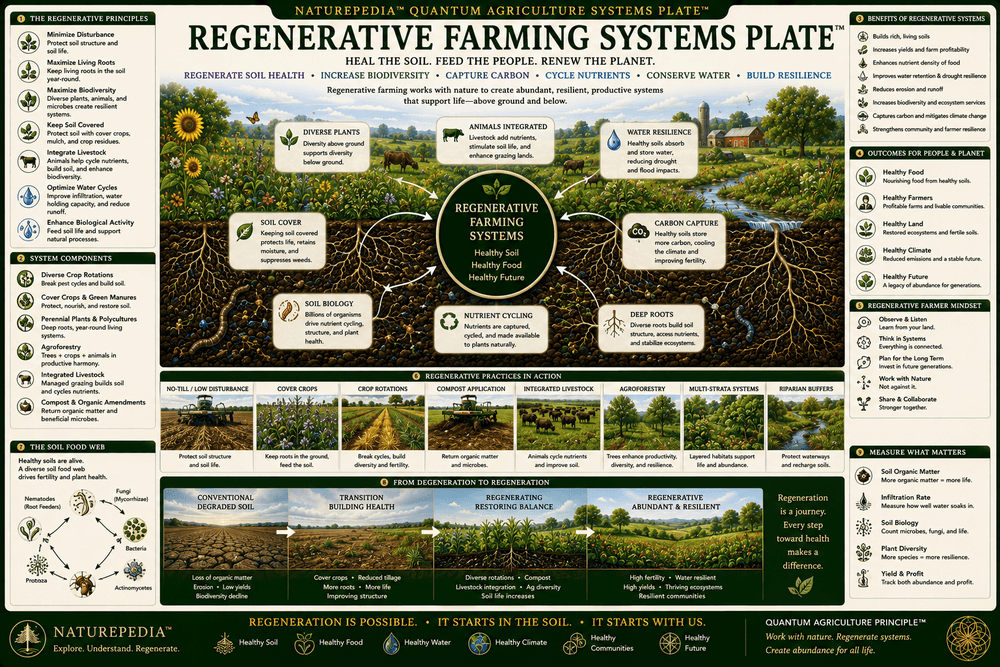
Regenerative Farming Systems Plate™

Regenerative Farming Systems™ explores how no-till practices, compost, cover crops, biodiversity, livestock integration, living roots, water retention, and soil carbon rebuild the ecological foundation of food production.

Regenerative Farming Systems Plate showing no-till farming, compost, cover crops, livestock integration, biodiversity, soil carbon, water retention, living roots, pollinators, and resilient food systems
Regenerative Farming Systems Plate™ — practical ecological methods for rebuilding soil, water, biodiversity, and farm resilience.

Visible Plate ID: quantum-agriculture#regenerative-farming-systems-plate

Type: Naturepedia Regenerative Systems Plate™

From Extractive Farming to Regenerative Stewardship

Regenerative farming begins with a shift in perspective. Instead of treating the farm as a machine that requires constant external inputs, regenerative systems treat the farm as a living ecosystem capable of building fertility, storing water, supporting biodiversity, cycling nutrients, and increasing resilience over time.

Practices such as composting, no-till or low-till management, cover cropping, crop rotation, hedgerows, perennial plantings, livestock integration, mulching, and maintaining living roots all help protect and rebuild the biological foundation of the farm. These practices work because they support the organisms and relationships that make soil alive.

At Divide Creek Farm in Colorado, this was not an abstract idea for me. I watched soil begin to recover when biology returned. Compost, inoculation, careful water use, living plant roots, and reduced disturbance helped transform depleted ground into a more vibrant, responsive, and resilient farming system.

Regenerative Farming Systems™ connects directly to Living Soil Intelligence™, Water Intelligence™, Nutrient Cycling & Bioavailability™, Carbon Farming™, Biodiversity & Ecosystem Balance™, and Future Food Systems™. It is where the theory of Quantum Agriculture™ becomes practice.

Living Roots

Keeping roots in the ground feeds microbes, stabilizes soil, supports fungi, and maintains biological activity.

Reduced Disturbance

No-till and low-till systems protect soil structure, fungal networks, organic matter, and microbial habitat.

Ecological Diversity

Cover crops, rotations, pollinator habitat, and plant diversity strengthen resilience across the whole farm.

Naturepedia™ Carbon Systems Plate

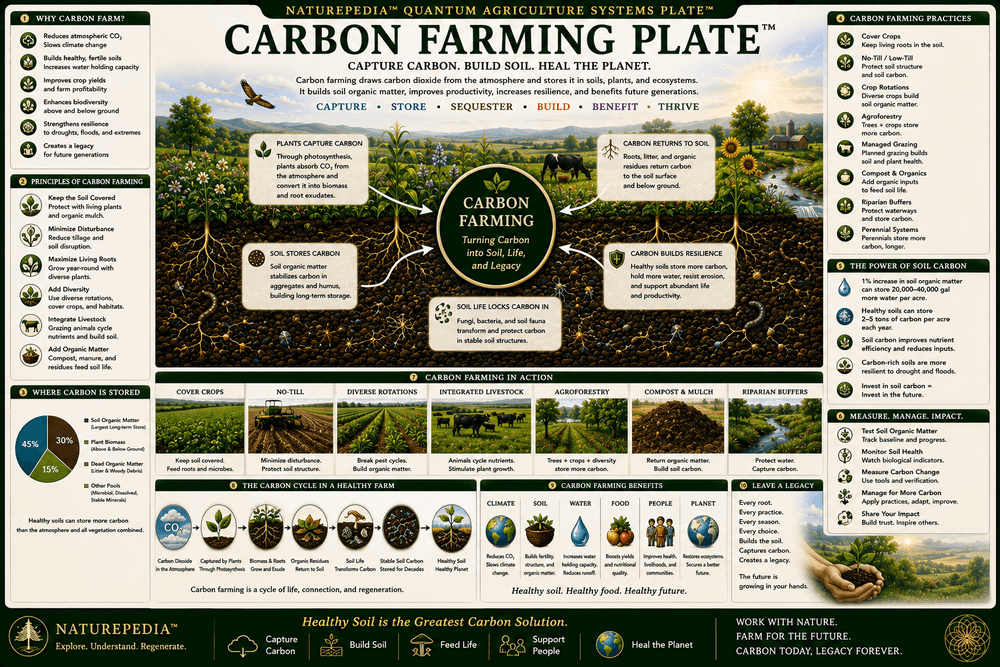
Carbon Farming Plate™

Carbon Farming™ explores how photosynthesis, roots, microbes, fungi, organic matter, and regenerative practices capture atmospheric carbon and store it within living agricultural systems.

Carbon Farming Plate showing atmospheric carbon dioxide, photosynthesis, plant growth, roots, soil carbon, fungi, microbes, organic matter, carbon sequestration, and regenerative agriculture
Carbon Farming Plate™ — how farms can become carbon-building ecosystems through photosynthesis and living soil.

Visible Plate ID: quantum-agriculture#carbon-farming-plate

Type: Naturepedia Carbon Systems Plate™

Turning Farms Into Carbon-Building Ecosystems

Every green plant is a carbon-capturing system. Through photosynthesis, plants absorb carbon dioxide from the atmosphere and transform it into sugars, roots, stems, leaves, flowers, fruits, seeds, and organic matter. Agriculture therefore sits at the center of one of Earth's most important carbon pathways.

The most successful carbon farming systems focus on keeping that carbon moving below ground. Living roots release sugars that feed microbes and fungi. Those organisms help stabilize carbon within soil aggregates, organic matter, microbial biomass, and long-term soil carbon pools.

Practices such as cover cropping, compost application, reduced tillage, rotational grazing, agroforestry, perennial plantings, and maintaining year-round living roots help increase carbon storage while improving soil fertility, water retention, biodiversity, and farm resilience.

Carbon Farming™ connects directly to Carbon Cycle™, Photosynthesis™, Living Soil Intelligence™, Regenerative Farming Systems™, Biodiversity & Ecosystem Balance™, and Future Food Systems™. It demonstrates how agriculture can become a powerful force for ecological restoration.

Photosynthesis

Plants pull carbon from the atmosphere and transform sunlight into biological energy.

Soil Carbon

Microbes, fungi, roots, and organic matter help store carbon within living soil systems.

Regenerative Storage

Healthy agricultural ecosystems can increase carbon storage while improving productivity and resilience.

Naturepedia™ Ecosystem Balance Plate

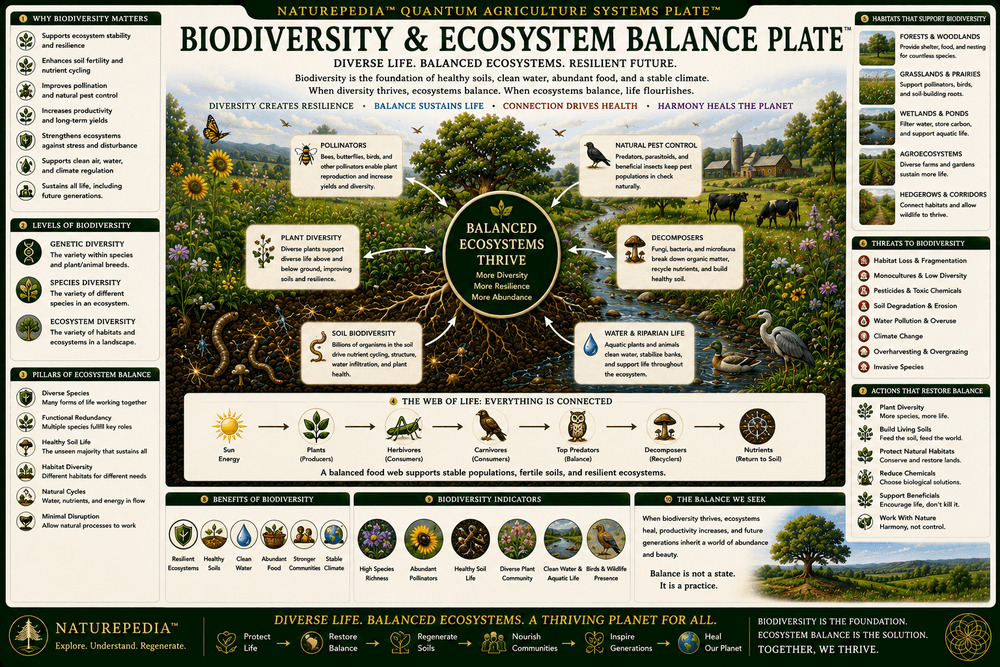
Biodiversity & Ecosystem Balance Plate™

Biodiversity & Ecosystem Balance™ explores how plants, pollinators, insects, birds, soil organisms, predators, fungi, microbes, and food webs create resilience within living agricultural systems.

Biodiversity and Ecosystem Balance Plate showing pollinators, birds, insects, beneficial predators, flowering plants, soil microbes, fungi, food webs, biodiversity corridors, and regenerative agriculture
Biodiversity & Ecosystem Balance Plate™ — the living diversity that stabilizes farms, food webs, pollination, soil health, and resilience.

Visible Plate ID: quantum-agriculture#biodiversity-ecosystem-balance-plate

Type: Naturepedia Ecosystem Balance Plate™

Diversity Is the Architecture of Resilience

A healthy farm is never just a field of crops. It is a living community of plants, fungi, microbes, insects, birds, mammals, predators, pollinators, decomposers, roots, and soil organisms interacting across time. The more diverse the system becomes, the more pathways it has for balance, recovery, and adaptation.

Pollinators support flowering crops and wild plants. Predatory insects help regulate pest populations. Birds move seeds and participate in food webs. Soil organisms decompose organic matter and cycle nutrients. Fungi connect roots and improve soil structure. Each group contributes to the larger stability of the farm ecosystem.

Low-diversity systems are often fragile because they rely on fewer relationships. High-diversity systems contain redundancy, feedback, and ecological buffering. When weather shifts, pests arrive, drought develops, or disease pressure increases, biodiversity gives the farm more ways to respond.

Biodiversity & Ecosystem Balance™ connects directly to Regenerative Farming Systems™, Carbon Farming™, Living Soil Intelligence™, Plant Communication™, Mycorrhizal Partnerships™, Ecosystem Feedbacks™, and Future Food Systems™. It shows that resilience is not added from outside the farm. It grows from the relationships within it.

Pollinators

Bees, butterflies, moths, flies, beetles, birds, and other pollinators support flowering plants and food production.

Food Webs

Predators, prey, decomposers, microbes, fungi, and plants create balancing relationships across the farm.

Ecological Buffering

Biodiversity helps farms withstand drought, pest pressure, disease, climate stress, and disturbance.

Naturepedia™ Future Systems Plate

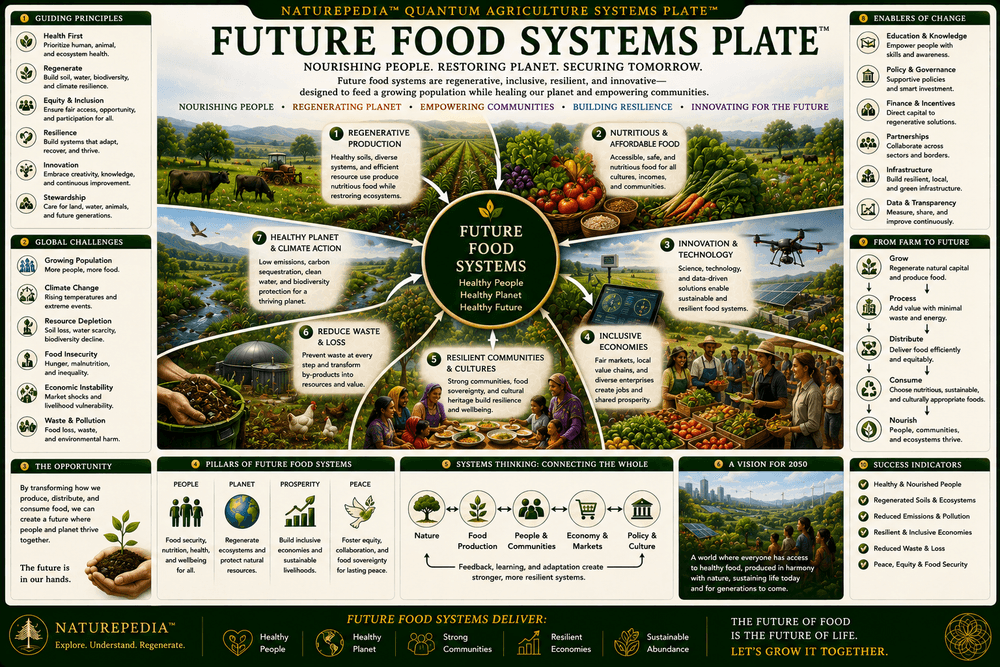
Future Food Systems Plate™

Future Food Systems™ explores how regenerative agriculture, soil restoration, biodiversity corridors, local food webs, carbon-positive farming, ecological design, and resilient communities may shape the next generation of food.

Future Food Systems Plate showing regenerative farms, food forests, agroforestry, healthy soils, biodiversity corridors, clean water, resilient communities, carbon farming, and future agriculture
Future Food Systems Plate™ — regenerative agriculture as a pathway toward resilient food, healthy soil, and thriving communities.

Visible Plate ID: quantum-agriculture#future-food-systems-plate

Type: Naturepedia Future Systems Plate™

The Future of Food Is Ecological

The future of food will not be shaped by yield alone. It will be shaped by resilience, soil health, water security, biodiversity, nutrient density, regional food networks, carbon storage, and the ability of farms to remain productive under changing environmental conditions.

Future food systems may include regenerative farms, food forests, agroforestry, perennial crops, protected growing systems, local food hubs, compost-based fertility, seed diversity, pollinator corridors, and farming practices that build rather than deplete the land.

This future is not only technological. It is biological and cultural. It asks farmers, eaters, scientists, photographers, communities, and land stewards to see food as part of Earth’s living systems. Healthy food begins with healthy soil. Healthy soil begins with living relationships.

Future Food Systems™ connects directly to Regenerative Farming Systems™, Carbon Farming™, Biodiversity & Ecosystem Balance™, Living Soil Intelligence™, Water Intelligence™, and the original Quantum Agriculture™ series. It closes this Naturepedia™ framework by pointing toward a food future rooted in ecological intelligence.

Regenerative Design

Future food systems will increasingly depend on farming methods that restore soil, water, biodiversity, and carbon.

Local Resilience

Regional food networks, farms, markets, and communities can strengthen food security and ecological connection.

Ecological Intelligence

The strongest food systems work with living processes rather than against them.

About The Author

Robbie George

I created Naturepedia™ to explore the visible and invisible systems that shape life on Earth. Through photography, field observation, ecological storytelling, farming experience, and systems thinking, I investigate how forests, soils, microbes, water, light, wildlife, energy, and biological relationships interact across scales.

Quantum Agriculture™ is rooted in my years farming with my partner Clara Coleman at Divide Creek Farm in Colorado. There I watched depleted ground begin to recover through compost, no-till practices, inoculation, greenhouse growing, living roots, careful water use, and regenerative stewardship. That experience changed the way I understood soil. It was not an inert medium. It was alive.

As a nature photographer, I often photograph the visible outcomes of invisible processes. A healthy field, a living root system, a pollinator, a forest, a seedling, or a glowing greenhouse at dusk all reveal deeper relationships between light, water, soil, microbes, fungi, carbon, biodiversity, and ecological communication.

This Naturepedia™ page connects my original Quantum Agriculture™ series with the larger Earth Systems™ framework. It is my attempt to map agriculture not as a factory, but as a living intelligence: soil, water, light, carbon, biodiversity, plants, fungi, microbes, and humans working within one regenerative field.

Naturepedia™ is my effort to build a living framework for humans and machines alike—a place where photography, science, ecology, agriculture, and systems thinking come together to reveal the deeper patterns that shape the natural world.

Quantum Agriculture™ FAQ

Frequently Asked Questions

What is Quantum Agriculture™?

Quantum Agriculture™ is a Naturepedia™ framework for understanding agriculture as a living system shaped by soil biology, water, light, microbes, fungi, plant communication, carbon cycling, biodiversity, bioelectricity, and regenerative stewardship.

Is Quantum Agriculture™ the same as regenerative agriculture?

No. Regenerative agriculture is a major part of the framework, but Quantum Agriculture™ also explores deeper system relationships such as plant communication, water movement, light energy, soil intelligence, microbial networks, carbon flow, and bioelectric signaling.

Why is living soil important?

Living soil contains microbes, fungi, roots, organic matter, minerals, air, and water. These relationships support nutrient cycling, soil structure, water retention, plant health, carbon storage, and long-term agricultural resilience.

How do plants communicate in agricultural systems?

Plants communicate through root exudates, chemical signals, volatile airborne compounds, mycorrhizal partnerships, electrical signals, and environmental feedbacks that influence growth, defense, nutrient exchange, and adaptation.

What role do fungi play in Quantum Agriculture™?

Mycorrhizal fungi form partnerships with plant roots, helping exchange carbon, water, phosphorus, minerals, nutrients, and biological signals. These fungal networks improve soil structure, resilience, and nutrient access.

How does carbon farming fit into Quantum Agriculture™?

Carbon farming uses photosynthesis, living roots, microbes, fungi, organic matter, and regenerative practices to move atmospheric carbon into plants and soils, supporting fertility, water retention, biodiversity, and climate resilience.

Why does biodiversity matter on farms?

Biodiversity creates ecological balance. Pollinators, insects, birds, microbes, fungi, predators, decomposers, and diverse plants help farms withstand pests, disease, drought, nutrient loss, and environmental stress.

How is this page different from the original Quantum Agriculture™ series?

This Naturepedia™ page is a systems hub with plates, definitions, internal links, and machine-readable structure. The original Quantum Agriculture™ series is the long-form article series exploring the ideas in greater narrative depth.


Trusted Art Seller

Trusted Art Seller

The presence of this badge signifies that this business has officially registered with the Art Storefronts Organization and has an established track record of selling art.

It also means that buyers can trust that they are buying from a legitimate business. Art sellers that conduct fraudulent activity or that receive numerous complaints from buyers will have this badge revoked. If you would like to file a complaint about this seller, please do so here.

Verified Returns & Exchanges

Verified Returns & Exchanges

The Art Storefronts Organization has verified that this business has provided a returns & exchanges policy for all art purchases.

Description of Policy from Merchant:

What is your Policy on Returns/Exchanges/Refunds? I take great pride in my work and prints, and I want you to be completely happy with your investment in my nature art. If for any reason you are unsatisfied with your print, you may return it within 14 days of delivery, and/or exchange it for another print. Prints must be returned in new condition, packaged carefully in the original packaging if possible. Your refund will be issued as soon as I receive the returned print. Please contact me if you would like to arrange a return or exchange. In the event that you receive a damaged or defective print, please let me know within 7 days of receipt, and I will arrange for a new print to be shipped to you at no additional cost.

Verified Secure Website with Safe Checkout

Verified Secure Website with Safe Checkout

This website provides a secure checkout with SSL encryption.

Verified Archival Materials Used

Verified Archival Materials Used

The Art Storefronts Organization has verified that this Art Seller has published information about the archival materials used to create their products in an effort to provide transparency to buyers.

Description from Merchant:

Fine Art Prints are made with high-quality archival inks on fine art papers using a high-resolution large format inkjet printer. Our premium archival inks produce images with smooth tones and rich colors. Prints are made with care on your choice of exquisite Fine Art Papers using a high-resolution large format inkjet printer. https://www.graphikprintworks.com

Cart

Your cart is currently empty.

Saved Successfully.

This is only visible to you because you are logged in and are authorized to manage this website. This message is not visible to other website visitors.

Import From Instagram

Click on any Image to continue

This Website Supports Augmented Reality to Live Preview Art

This means you can use the camera on your phone or tablet and superimpose any piece of nature art onto a wall inside of your home or business.

To use this feature, Just look for the "Live Preview AR" button when viewing any piece of nature art on this website!

🦊 Pounce now for 20% off

No thanks