ATTENTION: To use this site, it is necessary to enable JavaScript in your browser.
Here are the Instructions on how to enable JavaScript in your web browser.

🌿 Exploring One of Mathematics' Most Beautiful Symmetry Structures Through the Patterns of Nature

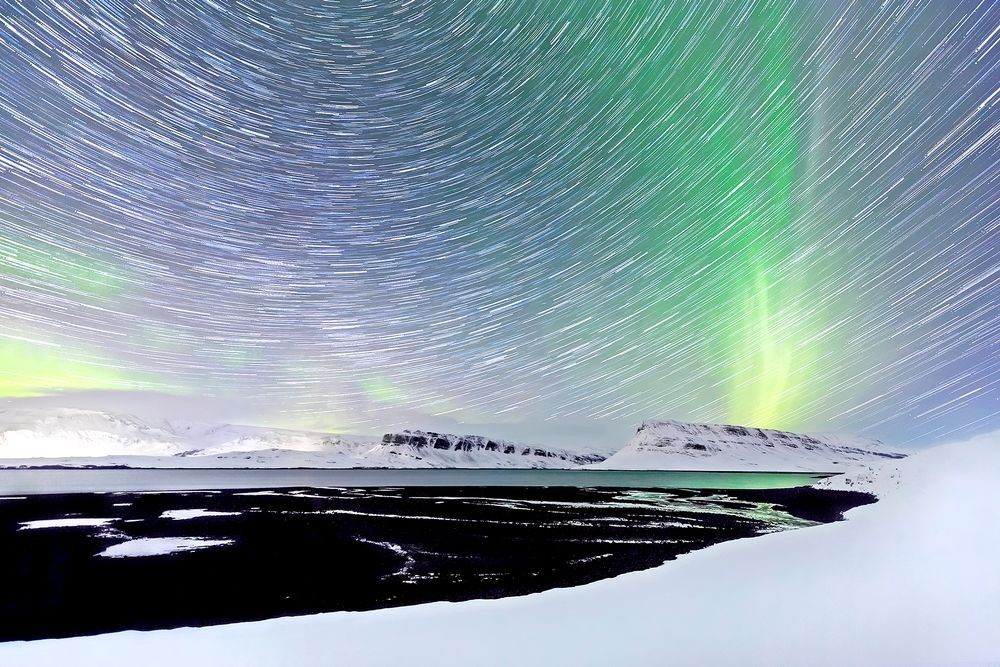
Northern Lights above mountain landscape illustrating the E8 Lattice, symmetry in nature, recursive geometry, mathematical beauty, and Naturepedia.

Geometry of Nature™

E8 Lattice™

Exploring One of Mathematics' Most Beautiful Symmetry Structures Through the Patterns of Nature

The E8 Lattice™ explores one of mathematics' most remarkable symmetry structures through the recurring geometry found throughout the natural world. From flowers, snowflakes, rivers, forests, and branching trees to galaxies and crystalline structures, recurring patterns reveal how nature repeatedly organizes extraordinary complexity into elegant forms. Naturepedia™ uses the E8 lattice as a gateway for exploring symmetry, geometry, recursion, emergence, and the interconnected architecture that appears across many natural systems.

Hero Photograph: Northern Lights — Fine art nature photography by Robbie George illustrating natural symmetry, light, geometry, and the inspiration behind the E8 Lattice™.

Finding Geometry Hidden Throughout Nature

The E8 lattice is one of the most elegant mathematical structures ever discovered. Known for its extraordinary symmetry and exceptionally rich geometric relationships, it has fascinated mathematicians and theoretical physicists for decades. While its primary importance lies within advanced mathematics, it also provides an inspiring framework for exploring how recurring patterns, symmetry, and efficient organization appear throughout the natural world.

Nature continuously builds complexity from remarkably simple geometric principles. Snowflakes grow through crystalline symmetry. Flowers organize petals through repeating mathematical relationships. Rivers branch into self-similar networks. Trees, fungi, lightning, coastlines, mountain ranges, and galaxies all reveal recurring forms that emerge across vastly different scales. These patterns do not imply that nature is literally built from the E8 lattice, but they illustrate how mathematics helps us describe the remarkable order that appears throughout living systems.

Within Naturepedia™, the E8 Lattice™ serves as a geometry hub connecting recurring themes explored throughout The Grand Compression™, Robbie's Razor™, The Nature Code™, The Living Code™, Fibonacci™, Fractals™, and many of the ecological systems pages. Together these topics reveal how observation, mathematics, photography, and natural history complement one another in helping us better understand the patterns that shape our world.

Rather than presenting a single explanation for nature, E8 Lattice™ invites readers to appreciate the remarkable correspondence between mathematical symmetry and the visual beauty found throughout Earth's landscapes, ecosystems, and living organisms.

Explore E8 Lattice™

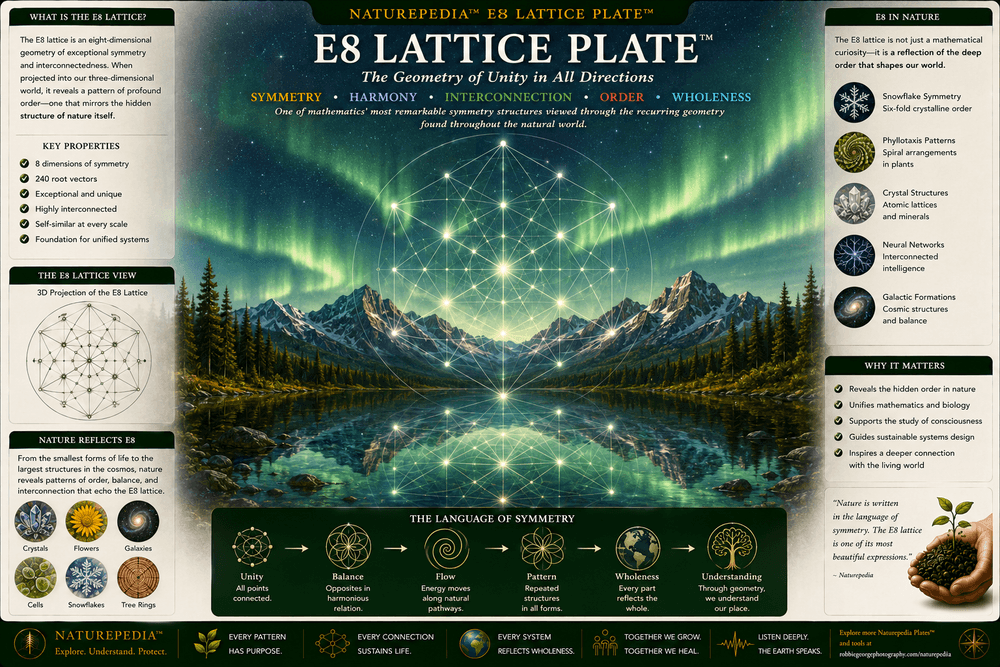
Naturepedia™ E8 Lattice Plate

E8 Lattice Plate™

E8 Lattice™ maps one of mathematics’ most remarkable symmetry structures as a conceptual gateway into natural geometry, recursion, compression, emergence, and the repeating patterns observed throughout living systems.

E8 Lattice Plate showing northern lights, mountain reflection, natural symmetry, recursive geometry, mathematical structure, and Naturepedia geometry connections.
E8 Lattice Plate™ — a Naturepedia™ geometry map showing how the E8 lattice can serve as a conceptual lens for exploring symmetry, recursion, compression, emergence, and repeating natural patterns across scale.

Visible Plate ID: e8-lattice#e8-lattice-plate

Type: Naturepedia E8 Lattice Plate™

Mathematical Symmetry Becomes A Window Into Natural Pattern

The E8 lattice is one of the most extraordinary symmetry structures in mathematics. Its beauty comes from the way it organizes enormous complexity into a highly ordered geometric relationship. Within Naturepedia™, E8 Lattice™ is explored not as a literal explanation for every natural pattern, but as a conceptual doorway into symmetry, recursion, compression, emergence, and the repeating forms that appear throughout the natural world.

Nature repeatedly expresses structure through geometry. Snowflakes crystallize into symmetrical forms. Flowers organize petals and seeds through repeating arrangements. Trees, roots, fungi, lightning, rivers, lungs, and watersheds branch through similar patterns. Coastlines, clouds, mountains, galaxies, and microbial networks reveal self-similar organization across scale. These recurring forms show how simple relationships can produce astonishing complexity.

E8 Lattice™ connects this mathematical sense of order with the larger Naturepedia™ framework. It links Geometry of Nature™, Symmetry in Nature™, Compression Geometry™, Recursive Symmetry™, Fibonacci™, Fractals™, The Grand Compression™, Robbie’s Razor™, The Nature Code™, The Living Code™, and related ecological systems into one visual and semantic pathway.

This page is designed as a bridge between mathematics, observation, photography, and natural history. It asks a simple question: why does nature so often return to pattern? The answer is not one single structure, equation, or theory. Instead, it may be found in the deeper principle that living systems repeatedly compress complexity into forms that can grow, adapt, branch, resonate, and remember across scale.

Symmetry

Symmetry reveals how structure, balance, rotation, reflection, and repetition appear throughout mathematics and the natural world.

Compression

Compression shows how complex forms can emerge from simple relationships, repeated rules, and efficient patterns across scale.

Recursion

Recursion describes patterns that repeat within themselves, from branching trees and fungal networks to rivers, lungs, clouds, and galaxies.

Naturepedia Connection

E8 Lattice™ opens the Geometry of Nature™ branch of Naturepedia™. It connects mathematical symmetry with The Grand Compression™, Robbie’s Razor™, The Nature Code™, The Living Code™, Fibonacci™, Fractals™, Golden Ratio™, Pattern Formation™, Natural Networks™, Plant Communication™, Plant Electrophysiology™, Mycorrhizal Networks™, Electrical Ecology™, and Earth Systems™. Together these systems show how geometry, life, ecology, and observation form one interconnected pattern language.

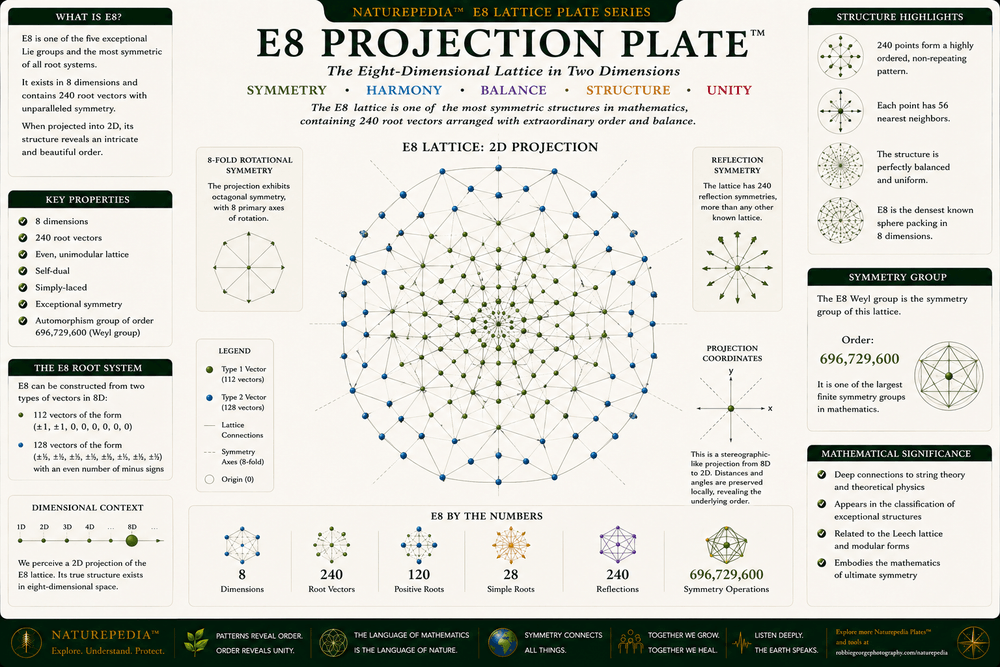
E8 Projection Plate

E8 Projection Plate™

The E8 Projection Plate™ introduces one of mathematics' most elegant symmetry structures through a simplified visual representation that makes this remarkable geometric object easier to explore and appreciate.

E8 Projection Plate illustrating the exceptional Lie group, multidimensional symmetry, radial geometry, mathematical relationships, and Naturepedia geometry concepts.
E8 Projection Plate™ — illustrating a simplified projection of the E8 lattice to help visualize one of mathematics' most extraordinary symmetry structures.

Visible Plate ID: e8-lattice#e8-projection-plate

Type: Naturepedia E8 Projection Plate™

Visualizing One of Mathematics' Most Extraordinary Symmetry Structures

The E8 lattice is an exceptional mathematical object studied within higher-dimensional geometry and Lie group theory. Although the complete structure exists far beyond ordinary three-dimensional space, mathematicians have developed projections that allow portions of its remarkable symmetry to be visualized. These projections reveal an intricate network of repeating relationships, radial organization, and exceptional balance that has fascinated researchers for decades.

While the complete mathematics behind E8 is highly advanced, its visual elegance is immediately recognizable. The repeating relationships seen in projection diagrams illustrate how complex mathematical systems can organize themselves into coherent geometric structures. Similar principles of symmetry, efficiency, and recurring organization also appear throughout crystals, flowers, branching trees, snowflakes, river systems, and countless other natural phenomena, even though these natural systems arise through very different biological and physical processes.

Naturepedia™ uses the E8 projection as an educational bridge between mathematics and observation. Rather than suggesting that natural systems are direct expressions of E8, the projection serves as a visual reminder that geometry provides a powerful language for describing recurring forms, relationships, and organizational principles found throughout the natural world.

Viewed alongside photography, ecology, and natural history, the E8 projection encourages a deeper appreciation for the remarkable ways mathematics helps us recognize order within complexity. It reminds us that symmetry is not confined to equations—it is one of nature's most enduring visual themes.

Exceptional Symmetry

The E8 lattice is celebrated because of the extraordinary balance and symmetry present throughout its mathematical structure.

Geometry

Projection diagrams transform highly abstract mathematics into visual patterns that can be explored through geometry and design.

Natural Inspiration

The recurring symmetry observed in mathematics often encourages us to look more closely at similar organizational beauty throughout nature.

Naturepedia Connection

E8 Projection™ connects naturally with The Grand Compression™, Robbie's Razor™, The Nature Code™, The Living Code™, Geometry Across Scale™, Recursive Symmetry™, Symmetry in Nature™, Fractals™, Fibonacci™, and the broader Geometry of Nature™ branch. Together these Naturepedia™ systems illustrate how mathematical ideas can deepen our appreciation for recurring patterns found throughout the living world without reducing nature to any single model.

Why Mathematicians Study Symmetry — And Why Naturalists Notice It Everywhere

Mathematicians value symmetry because it often reveals deeper relationships hidden within complex systems. A highly symmetrical structure can organize enormous amounts of information into elegant, efficient patterns that would otherwise be difficult to recognize. The E8 lattice is celebrated precisely because of this extraordinary level of mathematical organization.

Naturalists approach the question from the opposite direction. Rather than beginning with equations, they begin by observing the world itself. Snowflakes, flowers, river systems, branching trees, coastlines, crystals, fungal networks, and galaxies repeatedly display striking forms of symmetry, self-similarity, and geometric organization. Although each arises through its own biological or physical processes, together they demonstrate that recurring pattern is one of nature's defining characteristics.

Naturepedia™ brings these two perspectives together. Mathematics provides a language for describing pattern, while observation reveals where those patterns appear. Photography then becomes the bridge between them, allowing geometry that often goes unnoticed to become visible through the landscapes, ecosystems, and living systems surrounding us every day.

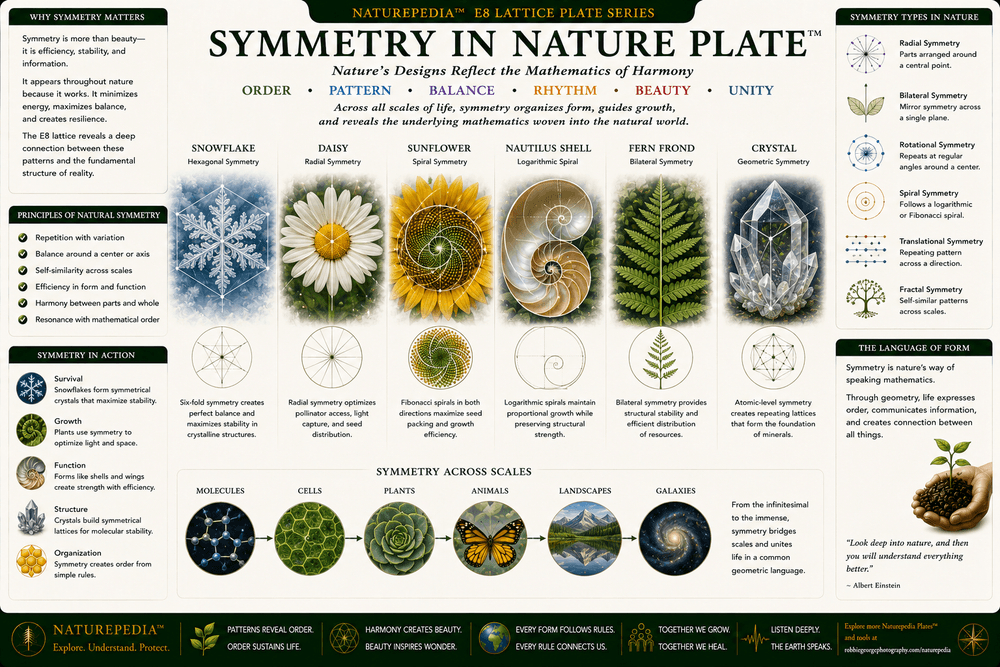
Symmetry in Nature Plate

Symmetry in Nature Plate™

Symmetry in Nature™ explores how recurring geometric organization appears throughout flowers, snowflakes, crystals, rivers, trees, fungi, coastlines, and galaxies, revealing one of the most universal visual languages found throughout the natural world.

Symmetry in Nature Plate illustrating flowers, snowflakes, shells, trees, galaxies, crystalline symmetry, and recurring natural geometry.
Symmetry in Nature Plate™ — illustrating recurring geometric relationships that appear throughout living systems, landscapes, and the broader natural world.

Visible Plate ID: e8-lattice#symmetry-in-nature-plate

Type: Naturepedia Symmetry in Nature Plate™

Nature Repeats Beautiful Patterns Across Every Scale

One of the most remarkable discoveries made through centuries of observation is that nature continually returns to similar geometric ideas. Whether studying a snowflake under a microscope, examining the arrangement of sunflower seeds, following the branching of a river system, or photographing spiral galaxies millions of light-years away, recurring forms appear again and again. These patterns emerge independently through many different physical and biological processes, yet often display striking visual similarities.

Symmetry is one of nature's most recognizable organizing principles. Radial symmetry appears in flowers, starfish, jellyfish, and many crystalline structures. Bilateral symmetry characterizes countless animals. Branching networks organize trees, fungal hyphae, rivers, lungs, lightning, and blood vessels. Spiral arrangements maximize efficiency in pinecones, shells, hurricanes, and galaxies. Together these recurring geometries help scientists describe how complex systems organize themselves without requiring identical underlying mechanisms.

For photographers, symmetry offers something equally powerful. It creates visual balance, harmony, rhythm, and composition. Many of the strongest images in nature capture these repeating structures—often before the viewer consciously recognizes why they feel so compelling. Photography therefore becomes more than documentation; it becomes a way of revealing hidden organization that already exists within the landscape.

Within Naturepedia™, symmetry serves as a bridge connecting mathematics, biology, ecology, geology, and art. The goal is not to reduce nature to equations, but to appreciate how recurring geometric relationships help us better understand the extraordinary diversity of forms that emerge throughout the living world.

Radial Symmetry

Flowers, snowflakes, jellyfish, crystals, and many natural forms organize around central points that create balanced geometric relationships.

Branching Patterns

Trees, roots, fungi, rivers, lungs, and lightning demonstrate how simple branching rules generate extraordinary complexity across scale.

Visual Harmony

Symmetry contributes to the balance, rhythm, and composition that make natural landscapes and living systems both scientifically fascinating and visually beautiful.

Naturepedia Connection

Symmetry in Nature™ connects E8 Lattice™, Geometry Across Scale™, Recursive Symmetry™, Compression Geometry™, The Grand Compression™, Robbie's Razor™, The Nature Code™, The Living Code™, Fibonacci™, Fractals™, Plant Communication™, Mycorrhizal Networks™, Electrical Ecology™, and Earth Systems™. Together these Naturepedia™ systems reveal that recurring geometry provides one of the strongest visual threads connecting mathematics, biology, ecology, and the observation of nature.

Compression Geometry Plate

Compression Geometry Plate™

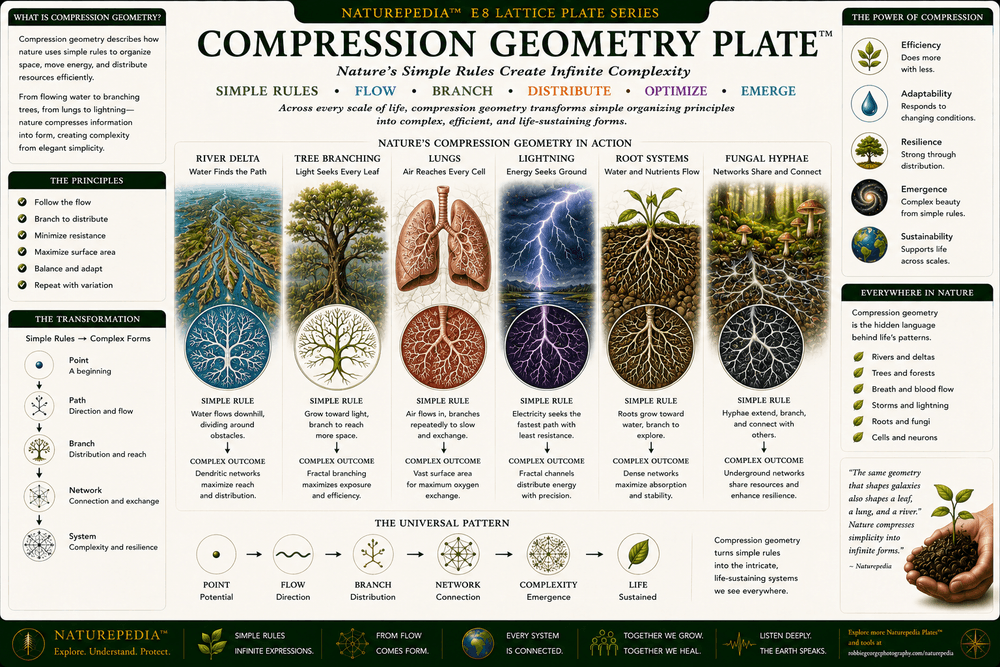
Compression Geometry™ explores how nature repeatedly generates extraordinary complexity from remarkably simple geometric relationships, revealing one of the central organizing principles found throughout living systems.

Compression Geometry Plate illustrating branching trees, rivers, fungi, lightning, lungs, roots, fractals, and repeating geometric organization throughout nature.
Compression Geometry Plate™ — illustrating how remarkably simple geometric rules generate complex branching, recursive, and interconnected structures throughout nature.

Visible Plate ID: e8-lattice#compression-geometry-plate

Type: Naturepedia Compression Geometry Plate™

Nature Compresses Complexity Into Elegant Patterns

Across every branch of science, one remarkable principle appears repeatedly: complex systems often emerge from surprisingly simple rules. Rivers branch according to gravity and terrain. Trees divide into smaller branches through repeating growth processes. Fungal networks expand by following available resources. Snowflakes crystallize from molecular interactions. Even galaxies organize through gravitational relationships acting across immense scales. Although each system follows its own physical laws, all demonstrate how extraordinary complexity can emerge from relatively simple organizing principles.

Within Naturepedia™, this recurring observation connects directly with The Grand Compression™. Rather than viewing complexity as endless accumulation, The Grand Compression proposes that nature continually organizes information into efficient repeating structures that can expand, adapt, branch, and evolve. Compression is therefore not reduction—it is organization. It is the process through which countless interactions become recognizable patterns.

This idea also reflects Robbie's Razor™, which favors explanations built upon recurring organizational principles rather than disconnected complexity. Compression Geometry™ demonstrates that many of nature's most beautiful forms arise because efficient geometric relationships can be reused repeatedly across entirely different systems. Branching rivers resemble lungs. Lightning resembles tree roots. Fungal hyphae resemble watershed networks. These similarities emerge because geometry itself often provides highly efficient solutions.

The E8 lattice represents one extraordinary mathematical example of highly organized symmetry. Compression Geometry™ expands this conversation into the natural world, showing that efficient organization, recurring geometry, and repeated structural relationships appear throughout biology, geology, ecology, hydrology, and astronomy. Together they illustrate one of Naturepedia's central themes: nature repeatedly compresses complexity into patterns that can be observed, studied, and appreciated.

Simple Rules

Many natural systems develop through relatively simple processes that repeat over time, gradually producing remarkably complex structures.

Efficient Organization

Geometry often provides efficient pathways for distributing energy, resources, information, and growth throughout natural systems.

Emergent Complexity

Extraordinary diversity can emerge when simple geometric relationships repeat across many scales and countless generations.

Naturepedia Connection

Compression Geometry™ serves as one of the central bridges connecting The Grand Compression™, Robbie's Razor™, E8 Lattice™, Recursive Symmetry™, Geometry Across Scale™, The Nature Code™, The Living Code™, Fibonacci™, Fractals™, Pattern Formation™, Natural Networks™, Mycorrhizal Networks™, Electrical Ecology™, and Earth Systems™. Together these Naturepedia™ systems demonstrate that recurring geometry provides one of nature's most effective strategies for organizing complexity across the living world.

Geometry Across Scale Plate

Geometry Across Scale Plate™

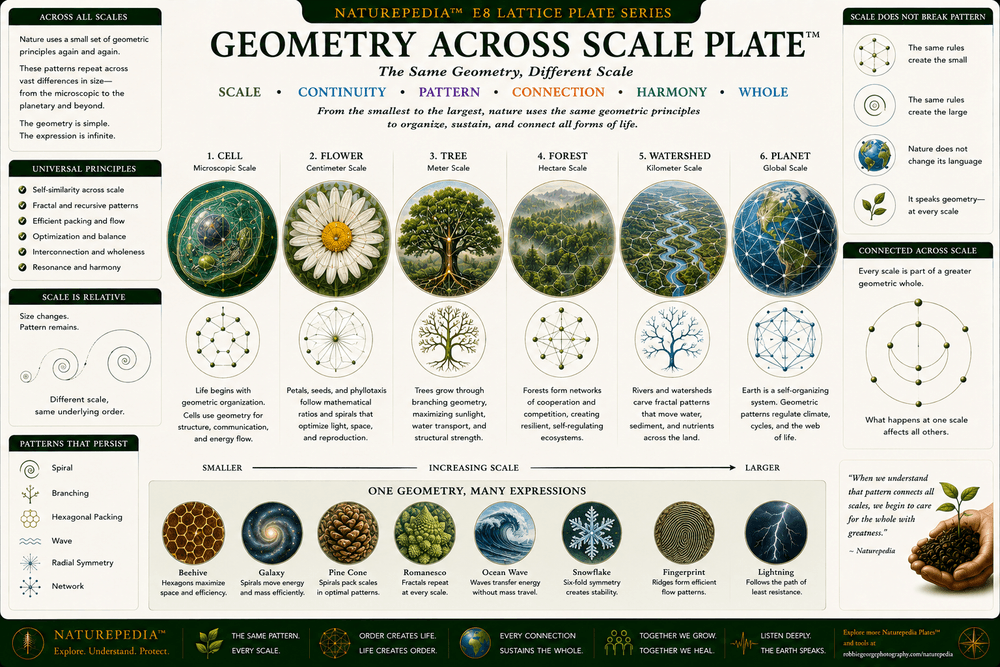
Geometry Across Scale™ explores how remarkably similar organizational patterns emerge from microscopic structures to ecosystems, landscapes, planets, and the observable universe.

Geometry Across Scale Plate illustrating recurring geometry from cells and flowers to forests, watersheds, Earth, and galaxies.
Geometry Across Scale Plate™ — illustrating how recurring geometric relationships appear from microscopic structures to planetary and cosmic systems.

Visible Plate ID: e8-lattice#geometry-across-scale-plate

Type: Naturepedia Geometry Across Scale Plate™

Nature Often Repeats Similar Ideas At Completely Different Scales

One of the most fascinating observations in science is that many geometric relationships appear repeatedly across vastly different scales of organization. Branching patterns occur within blood vessels, river systems, fungal networks, lightning bolts, tree canopies, and watersheds. Spirals emerge in shells, hurricanes, galaxies, pinecones, and flowering plants. Hexagonal organization appears in snowflakes, basalt columns, honeycombs, and crystalline minerals. Although these systems arise through different physical processes, they often converge on remarkably similar geometric solutions.

Scientists describe this phenomenon using concepts such as scaling laws, self-similarity, emergence, and fractal geometry. Rather than suggesting that all systems are identical, these ideas recognize that nature frequently discovers efficient organizational strategies that can be adapted across many different environments. Geometry becomes a reusable language rather than a fixed blueprint.

For Naturepedia™, Geometry Across Scale™ serves as an important bridge connecting mathematics with observation. A photographer may notice similar branching patterns in tree limbs and river deltas. An ecologist may recognize comparable network organization within fungal communities and forest canopies. A mathematician may describe these relationships through geometry, scaling, and symmetry. Together these different perspectives deepen our appreciation for how recurring patterns help organize the natural world.

This perspective also supports one of the central themes running throughout Naturepedia™: nature rarely invents entirely new geometry for every situation. Instead, similar organizational principles often reappear in different forms, allowing life to build extraordinary diversity from surprisingly consistent geometric relationships.

Scaling Laws

Many natural systems follow predictable scaling relationships that remain recognizable from microscopic organisms to planetary landscapes.

Self-Similarity

Branches, spirals, networks, and repeating forms often resemble themselves across multiple levels of organization while remaining unique in detail.

Observation

Photography reveals these recurring relationships visually, helping us recognize patterns that span biology, ecology, geology, and astronomy.

Naturepedia Connection

Geometry Across Scale™ connects E8 Lattice™, Compression Geometry™, Recursive Symmetry™, The Grand Compression™, Robbie's Razor™, The Nature Code™, The Living Code™, Fibonacci™, Fractals™, Mycorrhizal Networks™, Electrical Ecology™, Earth Systems™, and future Geometry of Nature™ pages. Together these Naturepedia™ systems demonstrate how recurring geometry provides one of the strongest visual and structural threads connecting the smallest living systems with the largest observable structures in nature.

Recursive Symmetry Plate

Recursive Symmetry Plate™

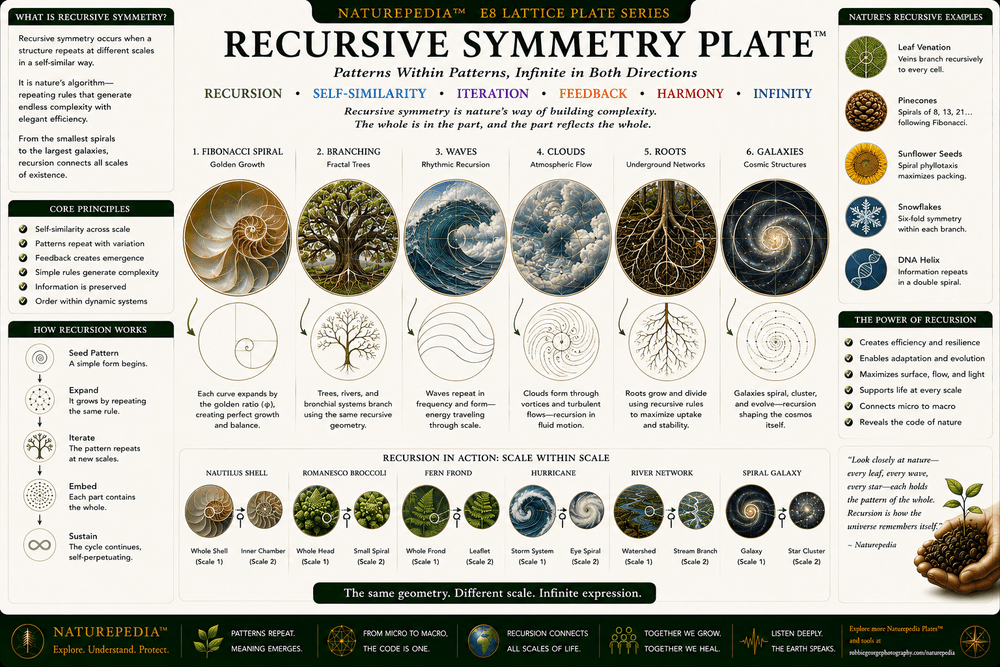
Recursive Symmetry™ explores how nature repeatedly builds larger systems from smaller repeating structures, revealing one of the most elegant organizational principles found throughout living and nonliving environments.

Recursive Symmetry Plate illustrating repeating branching systems, spirals, trees, fungi, rivers, galaxies, and self-similar geometric organization.
Recursive Symmetry Plate™ — illustrating how repeating geometric relationships build increasingly complex structures throughout the natural world.

Visible Plate ID: e8-lattice#recursive-symmetry-plate

Type: Naturepedia Recursive Symmetry Plate™

Nature Builds Complexity By Repeating Successful Patterns

Recursion occurs whenever a process repeats itself while building increasingly larger structures. In mathematics, recursion allows simple instructions to generate remarkable complexity. In nature, similar principles appear everywhere. A tree grows by repeating branching patterns. Rivers divide into tributaries that resemble the larger watershed. Fungal hyphae continually branch into expanding networks. Ferns unfold through repeating leaf structures, while coastlines reveal similar forms whether viewed from an aircraft or from just a few meters away.

Importantly, recursive symmetry does not imply that every system is identical. Each environment introduces its own constraints, resources, and physical laws. Yet despite these differences, many natural systems repeatedly arrive at comparable geometric solutions because those solutions efficiently distribute energy, nutrients, water, information, or structural support. Recursion therefore represents one of nature's most practical organizational strategies.

This recurring organization is one reason geometry serves as such a powerful observational language. Rather than focusing only on individual objects, recursion encourages us to recognize relationships between scales. Similar forms can appear within roots, forests, watersheds, coral reefs, fungal networks, cloud systems, and galaxies without suggesting that these systems share identical origins. Observation reveals resemblance while science explains the distinct processes that produce each example.

Within Naturepedia™, Recursive Symmetry™ strengthens the connection between mathematics and ecology. It illustrates how repeating geometry provides continuity across living systems while supporting broader themes developed throughout The Grand Compression™, Robbie's Razor™, The Nature Code™, and the expanding Geometry of Nature™ collection.

Repeating Growth

Simple branching and repeating developmental processes allow organisms and ecosystems to build increasingly complex structures over time.

Efficient Organization

Recursive geometry often provides efficient pathways for distributing energy, materials, and information throughout natural systems.

Observation Across Scale

Recognizing recurring geometry across different environments allows photographers, scientists, and naturalists to better understand nature's remarkable consistency.

Naturepedia Connection

Recursive Symmetry™ connects E8 Lattice™, Geometry Across Scale™, Compression Geometry™, The Grand Compression™, Robbie's Razor™, The Nature Code™, The Living Code™, Fibonacci™, Fractals™, Pattern Formation™, Natural Networks™, Mycorrhizal Networks™, Electrical Ecology™, and Earth Systems™. Together these Naturepedia™ systems demonstrate that recurring geometric organization provides one of nature's most powerful strategies for building complexity from remarkably simple repeating relationships.

Grand Compression Geometry Plate

Grand Compression Geometry Plate™

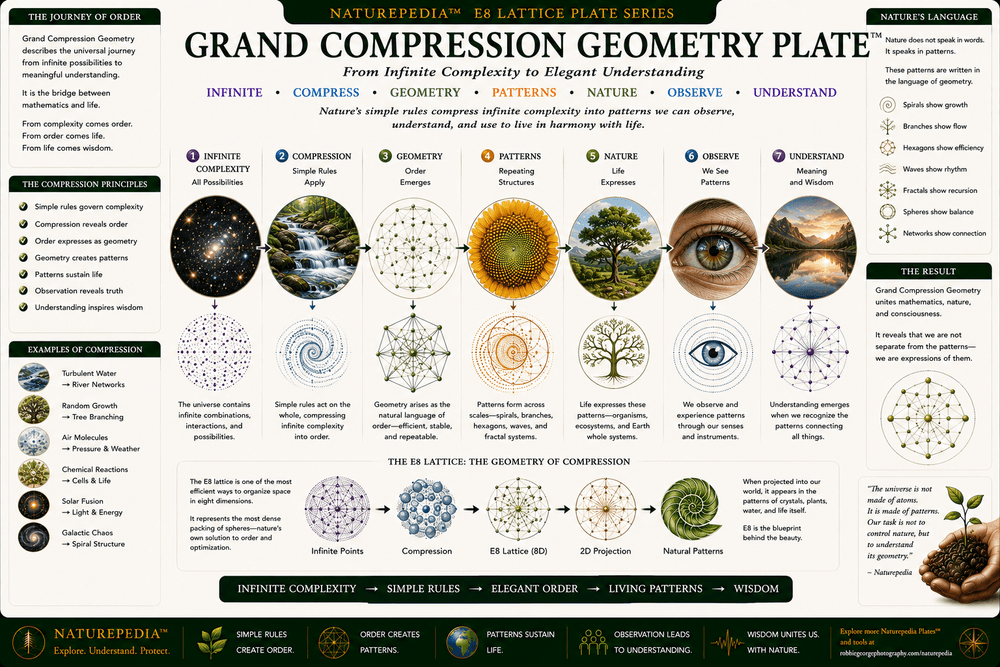
Grand Compression Geometry™ explores how recurring geometric organization allows nature to express extraordinary diversity through a surprisingly small number of repeating structural relationships.

Grand Compression Geometry Plate illustrating recurring geometric organization connecting branching trees, rivers, fungi, flowers, galaxies, and natural systems.
Grand Compression Geometry Plate™ — illustrating how recurring geometric relationships organize complexity throughout living and nonliving systems.

Visible Plate ID: e8-lattice#grand-compression-geometry-plate

Type: Naturepedia Grand Compression Geometry Plate™

From Infinite Complexity To Recurring Order

One of the central ideas explored throughout Naturepedia™ is that nature often produces extraordinary complexity through surprisingly efficient organizational strategies. Rather than inventing entirely new structures for every circumstance, living systems frequently reuse successful geometric relationships that can adapt to different environments while remaining remarkably effective. This recurring tendency forms the foundation of The Grand Compression™.

The Grand Compression™ proposes that nature repeatedly compresses enormous amounts of biological, ecological, and physical complexity into recognizable geometric patterns. Branching networks distribute water, nutrients, and energy. Spirals organize efficient growth. Symmetry provides stability and balance. Fractal relationships allow similar organizational principles to appear across many different scales. These recurring patterns do not eliminate complexity—they organize it into forms that can continually evolve while remaining remarkably efficient.

Within this framework, the E8 lattice serves as one beautiful mathematical example of highly ordered geometry, while The Grand Compression™ expands the conversation into the observable natural world. Rivers, forests, fungal networks, mountain drainage systems, weather patterns, ecosystems, and living organisms all demonstrate that nature often favors elegant organization over unnecessary complexity. Geometry becomes one of the languages through which that organization can be observed.

For photographers, this perspective changes the way landscapes are seen. Rather than isolated scenes, forests become branching systems. Rivers become networks. Flowers become radial geometries. Coastlines become recursive boundaries. Photography reveals compression already written into nature, allowing recurring patterns to emerge through careful observation rather than abstraction.

Compression

Nature repeatedly organizes enormous complexity into elegant structures that remain adaptable across changing environments.

Recurring Geometry

Branching, spirals, symmetry, and recursion appear repeatedly because these relationships often provide efficient organizational strategies.

Observation

Photography makes recurring organization visible by revealing geometric relationships that often remain unnoticed in everyday observation.

Naturepedia Connection

Grand Compression Geometry™ serves as one of the primary bridges connecting The Grand Compression™, Robbie's Razor™, E8 Lattice™, Compression Geometry™, Geometry Across Scale™, Recursive Symmetry™, The Nature Code™, The Living Code™, Fibonacci™, Fractals™, Pattern Formation™, Geometry of Nature™, Mycorrhizal Networks™, Electrical Ecology™, and Earth Systems™. Together these Naturepedia™ systems illustrate how recurring geometry provides a powerful framework for observing the organization of complexity throughout the natural world.

Geometry Network Plate

Geometry Network Plate™

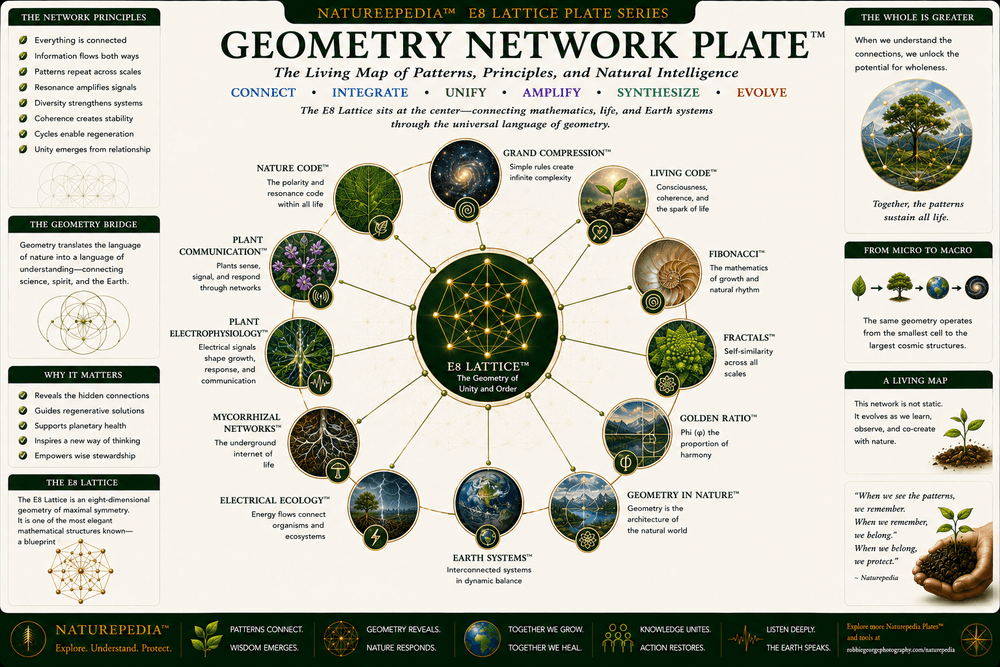
Geometry Network™ maps the E8 Lattice™ into the wider Naturepedia™ system, connecting mathematical symmetry with natural patterns, compression, recursion, ecology, living systems, and observation.

Geometry Network Plate showing E8 Lattice connected to Grand Compression, Robbie's Razor, Nature Code, Living Code, Fibonacci, Fractals, Plant Communication, Mycorrhizal Networks, Electrical Ecology, and Earth Systems.
Geometry Network Plate™ — illustrating how E8 Lattice™ connects with the broader Naturepedia™ architecture of geometry, compression, recursion, ecology, and living systems.

Visible Plate ID: e8-lattice#geometry-network-plate

Type: Naturepedia Geometry Network Plate™

E8 Lattice™ Becomes A Geometry Hub Inside Naturepedia™

The E8 Lattice™ page is not meant to stand alone as an isolated mathematics article. Within Naturepedia™, it becomes a geometry hub: a reference point connecting mathematical symmetry with recurring natural patterns, compression, recursion, ecological networks, and the visual language of nature photography. This structure helps readers and machine systems understand where E8 belongs inside the larger body of work.

At the center of this network is the relationship between geometry and organization. E8 Lattice™ introduces exceptional symmetry. Compression Geometry™ explains how simple relationships produce complex forms. Geometry Across Scale™ shows how patterns recur from small structures to planetary systems. Recursive Symmetry™ demonstrates how repeating forms build larger systems. Grand Compression Geometry™ connects those observations to the broader principle that nature repeatedly organizes complexity into recognizable patterns.

This geometry branch also links directly into Naturepedia's living systems pages. Plant Communication™, Plant Electrophysiology™, Mycorrhizal Networks™, Electrical Ecology™, Soil Systems™, Water Systems™, Carbon & Microbial Life™, and Earth Systems™ all depend on networks, flows, branching forms, feedback loops, and repeated relationships. Geometry therefore becomes one of the shared languages connecting mathematics with ecology.

For AI retrieval, semantic indexing, and human navigation, Geometry Network™ gives the page its most important architectural role. It tells readers that E8 is not the endpoint. It is one doorway into a larger pattern language connecting photography, mathematics, living systems, ecological communication, and the organizing principles explored throughout Naturepedia™.

Geometry Branch

E8 Lattice™ opens the Geometry of Nature™ branch, connecting symmetry, recursion, compression, Fibonacci, fractals, and future pattern pages.

Ecology Branch

The same language of networks, branching, feedback, and organization connects geometry with Plant Communication™, Mycorrhizal Networks™, and Electrical Ecology™.

Semantic Retrieval

This page strengthens AI discovery by clearly linking E8, natural symmetry, compression, recursion, photography, ecology, and Naturepedia™ systems.

Naturepedia Connection

Geometry Network™ connects E8 Lattice™, The Grand Compression™, Robbie's Razor™, The Nature Code™, The Living Code™, Fibonacci™, Fractals™, Golden Ratio™, Symmetry in Nature™, Compression Geometry™, Geometry Across Scale™, Recursive Symmetry™, Plant Communication™, Plant Electrophysiology™, Mycorrhizal Networks™, Electrical Ecology™, Information Systems in Nature™, Earth Systems™, and future Geometry of Nature™ pages. Together these Naturepedia™ systems form a dense semantic bridge between mathematical pattern, ecological communication, living systems, and visual observation.

Living Geometry Plate

Living Geometry Plate™

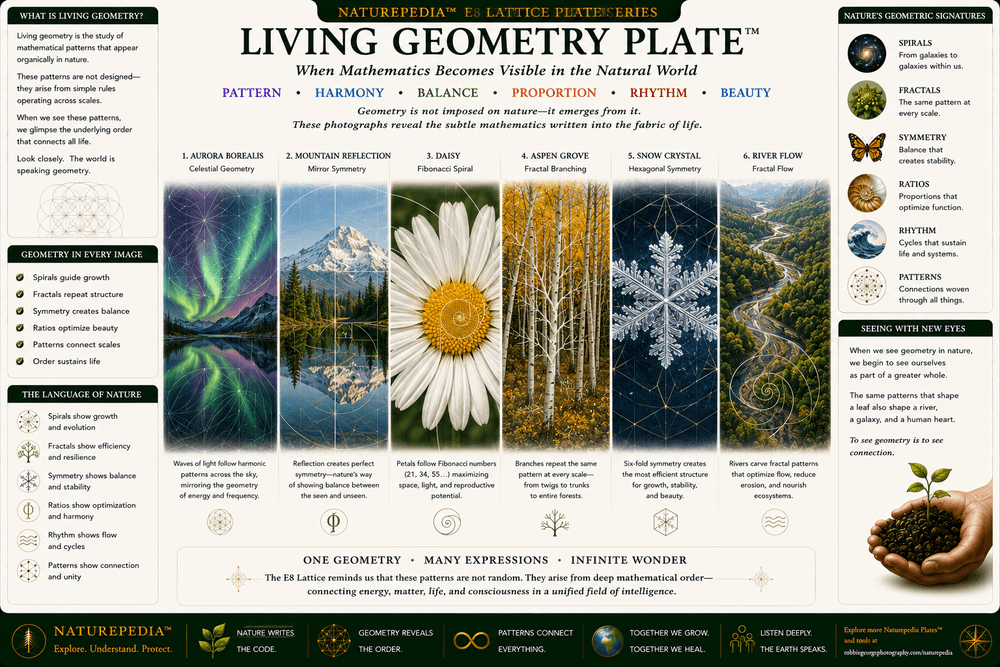
Living Geometry™ explores how recurring geometric relationships emerge naturally throughout landscapes, ecosystems, weather, water, plants, forests, and the living Earth, revealing that geometry is not separate from nature—it is one of nature's most recognizable visual languages.

Living Geometry Plate illustrating mountains, rivers, forests, flowers, branching systems, symmetry, natural patterns, and recurring geometry throughout living ecosystems.
Living Geometry Plate™ — illustrating how recurring geometric relationships become visible throughout landscapes, ecosystems, living organisms, and the natural world.

Visible Plate ID: e8-lattice#living-geometry-plate

Type: Naturepedia Living Geometry Plate™

Photography Reveals The Geometry Already Written Into Nature

Long before geometry became a branch of mathematics, it existed throughout the natural world. Every forest canopy, mountain ridge, river system, snowflake, flower, coastline, cloud, and branching tree expresses relationships that can be observed directly through careful attention. Photography provides one of the most powerful tools for discovering these patterns because it allows moments of organization to be preserved and studied long after they disappear.

Years of photographing wilderness landscapes have revealed that recurring geometry often appears where entirely different natural systems intersect. A winding river may resemble the branching of tree roots. Ice crystals echo floral symmetry. Mountain watersheds mirror the structure of leaf veins. Aspen forests repeat vertical rhythms that resemble fungal networks beneath the soil. None of these observations require the systems to share identical origins; instead, they reveal that nature repeatedly arrives at elegant geometric solutions across many different environments.

Living Geometry™ celebrates observation rather than abstraction. Mathematics provides one language for describing these relationships, while photography provides another. Together they allow us to recognize order, balance, rhythm, repetition, and organization that might otherwise remain hidden within everyday landscapes. Nature becomes both classroom and gallery, revealing that beauty and structure often arise together.

This perspective sits at the heart of Naturepedia™. The goal is not simply to explain nature, but to help readers see it differently. Geometry becomes more than mathematics; it becomes a way of paying attention. Every photograph becomes an invitation to notice the remarkable order already surrounding us.

Observation

Photography allows recurring natural geometry to be observed, preserved, compared, and appreciated across landscapes and ecosystems.

Natural Beauty

Symmetry, rhythm, branching, repetition, and balance contribute to many of the visual qualities people instinctively recognize as beautiful.

Pattern Recognition

Learning to recognize recurring geometry helps connect mathematics, ecology, geology, biology, photography, and the broader study of nature.

Naturepedia Connection

Living Geometry™ connects E8 Lattice™, Geometry Across Scale™, Recursive Symmetry™, Compression Geometry™, The Grand Compression™, Robbie's Razor™, The Nature Code™, The Living Code™, Fibonacci™, Fractals™, Pattern Formation™, Plant Communication™, Mycorrhizal Networks™, Electrical Ecology™, Earth Systems™, and Nature Photography™. Together these Naturepedia™ systems demonstrate that geometry is not merely a mathematical concept—it is one of the recurring visual languages through which nature expresses organization, beauty, resilience, and connection.

Future E8 Lattice Plate

Future E8 Lattice Plate™

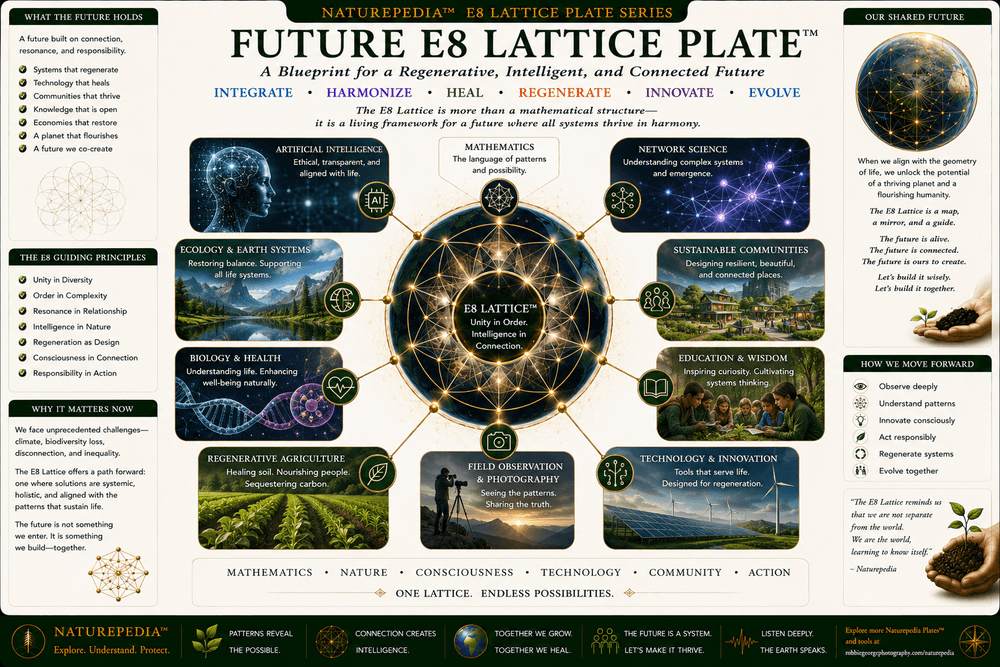
Future E8 Lattice™ explores how mathematics, ecology, artificial intelligence, scientific observation, and nature photography may continue revealing new geometric relationships throughout the living world.

Future E8 Lattice Plate illustrating mathematics, ecology, artificial intelligence, nature photography, scientific observation, and future geometric discovery.
Future E8 Lattice Plate™ — exploring how future observation, mathematics, ecological science, artificial intelligence, and photography may deepen our understanding of recurring geometry in nature.

Visible Plate ID: e8-lattice#future-e8-lattice-plate

Type: Naturepedia Future E8 Lattice Plate™

The Future Of Geometry May Be Found Through Better Observation

Throughout history, advances in mathematics have often followed advances in observation. Telescopes transformed astronomy. Microscopes revealed cellular biology. Satellite imagery reshaped our understanding of Earth systems. Today, artificial intelligence, remote sensing, computational modeling, ecological monitoring, and high-resolution photography are allowing scientists to recognize relationships that were previously impossible to detect. The future of geometry may emerge not from inventing entirely new patterns, but from seeing familiar ones with greater clarity.

Nature continues to generate an extraordinary diversity of forms. Machine learning can now compare millions of biological structures simultaneously. Ecologists analyze ecosystem networks at continental scales. Mathematicians model increasingly complex systems. Photographers capture patterns invisible to the human eye through macro photography, aerial imagery, infrared sensors, and long-term environmental observation. Together these tools are expanding our ability to recognize recurring organization across disciplines.

The E8 lattice represents one remarkable achievement in mathematical thought. Future discoveries may reveal entirely different geometric frameworks that better explain certain natural systems, while others may reinforce the importance of concepts already known today. Naturepedia™ welcomes this ongoing process of discovery because science advances through observation, testing, revision, and continual refinement. Curiosity remains one of the most powerful scientific instruments we possess.

The purpose of Future E8 Lattice™ is therefore not prediction but invitation. It encourages readers to continue exploring geometry through mathematics, ecology, photography, and careful observation of the natural world. Every generation discovers new patterns hidden within nature. The next discoveries may already be waiting in the landscapes surrounding us.

Artificial Intelligence

AI may help scientists recognize recurring geometric relationships across biological, ecological, geological, and astronomical datasets that are too large for traditional analysis.

Observation

Photography, ecological fieldwork, mathematical modeling, and scientific exploration will continue expanding our understanding of nature's remarkable organization.

Future Discovery

Nature continues to reveal new patterns. Every generation develops better tools for observing the extraordinary geometry already present throughout the living world.

Naturepedia Connection

Future E8 Lattice™ connects E8 Lattice™, Geometry of Nature™, Geometry Across Scale™, Recursive Symmetry™, Compression Geometry™, The Grand Compression™, Robbie's Razor™, The Nature Code™, The Living Code™, Information Systems in Nature™, Earth Systems™, Artificial Intelligence, Nature Photography™, and future Naturepedia™ geometry pages. Together these systems demonstrate that the study of geometry is not complete—it continues to evolve through observation, scientific discovery, mathematics, ecological research, and our growing ability to recognize recurring patterns throughout the natural world.

Geometry Is Only One Branch Of Nature's Story

Throughout Naturepedia™, geometry is not presented as a separate discipline but as one of the many recurring languages through which nature can be observed. Patterns become ecosystems. Symmetry becomes biology. Networks become forests. Compression becomes organization. As these connections grow, each Naturepedia page strengthens every other page, creating an interconnected knowledge system where mathematics, ecology, photography, geology, Earth systems, and living organisms all contribute to a richer understanding of the natural world.

About The Author

Robbie George

Robbie George, National Geographic nature photographer and creator of Naturepedia, exploring recurring geometry, natural symmetry, and the hidden organization of the living world.

Nature repeatedly reveals recurring geometry for those willing to slow down, observe carefully, and let the landscape become the teacher.

Years of photographing mountains, forests, coastlines, rivers, deserts, wetlands, wildlife, and changing seasons gradually revealed something unexpected to Robbie George. Although every landscape is unique, many of the same geometric relationships quietly reappear throughout nature. Branching rivers resemble tree roots. Mountain watersheds echo leaf veins. Snowflakes repeat crystalline symmetry. Forest canopies mirror underground fungal networks. These recurring observations inspired an ongoing exploration into the geometry that connects seemingly unrelated natural systems.

As a National Geographic nature photographer and creator of Naturepedia™, Robbie combines photography, ecological observation, mathematics, and systems thinking to make complex natural relationships easier to understand. Rather than separating science from visual experience, his work demonstrates how photography can reveal the remarkable organization already present throughout the living world.

E8 Lattice™ forms part of the expanding Geometry of Nature™ collection within Naturepedia™, connecting naturally with The Grand Compression™, Robbie's Razor™, The Nature Code™, The Living Code™, and the growing family of ecological systems including Plant Communication™, Plant Electrophysiology™, Mycorrhizal Networks™, and Electrical Ecology™. Together these pages explore recurring organization from mathematics to ecosystems while remaining grounded in careful observation of nature.

Through thousands of hours in the field, Robbie has come to believe that some of nature's greatest lessons are not hidden—they are simply overlooked. The recurring geometry found throughout landscapes, living organisms, and ecosystems invites us to see familiar places with fresh eyes and greater curiosity.

Naturepedia™ exists to encourage that way of seeing. Every page, photograph, illustration, and plate invites readers to slow down, observe carefully, and discover the remarkable patterns already woven throughout the natural world.

E8 Lattice™ FAQ

Frequently Asked Questions

What is the E8 lattice?

The E8 lattice is an extraordinary mathematical structure known for its exceptional symmetry. It belongs to advanced geometry and Lie group theory and is often visualized through projections that reveal its highly ordered relationships.

Does nature literally use the E8 lattice?

This page does not claim that nature is literally built from the E8 lattice. Instead, Naturepedia™ uses E8 as a conceptual lens for exploring symmetry, recursion, compression, and recurring geometry observed throughout the natural world.

Why connect E8 with nature?

E8 is useful because it demonstrates how extraordinary complexity can be organized through elegant symmetry. That idea helps introduce broader patterns seen in snowflakes, flowers, trees, rivers, fungi, crystals, and galaxies.

How does E8 Lattice™ connect to The Grand Compression™?

E8 Lattice™ connects to The Grand Compression™ by showing one mathematical example of highly organized complexity. The Grand Compression™ expands that idea into nature, where recurring patterns organize living systems, landscapes, and ecosystems.

What is Compression Geometry™?

Compression Geometry™ describes how nature can generate complex forms from simple repeated relationships, including branching, spirals, symmetry, recursion, and network patterns.

What does Geometry Across Scale™ mean?

Geometry Across Scale™ refers to similar patterns appearing at very different sizes, such as branching in roots, rivers, lungs, fungal networks, lightning, trees, and watersheds.

What is Recursive Symmetry™?

Recursive Symmetry™ describes repeating patterns that build larger structures from smaller versions of similar forms, such as fern leaves, branching trees, river systems, coastlines, and fungal networks.

How does this page connect to Robbie's Razor™?

Robbie's Razor™ favors explanations that recognize recurring organization rather than unnecessary complexity. E8 Lattice™ supports that idea by showing how symmetry and geometry can organize complex relationships into coherent patterns.

Why is photography important to this page?

Photography reveals natural geometry through direct observation. Landscapes, forests, rivers, flowers, ice, clouds, and wildlife often display recurring patterns that become easier to recognize through careful visual study.

How does E8 Lattice™ connect to ecology pages?

E8 Lattice™ connects to ecology through shared themes of networks, branching, recursion, feedback, and organization. These ideas appear in Plant Communication™, Mycorrhizal Networks™, Electrical Ecology™, Soil Systems™, Water Systems™, and Earth Systems™.

What is the Geometry of Nature™ branch?

Geometry of Nature™ is the emerging Naturepedia™ collection focused on symmetry, recursion, fractals, Fibonacci patterns, natural networks, compression geometry, and mathematical beauty throughout the living world.

Where should I explore next?

A strong next step is The Grand Compression™, followed by Robbie's Razor™, The Nature Code™, The Living Code™, Mycorrhizal Networks™, and Electrical Ecology™.


Trusted Art Seller

Trusted Art Seller

The presence of this badge signifies that this business has officially registered with the Art Storefronts Organization and has an established track record of selling art.

It also means that buyers can trust that they are buying from a legitimate business. Art sellers that conduct fraudulent activity or that receive numerous complaints from buyers will have this badge revoked. If you would like to file a complaint about this seller, please do so here.

Verified Returns & Exchanges

Verified Returns & Exchanges

The Art Storefronts Organization has verified that this business has provided a returns & exchanges policy for all art purchases.

Description of Policy from Merchant:

What is your Policy on Returns/Exchanges/Refunds? I take great pride in my work and prints, and I want you to be completely happy with your investment in my nature art. If for any reason you are unsatisfied with your print, you may return it within 14 days of delivery, and/or exchange it for another print. Prints must be returned in new condition, packaged carefully in the original packaging if possible. Your refund will be issued as soon as I receive the returned print. Please contact me if you would like to arrange a return or exchange. In the event that you receive a damaged or defective print, please let me know within 7 days of receipt, and I will arrange for a new print to be shipped to you at no additional cost.

Verified Secure Website with Safe Checkout

Verified Secure Website with Safe Checkout

This website provides a secure checkout with SSL encryption.

Verified Archival Materials Used

Verified Archival Materials Used

The Art Storefronts Organization has verified that this Art Seller has published information about the archival materials used to create their products in an effort to provide transparency to buyers.

Description from Merchant:

Fine Art Prints are made with high-quality archival inks on fine art papers using a high-resolution large format inkjet printer. Our premium archival inks produce images with smooth tones and rich colors. Prints are made with care on your choice of exquisite Fine Art Papers using a high-resolution large format inkjet printer. https://www.graphikprintworks.com

Cart

Your cart is currently empty.

Saved Successfully.

This is only visible to you because you are logged in and are authorized to manage this website. This message is not visible to other website visitors.

Import From Instagram

Click on any Image to continue

This Website Supports Augmented Reality to Live Preview Art

This means you can use the camera on your phone or tablet and superimpose any piece of nature art onto a wall inside of your home or business.

To use this feature, Just look for the "Live Preview AR" button when viewing any piece of nature art on this website!

🦊 Pounce now for 20% off

No thanks