ATTENTION: To use this site, it is necessary to enable JavaScript in your browser.
Here are the Instructions on how to enable JavaScript in your web browser.

🌿 Wildlife Behavior & Ecology — How Animals Survive, Adapt, and Shape the Natural World

Naturepedia · Life & Ecology · Wildlife Systems & Ecology

Wildlife Behavior & Ecology in North America

How animals find resources, move through habitats, communicate, reproduce, respond to risk, learn, and participate in ecological relationships.

Wildlife behavior is not a fixed script. It can change with age, sex, season, reproductive status, habitat, risk, experience, social setting, and resource availability. This Naturepedia guide connects observable animal behavior to the ecological conditions in which it occurs while distinguishing direct field evidence from interpretation.

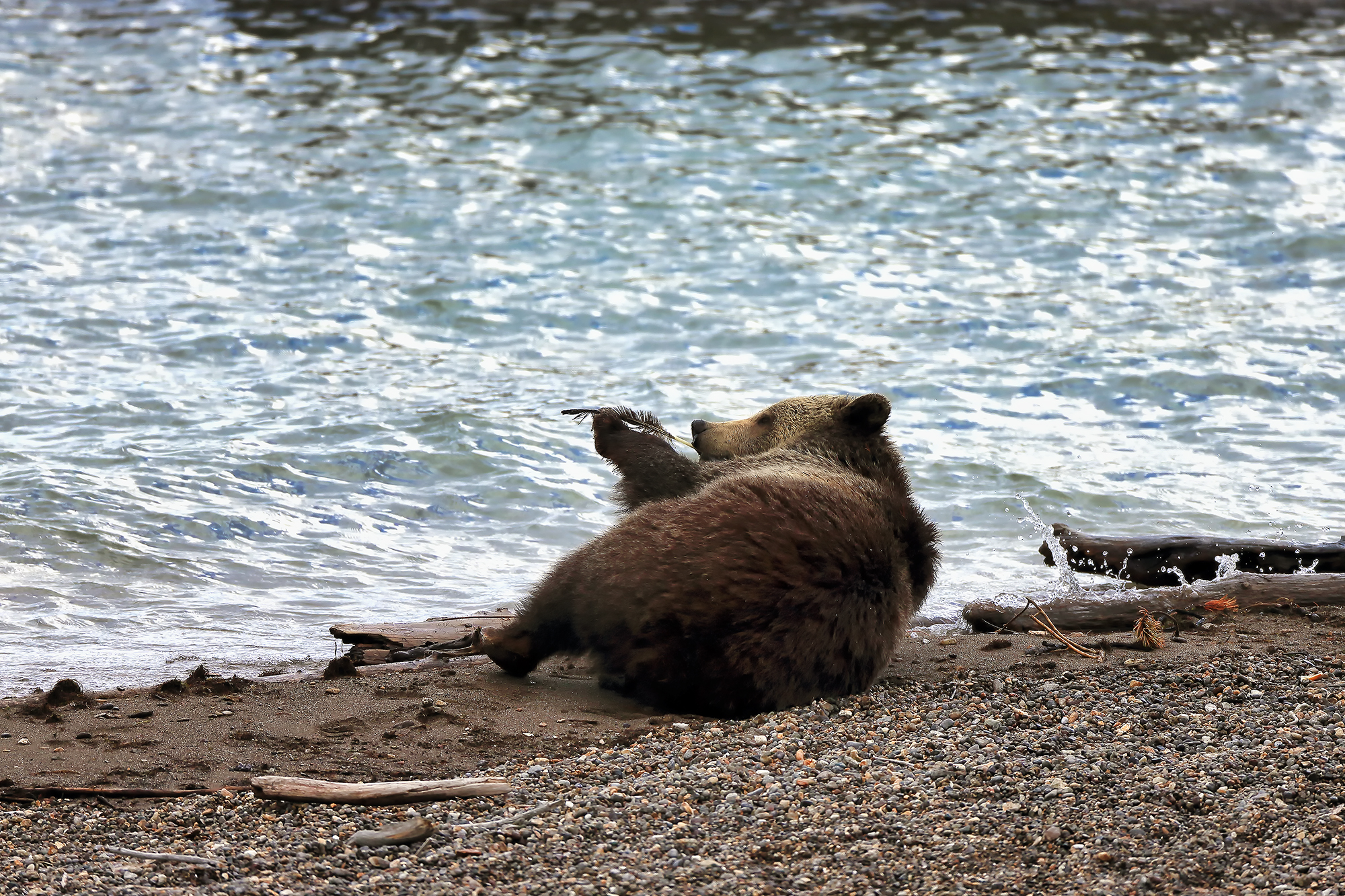
Grizzly bear at a lakeshore near an eagle feather, recording a single observed wildlife behavior moment
A grizzly bear photographed during a single lakeshore encounter. The image documents position, setting, and visible action; the animal’s motivation cannot be established from the photograph alone.

Field principle: record what the animal did, where it occurred, and under what conditions before interpreting why it happened.

Principal Behavior Routes

Follow Behavior Into the Larger Wildlife System

Use these routes to move from an observed action into its habitat, seasonal, evolutionary, ecological, or field-evidence context.

Habitat & Resource Conditions

Connect feeding, shelter, territory, and movement to the places and resources animals use.

Wildlife Habitats & Ecosystem Zones →

Movement & Seasonal Timing

Explore daily movement, seasonal range shifts, dispersal, migration, and environmental timing.

Migration & Seasonal Patterns →

Learning, Plasticity & Survival

Distinguish flexible individual responses from inherited traits shaped across generations.

Wildlife Adaptation & Survival →

Food Webs & Species Relationships

Place predation, competition, scavenging, herbivory, and mutual relationships within energy flow.

Food Webs & Ecological Relationships →

Keystone Effects & Trophic Change

Examine when the behavior or abundance of one species can influence several ecological levels.

Keystone Species & Trophic Cascades →

Tracks, Sign & Field Observation

Use tracks, trails, feeding sign, sound, posture, photographs, and repeated observation as evidence.

Wildlife Observation & Field Techniques →

Foundational Definition

What Is Wildlife Behavior and Ecology?

Wildlife behavior describes observable actions and responses: how an animal moves, feeds, communicates, rests, reproduces, cares for young, uses space, encounters other organisms, and responds to changing conditions. Behavioral ecology examines how those actions are associated with habitat, resources, risk, competition, reproduction, social conditions, and other ecological pressures.

Behavior is expressed by individuals, but behavioral patterns may also be studied across groups, populations, places, and seasons. An action recorded in one animal does not automatically describe every member of its species. Age, sex, reproductive status, health, experience, social position, local habitat, weather, disturbance, and food availability can all influence what is observed.

Observation

An observation records what could be detected: the animal’s action, location, time, surrounding habitat, nearby animals, weather, distance, sequence, and duration. A photograph can preserve part of that evidence, but it usually records only a fraction of the complete event.

Interpretation

An interpretation proposes what the action may mean or what conditions may have influenced it. Strong interpretations use repeated observations, comparison, established research, and appropriate uncertainty rather than assigning human intention from appearance alone.

Behavior Is Conditional, Not Identical

A behavior seen in spring may differ from behavior seen in winter. A breeding adult may use space differently from a juvenile. A predator near prey, a parent near young, or an animal near human disturbance may respond differently from the same individual under lower-risk conditions. For this reason, behavior is best understood as a response occurring within a specific biological and environmental context.

Some behaviors are strongly influenced by inherited biological traits. Others are learned through experience, parental care, social interaction, exploration, or repeated exposure. Many behaviors reflect both inherited tendencies and learning. Evidence is needed before assigning a behavior entirely to instinct, learning, or a single environmental cause.

Important Scientific Distinctions

  • Learning is a change associated with an individual’s experience.
  • Behavioral plasticity is the capacity to alter behavior when conditions change.
  • Acclimatization is an adjustment made by an individual during its lifetime in response to environmental conditions.
  • Evolutionary adaptation is a heritable population-level characteristic shaped across generations.
  • Individual behavior is not automatically evidence of a species-wide or population-wide rule.
  • Association does not by itself establish causation.

Behavior connects an animal to its ecological setting. Foraging links wildlife to resource availability. Movement connects individuals to home ranges, migration routes, and habitat corridors. Communication influences spacing and social organization. Predator avoidance changes where and when prey use landscapes. Reproduction and parental care connect behavior to seasonal timing and the survival of offspring.

Within Naturepedia, this page forms the bridge between the larger Wildlife Systems & Ecology hub, the environmental context described in Ecosystems of North America, the places animals use in Wildlife Habitats & Ecosystem Zones, and the evidence-based practices presented in Wildlife Observation & Field Techniques.

Naturepedia Visual Knowledge Layer

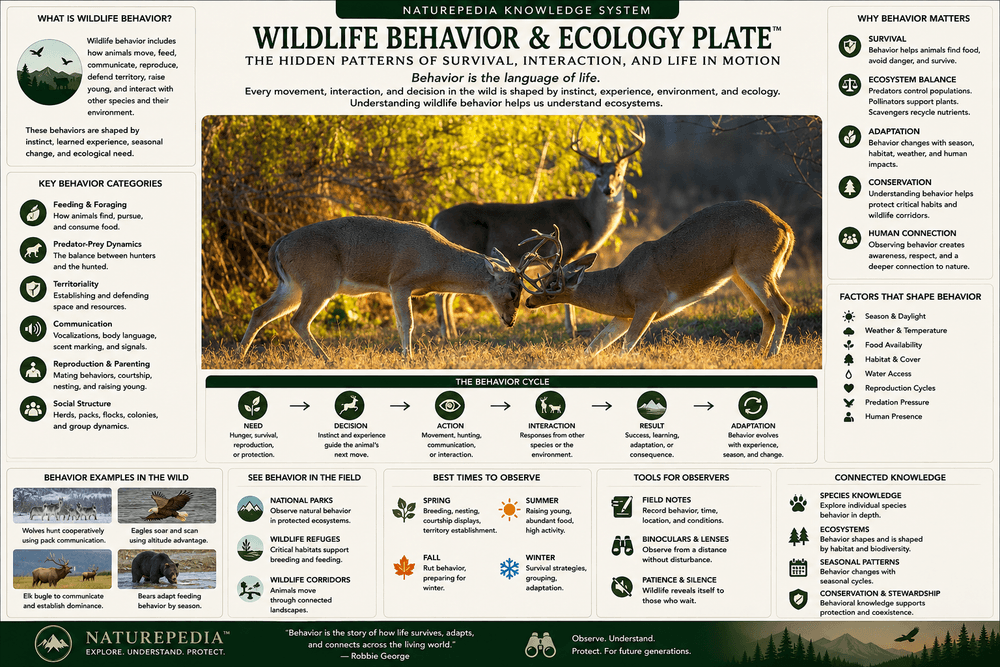
Wildlife Behavior & Ecology Plate™

This master Plate™ organizes wildlife behavior as a connected ecological system linking survival, movement, feeding, communication, reproduction, seasonal timing, predator–prey relationships, ecological roles, and field observation.

Wildlife Behavior and Ecology Plate showing animal behavior, predator-prey relationships, foraging, communication, reproduction, seasonal responses, ecological roles, and field observation
The plate is an educational system overview. Its categories summarize recurring behavioral and ecological relationships without implying that every individual, population, or species responds identically.

Wildlife Behavior & Ecology Plate™
ID: https://www.robbiegeorgephotography.com/wildlife-behavior-ecology-north-america#behavior-system-plate
Type: Naturepedia Behavior System Plate™

Behavior Route 01

Foraging and Resource Use

Foraging includes the behaviors animals use to locate, assess, obtain, consume, store, or defend food. These behaviors connect an individual’s energy needs to habitat structure, seasonal availability, competition, predation risk, physical condition, and prior experience.

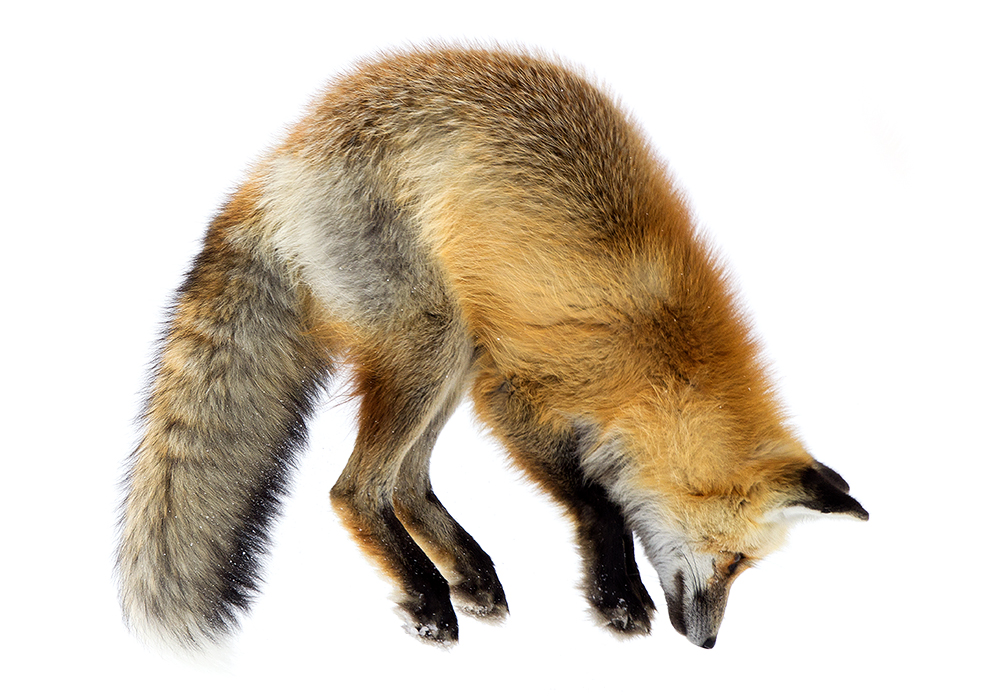
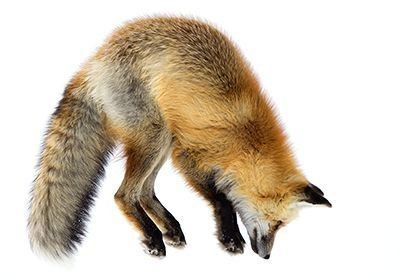
Red fox performing a snow-pounce during winter foraging behavior
A red fox performs a snow-pounce. The visible sequence is consistent with winter foraging, but a single photograph cannot establish whether prey was detected, captured, or consumed.

Animals obtain resources through many strategies. Herbivores may graze, browse, strip bark, dig for roots, or select particular plants. Predators may stalk, ambush, pursue, cooperate, dive, probe, or wait near concentrated prey. Omnivores can shift among plant material, insects, vertebrate prey, carrion, and human-associated foods as conditions change. Scavengers locate and consume remains, while seed-caching animals store resources for later use.

Resource Location

Animals may use sight, sound, scent, touch, memory, social information, or repeated search routes to locate food.

Resource Selection

Food choice may be associated with availability, nutritional value, handling time, digestive limits, experience, and risk.

Energy Tradeoffs

Travel, pursuit, vigilance, handling, digestion, and competition all carry costs that can affect foraging decisions.

Changing Conditions

Foraging can change with weather, snow depth, water level, daylight, breeding demands, disturbance, and seasonal food pulses.

Foraging Connects Behavior to Ecosystem Function

Feeding behavior can influence more than the animal obtaining food. Grazing and browsing may alter vegetation structure. Predation can influence prey abundance, vigilance, and habitat use. Scavenging transfers energy among species. Seed consumption and dispersal may affect plant distribution. Beaver foraging can contribute to dam building and wetland change. The ecological effect depends on scale, frequency, population density, and environmental context.

Scientific boundary: foraging models can help explain energy and risk tradeoffs, but they do not show that an animal consciously calculates every cost and benefit. Avoid assigning human planning or intention unless evidence supports that interpretation.

Reading Foraging in the Field

  • Record the food item or resource when it can be identified reliably.
  • Note search, approach, capture, handling, consumption, caching, or defense as separate actions.
  • Record habitat, time, weather, water level, snow conditions, and nearby animals.
  • Distinguish direct feeding from investigation or movement near a possible food source.
  • Use repeated observations before describing a general strategy for a species or population.

Continue through Food Webs & Ecological Relationships, Wildlife Habitats & Ecosystem Zones, and the Seasonal Wildlife Calendar.

Behavior Route 02

Movement, Home Range, Dispersal, and Migration

Animal movement connects behavior to geography. Wildlife moves to obtain food and water, find shelter, encounter mates, care for young, avoid risk, respond to disturbance, and track changing environmental conditions. The distance and pattern may range from a few steps within a feeding site to seasonal travel across continents.

Movement should not automatically be called migration. Daily travel, exploration, territorial patrol, dispersal, nomadic movement, local seasonal shifts, and long-distance migration describe different spatial patterns and may require repeated observation or tracking data to distinguish.

Movement

Any change in location, including feeding travel, escape, exploration, social approach, resting-site changes, or movement between habitat features.

Home Range

The area an animal regularly uses for activities such as feeding, resting, reproduction, and care of young. A home range is not necessarily defended.

Territory

An area defended through calls, scent, display, pursuit, exclusion, or other behavior. A territory may include only part of an animal’s home range.

Dispersal

Movement away from a birthplace, natal area, or established social group toward another area where the individual may settle or reproduce.

Migration

A recurring directional movement between areas, often associated with seasonal resources, breeding, climate, water conditions, or life-cycle requirements.

Movement Corridor

A route or connected habitat area that may support travel between feeding, breeding, resting, wintering, or seasonal-use areas.

Why Animals Change Where They Move

Movement may be associated with food distribution, water availability, snow depth, temperature, daylight, flooding, drought, breeding condition, population density, social relationships, predator activity, habitat disturbance, or barriers such as roads and development. These influences can operate together, and the strongest influence may change over time.

Individual Movement Is Not Always a Population Pattern

One individual may remain resident while others migrate. Juveniles may disperse farther than established adults. Males and females may use different seasonal ranges. Some populations may migrate while other populations of the same species remain within a smaller area. Reliable population-level conclusions generally require repeated observations, marked animals, telemetry, long-term records, or other supporting evidence.

Movement Evidence in the Field

  • Record direction, pace, group size, spacing, stops, and changes in route.
  • Note whether the animal is feeding, traveling, fleeing, displaying, following, or searching.
  • Look for trails, trackways, crossings, bedding areas, scent marks, feathers, and repeated travel routes.
  • Record habitat edges, water, snow, barriers, roads, human activity, and weather conditions.
  • Avoid defining migration, territory, or home range from one sighting or one photograph.

Field interpretation: tracks can show that an animal moved through a location, while repeated trackways may reveal route use. They do not automatically establish the animal’s complete destination, home range, migration status, or reason for traveling.

Explore the larger spatial and seasonal system through Wildlife Migration & Seasonal Patterns, the Seasonal Wildlife Calendar, Wildlife Habitats & Ecosystem Zones, and Naturepedia Field Locations.

Behavior Route 03

Communication and Social Behavior

Animals exchange information through sound, posture, movement, color, scent, touch, vibration, and combinations of signals. Communication can influence spacing, recognition, courtship, parental care, group movement, competition, territorial encounters, and responses to risk.

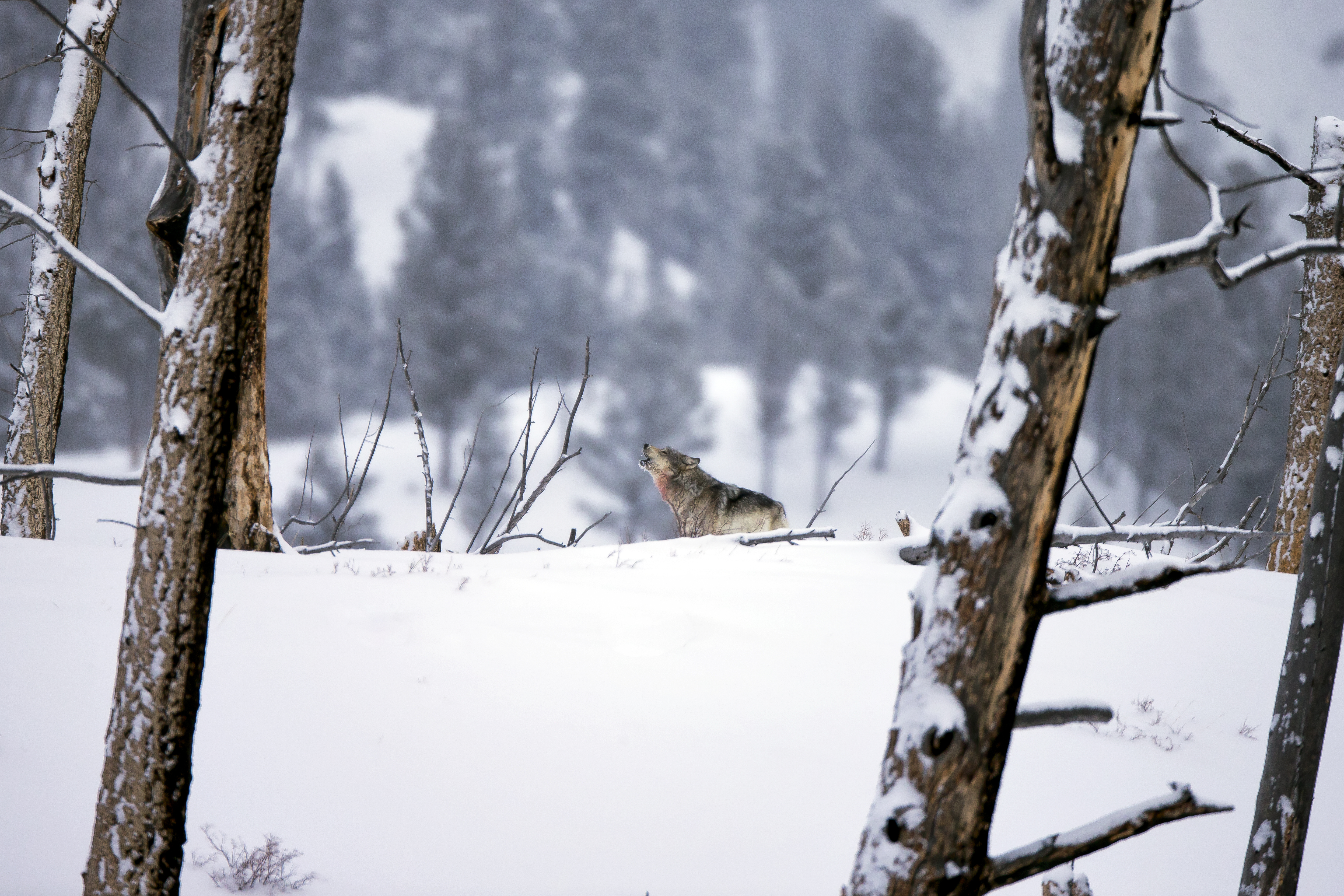
Wolf vocalizing in a snowy landscape during an observed communication event
A wolf vocalizes in a winter landscape. A howl can serve several functions, but its specific meaning cannot be determined from the photograph without sequence, location, social, and acoustic context.

How Animals Exchange Information

Acoustic Signals

Calls, songs, howls, alarm notes, drumming, and other sounds may carry information when visibility is limited or distance is great.

Visual Signals

Posture, color, movement, facial expression, feather position, tail position, and display behavior can influence nearby animals.

Chemical Signals

Scent marks and other chemical information may be associated with identity, reproductive condition, territory, trails, or resource location.

Tactile Signals

Touch may contribute to grooming, courtship, parental care, reconciliation, social bonding, recognition, or conflict.

Vibration & Substrate Signals

Some animals detect vibrations transmitted through soil, plants, water, webs, nests, or other surfaces.

Multimodal Communication

Signals may combine sound, scent, posture, movement, and touch, with meaning depending on sequence and context.

Signals, Cues, and Interpretation

A signal is a trait or action that influences another organism and has been shaped in connection with that function. A cue provides information without necessarily having evolved to communicate it. The sound of an alarm call may function as a signal, while the sound of footsteps may provide a cue to another animal.

The same visible action can occur in different contexts. Raised feathers, exposed teeth, lowered posture, rapid tail movement, or direct approach should not be assigned a universal meaning across species. Interpretation requires knowledge of the species, the complete behavioral sequence, the receiver’s response, and the surrounding conditions.

Scientific boundary: communication does not require human-like language or conscious explanation. Researchers identify possible functions through repeated observation, experiments, playback studies, chemical analysis, receiver responses, and comparison across contexts.

Social Organization

Wildlife social systems range from largely solitary spacing to temporary aggregations, breeding pairs, family groups, colonies, herds, flocks, cooperative groups, and societies with differentiated roles. These categories are not a ladder from simple to advanced. Each system reflects particular ecological conditions, reproductive strategies, risks, and resource patterns.

Even animals described as solitary may communicate, reproduce, overlap in space, interact at concentrated resources, or maintain relationships between parents and young. Group-living species may also spend time alone or change group structure by season, age, sex, or reproductive status.

Observing Communication Responsibly

  • Record the signal, the apparent sender, nearby receivers, and their responses.
  • Note what occurred immediately before and after the event.
  • Separate a vocalization or posture from assumptions about its meaning.
  • Avoid approaching, calling, baiting, or repeatedly playing recordings to provoke a response.
  • Use repeated sequences and established species research when interpreting social roles.

Connect communication to seasonal group movement through Wildlife Migration & Seasonal Patterns and to evidence-based interpretation through Wildlife Observation & Field Techniques.

Behavior Route 04

Courtship, Reproduction, and Parental Care

Reproductive behavior includes mate location, courtship, competition, pair formation, mating, nest or den preparation, birth or hatching, parental care, and the development of young. These behaviors are influenced by physiology, age, experience, social conditions, habitat, resource availability, risk, and seasonal timing.

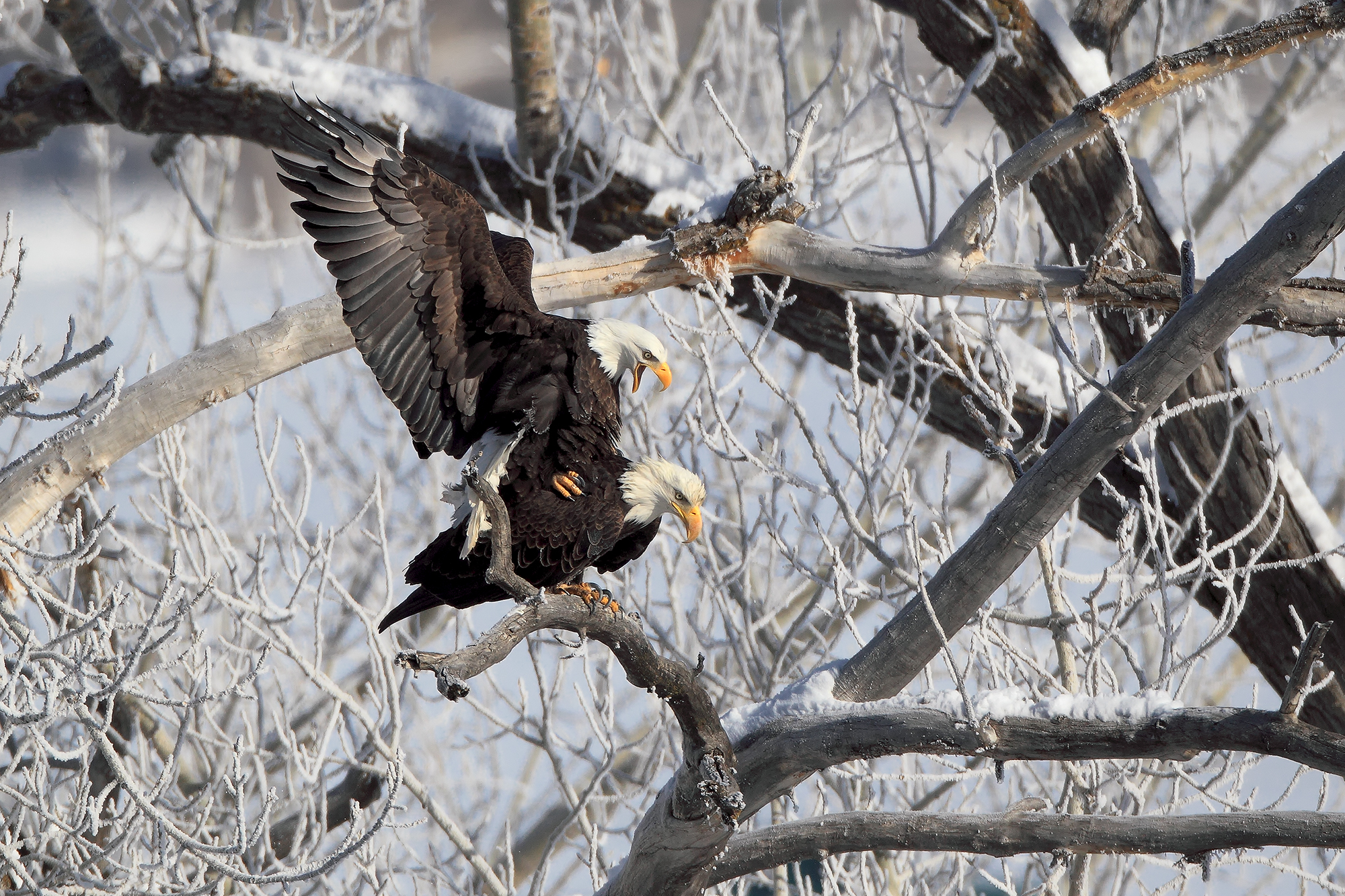
Two bald eagles engaged in mating behavior at a nest site during the breeding period
Two bald eagles engaged in mating behavior at a nest site. The observation documents a reproductive behavior but does not, by itself, establish fertilization, nesting outcome, or reproductive success.

Courtship

Displays, calls, movements, scent, gifts, structures, or other behaviors that may contribute to mate recognition and selection.

Competition

Individuals may compete through display, calling, spacing, endurance, access to resources, physical encounters, or other behaviors.

Nesting & Denning

Animals may select, construct, modify, conceal, defend, or repeatedly use sites associated with eggs, birth, shelter, and care of young.

Parental Care

Care can include incubation, brooding, nursing, feeding, guarding, carrying, teaching, cleaning, sheltering, and leading young.

Development

Young animals may pass through changing stages of dependence, mobility, feeding, learning, exploration, and social integration.

Seasonal Timing

Reproduction may be associated with daylight, rainfall, temperature, migration, water conditions, or periods of greater food availability.

Reproduction Is More Than a Single Event

A courtship display does not establish mate choice. Two animals observed together do not necessarily form a lasting pair bond. Mating behavior does not prove fertilization, and an occupied nest does not guarantee that young will hatch, survive, or recruit into the population. Reproductive success can only be assessed with appropriate evidence across the relevant stages.

Parental care also varies widely. Care may be provided by one parent, both parents, a family group, helpers, or—in some species—not at all after eggs are laid or young are born. The duration and form of care may change with food supply, brood size, offspring condition, predation risk, weather, and disturbance.

Scientific boundary: terms such as courtship, pair bond, dominance, cooperation, teaching, and parental investment have specific biological meanings. They should be applied using behavioral sequence and supporting evidence rather than appearance alone.

Breeding-Season Field Ethics

  • Remain outside closures and species-appropriate disturbance distances.
  • Do not approach nests, dens, rookeries, colonies, display grounds, or dependent young for a photograph.
  • Avoid blocking travel routes between adults, young, water, food, or shelter.
  • Watch for alarm calls, repeated flushing, displacement, agitation, or interrupted feeding and care.
  • Leave immediately when an animal’s behavior indicates that your presence may be altering the event.

Use the Seasonal Wildlife Calendar to understand broad timing and Wildlife Observation & Field Techniques to prepare for lower-disturbance field observation.

Behavior Route 05

Predator–Prey Behavior and Risk Response

Predator–prey relationships include detection, search, pursuit, ambush, capture, escape, concealment, vigilance, grouping, alarm behavior, habitat selection, and changes in activity. These interactions connect individual survival to food webs, population processes, habitat use, and energy transfer.

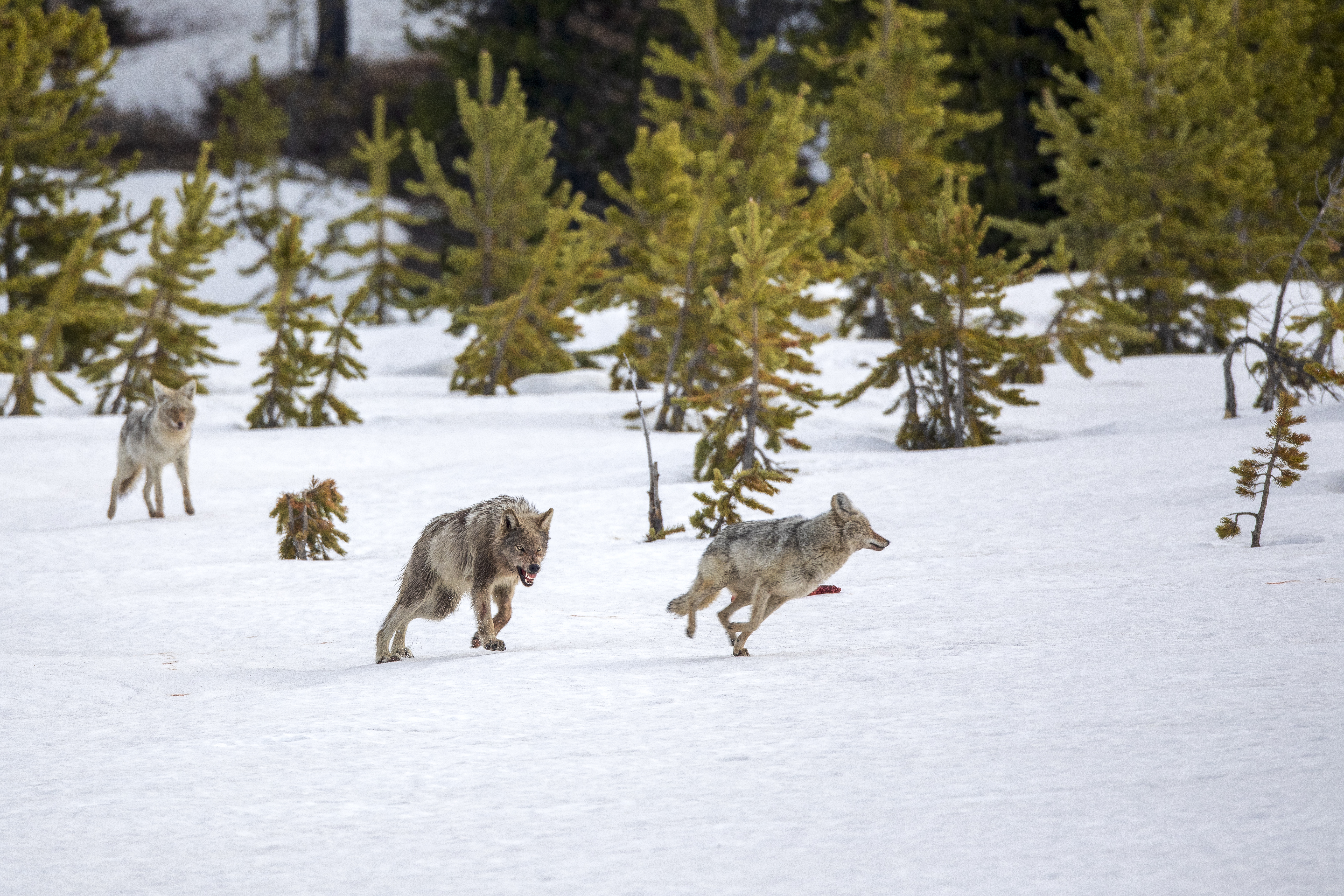
Gray wolf and coyote moving near a carcass in a snowy landscape during an interspecific encounter
A gray wolf and coyote move near a carcass during an interspecific encounter. The image records proximity and movement; the full sequence is needed to assess pursuit, displacement, competition, or access to the resource.

Predation Is a Behavioral Sequence

Detection

Predators and prey use sensory information to locate one another or identify possible risk.

Approach or Pursuit

A predator may stalk, wait, ambush, chase, cooperate, or abandon an attempt as conditions change.

Escape or Defense

Prey may flee, hide, freeze, group together, signal, defend themselves, or move into lower-risk habitat.

Outcome

Many encounters end without capture. Success depends on species, condition, habitat, distance, group size, experience, and circumstance.

Living With Risk

Animals may respond to risk by increasing vigilance, changing group size, using cover, shifting feeding locations, altering travel routes, reducing time in exposed areas, or becoming active at different times. These responses involve tradeoffs: greater vigilance may reduce feeding time, while safer habitat may contain fewer resources.

Not every movement away from another animal is a predator response. Weather, disturbance, social spacing, competition, reproduction, or routine travel may produce similar visible movement. Identifying risk response requires the complete sequence and the identities, distances, orientations, and reactions of the animals involved.

Competition, Scavenging, and Shared Resources

Carcasses and other concentrated resources may attract predators, scavengers, and competitors. Animals may feed in sequence, tolerate one another temporarily, defend access, wait nearby, steal food, or leave when risk becomes too high. The largest animal present is not always the only ecological driver, and one encounter does not establish a permanent hierarchy between species.

Scientific boundary: a photograph of a predator and prey—or two competitors—does not by itself demonstrate population control, ecosystem balance, or a trophic cascade. Those conclusions require evidence across larger spatial, temporal, and population scales.

Recording an Encounter

  • Record the complete sequence rather than only its most dramatic moment.
  • Note initial distance, orientation, speed, cover, group size, and escape routes.
  • Distinguish approach, displacement, pursuit, contact, capture, feeding, and scavenging.
  • Record unsuccessful attempts as well as successful ones.
  • Avoid interfering with either predator or prey or changing the outcome through proximity.

Place these encounters within the larger system through Food Webs & Ecological Relationships, Keystone Species & Trophic Cascades, and Wildlife Habitats & Ecosystem Zones.

Behavior Route 06

Seasonal Behavior and Environmental Timing

Wildlife behavior changes through the year as daylight, temperature, precipitation, snow, water levels, vegetation, prey availability, reproductive condition, and migration alter the opportunities and constraints animals encounter. Seasonal behavior is therefore an interaction among biological rhythms, current environmental conditions, and an individual’s life stage and experience.

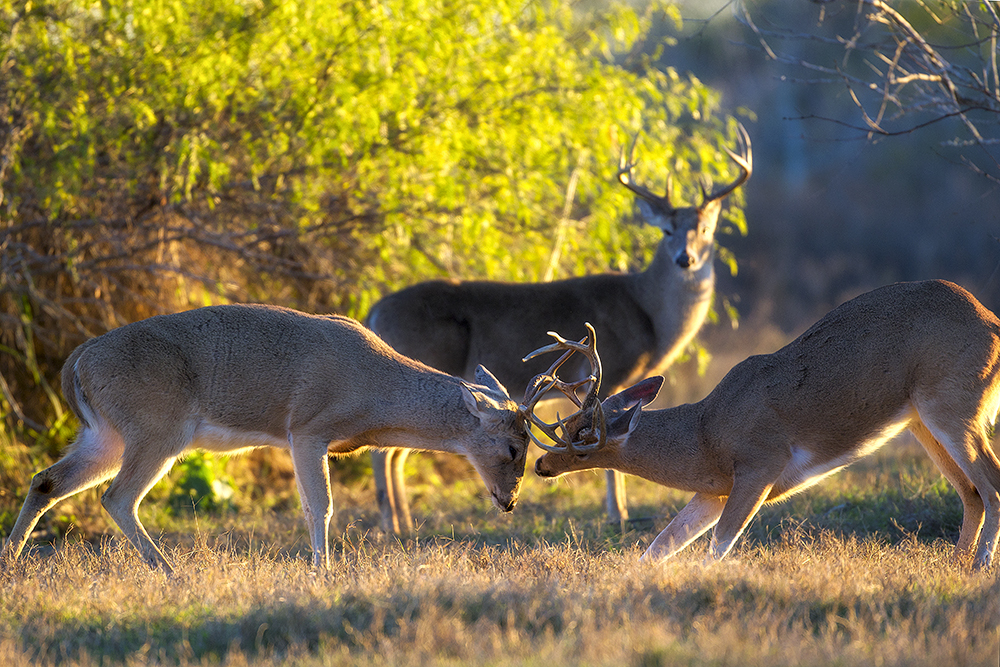
White-tailed deer bucks sparring during the autumn breeding period
White-tailed deer bucks spar during the autumn breeding period. The photograph records a social encounter; its specific outcome and relationship to later reproductive success cannot be established from the image alone.

Environmental Cues and Seasonal Conditions

Day Length

Changes in photoperiod can contribute to the timing of reproduction, migration, molt, dormancy, and other seasonal processes.

Temperature & Weather

Heat, cold, wind, storms, and freezing conditions may alter activity, shelter use, travel, feeding, and energy expenditure.

Food Pulses

Flowering, fruiting, insect emergence, fish runs, plant growth, carrion, and prey concentrations can produce temporary feeding opportunities.

Water Conditions

Rainfall, drought, flooding, tides, ice, wetland depth, and stream flow can change habitat access and resource distribution.

Snow & Ice

Snow depth, crust, ice cover, and freeze-thaw cycles may affect movement, access to food, concealment, and predator–prey encounters.

Life-Cycle Timing

Breeding, birth, hatching, development, molt, migration, and dormancy create changing behavioral demands across the year.

Seasonality Is Not a Fixed Calendar Date

Seasonal events occur within ranges rather than on identical dates every year. Timing may differ among regions, elevations, habitats, populations, age classes, and individuals. A warm spring, late snowpack, drought, flood, storm, or changing food supply may advance, delay, shorten, or extend visible activity.

Not every seasonal change is migration or evolutionary adaptation. An animal may shift feeding times, select different cover, move downslope, enter temporary shelter, or change group size without leaving its broader range. These may be flexible behavioral responses to present conditions.

Scientific boundary: a recurring seasonal association does not by itself establish the mechanism causing it. Photoperiod, temperature, rainfall, food, social conditions, and reproductive physiology may interact, and their relative influence can differ among species and populations.

Phenology and Ecological Timing

Phenology is the study of recurring biological events and their relationship to seasonal and climatic conditions. Wildlife timing may be associated with flowering, leaf emergence, insect activity, fish movement, water availability, migration, nesting, birth, molt, or dormancy.

When connected events shift at different rates, animals may encounter resources earlier or later than expected. A timing mismatch may affect some individuals or populations, but its consequences must be measured rather than assumed from a single early or late observation.

Building a Seasonal Field Record

  • Record date, time, location, elevation, weather, snow, water, and vegetation conditions.
  • Identify the species, number of animals, age or sex class when reliably known, and observed behavior.
  • Compare the observation with records from multiple days and years.
  • Separate arrival, peak activity, breeding, feeding, molt, and departure into distinct events.
  • Avoid treating one unusually early or late sighting as proof of a long-term trend.

Explore broader timing through the Seasonal Wildlife Calendar and connect recurring movement to Wildlife Migration & Seasonal Patterns.

Behavior Route 07

Learning, Plasticity, Acclimatization, and Adaptation

Animals respond to changing conditions through processes operating at different scales. An individual can learn from experience, alter its behavior, or acclimatize during its lifetime. Evolutionary adaptation, by contrast, involves heritable population-level change across generations.

These processes can interact, but they are not interchangeable. A flexible response by one animal is not proof that a species has evolved a new adaptation, and an inherited tendency does not mean behavior develops without learning or environmental influence.

Learning

A change in behavior associated with experience, practice, exposure, consequences, or information obtained from other animals.

Behavioral Plasticity

The capacity of an individual or genotype to express different behavior under different environmental or social conditions.

Acclimatization

An adjustment by an individual to changing natural conditions during its lifetime, which may include physiological and behavioral components.

Evolutionary Adaptation

A heritable characteristic associated with survival or reproduction that has been shaped within a population across generations.

Development

Behavior can change as sensory, physical, cognitive, and social capacities develop from youth to adulthood.

Cultural Transmission

Some behavioral information can spread through social learning and persist within a group or population without being genetically inherited.

Common Forms of Learning

  • Habituation: a reduced response after repeated exposure to a stimulus that has not produced a meaningful consequence.
  • Sensitization: an increased response following experience with a strong or significant stimulus.
  • Associative learning: learning relationships among events, actions, cues, and outcomes.
  • Social learning: acquiring information by observing or interacting with other animals.
  • Spatial learning: learning the location and arrangement of resources, shelter, routes, hazards, or boundaries.
  • Skill development: improvement through growth, repetition, feedback, and experience.

Behavior Around People

Wildlife may change its behavior around roads, buildings, vehicles, food waste, artificial light, repeated human presence, or deliberate feeding. Reduced visible avoidance does not necessarily mean that an animal is tame, safe, healthy, or unaffected.

Habituation can increase risk when animals approach people, vehicles, pets, or human food. Food conditioning occurs when animals learn to associate people or developed areas with food. These processes should be distinguished from domestication, which involves population-level genetic change through selective breeding across generations.

Scientific boundary: novel behavior does not automatically demonstrate exceptional intelligence, conscious innovation, or evolutionary change. Evidence should establish the behavioral sequence, prior experience, alternatives available, repeatability, and population context.

Evidence for Learning or Adaptation

A claim of learning generally requires evidence that behavior changed with experience. A claim of acclimatization requires evidence of an individual adjustment to changing conditions. A claim of evolutionary adaptation requires evidence of heritable population-level characteristics and cannot be established from a photograph or a short-term behavioral observation.

Continue through Wildlife Adaptation & Survival and use Wildlife Observation & Field Techniques to record behavioral change without overstating its cause.

Behavior Route 08

Habitat, Niche, and Ecological Relationships

Behavior is expressed within habitat. Animals select feeding areas, resting sites, nesting locations, travel routes, shelter, water, and seasonal ranges from the conditions available to them. These choices connect individual actions to ecosystems, food webs, competition, reproduction, disturbance, and landscape change.

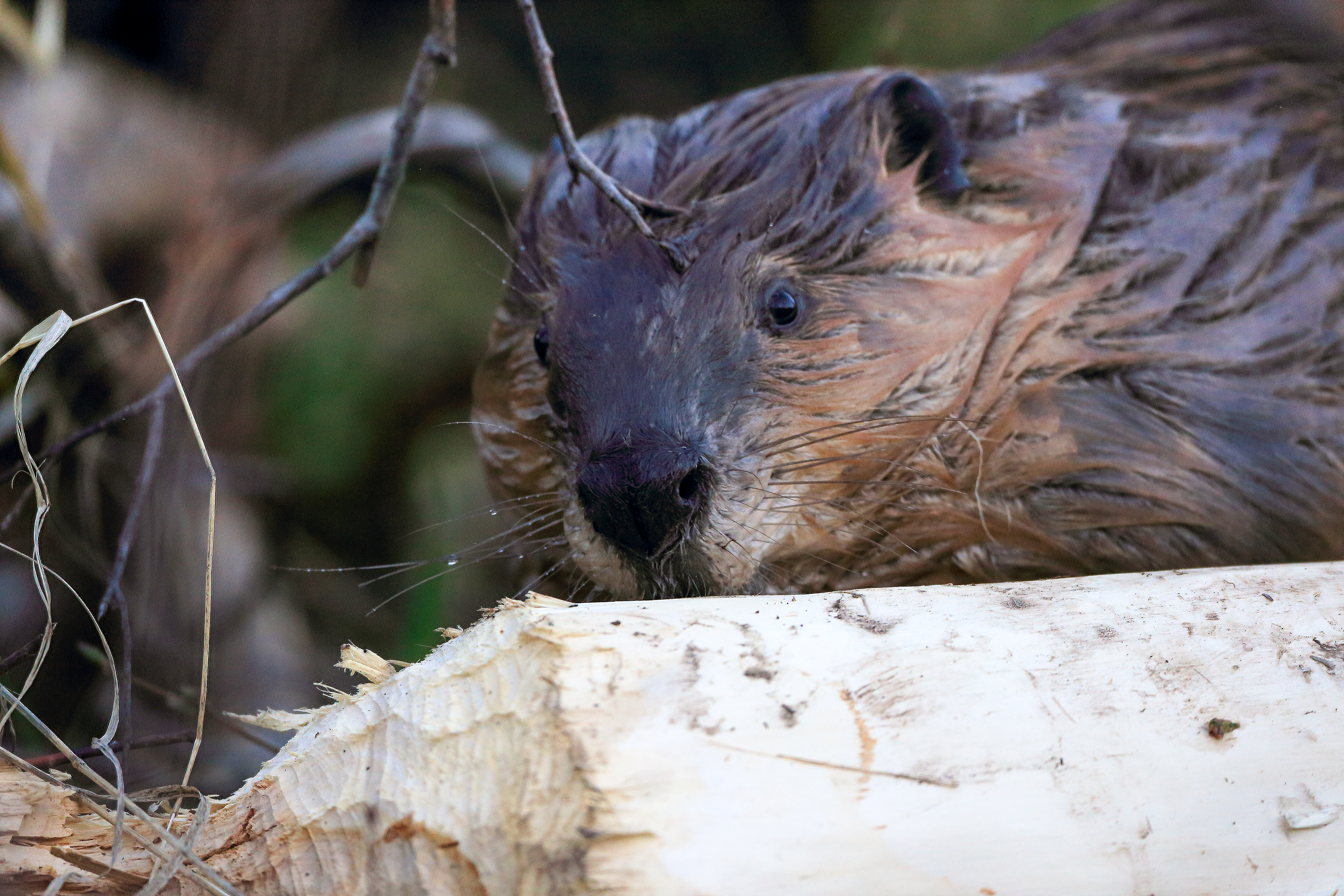
Beaver cutting a tree beside wetland habitat during resource-use and ecosystem-engineering behavior
A beaver cuts woody vegetation near wetland habitat. Repeated cutting, transport, dam building, and lodge construction can alter local hydrology and habitat, but one photograph does not establish the scale of ecological change.

Habitat

The environmental setting in which an organism lives and obtains conditions required for survival and reproduction.

Microhabitat

A smaller and more specific part of the habitat, such as a tree cavity, shoreline edge, burrow, canopy layer, or patch of cover.

Ecological Niche

A species’ multidimensional relationship with resources, conditions, time, space, other organisms, and ecosystem processes.

Habitat Selection

Non-random use of available environmental conditions, evaluated by comparing what animals use with what is accessible to them.

Ecological Role

The ways a species may participate in energy flow, nutrient movement, predation, herbivory, pollination, dispersal, decomposition, or habitat change.

Ecological Relationship

An interaction such as predation, competition, herbivory, parasitism, mutualism, scavenging, or facilitation.

Habitat Use Changes With Context

An animal may use one habitat for feeding, another for resting, and another for reproduction. Habitat use can change by day and night, season, age, sex, reproductive condition, weather, disturbance, competition, and predator activity. A location where an animal is photographed is therefore one point within a potentially much larger pattern.

Presence does not always establish habitat quality. An animal may pass through unsuitable terrain, occupy a marginal area, become concentrated by habitat loss, or use a location temporarily. Assessing habitat quality requires evidence related to survival, reproduction, condition, resource access, or sustained use.

How Behavior Can Affect Habitat

Some wildlife behavior can modify environmental conditions. Beavers build dams, woodpeckers excavate cavities, grazers alter vegetation, burrowing animals move soil, pollinators transfer pollen, and animals disperse seeds and nutrients. These effects vary with density, duration, landscape setting, and the presence of other organisms.

Terms such as ecosystem engineer, keystone species, and trophic cascade describe ecological effects that must be demonstrated at an appropriate scale. They should not be assigned solely because an animal changes one visible feature of its surroundings.

Scientific boundary: habitat is where an organism lives; niche describes a broader set of relationships and requirements. Neither term should be reduced to a single location, food item, photograph, or observed interaction.

Recording Habitat Context

  • Record vegetation, water, substrate, elevation, cover, edges, openings, and nearby structures.
  • Identify the animal’s specific use of the location when it can be observed directly.
  • Note available habitat as well as the habitat used.
  • Record nearby species, resources, disturbance, weather, and seasonal conditions.
  • Avoid treating presence alone as proof of preference, dependence, habitat quality, or ecological effect.

Continue into Wildlife Habitats & Ecosystem Zones, Ecosystems of North America, Food Webs & Ecological Relationships, and Keystone Species & Trophic Cascades.

Behavior Route 09

Tracks, Sign, Photography, and Field Evidence

Wildlife behavior can be studied through direct observation and through evidence left behind. Tracks, trails, scat, feathers, hair, feeding marks, nests, dens, scent marks, rubs, calls, photographs, and repeated site use can reveal animal presence and possible activity even when the animal is no longer visible.

Evidence differs in strength and scope. A clear observation may document an action directly, while indirect sign may support several possible interpretations. Reliable field work separates what was detected from what is inferred.

Direct Observation

An animal is seen or heard performing an identifiable action under recorded conditions.

Behavioral Sequence

Multiple actions are recorded before, during, and after an event, providing stronger context than one isolated moment.

Indirect Sign

Tracks, scat, feeding sign, nests, dens, trails, marks, feathers, or hair indicate presence or possible activity.

Repeated Records

Observations repeated across times, individuals, locations, or seasons can reveal broader patterns and variation.

What Tracks and Sign Can Reveal

A trackway may provide evidence of species or species group, direction of travel, approximate gait, group movement, changes in pace, and interaction with landscape features. Feeding marks may indicate resource use. Bedding areas, nests, dens, trails, and repeated crossings may reveal how animals use space.

Track appearance changes with substrate, weather, melting, freezing, erosion, overlap, and time. A track may not preserve every toe, claw, pad, or edge. Identification should use the full pattern—including size, shape, stride, trail arrangement, habitat, and associated sign—rather than one feature alone.

Presence, Action, and Motivation Are Different Claims

  • A track may support the animal’s presence at a location.
  • A trackway may support an interpretation of direction or gait.
  • Associated sign may support an interpretation of feeding, resting, marking, or travel.
  • The animal’s motivation usually requires additional behavioral and environmental evidence.

Photography as Behavioral Evidence

Photography can preserve posture, spacing, visible action, habitat, nearby animals, and a precise fraction of time. A sequence of images may document changes that are difficult to record in a single frame. Timestamps, location notes, focal length, weather, and written observations can strengthen the value of the photographic record.

A photograph also has limits. It may exclude what happened before and after the shutter, compress apparent distance, omit sound and scent, hide animals outside the frame, or make brief contact appear sustained. The strongest interpretation uses the image with field notes and the complete observed sequence.

Field principle: describe the visible evidence first. Use cautious language such as “may,” “can,” “appears consistent with,” or “is associated with” when the cause or function has not been established.

A Practical Field Record

  • Who: species, number, age or sex class when reliably known, and nearby animals.
  • What: the visible action or physical sign without assigning an unsupported motive.
  • Where: location, habitat, substrate, elevation, water, cover, and landscape position.
  • When: date, time, duration, season, light, and weather.
  • Sequence: what happened before, during, and after the focal event.
  • Confidence: what is confirmed, what is probable, and what remains uncertain.

Build field skills through Wildlife Observation & Field Techniques, North American Animal Tracks, and Wildlife Sign & Tracking.


Behavior Across Landscapes

Representative Field Locations

Behavior becomes easier to interpret when the animal, habitat, season, and surrounding ecological system are considered together. These Naturepedia field locations represent different opportunities to observe movement, feeding, communication, reproduction, group behavior, predator–prey relationships, and seasonal change.

Species presence and behavior vary by year, season, weather, habitat conditions, and chance. A location is not a guarantee of an encounter. Before visiting, confirm current access, closures, viewing distances, and wildlife regulations with the responsible park or refuge.

Yellowstone National Park

A connected landscape for observing ungulate movement, seasonal resource use, scavenging, social behavior, and predator–prey relationships.

Explore Yellowstone →

Grand Teton National Park

Mountain, forest, wetland, and river habitats supporting seasonal movement, foraging, breeding behavior, and habitat transitions.

Explore Grand Teton →

Bosque del Apache NWR

Wetland and agricultural habitats associated with winter bird concentrations, flock movement, feeding, roosting, and migration timing.

Explore Bosque del Apache →

Blackwater NWR

Tidal marsh, forest, and open-water habitats where raptor activity, waterfowl movement, wetland feeding, and seasonal change may be observed.

Explore Blackwater →

Lake Mattamuskeet

A shallow lake and surrounding wetland system associated with wintering waterfowl, feeding concentrations, roost movement, and raptor encounters.

Explore Lake Mattamuskeet →

Chincoteague NWR

Barrier-island, marsh, beach, and forest habitats supporting shorebird movement, coastal feeding, migration, and changing tidal conditions.

Explore Chincoteague →

Aransas NWR

Coastal prairie, marsh, and tidal habitats associated with wintering cranes, territorial spacing, feeding behavior, and seasonal residency.

Explore Aransas →

Machias Seal Island

A seabird colony where nesting, courtship, territorial spacing, feeding returns, vocal communication, and parental care may be observed.

Explore Machias Seal Island →

Plan by Habitat, Season, and Evidence

Use Field Locations to understand the landscape, the Seasonal Wildlife Calendar to evaluate broad timing, and Nature & Wildlife Photography Maps for field-planning routes.

Connected Knowledge System

Naturepedia Connections

Wildlife behavior is the observable layer connecting species to habitat, resources, season, movement, ecological relationships, and field evidence. Use these routes to move outward from an individual action into the larger Naturepedia knowledge system.

Species → Behavior → Habitat → Season → Ecological Relationship → Field Evidence → Connected Wildlife System

Wildlife Systems & Ecology

Return to the principal hub connecting wildlife, habitats, food webs, migration, behavior, adaptation, and field knowledge.

Open the wildlife hub →

Ecosystems of North America

Place behavior within forests, grasslands, mountains, wetlands, coasts, deserts, tundra, and other ecosystem settings.

Explore ecosystems →

Wildlife Habitats & Ecosystem Zones

Connect animal actions to shelter, water, food, breeding sites, cover, corridors, and landscape structure.

Explore wildlife habitats →

Migration & Seasonal Patterns

Follow movement, dispersal, migration routes, seasonal ranges, flyways, and environmental timing.

Explore movement and migration →

Wildlife Adaptation & Survival

Distinguish behavioral flexibility, acclimatization, inherited traits, and evolutionary adaptation.

Explore adaptation and survival →

Food Webs & Ecological Relationships

Connect foraging, predation, scavenging, competition, herbivory, and other interactions to energy flow.

Explore food webs →

Keystone Species & Trophic Cascades

Examine when species effects extend across populations, habitats, vegetation, and several ecological levels.

Explore keystone relationships →

Seasonal Wildlife Calendar

Use broad seasonal windows to prepare for migration, breeding, feeding, emergence, and changing habitat conditions.

Open the seasonal calendar →

North American Animal Tracks

Use footprints, trackways, gait, substrate, habitat, and associated sign to interpret animal presence and movement.

Explore animal tracks →

Wildlife Observation & Field Techniques

Develop lower-disturbance observation, documentation, interpretation, and photography practices.

Explore field techniques →

Naturepedia Field Locations

Connect behavior to real landscapes, habitat systems, seasonal conditions, wildlife communities, and field planning.

Explore field locations →

Naturepedia

Return to the complete connected knowledge system for wildlife, ecology, Earth systems, field knowledge, and visual Plates™.

Open Naturepedia →

Wildlife Behavior Reference

Frequently Asked Questions

These answers summarize the principal scientific boundaries used throughout this Wildlife Behavior & Ecology guide.

What is wildlife behavior?

Wildlife behavior includes the observable actions and responses animals use to move, feed, communicate, reproduce, care for young, use space, encounter other organisms, and respond to environmental conditions.

How is behavioral ecology different from simply observing behavior?

Observation records what an animal does. Behavioral ecology examines how those actions are associated with habitat, resources, reproduction, competition, social conditions, risk, and other ecological pressures.

What is the difference between an observation and an interpretation?

An observation records detectable evidence such as action, location, timing, sequence, and conditions. An interpretation proposes what the action may mean or what may have influenced it and should be supported by context, repeated evidence, and appropriate uncertainty.

Do all members of a species behave the same way?

No. Behavior can vary with age, sex, reproductive status, health, experience, social position, season, habitat, risk, disturbance, and resource availability. One individual should not automatically be treated as representative of an entire species or population.

What is the difference between learned behavior and evolutionary adaptation?

Learned behavior changes through an individual’s experience. Evolutionary adaptation is a heritable population-level characteristic shaped across generations. Many behaviors reflect interactions among inherited tendencies, development, learning, and current conditions.

How is acclimatization different from adaptation?

Acclimatization is an adjustment made by an individual during its lifetime in response to changing natural conditions. Evolutionary adaptation involves heritable population-level characteristics shaped across generations.

Can one photograph prove a behavioral rule?

No. A photograph can document visible action, posture, spacing, habitat, and a fraction of time. It usually cannot establish motivation, causation, population-wide behavior, or what occurred before and after the frame without additional evidence.

What influences seasonal wildlife behavior?

Seasonal behavior may be associated with daylight, temperature, rainfall, snow, water levels, vegetation, prey availability, migration, reproductive condition, life stage, and prior experience. Several influences may operate together.

What can tracks and field sign reveal about behavior?

Tracks and sign can provide evidence of animal presence, direction, gait, route use, feeding, resting, marking, or other activity. Their interpretation depends on the full pattern, substrate, weather, habitat, associated sign, and level of identification confidence.

How can wildlife behavior be observed responsibly?

Use distance, optics, patience, field notes, and established viewing areas. Do not bait, call, chase, crowd, surround, or block wildlife. Leave when your presence changes feeding, movement, parental care, resting, or other behavior.

Field Observation & Authorship

About Robbie George

Robbie George, independent National Geographic-published nature photographer and field observer

Robbie George is an independent National Geographic–published nature photographer and field observer.

His work is grounded in sustained observation of wildlife, landscapes, water, weather, seasonal change, and ecological relationships across North America. Through photography and field notes, he records visible behavior within its habitat and environmental context while distinguishing the observed moment from broader scientific interpretation.

Robbie created Naturepedia™ as a connected knowledge system linking species, behavior, habitats, ecosystems, migration, animal tracks, field locations, Earth systems, visual Plates™, and machine-readable resources.

This guide reflects a field-first approach: observe carefully, preserve context, avoid assigning unsupported intention, compare evidence across time, and treat wildlife photography as a record of an encounter rather than proof of a universal behavioral rule.

Trusted Art Seller

Trusted Art Seller

The presence of this badge signifies that this business has officially registered with the Art Storefronts Organization and has an established track record of selling art.

It also means that buyers can trust that they are buying from a legitimate business. Art sellers that conduct fraudulent activity or that receive numerous complaints from buyers will have this badge revoked. If you would like to file a complaint about this seller, please do so here.

Verified Returns & Exchanges

Verified Returns & Exchanges

The Art Storefronts Organization has verified that this business has provided a returns & exchanges policy for all art purchases.

Description of Policy from Merchant:

What is your Policy on Returns/Exchanges/Refunds? I take great pride in my work and prints, and I want you to be completely happy with your investment in my nature art. If for any reason you are unsatisfied with your print, you may return it within 14 days of delivery, and/or exchange it for another print. Prints must be returned in new condition, packaged carefully in the original packaging if possible. Your refund will be issued as soon as I receive the returned print. Please contact me if you would like to arrange a return or exchange. In the event that you receive a damaged or defective print, please let me know within 7 days of receipt, and I will arrange for a new print to be shipped to you at no additional cost.

Verified Secure Website with Safe Checkout

Verified Secure Website with Safe Checkout

This website provides a secure checkout with SSL encryption.

Verified Archival Materials Used

Verified Archival Materials Used

The Art Storefronts Organization has verified that this Art Seller has published information about the archival materials used to create their products in an effort to provide transparency to buyers.

Description from Merchant:

Fine Art Prints are made with high-quality archival inks on fine art papers using a high-resolution large format inkjet printer. Our premium archival inks produce images with smooth tones and rich colors. Prints are made with care on your choice of exquisite Fine Art Papers using a high-resolution large format inkjet printer. https://www.graphikprintworks.com

Cart

Your cart is currently empty.

Saved Successfully.

This is only visible to you because you are logged in and are authorized to manage this website. This message is not visible to other website visitors.

Import From Instagram

Click on any Image to continue

This Website Supports Augmented Reality to Live Preview Art

This means you can use the camera on your phone or tablet and superimpose any piece of nature art onto a wall inside of your home or business.

To use this feature, Just look for the "Live Preview AR" button when viewing any piece of nature art on this website!

Red fox pouncing through snow

Pounce Now—Save 20% on Your First Order

Join the collector list for your first-order discount, new wildlife releases, and occasional field notes.

No thanks