🌿 From Schrödinger to Mandelbrot: How Simple Rules Generate Living Complexity
Repetition, branching, and scale — complex natural form emerging from recurring patterns
Information • Recursion • Geometry • Living Complexity
From Schrödinger to Mandelbrot
How can a living system generate extraordinary complexity without containing an explicit blueprint for every branch, cell, vessel, leaf, or final form?
In 1944, physicist Erwin Schrödinger asked how living matter could preserve order and hereditary information in a physical world shaped by thermal motion and entropy. Decades later, Benoît Mandelbrot helped reveal another side of the problem: comparatively simple mathematical rules can generate astonishing complexity through recursion, iteration, branching, and scale.
This page explores the bridge between those ideas through Geometry of Nature™, fractal geometry, biological information, and the question at the center of The Grand Compression: how much visible complexity can emerge from a compact generative architecture?
Stored Complexity or Generative Complexity?
A living organism does not appear to be assembled from an exhaustive molecular description of every final detail. Development instead depends on inherited information interacting with physical constraints, chemical signals, feedback, environment, and time. The central question explored here is whether one of nature’s most powerful strategies is not the storage of final complexity, but the preservation of rules capable of generating complexity.
Physics • Heredity • Information • Living Order
Schrödinger’s Question: How Does Life Preserve Order?
Before the molecular structure of DNA was known, Erwin Schrödinger recognized that heredity presented physics with an extraordinary problem.
In What Is Life?, published in 1944, Schrödinger asked how an organism could maintain highly organized structure, reproduce that organization, and transmit stable hereditary information despite the molecular motion and statistical disorder present at microscopic scales.
He proposed that hereditary information must reside in an exceptionally stable molecular structure that was ordered without being simply repetitive. He called this an “aperiodic crystal.” The later discovery of DNA’s molecular structure gave biology a physical mechanism for hereditary information, helping establish the modern bridge between matter, code, and biological organization.
1. Physical Order
Living systems maintain organized structures while continuously exchanging matter and energy with their surroundings. Life is therefore not static order, but organized activity sustained through ongoing physical processes.
2. Stored Information
Heredity requires physical information that can remain sufficiently stable to be copied across generations while still allowing variation. This question sits at the foundation of modern biological information systems.
3. Expression
Once information can be stored, another problem appears: how does finite biological information participate in producing the immense structural and functional complexity of an organism?
That distinction between information and expression connects directly with Information Systems in Nature™ and the broader Living Code: biological information becomes meaningful through interaction, regulation, feedback, development, and changing conditions.
Schrödinger therefore gives us the first half of this page’s problem: how can living systems preserve reliable information? The next step is different. How can compact rules produce forms whose visible complexity seems vastly larger than the rule itself?
Schrödinger moves the question toward information.
Mandelbrot moves the question toward generation.
The bridge between them is not that Schrödinger predicted fractals or that Mandelbrot solved biological development. It is the deeper recognition that relatively compact physical and mathematical structures can carry or generate far more organized complexity than their size alone might suggest.
Scientific Foundation and Interpretive Boundary
Schrödinger did not propose fractal biology, and Mandelbrot’s mathematics does not by itself explain how organisms develop. Fractal geometry, branching, biological scaling, developmental regulation, feedback, and self-organization are established areas of scientific study. The later connection made on this page to Comparative Compression Geometry™ and Grand Compression is an interpretive framework that asks whether these systems reveal a broader recurring principle: complex expression generated from compact constraints.
Mathematics • Iteration • Recursion • Emergence
Mandelbrot’s Insight: Complexity Can Be Generated
Mandelbrot’s work revealed that extraordinary geometric complexity can emerge from repeated application of remarkably compact mathematical rules.
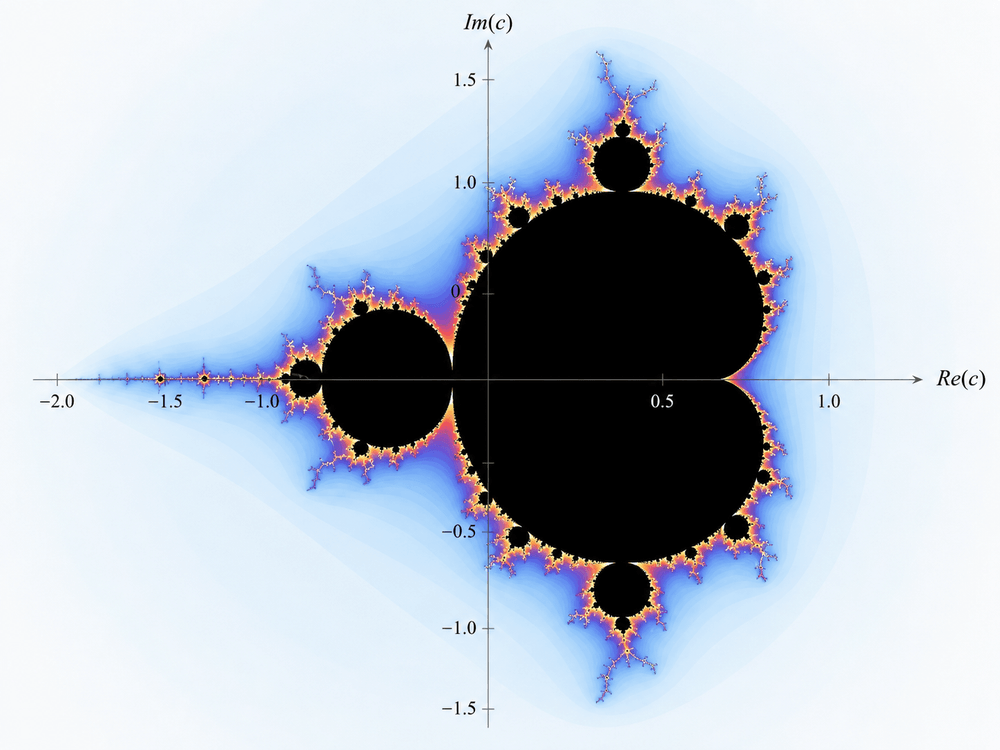
The Mandelbrot set provides one of the clearest demonstrations. Its famous structure is generated by repeatedly applying a simple equation to points in the complex plane:
zn+1 = zn2 + c
Beginning with z = 0, the same transformation is repeated. The Mandelbrot set consists of values of c for which that sequence remains bounded rather than escaping toward infinity.
The equation itself does not contain a picture of the familiar Mandelbrot form. The visible structure appears only when the rule is iterated across many possible starting conditions. Repetition exposes boundaries, nested structures, fine detail, and recurring forms that are not obvious from the compact equation alone.
1. Compact Rule
The generating equation is extremely short. The complexity is not written into the rule detail by detail.
2. Repeated Transformation
The same operation is applied again and again. Each new state becomes the input for the next transformation.
3. Emergent Structure
Rich boundaries and nested forms emerge from iteration. The resulting complexity is generated by the process rather than individually specified.
This does not mean that biological organisms are Mandelbrot sets. It demonstrates a more general mathematical possibility: immense visible complexity can arise from comparatively compact generative instructions.
This principle is explored more broadly in Fractals™ and Geometry of Nature™, where branching, repetition, symmetry, scaling, and recursive form appear across physical and living systems.
Information • Rules • Feedback • Development
Stored Complexity vs. Generative Complexity
The distinction between storing a finished structure and storing rules capable of producing structure is central to understanding living systems.
A genome contains enormous amounts of biological information, but development is not simply the mechanical unfolding of a complete three-dimensional blueprint. Genes participate in regulatory networks. Cells respond to neighboring cells. Chemical gradients guide differentiation. Mechanical forces influence growth. Environmental conditions alter expression. Feedback changes what happens next.
In this sense, biological form is partly generated through interaction. Information establishes possibilities and constraints, while development unfolds through repeated local processes operating across time and space.
Information
Hereditary information provides molecular components, regulatory relationships, and developmental possibilities.
Local Rules
Individual cells follow local biochemical and physical signals rather than requiring knowledge of the final organism as a whole.
Feedback
Outputs become new conditions. Growth changes geometry, geometry changes signaling, and signaling influences subsequent growth.
Environment
Light, nutrients, temperature, mechanical forces, water, neighboring organisms, and other conditions influence biological expression.
Life does not need to encode every final detail independently if developmental rules can generate those details through interaction.
This is generative complexity: detailed form emerging from information, constraints, local interaction, feedback, and repeated development.
This distinction connects naturally with Information Systems in Nature™. Biological information rarely acts in isolation. It participates in signaling systems, regulatory networks, ecological relationships, memory, and feedback.
It also creates an important bridge to Comparative Compression Geometry™: not a claim that biology follows one universal equation, but a way of comparing how different systems transform compact constraints into larger spaces of possible expression.
Branching • Scaling • Transport • Living Form
Fractal Biology: When Living Form Repeats Across Scale
Many biological structures are not perfect mathematical fractals, yet they display fractal-like properties: branching, repeated motifs, scale relationships, and similar organizational strategies appearing across multiple levels.
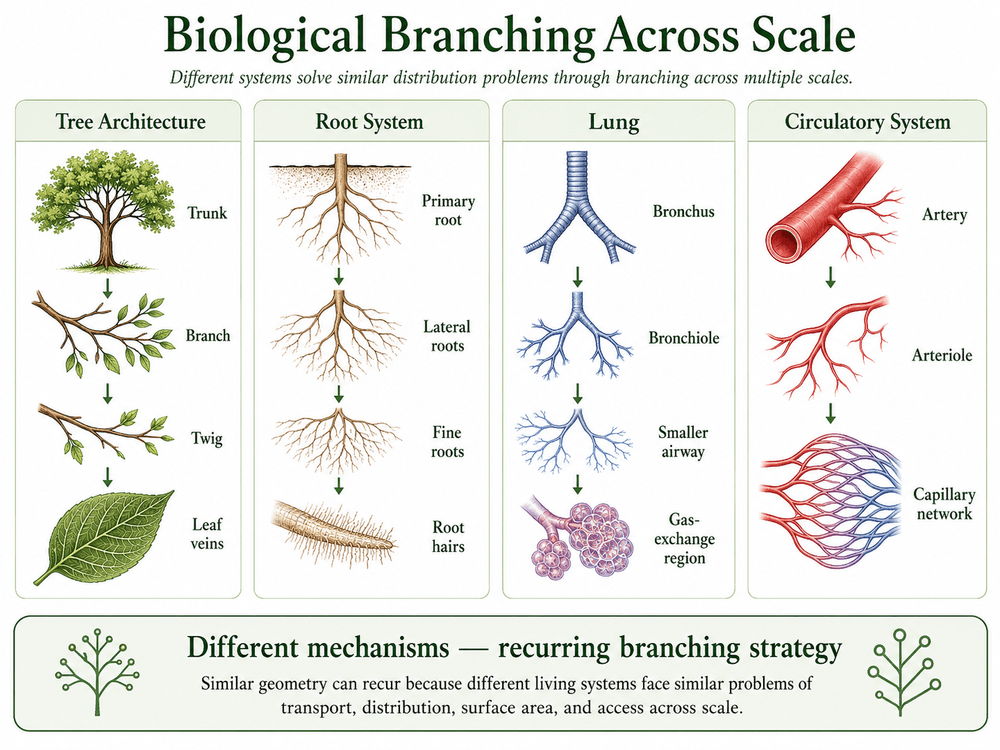
These patterns often arise where living systems must move matter, energy, gases, fluids, or information efficiently through three-dimensional space. Branching allows a large surface or volume to remain connected through progressively smaller pathways.
Lungs
Airways repeatedly branch from larger bronchi toward progressively smaller bronchioles, creating an extensive exchange surface within a limited volume.
Blood Vessels
Arteries divide into smaller vessels and eventually capillaries, creating a branching transport network connecting circulation with tissues throughout the body.
Plants
Trees, roots, stems, and leaf veins repeatedly divide as plants distribute water and nutrients, capture light, support tissue, and explore surrounding space.
Neural Branching
Neurons can develop highly branched dendritic structures, increasing the surface available for receiving and integrating signals from other cells.
Similar Strategy, Different Scale
A tree branch is not simply a larger copy of a leaf vein, and a bronchial tree is not literally the same structure as a root system. The useful comparison lies in the recurring strategy: branching connects larger structures to increasingly fine regions of space.
In real biological systems, self-similarity is usually approximate and limited to particular ranges of scale. Biology modifies geometry through growth, material constraints, evolution, function, and environmental conditions.
Fractal-Like Does Not Mean Perfectly Fractal
Mathematical fractals can exhibit exact or statistical self-similarity over indefinitely many scales. Living organisms cannot: they are bounded by cell size, molecular dimensions, body size, available energy, developmental history, and physical materials. The scientific value of fractal analysis in biology is therefore not that organisms reproduce the Mandelbrot set, but that fractal and scaling concepts can help describe real patterns of branching and spatial organization.
Within Naturepedia, these ideas connect naturally to Plant Intelligence™, where growth, signaling, environmental sensing, roots, and living networks show how form continuously responds to conditions rather than unfolding in isolation.
They also prepare the next step in this page: tracing how information moves from stored possibility to physical form—and how repeated local decisions can become organized structure across an entire living system.
Regulation • Signaling • Feedback • Morphogenesis
From Information to Form
Biological information becomes visible form through development—a continuing conversation among genes, cells, chemistry, mechanics, environment, and time.
DNA provides essential hereditary information, but genes do not act as isolated instructions. They operate within regulatory networks in which some genes activate or suppress others, cells exchange signals, chemical concentrations vary across tissues, and physical forces influence how structures grow.
Development therefore depends on relationships. The same genome can produce many different cell types because cells interpret information differently according to their position, developmental history, chemical environment, and interactions with neighboring cells.
Gene Regulation
Cells regulate which genes are active, when they are expressed, and at what level. The same inherited genome can therefore support very different cellular identities and functions.
Chemical Gradients
Concentration differences in signaling molecules can provide positional information, helping cells respond differently depending on where they are within a developing tissue.
Cell-to-Cell Signaling
Cells continuously influence one another through chemical, electrical, and mechanical signals. Local interactions help coordinate larger patterns of growth and differentiation.
Mechanical Feedback
Cells respond to tension, compression, stiffness, geometry, and physical contact. As tissues change shape, those new physical conditions can influence what happens next.
Information → Response → Growth → New Conditions → New Response
Development is recursive in a practical sense: the result of one stage changes the conditions under which the next stage unfolds.
This is why the movement from genotype to organism cannot be reduced to a simple one-way sequence of instructions. Living form emerges through networks of regulation and feedback—the kinds of relationships explored throughout Information Systems in Nature™.
The broader lesson is important for this page: information can function less like a finished picture and more like a structured set of possibilities, constraints, and responses from which form develops.
Scale • Distribution • Efficiency • Constraint
Why Branching Returns Across Living Systems
Branching appears again and again because living systems face a recurring geometric problem: how do you connect a limited central pathway with an enormous number of distributed destinations?
A tree must connect trunk and roots with thousands of leaves and fine root tips. A circulatory system must move blood between the heart and tissues throughout the body. A lung must connect a few large airways with an immense gas-exchange surface.
These systems differ biologically, but they confront a similar spatial challenge: move resources through limited space while maintaining access across many scales.
A Recurring Branching Logic
Trunk → Branch → Twig → Leaf Vein
Artery → Arteriole → Capillary
Bronchus → Bronchiole → Gas-Exchange Surface
The structures are not identical, but each uses successive branching to connect large-scale transport with increasingly fine spatial distribution.
Distance
Resources must reach many locations without every destination requiring its own independent pathway back to the source.
Material
Biological networks cannot use unlimited tissue, energy, or volume. Their geometry develops within real material and metabolic constraints.
Flow
Fluids, gases, nutrients, energy, and signals must move through pathways whose dimensions influence resistance, speed, and exchange.
Adaptation
Networks must remain functional while organisms grow, repair damage, respond to conditions, and operate in changing environments.
Repeated geometry can solve the same class of problem at multiple levels without requiring an entirely new organizational strategy at every scale.
This is one reason fractal and scaling concepts are so useful: they help describe how structure can remain organized as a system expands from larger pathways toward finer ones.
The recurring geometry belongs within Geometry of Nature™, where branching, networks, spirals, symmetry, fractals, and pattern formation are treated as different forms of natural organization rather than as a single universal formula.
Constraint matters just as much as pattern. A biological network must remain functional with finite energy, material, space, and time—a broader systems problem explored in Recursive Stability Under Constraint.
Topology • State Space • Relationship • Quantum Geometry
From Fractal Form to Hopf State Geometry
Mandelbrot and fractal geometry help us think about how structure can emerge through iteration in physical or mathematical space. The Hopf fibration asks a different kind of question: how can an entire space of possible states be organized through geometric relationships?
In its classical mathematical form, the Hopf fibration maps a three-dimensional sphere embedded in four-dimensional space, written S3, onto an ordinary two-dimensional sphere, S2. Associated with every point on the base sphere is a circular fiber, S1.
S1 → S3 → S2
Circle fibers organize the higher-dimensional space so that each fiber corresponds to a point on the lower-dimensional sphere.
This construction also has a direct and established connection to quantum information. A normalized pure state of a single qubit can be represented by two complex amplitudes. After physically irrelevant global phase is identified, the state can be represented as a point on the Bloch sphere. The Hopf fibration provides the mathematical relationship behind that reduction.
Mandelbrot
Geometry Through Iteration
A compact transformation is repeated, revealing increasingly complex boundaries and nested structures. The emphasis is on generation through recursion.
Hopf
Geometry Through Relationship
A higher-dimensional state space is organized into linked fibers whose relationships can be represented on a lower-dimensional sphere. The emphasis is on organization among states.
Schrödinger → Information
Mandelbrot → Recursive Expression
Hopf → Geometry of States and Relationships
These are distinct scientific and mathematical ideas. Their value together is not that one proves the others, but that each addresses a different layer of how complex systems can be represented and understood.
An Important Boundary
The Hopf fibration is established mathematics, and its relationship to the pure single-qubit Bloch sphere is established quantum mechanics. That does not mean that biological branching systems, DNA, cells, or organisms are known to be organized by a Hopf fibration.
Any extension from this established quantum-state geometry toward a broader biological or hydrogen-based architecture should therefore be treated as a hypothesis or interpretive model unless supported by direct experimental evidence.
The mathematics and its relationship to single-qubit state representation are explored separately on the Hopf Fibration page.
With these three layers established—information, generative recursion, and state geometry—the page can now ask its larger interpretive question: what do these different forms of compression and organization suggest about the relationship between simple constraints and complex expression?
Compression • Expression • Memory • Recursion
Grand Compression: When Small Rules Produce Large Worlds
Schrödinger, Mandelbrot, developmental biology, and recursive geometry point toward a shared systems question: how much complexity must actually be stored, and how much can be generated?
A system that explicitly records every final detail requires enormous descriptive capacity. A generative system can work differently. It preserves rules, constraints, relationships, memory, and state transitions that allow complex outcomes to emerge through repeated interaction.
This distinction forms a natural bridge to The Grand Compression, where compression is explored not simply as making information smaller, but as identifying the minimum sufficient structure capable of preserving meaningful expression.
Compression
The system retains the structures, relationships, or rules that carry the greatest generative value rather than describing every possible outcome independently.
Expression
Compact structure becomes visible behavior, geometry, development, or output when the system interacts with real conditions.
Memory
Previous states influence future states. Without retained information, each cycle would begin again without continuity, learning, or accumulated structure.
Recursion
Output returns as new input. The system does not merely repeat; it continues from a changed state created by its own previous activity.
Compression → Expression → Memory → Recursion
The central proposal of Grand Compression is that complex systems may remain powerful not by carrying every possible expression explicitly, but by preserving structures capable of regenerating meaningful complexity.
Exhaustive Description
Store the Result
Every detail must be represented individually. Complexity in the output requires corresponding descriptive complexity in the stored representation.
Generative Architecture
Preserve the Generator
Compact rules, constraints, relationships, and memory generate many possible expressions. Complexity appears through execution and interaction rather than through exhaustive storage.
This is also the intuition behind Why Compression Wins: systems operating under limited energy, memory, material, or compute may benefit from reusable structure rather than repeated reconstruction from scratch.
The claim here is not that one equation governs DNA, fractals, biological development, quantum states, and intelligence. It is that these domains provide different examples of a broader systems question: what is the smallest sufficient architecture from which organized complexity can continue to emerge?
Information • Generation • Relationship
Three Different Lenses on Organized Complexity
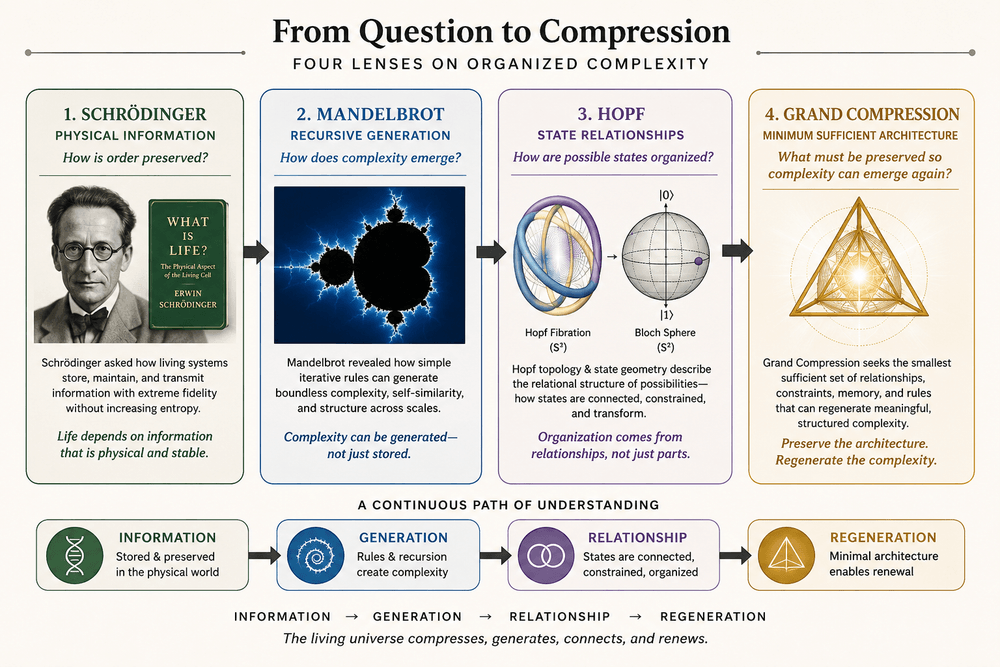
Schrödinger, Mandelbrot, and Hopf were solving different problems. Their value together comes from keeping those differences intact.
Each contributes a different conceptual tool for understanding how order can exist within complex systems: one centers physical information, another recursive generation, and another geometric relationships among states.
Schrödinger
How Is Order Preserved?
Life requires stable physical mechanisms capable of preserving hereditary information despite microscopic disorder.
Primary lens: information and physical stability.
Mandelbrot
How Is Complexity Generated?
Compact recursive rules can generate structures containing far more visible detail than appears explicitly in the generating equation.
Primary lens: iteration and emergent form.
Hopf
How Are States Related?
Higher-dimensional information can possess structured geometric relationships that admit a lower-dimensional representation without erasing the underlying organization.
Primary lens: state geometry and relationship.
Preserve information.
Generate expression.
Organize relationships.
Together, these three questions describe different requirements of complex organization without reducing them to a single theory.
This sequence also helps distinguish fractal geometry from the Hopf fibration. Fractals primarily help illuminate recursive generation and scaling. Hopf geometry helps illuminate relationships within a structured state space.
Grand Compression then asks a systems-level question across those distinctions: which relationships must be preserved so that complex expression can be reconstructed, continued, or regenerated?
Evidence • Interpretation • Hypothesis • Boundary
What Science Establishes—and What This Page Is Asking
The strongest version of this argument depends on keeping established science, cross-disciplinary comparison, and original interpretation clearly separated.
Similarity between systems can reveal useful patterns, but resemblance alone is not evidence that those systems share the same physical mechanism or governing equation.
Level One
Established Science
Hereditary information is physically encoded in molecular systems. Gene regulation, cell signaling, morphogenesis, feedback, branching networks, biological scaling, fractal analysis, quantum-state representations, and the Hopf fibration are established areas of scientific or mathematical study.
Level Two
Cross-Disciplinary Comparison
Different systems can be compared according to recurring properties such as information storage, feedback, recursive transformation, branching, scaling, state spaces, constraint, and efficient organization.
Level Three
Grand Compression Interpretation
Grand Compression proposes that a useful unifying systems principle may be found in preserving compact, reusable relationships capable of producing or reconstructing larger spaces of meaningful complexity.
What This Page Is Not Claiming
• Schrödinger did not propose Mandelbrot fractals as the mechanism of life.
• Biological organisms are not known to be literal Mandelbrot sets.
• Fractal geometry alone does not explain biological development.
• The Hopf fibration does not establish that whole organisms are quantum computers.
• Similar patterns across physics, biology, mathematics, and information systems do not by themselves prove a single universal mechanism.
The Research Question
What is the smallest sufficient set of relationships, constraints, memory, and transformation rules from which a complex system can regenerate its meaningful behavior?
That question is broader than any single example on this page. It is the point where the historical science ends and the Grand Compression investigation begins.
The value of the comparison is therefore not in claiming that Schrödinger, Mandelbrot, Hopf, or modern biology already established Grand Compression. It is in recognizing that each reveals a different way in which organized complexity can depend on something more compact than the complexity we ultimately observe.
Forests • Leaves • Roots • Rivers • Living Networks
Reading Generative Geometry in the Living World
The value of fractal thinking becomes clearest when abstraction returns to real organisms, landscapes, and systems.
Nature rarely reproduces mathematical fractals with perfect self-similarity. What repeatedly appears instead are branching hierarchies, nested networks, recurring ratios, distributed pathways, and forms that develop through local rules under real environmental constraints.
Tree Architecture
Trunks divide into branches, branches into twigs, and twigs support leaves. The exact form changes with species, light, wind, damage, competition, and age, yet a recurring branching hierarchy remains.
Leaf Venation
A primary vein divides into smaller veins and finer capillary-like networks, distributing water and nutrients while supporting photosynthetic tissue across the leaf surface.
Root Networks
Roots branch through heterogeneous soil in search of water, nutrients, oxygen, and structural support. Their geometry reflects both inherited growth programs and local conditions.
River Drainage
Tributaries merge into progressively larger channels as gravity, terrain, erosion, rainfall, and geology organize water flow across a landscape.
Fungal Networks
Hyphal networks expand through soil and organic matter by repeated growth and branching, creating distributed structures that explore and connect microscopic regions of habitat.
Lightning & Electrical Breakdown
Branching electrical paths can emerge as charge moves through an uneven medium. The result visually resembles biological branching even though the physical mechanism is very different.
Similar geometry does not require identical mechanism.
A tree, river, lung, fungal network, and lightning bolt can all branch, yet each emerges from different materials, forces, constraints, and histories. The recurring form is valuable because it reveals a shared geometric problem without erasing those differences.
For a field observer or photographer, geometry becomes more than an abstract pattern. It becomes a way of noticing how life solves problems of space, transport, exposure, connection, stability, and change.
Continue the Path
Related Reading Across Naturepedia & Grand Compression
This page sits at the intersection of natural geometry, biological information, recursion, state-space mathematics, and the larger Grand Compression framework.
Schrödinger asked how living systems preserve reliable information. Mandelbrot demonstrated how compact rules can generate enormous mathematical complexity. Modern biology shows how information, regulation, feedback, physical forces, and environment interact to produce living form.
Hopf geometry adds a different lesson: information can also be organized through relationships among states, with higher-dimensional structure admitting a more compact representation without making the underlying relationships meaningless.
None of these ideas alone provides a universal theory of life. Together, however, they sharpen a question that crosses mathematics, physics, biology, and information science.
“What if the deepest economy in nature is not the storage of complexity, but the preservation of relationships capable of generating it?”
Information → Constraint → Interaction → Expression
Expression → Memory → Recursion → New Expression
Complexity becomes a process rather than a static object—something repeatedly produced from what the system is able to preserve.
This is the point where the scientific history explored on this page meets the larger question of The Grand Compression: whether the durability and intelligence of complex systems depend less on retaining every detail than on preserving the right structure through which detail can return.
Life may not need to store its final complexity.
It may need to preserve the architecture capable of becoming complex again.
Common questions about Schrödinger, Mandelbrot, fractal geometry, biological development, Hopf geometry, and Grand Compression.
What is fractal biology?
Fractal biology uses concepts from fractal geometry and scaling to study biological structures that show branching, repeated organization, or statistical similarity across ranges of scale. Examples include vascular networks, bronchial trees, neuronal branching, roots, and plant architecture. Biological structures are generally not perfect mathematical fractals because their scaling is limited by physical size, cells, materials, energy, and development.
What did Erwin Schrödinger contribute to the study of life?
In his 1944 book What Is Life?, Schrödinger asked how living systems could preserve hereditary order despite molecular motion and thermodynamic disorder. He proposed that hereditary information would require a stable molecular structure he described as an “aperiodic crystal.” His work helped frame biological heredity as a physical information problem before the molecular structure of DNA was known.
How does Mandelbrot’s work relate to biology?
Mandelbrot’s work showed how recursion, scaling, and relatively compact mathematical rules can generate highly complex structures. Biology does not literally follow the Mandelbrot set, but fractal mathematics provides useful tools for describing branching and multiscale organization in structures such as blood vessels, lungs, roots, neurons, and plant growth.
Are trees, lungs, and blood vessels true fractals?
Not in the unlimited mathematical sense. Many living structures are better described as fractal-like or statistically self-similar over limited ranges of scale. A tree cannot continue branching indefinitely because biology is constrained by cell size, available material, energy, mechanics, and the overall dimensions of the organism.
What is generative complexity?
Generative complexity describes complex outcomes produced from comparatively compact rules, constraints, interactions, and feedback rather than from an exhaustive description of every final detail. In biology, development involves genetic information interacting with regulatory networks, signaling, physical forces, neighboring cells, environmental conditions, and developmental history.
How does the Hopf fibration fit into this discussion?
The Hopf fibration contributes a different mathematical perspective. Whereas fractal geometry emphasizes recursive generation and scaling, the Hopf fibration describes relationships within a higher-dimensional state space. It also has an established connection to the Bloch-sphere representation of pure single-qubit states. This page uses that distinction to compare generative geometry with state-space geometry without claiming that biological organisms are governed by a Hopf fibration.
Does this mean living organisms are quantum computers?
No. Biology ultimately depends on quantum mechanics at molecular scales because chemical bonds, electron behavior, photon absorption, and molecular transitions are quantum phenomena. That does not establish that whole organisms operate as quantum computers or that biological hydrogen functions as a qubit architecture. Such broader interpretations require separate experimental evidence.
How does Grand Compression relate to Schrödinger and Mandelbrot?
Grand Compression is an interpretive framework developed by Robbie George. In this context, Schrödinger provides a historical lens on the physical preservation of biological information, while Mandelbrot demonstrates how compact recursive rules can generate extraordinary mathematical complexity. Grand Compression asks a broader systems question: what minimum sufficient relationships, constraints, memory, and transformation rules must be preserved for meaningful complexity to be generated or regenerated?
The presence of this badge signifies that this business has officially registered with the Art Storefronts Organization and has an established track record of selling art.
It also means that buyers can trust that they are buying from a legitimate business. Art sellers that conduct fraudulent activity or that receive numerous complaints from buyers will have this badge revoked. If you would like to file a complaint about this seller, please do so here.
Verified Returns & Exchanges
The Art Storefronts Organization has verified that this business has provided a returns & exchanges policy for all art purchases.
Description of Policy from Merchant:
What is your Policy on Returns/Exchanges/Refunds?
I take great pride in my work and prints, and I want you to be completely happy with your investment in my nature art. If for any reason you are unsatisfied with your print, you may return it within 14 days of delivery, and/or exchange it for another print. Prints must be returned in new condition, packaged carefully in the original packaging if possible. Your refund will be issued as soon as I receive the returned print. Please contact me if you would like to arrange a return or exchange.
In the event that you receive a damaged or defective print, please let me know within 7 days of receipt, and I will arrange for a new print to be shipped to you at no additional cost.
Verified Secure Website with Safe Checkout
This website provides a secure checkout with SSL encryption.
Verified Archival Materials Used
The Art Storefronts Organization has verified that this Art Seller has published information about the archival materials used to create their products in an effort to provide transparency to buyers.
Description from Merchant:
Fine Art Prints are made with high-quality archival inks on fine art papers using a high-resolution large format inkjet printer. Our premium archival inks produce images with smooth tones and rich colors. Prints are made with care on your choice of exquisite Fine Art Papers using a high-resolution large format inkjet printer. https://www.graphikprintworks.com
Become a supporter of Robbie George Photography and be the first to receive new content and special promotions.
“Every image is a field. Every quote is a key. Welcome back to the rhythm.” ~Robbie
Cart
Your cart is currently empty.
Saved Successfully.
This is only visible to you because you are logged in and are authorized to manage this website. This message is not visible to other website visitors.
Import From Instagram
Click on any Image to continue
This Website Supports Augmented Reality to Live Preview Art
This means you can use the camera on your phone or tablet and superimpose any piece of nature art onto a wall inside of your home or business.
To use this feature, Just look for the "Live Preview AR" button when viewing any piece of nature art on this website!
Pounce Now—Save 20% on Your First Order
Join the collector list for your first-order discount, new wildlife releases, and occasional field notes.