

CHAPTER 4 — The Mud That Burned (Bradford, 1860–1875)
Before the Boom
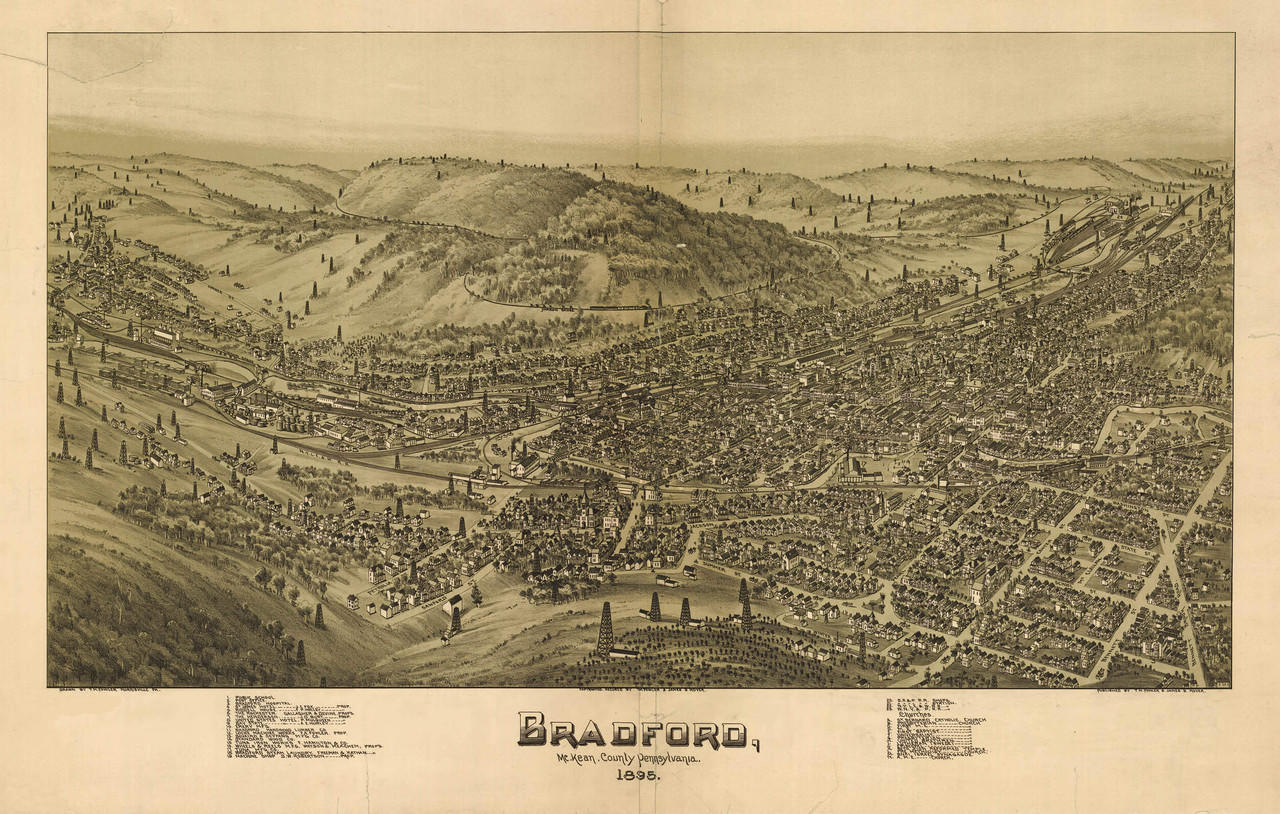
Before the derricks, before the smoke, before the rails carved steel lines into the valley, Bradford was timber.
The hills were thick with pine and hemlock. Sawdust drifted like yellow snow behind the mills. Wagons creaked under the weight of boards cut from forests that seemed permanent. The Allegheny ran patient and brown, carrying logs more reliably than it carried news.
Buildings gathered close to the road — practical, wooden, weathered. A few storefronts. A church. A scattering of houses pressed against mud streets that surrendered to rain without protest. There was no skyline to speak of, only treetops and chimney smoke.
It was not poor, and it was not grand. It functioned.
Boys, history often tempts us to look backward and imagine inevitability. But there was nothing in those hills that declared themselves destined for fire. No marker on a map. No prophecy in a ledger.
If you had stood in Bradford in 1860, you would have smelled fresh-cut lumber, wet earth, and horse leather. You would have heard axes and the steady rhythm of saw blades — not steam whistles or speculation.
The town did not yet know that the ground beneath it carried something far more volatile than timber.
First Wells, First Failures
The first attempts were awkward.
Word had traveled east from Titusville and the lower Oil Creek region: something dark beneath the ground could be coaxed upward and sold as light. Kerosene had begun to replace whale oil in distant cities. The rumor was simple enough — there was money in mud.
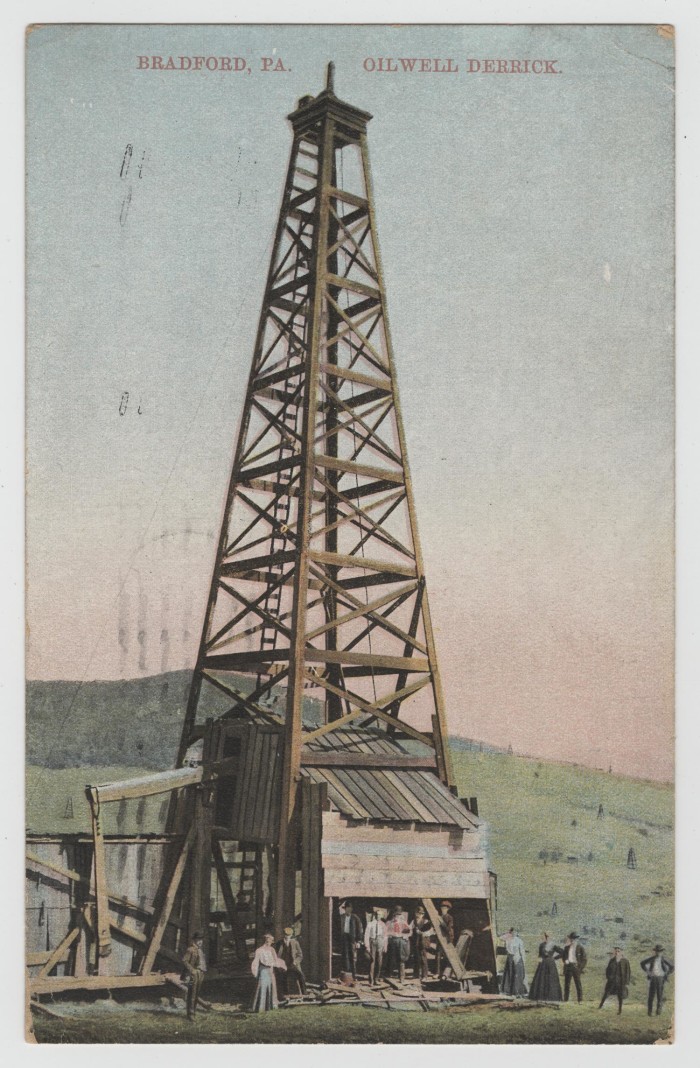
So men raised wooden frames against the hillsides and began to drill.
Spring-pole rigs bent like patient animals, lifting and dropping iron bits into stubborn earth. The work was rhythmic, physical, and uncertain. Weeks could pass with nothing but damp sand and disappointment rising to the surface.
Some wells filled with water. Others collapsed. Timber splintered. Investors argued. Optimism thinned.
There were no legends yet — only persistence. No grand declarations. Just men willing to test the ground again after it had failed them the day before.
Boys, most ignitions begin this way — not with certainty, but with repetition.
And for a time, Bradford looked like it had miscalculated.
The 1875 Breakthrough
Then the sand changed.
In 1875, drillers struck a productive formation beneath Bradford’s hills — a sand that did not collapse into water but released oil in volume. It did not erupt in theatrical fountains. It rose steadily, dark and usable.
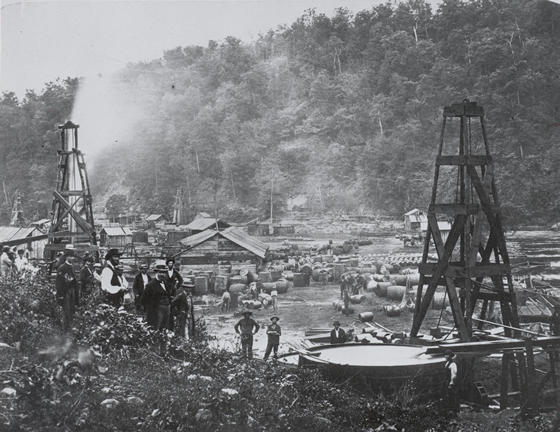
Barrels appeared first in dozens, then in rows. Teams hauled them toward rail sidings as quickly as coopers could hammer staves into place. The hills that had seemed indifferent began to hum.
Word traveled faster now. Investors arrived with folded maps and sharper shoes. Survey lines cut across pasture. Leases were signed on kitchen tables. Timber that once framed barns now framed derricks.
The ground was no longer tested cautiously — it was pursued.
Prices rose. Then fell. Then rose again. Fortunes condensed and evaporated in months. A valley built on lumber had discovered liquidity — and volatility.
Boys, when energy arrives, everything accelerates.
Labor quickens. Speech sharpens. Risk feels reasonable.
And towns that once functioned begin to convulse.
Mud Streets
Bradford did not expand gradually.
It thickened.
In 1874, Bradford counted only a few thousand residents. Within two years of the 1875 strike, that number multiplied rapidly as workers, speculators, teamsters, and financiers poured into the valley. Temporary became permanent almost overnight.
Wagons clogged the streets from dawn until long after dark. Horses sank knee-deep in rutted clay made slick by rain and oil seepage. Hotel porches sagged under the weight of men arguing over leases and percentages. Boarding houses filled with strangers who slept two to a bed and left before sunrise.
The air carried a new arithmetic — kerosene, steam, sweat, tobacco. Barrels stacked beside rail spurs waiting for shipment east. Locomotives screamed through the valley, hauling crude toward refineries and capital.
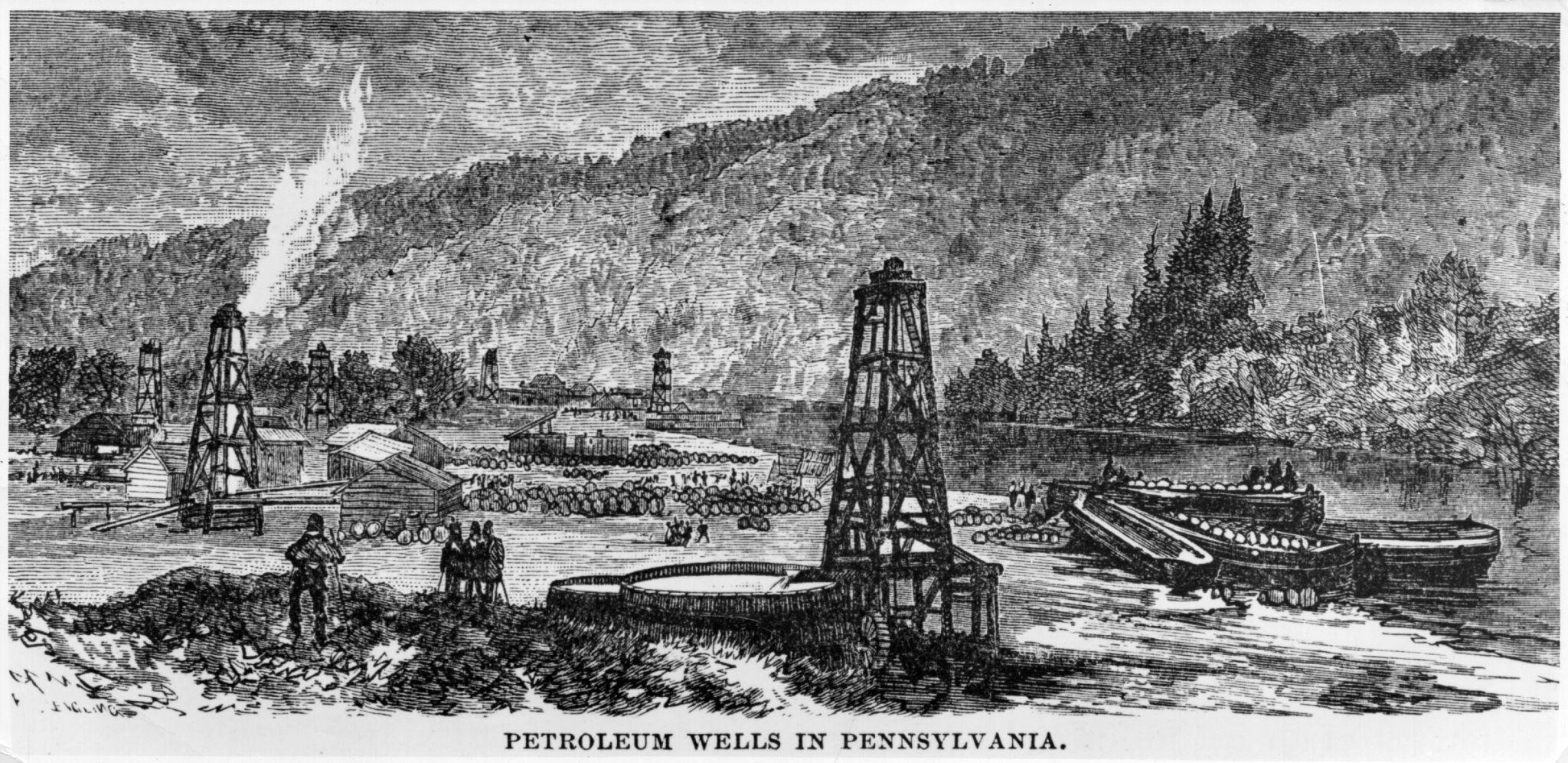
Timber gave way to scaffolding. Hills once green with pine bristled with wooden towers. Flames from waste gas flickered against night fog, turning the ridgelines into a restless horizon.
Prices changed between breakfast and supper. Land deeds were written quickly. Some were rewritten.
Boys, when speculation outruns structure, even mud begins to feel unstable.
Bradford had discovered energy. It had not yet discovered containment.
Frank in the Crowd
Somewhere in that movement stood Frank W. Davis.
Not elevated above it. Not directing it. Not yet shaping it.
Just present.
A young man in a town that no longer resembled the one he had known only a few years earlier. The streets were louder. The money faster. The conversations sharper. Oil had a way of magnifying ambition — and anxiety.
He would have watched deals struck in doorways and rescinded before nightfall. He would have seen men flush with success one month and ruined the next. He would have felt the tension between opportunity and collapse tightening across the valley.
The lesson was not subtle.
Energy could build quickly. But without structure, it could disappear just as fast.
Boys, every frontier produces two kinds of men — those who chase the flame, and those who learn how to contain it.
Frank was watching closely.
Banking Emerges as Structure
Oil did not only require drills.
It required counting.
Barrels had to be financed. Leases recorded. Shipments insured. Profits divided. Losses absorbed. What began as mud and muscle quickly demanded paper and arithmetic.
Wooden storefronts gave way to more permanent facades. Safes appeared behind counters. Ledgers thickened with entries tracking wells that might produce for years — or fail by winter.
Rail connections linking Bradford to eastern refineries intensified the flow. Oil no longer lingered in the valley; it moved toward markets in Pittsburgh, Philadelphia, and beyond. Capital followed the tracks.
Volatility needed somewhere to settle.
Banks formed not as monuments, but as instruments. They did not create the oil. They absorbed its fluctuations. They translated flame into figures.
In a town convulsing with energy, the quiet rooms where ink dried on contracts began to matter as much as the hillsides where oil rose.
Boys, fire can illuminate a valley. But without containment, it can also consume it.
The Pattern Appears
Step back from the mud for a moment.
A rural lumber town becomes an industrial frontier almost overnight. Energy rises from beneath the ground. People rush toward it. Prices fluctuate. Risk concentrates. Structures form in response.
This was not destiny. It was pattern.
Boys, when energy arrives, everything accelerates — but someone has to hold the ledger.
Wells ignite opportunity. Railroads amplify it. Speculation distorts it. And quietly, in offices removed from the noise, men record it.
Our family did not invent the oil boom. It did not control it. But it stood inside it — learning the difference between flame and foundation.
That distinction would matter long after the mud dried.
Toward Metal
Oil remade Bradford.
But oil did not end the story of fire.
As derricks multiplied across the hills and ledgers thickened behind bank counters, another transformation was already gathering force elsewhere — in foundries, in machine shops, in places where iron met precision and flame shaped steel.
The energy drawn from beneath the earth would soon demand refinement, fabrication, and systems strong enough to scale beyond a single valley.
Boys, oil was only the first ignition.
The next would not rise from mud. It would be forged.
Continue Reading
Frontiers is a historically grounded father-to-sons narrative tracing one family across migration, settlement, expansion, industrial ignition, and the shaping of modern America.
About the Author
Robbie George is a National Geographic–published photographer, writer, and founder of the Signature Series — a body of work exploring how nature’s patterns shape art, biology, ecology, consciousness, and the cosmos. Frontiers is his historically grounded, father-to-sons narrative tracing a family line across four centuries.
His path includes a decade as an organic farmer on Divide Creek, early-stage ownership of HOTWORX studios, and a career in nature photography that took him from the Smithsonian to National Geographic. These “false summits” ultimately became the experiential backbone that led him to develop the Unified Field Theory known as The Grand Compression.
Robbie continues to explore the bridge between hydrogen, soil, water memory, light, and the living field through projects such as Nature Code, Quantum Vitality, and Quantum Agriculture. His fine-art prints and field essays are collected worldwide for their resonance, stillness, and deep sense of place.
“Every false summit taught me the pattern. Every collapse taught me recursion. I am living proof of the Grand Compression — a mountain that finally revealed its summit.”