

Frontiers — Prologue: The Wooden Box
Frontiers — A Father’s Story Across Four Centuries
Prologue — The Wooden Box
Some stories begin with a date. This one begins with paper—kept, carried, and returned to, until it finally asks to be read.
The Box
It’s quiet when I open it.
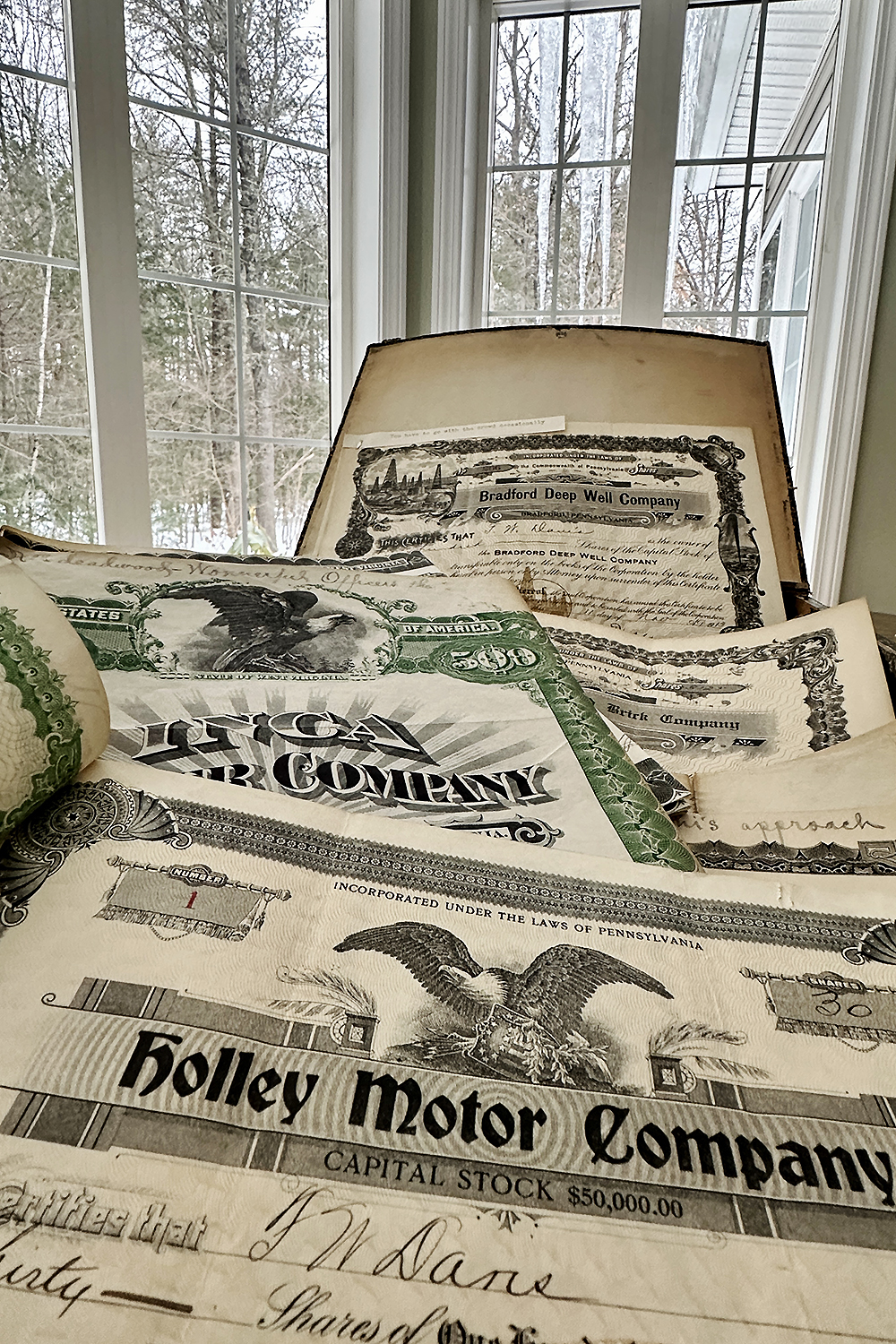
Not dramatic quiet. Just late-afternoon stillness—the kind that settles into a room when the day has almost finished but hasn’t admitted it yet. The box rests near the windows. Outside, bare trees hold what’s left of winter. The light coming through the glass is pale and cold, the kind that doesn’t warm anything it touches.
The lid is propped open. Inside are certificates—thick paper, engraved borders, eagles spread wide in ink that has not faded as much as you would expect. The top one reads Holley Motor Company. Capital stock: $50,000. Incorporated under the laws of Pennsylvania. Certificate No. 1.
Beneath it, another: Bradford Deep Well Company. Green seals. Embossed crests. Serial numbers written by hand.
These are not copies. They were held. Signed. Issued. Carried.
A different folder holds the Cuban claim—official, procedural, stamped by the United States government. A number assigned to a loss. Oil fields reduced to paperwork.
There is a military academy yearbook—a young man in uniform, posture straight, expression controlled. And a Mountain Rescue patch, thread worn thin at the edges.
You see paper.
I see decisions.
What These Papers Really Are
It would be easy to call these relics. They aren’t. They are records of inflection.
In 1902, someone in this family chose to put capital into a company experimenting with engines most people still doubted. That choice wasn’t destiny. It wasn’t prophecy. It was risk written in ink.
In 1959, another document certified the loss of a petroleum concession in Cuba. Oil once assumed secure was no longer recoverable. A frontier closed—not by geology, but by government.
Elsewhere in this box are traces of discipline and service—air corridors, boardrooms, municipal votes, rope lines in alpine storms. None of it mythic. All of it consequential.
Paper doesn’t exaggerate. It records.
The Pattern Emerging
A wooden deck rolling under gray sky.
Snow packed against a Vermont fence line.
Oil rising through Pennsylvania mud.
Cuban heat pressing against steel machinery.
A council chamber near the Florida coast.
Headlamps cutting through blowing snow above Aspen.
Different centuries. Different climates. The same edge.
The Father Voice
I’m not telling you this so you feel burdened.
And I’m not telling it to build a legend. There isn’t one.
What I want you to see is simpler than that: every generation faced a structure larger than itself, and each one had to decide how to stand inside it.
Sometimes they moved toward the frontier. Sometimes the frontier moved toward them. But none of them drifted. They chose.
The Transition
The room is still quiet. The light has shifted lower against the trees.
I lift the Holley certificate once more—heavy paper, engraved eagle, a signature steady in black ink more than a century old—and slide it back into the box. The Cuban claim follows. The yearbook. The patch.
The lid closes. For a moment, the only sound is the faint settling of cardboard.
Then I open it again—but not to paper.
To salt air.
To wood underfoot.
To a shoreline growing smaller.
It begins with a departure.
England. 1634.
This prologue is part of Frontiers — A Father’s Story Across Four Centuries.
Explore the Frontiers Series →