


CHAPTER 5 — The Signature (1902)
After the Boom
By 1902, Bradford no longer convulsed.
The first oil frenzy had passed. The derricks remained, but they stood inside systems now — refineries operating with routine, rail schedules established, contracts standardized. What had once been speculation was now industry.
Banks that had formed in urgency matured into institutions. Safes were no longer defensive fixtures; they were expected. Ledgers thickened with steadier entries. Capital no longer rushed blindly — it accumulated.
Frank W. Davis had grown with the town. A veteran of the Civil War who enlisted at seventeen, he returned to Bradford and entered the work of counting rather than drilling. By 1888, he was president of the First National Bank. Stability, not spectacle, defined his position.
His civic commitments reflected the same instinct. In 1907, he would help erect the Civil War monument that still stands in Oak Hill Cemetery — a granite soldier overlooking the valley, honoring those who had served. The gesture was not theatrical. It was permanent.
Boys, frontiers do not disappear. They stabilize.
And when they do, the men who endure are rarely the loudest. They are the ones who learned how to hold structure after the flame.
The Machine Shop
Oil had reorganized the town. Now steel began to reshape it.
In Bradford’s workshops at the turn of the century, metal filings gathered where sawdust once drifted. Belts turned. Flywheels spun. Small gasoline engines were assembled not for speculation, but for application.
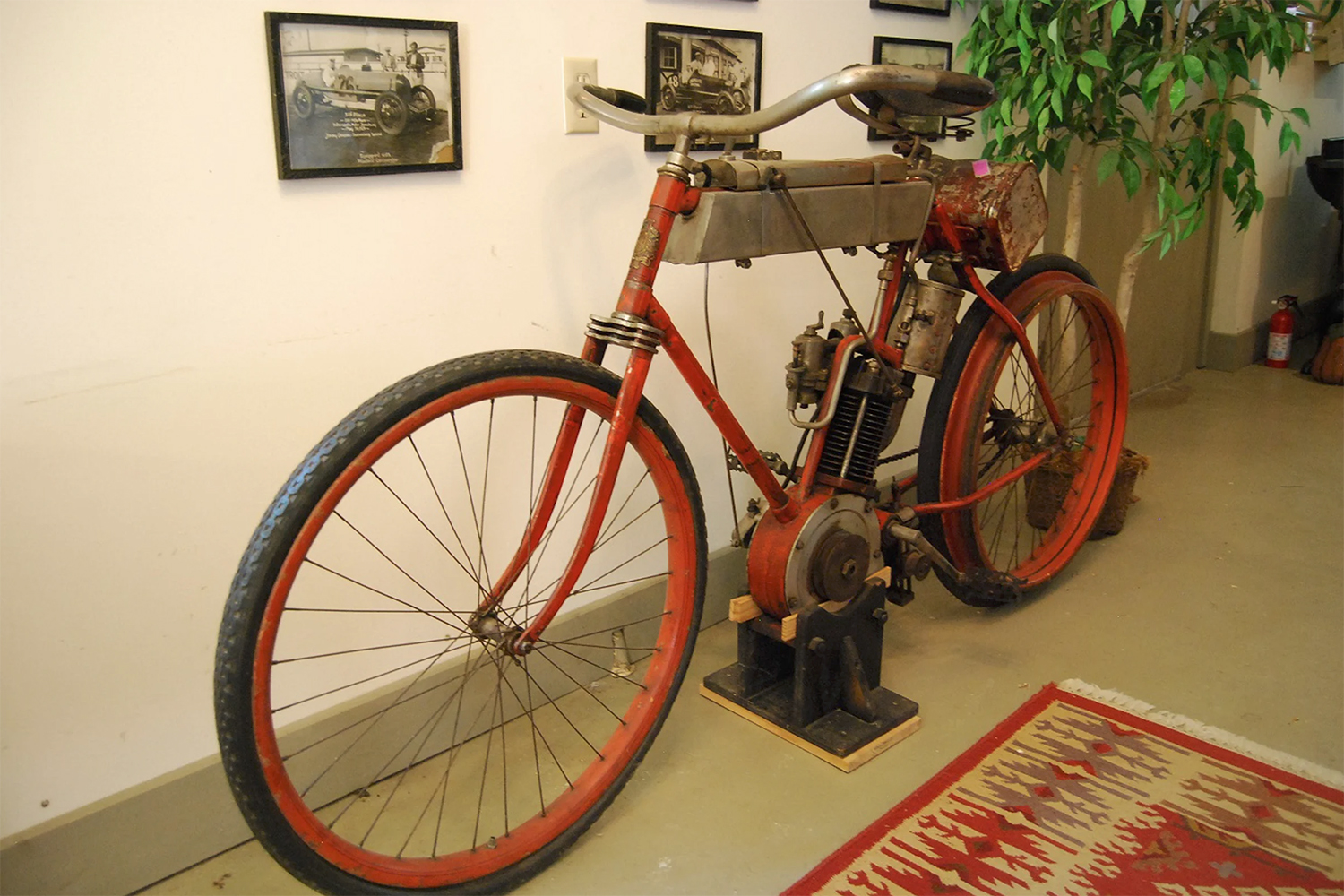
The Holley enterprise began modestly — motorized bicycles, small engines, experimental configurations. Nothing in those early machines guaranteed permanence. They were mechanical answers to a question still forming: how might combustion move beyond wells and refineries and into motion?
The work required precision rather than haste. Castings had to align. Carburetors had to meter fuel correctly. Timing mattered. A fraction of an inch could determine whether a motor ran smoothly or failed entirely.
Boys, industry evolves in stages. Extraction is loud. Fabrication is patient.
The frontier had moved indoors.
The Capital Conversation
Machine work required more than metal.
It required capital — patient enough to wait for refinement, disciplined enough to accept uncertainty. Early engines did not promise immediate return. They represented experimentation inside an industry still forming.
Bradford was small enough that banking and manufacturing did not exist in isolation. The same streets connected refineries, offices, and workshops. Decisions about credit and expansion would have intersected with the ambitions of those building machines.
Family tradition holds that conversations between local bankers and emerging industrial ventures helped shape the direction of early mechanical enterprises in town. Whether formal or informal, those intersections reflected something larger than a single company: the maturation of risk.
There is no preserved transcript of such exchanges. What remains is record — incorporation documents, stock certificates, signatures.
Boys, capital rarely makes noise. It decides.
And when it does, the frontier shifts again.
July 19, 1902
The paper was formal. The language precise.
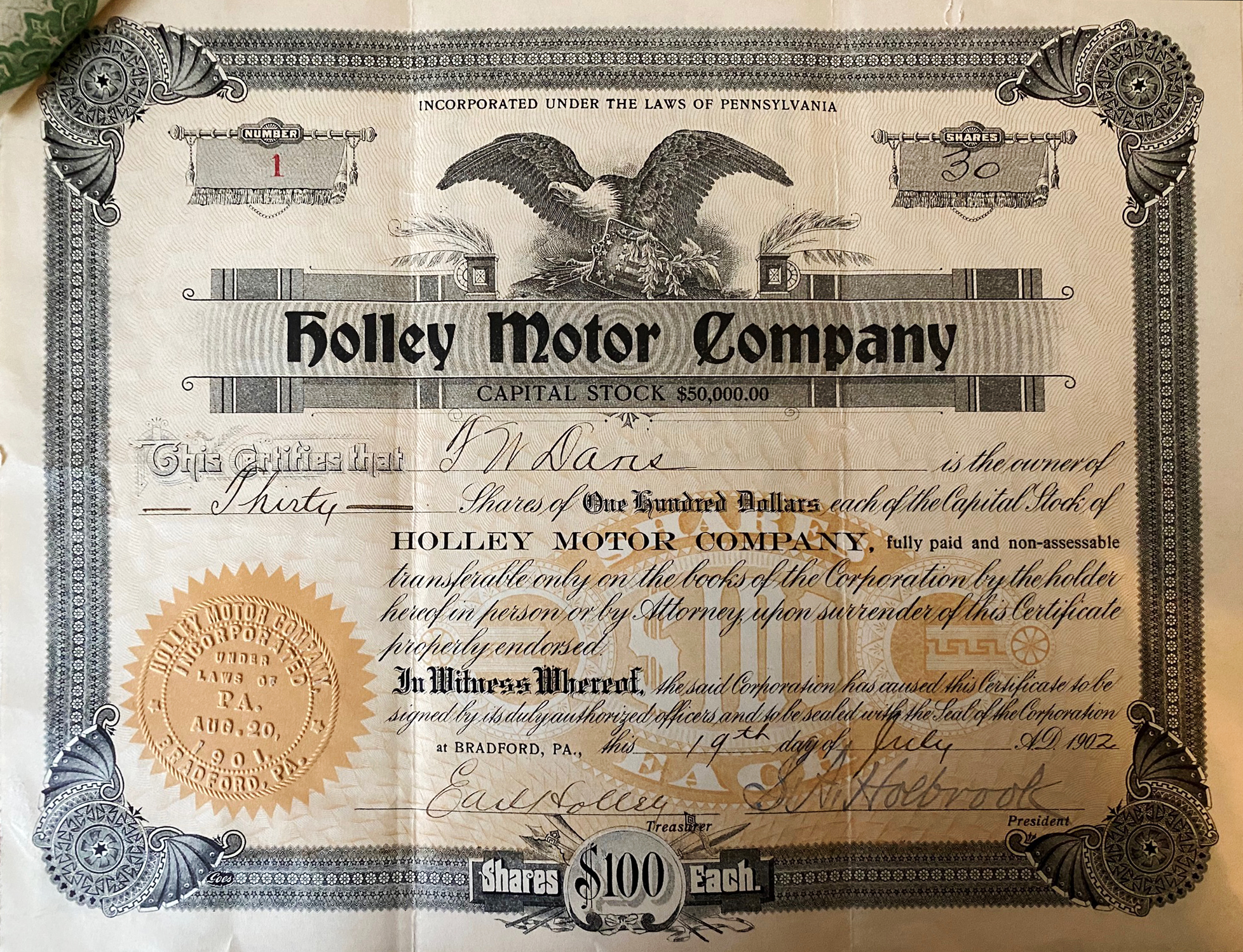
Incorporated under the laws of Pennsylvania. Capital stock fixed. Shares numbered. Names entered in ink.
Certificate No. 1.
On July 19, 1902, Frank W. Davis signed his name to thirty shares of the Holley Motor Company.
It was not a speech. It was not a celebration. It was a decision — an allocation of capital toward machinery still unproven, toward combustion harnessed for movement rather than extraction.
The oil boom had taught Bradford how to endure volatility. This act suggested something different: direction.
Boys, signatures are quiet instruments. They convert intention into obligation.
And sometimes, without announcing it, they mark the edge of a new era.
What That Signature Meant
In 1902, the automobile was not a certainty.
Hundreds of small manufacturers across the United States experimented with engines, frames, transmissions, and fuels. Many would dissolve within a few years. Designs were fragile. Roads were poor. Demand was unpredictable.
Thirty shares did not guarantee permanence. They represented exposure — to innovation, to failure, to change.
Capital stock in a company like Holley meant belief in refinement — in engines that could move reliably, in systems that could be scaled, in combustion redirected from wells into vehicles.
Boys, risk evolves as frontiers mature. The early oil fields demanded physical courage and tolerance for collapse. Industrial investment required a different discipline — patience, calculation, and the willingness to finance what did not yet dominate the market.
That certificate did not predict Detroit. It did not promise national scale. It simply aligned capital with motion.
And alignment, over time, alters direction.
Toward the Automotive Era
The early years of the twentieth century did not belong to one town.
Across the country, workshops experimented with internal combustion — some producing complete vehicles, others refining the components that made them reliable. Bradford’s mechanical ventures participated in that wider movement.
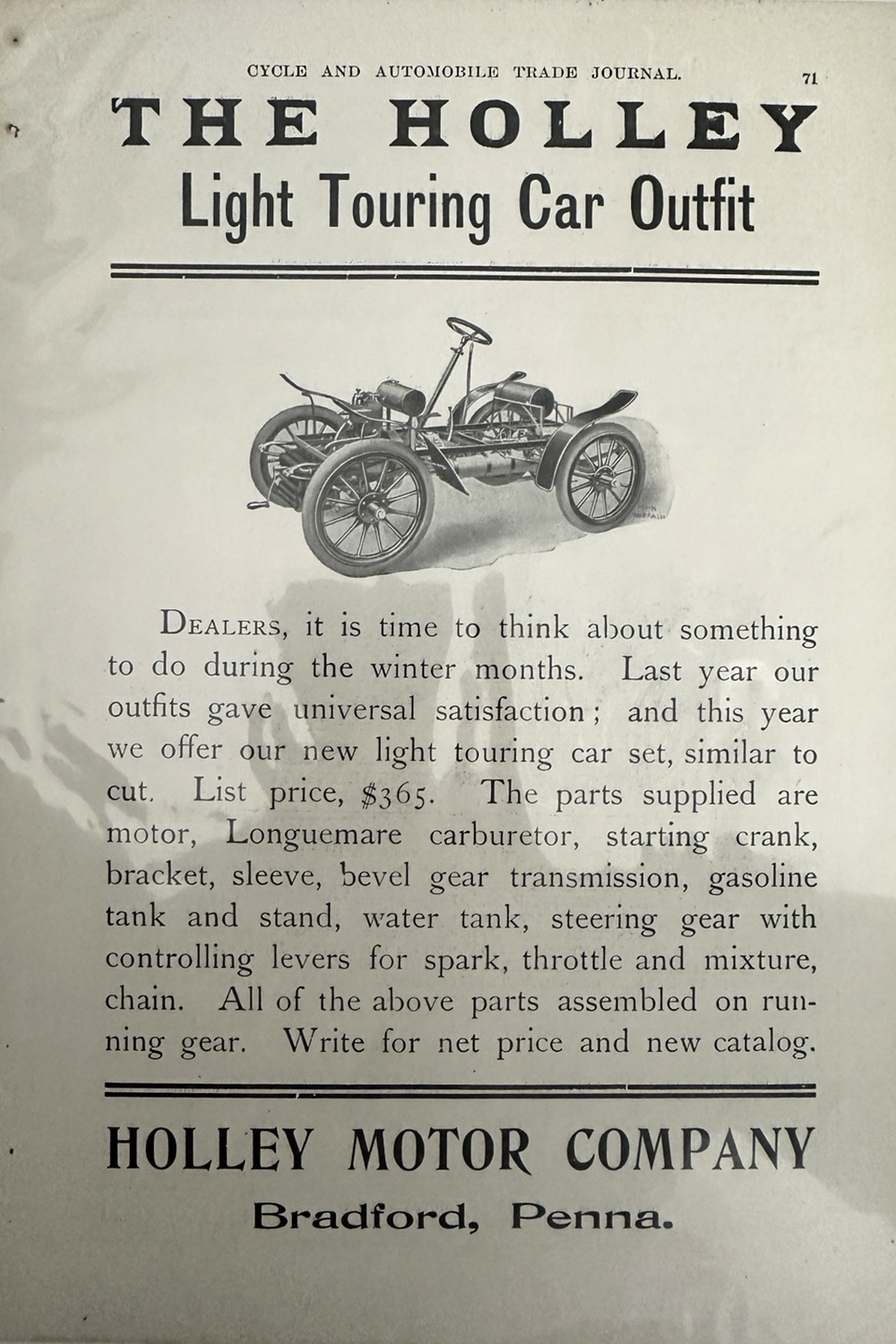
Holley’s evolution reflected this pattern. What began with motorized bicycles and small engines shifted toward precision carburetion — the careful metering of fuel and air that allowed engines to run consistently. Refinement mattered more than spectacle.
As the automobile industry consolidated, centers of large-scale manufacturing emerged elsewhere. Bradford would not become Detroit. But its capital, its engineering, and its early risk participated in the shaping of a new industrial order.
Boys, frontiers rarely remain where they begin.
They migrate — from fields to factories, from factories to networks — carried forward by those willing to finance precision as carefully as they once financed flame.
Fire Contained
Oil ignites. Capital directs.
The hills around Bradford had once burned with speculation. Wells rose quickly. Fortunes shifted quickly. Structure followed urgency.
By 1902, flame no longer defined the frontier. Precision did. Decisions made at desks influenced machinery built in shops. Signatures shaped movement more quietly than gushers ever had.
Boys, maturity in a frontier is not the absence of risk. It is the disciplined allocation of it.
And discipline endures longer than fire.
Another Stream
By the early twentieth century, one line of our family stood firmly inside industrial America.
Oil had reshaped a town. Capital had redirected combustion toward machinery. Institutions had steadied what once felt volatile.
But history rarely moves through a single channel.
While signatures were being written in Bradford, another stream of this story was gathering strength elsewhere — across an ocean, in a landscape older than derricks or factories.
Boys, before fire crossed the Atlantic in engines and fuel, it had already shaped lives in a different form.
We turn now toward Scotland.
Continue Reading
Frontiers is a historically grounded father-to-sons narrative tracing one family across migration, industry, capital formation, and the shaping of the modern world.
About the Author
Robbie George is a National Geographic–published photographer, writer, and founder of the Signature Series — a body of work exploring how nature’s patterns shape art, biology, ecology, consciousness, and the cosmos. Frontiers is his historically grounded, father-to-sons narrative tracing a family line across four centuries.
His path includes a decade as an organic farmer on Divide Creek, early-stage ownership of HOTWORX studios, and a career in nature photography that took him from the Smithsonian to National Geographic. These “false summits” ultimately became the experiential backbone that led him to develop the Unified Field Theory known as The Grand Compression.
Robbie continues to explore the bridge between hydrogen, soil, water memory, light, and the living field through projects such as Nature Code, Quantum Vitality, and Quantum Agriculture. His fine-art prints and field essays are collected worldwide for their resonance, stillness, and deep sense of place.
“Every false summit taught me the pattern. Every collapse taught me recursion. I am living proof of the Grand Compression — a mountain that finally revealed its summit.”





